


A strong, resilient back is the cornerstone of a healthy, active life. It's not just about aesthetics; it’s about posture, injury prevention, and the ability to perform daily tasks with ease. Many of us suffer from back discomfort, often stemming from sedentary lifestyles or improper movement patterns. This guide moves beyond generic advice to provide a detailed breakdown of the most effective exercises for back muscles, grounded in sound medical principles. We'll explore not only how to perform each movement correctly but also the crucial lifestyle changes that support long-term back health.
This isn't just a list of movements; it's a blueprint for building a functionally robust posterior chain. For those seeking lasting comfort, discovering effective massage for back pain relief can be a game-changing complement to a structured exercise programme.
From understanding spinal biomechanics to integrating preventative habits, this plan is designed to empower you with scientifically-backed knowledge. At The Lagom Clinic in Bristol, we champion a proactive approach to musculoskeletal health, and this guide reflects our philosophy: building a robust physique requires a balanced, holistic strategy. Prepare to build a back that supports you for years to come.
1. Deadlift
Regarded by many as the king of compound exercises, the deadlift is a fundamental movement for building a strong, powerful back. It involves lifting a loaded barbell from the floor to a standing, locked-out position at hip level. This single exercise recruits a vast network of muscles, making it one of the most efficient exercises for back muscles and overall posterior chain development. Its ability to engage the entire back, from the lower erector spinae to the upper trapeus, is why it's a cornerstone in strength training programmes worldwide.
How to Perform the Deadlift
Correct form is non-negotiable to maximise benefits and minimise injury risk. Start with a light weight to master the movement pattern before adding significant load.
- Stance: Stand with your feet hip-width apart, with the middle of your feet directly under the barbell.
- Grip: Hinge at your hips and bend your knees to grip the bar just outside your shins. You can use an overhand, mixed, or hook grip.
- Setup: Lower your hips, keeping your chest up and your back straight. Your spine should be in a neutral position, from your head to your pelvis. Engage your core and pull your shoulder blades down and back.
- The Lift: Drive through your heels to lift the weight. Keep the bar as close to your body as possible, dragging it up your shins and thighs. As the bar passes your knees, thrust your hips forward to meet the bar and stand up straight.
- The Descent: Reverse the motion by hinging at the hips first, then bending your knees to lower the bar back to the floor in a controlled manner.
Health Tip: Never sacrifice form for heavier weight. Improper deadlifting, especially rounding the lower back, can place significant shear stress on your lumbar vertebrae and intervertebral discs. Always stop a set if you feel your form breaking down.
This quick reference infographic summarises the key components of the deadlift, highlighting the primary muscles worked and crucial form tips.
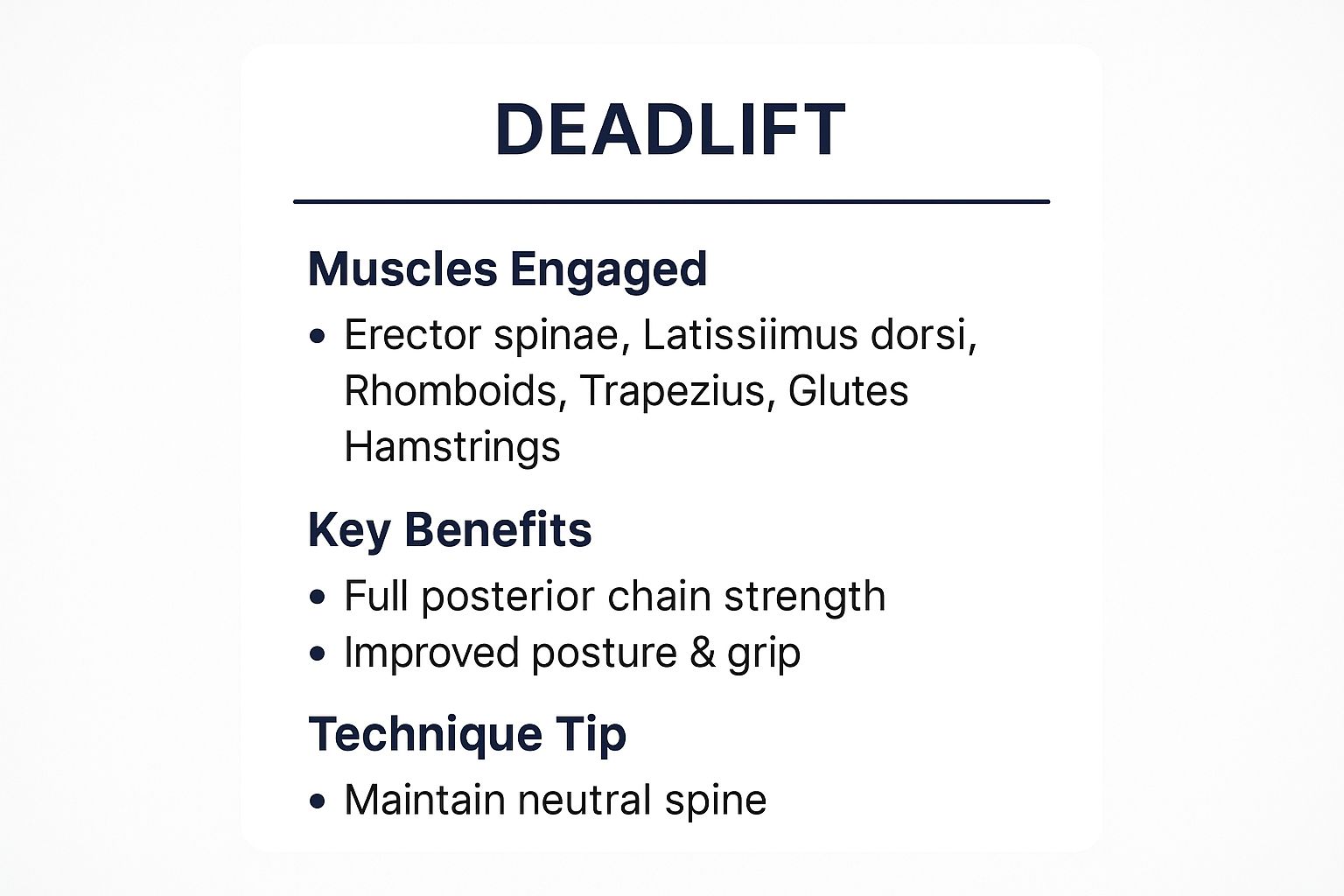
As the infographic highlights, maintaining a neutral spine is the most critical technical aspect for safety and effectiveness in this full-body strength builder.
2. Pull-ups/Chin-ups
A true test of upper-body relative strength, the pull-up and its close cousin, the chin-up, are unparalleled bodyweight exercises for back muscles. This movement involves pulling your body up to a fixed bar, using your back and arms to overcome gravity. The primary difference lies in the grip: pull-ups use an overhand (pronated) grip, which heavily targets the latissimus dorsi and builds back width, while chin-ups use an underhand (supinated) grip, recruiting more bicep assistance. Both are fundamental movements seen in everything from military fitness tests to calisthenics competitions.
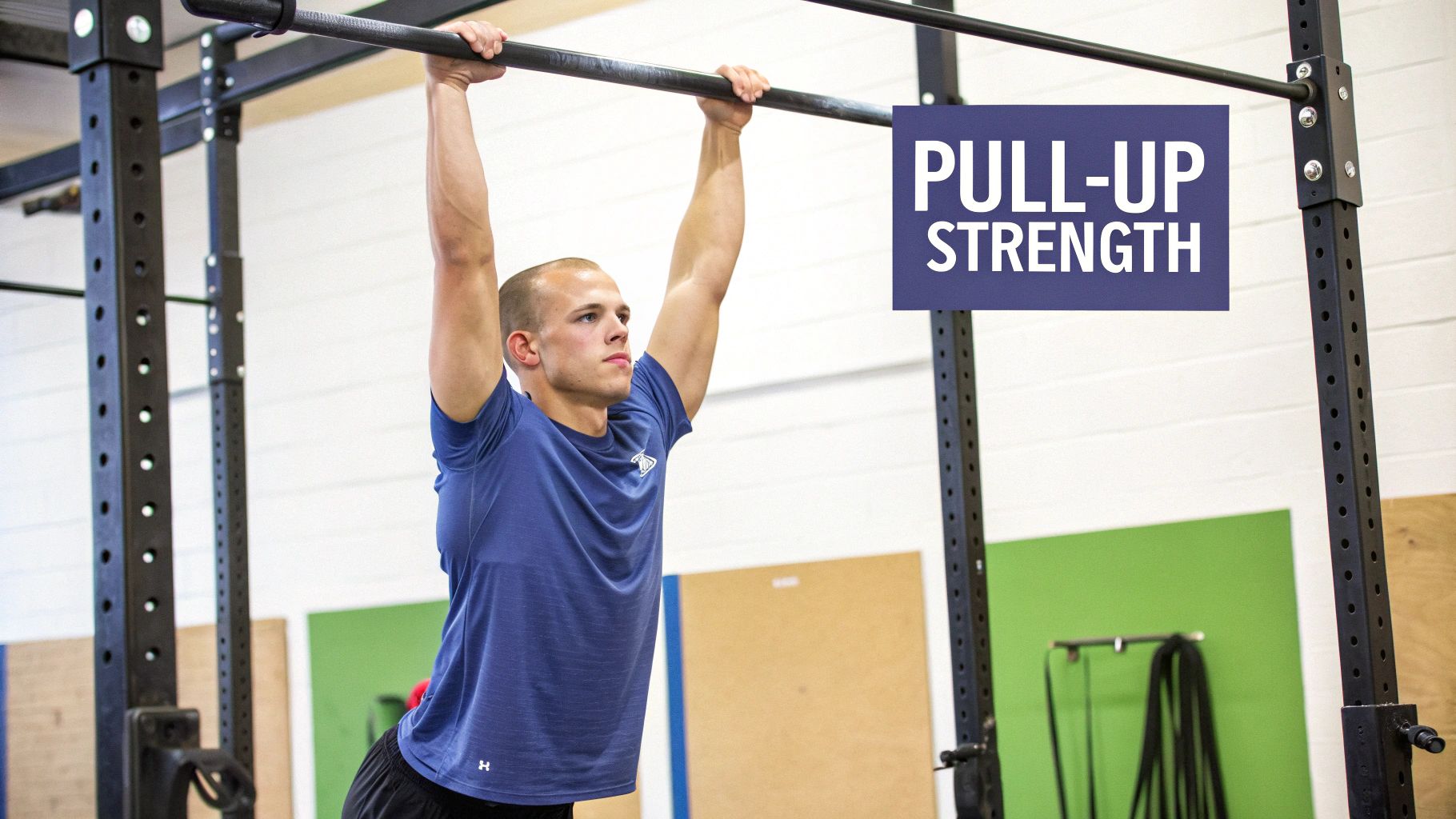
How to Perform Pull-ups/Chin-ups
Mastering the pull-up requires patience and consistent practice. The focus should always be on control and full range of motion rather than simply getting your chin over the bar.
- Grip and Hang: Grasp the bar with your preferred grip (overhand for pull-ups, underhand for chin-ups) slightly wider than shoulder-width. Hang from the bar with your arms fully extended, a position known as a dead hang.
- Scapular Retraction: Before you pull, initiate the movement by pulling your shoulder blades down and back. This engages your lats and protects your shoulder joints.
- The Pull: Drive your elbows down towards your ribs to pull your body upwards. Keep your core tight and avoid swinging. Continue pulling until your chin clears the top of the bar.
- Peak Contraction: Squeeze your back muscles at the top of the movement for a brief moment.
- The Descent: Lower your body back to the starting position in a slow, controlled manner. A controlled descent (eccentric phase) is crucial for building strength and muscle. Aim for a 2-3 second lowering phase.
Health Tip: To protect your shoulder joints, always initiate the pull by engaging your back muscles (scapular retraction) first, rather than pulling with your arms. This ensures the larger, more powerful lat muscles are doing the primary work, reducing strain on the rotator cuff.
For those unable to perform a full repetition, using assistance bands or a dedicated machine can help build the foundational strength necessary. Once you can comfortably perform 10 or more bodyweight repetitions with perfect form, consider adding weight via a dip belt to continue progressing.
3. Bent-Over Barbell Row
The bent-over barbell row is a cornerstone strength exercise, renowned for building a thick, muscular back. This powerful compound movement involves hinging at the hips and pulling a loaded barbell towards the lower chest, targeting a huge swathe of muscle. It is one of the most effective exercises for back muscles, specifically for developing the latissimus dorsi, rhomboids, rear deltoids, and middle trapezius, while also strengthening the spinal erectors and core as they work to stabilise your torso.
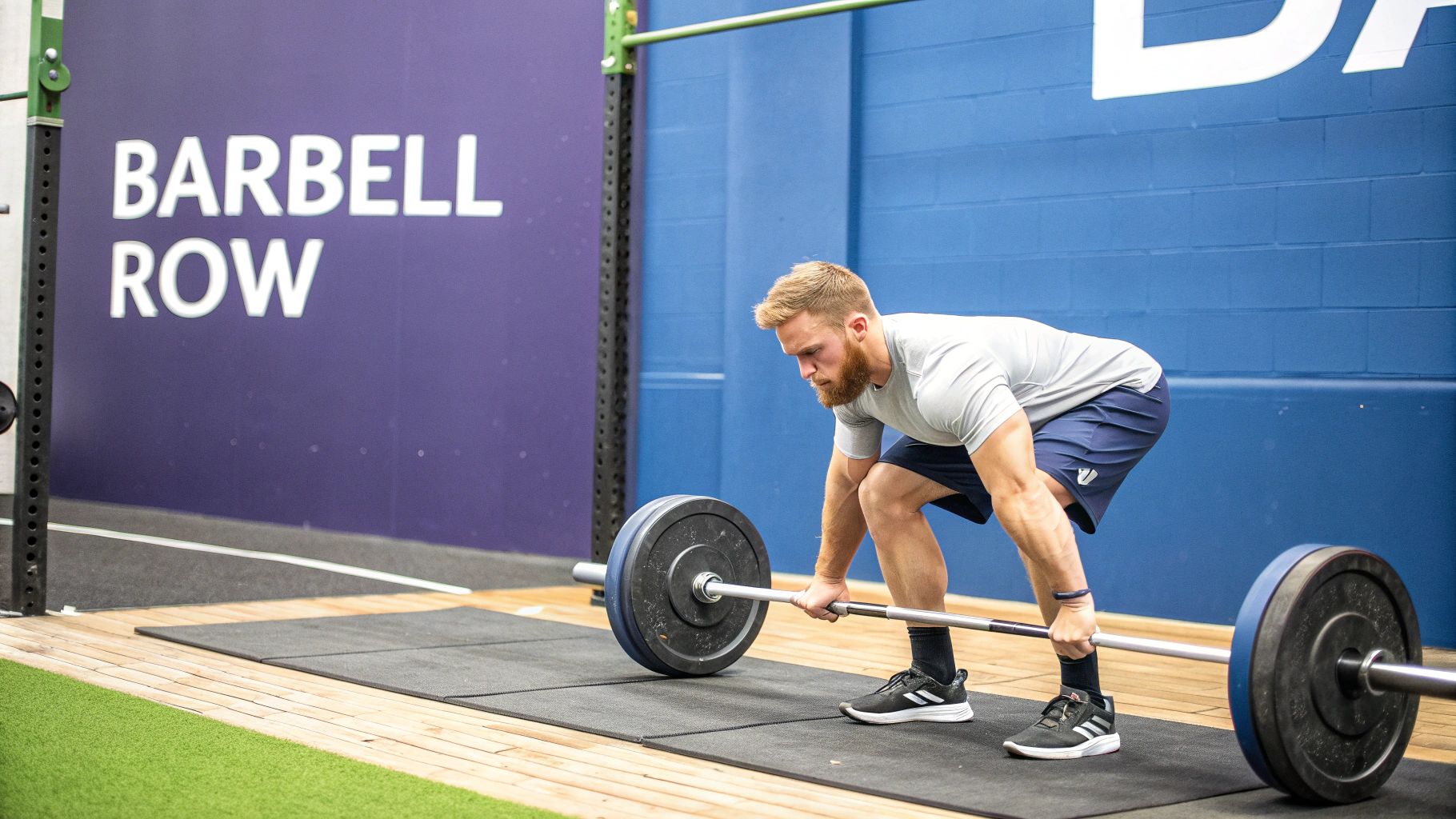
Popularised by legendary bodybuilders like Dorian Yates and Ronnie Coleman, this row is a staple in programmes designed for both strength and size. Its application extends beyond aesthetics, serving as a key accessory exercise in powerlifting and a functional movement for athletes in sports like rowing, improving pulling strength and postural endurance.
How to Perform the Bent-Over Barbell Row
Maintaining a strict, stable torso position is crucial to isolate the back muscles and prevent lower back strain. Begin with a manageable weight to perfect the form.
- Stance: Stand with your feet shoulder-width apart, with the barbell over the middle of your feet.
- Grip: Hinge at your hips and bend your knees slightly to grip the bar with a slightly wider than shoulder-width overhand grip.
- Setup: Lift the bar from the rack or floor as you would a deadlift. Hinge at the hips until your torso is at roughly a 45-degree angle to the floor. Keep your back straight, chest up, and core braced. The bar should hang with your arms fully extended.
- The Pull: Squeeze your shoulder blades together and pull the barbell upwards towards your lower chest or upper abdomen. Keep your elbows tucked in, driving them back towards the ceiling.
- The Descent: Lower the bar back to the starting position in a controlled manner, maintaining the rigid torso position throughout.
Health Tip: Avoid using excessive momentum or "body English" to lift the weight. Jerking the barbell places undue stress on the lumbar spine and reduces the effectiveness of the exercise for the target muscles. Keep the movement strict and controlled.
By focusing on this mind-muscle connection, you ensure the targeted muscles are properly engaged, which is vital for both muscular development and preventing compensatory patterns that could lead to injury.
4. Lat Pulldown
A staple in almost every gym, the lat pulldown is a fundamental machine-based exercise designed to isolate and develop the latissimus dorsi, the large V-shaped muscles that give the back its width. It involves pulling a weighted bar down from an overhead position to the chest while seated. This movement is highly effective for building a broader back and is particularly beneficial for those who cannot yet perform pull-ups, offering a scalable way to train the same primary muscles. Its controlled nature makes it one of the safest and most accessible exercises for back muscles, suitable for beginners and seasoned lifters alike.
How to Perform the Lat Pulldown
Proper technique is essential to engage the lats effectively and prevent the biceps or shoulders from taking over the movement. Always prioritise form over the amount of weight lifted.
- Setup: Adjust the knee pad so it firmly secures your legs, preventing your body from lifting during the exercise. Sit down and grasp the bar with a wide, overhand grip, slightly wider than your shoulders.
- Positioning: With your arms fully extended overhead, lean back slightly, around 15-20 degrees. Keep your chest up and create a small arch in your upper back.
- The Pull: Engage your core and pull the bar down towards your upper chest. Focus on driving your elbows down and back, squeezing your shoulder blades together at the bottom of the movement.
- The Peak Contraction: Pause briefly when the bar is at your upper chest, focusing on a strong contraction in your lats.
- The Return: Slowly and with control, allow the bar to return to the starting position, letting your lats stretch fully as your arms extend. Do not let the weight stack slam.
Health Tip: Never pull the bar behind your neck. This variation can place the shoulder joint in an unstable position and create unnecessary stress on the cervical spine. Always pull the bar down in front of you to your upper chest for a safer, more effective movement.
5. T-Bar Row
A classic movement popularised during bodybuilding's Golden Era, the T-bar row is a powerhouse for developing a thick, dense middle back. It uses a specialised setup where one end of a barbell is anchored to the floor, allowing the lifter to row the weighted end towards their chest. This fixed pivot point creates a unique arc of motion that specifically targets the latissimus dorsi, rhomboids, and trapezius muscles with heavy loads, making it one of the most effective exercises for back muscles and overall thickness.
How to Perform the T-Bar Row
Proper form is crucial to engage the correct muscles and protect the lower back. If your gym doesn't have a dedicated T-bar row machine, you can create one by wedging one end of a barbell into a corner.
- Stance: Load the free end of the barbell. Straddle the bar with your feet about shoulder-width apart, ensuring your mid-foot is roughly in line with the weight plates.
- Grip: Hinge at your hips and bend your knees to grip the bar. A V-handle attachment placed under the bar is most common, allowing for a neutral grip. Keep your back straight and nearly parallel to the floor.
- Setup: Engage your core, retract your shoulder blades, and keep your chest lifted. Your spine should remain in a neutral position from your head to your hips throughout the entire movement.
- The Pull: Drive your elbows up and back, pulling the weight towards your lower chest or upper abdomen. Focus on squeezing your shoulder blades together at the peak of the contraction.
- The Descent: Slowly lower the weight back to the starting position with full control, allowing your shoulder blades to stretch forward before initiating the next repetition.
Health Tip: Maintaining a neutral spine is paramount. If you find your lower back rounding during the lift, the weight is too heavy. Reduce the load and focus on keeping your torso rigid to prevent disc pressure and ensure the mid-back muscles are the primary movers.
The T-bar row's stability allows for significant weight to be lifted, which is a key driver for muscle growth. Its inclusion in programmes ranging from bodybuilding routines to athletic training for contact sports is a testament to its effectiveness in building a strong, powerful back.
6. Hyperextensions (Back Extensions)
Often performed on a 45-degree hyperextension bench, this exercise is an exceptional movement for isolating and strengthening the lower back. Hyperextensions primarily target the erector spinae, the crucial muscles that support and stabilise your spine. By focusing on controlled flexion and extension at the waist, this movement builds muscular endurance and resilience in the lower back, making it a staple in both physical therapy settings for rehabilitation and advanced strength programmes for injury prevention. Its targeted nature makes it one of the most effective exercises for back muscles, specifically for posterior chain health.
How to Perform Hyperextensions
Precision and control are paramount to ensure the erector spinae are engaged safely. Avoid using momentum; the focus should be on a slow, deliberate movement pattern to protect the lumbar spine.
- Setup: Position yourself on a hyperextension bench or glute-ham developer (GHD). Adjust the pad so that your hips are supported, allowing you to hinge freely at the waist. Secure your ankles under the roller pads.
- Starting Position: Align your body in a straight line from head to heels. Cross your arms over your chest or place your hands behind your head without pulling on your neck. Engage your core and glutes.
- The Descent: Keeping your back straight, slowly hinge at the hips and lower your upper body towards the floor. Continue until you feel a gentle stretch in your hamstrings, or as far as you can go without rounding your lower back.
- The Ascent: Squeeze your glutes and lower back muscles to raise your torso back to the starting position. Your body should form a straight line again. Avoid arching or hyperextending your spine past neutral at the top.
- Repetition: Pause briefly at the top, maintaining tension, before beginning the next controlled repetition.
Health Tip: The goal is spinal stability, not excessive flexibility. Avoid hyperextending (arching excessively) at the top of the movement. Stop once your body forms a straight line. Over-arching can compress the vertebrae in your lower back.
7. Cable Seated Row
The cable seated row is a staple in gyms and rehabilitation centres for its effectiveness in developing the middle back muscles. Performed from a seated position, this exercise involves pulling a cable attachment towards the torso, providing constant tension on the target muscles throughout the entire range of motion. This consistent resistance makes it one of the most reliable exercises for back muscles, particularly for building thickness in the rhomboids, latissimus dorsi, and middle trapezius. Its controlled nature also makes it an excellent choice for improving posture by strengthening the muscles responsible for retracting the shoulder blades.
How to Perform the Cable Seated Row
Proper form is crucial for targeting the back muscles effectively and protecting the lower spine. Always start with a moderate weight to ensure you can maintain control and feel the correct muscles working.
- Setup: Sit on the bench with your feet firmly placed on the foot pads, maintaining a slight bend in your knees. Grasp the handle or bar attachment with your chosen grip.
- Starting Position: Extend your arms fully and sit upright with a straight, neutral spine. Lean back just enough so that your torso is perpendicular to the floor. Engage your core and pull your shoulders down and back.
- The Pull: Exhale as you pull the handle towards your lower chest or upper abdomen. Focus on driving your elbows back and squeezing your shoulder blades together. Your torso should remain stationary.
- Peak Contraction: Pause briefly at the end of the movement, focusing on the strong contraction in your back muscles.
- The Return: Inhale and slowly reverse the motion, extending your arms and allowing your shoulder blades to stretch forward under control. Avoid letting the weight stack slam down.
Health Tip: A common mistake is leaning too far back and using momentum. Your torso should remain relatively still throughout the movement. This ensures the mid-back muscles are isolated and prevents the lower back from taking on excessive strain.
This exercise is particularly beneficial for those who spend long hours at a desk, as it directly counteracts the forward slouching posture common in office workers. By strengthening the postural muscles, the cable seated row contributes to a healthier spine and reduced risk of back pain.
7-Exercise Back Muscle Comparison Table
| Exercise | Implementation Complexity | Resource Requirements | Expected Outcomes | Ideal Use Cases | Key Advantages |
|---|---|---|---|---|---|
| Deadlift | High – needs proper technique and form mastery | Barbell, weights, training space | Full posterior chain strength, grip, posture | Strength training, powerlifting, rehab | Builds overall back strength, functional movement |
| Pull-ups/Chin-ups | Moderate to High – challenging for beginners | Pull-up bar or similar | Upper back width and strength, grip | Bodyweight training, military, climbing | No equipment needed (except bar), scalable difficulty |
| Bent-Over Barbell Row | Moderate – requires core strength and hip mobility | Barbell, weights | Upper back thickness and strength | Bodybuilding, powerlifting accessory | Heavy load potential, builds back thickness |
| Lat Pulldown | Low to Moderate – machine-based | Lat pulldown machine | Lat development, controlled resistance | Beginners, rehab, gym workouts | Adjustable weight, safer than pull-ups |
| T-Bar Row | Moderate – specialized bar setup required | T-bar row setup, weights | Middle back thickness, stable heavy loading | Bodybuilding, powerlifting assistance | More stable than bent-over rows, reduced back stress |
| Hyperextensions (Back Extensions) | Low – simple movement, proper form needed | Hyperextension bench | Lower back strength and endurance | Rehab, back health, accessory for deadlifts | Isolates erector spinae, injury prevention |
| Cable Seated Row | Low to Moderate – machine use with controlled form | Cable machine | Middle back development, posture improvement | Rehab, bodybuilding, safe training | Constant tension, joint-friendly, posture focus |
Integrating Back Health into Your Everyday Life
You've now explored a comprehensive arsenal of the best exercises for back muscles, from the foundational power of the Deadlift to the targeted precision of the Cable Seated Row. Mastering the correct form for each movement, such as the Bent-Over Barbell Row and Lat Pulldown, is a significant first step towards building a resilient, powerful, and pain-free back. However, the 30-60 minutes you spend in the gym are only one part of the equation; true, lasting spinal health is forged in the other 23 hours of your day.
Think of your dedicated training sessions as the strong foundation. The rest of your lifestyle habits, from posture to nutrition, are the structure you build upon it. A weak structure will eventually cause even the strongest foundation to falter. This is where integrating mindful, daily practices becomes essential for supporting your hard work and preventing injury.
Beyond the Gym: Building a Supportive Lifestyle
To truly protect and strengthen your back, you must extend your focus beyond your workout. Consider these critical areas for a holistic approach to back health:
- Workplace Ergonomics: For many professionals, prolonged sitting is a primary antagonist to back health. Assess your workspace critically. Is your chair providing adequate lumbar support? Is your monitor positioned directly at eye level to prevent neck strain, which often radiates downwards? Small adjustments can yield significant long-term benefits.
- Conscious Movement: Set a reminder to get up and move for a few minutes every hour. Simple stretches, a short walk, or just standing can counteract the compressive forces that sitting places on your spinal discs. Beyond specific exercises, integrating mindful practices like mastering safe lifting techniques into your daily routine is paramount for long-term back health, whether you're lifting a box at work or a child at home.
- Core Stability is Non-Negotiable: Remember that your core is not just your "abs". It's a 360-degree support system for your spine. Supplementing your primary back exercises with movements like planks, bird-dogs, and dead bugs is crucial. A strong, stable core acts as a natural corset, protecting your lumbar spine from excessive strain during both exercise and everyday activities.
- Nutritional Support: Your muscles and connective tissues need the right fuel to repair and grow stronger. Prioritise a diet rich in anti-inflammatory foods like leafy greens, berries, and fatty fish (rich in omega-3s). Furthermore, proper hydration is vital for maintaining the health and cushioning of your intervertebral discs.
By weaving these habits into your daily life, you create an environment where the strength you build in the gym can thrive. This integrated approach transforms your efforts from isolated workouts into a comprehensive strategy for lifelong musculoskeletal wellbeing, ensuring the powerful back you're building is one that serves you well in every aspect of your life.
Ready to create a personalised plan that addresses your unique needs and goals? If you're seeking expert guidance on incorporating exercises for back muscles safely or require specialised support for an existing condition, the team at The Lagom Clinic is here to help. Visit The Lagom Clinic to book a consultation and take the next step towards optimal back health and peak performance.


 Members Consultation