


For any runner serious about improving performance and staying healthy, strength training isn't just an optional extra—it’s a foundational component of a healthy lifestyle. Adopting a consistent strength routine is a powerful lifestyle change that builds a more powerful, efficient, and resilient body, enabling you to enjoy running for years to come.
When you strengthen your key running muscles, you fundamentally improve your running economy. In simple terms, this evidence-based lifestyle change helps you use less energy to run at any given pace, reducing strain and enhancing performance.
Why Smart Runners Lift Weights: A Health-First Approach

Have you hit a performance plateau where simply running more miles isn't leading to improvement? The solution is likely found not on the road, but through targeted strength work. Many runners mistakenly believe that more mileage is the only path to progress, but this approach often leads to burnout and injury, not personal bests.
This is where a medically sound strength training plan becomes essential. The goal isn't to become a bodybuilder, but to build functional strength that directly supports every stride. A useful analogy is to view your body as a vehicle. Running is your engine, but strength training reinforces the chassis and suspension, ensuring the entire system can safely handle the power you generate.
This table breaks down how this lifestyle change translates to better running health and performance.
| Health Benefit | Impact on Running | Key Lifestyle Takeaway |
|---|---|---|
| Improved Running Economy | Use less oxygen at a given pace, making you more efficient. | You can sustain a chosen pace for longer with less cardiovascular strain. |
| Increased Power | Stronger muscles generate more force with each footstrike. | Your stride becomes more explosive, improving speed and late-race kick. |
| Injury Resilience | Strengthened muscles and connective tissues absorb impact better. | Reduces the risk of common overuse injuries like runner's knee and shin splints. |
| Enhanced Form | A strong core and hips prevent your form from degrading when fatigued. | You maintain good posture and biomechanics, reducing stress on joints. |
| Greater Durability | Your body can handle higher training loads without breaking down. | You can train more consistently, which is crucial for long-term progress. |
Ultimately, a well-rounded runner is a strong runner. The health benefits go far beyond just lifting a heavier weight; they manifest in every run you do, promoting longevity in the sport.
The Science of a Faster, Stronger Stride
From a physiological perspective, strength work is about boosting your running economy—the clinical term for your oxygen consumption at a certain speed. When your glutes, hamstrings, and core are stronger, they generate more force with each push-off. This means you cover more ground with less metabolic effort.
This isn't just anecdotal advice; it's a shift backed by robust scientific evidence. Within the UK running community, strength work is now widely accepted as an essential component of training. A recent meta-analysis confirmed that mid- and long-distance runners who incorporated just two to four strength sessions per week saw significant improvements in their running economy and, critically, a reduction in injury rates.
Building Your Body's Natural Armour
Perhaps the most compelling medical reason for runners to lift weights is injury prevention. Each footstrike sends a force equivalent to several times your body weight through your legs. Without a strong musculoskeletal support system, this repetitive impact can lead to chronic issues.
A strong, stable core and resilient hip muscles act as your body’s natural shock absorbers. They control unwanted movement, maintain proper alignment, and protect your joints from the relentless stress of running.
This stability is your best defence against conditions like patellofemoral pain syndrome (runner's knee), IT band syndrome, and medial tibial stress syndrome (shin splints). By strengthening these areas, you're not just treating symptoms; you are addressing the root biomechanical cause of many common running ailments.
Of course, knowing what to do is only half the battle. Staying consistent requires the right mindset, and understanding the long-term motivation behind your health goals offers strategies for greater success on your running journey.
Common Gym Mistakes Runners Need to Avoid
Entering a gym with the goal of supporting your running is a positive step, but it's vital to ensure your efforts are beneficial. Many well-intentioned runners inadvertently hinder their progress by making a few classic mistakes. It's easy to follow generic advice that doesn't align with the specific physiological demands of running.
The most significant mistake is training like a bodybuilder instead of an endurance athlete. This often involves focusing on muscle isolation and hypertrophy (building size), which is counterproductive for a runner. Your goal is not larger muscles, but a stronger, more integrated system that propels you forward efficiently.
Neglecting Your Powerhouse Muscles
A common pitfall is focusing on the "mirror muscles"—quads, chest, and abs—while ignoring the posterior chain. Your true running power, which propels you up hills and through the final mile, originates from the muscles you can't see in the mirror: your glutes, hamstrings, and lower back. These are the primary engines of your stride.
When these powerhouse muscles are weak, your body compensates, often leading to a breakdown in running form, reduced power output, and a significantly higher risk of injury. If you've ever felt your form deteriorate late in a run, weak glutes and a disengaged core are often the silent culprits.
A strong posterior chain is the foundation of an efficient and injury-resistant stride. Neglecting it is like trying to fire a cannon from a canoe—all power and no stability.
The data underscores this point. A recent survey showed that while nearly half of UK adults exercise regularly, a mere 19% give balanced attention to all muscle groups. Even more telling for runners, a staggering 9% actively train crucial groups like the glutes, hips, and core. You can explore more insights on this training imbalance at Runner's World UK. This reveals a major discrepancy between what many runners are doing in the gym and what they should be doing for optimal health and performance.
Going Too Heavy Too Soon
Another critical error is attempting to lift too much weight or progressing too quickly. Your muscles, and just as importantly, your connective tissues (tendons and ligaments), require time to adapt to the new stress of strength training. Jumping into maximal lifts without first building a solid foundation is a fast track to injury, which completely defeats the purpose of your training.
Here are some other common slip-ups to be mindful of as you make this lifestyle change:
- Skipping the Warm-Up: A proper warm-up with dynamic stretches prepares your muscles for the work ahead. This evidence-based practice boosts performance and significantly reduces injury risk. Do not skip it.
- Ignoring Form for Weight: Lifting with improper technique to move more weight is a poor trade-off. It reinforces faulty movement patterns and poses a serious safety risk.
- Inconsistent Sessions: Sporadic gym visits will not build strength. Consistency is paramount. Just two focused sessions a week is the minimum required to create real, lasting physiological change.
- Forgetting Single-Leg Work: Running is a series of single-leg hops. Exercises like lunges and single-leg deadlifts are essential for building the stability and balance that translate directly to your run.
Essential Exercises for a Stronger Stride
Now that we've covered the common mistakes, let's focus on the exercises that are scientifically proven to benefit runners. Building a runner-specific strength routine isn’t about spending hours on complicated moves. It’s about focusing on a handful of key exercises that offer the greatest physiological benefit.
The objective is to build a body that is robust and functions as a single, synchronised unit. These foundational movements are the building blocks. They teach your body to generate force efficiently, maintain stability on one leg, and keep your core engaged when you fatigue. This isn't just about getting stronger; it's about making that strength functional for running.
Compound Lifts for Raw Power
Compound lifts are the cornerstone of your routine. These movements engage multiple muscle groups across several joints simultaneously. For runners, they are the gold standard for building a powerful posterior chain—your glutes and hamstrings—which is the engine that drives you forward.
- Squats: The squat is a fundamental lower-body exercise for good reason. It builds strength in your quads, glutes, and core. Prioritise perfect form over heavy weights. Keep your chest up, sink your hips back and down as if sitting in a chair, and ensure your knees track over your feet.
- Deadlifts: Specifically, Romanian Deadlifts (RDLs) are excellent for runners. They target the hamstrings and glutes while teaching the crucial hip-hinge pattern. This movement is about controlled, deliberate execution, strengthening the exact muscles responsible for pulling you forward with each stride.
With both exercises, proper form is non-negotiable. I cannot stress this enough. Begin with just your body weight or a very light dumbbell to master the movement pattern before considering adding more weight.
Single-Leg Work for Stability and Balance
Consider the biomechanics of running: it's a series of coordinated, single-leg hops. Therefore, single-leg exercises are non-negotiable for building the stability needed to absorb the impact of each footstrike. This is what prevents your form from collapsing when you become tired.
Lunges in all their variations—forward, reverse, walking—are an excellent starting point. They challenge your balance, improve hip mobility, and strengthen each leg independently. This is crucial for correcting muscular imbalances between your left and right sides. Strong, stable hips are especially vital, and for a deeper dive, you can find a range of specific exercises for hip strength in our detailed guide.
Health Tip: Think of single-leg exercises as your injury insurance policy. By mimicking the unilateral demands of running, they train your body to maintain alignment and stability, protecting your knees, ankles, and lower back mile after mile.
Core Endurance to Hold It All Together
A strong core is the crucial link between your upper and lower body. It prevents the late-run postural collapse where your hips sag, your back arches, and your running economy plummets. When discussing the "core," we refer not just to the rectus abdominis ("six-pack"), but to the entire trunk musculature, including your abs, obliques, and lower back.
- Plank: A simple yet incredibly effective exercise for building endurance throughout your midsection. The key is to maintain a straight line from your head to your heels—contract your glutes and brace your abdomen.
- Side Plank: This variation targets the obliques and hip abductors. These muscles prevent your hips from dropping side-to-side with each step, a major cause of biomechanical inefficiency and injury.
- Glute Bridge: An essential exercise for activating the gluteal muscles, which can become underactive from prolonged sitting. Squeeze your glutes to lift your hips, aiming for a straight line from your shoulders to your knees.
Incorporating these key exercises into your week two to three times will build a strong, resilient foundation. You will not only improve your performance but also significantly reduce your risk of being sidelined by injury.
How to Build Your Weekly Training Schedule
Knowing which exercises to perform is important, but integrating them effectively into your running week is where the real health benefits are realised. Consistency is what unlocks results, and creating a sustainable schedule is more straightforward than you might think. It's about working smarter, not just harder.
The key is intelligent timing. The golden rule is to pair your hard days. This means scheduling strength sessions on the same day as more demanding runs, like an interval session or a tempo run. While this may seem counterintuitive, it consolidates physiological stress, allowing for a full, uninterrupted day of genuine recovery afterwards. The principle is simple: hard days are hard, easy days are easy.
Finding Your Rhythm: Two Sessions a Week
For the majority of runners, two full-body strength sessions per week is the optimal frequency. This provides enough stimulus to build strength and resilience without causing excessive muscle soreness that could compromise your next run. It's a manageable lifestyle change that yields significant health dividends.
A sensible weekly structure could be:
- Monday: Easy Run
- Tuesday: Hard Run (e.g., Intervals) + Strength Session 1
- Wednesday: Rest or Cross-Training
- Thursday: Easy/Moderate Run
- Friday: Strength Session 2
- Saturday: Long Run
- Sunday: Rest or Active Recovery
This schedule provides at least one full day of recovery between strength workouts and, crucially, ensures your legs are fresh for the important long run on Saturday.
The Principle of Progressive Overload
To continue getting stronger, you must consistently challenge your body. This is the fundamental principle of progressive overload, and it is essential for progress. Without it, you will plateau, and your hard work will stagnate.
Health Tip: Your body is incredibly adaptive. You don't get stronger by repeating the same workout with the same weights indefinitely. Progressive overload is simply the stimulus that signals your body to adapt and grow stronger.
You can apply this principle in several ways:
- Increase the Weight: Once you can comfortably complete all your reps with good form, add a small amount of weight.
- Increase the Reps: Instead of adding weight, aim for a higher number of repetitions per set.
- Increase the Sets: Add another set of a particular exercise to your workout.
- Decrease Rest Time: Shorten the rest period between sets to challenge your muscular endurance.
This infographic illustrates a safe progression from foundational movements to more challenging stability and core work. It’s all about earning the right to progress.
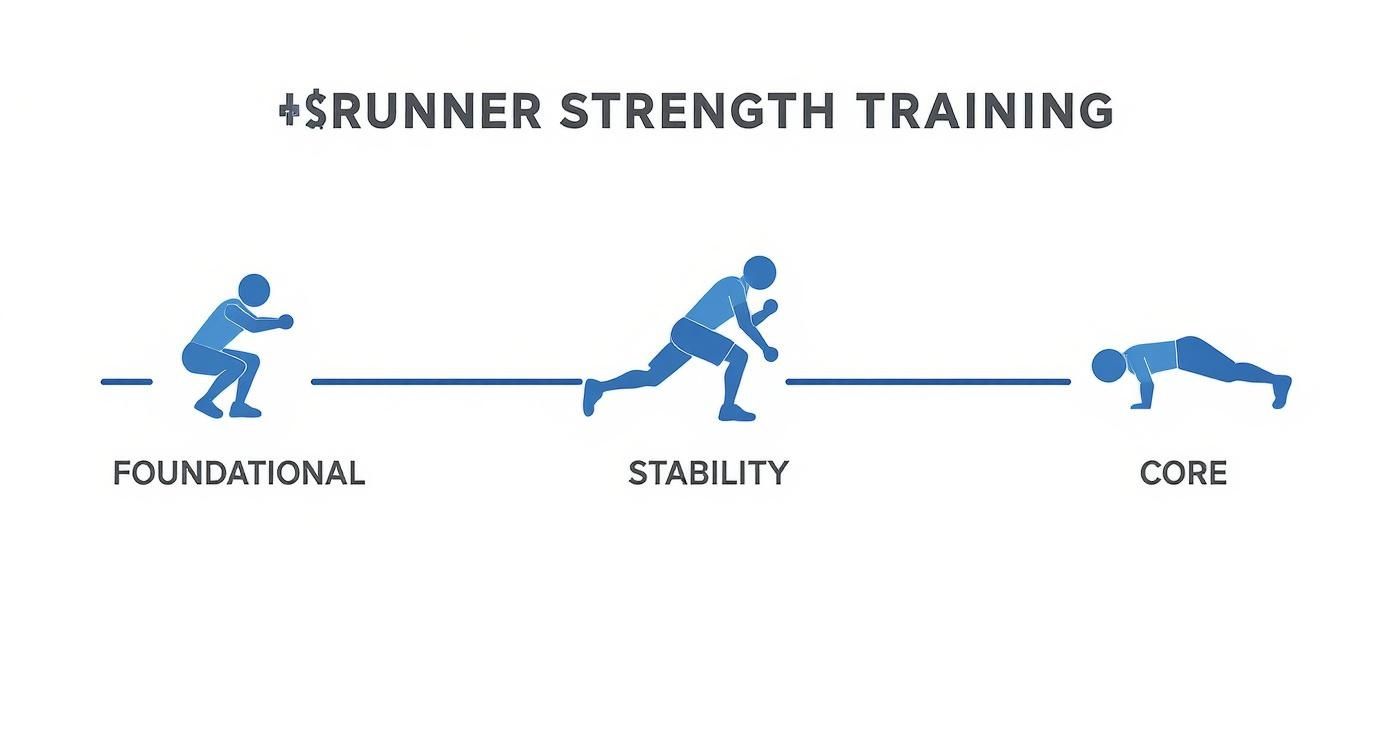
Mastering the basics first ensures you're building strength on a solid, safe foundation before advancing to more complex exercises.
Your schedule should be dynamic, changing with your goals and training cycle. Here’s a look at how you might structure your training phases.
Sample Weekly Training Schedules for Runners
| Training Phase | Focus | Running Days | Strength Days |
|---|---|---|---|
| Off-Season | Build max strength & power | 3-4 | 2-3 (heavier lifts) |
| Base Building | General strength & running volume | 4-5 | 2 (full body) |
| Race Build-Up | Maintain strength, focus on running | 5-6 | 1-2 (maintenance, lower volume) |
| Taper/Race Week | Recovery & peaking | 2-3 (very light) | 0-1 (very light, bodyweight only) |
This table shows that strength training is not a static addition; it adapts to support your running, whether you're building a base or preparing for a race.
Creating a cohesive plan is key. For those new to running, establishing a consistent running routine is the first step, and a good running schedule for beginners can provide that crucial structure.
Despite the proven health benefits, many people neglect strength work. According to UK Active, only 24% of women and 34% of men meet the recommended guidelines of two strength sessions per week. For runners, this represents a significant, untapped opportunity to gain a performance edge, prevent injuries, and improve long-term health.
Next Level Training: Plyometrics and Unilateral Work

Once you've established a solid foundation with core lifts, it's time to incorporate more advanced training modalities. Progressing as a runner doesn't just mean adding more weight; it means developing a body that is more responsive, powerful, and efficient.
This is where we introduce exercises that closely mimic the explosive, single-leg nature of running. By adding these movements, you bridge the gap between gym-based strength and on-road speed. You are teaching your body to generate force rapidly and maintain form under fatigue—a crucial factor on race day.
Unleash Your Inner Spring with Plyometrics
Plyometrics are explosive exercises that enhance power. They train your nervous system to recruit muscle fibres more quickly and forcefully. These exercises teach your muscles to function like a coiled spring, storing and releasing energy for maximum propulsion. For a runner, this translates directly into a more powerful finishing kick and a more efficient, elastic stride.
What you're really training is the stretch-shortening cycle (SSC). This is the rapid sequence of a muscle lengthening (eccentric contraction) and then immediately shortening (concentric contraction), which occurs every time your foot contacts the ground. A more efficient SSC means less ground contact time and greater energy return with each step.
A few key plyometric exercises for runners include:
- Box Jumps: Start with a low box. The goal is not height, but landing softly and quietly. This builds explosive power in the glutes, hamstrings, and quads.
- Bounding: This is an exaggerated running stride where the goal is to maximize distance with each leap. It is an excellent drill for developing raw stride power.
- Jump Squats: A simple but effective bodyweight exercise. It's a great introduction to explosive training, focusing on achieving maximal height on each jump.
Health Tip: When introducing plyometrics, prioritise quality over quantity. These are high-impact movements. Start with a low volume (e.g., a few reps per set) and ensure you are fully recovered between sets. Two short sessions per week is sufficient.
The Power of One: Unilateral Training
Running is, fundamentally, a series of one-legged hops. You are always supported by one leg at a time. This is precisely why single-leg, or unilateral, exercises are one of the most effective tools in a runner’s strength training arsenal. They translate gym strength directly into running stability.
Unilateral work is also excellent for identifying and correcting muscular imbalances between your left and right sides. A minor weakness on one side can lead to compensatory patterns that often result in injury. By forcing each leg to work independently, you build symmetrical strength and a more resilient body.
Must-Do Unilateral Exercises
These movements challenge your balance, stability, and control, building rock-solid strength from the ground up.
- Pistol Squats (or assisted variations): The gold standard for single-leg strength and balance. Begin with assistance, holding onto a TRX or post, or by squatting to a bench.
- Single-Leg Romanian Deadlifts (RDLs): An exceptional exercise for the hamstrings and glutes, this move demands significant hip stability. It is perfect for improving the powerful push-off phase of your stride.
- Step-Ups: A simple yet highly effective movement that directly mimics the forward drive of running. Focus on driving up through the heel of your leading foot, rather than pushing off with your back foot.
Integrating these more advanced techniques into your routine will elevate your running. You will forge the specific power and stability needed to run faster, maintain your form for longer, and, most importantly, stay healthy.
Your Top Strength Training Questions Answered
It is normal to have questions when adopting a new lifestyle habit. Let's address some of the most common concerns runners have about strength training, providing clear, medically sound advice to help you begin with confidence.
Will Strength Training Make Me Bulky and Slow Me Down?
This is a pervasive myth and is physiologically unfounded for endurance athletes. The type of strength training recommended for runners focuses on building muscular force and endurance, not necessarily muscle size (hypertrophy). Therefore, you will not become bulky.
The primary goal is to improve your neuromuscular efficiency—enhancing the communication between your brain and muscles so they work together more effectively. When combined with regular running, this results in a stronger, more powerful, and more efficient runner, not a heavier one.
How Should I Change My Lifting Before a Big Race?
Tapering your strength sessions is as crucial as tapering your running. In the one to two weeks before a key race, you must reduce both the weight and overall volume of your lifting. Your focus should shift to mobility and light activation exercises.
In the final week, most runners should either cease lifting entirely or perform one very light, full-body session early in the week to maintain neuromuscular connection without causing fatigue.
Medical Advice: The golden rule for race week is to do nothing that could cause muscle soreness. Your priority is rest and recovery to ensure your legs are completely fresh and ready for race day.
Can I Run and Lift on the Same Day?
Yes, this is an effective strategy, provided it is done correctly. The best approach is to perform your most important workout of the day—whether a tough track session or a tempo run—when you are freshest. Your strength session can then follow several hours later.
This method consolidates your training stress into a single "hard" day, allowing for more complete recovery on your easier days. If time constraints require back-to-back sessions, always run first. Performing a heavy leg workout before a key run can compromise running form and increase injury risk.
What if I Don’t Have a Gym Membership?
Lack of a gym membership is not a barrier. You can build a highly effective strength routine at home with minimal equipment. Bodyweight exercises are an excellent starting point.
- The Foundation: Exercises like squats, lunges, glute bridges, and planks create a powerful and stable base without any equipment.
- Adding Resistance: A simple set of resistance bands is an inexpensive and versatile tool for targeting the crucial hip and glute muscles.
- Making Progress: You can still apply the principle of progressive overload. Increase your repetitions, add more sets, shorten your rest periods, or advance to more challenging variations like single-leg squats.
At The Lagom Clinic, we focus on building a strong foundation for lifelong health and performance. If you're looking for expert guidance on how to integrate exercise with your overall wellness, our private GP services in Bristol can provide the personalised support you need.


 Members Consultation