


Finding effective health anxiety help starts with understanding that your fears, as overwhelming as they feel, are part of a recognised psychological pattern. Lasting relief begins when you learn to manage the cycle of worry, and the first step is to recognise that you have the power to influence your physical and mental state through proactive lifestyle changes and practical techniques.
What Health Anxiety Feels Like And Why It Happens
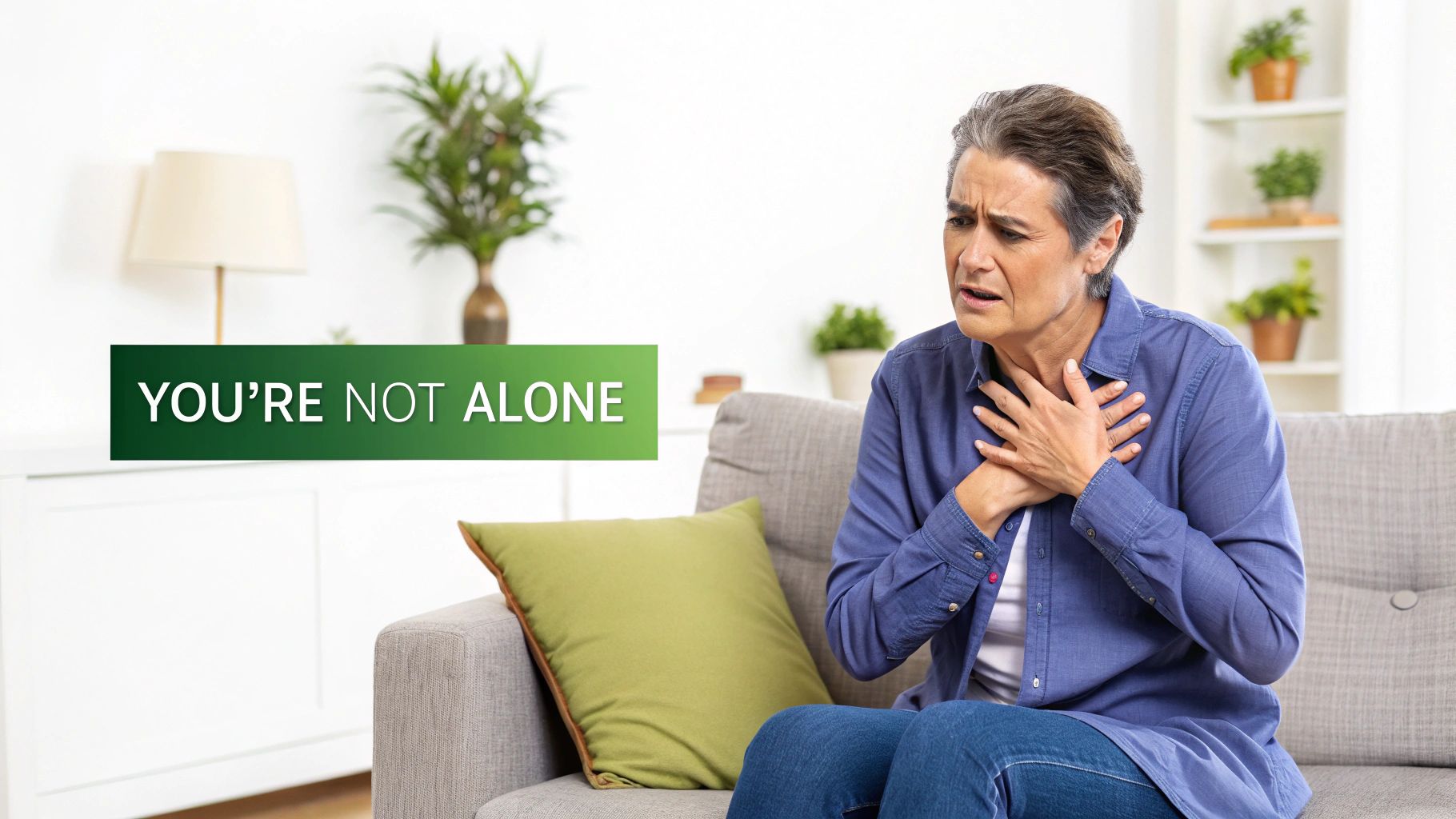
Health anxiety, sometimes referred to as hypochondria, intensifies your normal awareness of your body into a constant state of high alert. It’s an exhausting cycle where a minor muscle twitch, a fleeting headache, or a brief dizzy spell spirals into a deep, unshakable fear that you have a serious, undiagnosed illness. This is far more than just "worrying too much"; it's a condition that takes a heavy physical and emotional toll.
This struggle is far more common than you might think. Across the United Kingdom, anxiety-related health issues are on the rise, putting a real strain on our public health services. Since the pandemic, the number of working-age adults reporting high levels of anxiety has shot up to 23%, and GP-diagnosed cases of depression have nearly doubled. This has resulted in a record-breaking 5.2 million mental health referrals in England in 2024 alone—a staggering 37.9% jump from 2019, underscoring just how many people are looking for support. You can read more about these trends on institute.global.
The Vicious Cycle of Fear and Symptoms
At the heart of health anxiety is a powerful feedback loop where intense worry creates very real physical symptoms. When you fixate on the fear of being unwell, your body releases stress hormones like cortisol and adrenaline, which can cause a host of sensations:
- A racing or pounding heart
- Dizziness and light-headedness
- Muscle tension and aches
- Shortness of breath
- Tummy troubles or nausea
The cruel irony is that these stress-induced feelings become the very "evidence" your anxious mind was searching for. They seem to confirm your deepest fears that something is catastrophically wrong, and so the cycle continues.
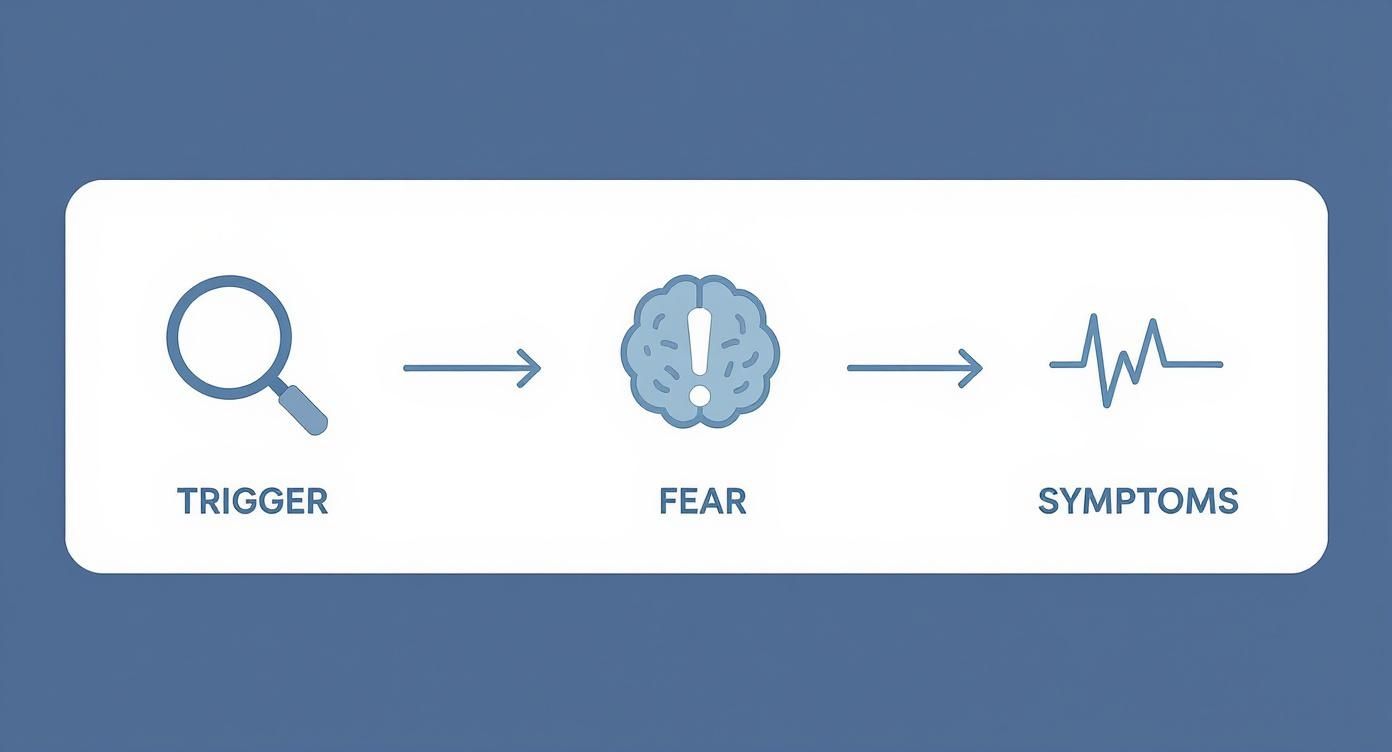
This cycle shows just how a simple trigger—like a completely normal bodily sensation—can escalate into intense fear. That fear then generates genuine physical symptoms, which only reinforces the original worry, making it stronger.
The most important thing to grasp is this: the physical symptoms you're feeling are absolutely real. But their source is often anxiety, not some sinister underlying disease. Understanding this connection is the first, and most crucial, step toward regaining control.
Normal Health Concern vs Health Anxiety
It's natural to worry about your health sometimes, but how can you tell when a reasonable concern has tipped over into health anxiety? This quick comparison can help you see if your worries are crossing that line, which is the first step to finding the right kind of support.
| Characteristic | Normal Health Concern | Potential Health Anxiety |
|---|---|---|
| Trigger | A new or persistent symptom prompts a GP visit. | A minor, everyday sensation (e.g., a twitch, a headache) triggers alarm. |
| Reassurance | Feeling relieved after a doctor confirms nothing is seriously wrong. | Reassurance from doctors or tests provides only temporary relief, or none at all. |
| Focus | Concern is limited to the specific symptom and fades after reassurance. | The worry is persistent, consuming, and often shifts from one illness to another. |
| Behaviour | You seek medical advice and follow it. | You constantly check your body for signs, research symptoms online for hours, or avoid medical appointments out of fear. |
| Daily Impact | The concern doesn't significantly disrupt your work, social life, or daily routines. | The anxiety interferes with your ability to enjoy life, focus, and maintain relationships. |
Seeing your experience laid out like this can be a real eye-opener. If the right-hand column feels familiar, it's a strong sign that it's time to seek support specifically for anxiety.
The constant mental and physical strain of this cycle is utterly draining. It’s no wonder so many people ask, "can stress cause fatigue?". The answer is a resounding yes. The relentless hyper-vigilance of health anxiety burns through your energy reserves, making it hard to focus at work, enjoy time with your family, or even just relax. Acknowledging this connection is a powerful move that empowers you to seek the right kind of help.
Actionable Techniques to Reframe Anxious Thoughts
Knowing how the anxiety cycle works is one thing, but actually breaking free from it is a whole different challenge. To find lasting help with health anxiety, you need practical tools to intercept and challenge fearful thoughts before they spiral. The good news is that many highly effective methods, adapted from Cognitive Behavioural Therapy (CBT), are things you can start doing on your own to feel more in control.
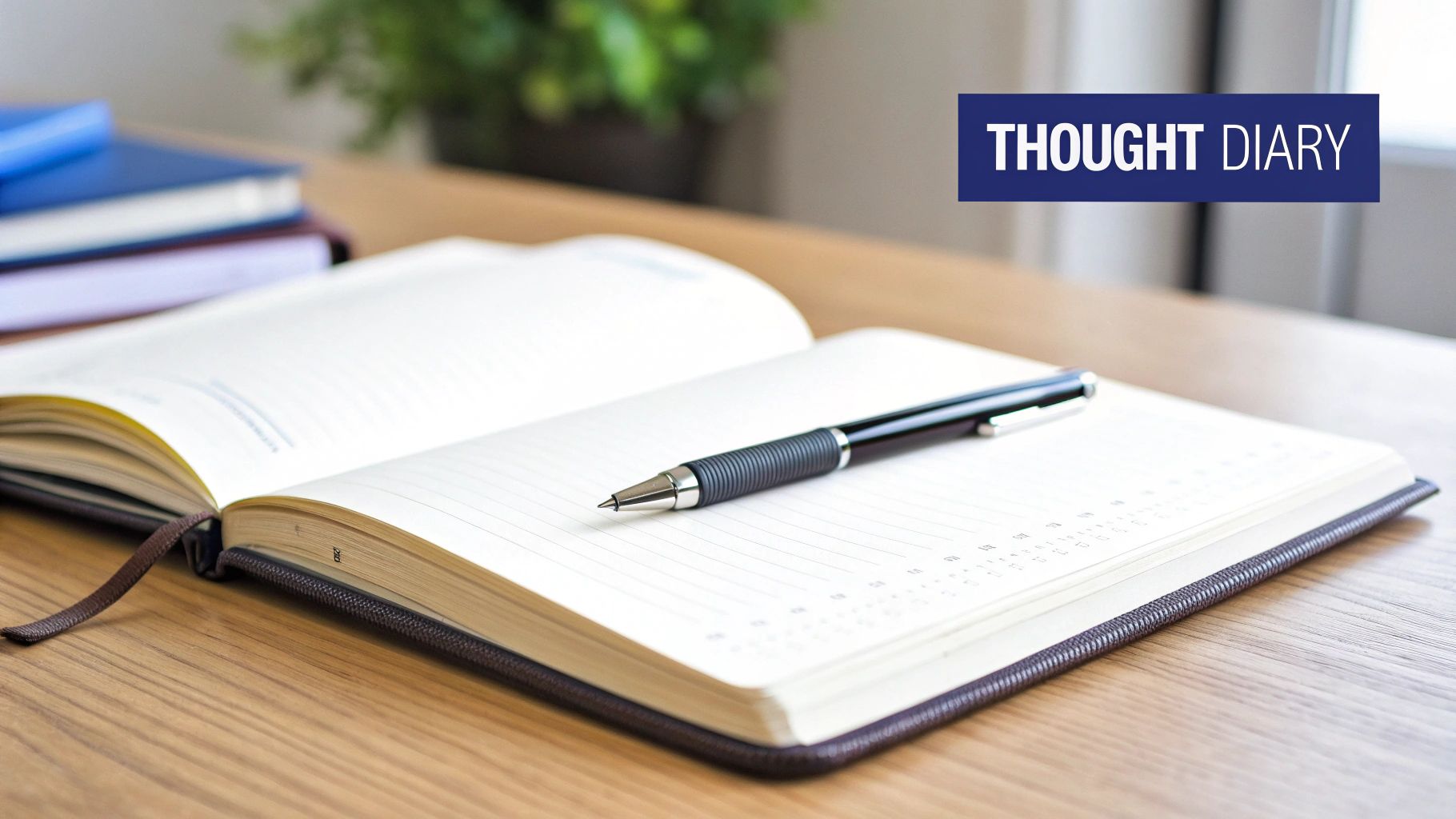
One of the most powerful strategies is keeping a thought diary. This isn't about dwelling on your fears. It’s about putting them under a microscope. Instead of letting a scary thought run wild in your head, you learn to catch it, write it down, and take a hard, critical look at it.
Catch and Challenge Your Thoughts
Let’s say a sudden, sharp headache pops up. Your immediate thought might be, "This has to be a brain tumour." That’s your cue to pause and grab your diary. Just the act of getting the thought out of your head and onto paper creates a bit of distance, giving you the space you need to challenge it logically.
Once it's written down, start asking some direct questions:
- What’s the actual evidence for this thought? (e.g., "I have a headache.")
- What’s the evidence against it? (e.g., "I often get headaches when I'm dehydrated or stressed. I don't have any other symptoms. I felt completely fine five minutes ago.")
- What’s a more likely, balanced explanation? (e.g., "This is probably just a tension headache from a long day at my desk.")
This simple process throws a spanner in the works of catastrophic thinking. Over time, you’re actually retraining your brain to consider rational explanations first, rather than jumping straight to the worst-case scenario. It helps you see your thoughts for what they are: just mental events, not concrete facts.
Break the Compulsion Loop
Health anxiety is often driven by a relentless need for reassurance. This might mean endlessly Googling symptoms, constantly checking your body for changes, or repeatedly asking loved ones if you seem okay. These actions are called compulsions, and while they might give you a temporary sense of relief, they actually make the anxiety stronger in the long run.
A game-changing technique here is response prevention. It's all about making a conscious choice to resist that urge to perform a compulsion. For example, if you notice a strange sensation in your chest, you actively decide not to search "causes of chest pain" for at least an hour. You just sit with the discomfort, allowing that initial wave of panic to rise and then, importantly, fall on its own.
By resisting the compulsion, you teach your brain a vital lesson: the anxiety will pass without you having to do anything about it. It’s tough, but it's an essential step in breaking your reliance on those safety behaviours.
Contain Your Worries
Trying to just force anxious thoughts out of your mind usually backfires—they just come back stronger. A much better way to handle it is to schedule a dedicated "worry period". Block out a specific 15-minute window each day where you give yourself permission to fully dive into your health fears.
If a worry pops up outside of that scheduled time, simply acknowledge it and tell yourself you'll deal with it during your worry period. This isn't about ignoring your feelings; it's about containing them so they don't contaminate your entire day. You’re taking back control, deciding when and where you’ll worry. For extra support during these intense moments, exploring techniques like deep pressure therapy can also offer some very practical relief.
Building Resilience Through Everyday Lifestyle Changes
While learning to tackle anxious thoughts head-on is a vital skill, the real groundwork for resilience is laid in your daily habits. Think of your lifestyle as the foundation supporting your emotional health. When that foundation is solid, you're far better equipped to ride out the aftershocks of anxiety.
This isn't about a complete life overhaul or striving for some impossible ideal. It's about making small, consistent tweaks to how you eat, move, and sleep. Over time, these simple choices build up, creating a powerful buffer against the turbulence that health anxiety brings.
Fuel Your Body to Calm Your Mind
The connection between your diet and your state of mind is incredibly strong. Unstable blood sugar, for example, can trigger shakiness, a racing heart, and dizziness—sensations your anxious mind is primed to misinterpret as a sign of something catastrophic.
A great starting point is to focus on balanced meals. Making sure you have a good source of protein—like chicken, eggs, lentils, or Greek yoghurt—at every meal helps keep your blood sugar steady. This prevents those energy spikes and crashes that so often mimic the feelings of panic, keeping you on a much more even keel. It's also wise to incorporate complex carbohydrates (like whole grains and vegetables) for sustained energy release.
It's also worth taking an honest look at your caffeine intake. As a stimulant, caffeine can put your nervous system on high alert, raising your baseline stress level and leaving you more vulnerable to anxious thought spirals. You don’t have to cut it out completely, but simply reducing it can make a world of difference.
Regulate Your Nervous System with Movement
When you feel stuck in a loop of anxious thoughts, sometimes the best escape is to get into your body. Physical movement is an incredible tool for calming an overactive nervous system, and you don’t need an intense gym session to feel the benefits.
- A Brisk Walk: Just 20 minutes of brisk walking is enough to release feel-good endorphins and burn off excess stress hormones like adrenaline and cortisol. It’s a fantastic circuit-breaker when you feel worry starting to build.
- Gentle Yoga or Stretching: Activities that connect your breath with your body, like simple stretching or yoga, are profoundly calming. They switch on the parasympathetic nervous system—your body's 'rest and digest' mode—which helps quieten a racing mind.
The real magic is in consistency. Try building a simple weekly routine, maybe a walk three days a week and a short stretching session on the other two. Finding out how to improve mental wellbeing is often about discovering physical activities you actually enjoy.
Prioritise Restorative Sleep
For emotional stability, good sleep is completely non-negotiable. A lack of quality rest directly impacts your prefrontal cortex, the part of your brain that handles logic and regulates emotion. This makes it far harder to push back against anxious thoughts and much easier to get swept away by fear.
Creating a consistent and relaxing bedtime routine—often called good sleep hygiene—is one of the most powerful things you can do for yourself. It sends a clear signal to your brain and body that it’s time to wind down.
It's also crucial to acknowledge that wider societal factors can deeply affect our mental health and ability to rest. Recent data from the 'Our Future Health' study starkly illustrates these disparities in the UK. For instance, individuals with household incomes under £18,000 are over 16 times more likely to report severe depression symptoms than those earning over £100,000. Furthermore, 50.7% of people unable to work due to sickness or disability report moderate to severe anxiety. These figures highlight that financial stability and access to resources are fundamental to our mental wellbeing. You can explore these UK mental health statistics in more detail.
Grounding Exercises for In-the-Moment Relief
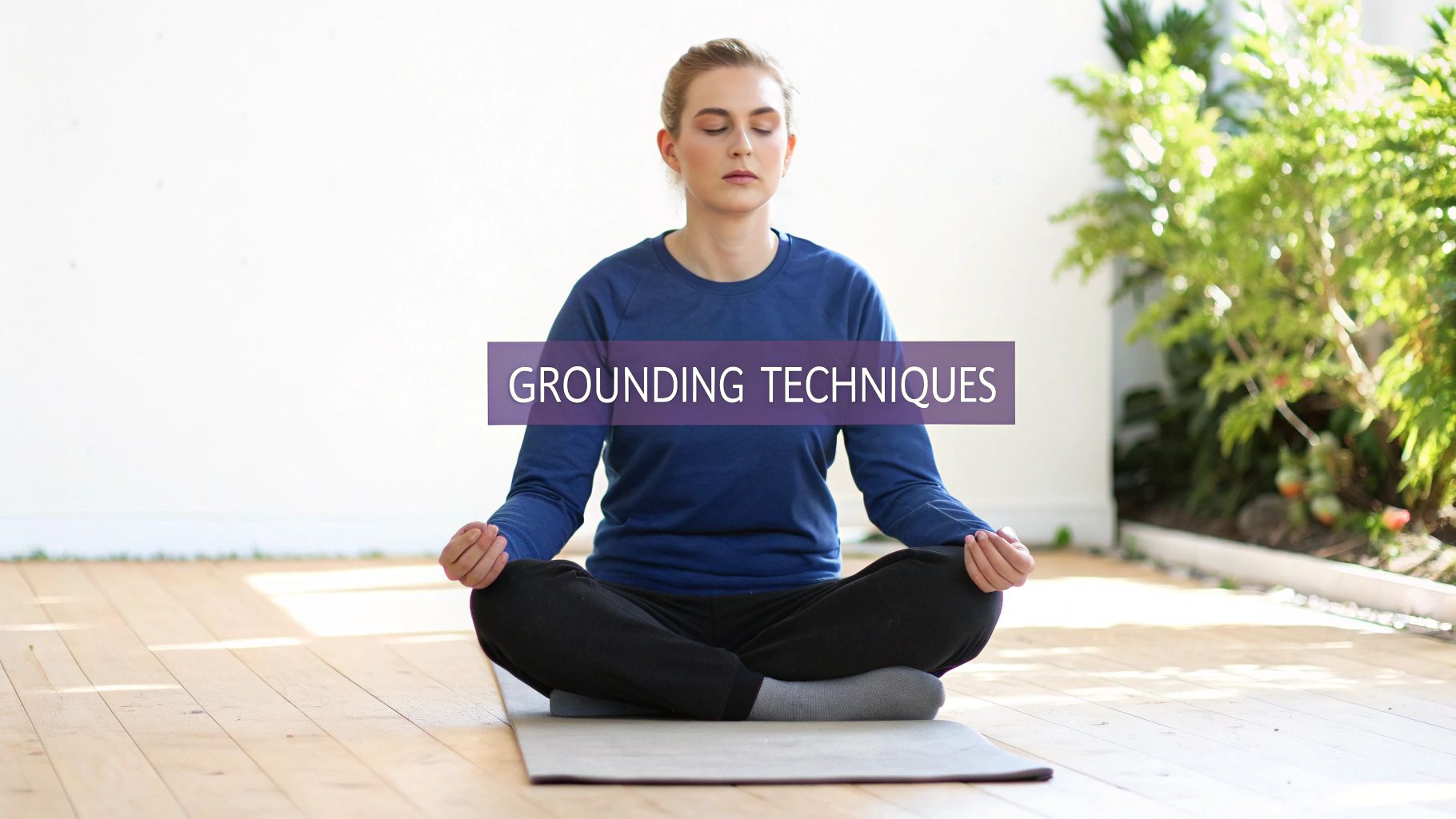
When a wave of health anxiety crashes over you, rational thought is often the first casualty. In those moments, you don't need a grand, complex plan. What you need is a circuit breaker—something to stop the spiral. That’s exactly what grounding exercises are designed for. They pull your focus away from the terrifying "what-if" scenarios and anchor you back in the here and now.
Picture this: you feel a sudden, sharp twinge in your chest. The familiar dread starts to creep in, and your mind immediately leaps to the worst possible conclusion. This is the critical moment. Instead of letting that panic sweep you away, you can use a simple, powerful tool to calm your nervous system, often in just a few minutes.
The 5-4-3-2-1 Senses Method
This technique is a personal favourite of mine because it’s so effective at forcing your brain to switch gears. It shifts your attention from scary internal sensations to the solid, real world around you. Best of all, it's easy to remember and you can do it anywhere, whether you're at work or in the middle of a crowded shop.
Just pause what you're doing. Take a breath. Then, either out loud or just in your head, start to identify:
- Five things you can see: Really look around. Name five separate objects. Don't just glance; notice their colour, their shape, even tiny details. "I see the blue ink in my pen, the dark grain of the wood on my desk, the waxy shine on the plant leaf, my glowing computer screen, and a spiderweb in the corner of the window."
- Four things you can feel: Tune into the physical sensations on your body. "I can feel the cool, smooth surface of the table under my hands, the soft wool of my jumper against my skin, the firm support of the chair, and the solid ground beneath my feet."
- Three things you can hear: Listen intently. What sounds are in the background that you usually tune out? "I hear the low hum of the fridge, the distant traffic outside, and the quiet sound of my own breathing."
- Two things you can smell: This one sometimes requires a bit more focus. Lean in if you have to. "I can smell the faint aroma of coffee from my mug and the clean scent of the soap on my hands."
- One thing you can taste: What is the lingering taste in your mouth? "I can taste the mint from the chewing gum I had earlier."
By deliberately walking through all five senses, you're not leaving much room for anxious thoughts to run wild.
This isn't about pretending the fear isn't there. It's about gently showing yourself that you can redirect your focus and regain a sense of control, even when your body is screaming "panic!"
Controlled Breathing to Calm Your Body
Panic makes your breathing shallow and fast, a physiological response that unfortunately just ramps up the physical symptoms of anxiety. By consciously slowing your breath down, you send a powerful message to your nervous system that the threat isn't real and it's safe to stand down. There are many effective breathing exercises for anxiety that can offer immediate relief.
One of the simplest and most effective is called box breathing.
It's easy to remember, even when you're feeling overwhelmed:
- Breathe in gently through your nose for a count of four.
- Hold your breath for a count of four.
- Exhale slowly through your mouth for a count of four.
- Hold again at the bottom of the breath for a count of four.
Just repeating this cycle four or five times can work wonders. The steady rhythm helps regulate your heart rate and brings a feeling of calm. This is the kind of practical, immediate health anxiety help you can give yourself anytime, anywhere.
How to Get Professional Health Anxiety Help in the UK
Self-help techniques and lifestyle adjustments are a powerful foundation, but recognising when you need more support is a sign of strength. If constant worry about your health is getting in the way of your work, putting a strain on your relationships, or just sucking the joy out of life, it’s probably time to talk to a healthcare professional.
Taking that first step can feel huge, but the path to getting help in the UK is more straightforward than you might imagine. Your GP is almost always the best first port of call. They are the gateway to NHS mental health services and are trained to handle these conversations with care and understanding. My advice? Book an appointment specifically to talk about your anxiety, so you have enough time and don't feel rushed.
Preparing for Your GP Appointment
A little bit of prep work can make a world of difference during your appointment. Before you go, it's worth jotting down a few notes. You don't need to write an essay – just some bullet points to jog your memory if you get flustered.
Try to include things like:
- Your Main Worries: What specific health fears are on your mind?
- Your Behaviours: Are you constantly checking for symptoms? Or spending hours on Google? Mention it.
- The Real-Life Impact: How is this anxiety affecting your sleep, your mood, or your day-to-day life?
For instance, you could say something like, "For the past month, I've been terrified I have a serious heart condition. I'm checking my pulse over 20 times a day, and I can't concentrate at work." This gives your doctor a crystal-clear picture of what's been going on.
What to Expect from the NHS
Your GP will listen without judgement and will likely ask a few questions to get a better sense of how things are for you. From there, they'll suggest a plan. For health anxiety, the most common and effective treatment recommended by the NHS is Cognitive Behavioural Therapy (CBT).
CBT is often called the gold standard for a reason. It’s a practical therapy that helps you break the cycle of anxious thoughts and compulsive actions. You learn real skills to challenge your fears and stop relying on constant reassurance.
You'll probably be referred to your local NHS talking therapies service (sometimes called IAPT services). In many areas, you can even refer yourself directly online without seeing a GP first. Waiting times can vary by region, but getting on that list is a vital step towards getting structured, proven support. Sometimes, medication like an antidepressant might be suggested to use alongside therapy, which can also be incredibly helpful.
The need for this kind of accessible support has never been clearer. Recent research has shown a worrying increase in mental illness symptoms among young people in the UK. Over the last decade, there’s been a 19% jump in self-reported psychological distress, which is a huge driver of health-related anxiety. These findings on youth mental health show a growing gap between how many people need help and the services available. That's why it's more important than ever to be proactive and seek out the support you absolutely deserve.
Answering Your Questions About Health Anxiety
When you're grappling with health anxiety, it's natural to have a lot of questions running through your mind. Let's tackle some of the most common ones with clear, practical answers to help you find your footing.
How Can I Tell Real Symptoms Apart From Anxiety?
This is a key challenge for anyone living with health anxiety. The physical sensations of anxiety are very real—a racing heart, shortness of breath, tingling fingers, or tense muscles. The key is to observe the context. Do your symptoms flare up when you're feeling stressed or thinking about your health, then fade when you’re distracted? That often points to anxiety. A symptom from a physical illness tends to be more persistent and consistent, regardless of your emotional state. Try keeping a simple journal for a week or two; you might start to see a clear pattern emerge between your thoughts and your physical feelings. If you are ever genuinely concerned about a new or persistent physical symptom, it is always advisable to consult a GP.
Is It Possible to Ever Fully Recover?
Yes, absolutely. Recovery is not just possible; it's a realistic goal. With the right support and strategies, you can learn to step back from anxious thoughts and break the relentless cycle of worry and checking.
Recovery doesn't mean you'll never have another health worry. Everyone does! It means those concerns won't dominate your life anymore.
The aim is to reach a point where a health concern is just that—a concern you can address calmly and rationally, not a catastrophe that steals your peace of mind. For most people, a blend of self-help strategies, lifestyle adjustments, and professional therapy is what leads to lasting relief.
How Do I Explain This to My Loved Ones?
This can be incredibly difficult. Friends and family often struggle to understand why a doctor's all-clear isn't enough to soothe your fears. It can sometimes help to frame it as being similar to Obsessive-Compulsive Disorder (OCD), where your brain gets stuck in a loop of fearful thoughts.
You could try saying something like, "My mind latches onto the what if of being ill, and it feels terrifyingly real, even when I logically know it's unlikely. Your patience and understanding mean more to me than reassurance, which can sometimes feed the anxiety." This helps them see the mechanism at play and gives them a concrete way to support you. Providing practical health anxiety help often starts with creating that supportive environment at home.
At The Lagom Clinic, we believe true health is about balance—mind and body. Our private GP practice in Bristol provides unhurried, personalised appointments to explore your concerns properly, giving you the time, reassurance, and guidance you deserve. Learn more about our balanced approach to your wellbeing at https://www.thelagom.co.uk.

 Members Consultation