


A knee injury can feel like a significant setback, disrupting everything from daily walks to your favourite sports. However, a structured and progressive exercise plan is the cornerstone of a successful recovery, helping you regain strength, flexibility, and confidence. This guide provides medically-sound, actionable knee injuries exercises that form the foundation of effective rehabilitation. We move beyond generic advice to give you step-by-step instructions, explain the science behind each movement, and outline crucial lifestyle changes to support your healing.
This article details a range of essential movements, from foundational isometric contractions like Quadriceps Setting to more dynamic functional training. Understanding how these exercises fit into a cohesive recovery strategy is crucial. As you embark on rebuilding a stronger, more resilient knee, consider how your personalised exercise regimen fits within broader frameworks. For insights into developing well-structured, holistic approaches, including physical therapy, explore more practical treatment plan examples.
Remember, recovery is a journey, not a race. Before beginning any new exercise programme, it is vital to consult with a healthcare professional, such as your GP or a physiotherapist, to ensure the exercises are appropriate for your specific injury and stage of recovery. This personalised guidance is key to a safe and efficient return to the activities you love.
1. Quadriceps Setting (Isometric Quads)
Quadriceps setting, also known as an isometric quad contraction, is a foundational exercise in early-stage knee rehabilitation. It involves tightening the large muscle group at the front of your thigh, the quadriceps, without actually moving the knee joint. This simple yet powerful action is scientifically proven to be crucial for preventing muscle atrophy (wasting) and re-establishing the mind-muscle connection, which is often disrupted after an injury or surgery.
 reconstruction or those who have just undergone a total knee replacement will find this to be one of the first exercises prescribed by their physiotherapist. Its primary goal is to maintain quadriceps strength and "wake up" the muscle fibres.
Key Insight: The brain can temporarily "forget" how to fire the quadriceps muscle after trauma, a phenomenon known as arthrogenic muscle inhibition. Quad sets directly combat this, helping to restore neuromuscular control which is fundamental for walking and balancing.
How to Perform It Correctly
Follow these steps for proper execution:
- Starting Position: Lie on your back on a firm surface, such as the floor or a bed, with your injured leg extended straight in front of you. You can place a small, rolled-up towel or a foam roller under your knee for support and tactile feedback.
- Contraction: Gently tighten the muscle on the top of your thigh (your quadriceps) as if you are trying to push the back of your knee down into the towel.
- Visual Cue: You should see the muscle bulge and your kneecap (patella) move slightly upwards towards your hip. This confirms you are engaging the correct muscle.
- Hold and Release: Hold this contraction for 5 to 10 seconds, then slowly and completely relax the muscle.
Aim to complete 15-20 repetitions for one set, and perform 3-4 sets daily. As you gain confidence and strength, this exercise serves as a safe stepping stone to more advanced movements like straight leg raises. A helpful tip is to perform these sets at regular intervals throughout the day—for example, every time a TV advert break comes on—to ensure consistency.
2. Straight Leg Raises (SLR)
A straight leg raise (SLR) is a fundamental progression from static quadriceps contractions, designed to build dynamic strength in the thigh muscles without bending the injured knee. The exercise involves lifting the entire leg off a surface while keeping the knee locked in full extension. This controlled movement strengthens the quadriceps and hip flexors, which are essential for restoring a normal walking pattern and providing stability to the knee joint.
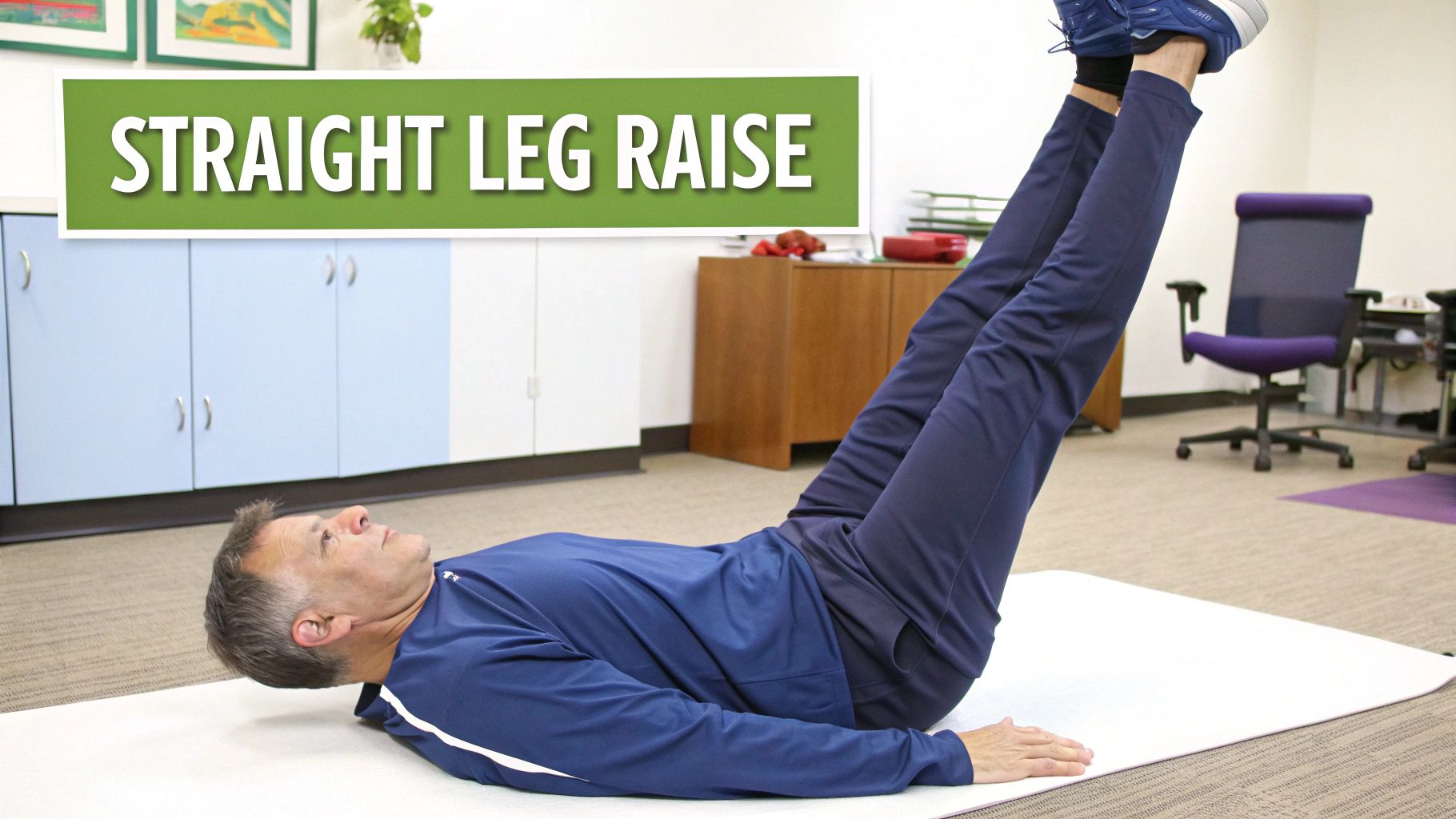
The SLR is one of the most widely prescribed knee injuries exercises because it introduces controlled movement and challenges the quadriceps against gravity, a critical step up from isometric holds. It is a cornerstone of early to mid-stage rehabilitation, helping to bridge the gap between basic muscle activation and more functional, weight-bearing activities.
Why This Exercise is Essential
This exercise is a staple in most post-operative knee protocols, particularly for ACL reconstruction (often introduced from week 3 onwards) and following a meniscectomy once initial swelling has subsided. It directly targets the muscles needed to support the body's weight when standing and walking. Mastering the SLR ensures the quadriceps are strong enough to stabilise the knee during daily movements, preventing the joint from buckling.
Key Insight: A common issue after knee injury is a "quad lag," where the leg drops or bends slightly when attempting to lift it. Straight leg raises directly combat this by training the quadriceps to maintain full knee extension throughout the entire range of motion, a crucial component for a stable gait.
How to Perform It Correctly
Follow these steps for proper execution:
- Starting Position: Lie on your back on a firm surface with your uninjured leg bent and foot flat on the floor. Your injured leg should be extended straight out.
- Engagement: First, perform a quadriceps set by tightening the muscle at the front of your thigh to lock your knee completely straight.
- The Lift: While keeping the muscle tight and knee straight, slowly lift your leg about 12-18 inches (or to the height of your other bent knee). Avoid any rotation of the pelvis or hiking your hip.
- Hold and Lower: Hold the leg at the top for 2-3 seconds, then slowly lower it back to the starting position with full control. Relax the muscle briefly before the next repetition.
Aim for 12-15 repetitions for one set, and perform 2-3 sets daily. As your strength improves, your physiotherapist may recommend adding light ankle weights (starting with 1-2 lbs) to progressively increase the challenge. Always ensure the movement is slow and controlled; speed is not the goal here.
3. Range of Motion (ROM) Exercises – Passive and Active-Assisted
Restoring movement is a fundamental objective in knee rehabilitation, and Range of Motion (ROM) exercises are the primary tool for achieving this. These exercises focus on safely moving the knee joint through its natural planes of flexion (bending) and extension (straightening). They progress from passive, where an external force moves the leg, to active-assisted, where you contribute to the movement, preventing the joint from becoming stiff and helping to reduce swelling.
This progression makes ROM one of our most crucial knee injuries exercises because it ensures the joint capsule, ligaments, and surrounding tissues remain pliable without overloading them. It's an indispensable component for anyone recovering from surgery or a significant injury where stiffness is a major concern.
Why This Exercise is Essential
ROM exercises are prescribed almost immediately after a knee injury or procedure. They are vital in the first six weeks following a total knee arthroplasty (TKA) to achieve functional bending and straightening. Similarly, for those recovering from an anterior cruciate ligament (ACL) reconstruction, gentle ROM work helps to prevent the formation of scar tissue that can permanently limit movement.
Key Insight: A stiff knee can lead to altered walking patterns (gait), which can cause secondary problems in the hip, back, and opposite knee. Early and consistent ROM work is not just about the knee; it's about preserving the function of the entire kinetic chain.
How to Perform It Correctly
Follow these steps for a common active-assisted version, Heel Slides:
- Starting Position: Lie on your back on a firm, flat surface with your injured leg extended. You may find it helpful to place a smooth mat or even a plastic bag under your heel to reduce friction.
- Initiate Movement: Slowly and gently slide the heel of your injured leg towards your buttocks, bending your knee as far as you can comfortably. Use a towel or strap looped around your foot to provide gentle assistance if needed.
- Controlled Motion: Focus on a smooth, controlled movement. Do not force the joint past the point of mild tension or pain. The goal is to gradually increase the range over time, not to push through sharp pain.
- Hold and Release: Hold the bent position for 3-5 seconds, then slowly slide your heel back to the starting position until your leg is straight.
Aim to complete 10-15 repetitions for one set, and perform 3-4 sets daily. Always move within a pain-free range. A valuable health tip is to apply a warm pack to the knee for 10-15 minutes before performing these exercises to help relax the muscles and improve flexibility.
4. Closed Chain Kinetic Exercises (CCKE)
Closed Chain Kinetic Exercises (CCKE) are movements where the foot remains stationary against a surface, such as the floor or a footplate, while the body moves around it. This group of exercises, including mini squats and leg presses, is fundamental to functional rehabilitation as it closely mimics everyday activities like walking, climbing stairs, and standing up from a chair.
These are some of the most effective knee injuries exercises because they promote co-contraction of the muscles surrounding the knee, including the quadriceps and hamstrings. This simultaneous activation creates a more stable and protected joint, reducing shear forces and allowing for safe strengthening without compromising healing structures like a newly repaired ligament.
Why This Exercise is Essential
CCKE are introduced once the initial pain and swelling have subsided and basic muscle activation is restored. They are a cornerstone of mid-stage rehabilitation, particularly for conditions like ACL sprains, patellofemoral pain syndrome, and osteoarthritis. For example, mini squats are often incorporated between weeks 6-12 of an ACL reconstruction protocol to rebuild strength in a functional, weight-bearing position. Their primary goal is to re-train movement patterns and build strength that translates directly to real-world function.
Key Insight: Unlike open-chain exercises where the foot moves freely (e.g., leg extensions), closed-chain movements distribute forces more evenly across the joint. This enhances joint stability and proprioception, which is the body's awareness of its position in space, a critical factor in preventing re-injury.
How to Perform It Correctly
Follow these steps for a wall squat, a common introductory CCKE:
- Starting Position: Stand with your back flat against a wall and your feet shoulder-width apart, about 18-24 inches away from the wall.
- Movement: Slowly slide your back down the wall until your knees are bent to a shallow angle (initially 0-30 degrees). Ensure your knees track directly over your second toe and do not cave inwards.
- Visual Cue: Check in a mirror that your hips, knees, and ankles are aligned. Your shins should remain relatively vertical.
- Hold and Return: Hold the position for 5 to 10 seconds, feeling the engagement in your quadriceps and glutes. Push through your heels to slide back up to the starting position.
Aim to complete 10-15 repetitions for one set, and perform 2-3 sets. Progress by increasing the depth of the squat or moving to more advanced variations like step-ups, but only once the initial movements are completely pain-free. A good tip is to place a small ball between your knees and gently squeeze it as you squat to improve alignment and activate inner thigh muscles.
5. Open Chain Kinetic Exercises (OCKE)
Open Chain Kinetic Exercises (OCKE) are movements where the distal end of the limb (in this case, your foot) moves freely and is not fixed to a surface. Unlike their closed-chain counterparts, these exercises excel at isolating and strengthening specific muscles around the knee joint. Common examples include seated knee extensions and seated hamstring curls, often performed with resistance bands or on weight machines.
This targeted approach makes them one of the most valuable knee injuries exercises for addressing specific muscular imbalances or weaknesses that may have contributed to the initial injury. By focusing on a single muscle group, such as the quadriceps or hamstrings, OCKE allows for controlled, precise strengthening without the body compensating with other muscle groups.
Why This Exercise is Essential
These exercises are particularly crucial when a specific muscle group shows significant weakness post-injury or surgery, for example, a weakened quadriceps after an ACL reconstruction. They allow for progressive loading in a highly controlled, often seated, and stable environment. This makes them a safe and effective way to rebuild foundational strength before progressing to more complex, functional movements that require coordination and stability.
Key Insight: While closed-chain exercises are more "functional" for daily activities, open-chain exercises are superior for surgically targeting and strengthening a specific weak muscle. A balanced rehabilitation programme will almost always include a strategic combination of both types of movements.
How to Perform It Correctly
Here is a guide for a seated knee extension, a classic OCKE:
- Starting Position: Sit upright on a sturdy chair with your back well-supported. Your knees should be bent at a 90-degree angle, with your feet flat on the floor. To add resistance, you can use a light ankle weight or a resistance band looped around the chair leg and your ankle.
- Execution: Slowly and with full control, extend your injured leg straight out in front of you until it is as straight as you can comfortably manage. Focus on squeezing your quadriceps muscle at the top of the movement.
- Hold and Return: Hold the fully extended position for 2-3 seconds. Then, slowly lower your foot back to the starting position, maintaining control throughout the entire motion.
- Important: Monitor for any sharp pain at the front of the knee. If this occurs, reduce the range of motion or the resistance.
Aim for 2-3 sets of 12-15 repetitions. As you build strength, you can gradually increase resistance in small increments. A useful tip is to perform these without any added weight initially to perfect the form and ensure your quadriceps are firing correctly.
6. Balance and Proprioceptive Training
Balance and proprioceptive training is a sophisticated yet essential component of knee rehabilitation that focuses on retraining the body's awareness of its position in space. This involves exercises that challenge your balance, coordination, and joint position sense, which are often diminished after an injury. By doing so, you re-establish a critical feedback loop between your knee joint, muscles, and brain, which is fundamental for dynamic stability and preventing future injuries.
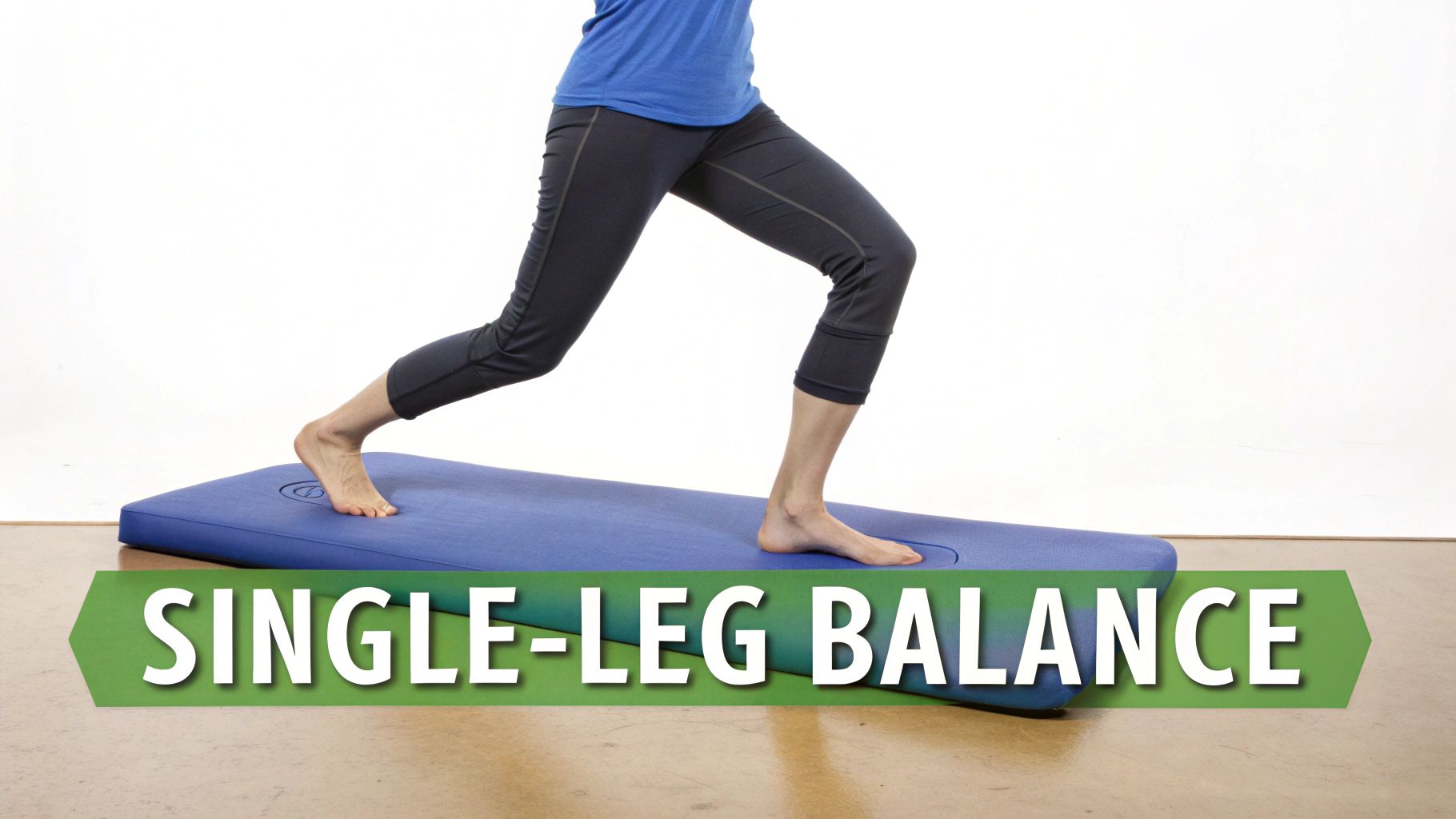
This makes it one of the most important knee injuries exercises for the later stages of recovery, as it prepares the joint for the unpredictable demands of daily life and sports. For an in-depth understanding of how your body senses its position and movement, crucial for injury prevention and recovery, explore the benefits of proprioception training.
Why This Exercise is Essential
This form of training is vital for anyone aiming to return to activities that require quick changes in direction, jumping, or navigating uneven surfaces. For instance, athletes recovering from an ACL reconstruction will use proprioceptive drills to regain the confidence to pivot and cut, while an individual with chronic knee instability can improve their functional performance and reduce their risk of falls. It bridges the gap between simple strengthening and real-world movement.
Key Insight: After a knee injury, the nerve receptors (mechanoreceptors) in the ligaments and joint capsule are often damaged. This impairs proprioceptive feedback to the brain. Balance training stimulates these pathways, helping the nervous system to relearn how to control the knee joint with precision and protect it from re-injury.
How to Perform It Correctly
Follow these progressive steps for safe and effective execution:
- Starting Position: Begin by standing on a firm, flat surface near a wall or sturdy counter for support. Keep your feet hip-width apart and your core engaged.
- Progression to Single Leg: Once comfortable, lift your uninjured foot off the ground and focus on maintaining your balance on the injured leg. Keep a slight bend in the standing knee and your hips level.
- Hold and Challenge: Aim to hold this single-leg stance for 30 seconds. To increase the difficulty, you can close your eyes (only after mastering it with eyes open) or stand on an unstable surface like a foam pad or wobble board.
- Advance Further: Once you can balance confidently, incorporate dynamic movements like gentle squats on one leg or reaching your arms in different directions.
Start with 3-4 repetitions of a 30-second hold on each leg. Perform 1-2 sets daily, ensuring you prioritise form over duration. A practical lifestyle tip is to practice single-leg balancing while doing everyday tasks like brushing your teeth or waiting for the kettle to boil.
7. Hamstring Strengthening Exercises
Strengthening the hamstrings, the large muscle group at the back of your thigh, is a critical component of comprehensive knee rehabilitation. The hamstrings (biceps femoris, semitendinosus, and semimembranosus) act as a dynamic stabiliser for the knee joint, counteracting the powerful pull of the quadriceps and protecting ligaments like the ACL from excessive strain. Building their strength is vital for restoring proper knee mechanics and preventing future injuries.
These targeted movements are some of the most important knee injuries exercises because a strength imbalance between the quadriceps and hamstrings is a well-documented risk factor for knee problems. By focusing on this posterior muscle chain, you create a more balanced and resilient joint that can better absorb shock and manage rotational forces during activity.
Why This Exercise is Essential
This group of exercises is particularly crucial for individuals recovering from ACL injuries, patellofemoral pain syndrome, or general knee instability. For instance, in ACL reconstruction protocols, hamstring strengthening often begins around week 6 (post-surgery) with exercises like prone hamstring curls, progressing to more demanding movements later in the rehabilitation process. It's also fundamental for athletes returning to sports that involve sudden stopping, cutting, or jumping.
Key Insight: An ideal strength ratio between the quadriceps and hamstrings is often cited as the quadriceps being no more than 1.5 times stronger than the hamstrings (a 3:2 ratio). An imbalance beyond this significantly increases the risk of both initial injury and re-injury, as the hamstrings cannot effectively brake knee extension.
How to Perform It Correctly
Here are the steps for a foundational exercise, the Prone Hamstring Curl:
- Starting Position: Lie face down on a mat or firm surface with your legs extended straight behind you. You can rest your forehead on your hands for comfort.
- Contraction: Keeping your hips pressed firmly into the floor, slowly bend your injured knee, drawing your heel up towards your glutes. Focus on isolating the movement to the hamstring muscle.
- Controlled Movement: Move through a pain-free range of motion. For added resistance, an exercise band can be looped around your ankle and a stable anchor point.
- Hold and Release: Squeeze your hamstring at the top of the movement for a second, then very slowly and with control, lower your leg back to the starting position. An eccentric (lowering) phase of 3-4 seconds is highly effective for building strength.
Aim for 2-3 sets of 8-12 repetitions on your injured leg, performing these exercises 2-3 times weekly. More advanced options include Nordic hamstring curls and machine leg curls. If you're managing a specific muscle tear, you can learn more about how to recover from a hamstring injury to tailor your approach.
8. Functional Movement Training and Return-to-Sport Exercises
Functional movement training represents the final, most dynamic phase of knee rehabilitation. This advanced stage bridges the gap between controlled clinical exercises and the unpredictable demands of sports or high-level activities. It involves re-educating the body to perform complex, sport-specific movements like cutting, jumping, and pivoting, ensuring the knee can handle real-world forces safely and efficiently.
This part of your recovery is one of the most critical knee injuries exercises because it rebuilds confidence and neuromuscular coordination under fatigue. These drills are designed to simulate the exact physical stresses your knee will face, restoring your ability to perform at your pre-injury level and significantly reducing the risk of re-injury upon your return to sport.
Why This Exercise is Essential
This phase is indispensable for athletes or highly active individuals aiming to return to activities like football, basketball, skiing, or running. It is typically initiated only after meeting specific strength and stability benchmarks, such as achieving at least 90% strength in the injured leg compared to the uninjured one. This ensures the foundational strength is there to support advanced dynamic movements.
Key Insight: A knee that feels strong during simple exercises may not be prepared for the rapid deceleration and rotational forces common in sports. Functional training exposes the knee to these controlled stresses, ensuring the entire kinetic chain, from your foot to your core, works in harmony to protect the joint.
How to Perform It Correctly
This is a progressive phase, always guided by a physiotherapist. The complexity and intensity should increase gradually.
- Starting with Agility: Begin with foundational agility drills. Use an agility ladder to practise quick feet movements or perform gentle side shuffles and carioca drills to reintroduce lateral motion.
- Introducing Plyometrics: Start with two-footed jumps, such as box jumps onto a low platform, focusing on soft, controlled landings with good knee alignment. Progress to single-leg hops and bounds.
- Adding Cutting and Pivoting: Begin with large, sweeping figure-8 running patterns. Gradually decrease the size of the turns to increase the rotational demand on the knee. T-drills are excellent for practising acceleration, deceleration, and changes of direction.
- Sport-Specific Integration: Finally, reintroduce skills specific to your sport. A footballer might start with passing drills before moving to dribbling and shooting, while a basketball player practises lay-ups and defensive slides.
This phase should be performed 2-3 times per week, focusing on perfect form over speed. As you can see in a detailed ACL recovery timeline, this stage is carefully structured. Video analysis can be a powerful tool to ensure your mechanics remain sound, especially as you begin to fatigue.
8-Point Comparison of Knee Injury Exercises
| Exercise | Implementation complexity | Resource requirements | Expected outcomes | Ideal use cases | Key advantages |
|---|---|---|---|---|---|
| Quadriceps Setting (Isometric Quads) | Very low — simple isometric holds | None (towel optional) | Maintains activation, limits atrophy | Immediate post-injury/surgery, acute stages | Low pain, can be done anywhere, early neuromuscular re‑engagement |
| Straight Leg Raises (SLR) | Low–moderate — single‑plane movement | Minimal — mat, optional ankle weights | Moderate quadriceps strengthening, progressive overload | Early–mid rehab (weeks 3–8), home programs | Effective hypertrophy, easy to quantify and progress |
| Range of Motion (ROM) Exercises (Passive/Active‑Assisted) | Moderate — requires technique and pacing | Therapist or caregiver for passive; minimal for active | Restores/maintains joint mobility, prevents stiffness | Immediate post‑op/TKA, early rehab to prevent contracture | Preserves ROM, improves synovial circulation, pain reduction |
| Closed Chain Kinetic Exercises (CCKE) | Moderate–high — multi‑joint, technique reliant | Space, possible equipment (leg press, step) | Functional strength, dynamic stability, proprioception | Mid‑to‑late rehab, return‑to‑function training | Functional carryover, less joint shear, improved neuromuscular control |
| Open Chain Kinetic Exercises (OCKE) | Low–moderate — controlled, isolated movements | Machines or free weights (leg extension/curl) | Targeted muscle hypertrophy, isolated strength gains | When isolating muscle deficits or limited ROM | Precise loading, easy resistance progression, addresses specific weaknesses |
| Balance and Proprioceptive Training | Moderate — progressions require skill | Minimal to moderate — foam, wobble board optional | Improved joint position sense, reduced re‑injury risk | Late rehab, re‑injury prevention, sport prep | Reduces re‑injury, enhances agility and confidence, scalable |
| Hamstring Strengthening Exercises | Moderate — needs specific progression (eccentric focus) | Bands, machines, or partner assistance | Increased posterior chain strength, eccentric control | ACL rehab, addressing quad/hamstring imbalances | Improves dynamic knee stability, reduces anterior shear, athletic transfer |
| Functional Movement & Return‑to‑Sport Exercises | High — complex, criteria‑based progressions | Facility, equipment, skilled supervision/coaching | Sport‑specific readiness, high‑level dynamic stability | Final rehab phase for return to sport/activity | Identifies deficits, builds confidence, mirrors sport demands |
Integrating Exercise with a Holistic Recovery Lifestyle
Navigating the path to recovery from a knee injury requires more than just mechanically performing a series of movements. While the knee injuries exercises detailed in this guide form the essential framework for rebuilding strength, true and lasting rehabilitation is achieved by integrating these physical efforts into a holistic lifestyle. Your daily habits, particularly nutrition, sleep, and stress management, provide the biological foundation needed for your body to heal effectively.
The journey back to a pain-free, fully functional knee is a process of rebuilding tissue. The exercises provide the necessary stimulus for repair and strengthening, but your lifestyle choices supply the essential resources to carry out these repairs. A scientifically sound recovery plan addresses both aspects in tandem.
Beyond the Mat: Lifestyle Pillars for Optimal Healing
To maximise the benefits of your rehabilitation programme, it's crucial to adopt lifestyle changes that support your body's natural healing mechanisms:
-
Anti-Inflammatory Nutrition: Your body's ability to repair tissue is directly influenced by what you eat. A diet rich in whole foods that actively combat inflammation can accelerate healing. Medically sound advice includes incorporating oily fish like salmon (rich in omega-3 fatty acids), colourful fruits and vegetables like berries and leafy greens (high in antioxidants), and healthy fats from avocados and nuts. Conversely, minimising pro-inflammatory foods like processed sugars, refined carbohydrates, and trans fats is crucial, as they can hinder the recovery process by promoting systemic inflammation.
-
Restorative Sleep: Sleep is not passive; it is your body's most critical period for tissue repair and regeneration. During deep sleep, your body releases growth hormone, which is vital for rebuilding damaged muscle and connective tissue. Aim for a consistent 7-9 hours of quality sleep per night. To improve sleep quality, establish a regular sleep schedule, avoid caffeine and screens before bed, and ensure your bedroom is dark, quiet, and cool.
-
Stress Management: High levels of chronic stress trigger the release of cortisol, a hormone that, in excess, can create a systemic inflammatory state and impede healing. Integrating evidence-based stress-reduction techniques into your routine is non-negotiable for optimal recovery. This can include mindfulness meditation, deep breathing exercises, gentle yoga, or spending time in nature—all of which have been shown to lower cortisol levels and support the body's repair processes.
By thoughtfully combining targeted knee injuries exercises with these supportive lifestyle changes, you create a powerful synergy that promotes faster, more robust healing. You are not just recovering from an injury; you are cultivating a stronger, more resilient body and establishing habits that protect your long-term joint health. Listen to your body, celebrate small victories, and remember that consistent, intelligent effort is the key to reclaiming your strength and confidence.
Ready to move beyond generic advice and create a recovery plan that is as unique as you are? The specialists at The Lagom Clinic provide comprehensive musculoskeletal assessments, personalised exercise prescriptions, and expert lifestyle guidance to support your journey back to full health and peak performance. Visit us at The Lagom Clinic to learn how our integrated approach can help you achieve a robust and lasting recovery.

 Members Consultation