


An electrocardiogram, more commonly known as an ECG, is a brilliantly simple yet powerful test that gives us a window into your heart’s electrical activity. In essence, it captures the tiny electrical pulses that make your heart beat and translates them into a visual trace. It’s like getting a real-time report on how your heart is behaving at that very moment.
Reading Your Heart's Electrical Story
The ECG is one of our most trusted tools in medicine for a reason. It's quick, completely painless, and gives us an immediate, non-invasive look at your cardiovascular health. It’s often the very first test we’ll run if you come to us with symptoms like chest pain, palpitations, dizziness, or shortness of breath.
It’s important to know that the test is a passive one – it doesn't send any electricity into your body. It’s purely a listening device, recording the signals your heart generates all on its own.
From this simple recording, we can learn a huge amount. The most basic insight is your heart rate. Is it too fast? Too slow? Or is it in that healthy, steady range? But it goes deeper than just speed. The ECG shows us the heart's rhythm. We can see instantly if your heartbeat is regular and consistent, or if there are signs of an irregular rhythm, which we call an arrhythmia.
"An electrocardiogram (ECG) records the electrical activity of the heart and is an essential diagnostic tool in cardiovascular health monitoring within the UK. ECGs translate the heart's electrical impulses into a graphical representation, showcasing the timing and duration of each cardiac cycle."
What an ECG Can Reveal
Even though the ECG only captures a snapshot in time, that single moment can be incredibly telling. It can reveal clues about what’s happening right now, as well as evidence of past events.
This quick summary gives you an idea of what your doctor is looking for in the results:
- Heart Rate and Rhythm: We can immediately confirm if your heart is beating at a normal rate and in a consistent pattern. A steady rhythm is crucial for pumping blood efficiently around your body.
- Blood and Oxygen Supply: The tracing can show tell-tale signs of poor blood flow to the heart muscle (ischaemia), which is a major red flag for coronary artery disease.
- Evidence of Heart Attacks: An ECG is a critical tool for diagnosing a heart attack in progress. It can also detect changes that suggest a previous, sometimes "silent," heart attack.
- Structural Abnormalities: We can also spot signs that certain parts of the heart are enlarged or being overworked. This might point towards underlying issues like long-term high blood pressure or problems with the heart valves.
The information we get is absolutely vital. The electrocardiogram is a cornerstone of heart health assessment because it provides so much crucial data without any invasive procedures. This allows us to spot problems early and decide on the best next steps. If you're interested in the deeper science, you can learn more about electrocardiography principles.
How Doctors Read Your Heartbeat's Rhythm
That ECG printout, with all its squiggly lines, can look like an indecipherable code. But to a trained eye, it tells a detailed story about your heart's health. The best way to think about it is like a piece of music, where each peak and dip in the waveform represents a specific event in your heart's electrical cycle.
Understanding these individual components helps you appreciate what your doctor is looking for. They're essentially checking if your heart's electrical wiring is working correctly, making sure the chambers contract and relax in a healthy, coordinated sequence. A normal rhythm is the bedrock of good heart function.
The Key Components of Your Heartbeat
When a doctor reads an ECG, they're breaking down that squiggly line into a few key parts. Each one corresponds to a specific electrical event that happens with every single heartbeat.
- The P Wave: This is the first little upward bump you see. It shows the electrical signal that makes your atria (the two upper heart chambers) contract, pushing blood down into the ventricles. It's the opening act.
- The QRS Complex: This is the big, sharp spike that usually dominates the tracing. It represents the powerful electrical jolt that causes your ventricles (the two lower chambers) to squeeze hard and pump blood out to your lungs and the rest of your body. This is the main event.
- The T Wave: After that big QRS spike, you'll see a gentler, rounded wave. This is the T wave, and it shows the ventricles resetting themselves electrically. It's the cool-down phase, getting the heart ready for the very next beat.
This visual map helps simplify what an ECG is really showing us—the core elements of your heart rate, rhythm, and overall cardiovascular health.
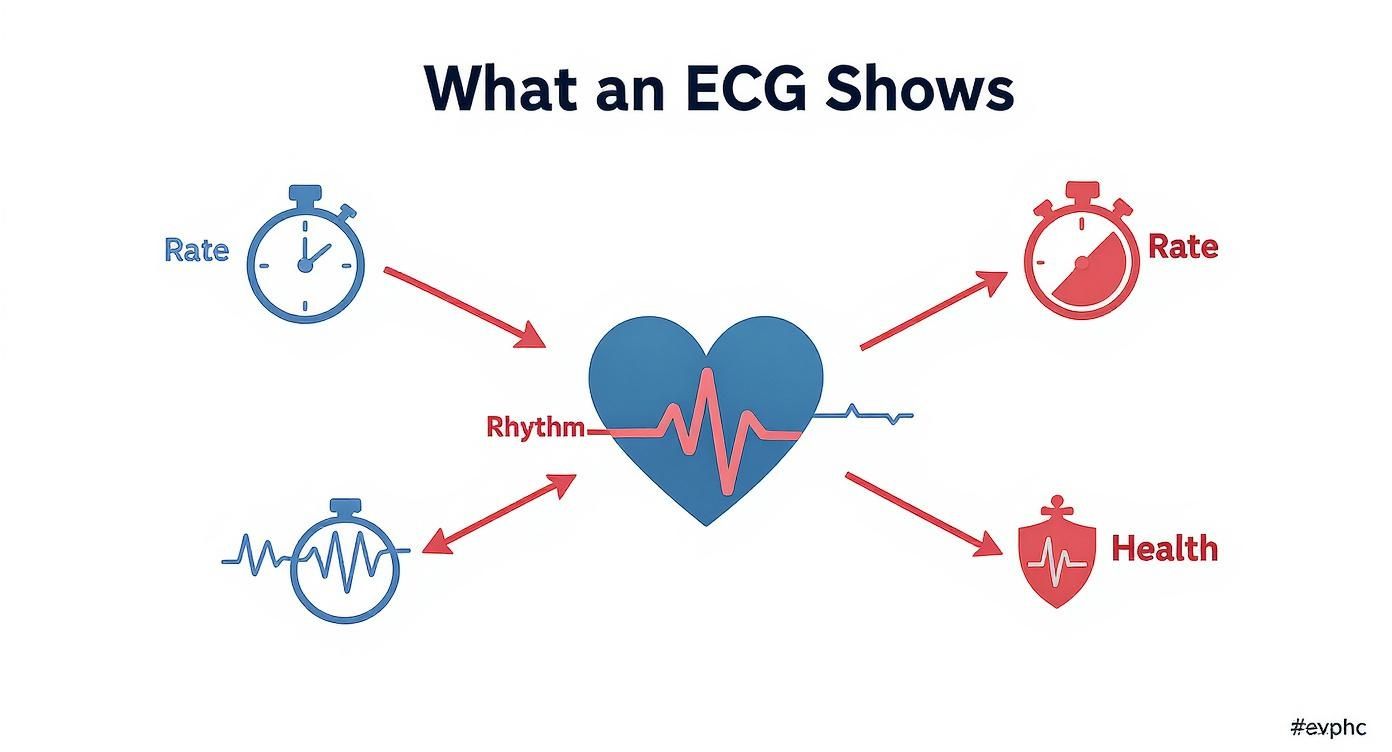
As the diagram suggests, a doctor's analysis goes far beyond just counting beats per minute. It’s a deep dive into the shape and timing of the waveform to get a clear picture of your heart's function.
Interpreting the Rhythm and Timing
It's not just about the individual waves; the gaps and timing between them are just as crucial. For example, the distance from the beginning of the P wave to the start of the QRS complex is called the PR interval. If this interval is too long, it can suggest a delay in the electrical signal travelling from the atria down to the ventricles.
Similarly, the section between the end of the QRS complex and the beginning of the T wave is called the ST segment. Doctors pay very close attention to this part. Any unusual changes here can indicate that the heart muscle isn't getting enough oxygen, which is a classic sign of conditions like coronary artery disease.
Health Tip: A steady, consistent rhythm is a fantastic sign of good heart health. You can support this rhythm by managing stress with mindfulness or yoga, aiming for 150 minutes per week of moderate exercise like brisk walking, and keeping stimulants like caffeine and alcohol in check.
By meticulously measuring these waves and intervals, a doctor can determine your heart rate, see if the rhythm is steady or irregular, and spot patterns that point towards underlying issues. For clinicians wanting to explore this topic further, there's an excellent resource available in a basic guide to ACLS ECG interpretation.
What Can an ECG Actually Tell Us About Your Heart?
Think of an ECG as a master detective for your heart. It doesn't just see the heart; it listens to its electrical story, picking up on subtle clues that point towards specific conditions. Once your doctor examines the unique patterns—those waves and intervals we talked about—they can piece together a remarkably clear picture of your cardiovascular health.
This is where the squiggly lines on the paper turn into real, meaningful answers, helping to explain the symptoms you might be feeling. The test is particularly brilliant at flagging problems with your heart's rhythm and structure, or even detecting damage caused by poor blood flow.
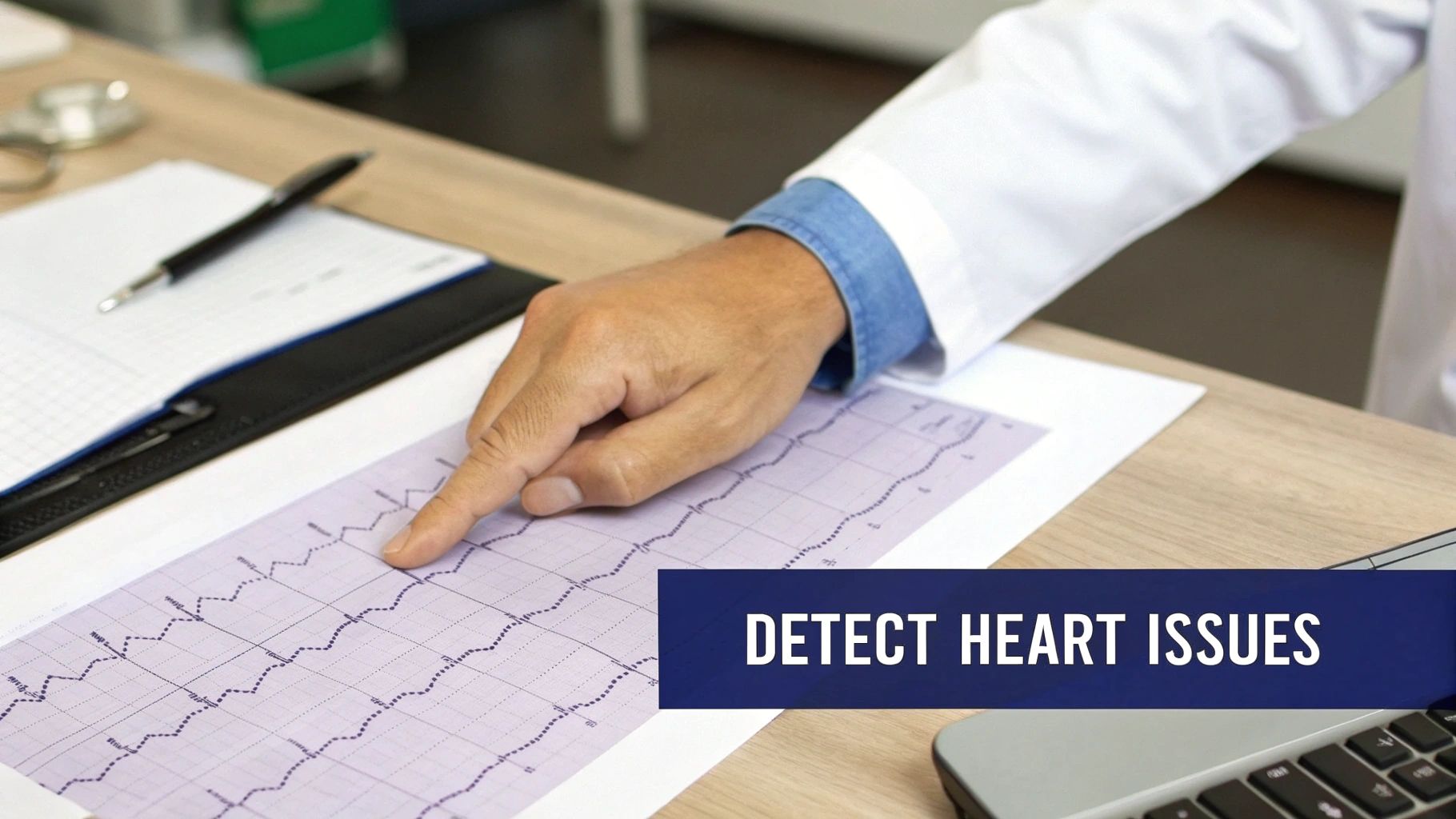
Here are some of the key issues an ECG is designed to uncover.
Problems With Heart Rhythm (Arrhythmias)
One of the most frequent reasons for ordering an ECG is to investigate an arrhythmia, which is simply an irregular heartbeat. Your heart might be beating too fast, too slow, or just erratically.
The ECG tracing can reveal several common rhythm problems:
- Tachycardia: This is when your heart races along, typically over 100 beats per minute while you're at rest. Sometimes, simple lifestyle tweaks like cutting back on caffeine or using stress-reduction techniques can help manage it.
- Bradycardia: The flip side of tachycardia, where your heart beats too slowly—usually under 60 beats per minute. While this can be normal for very fit athletes, for others it can lead to dizziness and fatigue.
- Atrial Fibrillation (AFib): A very common type of irregular heartbeat. In AFib, the heart's upper chambers (the atria) just quiver chaotically instead of beating properly. On an ECG, this shows up as a distinctly irregular rhythm with no clear P waves.
Evidence of a Past or Present Heart Attack
An ECG is absolutely vital when diagnosing a heart attack (also known as a myocardial infarction). It can tell us if a heart attack is happening right now by showing tell-tale changes in the ST segment of the tracing.
It can also find evidence of a previous heart attack, perhaps one you never even knew you had. Damaged heart muscle doesn't conduct electricity the same way healthy tissue does, and this leaves a permanent electrical "scar" visible on the ECG.
Health Tip: A heart-healthy diet is a cornerstone of recovery and prevention. Focus on adding oily fish like salmon, plenty of fruits and vegetables, and whole grains to your meals while cutting down on processed foods and saturated fats.
An Enlarged Heart (Hypertrophy)
If your heart has to pump against high pressure for a long time—often due to chronic high blood pressure—the muscle can thicken and grow larger. This condition is called hypertrophy.
An ECG can suggest hypertrophy by showing QRS complexes that are much larger than normal. This finding acts as an important prompt to get the underlying cause, usually high blood pressure, under control.
What's really interesting is that ECG abnormalities can show up even in people who feel perfectly fine. A major UK study found that around 32% of participants had some form of ECG abnormality. The most common was left ventricular hypertrophy (LVH), which is strongly tied to high blood pressure. These findings, published in the QJM journal, show how an ECG can be a powerful early warning system, spotting risks before symptoms ever appear.
Health Tip: Making a few simple lifestyle changes can make a world of difference. A brisk 30-minute walk five times a week can do wonders for controlling blood pressure. And if you smoke, quitting is one of the best things you can do—it allows your blood vessels to relax, lowering your heart rate and blood pressure almost straight away.
Common ECG Findings and What They May Indicate
To help connect the dots, this table outlines some common findings on an ECG report and what they might mean for your health.
| ECG Finding | Potential Condition | Common Symptoms to Watch For |
|---|---|---|
| ST-segment elevation | Acute myocardial infarction (heart attack) | Chest pain, shortness of breath, pain in arm/jaw |
| Atrial Fibrillation | Irregular, often rapid heart rhythm | Palpitations, dizziness, fatigue, shortness of breath |
| Left Ventricular Hypertrophy (LVH) | Enlarged heart muscle (often due to high blood pressure) | Often no symptoms initially; may cause chest pain or fatigue |
| Heart Block (e.g., AV block) | Disruption of electrical signals in the heart | Dizziness, fainting, extreme fatigue, slow pulse |
| Bradycardia | Abnormally slow heart rate (<60 bpm) | Fatigue, light-headedness, confusion, fainting |
| Tachycardia | Abnormally fast heart rate (>100 bpm) | Racing heart, palpitations, dizziness, chest discomfort |
Remember, an ECG is just one piece of the puzzle. Any unusual findings will always be interpreted by your doctor in the context of your overall health and symptoms.
Understanding the Limits of an ECG Test
An ECG gives us a fantastic amount of information, but it's crucial to understand what it can and can't tell us. The best way to think of it is as a snapshot. It’s a brilliant, detailed picture of your heart's electrical activity, but it only captures the exact moment the test is running.
Getting a normal ECG result is always good news. However, it isn't a crystal ball for your future heart health, nor can it rule out every single potential issue. This is because many heart conditions aren't present 100% of the time.
What an ECG Might Miss
Some heart problems, especially certain types of arrhythmias, come and go. Your heart might slip into an irregular rhythm for a few minutes or hours and then return to normal all on its own. If your ECG happens to be recorded during a period when your heart is behaving, the trace will look perfectly fine, even if you’ve been having symptoms at other times.
This is precisely why an ECG is often the first step in a cardiac investigation, not the final word. When looking at any medical test, it's always useful to have an idea of its diagnostic accuracy metrics like sensitivity and specificity.
To build a more complete picture of what's going on, we might recommend other tests:
- A 24-Hour Holter Monitor: Think of this as a portable ECG that you wear for a full day or longer. It records every single heartbeat, making it great for catching those fleeting irregularities that a standard ECG might miss.
- An Exercise Stress Test: Here, we monitor your ECG while you walk on a treadmill. It helps us see how your heart copes when it's working harder under physical stress.
- An Echocardiogram: This is essentially an ultrasound for your heart. It gives us a moving image, showing the heart's structure, its valves, and how well it's pumping blood. We have a full guide explaining what a heart echo scan involves.
Health Tip: A simple, proactive step you can take is to keep a symptom diary. Note down when you feel palpitations or dizziness, what you were doing at the time, and how long it lasted. This information can be invaluable for your doctor.
Finally, how an ECG is interpreted really matters. A huge UK analysis of over 342,000 patient ECGs showed just how much difference interpretation makes. Simply by applying a specific heart rate correction formula, 21% of readings initially flagged as abnormal were adjusted back to normal. This simple step reduced unnecessary warnings by a massive 57%. It just goes to show how important expert clinical analysis is.
How to Prepare for Your ECG Appointment
Knowing what to expect can make your ECG appointment at The Lagom Clinic a completely stress-free experience. The good news is that there’s very little you need to do to prepare. We've designed the entire process to be quick, comfortable, and completely painless.
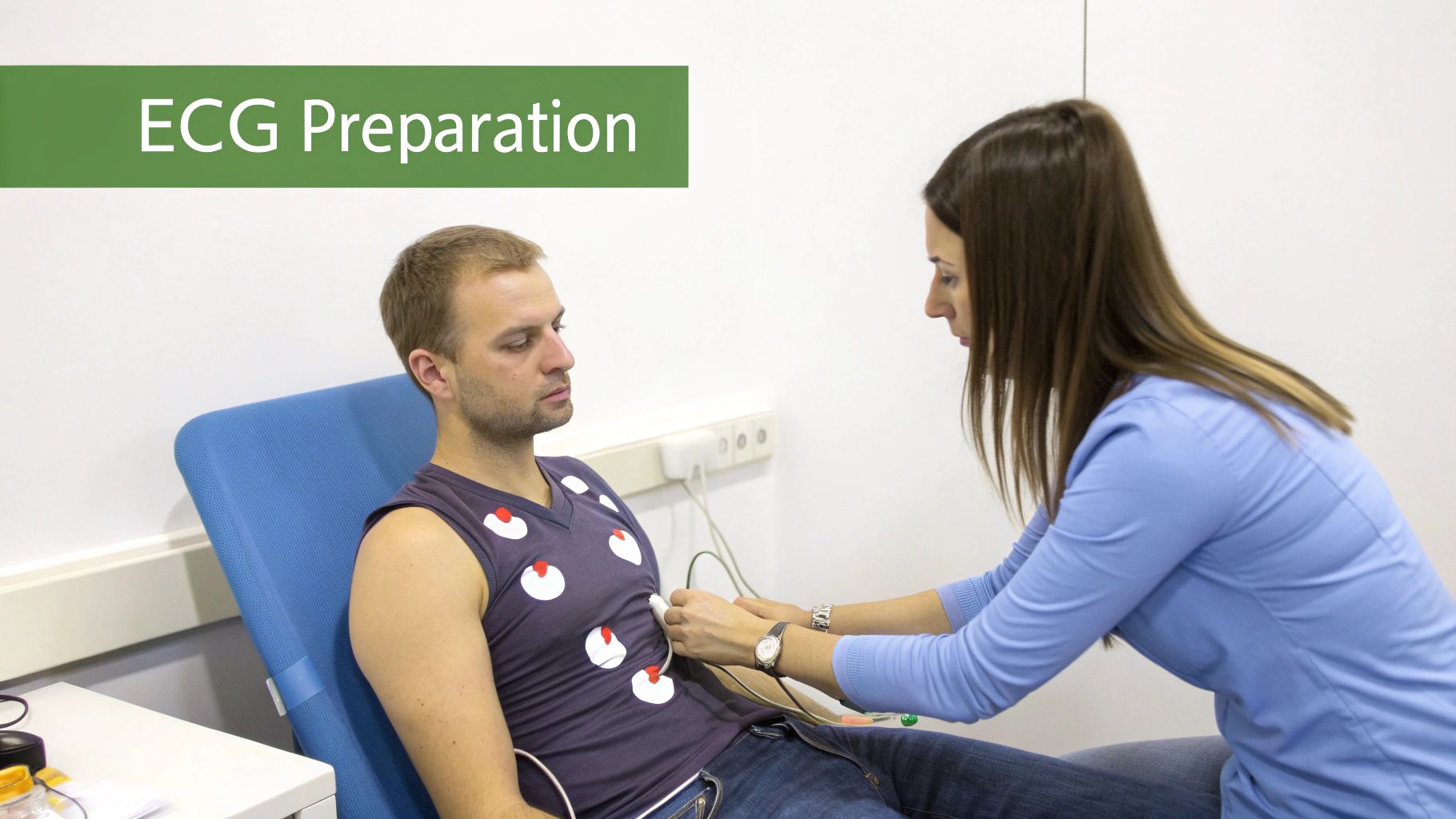
On the day of your test, we just have a couple of simple requests to ensure we get the clearest possible reading from your heart. These small steps help the electrode pads make solid contact with your skin, which is the key to an accurate trace of your heart's true electrical activity.
Simple Steps for a Smooth Test
To help your appointment go as smoothly as possible, please keep these simple guidelines in mind:
- Dress Comfortably: It's best to wear loose-fitting, two-piece clothing. You will be asked to remove clothing from your top half, so a shirt or blouse that’s easy to take off and put back on is ideal.
- Avoid Oily Lotions: On the day of your ECG, please avoid using any creams, oils, or lotions on your chest and limbs. These can create a barrier and make it tricky for the electrode pads to stick securely.
- Relax Beforehand: You don't need to fast or restrict fluids. That said, it’s a good idea to avoid vigorous exercise or drinking very cold water just before your appointment, as these can cause temporary, minor changes to your heart rate.
Health Tip: Think of the ECG as a listening exercise for your heart. The machine is completely safe and only records the natural electrical signals your body produces; it doesn't send any electricity into you.
The test itself is very quick, usually taking less than 10 minutes from start to finish. A technician will place small, sticky sensors on your chest, arms, and legs. You'll then be asked to lie still and breathe normally. It’s a moment to simply relax while the machine does its work, capturing a valuable snapshot of your heart's health.
Your Next Steps for a Healthier Heart
Getting your ECG results isn't the finish line; it's the starting point for taking charge of your heart health. Whether the findings were completely normal or flagged something to watch, this is the perfect moment to think about protecting your heart for the years ahead. Your doctor will walk you through what it all means, but remember, you're the most important person on your own healthcare team.
Making a few positive lifestyle changes is one of the most powerful things you can do. This isn't about a complete overhaul overnight. Small, steady habits are what truly make a difference in the long run.
Embrace a Heart-Friendly Diet
What you put on your plate has a direct line to your heart. A good, balanced diet helps keep your blood pressure in check, lowers cholesterol, and makes it easier to stay at a healthy weight.
Try to bring more of these into your daily routine:
- Fruits and Vegetables: Think of it as eating the rainbow. Different colours mean different vitamins and antioxidants. Berries, leafy greens like spinach, and oranges are fantastic places to start.
- Lean Proteins: Fish (especially oily ones like salmon, which are packed with omega-3s), chicken, beans, and lentils are all excellent sources of fuel without the unhealthy fats.
- Whole Grains: A simple switch from white bread to wholemeal, or from white rice to brown, can make a huge impact. The extra fibre is brilliant for your heart.
A balanced diet is also key for managing your lipid profile. If you want to dive deeper, you can start by understanding cholesterol levels and their role in your overall risk.
Make Gentle Movement a Habit
Getting active strengthens your heart muscle, just like any other muscle, and gets your blood flowing more efficiently. It’s all about consistency, not about running a marathon tomorrow.
Health Tip: The goal is to hit at least 150 minutes of moderate-intensity exercise each week. That could easily be a brisk 30-minute walk five times a week. Things like cycling, a gentle swim, or even a solid session in the garden all count.
Manage Stress and Prioritise Rest
Long-term stress can put a real strain on your heart, raising your blood pressure and heart rate. It’s absolutely vital to find healthy ways to decompress.
Simple techniques like mindfulness, a few deep breathing exercises during a busy day, or a calming yoga session can work wonders. Just as important is getting 7-8 hours of quality sleep each night. This is when your body, and your heart, gets the chance to properly rest and repair.
Crucial Lifestyle Adjustments
Finally, let's talk about two of the biggest wins for your heart. If you're a smoker, quitting is hands-down the best decision you can make. The benefits start almost immediately, drastically cutting your risk of heart attack and stroke.
Keeping an eye on your alcohol intake is also incredibly important. Sticking within the recommended guidelines helps control your blood pressure and reduces the overall burden on your heart. Taking these steps puts the power back in your hands, helping you build a healthier future, one heartbeat at a time.
Your ECG Questions, Answered
It's completely normal to have questions before any medical test. We get asked a lot about ECGs at the clinic, so let's walk through some of the most common queries to help put your mind at ease.
Is an ECG Painful or Dangerous?
Not at all. An ECG is a completely safe and painless test. It's what we call 'non-invasive', which simply means nothing enters your body. All it does is listen in on your heart's natural electrical signals.
You might feel a slight coolness when the electrode pads are placed on your skin, and removing them can feel a bit like peeling off a plaster. But the test itself is totally pain-free—no electricity is passed into your body.
How Long Will I Have to Wait for Results?
The actual recording is very quick, usually done and dusted in just a few minutes. A trained professional can often glance at the tracing right away to spot any urgent issues.
For a full, detailed analysis, a cardiologist will need to properly review the results. This typically takes anywhere from a few hours to a day or two. We'll always make sure you know exactly when to expect your detailed report and how you'll receive it.
Does a Normal ECG Mean My Heart is Perfectly Healthy?
Think of an ECG as a snapshot, not a crystal ball. It shows us what your heart's electrical system is doing at that very moment, which is incredibly useful. A normal result is certainly good news.
However, it doesn't guarantee you're completely immune from future heart problems or predict a heart attack down the line.
Health Tip: The best strategy for protecting your heart long-term is always a healthy lifestyle. Things like a balanced diet, regular physical activity, and finding good ways to manage stress are your most powerful tools for keeping your heart in good shape.
At The Lagom Clinic, we’re focused on proactive care that supports your health for years to come. If you have any concerns or would like to book a private ECG, you can find out more about our services at https://www.thelagom.co.uk.


 Members Consultation