


Lasting motivation to exercise isn't about brute force or guilt-tripping yourself into workouts you hate. From a medical standpoint, sustainable physical activity is built by connecting movement to something that genuinely matters to your long-term health and wellbeing. Think of it as creating a pull, not a push. This is the foundation that gets you moving long after initial enthusiasm has worn off, turning exercise from a chore into a rewarding and essential part of a healthy lifestyle.
Find Your Personal Reason to Move
It’s one thing to say, "I should exercise," but that vague sense of obligation is often the first thing to disappear when life gets busy. Real, lasting motivation comes from unearthing your personal ‘why’—the powerful, non-negotiable health reason that will anchor you when your energy is low and your calendar is full.
For many people, the reasons for moving are evolving beyond aesthetics. We're looking beyond the mirror and recognising just how profoundly physical activity impacts our mental and emotional state. In fact, improving mental health has become a major clinical driver. The recent PureGym UK fitness report highlighted this perfectly, revealing that 34% of adults now exercise primarily for their mental wellbeing—putting it on par with traditional goals like cardiovascular health.
Connect Movement to Your Core Values
To build this kind of motivation, you must tie exercise to what you truly value for your health. Vague goals like "getting fit" lack the power to drive consistent behaviour. The key is to get specific about what being healthier will actually allow you to do, feel, or experience.
Here are some medically sound lifestyle changes patients can focus on:
- For the parent managing fatigue: Your ‘why’ isn't just about weight; it’s about having the cardiovascular stamina to chase your kids around the park without getting winded, and having the energy to be fully present for them.
- For the professional juggling deadlines: It might be that a morning walk is your non-negotiable prescription for managing cortisol levels, reducing stress, and improving cognitive function for that 9 a.m. meeting.
- For anyone planning for the future: Your motivation could be about building bone density and muscle strength now to prevent osteoporosis and maintain an active, independent life for decades to come.
See the shift? You’re no longer exercising to punish your body. You're moving as a form of preventative healthcare. This positive reframing is an incredibly powerful tool, especially when you understand how to improve mental wellbeing through consistent, positive habits.
"Lasting motivation isn’t about finding the 'perfect' workout. It's about discovering a powerful, personal health reason to move your body, and then honouring that reason with consistency, even on the days you don't feel like it."
A Framework for Self-Reflection
Take a moment for an honest check-in. Grab a pen and paper—the act of writing reinforces the commitment—and reflect on these questions from a health perspective.
- What specific activities in my life would improve if I had more energy and physical strength? (Think hobbies, family time, work performance).
- How does stress manifest physically and mentally in my life, and how could exercise become my primary tool for managing it?
- When I picture my health in five years, what does it look like? What’s one single lifestyle change I can make today to start moving towards that vision?
Your answers are the bedrock of your motivation. They are yours and yours alone—far more potent than any generic fitness goal. This purpose will be your compass, helping exercise feel less like a task and more like an essential act of self-care.
Take an Honest Look at Your Starting Point
Before you begin a new physical activity regimen, it's crucial to have an honest discussion about where you are right now. Building a movement routine that sticks isn’t just about future goals; it's about understanding the genuine barriers that have been stopping you.
This isn’t about self-criticism. Think of it as a practical, judgement-free health audit. It’s about getting past vague feelings like "I'm just too busy" or "I have no motivation" and digging into the specifics. Those feelings are valid, but they aren't actionable. Pinpointing the real reasons is the first step to creating a realistic and safe plan that works for you.
Perhaps your demanding job genuinely leaves you with limited time. Or maybe a previous injury has left you feeling anxious about the idea of exercise. Getting specific is your secret weapon for creating a sustainable lifestyle change.
Identify Your Personal Roadblocks
Grab a pen and paper or a notes app. Take a moment to think about the last time you intended to exercise but didn't. What was the actual reason? Be specific and honest.
Your list might include:
- Time Constraints: "I finish work at 7 p.m., and after preparing dinner, I'm too physically and mentally drained to consider exercise."
- Resource Issues: "Gym memberships are a financial strain, and I don't have any exercise equipment at home."
- Mindset Barriers: "I feel self-conscious and don't know the correct form, so I'm worried about looking foolish or injuring myself."
- Knowledge Gaps: "Honestly, I don't know where to begin. What exercises are safe for my body? What is effective for my health goals?"
Once you see your reasons written down, they often feel less like insurmountable walls and more like a series of solvable problems—a much better starting point for a health plan.
Turning Barriers into Building Blocks
Now we can start dismantling those roadblocks with practical, medically sound advice. The idea is to find a realistic, manageable first step for each challenge, not a perfect solution for everything at once.
Here are some common hurdles and practical lifestyle adjustments to overcome them.
Common Exercise Barriers and Practical Solutions
| Common Barrier | What It Looks Like | A Practical First Step |
|---|---|---|
| Lack of Time | A schedule so packed that finding a spare hour for a workout feels impossible. | Don’t aim for an hour. The NHS recommends breaking up activity. Schedule one 15-minute "movement snack" this week—a brisk walk on your lunch break to aid digestion and boost circulation. |
| Gym Anxiety | Feeling intimidated or judged in a traditional fitness centre. | Start at home with guidance. Find a free beginner's yoga or bodyweight workout on YouTube led by a qualified instructor. This allows you to build confidence and learn proper form in a private space. |
| Low Energy | Experiencing profound fatigue after a long day, making exercise feel impossible. | Try a 10-minute walk as soon as you get home from work. It sounds counterintuitive, but light physical activity can improve blood flow and combat fatigue more effectively than resting. |
| Past Failures | Believing you're "not a fitness person" because you've stopped previous plans. | Redefine success. For the first week, your only goal is to put on your workout clothes twice. This small action helps build the routine without the pressure of performance. |
This honest assessment is the most critical groundwork you can do. By understanding your unique starting point—your current fitness level, your lifestyle, and your mindset—you can build a plan that is not just effective, but one that is designed to integrate safely into your life.
Create a Movement Plan That Fits Your Life
I’ve seen it time and time again in clinical practice: patients dive into a punishing, "all-or-nothing" exercise plan that is unsustainable. This is a classic mistake. Lasting motivation isn’t built on gruelling workouts that leave you exhausted and sore. It’s built on small, consistent wins that integrate so seamlessly into your daily routine they eventually become second nature.
This is about crafting a movement plan that is flexible, enjoyable, and tailored to you. Forget copying an intense gym schedule you saw online. A plan that works has to feel empowering, not intimidating, and that process starts with setting much smarter, health-focused goals.
Set Goals That Actually Work
Vague goals like "get in shape" are motivation killers because they are unmeasurable and lead to frustration. A much better, evidence-based approach is the SMART framework, which provides a clear roadmap for success.
A truly effective goal is:
- Specific: What, exactly, do you want to accomplish? Instead of "get stronger," try "be able to perform five full press-ups with good form."
- Measurable: How will you track progress? "Walk more" is a wish. "Walk for 20 minutes, three times this week" is a target you can achieve and record.
- Achievable: Is this genuinely realistic for your current health status? If you haven't run in years, aiming for a 5k next week is a recipe for injury. Aiming to run for five continuous minutes is a safe and fantastic starting point.
- Relevant: Does this goal support your personal ‘why’? If your primary goal is stress relief, a high-intensity, competitive sport might increase cortisol, not reduce it.
- Time-bound: Set a realistic deadline. "I will be able to hold a one-minute plank by the end of next month."
Hitting these small, achievable goals creates a powerful positive feedback loop. Each small win builds your confidence and momentum, fuelling your motivation to continue.
Use Habit Stacking to Make Movement Automatic
One of the most effective lifestyle modification techniques is to attach a new habit to an existing one. This is called habit stacking. Instead of trying to find new time in your day, you simply link the new behaviour to something you already do on autopilot.
Here are some practical examples:
- "After I finish my lunch, I will immediately go for a 10-minute brisk walk." (Aids digestion and regulates blood sugar).
- "While my morning coffee is brewing, I will do two minutes of gentle stretching in the kitchen." (Improves mobility and reduces stiffness).
- "As soon as I close my laptop for the day, I will change into my workout clothes." (Removes a barrier to starting your evening activity).
This simple process of assessing your current habits, identifying an opportunity, and solving the "when" and "where" is the secret to building a plan that sticks.
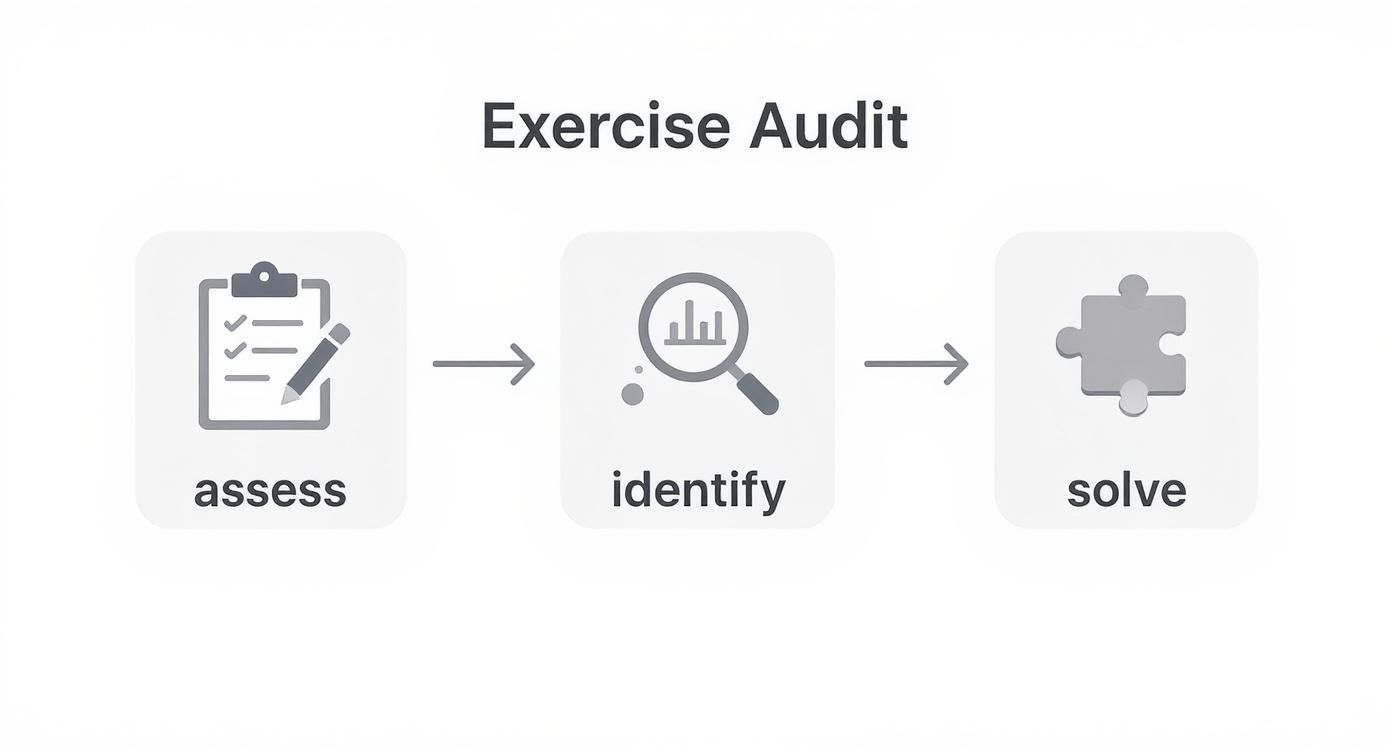
This flowchart shows you exactly how to audit your routine for these windows of opportunity, turning your existing schedule into a launchpad for healthy new habits. The key clinical insight here is that when you're just starting, consistency trumps intensity every single time.
Of course, a critical piece of the puzzle is choosing activities you genuinely enjoy. If you dread your workout, adherence will drop. If you love to dance, put on some music. If nature calms you, prioritise that walk in a local park. To dig deeper, our guide explores the right kind of exercise for wellness and health.
The goal is not to find the most punishing workout; it's to find a form of movement you enjoy enough to do consistently. Enjoyment is the most sustainable motivator of all.
Build Your System for Accountability and Tracking
Motivation can be a fantastic spark, but a reliable system is what fuels long-term adherence. On days when you don't feel like it, a solid structure for accountability and tracking is what ensures you stay on course. It provides an external push when internal drive is low.
Building this framework doesn't need to be complicated. It's about finding what works with your personality and schedule. This could mean partnering with a friend, using technology, or simply changing how you define and measure success. The aim is to make showing up feel almost automatic.
Finding Your Accountability Partner
There is significant evidence showing the power of social support. An accountability partner dramatically boosts your chances of adhering to a fitness plan. It is much harder to skip a planned activity when you know someone is expecting you.
Here are a few ways to build your support network:
- The Classic Workout Buddy: Team up with a friend, family member, or colleague with similar health goals. You could meet for a lunchtime walk, attend a class together, or simply text each other "Done!" after your respective workouts to provide mutual encouragement.
- Digital Communities: If you prefer to exercise alone, online groups can be an incredible source of motivation. Fitness apps, forums, and social media groups offer a space to share progress and receive encouragement from others on a similar journey.
The right partner provides encouragement, not pressure. It should feel like a supportive team effort.
Track What Truly Matters
Observing your own progress is one of the most potent motivators. The key is to track the right health metrics. The number on the scale is just one small, and often misleading, part of the overall health picture.
Instead, shift your focus to metrics that show how your health and fitness are improving:
- Performance Gains: Can you lift a slightly heavier weight with good form? Did you manage to walk up the hill without feeling quite so breathless? Note these functional improvements.
- Energy Levels: Keep it simple. Rate your energy from 1 to 10 each day in a journal or a notes app. You will likely see a steady upward trend as your fitness improves.
- Sleep Quality: Many wearables can track this, but you don't need them. Simply jot down how rested you feel upon waking. Improved sleep is one of the first and most significant benefits of regular exercise.
- Mood and Stress: How do you feel? Physical activity is a proven mood-booster. Noticing that you feel less stressed or more positive after exercise reinforces the habit like nothing else.
Seeing these tangible improvements creates a powerful feedback loop. You feel better, you see the proof in your notes, and that strengthens your resolve to keep going.
Focusing on these non-scale victories makes the process far more rewarding and sustainable. For more in-depth advice on making consistency second nature, this guide on how to effectively stick to a routine is a great place to start.
Navigating Setbacks and Plateaus
Let's discuss the inevitable: hitting a wall. Every long-term health journey has its rough patches. Life intervenes, you get sick, or your motivation wanes. This is a normal part of the process.
The real goal isn't to build a perfect, unbroken streak of workouts. The goal is to cultivate the resilience to get back on track after a setback, without letting a small stumble derail your progress completely.
This is not a failure. How you handle these moments is what shapes your long-term success. The trick is to have a sensible plan for when things don't go as expected.
How to Get Back on Track After a Break
So, you’ve missed a week. Maybe two. The worst thing you can do is try to jump back in at the same intensity. That all-or-nothing mindset is a common cause of burnout or, even worse, injury.
Instead, be smart and safe about your return. Your first priority is simply to restart, but at a reduced intensity.
Were you running for 30 minutes? Aim for 15. Lifting a certain weight? Reduce it by 20-30% for your first session back. The psychological boost you get from simply completing a workout is infinitely more valuable than its intensity. Everyone's consistency wavers; for practical advice, you can discover effective strategies for getting back on track and restart with renewed confidence.
Your only goal after a break is to show up. Ease back in gently to rebuild momentum and remind yourself that one off-week doesn't erase all your previous progress.
When to Seek Professional Guidance
Sometimes, a good plan and your own willpower aren't enough. Knowing when to consult a professional is a sign of wisdom, not weakness. It can be the key to overcoming a hurdle safely and effectively.
Here are a few scenarios where seeking professional health advice is a smart move:
- You're in Pain: If you feel any sharp, persistent, or recurring pain during or after exercise, stop immediately. Pushing through pain can lead to serious injury. A consultation with your GP or a physiotherapist is crucial to diagnose the issue and create a safe recovery plan.
- You’ve Hit a Plateau: You've been consistent for months, but you're no longer seeing progress. A certified personal trainer or a health coach can provide a fresh perspective on your routine and introduce new techniques to help you break through the stalemate safely.
- You're Managing a Health Condition: If you are living with a condition like diabetes, heart disease, or severe arthritis, professional guidance is essential. A clinical expert, like the team at The Lagom Clinic, can offer a musculoskeletal check or a lifestyle medicine consultation to ensure your fitness plan is supporting, not harming, your overall health.
Seeking expert help removes the guesswork. It provides a clear, medically sound path forward, equipping you to make physical activity a safe and sustainable part of your life for good.
Your Questions, Answered
Let's address some of the most common questions and barriers that arise when trying to build a consistent exercise routine. These are frequent patient concerns, and the answers are based on sound health principles.
How Long Does It Really Take to Form an Exercise Habit?
Forget the "21 days" myth. This was a misinterpretation of anecdotal observations, not a scientific rule for habit formation.
The scientific reality is that it varies significantly between individuals. Research published in the European Journal of Social Psychology shows it can take anywhere from 18 to 254 days for a new behaviour like exercise to become automatic. The average is around 66 days.
The key takeaway is to focus on consistency, not a deadline. The goal is to make the process so simple and rewarding that it requires minimal thought. Whether that takes two months or eight, the method is the same: make it simple, make it consistent.
What’s the Best Exercise When You Have Zero Motivation?
The best exercise is the one you will actually do. There is no single "best" workout, especially when motivation is low. The most effective choice is an activity you enjoy, or at the very least, do not dread.
Consider starting with something genuinely manageable:
- A simple walk: It’s free, low-impact, and can be done almost anywhere. It has proven benefits for both physical and mental health.
- Living room dancing: Put on your favourite music and move for 10 minutes. This raises the heart rate and releases endorphins.
- Gardening: A fantastic form of functional, moderate-intensity movement that doesn't feel like a formal workout.
Your initial goal is not a punishing gym session. It is simply to move your body in a way that feels good. This helps build a positive association with exercise, making it easier to be consistent.
I’m Just Too Tired to Exercise After Work. What Can I Do?
This is perhaps the most common barrier patients report. The solution often feels counterintuitive: a small amount of gentle movement can provide a significant energy boost. Post-work fatigue is a powerful force, and the hardest part is taking the first step.
Health Tip: Commit to a 10-minute walk the moment you get home. Don't sit down first. Don't check emails. Just put on your shoes and go outside. For many, this small action is enough to break the inertia and improve energy levels.
If chronic fatigue is a persistent issue, it may be a sign to look deeper. Are you getting enough quality sleep? Is your nutrition adequate? Persistent, unexplained fatigue warrants a discussion with your GP to rule out underlying medical conditions.
When you feel exhausted, modify the goal. Don't aim for a 45-minute workout. Aim for five minutes of gentle stretching. Often, that’s all it takes to get the ball rolling and lift your energy.
How Can I Stay Motivated When I’m Not Seeing Results?
This is where many people abandon their efforts. It is crucial to redefine what you consider a "result." If you're only looking for changes on the scale or in the mirror, you're focusing on lagging indicators that take time.
Instead, track your non-scale victories. These are the powerful, immediate health benefits of moving your body, and they appear far sooner than aesthetic changes.
Keep a simple health journal and log things like:
- Sleeping more deeply through the night.
- Having more energy to get through the afternoon.
- Feeling less breathless walking up stairs.
- Noticing a tangible improvement in your mood and focus.
These are real, measurable signs that your health is improving. Focusing on these powerful benefits provides the steady motivation needed to continue long enough for all the other results to follow.
At The Lagom Clinic, we know that building sustainable health habits is a deeply personal journey. If you're struggling with motivation, dealing with pain, or just don't know where to begin, our team is here to help. We offer expert lifestyle consultations and musculoskeletal checks to create a safe, effective plan that truly works for you. Discover our private GP services in Bristol.


 Members Consultation