


A knee injury can feel like a major setback, disrupting everything from daily walks to your favourite sports. However, a structured recovery plan centred on targeted exercises is the most effective way to not only heal but also build a more resilient joint for the future. This guide offers scientifically-backed advice on seven crucial knee injury exercises. We'll detail not just how to perform each movement, but why it works, who it's for, and how to safely progress.
This proactive approach is fundamental to a complete and lasting recovery. The movements detailed here are designed to restore range of motion, build strength in supporting muscles like the glutes and quadriceps, and improve overall joint stability without causing further strain. For a deeper dive into methods proven to deliver results in recovery, explore these evidence-based physical therapy techniques.
At The Lagom Clinic in Bristol, we champion this type of proactive care, empowering our patients with the knowledge and lifestyle strategies needed for a full return to activity. This isn't just about getting back on your feet; it's about building a stronger, more stable foundation to prevent future issues and enhance your long-term physical wellbeing.
1. Straight Leg Raises
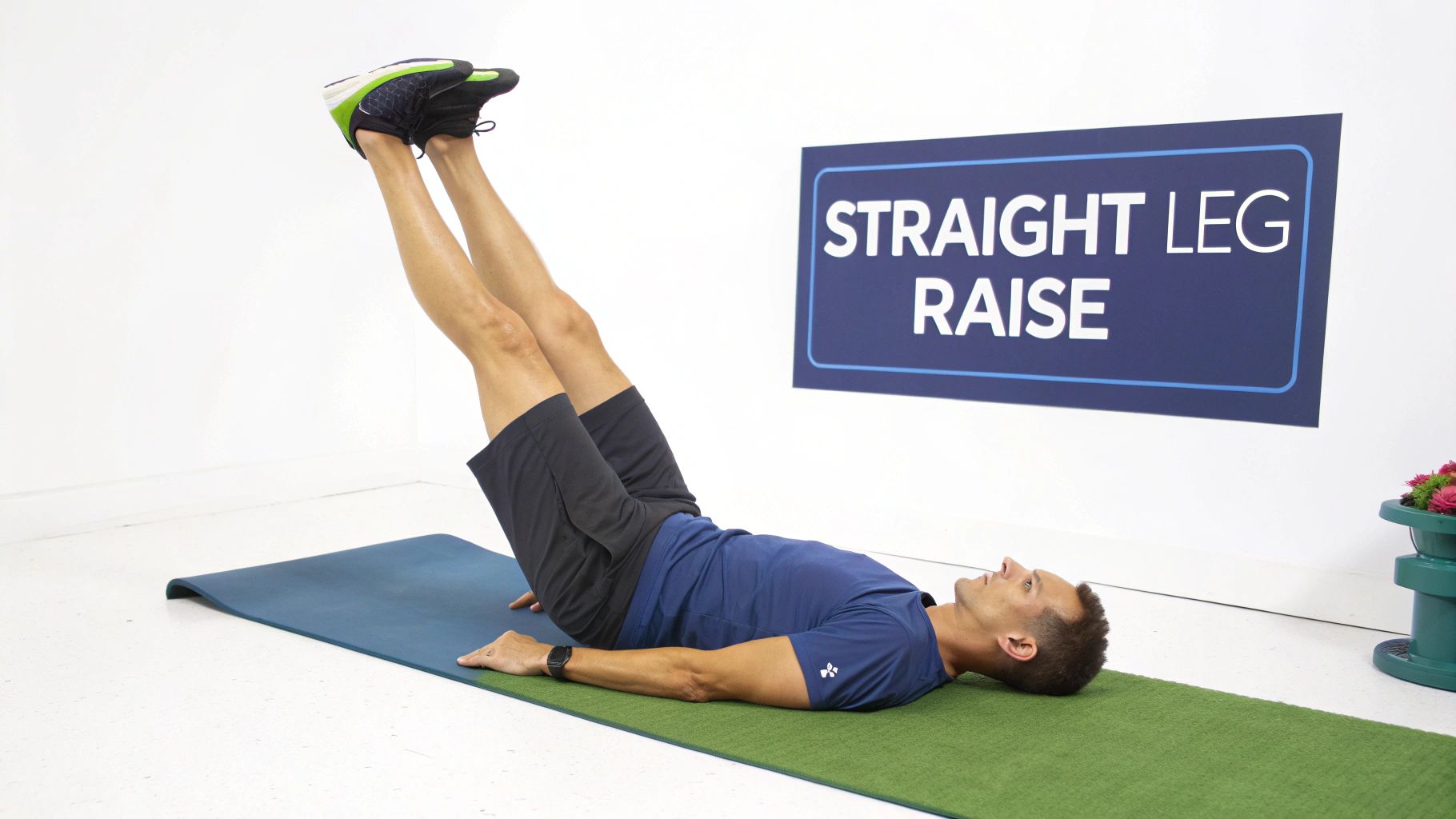
Straight Leg Raises (SLRs) are a cornerstone of rehabilitation for knee injuries. This foundational exercise isolates and strengthens the quadriceps, the large muscles at the front of your thigh, without putting direct weight or stress through the delicate knee joint. This makes it one of the safest and most effective initial knee injury exercises for rebuilding strength after surgery or during a flare-up of pain.
The primary purpose of an SLR is to activate the quadriceps isometrically, meaning the muscle contracts without changing length, which is crucial for maintaining muscle tone when bending the knee is painful or restricted. This targeted activation helps prevent muscle atrophy (wasting) and provides essential support to the knee structure, a principle widely adopted in post-surgical protocols at leading institutions like the Mayo Clinic and endorsed by the American Physical Therapy Association.
How to Perform a Straight Leg Raise
Correct form is paramount to ensure you are targeting the right muscles and protecting your lower back.
- Starting Position: Lie flat on your back on a firm surface, such as an exercise mat. Bend the knee of your uninjured leg, placing your foot flat on the floor for stability. The leg you intend to exercise should be straight out in front of you.
- Engagement: Tense the quadriceps muscle of your straight leg. Think about pushing the back of your knee down into the floor. This initial contraction is the most important part of the exercise.
- The Lift: Keeping your leg completely straight and your quad tensed, slowly lift your heel about 6-12 inches (15-30 cm) off the floor. The goal is to lift it to the height of your other bent knee.
- Hold and Lower: Hold the leg at the peak position for 3-5 seconds. Slowly and with control, lower your leg back to the starting position.
Actionable Health Tips
To maximise the benefits and avoid common mistakes, focus on these key details:
- Pacing is Key: Perform each repetition with a slow, controlled tempo. A good guide is 2-3 seconds to lift, hold for 3-5 seconds, and 2-3 seconds to lower. Avoid using momentum.
- Initial Volume: Begin with 3 sets of 10-15 repetitions per leg. Listen to your body and do not push through sharp pain. A mild muscle ache is normal, but sharp joint pain is a signal to stop.
- Protect Your Back: If you feel any strain in your lower back, it means your core may not be engaged or you are lifting the leg too high. Reduce the height of the lift and focus on bracing your abdominal muscles.
- Progressive Overload: Once you can comfortably complete your sets, consider adding light ankle weights, starting with 0.5-1 kg (1-2 pounds), to increase the challenge.
2. Wall Sits
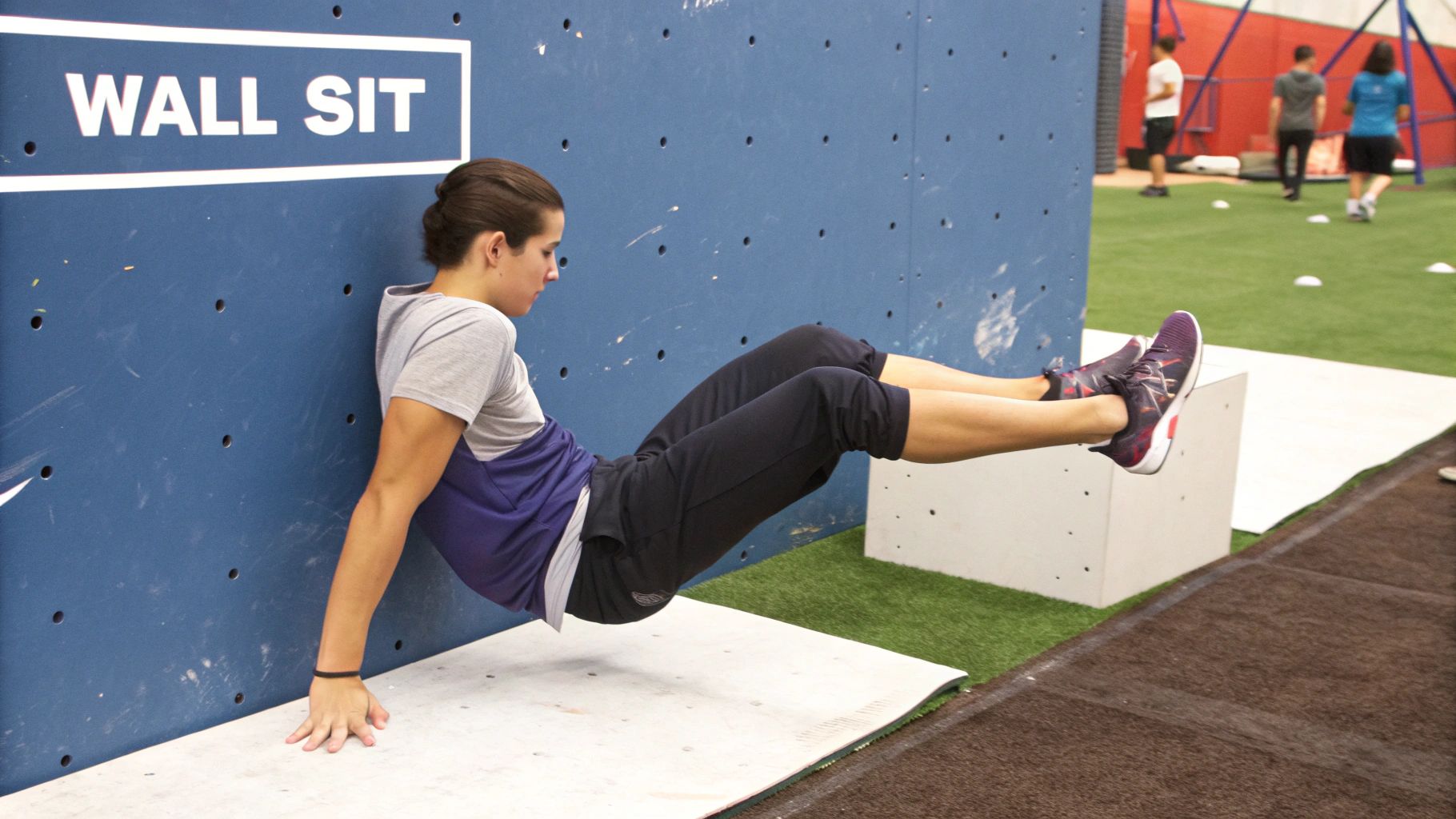
Wall Sits are an excellent isometric exercise for strengthening the muscles that support the knee, primarily the quadriceps and glutes. This static hold builds muscular endurance and stability without requiring any joint movement, making it an ideal choice among knee injury exercises, especially when dynamic movements like squats are painful. By holding a seated position against a wall, you engage key leg muscles for an extended period, which helps improve knee tracking and overall joint support.
The primary benefit of the Wall Sit is its ability to build significant strength with minimal stress on the knee cartilage. This makes it a staple in rehabilitation and prevention programmes, from those used in alpine ski training to conditioning protocols for elite athletes in the NBA and military fitness routines. The controlled, static nature of the exercise allows for safe muscle activation, helping to restore function and confidence after an injury.
How to Perform a Wall Sit
Proper form is crucial to maximise muscle engagement and protect your joints.
- Starting Position: Stand with your back flat against a smooth wall, with your feet about shoulder-width apart and roughly two feet away from the wall.
- Engagement: Engage your core muscles by drawing your belly button towards your spine. This will help maintain a flat back throughout the exercise.
- The Descent: Slowly slide your back down the wall until your thighs are parallel to the floor, as if you are sitting in an invisible chair. Ensure your knees are directly above your ankles, forming a 90-degree angle.
- Hold and Ascend: Hold this position for the desired duration, focusing on steady breathing. To finish, gently push through your heels to slide back up the wall to the starting position.
Actionable Health Tips
To get the most out of this exercise and perform it safely, pay attention to these details:
- Mind Your Depth: Only go as deep as you can without pain. A 90-degree angle at the knee is the goal, but starting with a higher, less acute angle (e.g., 45 degrees) is perfectly acceptable and safer in early recovery.
- Initial Volume: Begin by holding the position for 20-30 seconds. Aim to complete 3 sets, resting for 30-60 seconds between each hold. Quality is more important than duration.
- Keep Everything Aligned: Ensure your back remains flat against the wall and your feet are pointing straight ahead. Do not let your knees cave inwards; keep them aligned with your hips and feet.
- Progressive Overload: As you get stronger, gradually increase the hold time. Work your way up to holding the position for 60-90 seconds per set. You can also add a challenge by holding a weight or placing a resistance band around your thighs.
3. Clamshells
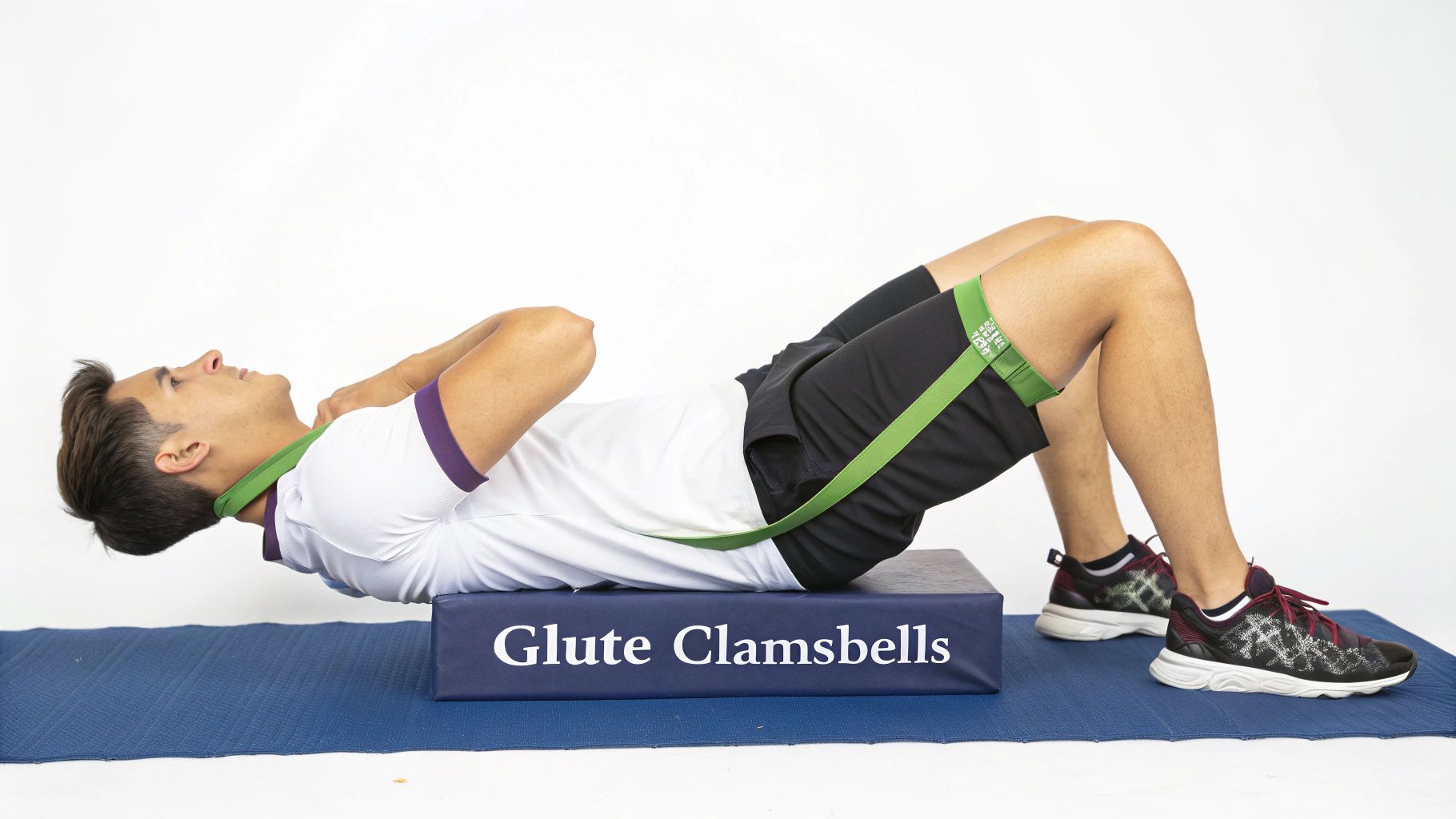
Clamshells are a critical hip-strengthening exercise that plays an indirect yet powerful role in knee health. This exercise targets the gluteus medius and external hip rotators, muscles essential for pelvic stability and controlling the alignment of the femur (thigh bone). Strengthening these muscles helps prevent knee valgus, a common issue where the knee collapses inward during movements like squatting or landing, which is a significant risk factor for conditions like runner's knee and ACL injuries.
The primary purpose of the clamshell is to improve neuromuscular control and strength in the hip abductors. This provides better dynamic stability to the entire lower limb, ensuring the knee tracks correctly over the foot. This principle is a cornerstone of modern physiotherapy and is integral to injury prevention protocols like the Prevent Injury and Enhance Performance (PEP) Program and the FIFA 11+ warm-up, which are designed to reduce lower-body injuries in athletes. As such, clamshells are some of the most frequently prescribed knee injury exercises for both rehabilitation and pre-emptive strengthening.
How to Perform a Clamshell
Proper technique is essential to isolate the glute muscles and avoid compensating with other parts of the body, such as the lower back.
- Starting Position: Lie on your side with your hips and knees bent at approximately a 45-degree angle, stacking your legs one on top of the other. Your heels should be in line with your spine. You can rest your head on your lower arm for support.
- Engagement: Brace your core muscles to stabilise your spine and pelvis. This prevents your body from rocking backward during the movement.
- The Lift: Keeping your feet touching, slowly raise your top knee towards the ceiling as high as you can without letting your hips roll back. The movement should be a pure rotation at the hip joint.
- Hold and Lower: Hold the top position for 2-3 seconds, feeling the contraction in your outer hip and glute. Slowly and with control, lower your knee back to the starting position.
Actionable Health Tips
To ensure you're getting the most out of this exercise, focus on these details:
- Mind-Muscle Connection: Concentrate on squeezing the glute muscle of the working leg. If you feel it more in your lower back, reduce the range of motion and focus on keeping your pelvis still.
- Initial Volume: Aim for 2-3 sets of 15-20 repetitions on each side. Quality of movement is far more important than the number of reps. A sign of fatigue is when you start to lose form.
- Control is Everything: Avoid using momentum. The movement should be deliberate and controlled in both the lifting and lowering phases to properly engage the target muscles.
- Progressive Overload: Once you can easily complete your sets with perfect form, add a resistance band around your thighs (just above the knees) to increase the challenge and further stimulate muscle growth.
4. Glute Bridges
The Glute Bridge is a fundamental exercise for rehabilitating knee injuries by strengthening the entire posterior chain, which includes your glutes and hamstrings. Weak gluteal muscles often lead to poor movement patterns where the quadriceps and knee joint take on excessive strain. By activating and building strength in your hips and the back of your legs, this exercise helps to stabilise the pelvis and improve lower body mechanics, making it one of the most effective knee injury exercises for addressing the root cause of many knee problems.
The primary purpose of a Glute Bridge is to teach proper hip extension, which is crucial for reducing stress on the anterior knee. This movement pattern is a core component of Shirley Sahrmann's influential movement system approach and is widely used in elite athlete return-to-sport protocols. Strengthening the gluteus maximus provides powerful support for the knee, offloading the joint during daily activities like walking, climbing stairs, and standing up from a chair.
How to Perform a Glute Bridge
Executing this exercise with proper form ensures that the glutes are the prime movers, not the lower back or hamstrings.
- Starting Position: Lie on your back on an exercise mat with your knees bent and feet flat on the floor, about hip-width apart. Your heels should be a comfortable distance from your buttocks. Place your arms by your sides with your palms facing down.
- Engagement: Before lifting, gently brace your core muscles. Squeeze your gluteal muscles to initiate the movement.
- The Lift: Press through your heels to lift your hips off the floor until your body forms a straight line from your shoulders to your knees. Avoid arching your lower back; the power should come from your hips.
- Hold and Lower: Hold the top position for 2-3 seconds, focusing on a strong glute contraction. Slowly and with control, lower your hips back to the starting position.
Actionable Health Tips
To get the most out of every repetition and progress safely, keep these details in mind:
- Mind-Muscle Connection: Actively think about squeezing your glutes at the peak of the movement. This focus is more important than how high you lift your hips.
- Initial Volume: Begin with 2 sets of 15-20 repetitions. Ensure the movement is pain-free before increasing the volume or difficulty.
- Knee Alignment: Keep your knees parallel throughout the exercise. Do not let them fall inwards or outwards, as this can place unwanted stress on the knee joint. This reinforces good movement patterns.
- Progressive Overload: Once you can perform the basic bridge with ease, challenge yourself by progressing to single-leg variations or by placing a resistance band around your thighs to activate your hip abductors.
5. Step-Ups
Step-Ups are a highly functional strengthening exercise that directly translates to everyday activities like climbing stairs, getting out of a chair, or stepping over an obstacle. By building single-leg (unilateral) strength, this exercise addresses muscle imbalances between legs and enhances neuromuscular control, which is vital for stabilising the knee joint during movement. This makes it an indispensable component of many knee injury exercises and rehabilitation programmes.
The primary goal of the Step-Up is to strengthen the quadriceps, hamstrings, and gluteal muscles, which all work together to support and protect the knee. As noted in numerous physical therapy protocols and by functional training pioneers like Vern Gambetta, this exercise improves proprioception (your sense of body position) and balance. It is frequently used in ACL return-to-sport testing and elderly fall prevention programmes because it safely mimics the demands placed on the knee in dynamic, real-world situations.
How to Perform a Step-Up
Proper technique is essential to maximise the benefits for your knee while minimising any risk of strain. The focus should always be on smooth, deliberate movement.
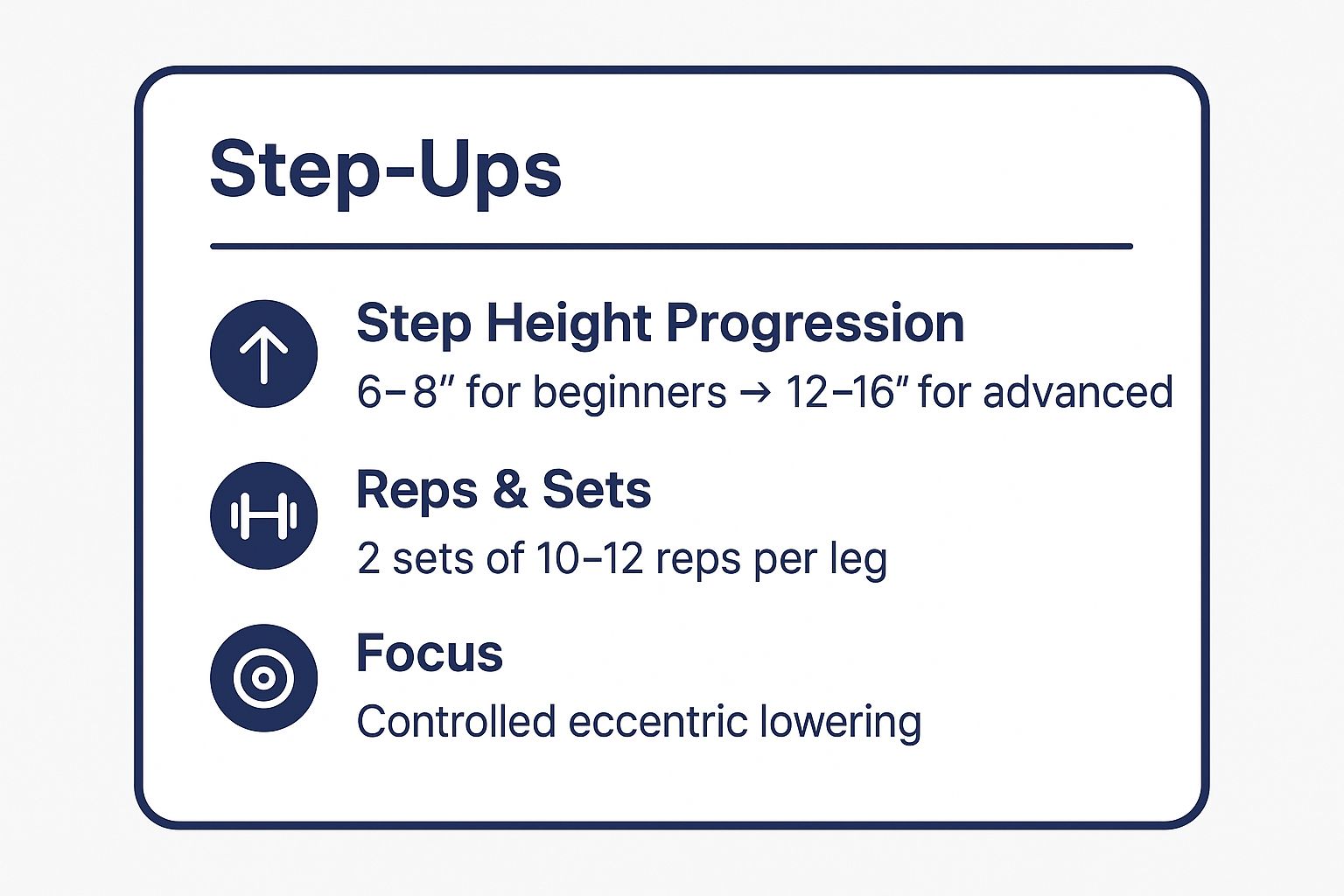
- Starting Position: Stand facing a sturdy, non-slip box, bench, or stair. Your feet should be hip-width apart. The height of the step should be low initially, around 6-8 inches (15-20 cm).
- Engagement: Place your entire right foot firmly onto the centre of the step. Shift your weight onto this foot, engaging your glute and quad muscles.
- The Lift: Drive through your right heel to lift your body straight up until your right leg is straight. Your left foot should come off the floor and can either tap the step or hover beside it for balance.
- Hold and Lower: Pause for a moment at the top. The most critical phase is the lowering: slowly and with control, bend your right knee to lower your left foot back to the floor.
Actionable Health Tips
To ensure you are performing the Step-Up effectively and safely, keep these details in mind:
- Pacing is Key: Focus on the lowering (eccentric) phase. Aim for a 1-second count on the way up and a slow, 3-4 second count on the way down. This eccentric control is crucial for building tendon and muscle resilience.
- Initial Volume: Start with 2 sets of 10-12 repetitions per leg. Ensure you complete all reps on one side before switching to the other.
- Avoid Pushing Off: The work should come entirely from the leg on the step. Do not push off with the foot on the floor; it should only lift off as a result of the working leg doing its job.
- Progressive Overload: As the exercise becomes easier, you can increase the step height or hold light dumbbells to add resistance. Always prioritise perfect form over added weight or height.
6. Terminal Knee Extensions (TKEs)
Terminal Knee Extensions (TKEs) are a critical exercise in knee rehabilitation, specifically designed to strengthen the quadriceps as they perform their most vital function: fully straightening the knee. This movement targets the vastus medialis oblique (VMO), the teardrop-shaped muscle on the inside of the thigh, which is essential for patellar (kneecap) stability and achieving the final degrees of extension. Many knee injury exercises focus on general strength, but TKEs are unique in their ability to restore this end-range control, which is often lost after injury or surgery and is fundamental for a normal walking gait.
The primary purpose of a TKE is to actively engage and strengthen the muscles responsible for locking out the knee. This is a crucial component of rehabilitation protocols, from post-surgical ACL recovery plans popularised by experts like Dr. Kevin Wilk to programmes used in professional sports medicine. By isolating the final 20-30 degrees of extension against resistance, TKEs help re-educate the VMO, improve joint stability, and restore full, functional knee motion.
How to Perform a Terminal Knee Extension
Proper form is crucial to isolate the VMO and avoid compensation from other muscle groups.
- Starting Position: Secure a resistance band to a stable anchor point (like a door handle or sturdy furniture leg) at roughly knee height. Loop the other end of the band around the back of the knee of your injured leg. Step back until you feel a gentle pull, with a slight bend in that knee.
- Engagement: Stand with your feet hip-width apart. You can hold onto a chair or wall for balance if needed. Engage your core and quadriceps muscles on the affected leg.
- The Extension: Keeping your heel on the floor, slowly straighten your leg against the band's resistance. Focus intently on squeezing your quad to pull your kneecap up and "lock" the knee straight.
- Hold and Return: Hold this fully straightened position for 2-3 seconds, feeling a strong contraction in the VMO. Slowly and with control, allow the band to pull your knee back to the slightly bent starting position.
Actionable Health Tips
To ensure you get the most out of this targeted exercise, concentrate on these details:
- Focus on the Squeeze: The goal is the quality of the contraction at the end of the movement, not the amount of resistance. Prioritise a powerful quad squeeze when your leg is straight.
- Initial Volume: Start with 2-3 sets of 15-20 repetitions. The higher repetition count helps build muscular endurance and re-establish neuromuscular control.
- Controlled Movement: Avoid snapping your knee back into extension. The entire movement should be deliberate and controlled, both when straightening and when returning to the start.
- Progressive Overload: As the exercise becomes easier, you can increase the challenge by using a stronger resistance band or by stepping further away from the anchor point.
7. Heel Slides
Heel Slides are a gentle yet fundamental exercise focused on restoring and maintaining the knee's range of motion, specifically its ability to bend (flexion). This controlled movement is often one of the first knee injury exercises prescribed after surgery, such as a total knee replacement, or in the initial phases of managing an acute injury. Its primary value lies in its ability to improve joint mobility and prevent stiffness without placing significant load on the recovering tissues.
The main purpose of a Heel Slide is to gently guide the knee joint through a controlled arc of motion, helping to break down scar tissue, reduce swelling, and re-establish neuromuscular pathways. By actively or passively encouraging the knee to bend, it addresses one of the most common functional limitations following an injury: loss of flexion. This principle is a cornerstone of post-operative protocols in orthopaedic surgery and is universally recommended by physical therapists to ensure a successful return to daily activities like walking and climbing stairs.
How to Perform a Heel Slide
Correct technique is vital for safely improving your range of motion and avoiding compensatory movements.
- Starting Position: Lie on your back on a firm surface, like an exercise mat or bed. Keep both legs extended straight in front of you.
- The Slide: Slowly slide the heel of your injured leg towards your buttocks, allowing your knee to bend as much as is comfortable. Focus on keeping your heel in contact with the surface throughout the movement.
- The Hold: Hold the bent position for 3-5 seconds at the point of a gentle stretch. You should not feel sharp pain.
- Return and Repeat: Slowly slide your heel back to the starting position until your leg is fully straight.
Actionable Health Tips
To get the most from this exercise and progress safely, keep these details in mind:
- Reduce Friction: If your heel sticks to the surface, place a plastic bag or a small towel under it to allow for a smoother, more controlled slide.
- Initial Volume: Aim for 3 sets of 10-15 repetitions. This exercise can often be performed several times throughout the day to prevent stiffness from setting in.
- Assist if Needed: In the very early stages, you may need help. Loop a towel or strap around your foot and gently pull to assist the knee into a deeper bend (passive range of motion).
- Track Your Progress: A simple way to measure improvement is to note how close your heel gets to your buttocks each session. Small, consistent gains are the goal. If swelling increases after a session, applying ice for 15 minutes can be beneficial.
7-Key Knee Exercise Comparison
| Exercise | Implementation Complexity | Resource Requirements | Expected Outcomes | Ideal Use Cases | Key Advantages |
|---|---|---|---|---|---|
| Straight Leg Raises | Low – simple movement | None or optional ankle weights | Quadriceps strength without knee stress | Early-stage rehab, knee pain management | Safe for acute injuries, easy at-home use |
| Wall Sits | Moderate – isometric hold | None | Leg strength, endurance, knee stability | Strength/endurance training, rehab | Builds endurance, improves knee tracking |
| Clamshells | Low – side-lying hip rotation | Optional resistance bands | Hip external rotator strength, knee alignment | Knee pain prevention, hip weakness | Addresses root cause of knee dysfunction |
| Glute Bridges | Low to moderate – hip extension | None or optional bands | Posterior chain strength, hip mobility | Hip weakness, posterior chain rehab | Activates glutes, safe, improves function |
| Step-Ups | Moderate – functional movement | Step/platform | Unilateral leg strength, balance | Functional training, sport rehab | Highly functional, improves balance |
| Terminal Knee Extensions (TKEs) | Moderate – resistance band setup | Resistance band | VMO strength, full knee extension | Post-surgical rehab, extension deficits | Targets critical extension phase |
| Heel Slides | Low – gentle range-of-motion | None | Maintains knee flexion range | Early rehab, post-surgery mobility | Safe for early stages, prevents stiffness |
Beyond the Exercises: Integrating Recovery into Your Lifestyle
Navigating the path back from a knee injury requires more than just completing a set number of repetitions. The exercises detailed in this guide form the bedrock of your physical recovery. They are designed to systematically rebuild strength, stability, and control around the knee joint, creating a resilient support system that protects it from future harm. Mastering the correct form for each movement is your primary goal, as this ensures you are activating the right muscles and not inadvertently causing further strain.
However, true, lasting recovery transcends the gym mat. Think of your rehabilitation as a complete system. While these knee injury exercises are the engine, their effectiveness is magnified by the lifestyle choices you make every day. Lasting knee health is built on a holistic foundation that supports your body's natural healing processes.
Adopting a Pro-Recovery Lifestyle
To truly optimise your recovery and safeguard your joints for the future, consider integrating these supportive habits into your daily routine:
- Prioritise an Anti-Inflammatory Diet: What you eat directly impacts inflammation levels. Focus on incorporating foods rich in omega-3 fatty acids, such as salmon and walnuts, and antioxidants found in berries, spinach, and other colourful vegetables. These nutrients help to naturally manage inflammation and provide the building blocks for tissue repair.
- Embrace Restorative Sleep: Healing doesn't just happen when you're awake. During deep sleep, your body releases growth hormone, which is critical for repairing damaged muscle fibres and soft tissues. Aim for 7-9 hours of quality, uninterrupted sleep per night to give your knee the best possible chance to recover.
- Manage Stress Effectively: Chronic stress can heighten your body’s sensitivity to pain and increase systemic inflammation, hindering recovery. Integrating practices like mindfulness, deep breathing exercises, or even gentle yoga can help regulate your stress response and create a more favourable internal environment for healing.
- Maintain a Healthy Weight: Excess body weight significantly increases the load on your knee joints—every extra pound adds about four pounds of pressure on the knees when walking. Achieving and maintaining a healthy weight through a balanced diet and regular low-impact exercise is one of the most effective lifestyle changes for long-term knee health.
Smart Activity and Listening to Your Body
Returning to your favourite activities is the ultimate goal, but it must be done intelligently. Cross-training with low-impact activities like swimming or cycling is an excellent way to maintain cardiovascular fitness without placing excessive stress on the recovering joint. As you gradually reintroduce more demanding activities, it is crucial to listen to your body’s signals. A dull ache during exercise is different from a sharp, stabbing pain. Never push through the latter.
For those looking for additional support during activities that might stress the knees, such as hiking or long walks, a common question arises: Do walking sticks help with knee pain? Using supportive aids can be a valuable strategy to offload the joint, allowing you to stay active with greater confidence during your rehabilitation.
Ultimately, your journey back to full strength is a partnership between dedicated effort and intelligent self-care. By combining the targeted knee injury exercises in this guide with a supportive lifestyle, you are not just healing an injury; you are building a stronger, more resilient foundation for a lifetime of pain-free movement.
Ready to create a personalised recovery plan that addresses your specific injury and lifestyle? At The Lagom Clinic, our experts in musculoskeletal and lifestyle medicine can provide a comprehensive assessment and a bespoke strategy to guide you back to optimal health. Book your consultation today and take the definitive next step in your recovery journey.

 Members Consultation