


Effective patellar tendonitis treatment isn't about one magic bullet. It’s a combination of reducing the strain on the tendon, strengthening the surrounding muscles, and managing pain. For most people, a sensible mix of strategic rest, targeted exercises, and positive lifestyle changes is the key to letting that overstressed tendon heal and rebuild its strength.
Understanding What Is Happening Inside Your Knee
That nagging ache just below your kneecap, especially after a run or a game of five-a-side, is your body sending you a pretty clear signal. This is often the classic sign of patellar tendonitis, a condition better known as "jumper's knee". It's rarely a big, sudden injury; instead, it's the result of repetitive strain that has slowly pushed your patellar tendon past its breaking point.
Think of your patellar tendon as a strong, vital rope connecting your kneecap (patella) to your shinbone. Its job is to handle massive forces every time you jump, sprint, or cut from side to side. When you consistently ask it to do too much, too fast, tiny micro-tears start to form within the fibres of that rope. Without enough time to repair themselves, these small injuries add up, eventually leading to the pain and weakness you're feeling.
Common Triggers for Tendon Overload
The most frequent culprit is simple overuse, particularly from sports involving explosive leg movements. But it's not always just about doing too much. Several other lifestyle factors can conspire to overload the tendon:
- Sudden Spikes in Training: Ramping up the intensity, frequency, or duration of your workouts without giving your body a chance to adapt.
- Muscle Imbalances: If your quadriceps are too tight or your glutes are too weak, your movement patterns can get thrown off, forcing the patellar tendon to pick up the slack.
- Poor Biomechanics: Incorrect form during squats, lunges, or landing from a jump can place a huge amount of direct, unnecessary stress on the tendon.
- Unsupportive Footwear: Worn-out trainers that have lost their cushioning can't absorb shock properly, sending more force straight up your legs and into your knees.
This infographic breaks down how these different risk factors can stack up, leading to tendon overload and that familiar knee pain.
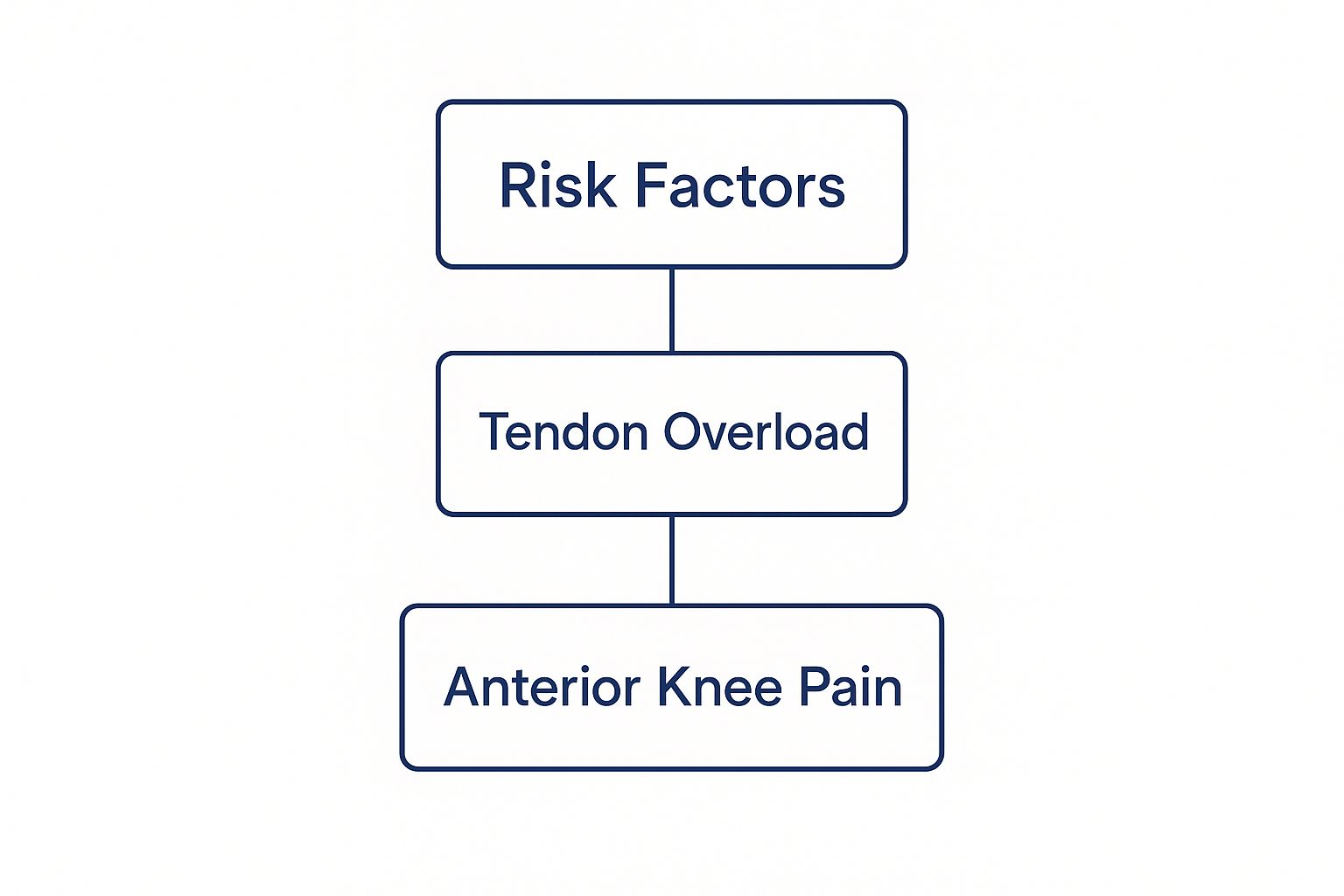
As you can see, the final outcome of anterior knee pain stems directly from overloading the tendon, which itself is often caused by a combination of these underlying issues.
The Stages of Patellar Tendonitis
To treat jumper's knee effectively, you first need to understand its progression. In the United Kingdom, it’s a very common overuse injury, especially among active people. While it affects less than 1% of the general UK population, its prevalence can shoot up to between 14-20% among athletes in sports like volleyball and football. You can read more about the prevalence of patellar tendonitis in UK athletes.
The condition typically moves through distinct stages, which are defined by when you feel the pain. Knowing which stage you're in is crucial for figuring out the right recovery plan.
The table below can help you pinpoint the severity of your condition based on your symptoms.
Understanding the Stages of Patellar Tendonitis
| Stage | When You Feel Pain |
|---|---|
| 1 | Only after intense activity. It doesn't affect your performance. |
| 2 | During and after activity, but you can still perform reasonably well. |
| 3 | Constant pain during and after activity, which hurts your performance. |
| 4 | A complete tear of the tendon, which requires surgical repair. |
Once you’ve identified your stage, you can start building a smart, effective plan to get back on your feet.
Your Immediate Action Plan for Pain Relief
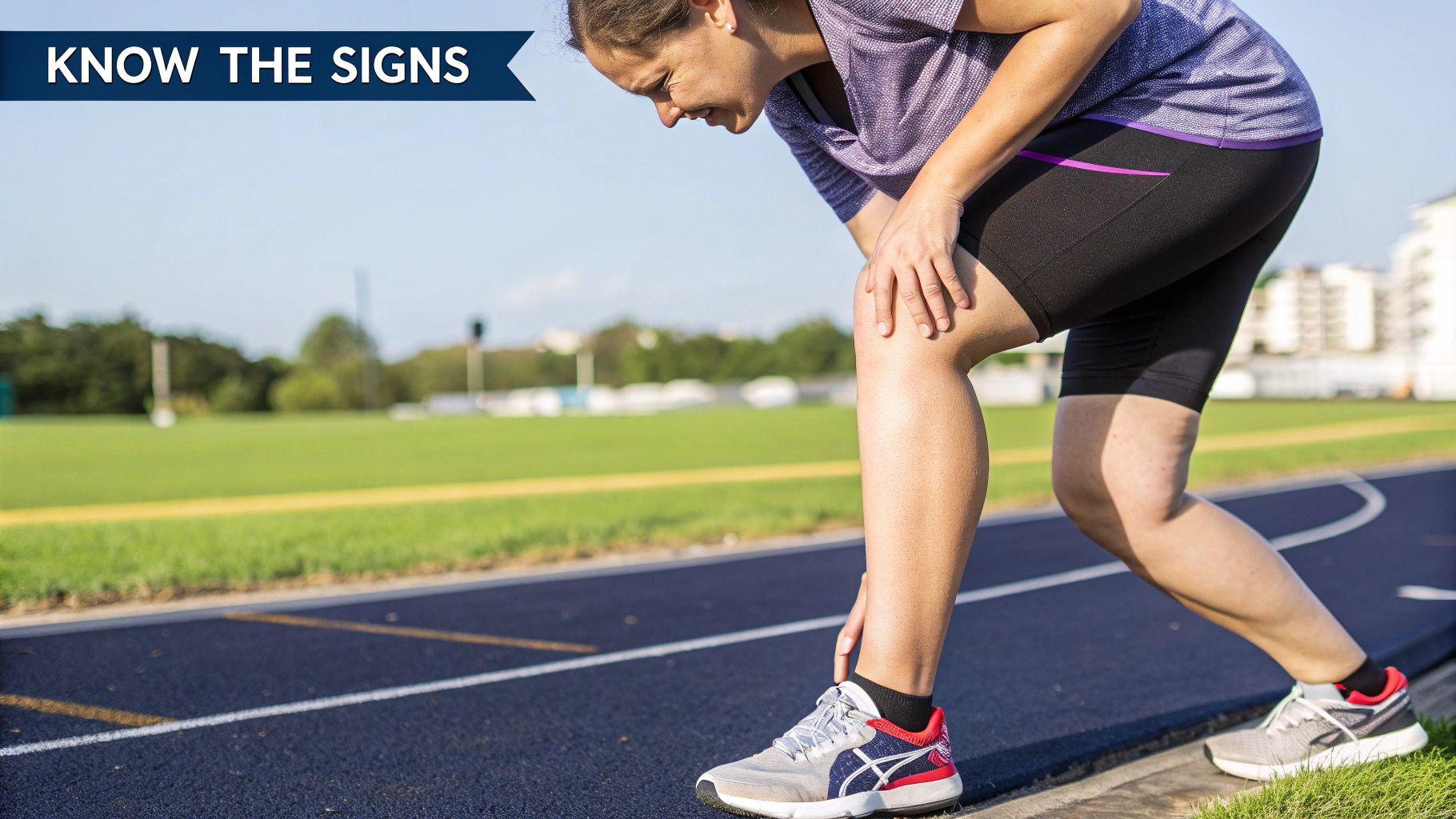
When that sharp pain below your kneecap flares up, your initial response should be to reduce aggravating activities. However, complete rest is often not the best long-term strategy. The goal is what healthcare professionals call relative rest.
This isn't about becoming a couch potato; it's about making smart choices. You should dial back the activities that are clearly aggravating the tendon without letting everything seize up. The idea is to calm the irritated tendon while keeping the surrounding muscles from weakening, which is exactly what happens with total inactivity. This approach creates the ideal environment for healing to begin.
Applying The P.R.I.C.E Protocol Correctly
For the immediate, acute phase of pain and swelling, the well-established P.R.I.C.E. protocol is your go-to first aid. For it to be effective, you must apply it correctly.
- Protection: Shield the knee from further strain. A practical tip is to use a patellar tendon strap when you need to be on your feet, as it helps redirect forces away from the sore spot.
- Rest: This is the "relative rest" we just discussed. Your health advice is to avoid jumping, running, or any high-impact movements that cause sharp pain in the tendon.
- Ice: Apply a cold pack, wrapped in a thin towel, for 15-20 minutes at a time, every few hours. This is an excellent tip for numbing pain and can help manage initial inflammation. Medically, it's crucial not to apply ice directly to the skin to prevent ice burns.
- Compression: A simple compression bandage or sleeve can be very beneficial. It helps limit swelling and provides the joint with a sense of support.
- Elevation: Whenever you're sitting or lying down, prop your leg up on pillows so your knee is above the level of your heart. This uses gravity to help drain excess fluid and reduce swelling.
Remember, the P.R.I.C.E. method is a first-aid strategy designed to control symptoms. It's the first step, not the whole solution. True recovery will require addressing the underlying causes of the tendon strain.
Smart Lifestyle Adjustments You Can Make Today
Beyond initial first aid, simple tweaks to your daily routine can make a huge difference in taking the load off your patellar tendon. These lifestyle changes are medically sound and highly recommended.
First, evaluate your exercise habits. If you're a runner, it's a wise lifestyle change to temporarily swap the pavement for the pool. Low-impact alternatives like swimming or cycling allow you to maintain cardiovascular fitness without the jarring impact on your knees.
Also, consider your work setup if you have a desk job. Ensure your chair is at the right height—your feet should be flat on the floor with your knees bent at a comfortable 90-degree angle. Prolonged sitting can keep the tendon under constant low-level tension. A helpful tip is to set a reminder to get up, walk around, and stretch every hour. These small changes reduce daily micro-stress and give your tendon a real chance to heal.
Rebuilding Your Tendon with Key Exercises
Once the initial, sharp pain has settled down, the real work of rehabilitation begins. This phase moves from managing symptoms to actively rebuilding the patellar tendon. Think of it less like resting and more like a carefully planned construction project for your knee—you're laying down new, stronger materials to build a more resilient structure.
The scientifically-backed principle here is progressive loading. This term describes the gradual and methodical increase in demands placed on your tendon. This controlled stress is the exact signal your body needs to start laying down new, healthy collagen fibres, which is how you heal micro-tears and genuinely strengthen the tendon from the inside out.
The Power of Eccentric Training
One of the most evidence-based methods for tendon healing is eccentric training. The concept is brilliantly simple: it focuses on the part of an exercise where the muscle is lengthening while under tension.
For your knee, this is the slow, controlled downward motion of an exercise like a squat. This specific movement puts a unique, therapeutic type of load on the patellar tendon, which has been shown in clinical studies to be incredibly effective for promoting healing and pain relief.
A classic and highly effective eccentric exercise for this condition is the decline squat.
- Get Set Up: Stand on a small slanted board or a plank with your heels elevated. This angle naturally shifts your weight forward, putting more focus directly on the patellar tendon.
- Lower Slowly: Using only your affected leg, lower yourself down into a squat. The key is to be slow and controlled—aim for a three-second count on the way down. This is the eccentric phase where the therapeutic benefit occurs.
- Use Support to Rise: At the bottom of the squat, use your uninjured leg to push yourself back to the starting position. This avoids stressing the injured tendon on the way up (the concentric, or shortening, phase).
- Repeat: A medically sound starting point is 3 sets of 15 repetitions, twice a day.
The goal here is control, not speed. The therapeutic magic happens in that slow, deliberate downward movement, which stimulates the tendon to rebuild and get stronger.
Heavy Slow Resistance Training
Another powerful, scientifically-validated tool is Heavy Slow Resistance (HSR) training. This involves using heavier weights but moving through the exercises at a very deliberate, slow pace. For anyone serious about rebuilding their patellar tendon for the long haul, implementing effective strength training regimens is a crucial part of a complete recovery plan.
Unlike eccentric-only exercises, HSR works both the lowering (eccentric) and lifting (concentric) phases of a movement. A health tip is to perform exercises like the leg press or hack squats with a 3-second lifting phase and a 3-second lowering phase. The weight should be challenging enough that you can only manage about 6-8 repetitions with perfect form. This approach not only stimulates tendon repair but also builds significant strength in the supporting quadriceps and glutes.
Don't Forget to Stretch the Supporting Muscles
Your patellar tendon does not work in isolation. It’s part of an interconnected kinetic chain, and tightness in the surrounding muscles can create extra strain on your knee. That's why a consistent stretching routine is an essential lifestyle habit for your recovery.
Your health plan should include stretches for these three key areas:
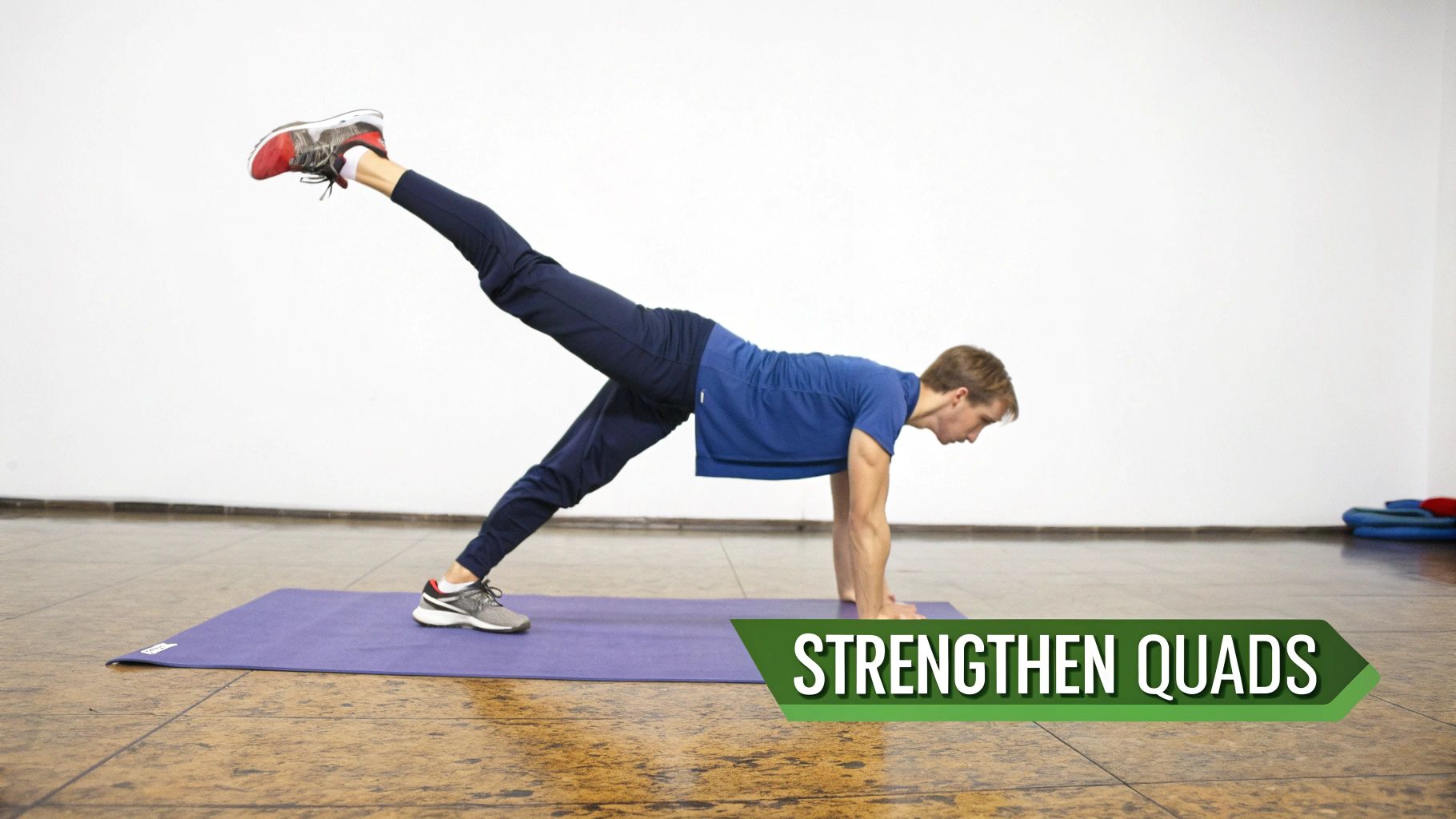
- Quadriceps: Tight quads pull directly on your kneecap and, by extension, your patellar tendon. A simple standing quad stretch—holding your ankle and pulling your heel toward your glute—held for 30 seconds is essential.
- Hamstrings: When your hamstrings are tight, they can alter your posture and movement patterns, which indirectly puts more stress on the front of your knee. A gentle seated hamstring stretch is highly beneficial.
- Calves: Your calf muscles are connected down to your foot. If they’re tight, it can change your foot mechanics, sending shockwaves up the leg to your knee. A classic runner’s stretch against a wall is perfect for this.
Weaving these exercises and stretches into your daily routine is the most reliable path not just to recovery, but to building a stronger, more bulletproof knee for the future.
When to Consider Advanced Medical Treatments
If you've been diligently following your rehabilitation programme for months but the stubborn pain persists, it can be frustrating. When physiotherapy and lifestyle changes aren't sufficient, it may be time to consult with your doctor about more advanced medical treatments.
These interventions are not first-line treatments but are valuable options for persistent cases. They are designed to give your tendon a direct stimulus, encouraging repair, reducing pain, and tackling the degenerative changes that have occurred over time.
Non-Invasive and Injection Therapies
Before considering surgery, there are less invasive, scientifically-supported procedures that can make a real difference. Two of the most common options for patellar tendonitis are Extracorporeal Shockwave Therapy (ESWT) and Platelet-Rich Plasma (PRP) injections.
-
Extracorporeal Shockwave Therapy (ESWT): This is a non-invasive treatment that uses high-energy acoustic waves aimed at the sore tendon. These shockwaves create a controlled micro-trauma, which stimulates the body's natural healing processes by increasing blood flow and cell activity in the area.
-
Platelet-Rich Plasma (PRP) Injections: PRP therapy utilizes your body's own healing components. A small sample of your blood is spun in a centrifuge to concentrate the platelets. This platelet-rich solution, which is full of growth factors, is then injected directly into the tendon to accelerate tissue regeneration.
For those dealing with long-term discomfort, exploring complementary approaches like acupuncture for chronic pain can also be a helpful part of your overall management plan.
It’s important to remember these advanced options are designed to restart a stalled healing process. They work best when combined with your ongoing physiotherapy exercises, not as a replacement for them.
When Surgery Becomes an Option
Surgery is the absolute last resort for patellar tendonitis. It is reserved for severe, chronic cases where all other evidence-based treatments have failed to provide relief. The surgical goal is usually to remove the damaged, degenerative portion of the tendon, which can stimulate a fresh healing response.
This path is typically only considered after at least six months of consistent, high-quality conservative care has proven unsuccessful. NHS data shows that patellar tendinopathy is a significant burden on musculoskeletal services. For the small percentage of cases requiring surgery, the average cost can be around £3,000, covering imaging, the procedure itself, and crucial post-operative rehabilitation.
The decision to pursue any of these advanced treatments requires a thorough discussion with your doctor or a specialist. Together, you can weigh the potential benefits against the risks and determine the best course of action for your specific situation.
Building a Lifestyle to Prevent Future Knee Pain
Getting over patellar tendonitis isn't just about the exercises you do right now. True, lasting recovery means adopting a lifestyle that protects your knees from future problems. This involves weaving preventative habits into your daily routine—changing how you prepare for activity, how you train, and even how you recover.
These lifestyle adjustments are your long-term insurance policy against recurring knee pain. By focusing on smart preparation, intelligent training, and supportive nutrition, you can build a more resilient body that is far less likely to suffer from the overuse that caused the issue in the first place.
The Non-Negotiable Warm-Up and Cool-Down
Skipping a warm-up is like trying to stretch a cold rubber band—it’s stiff, unresponsive, and more likely to tear. A proper warm-up is medically essential. It increases blood flow to your tendons and muscles, improving their elasticity and preparing them for the demands of your workout.
A great health tip is to dedicate five to ten minutes to a warm-up before any intense activity.
- Light Cardio: Start with gentle jogging, cycling, or jumping jacks to raise your body temperature.
- Dynamic Stretches: Move through exercises like leg swings, walking lunges, and bodyweight squats. This actively prepares your joints and muscles for the specific movements they are about to perform.
The cool-down is equally important. After a workout, your muscles are warm and pliable, making it the perfect time for static stretching. Holding stretches for your quads, hamstrings, and calves for 30 seconds each helps to improve flexibility and initiate the recovery process, preventing the tightness that can lead to tendon strain.
Smart Choices for Training and Nutrition
How you train and what you eat play a massive role in the health of your tendons. Making small, consistent lifestyle changes in these areas can deliver huge preventative benefits and form the cornerstone of your plan to keep patellar tendonitis away for good.
First, you must manage your training load intelligently. A crucial health tip is to avoid sudden, massive jumps in exercise intensity or duration. Instead, follow the 10% rule: do not increase your weekly training volume, distance, or intensity by more than 10%. This gradual progression gives your tendons the time they need to adapt and strengthen, preventing overload.
Your diet provides the raw materials your body uses for tissue repair. Since tendons are made mostly of collagen, their health is directly tied to what you eat. A key lifestyle tip is to give your body the right building blocks to prevent future injuries.
Finally, don’t overlook these lifestyle factors that support tendon resilience:
- Footwear: Ensure your shoes provide proper cushioning and support for your chosen activity. A good tip is to replace them before they are completely worn out, as good shock absorption is key.
- Hydration: Water is vital for keeping your tendons elastic and healthy. Dehydration can make them stiffer and more prone to injury, so make a conscious effort to stay hydrated throughout the day.
- Nutrition: A medically sound diet for tendon health includes plenty of vitamin C, zinc, and protein. These nutrients are essential for collagen synthesis and tissue repair. Focus on eating citrus fruits, lean meats, and nuts.
Common Questions on Patellar Tendonitis Recovery
As you start to navigate your recovery from patellar tendonitis, it's completely normal for questions to pop up. Understanding the road ahead can make a huge difference, not just for your physical progress but for your confidence, too.
Let's tackle some of the most frequent queries from patients. These insights will help you set realistic expectations, make smarter lifestyle choices about your activity levels, and know exactly when it’s time to seek expert medical advice.
How Long Does Patellar Tendonitis Take to Heal?
This is the big question, and the honest medical answer is: it varies significantly between individuals. Patience is essential. If you've caught a mild case early and are managing it with appropriate lifestyle changes, you might feel a noticeable improvement within a few weeks. However, this is usually just the initial, acute pain settling down.
For a more persistent injury, a full recovery often takes between three to six months of consistent, dedicated rehabilitation. This means adhering strictly to your strengthening exercises and making the necessary adjustments to your training. In chronic cases where the tendon shows degenerative changes, it can take up to a year to become fully pain-free and resilient. The single most important factor for success is consistency with your physiotherapy programme.
Is It Okay to Exercise with Jumper's Knee?
Yes, but with a critical caveat: it must be the right kind of exercise. Old advice often recommended complete rest, but modern sports medicine has evolved. The current, evidence-based approach is about modifying your activity, not stopping it altogether. The key health tip is to avoid any movements that bring on sharp pain while continuing with exercises you can do comfortably. This strategy is known as load management.
A valuable tool for this is the 'pain monitoring model'. A good rule of thumb is this: if your pain stays below a 3 out of 10 during an activity and returns to its usual baseline level within 24 hours, you’re likely in a safe and productive zone for healing.
Low-impact lifestyle activities like swimming or cycling are fantastic for maintaining fitness without overloading the tendon. The goal is to keep the tendon and its supporting muscles active without triggering a painful flare-up.
Do Knee Straps or Braces Actually Work?
They can be a genuinely helpful tool, especially for providing temporary pain relief while you're active. A patellar tendon strap works by applying gentle pressure across the tendon, which can alter how forces are distributed through it. For many people, this simple change can reduce discomfort enough to make their rehab exercises more manageable.
However, a crucial piece of health advice is to view these devices as a supportive aid, not a cure. A strap doesn’t fix the underlying problem, which is almost always weakness or overload. The real, lasting solution comes from the consistent strengthening and mobility work that addresses the root cause. Think of the strap as a tool that helps you do that essential work more comfortably.
When Should I See a Doctor or Physiotherapist?
You should always seek professional medical advice if your pain is severe, you are struggling to bear weight on your leg, or you have seen no improvement after a couple of weeks of sensible self-care. A physiotherapist is an expert in diagnosing and treating this condition and can rule out other knee problems.
Most importantly, they will create a personalised, evidence-based exercise plan tailored specifically to your needs and goals. This professional guidance is crucial for ensuring your recovery is safe, effective, and follows the most reliable path back to full function.
At The Lagom Clinic, we specialise in providing personalised musculoskeletal medicine and sports performance advice to help you recover from injuries like patellar tendonitis and prevent them from returning. Our patient-focused approach ensures you get the time and expert guidance needed for a full recovery. Book a consultation at The Lagom Clinic today to start your journey back to optimal health.

 Members Consultation