


When a knee ligament tears, the signs are often dramatic and unmistakable. The most common things people report are a sudden 'pop' sound or sensation at the moment of injury, followed by immediate, sharp pain. You’ll also likely see rapid swelling around the joint and get a distinct feeling that your knee is unstable or could "give way." These are all red-flag symptoms that point towards a significant ligament injury.
Decoding the First Signs of a Knee Ligament Injury
In the confusing and painful moments right after a knee injury, the first question on your mind is often, "Have I torn a ligament?" Learning to recognise the classic tell-tale signs is the first step toward figuring out what to do next.
The Tell-Tale ‘Pop’ and Immediate Pain
Many people describe hearing or feeling an audible 'pop' at the exact time of the incident. This isn’t a subtle click; it’s a distinct sound often caused by the ligament itself snapping under intense force. This is almost always accompanied by a sudden wave of pain, making it nearly impossible to continue whatever you were doing. Health Tip: If you experience this, stop all activity immediately. Attempting to "walk it off" can cause further damage.
Swelling and Instability
Another key indicator is how quickly the swelling appears. We aren't talking about minor puffiness that develops overnight. A significant ligament tear, particularly an ACL tear, often causes bleeding inside the knee joint (haemarthrosis), leading to major swelling within just a couple of hours.
But perhaps the most unnerving symptom is the feeling of instability. Your knee might feel wobbly, untrustworthy, or as if it’s about to buckle, especially when you try to change direction or put weight on it. This sensation is a direct consequence of a crucial stabilising ligament failing to do its job. Health Tip: Do not attempt to bear full weight on a knee that feels unstable. Use crutches if available and seek a professional medical opinion.
Symptom Comparison for Major Knee Ligament Tears
To help you get a clearer picture, it’s useful to see how the symptoms can differ depending on which of the four main ligaments is injured. This table breaks down the hallmark signs for each.
| Ligament | Common Cause of Injury | Key Symptoms | Typical Location of Pain |
|---|---|---|---|
| ACL | Sudden stop, pivot, or awkward landing | Loud 'pop', rapid swelling, instability | Deep within the knee |
| MCL | Direct blow to the outside of the knee | Swelling, pain, and tenderness | Inner side of the knee |
| PCL | Direct blow to the front of the shin | Mild swelling, posterior knee pain | Back of the knee |
| LCL | Direct blow to the inside of the knee | Swelling and pain | Outer side of the knee |
While this table offers a good starting point, remember that injuries can be complex and sometimes involve more than one ligament. A proper diagnosis from a healthcare professional is always the next step.
Understanding Your Knee's Support System
Before we can really get into the specific symptoms of a torn ligament, it’s helpful to have a picture of what’s going on inside your knee. Think of it as a complex and powerful hinge, one that needs to be incredibly stable. What keeps this hinge secure are four main ligaments – essentially strong, fibrous ropes that hold everything together.
Each of these ligaments has a very specific role. When you know what each one does, it becomes much clearer why an injury to it causes such distinct problems. They work in pairs, controlling the knee’s movement and, crucially, stopping it from bending or twisting in ways it was never meant to.
The Internal Stabilisers
Deep inside the knee joint, two powerful ligaments cross over each other in an ‘X’ shape. These are the cruciate ligaments, and their main job is to control the forwards and backwards movement of your knee.
- Anterior Cruciate Ligament (ACL): This is the one you’ve likely heard about. It stops your shin bone (tibia) from sliding out in front of your thigh bone (femur). It’s absolutely vital for stability when you stop suddenly, pivot, or change direction.
- Posterior Cruciate Ligament (PCL): Working in opposition to the ACL, the PCL prevents the shin bone from shifting too far backwards.
The Side Stabilisers
Running along the inner and outer sides of your knee are the collateral ligaments. Imagine them as two sturdy straps that give you side-to-side stability, stopping your knee from buckling inwards or outwards.
These ligaments are the knee's first line of defence against unnatural twisting forces and side impacts. When one of these 'ropes' gets stretched too far or tears, the whole joint's stability is thrown into question. This is what leads directly to the symptoms you experience.
The image below gives a great visual overview of the main symptoms you might encounter after a tear.
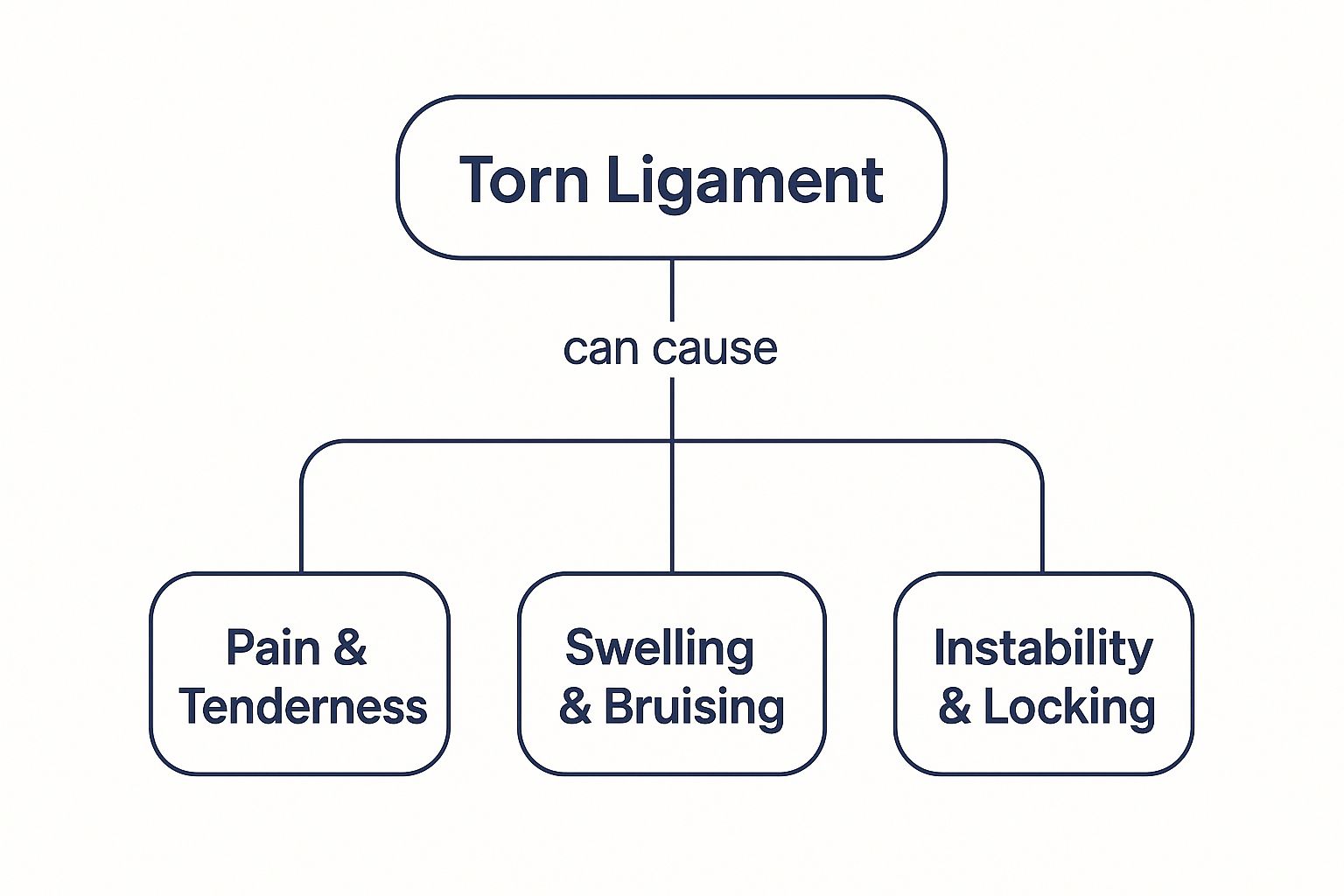
It really shows how a single injury can set off a chain reaction of issues, from that first sharp pain to a long-term feeling of instability. Having this anatomical map in mind helps make sense of why a simple awkward landing or a direct blow can cause such a cascade of problems.
A Deeper Look at Common Ligament Tear Symptoms
The immediate shock of a knee injury is one thing, but it’s the symptoms that develop in the hours and days that follow that really tell the story. Paying close attention to these signs can give you a much clearer idea of what’s happened inside the joint.
Many people describe hearing an unmistakable ‘pop’ at the moment of injury. This isn’t a subtle click or crackle; it’s a distinct, unnerving sound that often signals a ligament has been stretched past its breaking point and torn.
Pain and Swelling Unpacked
The pain of a torn knee ligament usually hits hard and sharp right away, but it often settles into a deep, throbbing ache over the next few hours. At the same time, you’ll almost certainly see the knee swell up, and often quite dramatically.
This isn’t just your garden-variety puffiness. When a major ligament like the ACL tears, it can bleed directly into the joint capsule, a condition called haemarthrosis. This internal bleeding is what causes the knee to balloon so quickly, and it's a major red flag for a significant injury. In the UK alone, there are around 20,200 anterior cruciate ligament (ACL) injuries each year, and many of these involve this kind of rapid, severe swelling. You can learn more about the impact of ACL injuries from NHS data to understand just how common these long-term issues are.
The feeling of instability, where the knee feels like it could give out at any moment, is one of the most classic torn ligament in knee symptoms. This isn't just a feeling of weakness; it's a mechanical failure.
The Feeling of Instability
Perhaps the most telling symptom of all is a profound feeling of instability. You might feel that your knee is suddenly untrustworthy, as though it could simply buckle or give way without warning when you try to change direction, pivot, or even just walk.
This happens because the ligament's job is to act like a strong rope, holding the knee joint steady. Once that rope has snapped, the structural integrity is gone. The joint becomes loose and unreliable, creating that frightening sensation that it could collapse underneath you at any moment.
How Professionals Diagnose a Torn Ligament
While you can get a good idea of what’s wrong from your symptoms, you'll need a medical professional for a definite diagnosis. Knowing what to expect when you see a doctor or physio can make the whole process feel a lot less daunting.
The first port of call is always a proper physical examination. Your clinician will want to know exactly how the injury happened – the specific twist, turn, or impact – as the story of the injury itself is a huge clue. After that, they’ll move on to a few hands-on tests to check how stable your knee feels.
Hands-On Physical Tests
These aren't complicated. They’re simply manual checks where your specialist will gently move your knee to feel for any unusual looseness or wobbling that shouldn't be there. It’s all about assessing how well the ligaments are doing their job.
- Lachman Test: This is the go-to test for the ACL. The clinician will carefully pull your shin bone forward to see if there’s more give than there should be.
- Varus/Valgus Stress Tests: These are for your collateral ligaments (MCL and LCL). Gentle pressure is applied to the sides of the knee to check if the joint gaps open, which is a tell-tale sign of a tear.
Combining these tests with what you've told them gives the clinician a really strong picture of what's going on. To give you an idea of how common this is, data from the UK's National Ligament Registry shows that between 2012 and 2021, over 18,600 patients were logged with ACL injuries alone. You can dive into the full 2022 report for more detailed statistics if you’re interested.
Advanced Imaging for a Clear Diagnosis
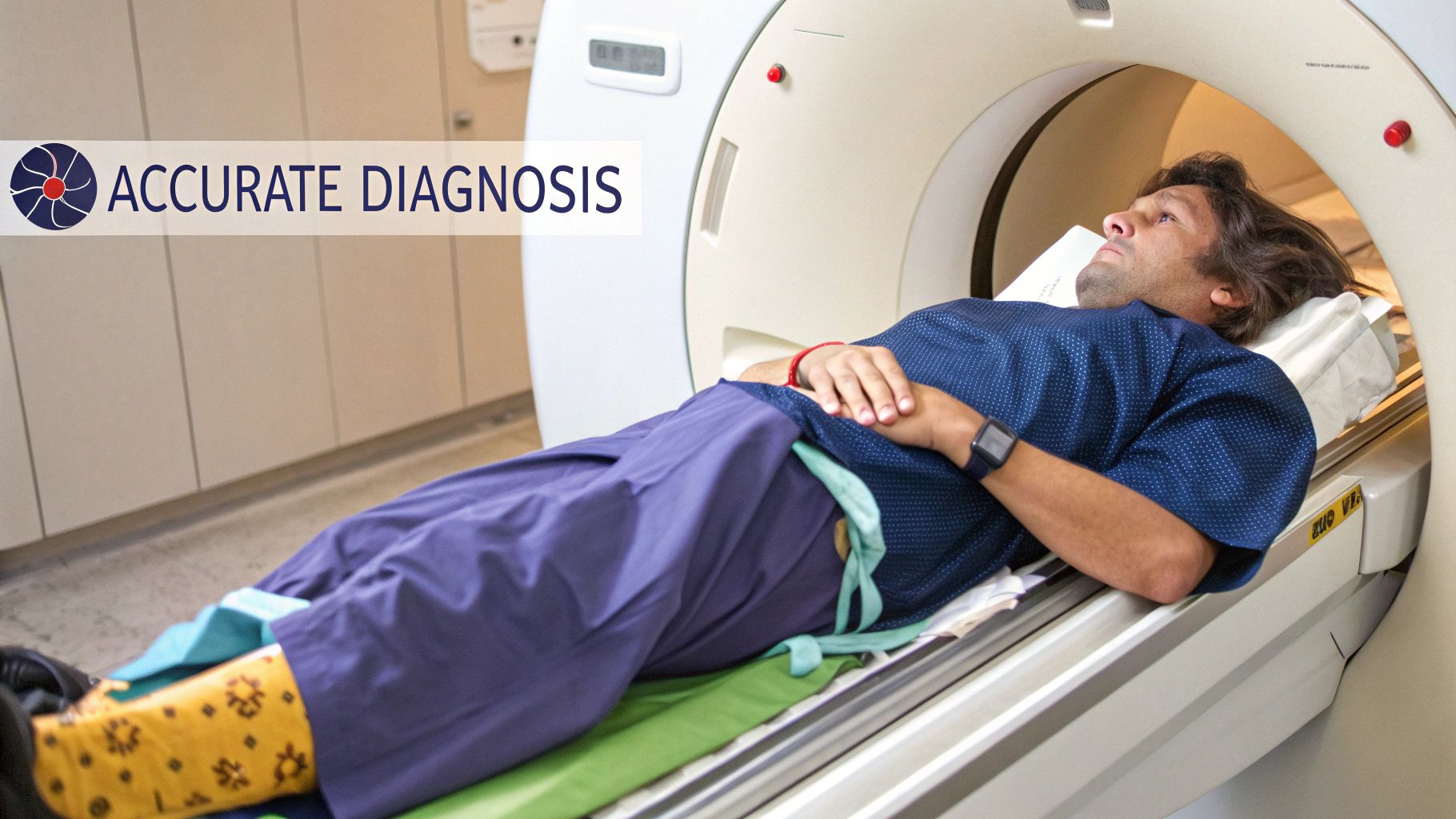
If the physical exam points towards a significant tear, imaging is the next logical step. You’ll likely be sent for an X-ray first. This might seem odd, as X-rays don’t show ligaments, but it's an essential check to make sure you haven’t fractured a bone at the same time.
For the definitive look at the soft tissues, an MRI (Magnetic Resonance Imaging) scan is the gold standard. It gives a crystal-clear picture of your ligaments, tendons, and cartilage, confirming exactly where the tear is and how bad it is. If you're scheduled for one and aren't sure what's involved, we have a helpful guide on how long an MRI scan typically takes.
Lifestyle Adjustments for Better Knee Health

Recovering from a torn ligament isn't just about clinical treatments. A successful, long-term recovery depends heavily on the lifestyle choices you make every day. Making conscious, scientifically-sound changes to your routine can significantly speed up healing, reduce the risk of re-injury, and improve your overall joint health.
One of the most impactful lifestyle changes is managing your weight. The physics are simple but powerful: for every extra pound of body weight, your knees experience four to six extra pounds of pressure with each step. Maintaining a healthy weight is one of the most effective ways to reduce daily stress on your knee joints, allowing the ligaments to heal in a lower-strain environment.
Fuel Your Recovery with an Anti-Inflammatory Diet
Your diet directly influences your body's inflammatory response, which is a critical factor when managing torn ligament in knee symptoms. Adopting an anti-inflammatory eating plan can help control swelling and provide the essential nutrients needed for tissue repair. This isn't about a restrictive diet; it's about making smart additions.
Consider your food as a key component of your recovery toolkit. It works synergistically with rest and physiotherapy to enhance your body's innate healing capabilities.
Focus on incorporating these evidence-based food groups:
- Omega-3 Fatty Acids: These are potent anti-inflammatory agents. Find them in oily fish (salmon, mackerel, sardines), flaxseeds, and walnuts.
- Antioxidant-Rich Foods: Berries, leafy greens (spinach, kale), and colourful vegetables are packed with compounds that combat cellular damage and support healing.
- Lean Proteins: Ligaments are made of protein. Consuming adequate lean protein from sources like chicken, beans, lentils, and tofu provides the essential building blocks for repairing damaged tissue.
- Vitamins and Minerals: Ensure you get enough Vitamin C (citrus fruits, bell peppers), which is crucial for collagen synthesis, and Zinc (nuts, seeds, whole grains), which aids tissue repair.
Smart Exercise and Protective Habits
While high-impact activities must be paused, staying active is crucial for recovery. The key is to choose movements that support rather than stress the joint. Low-impact exercises like swimming, water aerobics, or using a stationary bike maintain cardiovascular health and strengthen supporting muscles without jarring the knee.
Finally, integrate protective habits into your daily life. Always perform a dynamic warm-up before any physical activity to prepare muscles and ligaments. Invest in supportive footwear with good cushioning to absorb shock and improve alignment. These small, consistent changes significantly reduce the cumulative strain on your knees, promoting a safer and more durable recovery.
Your Roadmap to Recovery and Rehabilitation
Getting back on your feet after a ligament tear is a journey, not a sprint. It takes patience and, most importantly, a solid plan. The first steps happen right after the injury, focusing on managing that immediate, often intense, pain and swelling.
Your first line of defence is the PRICE principle – that’s Protection, Rest, Ice, Compression, and Elevation. Think of it as essential first aid for your knee. It helps calm the inflammation and protects the joint from further damage while you're waiting to see a professional. Health Tip: Apply ice for 15-20 minutes every 2-3 hours during the first 48 hours to effectively manage swelling and pain.
The Central Role of Physiotherapy
Whether your tear needs surgery or not, rehabilitation is non-negotiable. A huge part of your recovery will be guided by dedicated physiotherapy services. A good physio won't just give you a generic sheet of exercises; they'll create a plan built around your specific injury and what you want to get back to doing.
This programme will be carefully designed to hit several key milestones:
- Restoring Range of Motion: The first goal is often just to get the knee bending and straightening again without stiffness.
- Rebuilding Muscle Strength: Strong muscles, especially your quads and hamstrings, act like a natural brace for the knee, so rebuilding them is crucial.
- Retraining Proprioception: This is about re-educating your joint's sense of position and balance, which is vital for preventing that wobbly, unstable feeling.
Consistency is everything. Sticking with your physiotherapy exercises is the single most important thing you can do to prevent long-term instability and drastically lower the risk of injuring the same knee again.
Proper rehab is more important than ever, especially as we see a worrying rise in these injuries among younger people. In fact, there's been a shocking 29-fold increase in ACL reconstruction surgeries for UK teenagers in the last two decades, often from simple, awkward landings during sport.
As you start on your recovery, you can check out our guide on effective knee injury exercises to get an idea of the movements your physio might introduce. It really highlights why a full commitment to rehab is so critical for the long-term health of your knee.
Your Knee Ligament Tear Questions Answered
If you’ve injured your knee, it’s completely natural to have a hundred questions running through your mind. Getting to grips with what’s happened and what the road ahead looks like can make a world of difference. Let's tackle some of the most common concerns people have after tearing a knee ligament.
Is surgery always on the cards?
Not necessarily. Whether you’ll need surgery really comes down to which ligament you’ve injured and just how badly. The MCL, for example, has a great blood supply, which means more minor tears often heal beautifully with just a brace and some focused physiotherapy.
A complete ACL tear, on the other hand, is a different beast entirely. When the ACL snaps, the two ends pull back into the joint, and they simply can't find each other to heal naturally. While it’s true that some people can get by without an ACL, if you live an active life, surgery is usually the best bet to get that crucial stability back and avoid bigger joint problems down the line.
How long will it take to get back on my feet?
Recovery time can be anything from a few weeks to a full year, depending on the damage. A mild Grade 1 sprain, where the ligament is just stretched, might feel better within two to four weeks if you’re diligent with your care.
Recovering from an ACL reconstruction is a marathon, not a sprint. You're looking at a carefully structured rehabilitation journey that typically takes nine to twelve months before you can safely return to your sport.
When should I head to the hospital?
Some signs are too serious to ignore. You should get to A&E or seek immediate medical help if you notice any of these "red flags":
- You can't put any weight on your leg at all.
- The knee looks obviously out of place or deformed.
- You heard a distinct 'pop' at the time of injury, followed by rapid, severe swelling.
- You’re getting numbness, tingling, or pins and needles in your foot or lower leg.
These symptoms could point to a severe injury that needs checking out right away.
At The Lagom Clinic, our private GPs in Bristol are experts in musculoskeletal injuries. We can provide quick access to scans and specialist opinions to get you on the right path to recovery. You can learn more about our personalised approach at https://www.thelagom.co.uk.


 Members Consultation