


One of the first questions people ask is, "How long will my MRI take?" The simple answer is that the scan itself usually lasts somewhere between 15 and 90 minutes.
Of course, that's just the time you’ll be inside the scanner. Your total time at the clinic will be a bit longer to make sure everything is prepared correctly before and after the scan.
Your Quick Guide to MRI Scan Times
Knowing what to expect can really help ease any nerves you might have before your appointment. The vast majority of that time is spent quietly capturing incredibly detailed images of what’s going on inside your body. It’s a completely painless process that uses a powerful magnet and radio waves – not radiation – to give your doctor a crystal-clear view.
You could think of it a bit like a highly advanced photoshoot. A photographer doesn't just take one picture; they take lots of shots from different angles and with different settings. An MRI scanner does something similar, running a series of "sequences" to capture different views. Each sequence can last anywhere from a few seconds to several minutes, and the total number of sequences adds up to your final scan time.
It's also important to remember that the scan is only one part of your visit. You'll need to allow extra time for a few other things:
- Arriving and checking in at the reception desk and filling out any final forms.
- Getting changed into a medical gown and making sure you've removed all metal items like jewellery, watches, or hearing aids.
- A quick chat with the radiographer who will explain the procedure and get you comfortably positioned on the scanner bed.
This whole check-in and preparation phase typically adds another 15 to 30 minutes to your appointment, so it's wise to factor that in.
Average MRI Scan Duration by Body Part
To give you a more specific idea of what to expect, we've put together a table showing typical scan times for different parts of the body here in the UK.
Average MRI Scan Duration by Body Part
This table shows the typical time a patient will spend inside the MRI scanner for various common procedures in the UK.
| Body Part Being Scanned | Average Time Inside Scanner |
|---|---|
| Brain | 30–60 minutes |
| Lumbar Spine | 20–45 minutes |
| Knee | 20–40 minutes |
| Abdomen | 30–90 minutes |
| Shoulder | 20–40 minutes |
| Pelvis | 30–60 minutes |
Keep in mind these are just averages. Your own scan might be a little shorter or longer depending on your specific situation. The extra time built into your appointment ensures the clinical team can capture the highest quality images needed for an accurate diagnosis.
What Happens During Your MRI Scan

An MRI machine can certainly look a bit intimidating, but knowing what goes on step-by-step helps take the mystery out of it all. Rather than a confining tube, it’s better to think of it as a powerful, highly specialised camera. It uses a strong magnet and radio waves—no radiation involved—to create an incredibly detailed map of what’s going on inside your body.
Your experience on the day starts in a private changing room. Here, you’ll swap your clothes for a hospital gown and remove anything metal, like jewellery, watches, or hearing aids. This is a non-negotiable safety measure because the MRI’s magnet is exceptionally powerful. A radiographer will then meet you, double-check your safety questionnaire, and walk you through the process. They're there to make you feel comfortable and answer any last-minute questions you might have.
Getting Positioned for the Scan
When you're ready, you'll be led into the scanner room. The radiographer will help you get comfortable on a motorised bed, which then smoothly glides into the centre of the MRI machine. Their main job is to get you positioned just right to capture the clearest images possible.
You'll get earplugs or headphones to block out the loud knocking and buzzing sounds the scanner makes. Many places let you listen to music, which can really help you relax. You'll also be given a small call button to hold, giving you a direct line to the radiographer throughout the scan.
The single most important thing you can do is lie as still as you can. It's just like taking a photograph with a long exposure—any movement can blur the final picture. If that happens, the scan sequence might need to be redone, which will make your appointment longer.
The Role of Contrast Dye
In some cases, your doctor might order a scan with contrast dye, which usually contains a substance called gadolinium. This dye is fantastic for making certain tissues, blood vessels, or potential problems show up much more clearly on the final images.
If your scan requires it, the dye is given through a small intravenous (IV) line, usually in your arm or the back of your hand. It's a quick and generally painless process, though some people notice a brief cool sensation as it enters the bloodstream. Staying well-hydrated in the days before your scan can make vein access easier for the radiographer. Using contrast typically adds an extra 10 to 15 minutes to the total scan time because the radiographer often needs to capture images both before and after the injection. It's a small detail, but knowing this can help you plan your day a bit better.
Why Your MRI Scan Time Can Vary
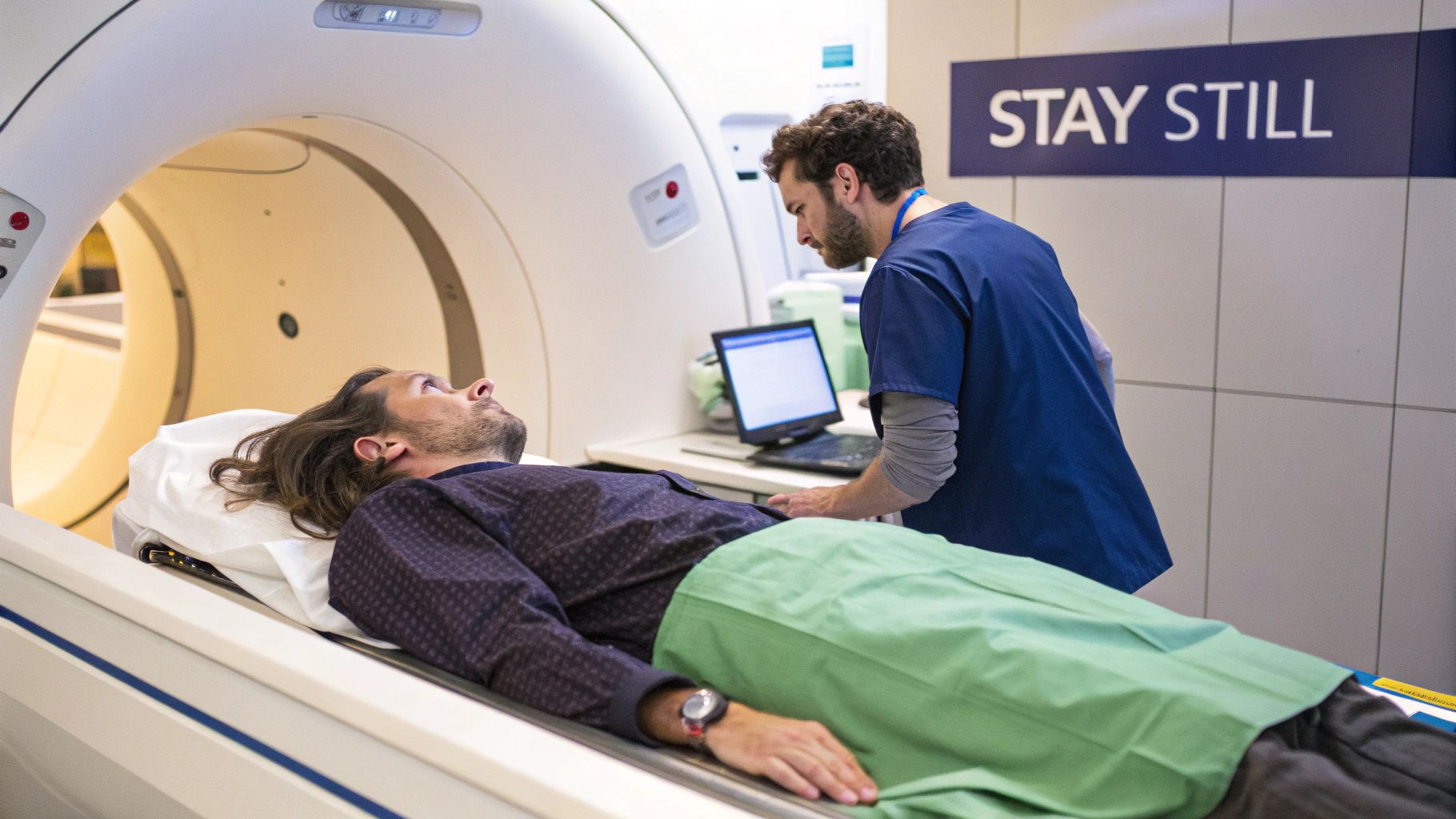
Have you ever wondered why your friend’s knee MRI was over in 30 minutes, but your doctor booked a 60-minute slot for a brain scan? It’s a common question, and the answer is simple: no two MRI scans are the same. Each procedure is carefully tailored to get the exact information your doctor needs to make an accurate diagnosis.
The biggest factor dictating how long an MRI takes is the part of the body being examined. A small, straightforward joint like a knee just doesn't require as much scanning time as a large, complex area like the abdomen or the entire spine. Capturing a bigger, more intricate part of the body in high detail naturally takes longer.
In the UK, a typical MRI scan can last anywhere from 15 minutes to an hour. This variation is completely normal. It's also worth noting that NHS waiting times can be quite long—often between six and eighteen weeks for the appointment itself. Once the scan is done, you might wait another one to two weeks for the results. If you want to learn more about this process, Practice Plus Group offers some great insights into MRI waiting times.
The Importance of Image Sequences
Beyond just the size of the area, the time you spend in the scanner depends heavily on the number of image sequences the radiographer needs to run. You can think of an image sequence as a specific type of photograph, each designed to show something different.
For example, a "T1-weighted" image is great for looking at your general anatomy, while a "T2-weighted" image is used to highlight areas of inflammation or fluid. A standard scan will almost always involve multiple sequences. If your doctor is investigating something complex, they'll need more of these "photos" to build a complete picture, which adds to the overall time.
Think of the radiologist as a detective at a crime scene. Each image sequence is a different clue. The more complicated the case, the more clues they need to gather to solve the mystery and give you a clear diagnosis.
Other Key Factors That Affect MRI Duration
A few other things can stretch out or shorten your time in the scanner. Knowing about them beforehand can help you feel more prepared on the day.
-
Use of Contrast Dye: As we've touched on, sometimes a contrast dye is needed to make certain tissues or blood vessels stand out. This involves taking images both before and after the dye is injected, which can easily add another 10 to 15 minutes to the procedure.
-
Staying Still: This is absolutely critical. Any movement, no matter how small, can blur the images. It’s just like trying to take a photo with a shaky hand. If an image comes out blurry, the radiographer has to repeat that entire sequence, which means more time in the machine for you.
-
Patient Comfort: Your comfort is a top priority. If you start to feel anxious or uncomfortable, the team might need to pause the scan to help you get settled again. Taking a moment to make sure you're okay is far better than having to repeat scans because you were fidgeting.
From Referral to Results: The Complete MRI Timeline
It’s easy to focus on the time you’ll spend inside the MRI scanner, but that's really just one stop on a longer journey. Getting a clear picture of the entire process—from the moment your doctor refers you to the day you get your results—can help you know what to expect and feel more prepared. The whole timeline has a few distinct stages, each with its own pace.
It all starts with your GP. If they believe an MRI is the right next step for you, they'll put in a referral. This is the starting gun, and getting a prompt consultation can really get the ball rolling. If you're wondering how to get seen quickly, our guide on securing a same-day GP appointment has some great tips.
Once that referral is sent, you're officially in the queue for scheduling. This is often the longest stretch of waiting, especially if you're going through the NHS.
From Waiting List to Scan Day
How long you wait for the appointment itself can vary quite a bit. If you opt for private healthcare, you might get a slot within a few days or a week. On the NHS, the timeline is typically longer, though this really depends on how urgent your case is and the demand in your local area.
Things have been improving, though. The median wait time between a referral and certain diagnostic tests, including MRIs, in England was recently around 23 days. It's a reminder that while efforts are being made to shorten queues, there's still a significant waiting period to factor in.
This brilliant infographic gives you a snapshot of what to expect on the day of your actual scan.
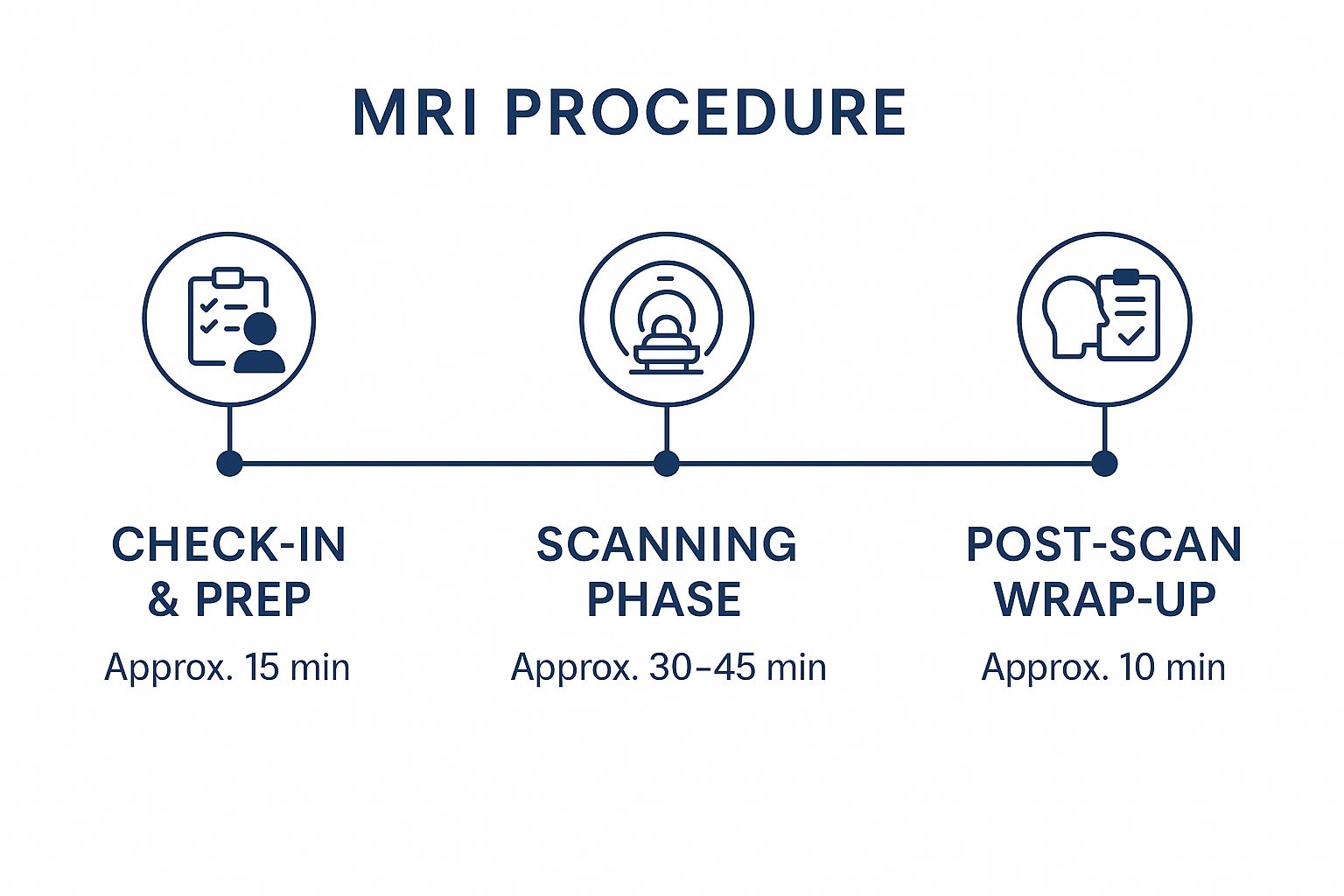
As you can see, the scan is the main event, but it's bookended by some crucial prep and follow-up steps.
On the day, make sure to budget more time than just the scan itself. You'll need to check in, fill out safety questionnaires, change into a hospital gown, and have a chat with the radiographer. All told, these pre-scan activities usually take an extra 15 to 30 minutes.
From Images to an Expert Report
Once you're out of the scanner, the process still has a little way to go. The high-resolution images are whisked off to a radiologist—a doctor who specialises in reading and interpreting these kinds of scans. They'll painstakingly analyse every slice and detail, searching for any clues before writing up a full report for the doctor who referred you.
This last leg of the journey is actually quite swift. According to NHS England data, the median time it takes for an MRI report to be written up after the scan is just four days. It goes to show that once the images are captured, the expert analysis happens pretty quickly.
Your doctor will get this report and then get in touch with you to go over the findings and discuss what comes next. That final conversation is what brings the entire MRI process to a close.
Getting Ready for Your Scan: Tips for a Smooth MRI
Thinking ahead and doing a bit of prep can make a world of difference to your MRI experience. It’s not just about comfort; a well-prepared patient often means a more efficient scan, which can even influence how long the whole thing takes. A few simple, medically sound steps can set you up for success.
First, let's talk about lifestyle choices that support your overall health. Unless you've been specifically told to fast, make sure you're well-hydrated in the days leading up to your appointment. Being properly hydrated makes it easier for the team to find a vein if you need a contrast dye injection. Plus, you’ll just feel better. A good night’s sleep beforehand is also a massive help – it can take the edge off any anxiety and make it easier to lie still.
Staying Calm and Comfortable in the Scanner
It's completely normal to feel a bit anxious or claustrophobic about an MRI. The good news is there are proven techniques you can use to stay calm, which helps prevent the kind of fidgeting that can cause delays or require re-scans.
- Practise your breathing: Focus on slow, deep breaths. Inhale through your nose for a count of four, hold for four, and exhale slowly through your mouth for a count of six. This diaphragmatic breathing is incredibly effective at calming your nervous system. Try it for a few minutes each day leading up to your scan.
- Try a little mindfulness: You could focus on the physical sensation of your breath or picture yourself in a calm, happy place. These techniques give your mind something to anchor to, stopping it from drifting into anxious thoughts inside the scanner.
- Dress for success: Your best bet is comfortable, loose-fitting clothing with absolutely no metal. Think joggers, leggings, and simple cotton t-shirts. This way, you might not even need to change into a hospital gown, and it completely removes any worry about metal interfering with the scan.
Don't forget to give the clinical team your full medical history. It's crucial they know about any metal implants, pacemakers, surgical clips, or even tattoos that might contain metallic ink. Being thorough upfront avoids last-minute safety checks or cancellations, keeping your appointment on track.
Your Final Checklist Before You Go
On the day of your scan, give your instructions one last read-through. Have you been asked to avoid food or drink? This is a common requirement for abdominal or pelvic MRIs, as it’s essential for getting clear images. Forgetting this could mean your scan has to be rescheduled.
It’s also wise to leave all your valuables at home – jewellery, watches, hearing aids, anything with metal. If you bring them, you’ll only have to spend extra time removing and storing them at the centre. By taking these small steps, you’re not just easing your own stress; you’re helping the medical team do their job as efficiently as possible.
Understanding UK MRI Waiting Times and What the NHS is Doing About It

If you've been referred for an MRI, the wait for your appointment can be a source of real anxiety. It’s a common concern, and historically, the time between a GP referral and the actual scan has been a sticking point for many of us in the UK.
The good news is that things are changing. New initiatives are now in place, actively working to shorten those waiting lists and improve access to these vital scans right across the country.
A New Approach to Diagnostics
One of the biggest game-changers has been the introduction of Community Diagnostic Centres (CDCs). Think of these as local hubs, bringing tests and scans closer to home. They often run during evenings and weekends, making appointments much more convenient.
The whole point of CDCs is to boost the NHS's capacity for scans, taking some of the strain off major hospitals and chipping away at the patient backlog.
Are These Changes Actually Working?
The latest figures from NHS England suggest they are. We're seeing a really encouraging drop in how long people are waiting for an MRI. In just one month, only 6% of patients were on the list for more than six weeks.
To put that in perspective, that’s down from 26% the previous year—a significant improvement. This progress is also helped by clever innovations like teleradiology services, which help imaging centres work more efficiently and get through scans faster.
The establishment of over 160 Community Diagnostic Centres is a key part of the NHS plan to tackle backlogs, making it quicker and easier for millions of patients to get the checks they need. These centres have already delivered millions of additional tests, scans, and checks.
Even with these fantastic strides, waiting is still a reality for some. If you're weighing up your options, it's worth getting to grips with the typical timelines in both the public and private sectors. Our detailed comparison of private healthcare vs the NHS can give you a clearer picture.
Ultimately, these developments show that real, concrete steps are being taken to shorten the time it takes from your referral to the day of your scan.
A Few Common Questions About Your MRI Scan
It's completely normal to have a few practical questions buzzing around your mind before an MRI. Getting clear, straightforward answers can make all the difference, helping you feel calm and prepared for what happens on the day and afterwards.
Can I Get My MRI Results Any Faster?
While the expert analysis by the radiologist can't be rushed, you can definitely help avoid any hold-ups. A simple, proactive step is to double-check that your referring doctor has all your up-to-date contact details.
It's also perfectly fine to ask your doctor what their usual timeframe is for getting in touch with results. If that time passes, a polite follow-up call is completely appropriate. Staying informed and engaged in your healthcare journey is always a positive step.
What Happens If I Move During the Scan?
Think of it like taking a photograph. If the subject moves, the picture comes out blurry. It's the same with an MRI. Any movement can smudge the images, which might mean the technologist has to repeat part of the scan. This, of course, adds to how long an MRI takes overall.
The best way to avoid this is simply to focus on staying as still as you can. Practising some gentle, deep breathing can help, and always let the technologist know if you're starting to feel uncomfortable. They can often help you get settled again.
Is an Open MRI Quicker Than a Standard One?
Not really, no. The time an MRI takes is dictated by the part of the body being scanned and the level of detail needed, not so much the shape of the machine.
While open MRI scanners are a fantastic option for anyone who feels claustrophobic, sometimes they can actually take a little bit longer to capture images with the same high quality as a traditional closed scanner. It’s a trade-off between patient comfort and imaging technology.
At The Lagom Clinic, we believe that proactive, personalised healthcare starts with giving you clear information at every stage. If you need quick access to private imaging or a GP who genuinely takes the time to answer all your questions, we invite you to explore our services.
Need an MRI referral?
A private GP consultation at The Lagom Clinic can arrange fast-track MRI and imaging referrals to specialist centres.

 Members Consultation