


At its heart, the difference between private healthcare and the NHS is simple.The NHS provides comprehensive care that's free at the point of use because it's funded by our taxes. Private healthcare, on the other hand, is paid for either directly out of your own pocket or through an insurance plan, and its main draw is faster access to specialists and a greater degree of choice.
Your decision really boils down to what you value more: universal access for all or the speed and personalisation that comes with going private.
Understanding Your UK Healthcare Options
Figuring out whether to stick with the NHS or explore private healthcare can feel like a big decision. The National Health Service is, without a doubt, the foundation of UK health, built on the principle of providing care to everyone, no matter their financial situation. Private healthcare runs in parallel, offering a different path that often puts convenience and speed first.
This guide is designed to give you a balanced look at both, helping you understand the real-world differences. We'll get into the specifics of critical factors like cost, waiting times, and the level of care you can expect from each, moving beyond the obvious funding models to see how they compare in practice.
Proactive Health is Your First Defence
Before we dive into the systems, it's crucial to understand that your health is your greatest asset. No matter which route you choose, taking proactive steps through evidence-based lifestyle changes can significantly reduce your need for medical intervention.
Focusing on a balanced diet rich in whole foods, engaging in regular physical activity, and effectively managing stress are not just suggestions; they are scientifically proven strategies to prevent chronic diseases like type 2 diabetes, heart disease, and certain cancers. You can learn more about the importance of health screenings in our detailed guide, as they are a crucial part of preventative care.
A focus on preventative medicine and healthy lifestyle choices empowers you to be an active participant in your own health journey, rather than a passive recipient of care.
The Shifting Healthcare Landscape
This choice is becoming more relevant than ever. With NHS waiting lists hitting record highs, it's predicted that by the end of 2025, over 1 million people will have opted for private healthcare. This isn't just a statistic; it shows a real shift as people seek alternatives to long waits, putting the NHS's promise of timely care under immense pressure.
Here’s a quick snapshot of the core differences:
| Feature | NHS | Private Healthcare |
|---|---|---|
| Funding | Publicly funded through taxation | Paid directly or via insurance |
| Access | Universal access for all UK residents | Based on ability to pay or insurance coverage |
| Waiting Times | Can be long for non-urgent care | Typically much shorter |
| Choice | Limited choice of consultant or hospital | Greater choice of specialists and facilities |
The Financial Reality of NHS and Private Care

When you weigh up private healthcare vs NHS, the conversation almost always starts with money. At its core, the NHS is funded through our taxes and is free when you need it. But "free at the point of use" doesn't mean it's completely without cost.
If you live in England, you'll still need to budget for things like prescriptions, dental work, and eye tests. While these charges are usually manageable, they can add up. Most adults pay a standard fee for prescriptions, and dental costs are tiered, rising with the complexity of the treatment you need. It’s a crucial part of the financial picture to remember.
Paying for Private Healthcare
Going private means you're taking on the costs yourself, and there are really two ways to go about it: paying as you go (self-funding) or taking out private medical insurance (PMI).
Self-funding is exactly what it sounds like—you pay for your treatment directly out of your own pocket. This is often the route people take for one-off procedures when they just want to get something sorted quickly. A private MRI scan, for instance, could set you back anywhere from £300 to £700. For major surgery like a knee replacement, you’re looking at a bill between £12,000 and £15,000. These numbers show why some people build a dedicated health fund if they think they might opt for private care down the line.
The other option is private medical insurance. Here, you pay a regular premium, and the cost depends on a few key things:
- Your age and health history: Premiums tend to climb as you get older or if you have pre-existing conditions.
- Your lifestyle: Things like smoking will almost certainly push your premium up.
- The level of cover you choose: A basic plan might just cover you for a hospital stay, whereas a comprehensive policy will include outpatient appointments and diagnostic tests.
When you're looking at PMI policies, the real trick is to find that sweet spot. You want cover that's genuinely useful for you, without forking out for extras you'll likely never need.
Smart Financial Health Planning
Whichever route you lean towards, being smart about your health finances is non-negotiable. If private care is on your radar, setting up a health savings fund can give you a safety net for unexpected bills or planned treatments. If you're considering insurance, you need to do your homework to find a policy that fits your budget and lifestyle.
Of course, both the NHS and private providers are always looking for better strategies for reducing healthcare costs, and understanding these dynamics gives you a clearer view of the whole system.
Ultimately, investing in your health is the most effective way to manage future medical costs. Adopting a healthy lifestyle reduces the risk of long-term conditions that require ongoing treatment. Similarly, getting a same-day GP appointment can help address health issues early, preventing them from becoming more complex and costly problems.
Comparing Access to Treatment and Specialists
When weighing up private healthcare vs NHS, one of the most defining factors is how long you have to wait to see a specialist. This is often the single biggest reason people decide to explore private options for non-urgent conditions. While the NHS is second to none in an emergency, delivering immediate, life-saving care, the journey for elective treatments and diagnostics can be a long one.
The private sector, on the other hand, is built for speed. A GP referral can land you a specialist consultation within a matter of days, not the weeks or months you might face elsewhere. This swift pathway means you get a diagnosis faster and can start your treatment plan almost right away, which makes a world of difference for conditions impacting your quality of life or ability to work.
The Reality of Waiting Times
The NHS has a target for patients to begin treatment within 18 weeks of a GP referral for non-urgent issues. The reality, however, is that immense demand often means this target gets missed. Depending on the specialism and where you live, the wait can be considerably longer, leaving patients in a state of discomfort and uncertainty.
Private healthcare is the fast track. It lets you sidestep these queues entirely. Because you can book appointments directly and often choose your specialist, the whole process from that first consultation to actual treatment is dramatically shorter. This efficiency is a cornerstone of its appeal.
The image below paints a clear picture of the different waiting room experiences, capturing the quicker access that is so common in private facilities.
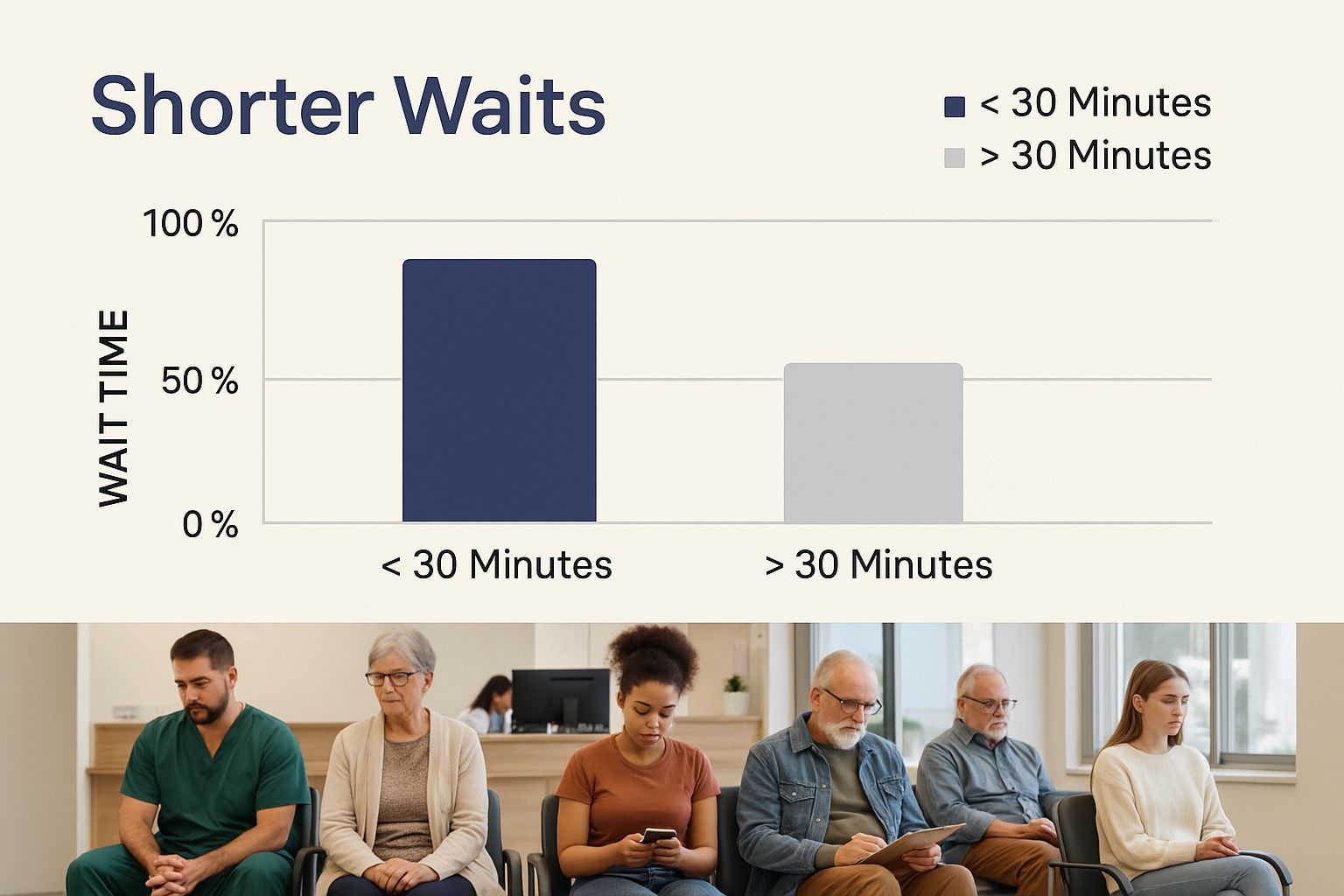
This visual really brings home how private care focuses on getting you in front of a medical expert with minimal delay.
The demand for this faster access is clear in the latest figures. Private healthcare admissions hit a record 939,000 in the UK in 2024, which is a 20% jump compared to pre-pandemic numbers from 2019. This consistent growth highlights just how many people are now putting a premium on shorter waiting times for their care. You can explore more data on this trend and what it means for healthcare choices in the UK.
The core difference isn't the quality of the specialists—many work in both sectors—but the speed at which you can access their expertise. For many, reducing this waiting time is worth the investment.
Let's look at how the timelines for a non-urgent procedure typically stack up.
Typical Waiting Times NHS vs Private Healthcare
The table below breaks down the estimated waiting times for different stages of non-urgent medical treatment, offering a clear comparison between the two systems.
| Treatment Stage | Typical NHS Waiting Time | Typical Private Healthcare Waiting Time |
|---|---|---|
| GP Referral to Specialist | 4–12 weeks | 1–7 days |
| Specialist to Diagnostics | 4–8 weeks | 1–7 days |
| Diagnostics to Treatment | 8–20 weeks | 1–4 weeks |
Ultimately, the right choice often comes down to the urgency of your condition and your personal tolerance for waiting. If a health problem is actively affecting your daily life, the speed of the private route offers a tangible, undeniable advantage.
Quality of Care and Treatment Options

When we look at private healthcare vs NHS, the discussion inevitably shifts from wait times and costs to the actual quality and variety of treatments on offer. The NHS is, without a doubt, a world-renowned institution, respected for its high clinical standards and the sheer breadth of services available to everyone, regardless of their ability to pay.
But it's a system that has to work within tight budgets and strict guidelines. This can mean that access to the very newest—and often most expensive—drugs and treatments might be slower. Before a new therapy is rolled out across the NHS, it usually needs a green light from the National Institute for Health and Care Excellence (NICE), a process that takes time. Private healthcare can sometimes bridge this gap, offering access to innovative options before they're available on the NHS.
Personalisation and Choice in Your Treatment
Here’s where one of the biggest distinctions comes into play: the degree of personal choice. The private system is built around you, the patient. You often get to choose your consultant and even the hospital for your treatment. This level of control extends to logistics too, with appointments that can be scheduled to fit your life, not the other way around.
The whole experience is designed to be more comfortable. Think private rooms, more flexible visiting hours, and a generally higher standard of amenities. It's a key part of the value proposition.
In private care, the emphasis is on a bespoke patient journey. You're not just receiving treatment; you're an active partner in deciding how, when, and by whom that care is delivered.
This is quite different from the NHS model. While the clinical care is excellent, the system is engineered for efficiency on a massive scale. That means your consultant and hospital are usually assigned based on your GP’s location and who has availability, rather than your personal preference.
The Strength of an Integrated System
It's also important to give credit where it's due. The NHS has a unique, powerful advantage, especially when it comes to complex, chronic, or emergency conditions. It excels at providing truly integrated, multi-disciplinary care.
Imagine having surgeons, physiotherapists, dietitians, and other specialists all collaborating on your case under one roof. This seamless, joined-up approach is incredibly effective for managing long-term health issues and is something the more fragmented private sector often struggles to replicate.
Proactive Steps for Better Health Outcomes
Regardless of which system you rely on, the best health strategy is prevention. Many chronic conditions that place a heavy burden on both the NHS and private healthcare are preventable or manageable through targeted lifestyle changes.
Adopting these scientifically-backed habits can significantly improve your health and reduce your long-term need for medical care.
- Adopt a Balanced Diet: Focus on a diet rich in whole foods—fruits, vegetables, lean proteins, and whole grains. Reducing your intake of processed foods, sugary drinks, and saturated fats is a proven method for lowering your risk of heart disease, type 2 diabetes, and certain cancers.
- Embrace Regular Physical Activity: Aim for at least 150 minutes of moderate-intensity exercise per week, as recommended by the NHS. This can include brisk walking, cycling, swimming, or dancing. Regular exercise helps maintain a healthy weight, lowers blood pressure, and boosts mental well-being.
- Prioritise Stress Management: Chronic stress can negatively impact your immune system and overall health. Incorporate stress-reduction techniques into your daily routine. Mindfulness, deep-breathing exercises, yoga, or spending time in nature are effective ways to build resilience and improve your physical and mental health.
Who Chooses Private Care and When?
The decision to go private often has less to do with statistics and more to do with real-life pressures. While the NHS is a fantastic safety net for all of us, there are specific moments and life stages that lead people to look for private options.
One of the biggest drivers is work. Imagine a self-employed consultant with a nagging knee injury. A long wait for an NHS diagnosis and treatment isn't just an inconvenience; it's a direct threat to their income. For them, paying for private care to get back on their feet quickly is simply a sound business decision.
It’s a similar story for parents worried about a child's health. The thought of waiting months to see a paediatric specialist can be incredibly stressful. In these situations, the peace of mind that comes from getting fast answers often makes the cost of a private consultation feel entirely justified.
The Role of Employment and Life Stage
For many, the door to private healthcare is opened by their employer. In fact, work-based schemes are the most common way people get cover. Recent YouGov data shows that over half (53%) of those with private medical insurance have it as a job perk. This is especially true for people aged 35–54, with coverage peaking at 69% for those between 45 and 54. You can read more about the demographics of private healthcare users in the UK.
The choice isn't always about replacing the NHS entirely. Many people use private care to bypass a specific bottleneck, like a long wait for a hip replacement, allowing them to regain their quality of life much sooner.
Embracing a Hybrid Healthcare Model
More and more, people are creating their own 'hybrid' healthcare plan, mixing and matching the best of both worlds. It’s a very practical approach: you stick with your NHS GP for day-to-day issues and referrals but turn to private services when you need something done quickly.
This blended model really gets to the heart of the private healthcare vs NHS dilemma. Someone might pay for a private MRI to get a diagnosis in days rather than months, but then take that diagnosis back to the NHS to continue their treatment. It’s also common in mental health; understanding how to find a therapist privately is often the first step for those facing long NHS waiting lists. This shows how the two systems can work together, letting you build a healthcare journey that fits your own unique circumstances.
Making the Right Health Decision for You
Choosing between the NHS and private healthcare isn't about one being definitively 'better' than the other; it’s about what’s right for you. It comes down to your personal situation, what you value most, and your specific needs at that moment.
To cut through the noise, start by asking some honest questions. How pressing is your health issue? Can you realistically wait, or will a long delay affect your job, family life, or mental well-being?
Then, of course, there's the financial side. You need to look at your budget frankly. Could you cover the cost of a one-off procedure out of pocket, or does a monthly insurance premium make more sense? Being clear on what you can comfortably afford is non-negotiable. Finally, think about control—how important is it for you to choose a particular specialist or hospital?
Taking Control of Your Long-Term Health
Whether you stick with the NHS, go private, or use a mix of both, the single most effective action you can take is to become an active participant in your own health. Proactive, preventative care can significantly reduce your future reliance on either system.
This involves shifting your focus from treating illness to cultivating wellness. Small, consistent lifestyle changes are scientifically proven to have a major impact on your long-term health outcomes.
Adopting a healthier lifestyle is one of the most effective forms of preventative medicine available. It addresses the root causes of many chronic conditions, rather than just treating the symptoms.
Actionable Lifestyle Tips for Better Health
Making lasting changes is about integrating new, healthy habits into your daily life. Focus on these evidence-based strategies to build a strong foundation for your well-being.
- Improve Your Diet: A diet centred on whole foods—fruits, vegetables, lean protein, and whole grains—is fundamental to good health. Minimising processed foods, sugary drinks, and unhealthy fats directly lowers your risk of chronic diseases like heart disease and type 2 diabetes.
- Stay Physically Active: Aim for at least 150 minutes of moderate-intensity exercise each week. This could be a brisk walk, a cycle ride, a swim, or a dance class. Regular physical activity is crucial for weight management, cardiovascular health, and mental clarity.
- Manage Stress Effectively: Chronic stress can compromise your immune system and contribute to various health problems. Develop healthy coping mechanisms such as mindfulness, deep-breathing exercises, yoga, or spending regular time in nature to build resilience and promote calm.
By prioritising these areas, you are making a powerful investment not just in your future health, but in your present quality of life.
Frequently Asked Questions
When you're weighing up your healthcare options, it’s natural for practical questions to pop up about how the NHS and private systems actually interact. Getting clear on these details is the key to feeling confident in your decision. Here are some straightforward answers to the questions we hear most often.
Can I Use Both the NHS and Private Healthcare?
Absolutely. In fact, lots of people create a 'hybrid' approach that taps into both systems. It’s quite common to see your NHS GP for an initial diagnosis, then use a private specialist to get seen faster or to have a specific procedure done.
The one crucial rule to remember, though, is that you can't mix and match within a single course of treatment. A continuous treatment pathway for one specific condition must be handled either entirely by the NHS or entirely by a private provider. For example, you couldn't have surgery on the NHS and then switch to private care for the follow-up appointments related to that same operation.
Does Using Private Care Affect My NHS Entitlement?
Not at all. Your right to NHS care is completely separate from any private healthcare choices you make. Whether you pay for private treatment yourself or have insurance, you are still entitled to the full range of NHS services, from GP visits to emergency care, just like every other UK resident.
Your use of private healthcare is a separate choice and does not impact your fundamental entitlement to NHS treatment. The two systems can coexist without penalty.
Are Pre-existing Conditions Covered by Private Insurance?
This is a really important one to get right, because the answer can vary quite a bit. The vast majority of standard private medical insurance policies do not cover pre-existing conditions. A pre-existing condition is usually defined as any illness or injury you've had symptoms of, or received treatment for, in the five years before your policy begins.
While some specialist policies might offer cover for certain chronic conditions, this is far less common and almost always means paying a much higher premium. It’s vital to read the fine print of any policy to see exactly what is and isn't included before you sign up.
For a wider array of articles, discussions, and insights related to UK healthcare and frequently asked questions, further explore the Salthea Healthcare Blog.
At The Lagom Clinic, we believe in building a healthcare plan that works for you. Whether you need flexible appointments, in-depth health screenings, or expert lifestyle advice, our private GP practice in Bristol is here to help you achieve your wellness goals. Discover a more personalised approach to your health by visiting The Lagom Clinic today.
Considering private healthcare?
At The Lagom Clinic, private GP consultations start from £125 for 30 minutes — with same-week availability and no waiting lists.


 Members Consultation