


Staying healthy on the run isn't about luck; it's a skill built on a foundation of smart, consistent lifestyle habits. Preventing injuries comes down to a few key areas: balancing your training load, strengthening the right muscles to support your body, refining your running form, and—crucially—making recovery a priority.
Why Do Runners Get Injured So Often?
Running should feel freeing, but for many, it comes with a frustratingly high risk of injury. We've all been there: you're getting into a good rhythm, feeling the buzz of progress, and then a niggle appears. Before you know it, you're sidelined with pain.
The medical reality is that most running injuries are overuse injuries, stemming from a simple case of training load outpacing the body's ability to adapt. When we increase mileage or intensity too quickly, we overload our muscles, tendons, and joints beyond their capacity to repair and strengthen. This is a significant issue in the UK's running community, especially for those training for a specific event.
In fact, physiotherapy data from UK runners shows that around 30% to 40% report an injury while training for a race. It’s a stark reminder that without a proper, gradual plan, our ambition can lead to physical breakdown.

Shifting to a Proactive Mindset
Instead of reacting to pain, the most effective strategy is to prevent it from ever occurring. Think of staying injury-free as a skill you can learn and master through healthy lifestyle changes. For a wider perspective, many of the same principles apply across different activities, which we cover in our guide on how to prevent sports injuries.
This proactive, evidence-based approach is built on four core pillars, which we'll explore in detail.
Here's a quick look at the core concepts we'll cover to help you stay injury-free.
The Four Pillars of Injury Prevention
| Pillar | Why It Matters | Key Action |
|---|---|---|
| Smart Training | Allows your body to adapt and get stronger without being overloaded. | Follow a structured, progressive plan that avoids sudden jumps in mileage or intensity. |
| Functional Strength | Builds a robust support system to absorb impact and protect your joints. | Incorporate targeted strength work for your glutes, core, and legs at least twice a week. |
| Efficient Form | Minimises stress on your body, helping you run more smoothly and with less effort. | Focus on your cadence, posture, and foot strike to reduce braking forces. |
| Dedicated Recovery | Gives your body the time and resources it needs to repair and rebuild. | Prioritise sleep, nutrition, and active recovery days to manage training stress. |
By mastering these four areas, you can fundamentally change your relationship with running.
You'll move from constantly managing aches and pains to building a resilient body that supports years of consistent, enjoyable running. Let's get started.
How to Build a Smarter Training Plan
Your best defence against running injuries isn't a pricey pair of trainers or a high-tech watch. It's something much more fundamental: a thoughtful, well-structured training plan. The single biggest clinical error that sidelines runners, from beginners to veterans, is the classic 'too much, too soon' syndrome. When motivation outstrips physical preparedness, the body pays the price.
A smarter plan is all about respecting your body's capacity for adaptation. By introducing training stress in small, manageable doses, you give your muscles, tendons, and bones the time they need to repair and grow stronger. Rushing this physiological process is a direct path to injury.
The Problem with Guesswork
Heading out the door and running based on feel might seem liberating, but it's a high-risk approach for long-term health. This unstructured method makes it incredibly easy to accidentally spike your mileage or intensity, a common precursor to overuse injuries like medial tibial stress syndrome (shin splints) or patellofemoral pain syndrome (runner's knee).
This is precisely why structured plans like the Couch to 5K programme are so effective for beginners—they are built on the principle of progressive overload. They carefully balance running with walking and rest to allow for adaptation. In fact, a study involving 1,145 UK runners found that those following self-made plans were far more likely to get injured in their first year. The research also highlighted that runners with over two years of experience had a lower injury risk, demonstrating how gradual, consistent training builds resilience over time. You can review the specifics in the full research paper on how structured training reduces injury risk.
The real goal isn't just to finish your next run; it's to build a resilient running habit that you can enjoy for years. A smart plan is the blueprint that makes this happen.
Applying the 10 Percent Rule
One of the most reliable and evidence-backed guidelines for safe progression is the 10 percent rule. It’s simple: do not increase your total weekly mileage by more than 10% from one week to the next.
For example, if you ran a total of 20 kilometres this week, your absolute maximum for next week should be 22 kilometres. This small, controlled increase gives your musculoskeletal system a fighting chance to adapt without being overwhelmed. It's a fantastic safety net that helps you build fitness without breaking your body down.
This principle requires patience, which is a critical lifestyle change for many runners. It may feel slow, but this disciplined approach pays off by keeping you healthy and running consistently, which is far more effective than a cycle of intense training followed by weeks of injury-related rest.
This image really drives home how a strong core, which a good training plan helps develop, is fundamental to staying injury-free.
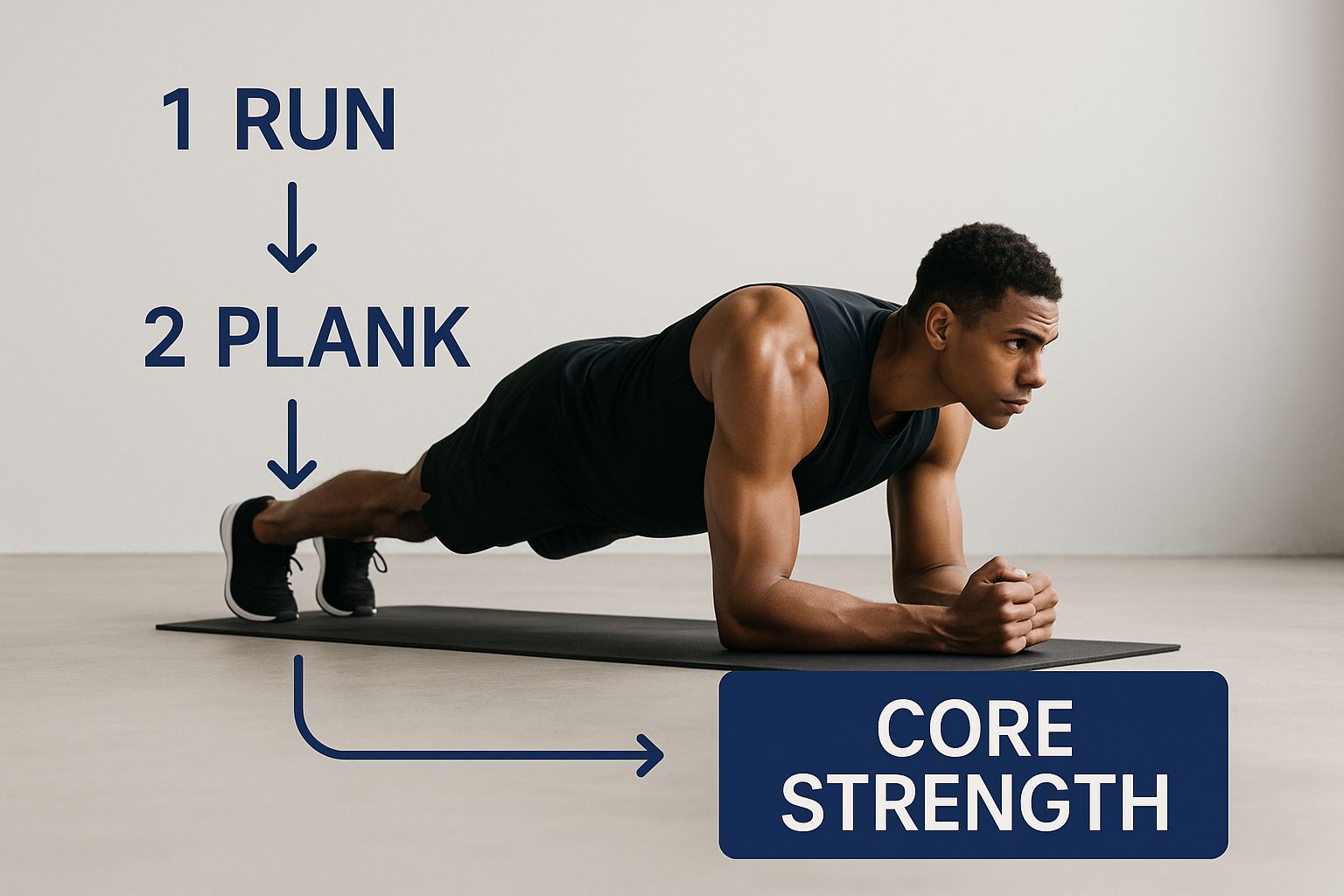
Think of your core as the chassis of a car. If it's weak and unstable, everything else will rattle and eventually break down. A balanced training schedule is what builds and maintains that strong centre.
Embrace Variety in Your Running Week
A truly effective plan involves more than just logging kilometres at the same pace. To build a robust aerobic base and avoid the repetitive strain that leads to injury, it is vital to vary your running intensity. Constantly running at the same moderate speed puts cyclical stress on the exact same muscles and joints.
A well-balanced week should include varied stimuli:
- Easy Runs: The foundation of your training. Approximately 80% of your runs should be at a relaxed, conversational pace. These runs build your aerobic engine and mitochondrial density without excessively stressing the body.
- The Long Run: Once a week, a longer, slower effort builds both physical endurance and mental fortitude. It is a cornerstone of training for any distance.
- Intensity Work: This does not have to be a lung-busting track session. It could be a tempo run, hill repeats, or structured intervals. These workouts improve your lactate threshold and running economy, but should be used sparingly (e.g., once a week) to manage injury risk.
By varying your efforts, you challenge your body in new ways. This not only makes you a more well-rounded runner but also spreads the mechanical load across your musculoskeletal system, dramatically lowering your risk of repetitive strain injury.
Strengthening Your Body For Running
Think of your muscles as the suspension and guidance system for your body. A strong, well-conditioned muscular system absorbs shock, stabilises joints, and maintains proper biomechanical alignment during running. If those muscles are weak, that force is transferred to passive structures like tendons, ligaments, and bones—tissues not designed to handle such high loads.
Many common running injuries, from patellofemoral pain (runner's knee) to IT band syndrome, often have their root cause far from the site of pain. The real culprit is frequently found in functional weakness further up the kinetic chain: weak glutes, unstable hips, or a core that fails to provide stability. When these key muscle groups are not functioning optimally, your form breaks down, creating abnormal stress elsewhere.

This is why strength training is a non-negotiable component of any serious injury prevention strategy for runners. The goal is not bodybuilding, but building resilience. Consistent strength work trains your body to activate the right muscles at the right time, leading to a more stable, powerful stride that is both more efficient and significantly less prone to injury.
Building Your Runner's Toolkit
You don’t need to spend hours lifting heavy weights. A study showed that runners who consistently managed just two 20-minute strength sessions a week had an 85% lower likelihood of injury than those who skipped it. The key lifestyle change is consistency, not volume.
Focus on functional, compound movements that mimic the demands of running. These are the essential exercises for any runner's strength routine:
- Squats: The ultimate exercise for lower-body strength, building power in your quadriceps, hamstrings, and glutes—all crucial for propulsion and shock absorption.
- Glute Bridges: Specifically targets and activates the gluteal muscles, which are vital for stabilising the pelvis and preventing the knee from collapsing inwards (valgus collapse).
- Planks: A core stability exercise that strengthens the entire trunk, helping you maintain an upright posture and stable pelvis, especially as you fatigue.
The purpose of strength training isn't just to get stronger in the gym. It's to become a more durable and efficient runner. Every squat, lunge, and plank directly contributes to better biomechanics and fewer injuries.
The Secret Weapon: Single-Leg Exercises
Running is fundamentally a series of single-leg hops; you are never on both feet at the same time. This is why incorporating unilateral (single-leg) exercises into your routine is one of the most powerful lifestyle changes you can make to prevent injury.
Working one leg at a time exposes and corrects muscular imbalances that are often masked during bilateral exercises like a standard squat. If your right glute is weaker than your left, a single-leg exercise will make that immediately apparent.
Start by adding these exercises to your routine:
- Single-Leg Deadlifts: Builds hamstring and glute strength while challenging your balance and core stability.
- Lunges: Whether forward, reverse, or walking, lunges target each leg independently to improve strength, stability, and hip mobility.
- Step-Ups: Stepping onto a box or bench isolates and strengthens the quadriceps and glutes of the stance leg, mimicking the propulsive phase of running.
Since hip weakness is a common root cause of running ailments, consider exploring targeted exercises for hip strength to complement these fundamental movements.
How to Fit It All In
Integrating strength work into a running schedule can feel challenging, but it is achievable. Aim for two or three short sessions each week, ideally on your easier run days or rest days. A session can be as short as 20-30 minutes and still be highly effective.
Remember, a strong core includes your lower back, which is crucial for preventing injuries. It's wise to incorporate exercises focused on strengthening your lower back for comprehensive core stability.
Here’s a sample weekly schedule:
| Day | Activity |
|---|---|
| Monday | Easy Run |
| Tuesday | Strength Session 1 (25 mins) |
| Wednesday | Harder Run (e.g., intervals) |
| Thursday | Strength Session 2 (25 mins) |
| Friday | Rest or Cross-Training |
| Saturday | Long, Slow Run |
| Sunday | Easy Run or Rest |
Consistency is key. Two focused, 20-minute sessions performed every week will provide far greater benefit than one long session done sporadically. Treat your strength training as an essential part of your running health.
Fine-Tuning Your Form and Gear
How you train and strengthen your body are critical pieces of the injury prevention puzzle, but your running biomechanics—and the gear you use—are also significant factors. The way you run determines how your body absorbs and distributes the force of every footstrike. Your shoes can either support or hinder this process.
The goal is not to force your running style into a "perfect" mould, but to make small, mindful adjustments to find a more efficient, less stressful stride that works for your body. Combining better form with appropriate equipment creates a powerful defence against common running injuries.
What Good Running Form Actually Looks Like
Many runners get caught up trying to consciously control every movement, which often feels awkward and unnatural. A more effective, medically-sound approach is to focus on simple, actionable cues that guide your body into a more efficient pattern.
Instead of obsessing over foot strike, focus on these key principles:
-
Run Tall: Imagine a string gently pulling you up from the crown of your head. This cue encourages an upright posture, which reduces strain on the lower back and improves breathing mechanics. Keep your chest open and your gaze forward.
-
Increase Your Cadence: Cadence refers to the number of steps you take per minute. A slow, loping cadence often leads to overstriding—landing with your foot far out in front of your body's centre of mass. This acts as a braking force and sends significant impact shock up the leg. A slightly quicker, shorter stride where your feet land more underneath your hips is mechanically less stressful on your joints.
-
Use Your Arms: Your arms counterbalance your legs and contribute to forward momentum. Keep them bent at roughly a 90-degree angle and swing them from the shoulder, primarily in a forward-and-back motion. Avoid excessive crossing over your body's midline.
You don't need to change everything at once. Pick one cue to focus on during your next run, such as running tall. By making these small, gradual adjustments, they will begin to feel natural over time.
Finding Your Cadence Sweet Spot
Forget the myth of hitting a magic number like 180 steps per minute. A personalized approach is far more effective. The goal is to find your current cadence and increase it by 5-10%.
Here is a simple method to try:
- Count Your Steps: During an easy run, use a timer and count how many times your left foot hits the ground in 30 seconds.
- Calculate: Multiply that number by four. This is your current cadence in steps per minute (spm). For instance, if you counted 40 steps, your cadence is 160 spm.
- Set a New Target: Add 5%. In our example, this brings your target to 168 spm. You can use a running watch with a metronome feature or a free metronome app to practise this slightly faster rhythm.
This small lifestyle change is surprisingly effective at reducing the impact forces transmitted through your knees and hips with each step.
Choosing the Right Running Shoes
The world of running shoes can seem overly complex, with terms like stability, cushioning, and heel-to-toe drop. However, the most important factor, supported by scientific research, is simple: comfort. A shoe that feels comfortable to you is often the one that best matches your unique biomechanics and is least likely to cause injury.
Here is a brief guide to shoe terminology:
| Shoe Feature | What It Means for You |
|---|---|
| Cushioning | The softness or firmness of the shoe's midsole. This is largely a matter of personal preference and the type of surface you run on. |
| Stability | Stability shoes include features designed to control pronation (the natural inward roll of the foot). A gait analysis can determine if you overpronate, but many runners do well in a neutral shoe. |
| Heel Drop | The height difference between the heel and the forefoot. A lower drop (0-4mm) may encourage a midfoot strike, while a higher drop (8-12mm) is more traditional. Any significant change in drop should be made gradually to allow your calf muscles and Achilles tendon to adapt. |
It is a crucial health tip not to buy shoes based on colour or brand loyalty. The best way to prevent shoe-related injuries is to get a professional fitting at a specialist running shop where staff can observe your gait and provide an informed recommendation.
Finally, small lifestyle choices matter. A good pair of moisture-wicking running socks can prevent blisters, while comfortable, non-chafing apparel allows for unrestricted movement.
Mastering Recovery and Listening to Your Body
The physiological adaptations from running—getting stronger and fitter—occur during periods of rest, not during the run itself. Recovery is an active process where your body repairs microscopic muscle damage, replenishes energy stores, and adapts to the training stress. Neglecting recovery is one of the fastest routes to overtraining, injury, and performance plateaus.
Mastering recovery involves two key lifestyle changes. First, provide your body with the necessary resources for repair. Second, learn to interpret your body's signals—knowing the difference between beneficial muscle soreness and the warning signs of impending injury.
Fuel Your Repair Process
Your post-run nutrition is a critical health habit. The primary goal is to replenish muscle glycogen (fuel stores) and provide protein to initiate muscle protein synthesis (repair). Simple, whole foods are highly effective.
Aim to consume a snack with a good mix of carbohydrates and protein within the 30-60 minute "recovery window" after finishing your run. During this time, your body is most receptive to nutrient uptake.
Excellent post-run nutrition options include:
- A glass of chocolate milk (offers a near-ideal carbohydrate-to-protein ratio).
- A banana with a tablespoon of peanut butter.
- A pot of Greek yoghurt with berries.
- A smoothie made with fruit, a scoop of protein powder, and milk or water.
This strategic snack provides the essential building blocks for recovery, helping to reduce muscle soreness and prepare you for your next session.
Sleep: The Ultimate Performance Enhancer
Sufficient sleep is arguably the most potent recovery tool available. During deep sleep, your body releases human growth hormone, which is essential for tissue repair and muscle building. Chronic sleep deprivation impairs this crucial physiological process, leading to persistent fatigue, a suppressed immune system, and a significantly higher risk of injury.
Make 7-9 hours of quality sleep a non-negotiable part of your training. To improve sleep quality, adopt good sleep hygiene practices: maintain a consistent bedtime, avoid screens for an hour before bed, and ensure your bedroom is dark, cool, and quiet.
An unscheduled rest day isn't a sign of weakness. It's a sign of a smart, mature runner who's playing the long game. Prioritising rest when your body is screaming for it is the strongest thing you can do for your running.
Learn Your Body's Language
A crucial skill for any runner is distinguishing between normal post-exercise soreness and the pain that signals injury. A dull, generalised muscle ache that improves with movement is typically Delayed Onset Muscle Soreness (DOMS)—a normal sign of adaptation.
In contrast, injurious pain often presents differently:
- It is often sharp, stabbing, or localised to a specific point.
- It worsens during a run, sometimes forcing an alteration of your gait.
- It is present upon waking or persists for several days.
- It is typically unilateral, affecting only one side (e.g., your right knee or left ankle).
Data from the 2025 SportsShoes Running Report revealed a concerning trend among UK runners: 52% admitted to running through side stitches and 42% have pushed on despite being dehydrated. This highlights a common tendency to ignore the body's warning signals, which can turn a minor issue into a significant injury. You can explore more of these insights in the full report on runner wellbeing.
If you experience sharp or persistent pain, it is a clear signal to stop. For any pain that lingers, seeking an assessment for professional physiotherapy is a wise medical decision. A professional can provide a diagnosis and a rehabilitation plan to prevent future issues and ensure a safe return to running.
Your Running Injury Questions, Answered
We've covered the core principles of staying injury-free, but here are answers to some common questions.
Should I Stretch Before a Run?
The evidence suggests that static stretching (holding a stretch for 30 seconds) before a run is not beneficial and may even be detrimental. Stretching a "cold" muscle can increase the risk of a strain and has been shown to temporarily reduce muscle power output.
Instead, a dynamic warm-up is the medically recommended approach. This involves active movements that prepare your body for running by increasing blood flow, raising core temperature, and activating key muscle groups.
A good dynamic warm-up could include:
- Leg swings (forward-backward and side-to-side) to improve hip mobility.
- High knees and butt kicks to activate the neuromuscular system.
- Walking lunges to engage glutes and quads.
- A 5-10 minute period of very light jogging to ease into the activity.
These movements serve as a rehearsal for the run itself. Save your static stretches for after your run, when your muscles are warm and more pliable.
A warm-up isn't about forcing flexibility. It’s about waking your body up and signalling that it's time to run. Dynamic movement is the perfect way to send that message.
How Often Should I Replace My Running Shoes?
Your running shoes are your most critical piece of equipment, but the cushioning material (EVA foam) degrades over time. The general guideline is to replace your shoes every 300 to 500 miles.
However, this is just an estimate. The lifespan of a shoe depends on factors like your body weight, running surface (tarmac is more abrasive than a trail), and your individual biomechanics.
The best health advice is to pay attention to your body and your shoes. Do the shoes feel "flat" or less responsive? Have you started experiencing new aches in your shins, knees, or feet? If so, it is likely time for a new pair, regardless of the mileage. Continuing to run in worn-out shoes is a common and preventable cause of injury.
At The Lagom Clinic, we believe that taking a proactive approach to your health is the key to performing your best, whether that's in sport or in life. If you need expert guidance on sports performance, injury prevention, or a personalised health plan, we're here to help. Discover a balanced approach to your wellbeing by visiting us at The Lagom Clinic website.


 Members Consultation