


It's a classic cyclist's dilemma: you finish a ride that was supposed to be kind to your joints, only to be met with screaming knees. More often than not, the root of the problem isn't cycling itself, but your bike fit, training habits, or underlying muscle imbalances. Understanding and addressing these factors through simple lifestyle changes is the key to lasting relief.
The pedalling motion is incredibly repetitive. Even a tiny misalignment gets magnified thousands of times over a single ride, eventually leading to strain. The good news? This also means that small, targeted adjustments to your setup and routine can make a world of difference.
Uncovering the Cause of Your Knee Pain
Cycling is a fantastic low-impact sport, so it’s hugely frustrating when knee pain crops up. The key is to play detective and figure out what’s causing the stress. Nearly every case of a cyclist's sore knees boils down to one of these three lifestyle factors:
- Your Bike Fit is Off: This is the most common culprit. Your bike setup is everything. If your saddle is too high, too low, or in the wrong fore/aft position, it throws your knee's mechanics completely out of whack, stressing ligaments and tendons with every pedal stroke.
- You've Ramped Up Training Too Fast: It's easy to get carried away by enthusiasm. A sudden jump in mileage or intensity is a classic recipe for an overuse injury. The same goes for constantly "mashing" big gears at a low cadence, which puts a huge amount of force through your kneecaps.
- You Have Muscle Imbalances: Your body works as a system. If key muscles like your glutes, core, or quads are weak, other muscles must compensate. Likewise, tight hamstrings or hip flexors can pull your pelvis out of alignment, causing your knee to track poorly through the pedal stroke.
You Are Not Alone
If your knees are giving you grief, you're in very good company. Knee injuries are the most common overuse issue for cyclists. In fact, studies suggest that anywhere from 40% to 60% of regular riders will experience knee pain.
This is often a direct result of the thousands of flexion and extension cycles the knee goes through on a ride, combined with one of the bike fit or training mistakes mentioned above. You can dive deeper into the research on the prevalence of cyclist's knee pain to see just how common it is.
The location of the pain is your biggest clue. Think of it as a roadmap pointing you directly to the source of the problem.
To help you start your investigation, we've put together a quick diagnostic table. Use this to connect where you feel the pain with its most likely cause, helping you focus your efforts on the right solution.
Decoding Your Knee Pain: A Quick Diagnostic Guide
| Pain Location | What It Often Means | Common Bike Fit Culprit |
|---|---|---|
| Front of Knee (Anterior) | Patellofemoral Pain Syndrome (PFPS) – strain on the patellar tendon. | Saddle is too low or too far forward. Pushing excessively hard gears. |
| Back of Knee (Posterior) | Strain on the hamstring tendons (biceps femoris) or calf muscle (gastrocnemius). | Saddle is too high or too far back, causing over-extension of the leg. |
| Inside of Knee (Medial) | Irritation of the medial collateral ligament (MCL) or pes anserine tendons. | Cleats are positioned incorrectly, causing your feet to point too far outwards (duck-footed). |
| Outside of Knee (Lateral) | Iliotibial (IT) Band Syndrome – friction where the IT band crosses the knee. | Cleats are positioned incorrectly, causing your feet to point too far inwards (pigeon-toed). |
This table isn't a substitute for professional medical advice, of course, but it's an excellent starting point for troubleshooting. By pinpointing the likely cause, you can start making targeted adjustments to your bike and your body to get back on the road, pain-free.
Dialing In Your Bike Fit to Protect Your Knees
If there's one single culprit behind sore knees from cycling, it's almost always a poor bike fit. When your setup is even a few millimetres out, it forces your knee to track through an unnatural, stressful path. Multiply that flawed motion by thousands of pedal strokes, and it’s no surprise that aches and pains start to creep in.
The good news? You don't necessarily need an expensive professional fitting to make a real difference.
Often, a few small, methodical tweaks at home can bring massive relief. The three areas that pack the biggest punch are your saddle height, its fore/aft position (how far forward or back it is), and your shoe cleat placement. Nailing these can fix the underlying mechanical issues putting strain on your knees, solving the problem before it becomes a long-term battle.
Finding Your Ideal Saddle Height
Think of your saddle height as the foundation of your entire bike fit. It has a direct and powerful effect on the front and back of your knee. If your saddle is too low, your quadriceps are forced to do all the heavy lifting, which puts excessive pressure on the patellar tendon at the front of your knee.
On the flip side, a saddle that’s too high makes you over-extend your leg on every downstroke. This strains your hamstrings and the tendons behind the knee.
Here’s a tried-and-tested method to get you into the right ballpark:
- The Heel-to-Pedal Method: Get on your bike in your cycling shoes and lean against a wall for support. Place one heel on the pedal and slowly pedal backwards. At the very bottom of the stroke, your leg should be completely straight. If your knee is still bent, the saddle is too low. If you have to rock your hips side-to-side to reach, it's definitely too high.
This simple check will get you surprisingly close to your ideal height. From that point, you can fine-tune it with tiny adjustments of just 1-2 millimetres per ride until it feels absolutely spot-on.
Adjusting Your Saddle’s Fore and Aft Position
With your saddle height sorted, it's time to look at its horizontal position. Shifting the saddle forwards or backwards along its rails dictates where your knee sits in relation to the pedal axle. Get this wrong, and you can easily end up with that nagging pain at the front of your knee.
A great starting point is the classic KOPS (Knee Over Pedal Spindle) method. It's not a rigid, non-negotiable rule, but for most riders, it’s an excellent guide.
To give it a go, sit on your bike with your feet clipped in and stop the pedals when they are level with the ground (in the 3 o'clock and 9 o'clock positions). Now, imagine a plumb line dropping from the bony bit just below your kneecap on your front leg. That line should pass straight through the centre of the pedal axle. If it falls in front of the axle, slide your saddle back. If it's behind, nudge the saddle forward.
Perfecting Your Cleat Placement
For anyone riding with clipless pedals, your cleat position is critical. If your cleats are misaligned, they can force your foot into an unnatural angle. That twist travels right up your lower leg into the knee, often causing pain on the inside or outside of the joint. It is a common trigger for IT band syndrome or irritation of the medial knee ligaments.
This infographic breaks down how these different factors—bike fit, overuse, and muscle imbalances—are all connected.
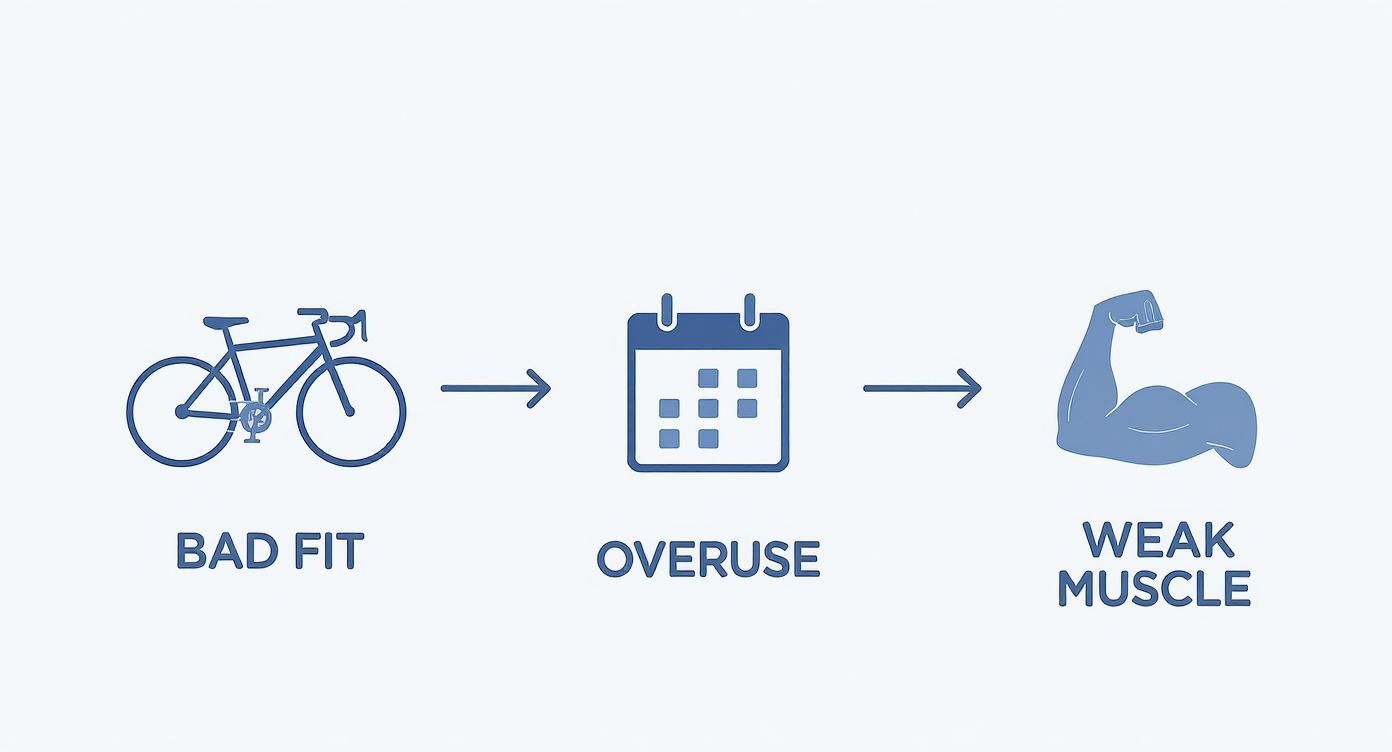
As you can see, a bad bike fit is frequently the first domino to fall, kicking off a cycle of strain and pain.
The goal here is simple: set your cleats so your feet can sit in their natural position. An easy way to find this is to sit on the edge of a high table and let your legs dangle freely. Take a look at your feet. Do they point dead straight, turn slightly inwards, or angle outwards? Your aim is to mimic that natural angle when you set up your cleats. It takes a bit of trial and error, but making small, patient adjustments is the key to getting it right and finally shaking off that knee pain.
Building Stronger Knees Off the Bike
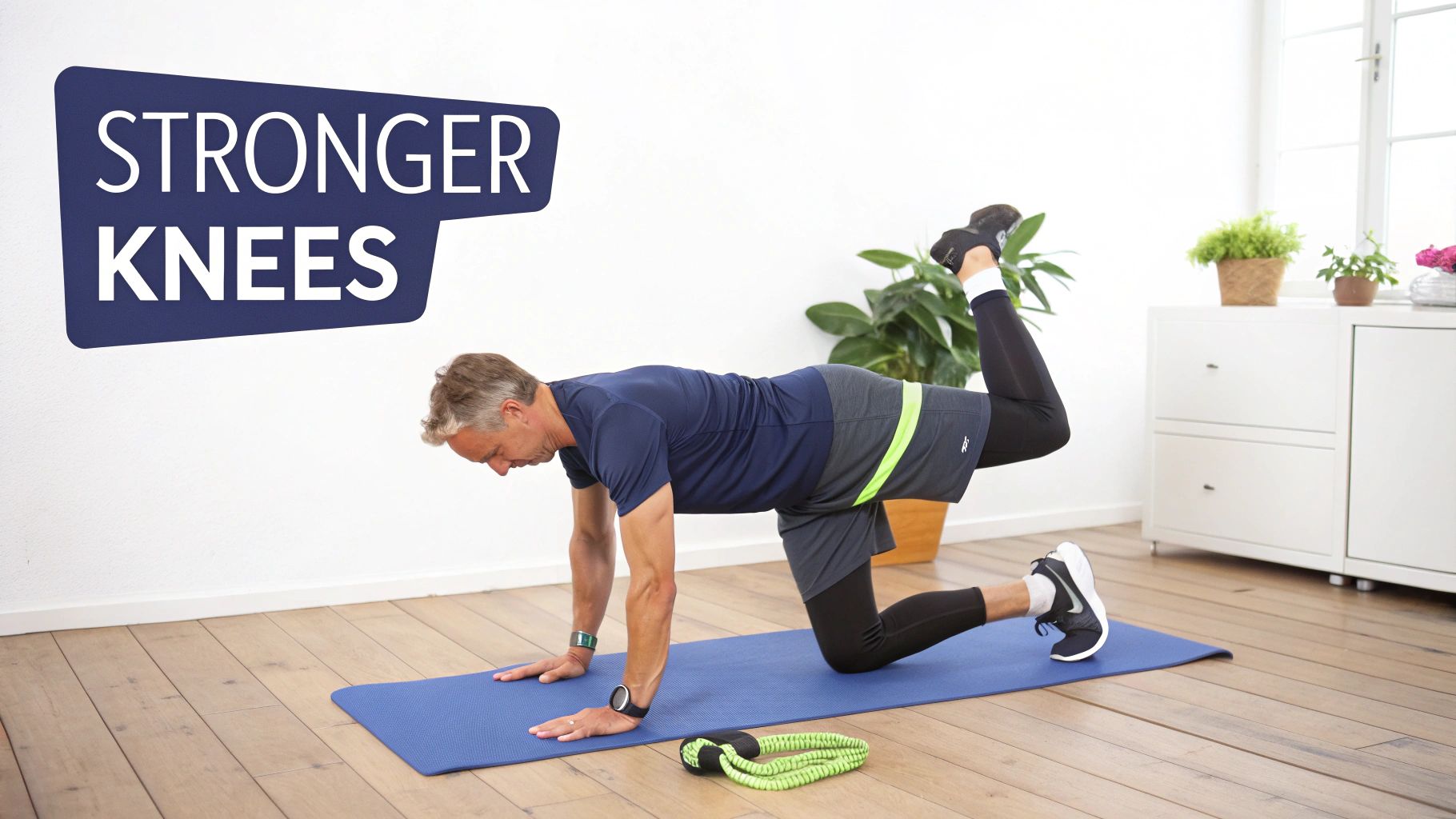
While getting your bike fit dialled in is a huge step toward pain-free riding, what you do off the bike is just as important. Think of your muscles as the scaffolding around your knee joint. If that scaffolding is weak or unbalanced, the joint itself is left to handle forces it was never designed for.
This is where that nagging ache often comes from. When powerhouse muscles like your glutes and core aren't pulling their weight, your quads tend to take over. This muscular imbalance can tug the kneecap out of its natural alignment, creating friction and irritation with every pedal stroke.
The good news is that you don't need to spend hours in the gym. A few smart, targeted exercises and some dedicated stretching can build a much more robust support system, protecting your knees for thousands of miles to come.
Strengthening Your Knee's Support System
The real goal here is to activate and strengthen the muscles that stabilise your pelvis and leg as you pedal. When these are working properly, your knee tracks like it’s on rails – straight up and down, with no wobbling to the side.
A solid routine should look beyond the knee itself and focus on the entire chain of muscles you use on the bike. Try working these movements into your week:
- Glute Bridges: Cyclists often have underactive glutes, and this exercise is the perfect wake-up call. Lie on your back, knees bent and feet flat. Drive your hips up to the ceiling by squeezing your glutes, hold for a second, and lower back down with control.
- Bodyweight Squats: This is a classic for a reason. It builds all-around strength in your quads, hamstrings, and glutes. The key is good form: keep your chest proud, back straight, and make sure your knees follow the line of your feet.
- Clamshells: An absolute must for strengthening the gluteus medius, which stops your knees from collapsing inwards. Lie on your side with knees bent to 90 degrees. Keeping your heels glued together, lift your top knee without letting your hips rock backward.
You'll be surprised at the difference just two or three sets of 10-15 reps, a few times a week, can make. For more ideas, you can find a whole range of exercises to help with a knee injury that work just as well for prevention.
The Importance of Post-Ride Stretching
Cycling is an incredibly repetitive motion. Thousands of pedal strokes can leave your muscles feeling tight and shortened, which in turn pulls your joints out of alignment. This is a classic recipe for pain.
Stretching isn't just about becoming more flexible. It’s about restoring balance to your body. For example, chronically tight hip flexors can tilt your pelvis, putting extra strain directly onto the front of your knee.
Make it a non-negotiable habit to spend five minutes stretching after every single ride. This simple ritual helps release all that built-up tension, improves your overall mobility, and stops minor tightness from snowballing into a real problem.
Pay special attention to these four areas:
- Hip Flexors: A simple kneeling lunge gets right into them.
- Quadriceps: The standing quad stretch is an old favourite that works.
- Hamstrings: Gently ease into a seated forward fold.
- Iliotibial (IT) Band: The standing cross-leg stretch is a great way to target this.
Hold each stretch for at least 30 seconds. Don't bounce; just breathe and let the muscle relax and lengthen. Consider it your first line of defence against that all-too-common post-ride knee pain.
Smarter Training Habits for Healthy Knees
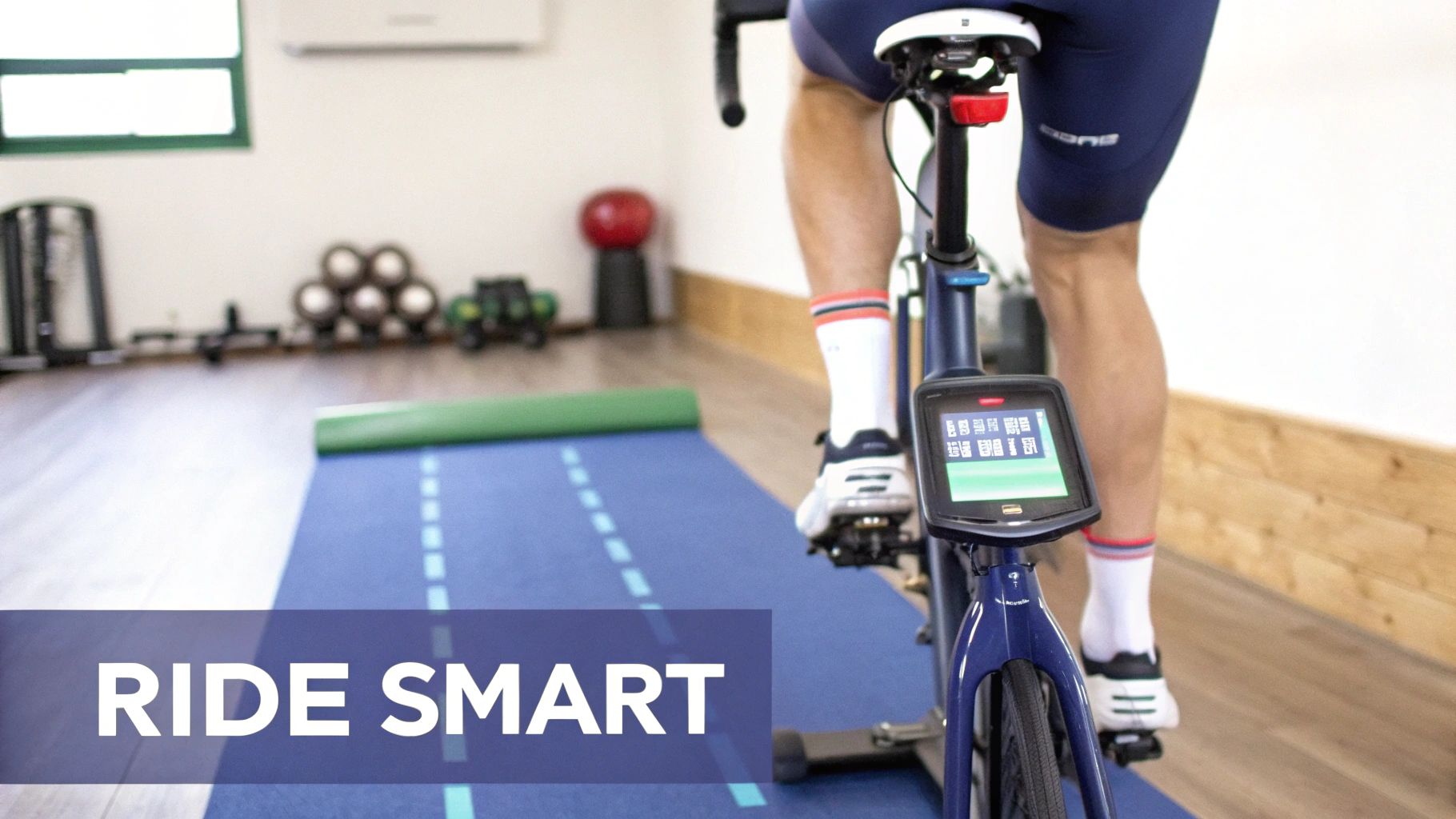
It’s a classic story. You’re feeling good, you discover a new route, and you suddenly decide to double your mileage for the week. While that burst of motivation is fantastic, jumping up in volume or intensity too fast is one of the surest ways to end up with sore knees after a ride.
Your knees are brilliant, but they need time to adapt. When you suddenly ask far more of them than they’re used to, the connective tissues get overloaded and inflamed. This is the very definition of an overuse injury, and it's what causes that dull, nagging ache that can quickly ruin the fun of cycling.
This isn't a minor issue. A 2021 study of 115 British cyclists found a lifetime knee pain prevalence of 48%. What's really telling is that almost 70% of those riders said their pain was made worse by cycling itself, which shows just how vital smart training habits are. You can dive into the full research about these findings on UK cyclists' knee pain here.
Ditch the Heavy Gears
One of the biggest mistakes riders make is "mashing" the pedals in a heavy gear at a low cadence (how fast you pedal). It might feel like you’re putting down serious power, but you’re also putting a huge amount of compressive force right through your kneecap and patellar tendon. It’s like doing a mini leg press with every single pedal stroke.
The better approach? Shift down to an easier gear and spin faster. Aim for a smooth cadence of 80-95 revolutions per minute (RPM). This simple change moves the effort from your joints to your cardiovascular system, dramatically cutting down on knee strain while still giving you a great workout.
Honestly, this one habit change is often enough to get rid of that front-of-the-knee pain completely. A higher, smoother cadence is not only kinder to your joints but it’s also far more efficient for longer rides.
Embrace Gradual Progression and Rest
If you want to keep your knees happy for the long haul, you need a patient, structured approach to your training. That means no more massive jumps in your weekly mileage or throwing in a bunch of brutal hill climbs all at once.
Here are a few principles to adopt as part of your cycling lifestyle:
- The 10% Rule: This is a solid guideline. Try not to increase your total weekly mileage or time on the bike by more than 10% compared to the week before.
- Listen to Your Body: This is non-negotiable. If you feel a twinge or a niggle, don't be a hero and push through it. It's much smarter to take an extra rest day now than to turn a small problem into a long-term injury.
- Schedule Rest Days: Recovery is when you get stronger. Your muscles need time to repair and rebuild. Pencil in at least one or two days of complete rest each week, especially after a particularly tough ride.
Looking after your body post-ride is just as important. To help ease any discomfort and support your overall knee health, it's worth exploring different strategies to reduce muscle soreness. This will help you get back in the saddle feeling fresh and ready to go.
Knowing When to See a Professional
Most of the time, you can resolve sore knees from cycling with a few tweaks to your bike fit, training routine, and some off-the-bike conditioning. But some symptoms are too serious to ignore. While at-home care works wonders for minor niggles, persistent or sharp pain is your body's way of signalling for expert help.
Ignoring these signals can turn a simple, fixable issue into a chronic problem that could sideline you for months. It is important to know when to stop self-managing and seek a professional medical opinion.
Red Flags That Mean "See a Pro"
If any of the following sound familiar, it’s time to get a professional opinion. These aren't just aches and pains; they're signs that something more specific is going on that needs a proper diagnosis and a solid treatment plan.
- Pain That Persists or Worsens: If your knee still hurts after a week of rest and sensible adjustments, or if the pain is increasing, don’t push through it.
- Sharp, Stabbing Sensations: A dull ache after a long ride is one thing. A sharp, localised pain, especially one that hits at the same point in your pedal stroke every time, points to a more acute problem.
- Obvious Swelling or Redness: If you can see swelling, or the area around your knee feels warm and looks red, that’s a clear sign of inflammation that needs a proper look.
- An Unstable Feeling: Any sense that your knee might "give way," lock up, or just feels wobbly is a major red flag. This isn't something you should risk on the bike or even walking around.
- Loud Clicks, Pops, or Grinding: A loud pop during an injury is an immediate stop sign. The same goes for any painful clicking or grinding you feel when you move.
It's easy to fall into the "it'll sort itself out" trap. But here's a sobering thought: a study of high-level cyclists with non-traumatic knee pain found that while pros seek help within about three months, amateurs often wait nearly two years. That delay can make recovery a whole lot harder.
What to Expect from a Professional Assessment
Seeking a professional assessment is the quickest way to get an accurate diagnosis and a recovery plan that works. A qualified physiotherapist will conduct a full assessment of your movement, check your muscle strength, and evaluate your joint function to identify the root cause of the problem.
If you're curious about what a session entails, our guide on what musculoskeletal physiotherapy is breaks it down nicely.
They might also suggest other treatments to help speed things along. For instance, understanding the benefits of sports recovery acupuncture could be useful if your physio thinks it might help.
Ultimately, getting expert help means you’re fixing the actual problem, not just masking the symptoms. That’s how you get back to pain-free cycling faster and with the confidence that you’re not going to end up in the same situation again.
Common Questions About Cycling and Knee Pain
When your knees start hurting, the questions start swirling. You want to keep riding, but you also need to listen to your body. Let's tackle some of the most common concerns cyclists have when their knees are giving them grief.
Should I Push Through Mild Knee Pain?
The health advice is clear: pushing through pain is rarely a good idea. While a very gentle, short spin with a high, easy cadence might be okay for a minor niggle, any sharp pain or an ache that worsens as you pedal is a signal to stop immediately.
Think of it this way: pushing through pain is how a minor annoyance becomes a real injury. A bit of rest now will get you back on the bike much faster in the long run than gritting your teeth and making things worse.
Are Flat Pedals Better for Sore Knees?
Not necessarily. The choice between flat and clipless pedals is less about the pedal type and more about your personal setup and biomechanics. Flats allow for natural foot movement, which can be beneficial, but they don't provide the same stability as clipless systems.
The real culprit behind knee pain is almost always alignment, not the pedal itself. Incorrectly positioned clipless cleats can lock your knee into a stressful angle. Conversely, a perfectly adjusted clipless system can support proper knee tracking. For many riders prone to knee issues, using clipless pedals with a bit more rotational float offers the ideal middle ground – stability with just enough wiggle room.
The bottom line is this: either pedal system can be great for your knees when set up properly, and both can cause problems if they aren't. It’s all about dialling in the setup to suit your body’s natural movement.
How Long Until My Knee Pain Goes Away?
This depends on the underlying cause and the lifestyle changes you make. For a simple bike fit issue, you could feel relief almost instantly. I’ve seen riders feel a world of difference just by dropping their saddle by 5mm or making a tiny cleat adjustment.
If the soreness is from overtraining, a few days of rest and easy activity should resolve it. For more stubborn conditions like tendinopathy or IT band syndrome, patience is key. Recovery can take several weeks, or even a couple of months, of dedicated stretching, strengthening, and smarter training to get back to 100% and prevent it from coming back.
Is Cycling Good for Knees with Arthritis?
Yes, absolutely. As long as it's done correctly, cycling is one of the best exercises you can do for osteoarthritis. As a low-impact activity, it avoids the jarring forces on your joints that come from activities like running.
Even better, cycling builds up the very muscles that support and protect the knee joint – your quads, hamstrings, and glutes. These muscles act as a natural brace for your knee; the stronger they are, the less stress the joint has to handle. The key for arthritic knees is to ensure your bike fit is correct and to avoid ramping up your riding volume too quickly.
At The Lagom Clinic, we specialise in helping active individuals overcome issues like knee pain to maintain a healthy lifestyle. If you're struggling with persistent discomfort, our experts can provide a thorough assessment and personalised plan to get you back on the road pain-free. Book your consultation at https://www.thelagom.co.uk.

 Members Consultation