


A swim training plan is what takes you from just splashing about to making real, tangible progress in the water. Medically speaking, it’s the difference between random activity and a structured regimen designed to improve cardiovascular health, muscular endurance, and metabolic function. It gives your time in the pool purpose, building your fitness, technique, and endurance piece by piece, all while minimizing the risk of strain.
Building Your Personal Swim Blueprint
Jumping into any new fitness routine can feel a bit overwhelming. The secret to a swim plan that actually works is to build it on a realistic foundation – something you can genuinely stick to for long-term health benefits. This process doesn't start in the pool, but with a good, honest look at where you are right now and where you want to go.
Assess Your Starting Point Honestly
Before you get caught up in distances and speeds, you need a clear picture of your current ability. This isn't about being hard on yourself; it's a crucial step to avoid injury and create a plan that helps you improve, not one that just leaves you frustrated. Proper assessment prevents common overuse injuries like swimmer's shoulder.
Ask yourself a few simple questions:
- How comfortable am I? Are you a complete novice who gets a bit nervous in the deep end, or can you already swim continuous laps without a problem? Your comfort level affects your breathing and heart rate.
- What’s my current fitness like? Can you swim 100 metres without a break, or do you find yourself needing to stop after every length? Be specific. This helps gauge your current cardiovascular capacity.
- Do I know the basics? Have you got a decent grasp of strokes like freestyle and breaststroke, or is that the very first thing you need to work on? Correct form is vital for preventing joint strain.
This self-check helps you set a sensible starting point. One of the most common mistakes is trying to do too much, too soon, which is a fast track to burnout and injury. If staying committed is a hurdle, figuring out how to get motivated for exercise can give you the mental edge you need.
Define What Success Looks Like for You
The goals you set will shape your entire plan. Vague targets like "get better at swimming" won't cut it. You need goals that are specific, measurable, and meaningful to you and your health.
A fundamental part of building your personal swim blueprint involves not only stroke mechanics but also understanding posture and its musculoskeletal effects to ensure efficiency and prevent injury. Good posture out of the water translates to a more streamlined, powerful, and sustainable technique in it.
Think about goals that go beyond just swimming further. For example:
- Technique Focus: "I want to nail bilateral breathing in my freestyle within six weeks to ensure balanced muscle development and even oxygen intake."
- Endurance Goal: "My aim is to swim for 20 minutes straight without stopping in two months to improve my cardiovascular stamina."
- Strength Target: "I want to feel strong on my last lap, not completely gassed out, by building muscular endurance."
Finally, there’s a practical side to all this: facility access. Your ability to stick to a plan is directly tied to being able to get to a pool. Recent data showed the number of UK sites with a pool had dropped to 2,882 by March 2025, which can be a real challenge. Finding a convenient, reliable pool is a non-negotiable first step.
The Anatomy of a Powerful Swim Workout
A truly effective session is so much more than just churning out endless, mind-numbing laps. A proper workout has distinct parts, and each one has a specific job to do—all designed to make you a better swimmer and keep you injury-free. When you understand the 'why' behind each component, you can turn a casual paddle into a seriously powerful part of your swim training plan.
Think of your workout like a story with a beginning, a middle, and an end. Just jumping into the pool and hammering out a hard set is a classic recipe for pulled muscles and sloppy, inefficient swimming. A solid warm-up is non-negotiable from a physiological standpoint. It’s all about gradually raising your heart rate, getting blood flowing to your muscles, and activating your nervous system for the work ahead.
This isn't just about 'feeling' ready; it's about what's happening inside your body. A good warm-up can increase your muscle temperature by a few degrees, making them more pliable and far less likely to strain. It's a simple lifestyle habit that protects your body and lets you train consistently over the long haul.
The Building Blocks of Your Session
The core of any structured swim workout is built from a few key elements. While the main set gets all the glory, the supporting acts are what really allow you to perform at your best and recover properly.
Here’s a look at how a typical session breaks down:
- Warm-Up: This should take up about 10-15% of your total pool time. Think easy swimming, slowly picking up the pace, and mixing in different strokes to get all your key muscle groups firing. This prepares your heart, lungs, and muscles for more intense work.
- Drill Set: This is where you put your technique under the microscope. You might grab a kickboard or pull buoy, or you might work on specific movements like the fingertip drag drill or sculling to get a better feel for the water. This phase is about improving neuromuscular coordination.
- Main Set: This is the heart of your workout. It's designed to push a specific energy system, whether that’s building your aerobic engine with steady-state swimming or developing raw power with sprints and intervals.
- Cool-Down: Just as important as the warm-up, this is all about easy swimming to let your body wind down. It helps flush out metabolic byproducts like lactic acid that build up in your muscles, which can make a big difference in reducing post-exercise soreness.
The real difference between a technique drill and a main set comes down to focus versus effort. You do drills at a low, controlled intensity to perfect your movements. The main set is where you push your physical limits to build speed and stamina.
From Drills to Main Sets
Once you’re properly warmed up, it’s time to dial in your technique. Drills are your chance to break down your stroke and iron out any bad habits. For example, the Tarzan Drill—where you swim freestyle with your head completely out of the water—is brilliant for strengthening your neck muscles and getting you comfortable with sighting in open water.
After you've sharpened your technique, you dive into the main set. This is where you really go after your main goal for that day's session. If you're building endurance, your main set might be a long, continuous swim at a comfortable, steady pace. If speed is the name of the game, you could be looking at high-intensity intervals, something like 8 x 50 metres fast with just a short rest between each one. It's this variety that keeps your body guessing and adapting, which is the key to consistent improvement.
Designing Your Weekly Swim Schedule
If there's one secret ingredient to getting better in the water, it's consistency. A well-thought-out weekly schedule is what transforms random swims into real, measurable progress. It helps you build a rhythm that actually fits into your life, side-stepping the burnout that so often comes from trying to cram too much in. The aim here is to build a swim training plan that pushes you but doesn't break you.
Whether you can get to the pool twice a week or five times, having a structure is everything. It's not just about the number of sessions, but what you do during that time. A smart schedule mixes up high-intensity work with lighter, technique-focused days and, crucially, gives your body time to rest and recover.
Balancing Intensity and Recovery
One of the most common mistakes I see is swimmers going flat-out every single time they get in the pool. That's a fast track to fatigue, sloppy form, and even injury. A much better approach is to build your week around a principle called periodization, which basically means you cycle through different levels of intensity.
So, no, not every swim needs to be a lung-buster. Some days are for building your engine with longer, steadier swims. Others are for sharpening your speed with short, sharp intervals. And just as important are your recovery days – which might be a very gentle swim focused on feel, or a complete day off. This mix is the key to breaking through those frustrating plateaus and preventing overtraining syndrome.
Smart scheduling is less about raw hours and more about purpose. A focused 45-minute session with a clear goal—like improving your kick—is far more valuable than two hours of aimless, sloppy laps.
This simple breakdown shows the three core parts of any good swim session. Think of these as the building blocks you'll use to construct your weekly schedule.
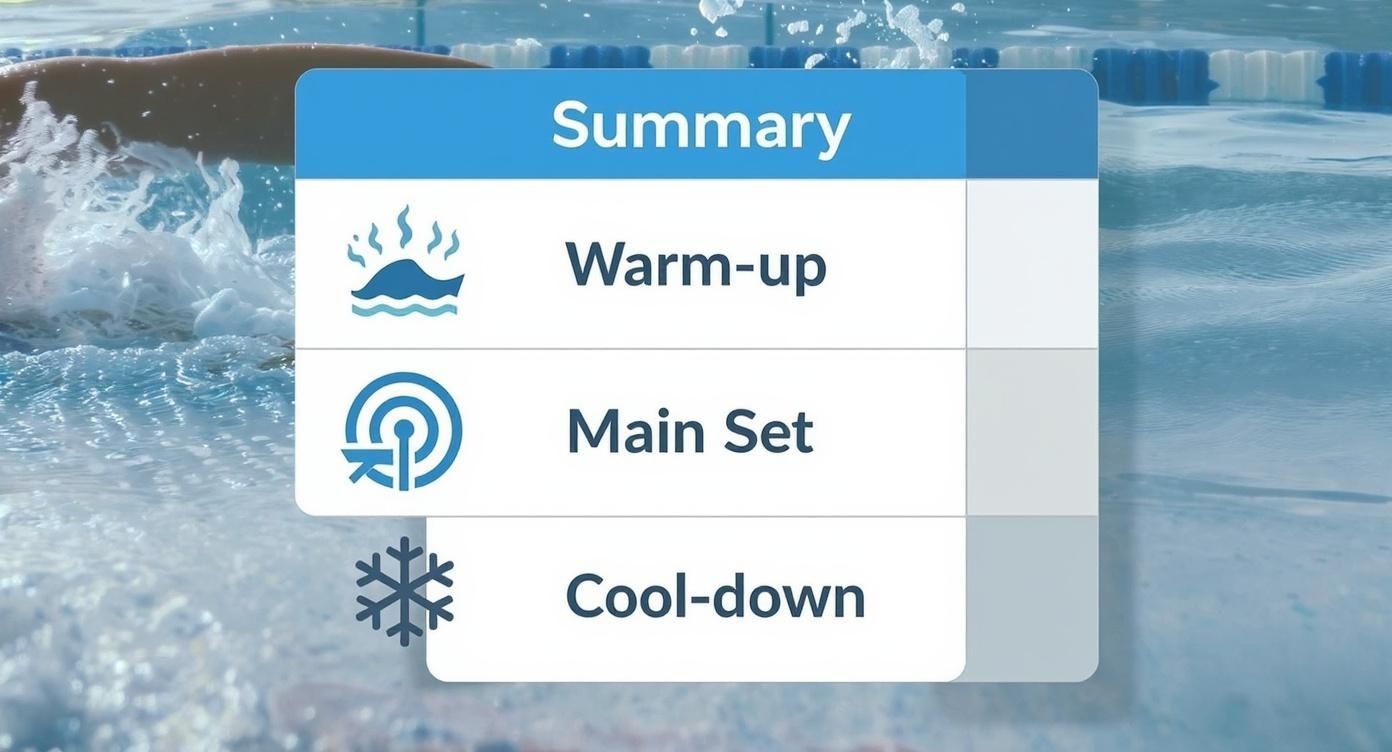
Each of these stages has a specific job to do, from getting your body ready for the main effort to helping it wind down and recover properly afterwards.
Sample Schedules for Different Goals
Naturally, your weekly plan will look different depending on your experience and what you're aiming for. A beginner's schedule is worlds away from what an advanced competitor needs.
For example, if you're just starting out, your week might be built around two sessions focused heavily on technique and one dedicated to building a bit of endurance. An advanced swimmer, on the other hand, might have five sessions: two for high-intensity speed work, two for building their aerobic base, and one for active recovery and drills. The trick is to plan your week ahead and give every session a clear purpose.
This structured approach is gaining traction everywhere. In the UK, for instance, well-organised training plans are becoming fundamental to community swimming. The State of the UK Swimming Industry Report 2025 found that a staggering 85% of young people learn to swim in public pools, with schools often relying on these programmes. This really underscores how vital structured plans are, right from the grassroots level. You can read more in the full 2025 swimming industry report.
To give you a clearer idea of how this might look, here are a few examples.
Sample Weekly Swim Training Plan Structures
| Day | Beginner (2-3 sessions/week) | Intermediate (3-4 sessions/week) | Advanced (4-5 sessions/week) |
|---|---|---|---|
| Monday | Technique & Drills | Technique & Drills | High-Intensity Intervals (Speed) |
| Tuesday | Rest | Rest or Active Recovery | Endurance (Aerobic) |
| Wednesday | Endurance (Steady Pace) | Endurance (Threshold) | Rest or Active Recovery |
| Thursday | Rest | Rest | High-Intensity Intervals (Race Pace) |
| Friday | Technique & Drills | Technique & Speed Play | Endurance (Aerobic) |
| Saturday | Rest | Rest | Technique & Recovery Swim |
| Sunday | Rest | Optional Long, Easy Swim | Rest |
These are just templates, of course. The best plan is one you can stick to, so feel free to move days around to fit your life.
No matter what level you're at, always remember that the magic happens during recovery. That's when your body adapts and gets stronger. If you ignore it, you risk overtraining. It’s well worth learning how to prevent sports injuries by listening to your body and making rest a non-negotiable part of your plan.
Fueling Your Body for Peak Performance
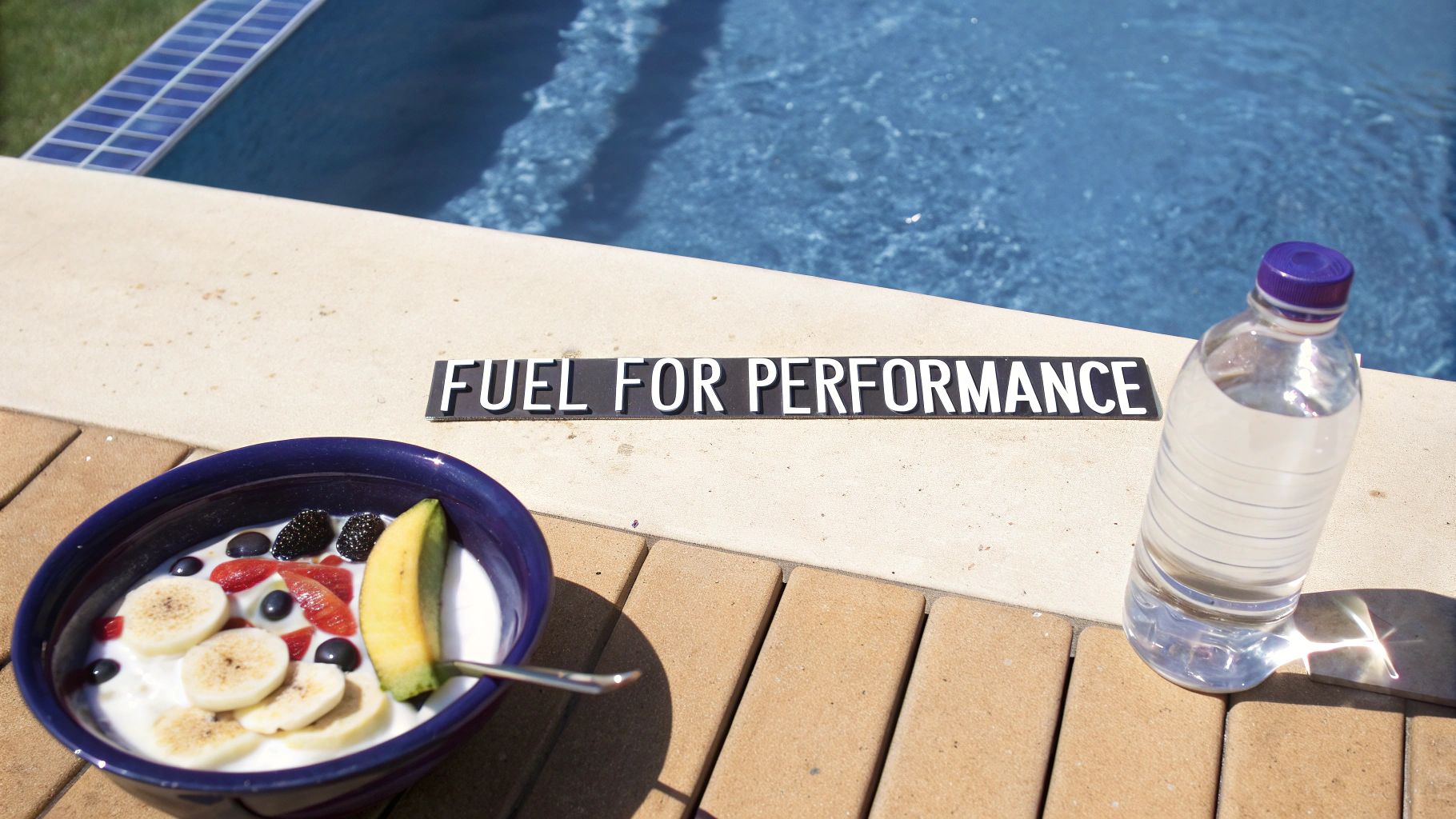
To get the most out of any training plan, you have to realise what happens outside the pool is just as crucial as the laps you put in. Your nutrition, hydration, and recovery are the engine powering your performance. Get them wrong, and you’ll struggle.
Think of it like this: your body is a high-performance car. You wouldn't fill it with shoddy fuel and expect it to win a race. The same principle applies to swimming.
Scientifically, your body needs the right nutrients at the right times. Before a swim, the focus is all on easily digestible carbohydrates. They’re your body’s go-to energy source, providing the quick fuel your muscles need to fire efficiently from the first length to the last.
This doesn't mean you need a massive meal. A small, carb-focused snack about 60-90 minutes before you hit the water is perfect. It tops up your glycogen stores—the energy saved in your muscles and liver—so you don't hit that wall midway through your main set.
Pre-Swim Fuel Ideas
- A small banana or a handful of dates for a quick, natural sugar kick.
- A slice of toast with a thin layer of jam.
- A small bowl of porridge made with water or milk.
After your session, the game changes. Now, your priorities are twofold: replenishing the energy you've just burned and giving your muscles the building blocks they need to repair. This is where a combination of carbohydrates and protein is essential. Protein helps mend the microscopic tears in your muscle fibres that occur during training, which is exactly how you get stronger over time.
Try to get a post-swim snack or meal in within 30-60 minutes of finishing your workout. This "recovery window" is when your body is primed for nutrient absorption, letting you kick-start the recovery process immediately.
Your lifestyle outside of training dictates your success within it. Consistent, high-quality nutrition and sleep are not optional extras; they are fundamental components of any effective training plan.
If you’re serious about your performance, it’s worth looking into an ultimate nutrition plan for athletes that’s built around your specific training demands.
Post-Swim Recovery Meals
- A smoothie with protein powder, fruit, and milk or a dairy-free alternative.
- Greek yoghurt with berries and a sprinkle of granola.
- A chicken or tofu salad sandwich on wholemeal bread.
Beyond food, hydration is completely non-negotiable. It’s easy to forget you’re sweating in the pool, but you lose a surprising amount of fluid. Dehydration of just 2% of your body weight can seriously hamper your performance. So, sip water throughout the day and always have a bottle on the poolside.
Finally, never, ever underestimate the power of sleep. It's during those deep sleep cycles that your body releases growth hormone, which is vital for muscle repair and adaptation. Aiming for 7-9 hours of quality sleep per night is one of the best recovery tools you have, making sure you’re genuinely ready for the next session.
How to Keep Getting Better and Smash Through Plateaus
If you’re not tracking your progress, you're just guessing. A good swim training plan isn't set in stone; it lives and breathes based on how you’re doing. Knowing what’s working and what isn’t is everything, especially when you feel like you’ve hit a wall.
The good news? You don’t need a load of fancy tech to do this. A few simple numbers can tell you the whole story, giving you hard facts instead of just a feeling that you're stuck. It turns a frustrating plateau into a puzzle you can actually solve.
The Metrics That Really Matter
First things first, let's get a baseline. Think of these not as a test, but as your starting point—the data that will shape your entire plan.
- Your Benchmark Swim: Time yourself swimming a set distance, say a 400m time trial. Do this every 4-6 weeks. This is your clearest, most honest indicator of whether you're getting faster and fitter.
- Stroke Count per Length: Swim one length at a nice, steady pace and count how many strokes it takes. As you get better, you'll find this number starts to drop. It's a fantastic sign that you're becoming more efficient, covering more water with every single pull.
- Your SWOLF Score: This one is a classic for a reason. It beautifully combines your speed and efficiency. To get it, just add your time for one length (in seconds) to your stroke count for that same length. For example, if you swim a 25m length in 30 seconds taking 15 strokes, your SWOLF score is 45. The goal is to get that number as low as possible.
Tracking progress isn’t just for the pros. It’s for anyone who wants to make sure their effort in the pool is actually paying off. This is what separates structured training from just splashing about.
It seems more people are catching on to this focused approach. In England, the percentage of swimmers getting involved in competitions recently jumped from 1.4% to 2.6%. Even with overall numbers going up and down, it points to a real appetite for goal-driven swimming. You can dig into more of the data on UK swimming participation on Statista.com.
What to Do When You Hit a Wall
Every swimmer, from a newbie to an Olympian, eventually hits a plateau. It’s that frustrating point where you stop seeing improvements, no matter how hard you work. Don't panic. It's a completely normal part of the process and usually just means your body has gotten used to what you're throwing at it.
A plateau is often just a symptom. The real cause might be a subtle flaw in your technique that’s holding you back, or you could simply be overdoing it, not giving your body the rest it needs to rebuild and get stronger.
Here are a few tried-and-tested ways to break through:
- Get Someone to Film You: This is a game-changer. Ask a friend to record you swimming from a few different angles—above the water, from the side, and even underwater if you can. You’ll be amazed at what you see. Flaws you can’t feel, like a dropped elbow or a lazy kick, suddenly become glaringly obvious on screen.
- Mix in Some Cross-Training: Sometimes the best thing you can do for your swimming is to get out of the pool. Yoga is brilliant for improving your flexibility and core strength, which is the foundation of a powerful stroke. A bit of light weight training can also build strength that translates directly to more power in the water.
- Go Back to Basics for a Week: Forget about the clock for a little while. Dedicate an entire week to focusing on just one tiny part of your technique. Maybe it's your hand entry, your body rotation, or your breathing pattern. This kind of focused, deliberate practice can unlock huge gains in efficiency that will make you faster in the long run.
Common Questions About Swim Training
Whenever you start a new swim plan, a few questions almost always pop up. Getting solid, science-backed answers can make a huge difference, helping you train smarter, avoid injury, and feel more confident in what you're doing. Let's dive into some of the most common ones.
How Many Times a Week Should I Swim?
When it comes to seeing real improvement, consistency is everything. It’s far better than cramming in a couple of huge, exhausting sessions a week. The perfect number of swims really hinges on your fitness level and what you’re trying to achieve, but the golden rule is always to listen to your body.
If you’re just starting out, aiming for two to three sessions a week is a brilliant goal. This gives your body enough time to build muscle memory and improve your aerobic fitness without pushing you towards burnout. Swimmers with a bit more experience often hit their stride with three or four sessions, while the more advanced among us might be in the pool four to six times a week.
Remember, rest is where the magic happens—it’s when you actually get stronger. A focused, high-quality 45-minute workout will always beat a sloppy 90-minute session where your form falls apart from fatigue.
What Training Gear Is Actually Worth Buying?
The market is flooded with all sorts of swimming gadgets, but you only need a couple of core items to make a real difference. Forget the fancy tech for now; mastering the basics with simple, effective tools is what builds a powerful foundation in the water.
First things first, get yourself a pair of comfortable, well-fitting goggles that don’t leak. There’s nothing more frustrating than constantly stopping to empty water from your eyes—it completely kills your rhythm. After that, a kickboard and a pull buoy are your best friends in training.
- A kickboard lets you isolate your legs, so you can really zero in on building a stronger, more efficient kick.
- A pull buoy, tucked between your thighs, does the opposite. It keeps your legs still, forcing you to focus entirely on your pull and upper-body strength.
These two pieces of kit are fundamental. They let you break down your stroke and strengthen each part individually, which is a cornerstone of any effective swim training plan.
How Can I Prevent Swimmer's Ear and Skin Irritation?
A few simple lifestyle habits can stop the most common pool-related annoyances in their tracks, making sure your time in the water stays enjoyable. It’s all about being proactive right after you finish your swim.
For swimmer's ear (otitis externa), the main goal is just to get trapped water out of your ear canal. As soon as you’re out of the pool, tilt your head to each side and give your earlobe a gentle tug to help it drain. Then, use the corner of your towel to carefully dry your outer ear. For persistent issues, using a few drops of a half-white vinegar, half-rubbing alcohol solution after swimming can help dry out the ear and prevent bacterial growth, but consult a doctor first.
To deal with that dry, itchy feeling from chlorine, the number one rule is to rinse off immediately. A quick shower with a gentle, moisturising soap washes away the chemical residue and helps restore your skin’s natural protective barrier. For your hair, try applying a little leave-in conditioner before putting on your swim cap; it creates a protective barrier against the chlorine.
Don’t forget that proper hydration is a massive part of this, too. Drinking plenty of water all day helps your body, including your skin, better handle exposure to pool chemicals from the inside out.
At The Lagom Clinic, we believe that expert guidance is key to achieving your health and performance goals. If you're looking to optimise your training, prevent injuries, or get personalised advice on your fitness journey, our team is here to help. Explore our services and book a consultation at https://www.thelagom.co.uk.


 Members Consultation