


Improving your running endurance is not about a quick fix. It is a long-term commitment that hinges on consistent training, fuelling your body correctly, and allowing adequate time for recovery. This is a journey of steady, sustainable lifestyle changes that lead to profound physiological improvements.
Build Your Foundation for Lasting Endurance
Before increasing your mileage or chasing a new personal best, it's crucial to understand what building endurance does to your body from a medical standpoint. You are creating physiological adaptations that allow you to sustain a strong pace for longer. By focusing on core health principles from the beginning, you’ll build a solid base that helps prevent injury and guarantees lasting improvement.
This foundational phase is about building healthy habits that support your running. This involves creating a realistic schedule you can adhere to, learning to interpret your body’s signals to avoid overexertion, and setting goals that keep you motivated for the journey ahead.
Understanding the Science of Stamina
From a physiological perspective, improving running endurance is about enhancing your body's ability to deliver oxygen to your muscles and use that oxygen efficiently. There are three key physiological components that are central to this process.
To understand your training, let's break down the core pillars of running endurance. These are the physiological metrics that your training will directly influence, providing a clear picture of why certain lifestyle changes and workouts are so effective.
Your Core Pillars for Running Endurance
Understand the three key physiological components of endurance and a simple, healthy action to start improving each one.
| Endurance Pillar | What It Means for Your Health | Your First Action Step |
|---|---|---|
| VO2 Max | This is the maximum rate of oxygen your body can consume during intense exercise, reflecting cardiovascular fitness. A higher VO2 max means your heart and lungs are highly efficient at supplying your muscles with oxygen. | Incorporate short, high-intensity intervals (like 400m repeats) into one run per week to challenge your cardiorespiratory system. |
| Lactate Threshold | This is the intensity at which lactate builds up in your blood faster than it can be cleared. A higher threshold allows you to run faster for longer before fatigue sets in. | Add a weekly "tempo run" where you hold a comfortably hard pace for 20-30 minutes to improve lactate clearance. |
| Running Economy | This refers to your energy efficiency at a given pace. Better biomechanics and functional strength make you a more efficient runner, conserving energy over long distances. | Practise simple running drills like high knees and butt kicks twice a week to improve your form and reduce wasted motion. |
By targeting these three areas in your training, you’re not just running more—you’re systematically building a more capable and resilient cardiovascular and musculoskeletal system.
Consistency Is Your Greatest Ally
The most critical lifestyle change for building endurance is consistency. Sporadic, intense efforts cannot compete with the cumulative power of regular, manageable runs. It takes time for your body to build more capillaries, increase the mitochondria in your cells (your cellular power stations), and strengthen your heart muscle.
This is supported by scientific evidence. A detailed study of recreational runners showed a clear link between years of experience and performance in longer races, finding that marathon and ultra-marathon runners consistently had more years of running under their belts. Long-term consistency was a key factor in their endurance. You can review the full findings on how running experience impacts performance on Nature.com.
Building endurance is a testament to the power of accumulation. Every consistent run, no matter how short or slow, is a deposit into your fitness bank. Over time, these small deposits compound into significant health gains that a few heroic, inconsistent efforts can never match.
Setting Realistic and Motivating Goals
To stay consistent, you need goals that are both inspiring and medically sensible. A common mistake is aiming for an overly ambitious goal too quickly, which is a fast track to burnout or injury. A much smarter approach is to progress in stages.
If you are new to running, your first goal could be running for 20 minutes without stopping. Once achieved, you could aim for a local 5k. For an experienced runner, a healthy goal might be to improve a half-marathon time over a six-month training period.
The key is to embrace the process, not just the outcome. Celebrate small victories—like completing all your planned runs for the week or noticing a familiar route feels a little easier. This positive feedback builds momentum and makes the journey more enjoyable, ensuring you’ll stick with it for the long run.
Design Your Weekly Training for Real Gains
To genuinely improve your running endurance, you need a plan that is more sophisticated than simply running more. A well-balanced weekly schedule that incorporates different types of runs, each with a specific physiological purpose, is the most effective approach. This method is your best defence against burnout and injury and is what builds a truly resilient, well-rounded runner.
It's time to move beyond simply logging kilometres and start training with intention. A well-designed week will systematically build your aerobic base, improve your ability to hold faster paces, and boost your top-end speed. All of these elements combine to create superior endurance.
This infographic breaks down the simple but powerful cycle of effective endurance training.
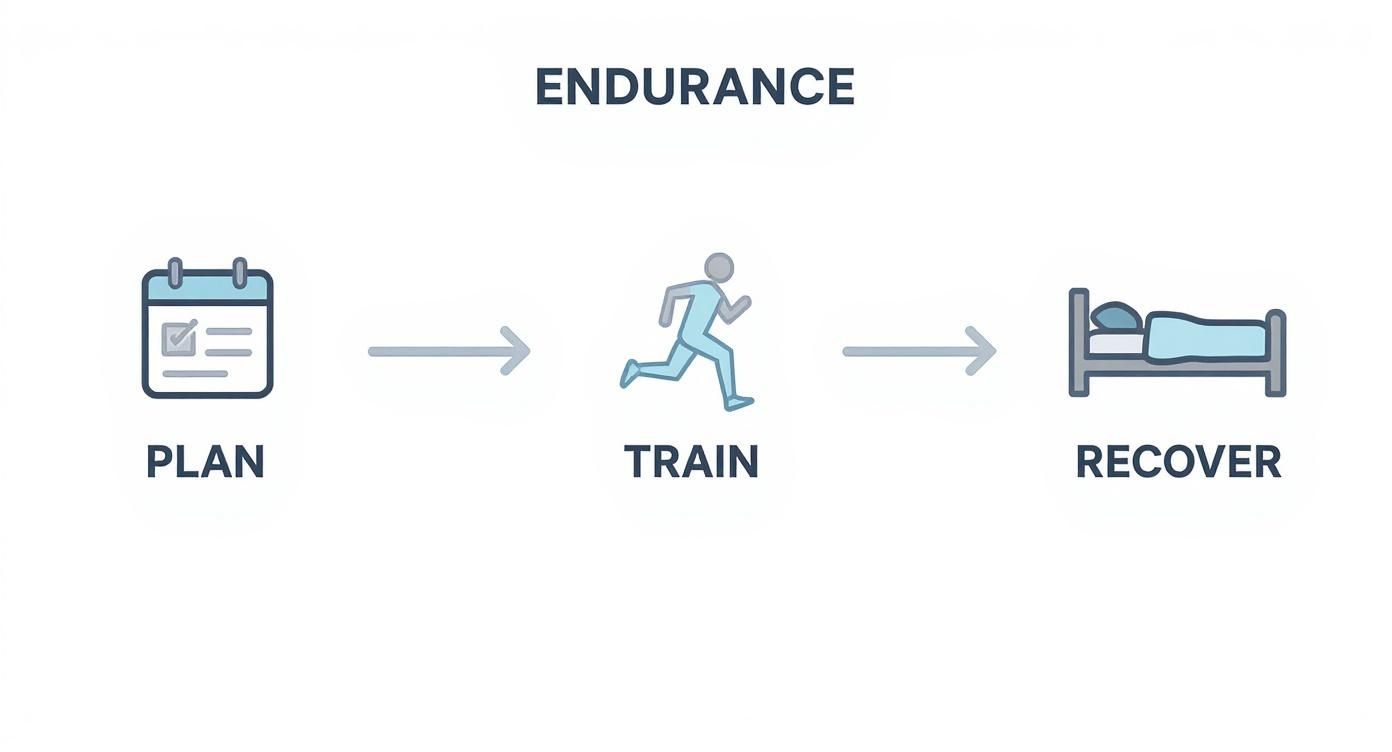
As you can see, progress is not just about the running itself. It's a continuous loop of planning, training, and proper recovery. That recovery phase is crucial—it's when your body adapts and actually gets stronger.
Embrace the 80/20 Rule for Balanced Training
One of the most evidence-based principles in endurance training is the 80/20 rule. It's a simple guideline: about 80% of your weekly running should be at a low intensity (an easy, conversational pace), with the remaining 20% at a moderate to high intensity.
Many runners fall into the trap of doing nearly all their runs at a 'medium-hard' effort. This leads to chronic fatigue without providing the unique benefits of either a truly easy or a genuinely hard session. By polarising your training, you build a massive aerobic foundation with the easy runs, which allows you to approach your hard sessions with enough energy to make them effective.
Following this rule ensures you are rested enough to give your all during key high-intensity workouts, maximising the physiological benefit of every effort.
The Cornerstone of Endurance: Long Slow Distance
The Long Slow Distance (LSD) run is a non-negotiable component for anyone serious about improving their running endurance. This weekly long run, performed at a genuinely easy pace, is where crucial aerobic adaptations occur.
During these extended efforts, your body undergoes critical changes:
- Mitochondrial Biogenesis: Your body builds more mitochondria, the 'power plants' inside your muscle cells that generate energy.
- Increased Capillary Density: More capillaries are formed, creating more pathways for efficient oxygen delivery to your working muscles.
- Improved Fat Metabolism: You train your body to use fat as a fuel source, conserving your limited glycogen stores for when you need them most.
A common mistake is running the long run too fast. The pace should be comfortable, allowing you to hold a full conversation. The goal is time on your feet, not speed.
The purpose of the long run isn't to make you a faster runner for one hour. It's to make you a stronger runner for every hour that follows. It builds the deep, fatigue-resistant foundation that all other speed work is built upon.
Sharpen Your Pace with Tempo Runs
While long runs build your base, tempo runs train your body to sustain a faster pace for longer. This type of workout directly targets your lactate threshold—the point where fatigue rapidly sets in. By training at this threshold, you increase it, meaning you can run faster for longer before hitting your limit.
A tempo run should feel "comfortably hard." It is not an all-out sprint, but it is challenging enough that you could only speak a few words at a time. A standard tempo workout might involve a 10-minute warm-up, followed by 20-30 minutes at your tempo pace, and a 10-minute cool-down.
This workout is mentally challenging but incredibly effective. It prepares you for the sustained discomfort of racing and is one of the most efficient ways to improve your race times.
Supercharge Your Fitness with Interval Training
Interval training is the final piece of the training puzzle. These short, intense bursts of effort followed by recovery periods are the most potent way to boost your VO2 max—your body's maximum capacity to utilize oxygen. A higher VO2 max is a key indicator of elite endurance performance.
Intervals can range from 400-metre repeats on a track with a recovery jog in between to hill repeats that build power and strength. Due to their intensity, they should constitute a small portion of your weekly mileage, fitting squarely into the "20%" of the 80/20 rule.
As you plan your week, consider how different types of exercise can support your running. For tips on combining cardio and strength training effectively, this guide offers sound advice. Remember, running isn't the only activity that will make you a better runner. For a deeper dive, our complete guide to strength training for runners covers the best exercises to support your endurance goals.
Fuel Your Body for Better Performance
Your diet and hydration have a direct, undeniable impact on your running performance. Think of your body as a high-performance engine; the fuel you provide dictates its performance. Smart, sustainable food choices are not about restrictive diets but about understanding your body's nutritional needs.
From the pre-run snack that tops up your energy stores to the post-run meal that repairs muscle tissue, every choice counts. Let's break down the essentials of fuelling, hydration, and recovery to help you run stronger and longer.

The Power of Carbohydrates
For any endurance athlete, carbohydrates are the primary energy source. They are your body's most efficient fuel. When you consume carbohydrates, your body converts them into glucose and stores it in your muscles and liver as glycogen. These glycogen stores are the high-octane fuel ready to be burned when you exercise.
"Hitting the wall" or "bonking" on a long run is the result of glycogen depletion. This is a sudden, profound fatigue as your body is forced to switch to less efficient energy sources like fat, making it nearly impossible to maintain your pace. Keeping your glycogen stores topped up is the foundation of endurance.
For most runners, carbohydrates should constitute 50-65% of your total daily calories. This provides ample energy for your runs, aids recovery, and powers you through your day.
Fuelling Your Runs Effectively
Timing your pre-run fuel is key to a successful run. The goal is to maximize energy stores without causing gastrointestinal distress.
A good guideline is to have a balanced meal 2-4 hours before a run. If you run first thing in the morning or are short on time, a smaller, easily digestible snack about 30-60 minutes beforehand is sufficient.
Here are some practical, well-tolerated options:
- 2-4 hours before a run: A bowl of porridge with a sliced banana and honey, or a jacket potato with beans.
- 30-60 minutes before a run: A small banana, a handful of dates, or a slice of toast with jam.
Focus on simple carbohydrates and minimize fat, fibre, and protein immediately before you run, as they take longer to digest and can cause cramps or gastrointestinal discomfort.
Post-Run Recovery Nutrition
Your recovery begins the moment you stop your watch, and nutrition is paramount. There is a "golden window" for refuelling, within 30-60 minutes post-exercise. During this time, your muscles are highly receptive to absorbing nutrients to replenish glycogen and initiate muscle repair.
Your post-run meal or snack should combine carbohydrates and protein, aiming for a ratio of about 3:1 or 4:1 carbs to protein. The carbohydrates restock depleted energy stores, while the protein repairs the micro-tears in your muscle fibres.
Think of post-run nutrition as laying the foundation for your next run. Skipping it is like asking your body to build a stronger house without giving it any bricks or mortar.
Making post-run refuelling a consistent habit will dramatically speed up your recovery, reduce muscle soreness, and prepare you for your next session. It is one of the most effective lifestyle changes you can make to consistently improve your running endurance.
Hydration and Electrolyte Balance
Staying hydrated is as crucial as your nutritional choices. Even mild dehydration—a loss of just 2% of your body weight—can significantly impair performance, increase perceived effort, and elevate your heart rate.
Do not wait until you feel thirsty to drink. Thirst is an indicator that you are already dehydrated. Sip water consistently throughout the day to maintain adequate hydration.
For runs longer than 60-90 minutes, especially in warm conditions, you must also replace electrolytes. These are essential minerals like sodium, potassium, and magnesium lost through sweat. They are vital for muscle function and fluid balance.
An electrolyte imbalance can lead to muscle cramps and fatigue. Here are simple strategies to maintain balance:
- Add an electrolyte tablet or powder to your water during long runs.
- Consume a salty snack, like pretzels, after a particularly sweaty session.
- Incorporate electrolyte-rich foods into your diet, such as bananas (potassium) and nuts (magnesium).
Proper hydration is not just for race day; it is a daily discipline that underpins all aspects of your training and recovery.
Prioritise Recovery to Run Stronger
It is a common misconception that you get fitter during a run. The physiological adaptations that improve endurance occur in the hours and days that follow, during rest and recovery. Neglecting proper recovery negates the hard work of training.
Focusing on key lifestyle habits allows your body to adapt, prevent injuries, and ultimately become stronger. Let's explore the most powerful recovery tools, from sleep to active recovery, and learn how to listen to your body's signals.

Embrace Sleep as Your Ultimate Performance Enhancer
Sleep is, unequivocally, the single most effective recovery tool available. It is not merely about feeling rested; it is when critical biological repair occurs. During deep sleep, your body releases human growth hormone (HGH), which is essential for repairing the microscopic muscle damage from running and building them back stronger.
Achieving a consistent 7-9 hours of quality sleep per night is non-negotiable for anyone serious about improving running endurance. Sleep deprivation disrupts hormones, increases the stress hormone cortisol, and impairs your body's ability to store glycogen—leaving you fatigued and unprepared for your next run.
It is medically advisable to learn how to improve sleep quality naturally for restorative rest to ensure you are getting the deep, effective rest your body needs to adapt and recover.
Think of sleep as the final, crucial step of every training session. A hard workout creates the stimulus for change, but sleep is when the body actually carries out the upgrades.
Implement Smart Active Recovery Techniques
Recovery is not solely about being sedentary. Active recovery, which involves light-intensity movement, can facilitate faster recovery than complete rest. These techniques enhance blood flow to tired muscles, helping to clear metabolic waste products and deliver oxygen-rich blood to accelerate the repair process.
Incorporating these simple methods into your routine can significantly reduce delayed onset muscle soreness (DOMS) and keep you feeling fresh.
Here are some effective active recovery strategies:
- Gentle Cross-Training: On your rest days, engage in a short, low-impact session of swimming, cycling, or walking. This keeps the body moving without the high impact of another run.
- Foam Rolling: Also known as self-myofascial release, a few minutes with a foam roller can help release muscle tightness and knots, improving flexibility and reducing soreness.
- Strategic Stretching: Dynamic stretches are recommended before a run to warm up, while gentle static stretches are beneficial afterwards. Holding a static stretch for 20-30 seconds post-run helps restore muscles to their resting length and improves long-term flexibility.
These are not optional extras; they are vital components of any training plan designed to build lasting running endurance.
Learn to Recognise the Signs of Overtraining
More training is not always better. Pushing your body too hard without adequate rest can lead to overtraining syndrome—a state of chronic fatigue where performance declines. Recovery can take weeks or even months. Learning to listen to your body is a crucial skill for long-term health and performance.
Recognizing early warning signs is key to preventing overtraining.
Be vigilant for these common red flags:
- An elevated resting heart rate upon waking.
- Persistent muscle soreness that does not resolve with rest.
- Difficulty sleeping or waking up feeling unrefreshed.
- Increased irritability, mood swings, or a lack of motivation to run.
- A plateau or decline in running performance despite continued training.
If you experience several of these symptoms, it is a clear signal from your body to reduce training intensity and prioritize rest. This proactive approach is essential for consistent training and is a key part of how to prevent running injuries before they occur.
Staying the Course: How to Keep Motivated and Consistent
The most well-designed training plan is useless if not followed. Building running endurance is as much a mental challenge as it is a physical one. Real, lasting progress is born from consistency, which requires finding ways to stay motivated long after the initial enthusiasm fades.
This is where social support and smart goal-setting can be transformative. These lifestyle changes can shift running from a solitary chore into a rewarding journey, providing the motivation needed to train consistently.
Find Your Tribe
Running with others is one of the most effective ways to maintain consistency. Accountability to a group makes it harder to skip a session. However, the benefits extend beyond just showing up.
Joining a local running club or a free weekly event like parkrun provides an instant support network. It allows you to share experiences, celebrate successes, and connect with like-minded individuals. The social aspect makes the process more enjoyable and sustainable.
Motivation rarely strikes before you start; it shows up once you’re moving. The toughest part is often just getting out the door. Committing to run with others makes that first step infinitely easier.
Having an organized event on the calendar also provides a clear focus for your training. In the UK, a significant number of runners are motivated by races. Research shows that around 10% of people who took up running were driven by a specific event, demonstrating the power of a tangible goal. You can explore these UK running stats on Aspire PR's website.
Set Goals That Actually Drive You
Clear goals provide purpose and transform a vague aspiration into a concrete plan. The most effective goals are specific, measurable, achievable, relevant, and time-bound—the SMART framework.
This structure turns "I want to run farther" into "I will complete my first 10k race in three months." This provides a clear objective and a deadline, allowing you to create a structured training plan.
To maintain motivation, it is helpful to set a variety of goals:
- Process Goals: These focus on your actions, such as, "I will complete my three scheduled runs this week." You have complete control over these.
- Performance Goals: These focus on personal achievements, like, "I will improve my 5k time in my next race."
- Outcome Goals: These relate to the final result, for example, "I aim to finish in the top half of my age group at the local half-marathon."
Achieving smaller process goals week after week builds the confidence and momentum needed to pursue larger, more ambitious targets.
Build a Tougher Mindset
Even with excellent support and clear goals, difficult days are inevitable. There will be days when your legs feel heavy, your breathing is laboured, and you are mentally tempted to stop. Overcoming this mental barrier is a trainable skill, just like physical fitness.
A simple yet powerful technique is to use motivational mantras. When negative self-talk begins, consciously replace it with positive affirmations like "I am strong" or "Just get to the next corner."
Another effective mental strategy is to break down your run into smaller, manageable segments. If a 10-mile run feels overwhelming, focus only on reaching the next lamppost or completing the next kilometre. This turns a daunting challenge into a series of small, achievable victories, helping you move forward one step at a time.
Got Questions About Running Endurance? We've Got Answers.
As you increase your mileage and push your limits, questions will naturally arise. This is a normal part of the process for every runner. Let's address some of the most common queries to help you continue your journey with confidence.
How Quickly Will I Actually See Results?
This is a very common question. Generally, you can expect to feel a noticeable improvement in your breathing and stamina within 4 to 6 weeks of consistent training. A familiar route may feel less challenging, or you might find it easier to hold a conversation while jogging.
However, it is important to distinguish this initial fitness gain from long-term physiological adaptations. Deeper changes—such as increased mitochondrial density and improved biomechanical efficiency—take months, and sometimes years, to fully develop. New runners often experience rapid initial progress, which is highly motivating. For all runners, patience and adherence to a sensible plan are essential.
Is Strength Training Really Necessary for Endurance?
Yes, absolutely. Strength training is a crucial component of a comprehensive running program. The goal is not to build bulk but to develop a more resilient, efficient, and injury-resistant body. This is non-negotiable for serious, long-term running.
Focus on foundational, compound movements that strengthen the entire kinetic chain used in running.
- Squats: Build strength in the glutes and quadriceps, the primary power-producing muscles.
- Lunges: Develop single-leg stability, which is fundamental to the running motion.
- Deadlifts: Strengthen the posterior chain (glutes, hamstrings, lower back) for better posture and propulsion.
- Core Work: Planks, leg raises, and bird-dogs create a stable core, which is essential for absorbing the impact of running.
A stronger frame improves your running economy, meaning you use less energy to run at a given pace. Aim for two sessions per week on non-running or easy days.
Strength training isn't just an optional extra. It's the robust chassis that allows your endurance engine to perform at its peak, safely handling more mileage and intensity without breaking down.
What's the "Right" Way to Breathe When Running?
Breathing is typically an automatic process, but during intense running, conscious control can improve performance. The key is to shift from shallow chest breathing to deep diaphragmatic breathing, or "belly breathing." This technique engages your diaphragm fully, drawing more oxygen into the lower lobes of your lungs.
To practice this, focus on your belly expanding on inhalation, rather than just your chest. Breathe through both your nose and mouth to maximize oxygen intake, especially at higher intensities. A complete exhalation is also important to clear carbon dioxide. Adopting this deeper breathing pattern can prevent the feeling of breathlessness and may help avoid side stitches. Finding a natural, deep rhythm is more important than forcing a specific step-to-breath count.
At The Lagom Clinic, we champion a proactive, balanced approach to your health and running goals. If you're looking to fine-tune your performance, recover from an injury, or simply get expert medical guidance on your wellbeing, our private GP services in Bristol are designed for you. See how we can support your journey by visiting us at The Lagom Clinic.


 Members Consultation