


When dealing with knee pain, the right kind of movement is a powerful tool for relief and long-term health. A balanced approach combining strengthening, stretching, and low-impact cardiovascular exercise is scientifically proven to support the joint, reduce pain, and improve function. Gentle, controlled movement nourishes the knee cartilage and builds the crucial muscular support system that protects the joint from daily stress.
The key principle is to start slowly and listen carefully to your body's signals to avoid over-exertion and injury.
Why Movement Is Your Best Medicine for Knee Pain
If you're already dealing with a painful knee, the thought of exercising it can feel pretty intimidating. It’s a completely normal fear—when something hurts, our first instinct is to protect it and keep it still. But for most types of chronic knee pain, that inactivity can actually worsen the condition in the long run.
Controlled, gentle movement is one of the most effective interventions for joint health. Knee cartilage, which cushions the bones, lacks a direct blood supply. It relies on the "pumping" action of joint movement—a process called synovial fluid lubrication—to absorb nutrients and expel waste products. Without regular motion, the cartilage can lose its health and resilience, contributing to conditions like osteoarthritis.
Understanding Your Knee's Support System
Your knee is a complex synovial hinge joint involving bones, cartilage, ligaments, and muscles all working in harmony. The muscles surrounding your knee—especially the quadriceps at the front of your thigh and the hamstrings at the back—act as a natural, dynamic brace.
When these muscles are strong, they absorb a significant amount of the shock from everyday activities like walking or climbing stairs. This offloads pressure from the joint surface itself. Conversely, weak muscles force the knee joint to bear the full impact, which can lead to cartilage wear, inflammation, and increased pain.
This is precisely why targeted exercise for knees is a cornerstone of management. It’s about building a strong, protective scaffold around the joint to provide stability and reduce mechanical strain.
"Movement is a lubricant for the joints. When you stop moving, you create a cycle of stiffness and weakness that only perpetuates the pain. The goal is to break that cycle safely and effectively."
Overcoming the Fear of Movement
The worry that exercise will do more harm than good is completely understandable, especially if you've tried something before that caused pain. A critical skill is learning to differentiate between "bad" pain and the "good" discomfort of muscle fatigue. A sharp, stabbing, or worsening pain is a definite red flag to stop. But mild muscle fatigue or a gentle stretching sensation is often a sign of productive exercise.
Starting with low-impact activities is the perfect way to build strength and confidence without overloading the joint. This approach is fundamental for managing conditions like osteoarthritis, a major cause of disability in the UK. In 2012, it was estimated that 18.2% of people aged 45 and over in England were affected by it, with 6.1% experiencing severe forms.
If you're dealing with a specific issue like patellofemoral pain, these runner's knee tips can offer some great insight into recovery. By picking the right exercises and tuning in to your body's signals, you can turn movement from something you fear into the best medicine for healthier, happier knees.
Your Pre-Exercise Safety Checklist
Before you jump into any new exercises, a few minutes of preparation can be the difference between helping your knees and causing a setback. This is your essential pre-activity check.
First and foremost, seek a professional medical opinion. It is always recommended to consult with your GP or a chartered physiotherapist before starting a new routine, especially if you have a specific diagnosis, are recovering from surgery, or have a history of significant knee pain. They can provide a diagnosis and tailored advice that respects your body’s unique condition.
Recognising Red Flag Symptoms
Your body provides clear signals when something is wrong. Some symptoms are more than just a minor ache – they are serious red flags indicating you should stop immediately and seek medical advice.
Pushing through these warning signs can lead to significant, long-term damage. Be on high alert for any of the following during or after exercise:
- Sudden, sharp pain that is distinct from typical muscle exertion.
- Rapid and noticeable swelling around the knee joint.
- A feeling of the knee "giving way," locking, or catching.
- The inability to put your full weight on the affected leg.
- Any obvious deformity or a loud 'pop' at the time of injury.
Some symptoms are clear indicators that you should pause your exercise plan and get a professional opinion. Pushing through these could turn a minor issue into a major one.
Red Flag Symptoms Demanding Medical Attention
| Symptom | What It Could Mean | Recommended Action |
|---|---|---|
| Sudden, severe joint pain | Ligament tear, cartilage damage, or fracture. | Stop all activity immediately. Seek urgent medical care (GP, A&E, or physio). |
| Rapid swelling and bruising | Internal bleeding in the joint (haemarthrosis), possibly from a torn ACL or fracture. | Cease exercise. Apply ice and compression, and see a doctor right away. |
| Knee "giving way" or locking | Instability from a ligament injury (like an ACL tear) or a loose piece of cartilage (meniscus tear). | Avoid weight-bearing. Consult a GP or physiotherapist for a diagnosis. |
| Inability to bear weight | Could indicate a significant injury such as a fracture or a complete ligament rupture. | Do not force it. Use crutches if available and seek immediate medical evaluation. |
| Audible "pop" or "snap" | Often associated with an ACL tear or other significant ligament injury. | Stop exercise immediately. This requires prompt professional assessment. |
If you experience any of these, do not try to "walk it off." Your priority is to obtain a proper diagnosis to ensure a safe return to activity.
Creating Your Safe Workout Environment
Once you have medical clearance, set up your space for safety and focus. A state-of-the-art gym isn't necessary; you just need a safe area where you can concentrate on your form.
Start by clearing a clutter-free zone with enough room to move freely without trip hazards. Ensure your floor is level and non-slip. A good-quality exercise mat provides both cushioning and a stable surface. It's also worth looking into proven strategies to prevent running injuries, as many principles of preparation and form apply to any knee-focused exercise.
Key Takeaway: Create a space where your only focus is your movement. By removing obstacles and distractions, you can concentrate entirely on your form and technique.
Good lighting helps you monitor your alignment. Finally, gather any equipment you need – a chair for balance, resistance bands, or a foam roller – and place it within easy reach before you begin.
Good Pain Versus Bad Pain
This is one of the most vital lessons to learn: how to differentiate between the ache of a working muscle and the pain of an injury.
- Good Pain (Muscle Soreness): This refers to the dull ache or burning sensation you feel in your muscles, known as Delayed Onset Muscle Soreness (DOMS). It typically appears 24 to 48 hours after a workout and is a positive sign that your muscles are adapting and becoming stronger.
- Bad Pain (Joint or Injury Pain): This is different. It’s often sharp, stabbing, or constant. You’ll feel it in the joint itself, not just the surrounding muscles, and it tends to worsen with movement. This is your body's alarm bell telling you to stop.
Learning to read these signals allows you to challenge yourself enough to make progress without crossing the line into injury.
The Four Pillars of a Healthy Knee Programme
To build a truly resilient knee, a comprehensive approach is required. An effective routine is built on four key pillars: strengthening, mobility, stretching, and balance. Think of it as creating a complete support system for the joint.
Strengthening builds the muscle armour, mobility keeps things moving smoothly, stretching eases tension, and balance fine-tunes your neuromuscular control. Neglecting one pillar compromises the entire structure.
Let’s look at how to put each pillar into practice with some simple, effective exercises.
Pillar 1: Strengthening Your Muscular Support
Your muscles are the knee's first line of defence, acting as natural shock absorbers that offload the cartilage and ligaments with every step. The goal is to build strength in key muscle groups around the knee without overloading the joint itself.
Here are two excellent, low-impact exercises to start with.
- Supported Squats (or Chair Squats): This is a fundamental functional exercise that mimics the everyday motion of getting up and down.
- How to do it: Stand in front of a sturdy chair with your feet shoulder-width apart. Keeping your chest up and back straight, push your hips back and bend your knees as if you're about to sit. Lightly touch the chair with your bottom, then drive through your heels to stand back up.
- Technique Tip: Avoid letting your knees drift inwards (knee valgus). Imagine screwing your feet into the floor to activate your hip stabilisers. Aim for 2-3 sets of 10-12 repetitions.
- Standing Hamstring Curls: This move targets the muscles at the back of your thigh, which are crucial for controlling the knee and preventing hyperextension.
- How to do it: Stand tall, holding onto a wall or the back of a chair for balance. Slowly bend one knee, bringing your heel towards your glutes. Pause for a second at the peak of the contraction, then lower your foot back down with control.
- Common Mistake: Avoid arching your lower back to lift the heel higher. Keep your core engaged and your standing knee slightly bent. Perform 10-15 curls on each leg.
Pillar 2: Enhancing Mobility and Range of Motion
Mobility refers to the joint’s ability to move smoothly through its full, natural range of motion without pain or restriction. For the knee, this primarily involves bending (flexion) and straightening (extension).
Gentle movements help circulate synovial fluid, which lubricates the joint and nourishes the cartilage.
- Heel Slides: This is a cornerstone exercise for stiff knees, particularly beneficial in the morning or post-surgically.
- How to do it: Lie on your back on the floor or bed with both legs straight. Slowly drag the heel of one leg towards your glutes, bending the knee as far as is comfortable. Hold the gentle bend for a moment, then slowly slide the heel back to the starting position.
- Make it easier: If your foot catches on the surface, place a plastic bag or a small towel under your heel to help it glide. Aim for 15-20 slides per leg.
With mobility, the aim is gentle persuasion, not force. You’re simply encouraging the joint to move through its pain-free range. Consistent, gentle motion is what keeps the joint healthy.
Pillar 3: Stretching to Alleviate Tightness
Excessively tight muscles can negatively impact knee mechanics. Chronically tight quadriceps, hamstrings, or calf muscles can alter the alignment of the kneecap and joint, leading to irritation and pain. A consistent stretching routine helps release this tension and restore muscular balance.
The key is to hold each stretch steadily for a sustained period—never bounce.
- Quadriceps Stretch: This stretch targets the large muscles on the front of your thigh.
- How to do it: Stand next to a wall for support. Grasp your ankle and gently pull your heel towards your glute until you feel a comfortable stretch in the front of your thigh. Keep your knees aligned side-by-side.
- Hold: Aim for a 20-30 second hold. If you cannot reach your ankle, loop a towel around it and hold the ends.
- Hamstring Stretch: This helps to lengthen the muscles on the back of your thigh.
- How to do it: Sit on the floor with one leg straight out and the other bent, with the sole of your foot resting against your inner thigh. Hinge forward from your hips (maintaining a straight back) over the straight leg until you feel a stretch.
- Hold: Breathe into the stretch for 20-30 seconds, then swap sides.
- Calf Stretch: Tight calf muscles can alter your gait and place additional stress on the knee.
- How to do it: Face a wall, placing your hands on it for support. Step one foot back, keeping the leg straight and the heel firmly on the floor. Gently lean forward until you feel the stretch in your back calf.
- Hold: Hold for 20-30 seconds before switching legs.
Pillar 4: Improving Balance and Stability
Balance, or proprioception, is your body's ability to sense its position in space. It relies on constant feedback between your brain, nerves, and muscles to make tiny adjustments that keep you stable. Good balance is critical for protecting your knees from unexpected twists or falls.
You can improve this skill with simple exercises.
- Single-Leg Stance: This is the foundational exercise for improving balance.
- How to do it: Stand near a wall or countertop for support. Shift your weight onto one foot and lift the other off the floor by a few inches. Try to hold this position for 20-30 seconds.
- Ready for a challenge? Once this becomes easy, try closing your eyes for a few seconds or standing on a slightly unstable surface like a folded towel.
- Common Mistake: Avoid letting the hip on your lifted side drop. Keep your hips level by engaging the gluteal muscles of your standing leg.
By consistently working on these four pillars, you are not just performing random exercises. You are building a comprehensive support system that creates a stronger, more mobile, and more stable knee.
How to Build a Sustainable Knee Exercise Routine
Knowing which exercises to do is half the battle. The other half is integrating them into a consistent, progressive routine that you can stick with long-term. Lasting results come from structure and gradual progression over time. This is your roadmap to building strength and confidence without causing a flare-up.
The key is to start at your current level. A plan for someone recovering from knee surgery will differ significantly from one for a runner aiming to prevent injuries. It all comes down to appropriate frequency, intensity, and, most importantly, listening to your body.
Your Gentle Starter Plan for Pain Reduction
If your main goal is to reduce daily aches and pains, your focus should be on gentle, consistent movement. The initial aim is not to build maximum strength, but to activate muscles, improve joint mobility, and establish a solid foundation without causing irritation.
- Frequency: Aim for a session 3 to 4 days per week on non-consecutive days. Rest is critical for muscle repair and strengthening.
- Structure: A good session should start with mobility (e.g., heel slides), move into 2-3 basic strengthening exercises (e.g., chair squats, glute bridges), and finish with gentle stretches for the quadriceps and hamstrings.
- Sets and Reps: Start with 2 sets of 10-12 repetitions for strength exercises. Your entire focus should be on perfect, pain-free technique.
The most effective approach at this stage is 'little and often'. A well-executed 15-minute routine performed four times a week is far more beneficial than one strenuous hour-long session that leaves you sore for days.
The Intermediate Routine for Building Real Strength
Once daily pain has subsided and the beginner exercises feel easy, it's time to build more resilience. This involves introducing greater challenges to encourage muscle adaptation and growth, providing your knee joint with robust support.
This is where all the elements of a balanced routine really start to work together—strengthening, stretching, and balance.
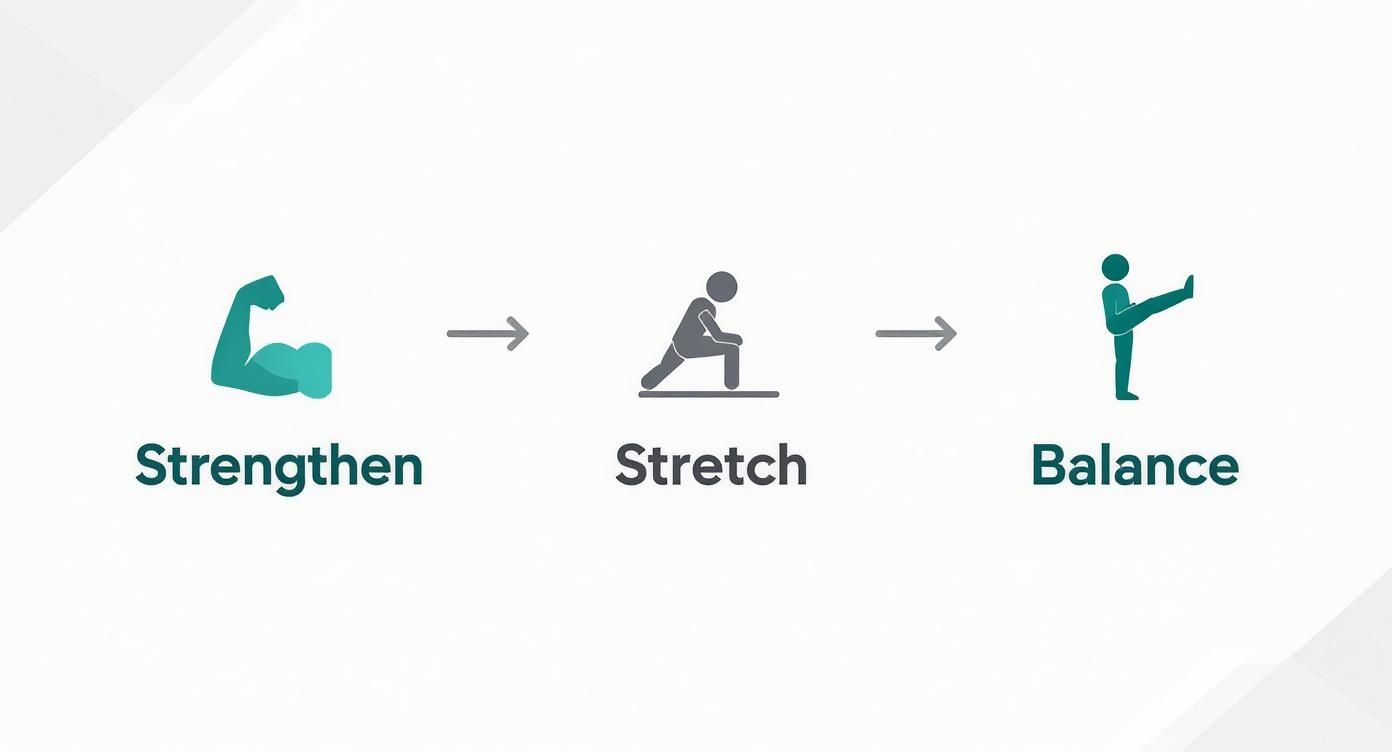
This simple visual is a great reminder that a successful knee programme isn't just one thing; it's a blend of these three essential pillars.
- Frequency: Continue with 3-4 days per week, but your sessions may become slightly longer as your endurance improves.
- Structure: Maintain the mix of all four pillars, but start substituting more challenging variations. For example, progress from a double-leg glute bridge to a single-leg version, or add a light resistance band to your standing hamstring curls.
- Sets and Reps: You can now increase the volume. Aim for 3 sets of 12-15 repetitions. The last few reps in each set should feel challenging, but your form should never falter.
An Advanced Plan for Sport and High-Impact Activities
For those aiming to return to running, tennis, or other demanding activities, the final phase focuses on building power, control, and durability. These routines incorporate more dynamic movements to prepare your knees for the stresses of jumping, landing, and rapid changes in direction.
- Frequency: At this level, you might exercise 4-5 times a week, potentially dedicating different days to specific training types (e.g., strength days, balance/plyometric work, and low-impact cardio).
- Structure: Introduce exercises like walking lunges, step-ups onto a box, and advanced single-leg balance work, perhaps on an unstable surface like a wobble cushion.
- Sets and Reps: The goal shifts towards building maximal strength and power. You could use heavier resistance for 3 sets of 8-10 reps.
The Art of Safe Progression
How do you know when you're ready to advance? The golden rule is to change only one variable at a time. Never increase the weight, reps, and sets all in the same week, as this can lead to overload injuries.
- Nail the Form First: You must be able to complete all your reps and sets with perfect, controlled technique before adding any challenge.
- Add Reps: If you can comfortably complete your target reps, try adding 2-3 more to each set in your next session.
- Add a Set: Once the higher rep range is manageable, go back to your original rep count but add one more set to your routine.
- Add Resistance: Only when you have mastered the bodyweight version with excellent form should you consider adding light weights or resistance bands.
This gradual, patient approach is your best defence against setbacks. A UK survey of physiotherapists found that most patients with knee osteoarthritis receive only 2 to 3 treatment sessions, far fewer than the 6, 12, or more sessions used in clinical trials that proved exercise efficacy. There's a clear gap between standard practice and what the evidence shows is needed. You can discover more about these physiotherapy findings to understand why your long-term consistency is so vital. By learning to progress yourself safely, you take control of your own recovery.
Lifestyle Habits That Support Healthy Knees
Specific exercises are a huge part of the equation, but they exist within the context of your overall lifestyle. Your daily habits set the stage for your knees to either heal and strengthen or remain a source of chronic pain. A 24/7 commitment to your joints, built on smart lifestyle choices, will amplify the benefits of your workouts.
Everything from your diet to your body weight plays a critical role in creating a holistic system of care for long-term relief and resilience.
The Power of Weight Management
If there is one piece of lifestyle advice for knee health to prioritise, it is this: manage your weight. The biomechanics are simple but incredibly powerful. For every extra pound of body weight you carry, your knees experience approximately four pounds of extra pressure with each step.
This means even modest weight loss has a dramatic effect. Losing just 10 pounds can remove 40 pounds of stress from your knees with every step. Multiplied by thousands of steps a day, this significantly reduces the daily mechanical load on your cartilage, which can help calm inflammation and slow degenerative processes.
The goal is not crash dieting, but finding a sustainable balance through sensible nutrition and regular, gentle movement. Reaching a healthy weight can often be more effective for knee pain relief than any single exercise.
Fueling Your Joints With Anti-Inflammatory Nutrition
The food you eat can either promote or combat inflammation. A diet high in processed foods, sugar, and unhealthy fats contributes to systemic, low-grade inflammation, a known factor in worsening joint pain. Conversely, a diet rich in whole, nutrient-dense foods can have a powerful anti-inflammatory effect.
Build your meals around foods known to fight inflammation:
- Oily Fish: Salmon, mackerel, and sardines are rich in omega-3 fatty acids, which are potent natural anti-inflammatories.
- Leafy Greens: Spinach, kale, and other dark greens are packed with antioxidants that help protect cells from damage.
- Berries and Cherries: These fruits contain compounds called anthocyanins, which have been shown to reduce inflammatory markers.
- Nuts and Seeds: Almonds, walnuts, and flaxseeds provide healthy fats and further anti-inflammatory benefits.
- Spices: Turmeric (containing curcumin) and ginger have been used for centuries for their anti-inflammatory properties.
By making these foods staples in your diet, you are actively managing symptoms from the inside out. For a much deeper look into this, check out our detailed guide on how to improve joint health through nutrition and lifestyle.
Choosing Low-Impact Cardio for Fitness
Maintaining cardiovascular health is non-negotiable for overall well-being, but high-impact activities like running can be problematic for painful knees. Fortunately, there are many excellent low-impact alternatives that elevate your heart rate without pounding your joints.
These activities are the perfect complement to your strengthening and stretching routines.
- Swimming and Water Aerobics: The buoyancy of water supports your body weight, making movement nearly impact-free. It's one of the best ways to improve fitness and mobility without stressing the joints.
- Cycling: Whether on a stationary bike or outdoors, cycling is a non-weight-bearing activity that effectively strengthens the quadriceps and hamstrings. Health Tip: Ensure your bike is properly fitted. A seat that is too low can increase pressure on the kneecap (patellofemoral joint).
- Elliptical Trainer: The elliptical machine mimics the motion of running, but your feet never leave the pedals, eliminating the jarring impact.
When you weave these lifestyle changes into your routine, you create a powerful, synergistic support system for your body. They work in tandem with your prescribed exercise for knees to reduce pain, improve function, and build a solid foundation for healthy joints for years to come.
Your Knee Exercise Questions, Answered
Starting a new exercise plan for your knees can bring up a lot of questions. It's totally normal to wonder what you should be feeling, what's a good sign, and what’s a warning to back off. Let’s address some of those common concerns with practical, evidence-based advice.
Understanding the difference between the ache of a working muscle and the sharp signal of joint pain is arguably the most important skill you’ll learn.
Is It Normal to Feel Some Pain When Exercising?
The answer requires careful self-monitoring. You need to become adept at interpreting your body’s signals and differentiating between "good" muscle fatigue and "bad" joint pain.
- Muscle Soreness: A dull, tired ache in your quadriceps or hamstrings the day after a workout is typically a positive sign of your muscles adapting and getting stronger (DOMS).
- Joint Pain: Sharp, stabbing, or grinding pain that feels like it’s inside the knee joint is a definite red flag. This is your body’s signal to stop that specific movement.
The golden rule is to challenge, not traumatise. A little bit of muscle ache is fine, but you should never, ever push through sharp or worsening pain. If a particular exercise causes that kind of jab, stop immediately and try an easier version.
How Long Until I See Results?
Patience and consistency are crucial. While everyone's body responds differently, most people start to feel a noticeable improvement in knee stability and a reduction in daily pain within four to eight weeks of adhering to a regular programme (exercising 3-4 times per week).
Building significant muscle strength—the kind that provides robust, long-term protection for your knee—takes longer, typically several months. View this as a long-term investment in your future mobility and quality of life.
What Is the Best Way to Manage Post-Exercise Discomfort?
It’s normal for your knee to feel tired or even slightly puffy after a new or challenging session. Smart recovery strategies can make a significant difference.
- Ice: For post-workout care, ice is generally best. Applying a cold pack (wrapped in a thin towel) to the knee for 15 minutes can help reduce inflammation and mild swelling.
- Heat: Heat is more appropriate for use before exercise. A warm compress can increase blood flow and loosen stiff muscles, preparing the joint for movement.
Never apply ice or heat directly to your skin. Ultimately, listen to your body—if a modality provides relief, it is likely the right choice for you at that moment.
We often get asked similar questions by clients just starting out, so we've put together a quick FAQ table to cover the most common queries.
Frequently Asked Questions
| Question | Answer |
|---|---|
| Can I exercise every day? | It's better to start with 3-4 sessions a week, giving your knees a day of rest in between. Rest is when your muscles repair and get stronger. Listen to your body and don't overdo it, especially at the beginning. |
| What if the pain gets worse after a few weeks? | If your pain is consistently worsening despite following the programme and its modifications, it's a clear sign to stop and seek professional advice. Book an appointment with your GP or a physiotherapist. |
| Should I wear a knee brace while exercising? | A simple sleeve-style brace can provide compression and a sense of support, which many people find helpful. However, it shouldn't be used to mask sharp pain. If you need a brace just to get through an exercise, the exercise is likely too advanced for you right now. |
| Is walking good for bad knees? | Absolutely! Walking on flat, even surfaces is a fantastic low-impact exercise that keeps the joint mobile and the surrounding muscles active. Just make sure you're wearing supportive footwear. |
Hopefully, these answers give you a bit more confidence as you get started.
At The Lagom Clinic, we believe in building a complete picture of your health to provide guidance that works for your life. If you're struggling with knee pain and want personalised advice on exercise, nutrition, and overall well-being, we're here to help. Discover a balanced approach to healthcare by visiting us.


 Members Consultation