


You might be functioning well on paper and still feel that something isn’t right. You meet deadlines, answer messages, keep family life moving, and look composed to everyone else. Yet your mind never seems to switch off, small things irritate you more than they used to, and rest doesn’t feel restorative.
That’s often the moment people start wondering about mental health therapy. Not because life has fallen apart, but because they can sense they’re carrying too much, for too long, without the right support. As a GP, I often find that people don’t need more willpower. They need a safe, structured place to think clearly, understand what’s happening, and learn better ways to cope.
What Is Mental Health Therapy Really
For many people, therapy sounds like something reserved for crisis. That idea puts people off for months, sometimes years. In reality, mental health therapy is often much more like preventive care for your inner life.

Think of it this way. If your shoulder felt tight every day, you wouldn’t wait until you couldn’t lift your arm before asking for help. You’d want to know what’s driving it, what habits are making it worse, and what would help you recover. Therapy works in a similar way, except the focus is your thoughts, emotions, reactions, relationships, and coping patterns.
Therapy is not just talking for the sake of it
A lot of patients tell me, “I already talk to friends.” That can help, but therapy is different. A trained therapist listens in a deliberate way. They help you notice patterns you may miss on your own.
That might include:
- Stress responses: why you go into overdrive when demands rise
- Thought habits: how self-criticism, catastrophising, or perfectionism keep you stuck
- Emotional patterns: why you feel numb, guilty, anxious, or unusually flat
- Behaviour loops: how avoidance, overworking, scrolling, drinking, or people-pleasing bring short-term relief but prolong the problem
Therapy can be proactive, not reactive
You don’t need a diagnosis to benefit from therapy. Many people use it to build resilience, improve boundaries, recover from burnout, adjust to change, or understand themselves better.
Practical rule: If your current way of coping is keeping you functional but not well, therapy is worth considering.
I often describe therapy as a mix of three things. A mirror, a toolkit, and a working relationship. The mirror helps you see yourself more clearly. The toolkit gives you practical ways to respond differently. The relationship gives you a calm, confidential space to practise honesty without being judged.
Some people come because they feel anxious. Others come because they’ve lost motivation, keep repeating the same relationship patterns, or can’t seem to enjoy their life even when things are going well. All of those are valid reasons.
If you’re trying to strengthen your foundations more broadly, our guide on how to improve mental wellbeing can help you think about therapy alongside sleep, movement, routine, and recovery.
Signs It Might Be Time to Talk to Someone
People often wait for a dramatic breaking point. More commonly, the signs are quieter. You’re still doing what needs to be done, but it takes more effort, more masking, and more recovery time than before.
One important gap matters here. Mental health access gaps for UK professionals in workplace settings remain largely unaddressed despite high occupational stress, and early intervention through accessible mental health services improves outcomes, as discussed in this review of access barriers and early support. In practice, that means many capable people keep pushing through distress until it affects health, work, or home life.
Signs that often get dismissed
These patterns don’t always look “serious” from the outside, but they matter:
- You’re more irritable than usual: small delays, noise, requests, or mistakes trigger a sharper reaction than they used to.
- Your concentration has slipped: you read the same email three times, forget basic tasks, or struggle to make decisions.
- You feel emotionally blunted: not overcome by sadness, but disconnected, flat, or unable to enjoy anything fully.
- You can’t switch off: your body is at home, but your mind is still in the meeting, the argument, or tomorrow’s to-do list.
- You’ve normalised unhealthy coping: another drink to come down, another late night catching up, another weekend lost to exhaustion.
A common confusion is this. People assume that if they’re still productive, they must be okay. Productivity can hide distress for quite a long time.
Physical symptoms count too
Mental strain often shows up in the body first. Patients frequently come in asking about sleep, headaches, palpitations, digestive upset, jaw tension, or fatigue before they realise stress is part of the picture.
Here’s a simple way to think about it.
| What you notice | What it may be signalling |
|---|---|
| Poor sleep despite exhaustion | A nervous system that isn’t settling properly |
| Tension headaches or muscle tightness | Ongoing stress load and lack of recovery |
| Comfort eating or loss of appetite | Emotional regulation difficulties |
| Increased drinking or overworking | A coping strategy that’s becoming costly |
You don’t have to wait until symptoms become unmanageable. Earlier support is often easier, gentler, and more effective.
Everyday examples
A senior manager starts avoiding difficult conversations because they feel disproportionately overwhelmed.
A parent finds themselves snapping at the children, then feeling ashamed afterwards.
An athlete notices that a single poor performance lingers mentally for days.
A professional who seems calm in meetings lies awake replaying every detail at night.
If alcohol has subtly become part of how you manage tension, our article on whether alcohol causes anxiety may help you spot a pattern that’s easy to miss.
Navigating Different Types of Mental Health Therapy
One reason people delay starting therapy is that the options sound technical. The good news is that you don’t need to master all the terminology before booking an appointment. It helps to know the broad shape of each approach so you can ask better questions and choose something that fits your needs.
Here’s a visual overview first.
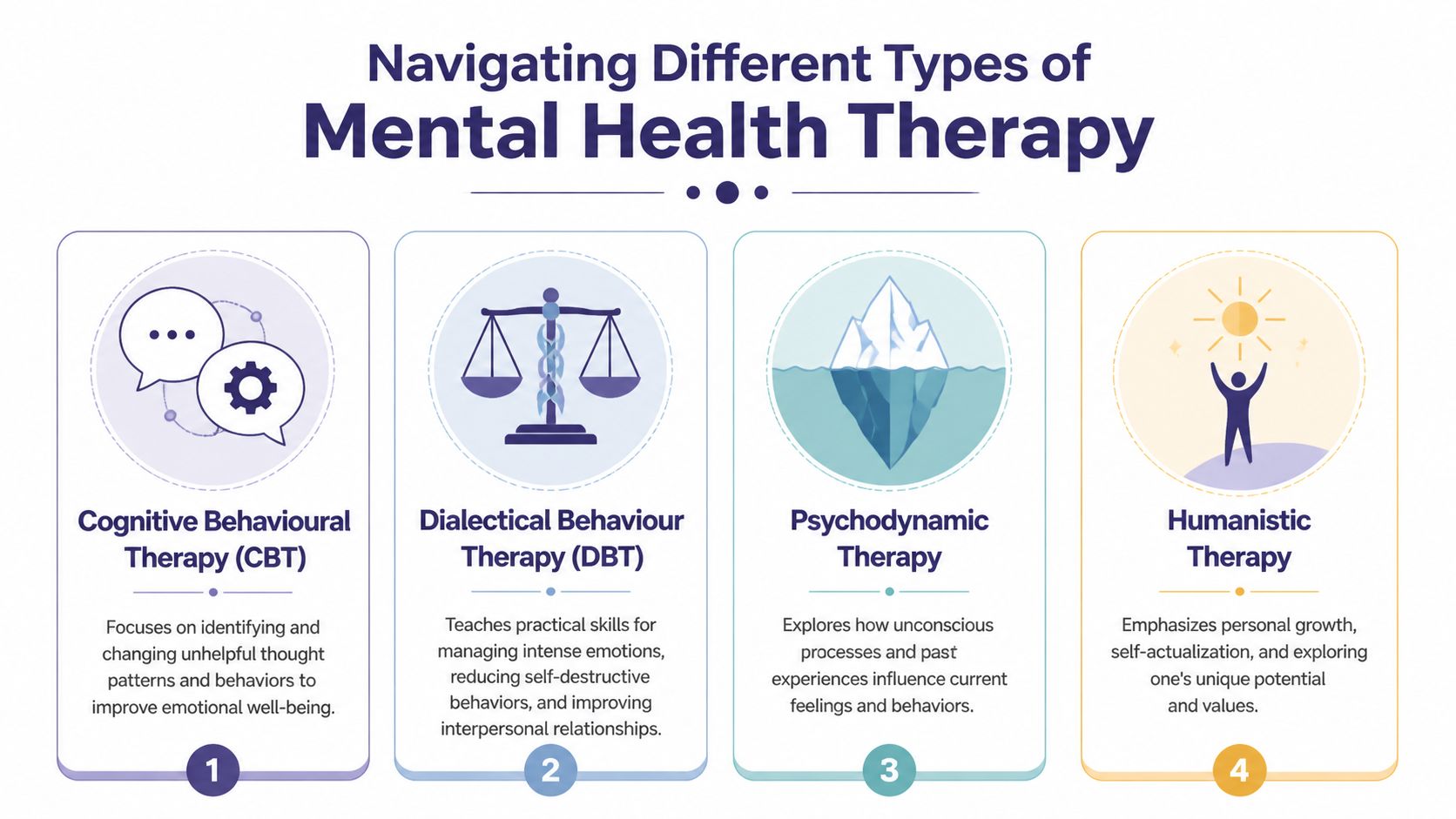
A simple comparison
| Therapy type | Main focus | Often useful for | What sessions may feel like |
|---|---|---|---|
| CBT | Thoughts, behaviours, and present-day patterns | Anxiety, panic, low mood, unhelpful habits | Structured, practical, skills-based |
| Psychodynamic therapy | Past experiences, unconscious patterns, relationships | Repeated emotional themes, relationship difficulties, longstanding distress | Reflective, exploratory, insight-focused |
| ACT | Values, acceptance, and psychological flexibility | Anxiety, stress, self-criticism, avoidance | Practical but reflective, with exercises and mindset shifts |
| Counselling | Supportive listening, emotional processing, problem-solving | Life transitions, grief, stress, decision-making | Conversational, containing, person-centred |
| Couples or family therapy | Patterns between people | Conflict, communication problems, family strain | Shared discussion with guided structure |
If you want a broad external overview, the Sachs Center on therapy types gives a useful summary of different approaches in plain language.
Cognitive Behavioural Therapy
CBT is often the easiest to explain because it’s very practical. It looks at the link between what you think, what you feel, and what you do.
If your mind jumps to “I’m going to mess this up,” your body may respond with anxiety, and your behaviour may shift into avoidance or overpreparation. CBT helps you catch that chain earlier and respond differently.
It can be especially helpful if you want concrete tools such as:
- Thought records: noticing unhelpful interpretations
- Behaviour experiments: testing whether feared outcomes occur
- Exposure work: reducing avoidance gradually
- Routine changes: improving sleep, structure, and momentum
People sometimes worry that CBT is too simplistic. Done well, it isn’t about positive thinking. It’s about accurate thinking and more helpful action.
Psychodynamic therapy
Psychodynamic therapy is less about immediate symptom tools and more about understanding the deeper pattern. I often compare it to archaeology. You’re not digging up the past for the sake of it. You’re trying to understand why current reactions feel so powerful, familiar, or hard to shift.
This approach may suit you if you keep finding yourself in the same emotional position. Perhaps you work endlessly for approval, feel abandoned quickly in relationships, or shut down whenever conflict appears.
A useful question: “Does this problem only happen in this situation, or does it echo through many parts of my life?”
That question often points towards whether deeper exploratory work may help.
ACT and counselling
Acceptance and Commitment Therapy, or ACT, teaches a different skill. Instead of fighting every difficult thought or feeling, you learn how to make room for discomfort without letting it run your life. I sometimes describe it as learning to surf emotional waves rather than trying to flatten the sea.
ACT can be helpful when you’re caught in struggle with your own mind. The more you try not to feel anxious, guilty, or uncertain, the more dominant those feelings become. The work then shifts towards values, attention, and committed action.
Counselling is broader. It usually offers a supportive, thoughtful space to talk things through, process emotion, and make sense of what’s happening. It may be less structured than CBT and less interpretive than psychodynamic therapy.
Other approaches you may hear about
You may also come across DBT, especially for intense emotions and interpersonal difficulties, and humanistic therapy, which focuses on self-understanding and growth. In couple or family work, the therapist pays attention not just to one person’s distress but to the interaction pattern between people.
The “right” therapy depends on the question you’re trying to answer. If you want skills for panic symptoms, one approach may fit better. If you want to understand why the same painful relationship dynamic keeps repeating, another may be more useful.
Your First Therapy Session and What Follows
Feeling some nerves before a first session is common. That’s normal. The unknown is often more intimidating than the appointment itself.

What usually happens first
The first contact is often brief. You enquire, mention the main issue, and arrange an initial appointment. Some therapists offer a short introductory call, while others begin with a full assessment session.
In that first proper meeting, the therapist usually asks about:
- What brought you in now
- How long things have felt difficult
- Your current symptoms or struggles
- Relevant background, including family, relationships, work, and health
- What you hope will be different if therapy helps
You don’t need to tell your life story perfectly. You don’t need to be eloquent. A good first session isn’t a performance.
What the first session feels like
Some people expect instant relief. Others worry they’ll be pushed into discussing painful events before they’re ready. Most first sessions are steadier than that.
The therapist is usually trying to understand three things. What’s happening, how it affects your life, and what kind of support is likely to help. You’re doing the same from your side, even if you don’t realise it. You’re noticing whether you feel listened to, safe, respected, and understood.
A first session may end with a shared sense of direction. You might agree to focus on panic symptoms, work stress, grief, low mood, trauma, or relationship patterns. Or you may decide that a different therapist or approach would be a better fit.
Starting therapy doesn’t mean handing over control. It means entering a structured conversation where your goals matter.
What happens after that
Ongoing sessions are usually more focused. Some are highly structured, especially in CBT. Others are more open and exploratory. Over time, the work often includes a mixture of noticing patterns, learning skills, reflecting on relationships, and trying new responses in daily life.
Many patients find it helpful to think of therapy as active work between sessions too. That doesn’t always mean homework sheets. It may mean pausing before reacting, tracking moods, writing down difficult thoughts, or practising a boundary-setting conversation.
Here’s what often helps patients get more from the process:
- Come with one real example: a recent argument, a difficult meeting, a panic episode, a weekend slump.
- Say when you’re confused: therapy shouldn’t feel like decoding a hidden language.
- Mention if something doesn’t fit: a good therapist can adjust pace and style.
- Expect progress to be uneven: insight can feel relieving one week and uncomfortable the next.
Confidentiality and trust
Confidentiality is a major reason therapy works. You need to know that what you say is handled professionally and privately. Therapists will usually explain the boundaries clearly, including limited situations where safety concerns may require further action.
That clarity matters. When people understand the ground rules, they can speak more openly. And open conversation is where therapy begins to become useful, rather than merely polite.
How to Choose the Right Therapist
Choosing a therapist is partly about credentials and partly about fit. Both matter. A well-qualified therapist who doesn’t understand your world may not be the right person for you. Equally, someone who feels warm but lacks appropriate training may not provide safe or effective care.
Start with the basics
In the UK, it’s sensible to look for a therapist registered or accredited with a recognised professional body such as BACP or UKCP. If they’re a psychologist, they may also be registered with the HCPC.
Those letters don’t tell you everything, but they do help answer basic questions about training, professional standards, and accountability.
A practical shortlist often includes:
- Training and registration: what qualification do they hold, and with which body are they registered?
- Therapy style: do they offer CBT, counselling, psychotherapy, or an integrative approach?
- Relevant experience: have they worked with concerns similar to yours?
- Logistics: location, online options, session times, fees, and cancellation policy
Questions worth asking
Many people don’t realise they’re allowed to ask direct questions before starting. You are.
Try asking:
- What kind of clients do you often work with?
- How do you usually approach anxiety, burnout, grief, or relationship difficulties?
- What does a typical session with you look like?
- How will we know whether therapy is helping?
- Do you offer in-person, remote, or mixed sessions?
These questions aren’t rude. They help you judge whether the therapist can meet you where you are.
Fit includes identity and context
This point is especially important if you want care that recognises identity, family structure, or social experience. Access to gender-affirming care significantly improves mental health outcomes for transgender populations, and joint informed decision-making among patients, families, and providers is essential, as noted in this discussion of disparities and affirming care.
For LGBTQIA+ patients, that means it’s reasonable to ask whether a therapist offers affirming care and how they work alongside broader health needs. You shouldn’t have to educate your clinician about your identity before genuine therapeutic work can begin.
Key point: The right therapist doesn’t just understand symptoms. They understand the life context those symptoms sit inside.
If you’re also exploring whether neurodivergence might be part of the picture, this article on ADHD and autism psychological assessment may help you think through what kind of professional support to seek alongside therapy.
Green flags and reasons to pause
A few green flags are easy to recognise. The therapist explains their approach clearly. They answer questions without defensiveness. They don’t overpromise. You feel heard, even if the conversation is challenging.
Reasons to pause include feeling rushed, judged, persistently misunderstood, or pushed into an approach that doesn’t make sense to you. Therapy isn’t about finding someone perfect. It’s about finding someone competent, respectful, and suitable for your needs.
How Therapy Works with Your GP and Medication
Therapy doesn’t sit in a separate box from the rest of your health. Your mood, sleep, hormones, stress load, nutrition, alcohol use, exercise, pain levels, and medical history often interact. When care is coordinated, treatment tends to make more sense to the patient.

Therapy and medication are not rivals
A very common misconception is that you must choose one or the other. In reality, some people do well with therapy alone, some benefit from medication, and some need both.
Medication may reduce the intensity of symptoms enough for therapy to become more effective. Therapy may then help you understand triggers, change habits, improve relationships, and prevent old patterns from taking over again. They can work together.
This often matters when symptoms are affecting basic function. If you’re sleeping badly, feeling persistently low, or too anxious to think clearly, talking alone may feel hard at first. Medical review can help identify whether medication, physical assessment, or both should be part of the plan.
What your GP adds
A GP looks at the wider clinical picture. That includes screening for physical contributors to low mood, anxiety, fatigue, or poor concentration. Sometimes stress is central. Sometimes there’s also pain, perimenopause, thyroid issues, sleep disruption, medication side effects, or another health factor adding to the burden.
A GP can also help with:
- Initial assessment: clarifying symptoms and urgency
- Risk review: checking safety, severity, and practical supports
- Medication decisions: starting, monitoring, adjusting, or stopping safely
- Referral planning: helping you find the right level of support
- Physical health review: considering tests or wider medical factors where appropriate
In a private setting such as The Lagom Clinic, that can also mean a longer appointment to discuss mental wellbeing, lifestyle, and referral options in one place.
Lifestyle changes that support therapy
Therapy works best when your everyday routine gives your brain a chance to recover and learn. Lifestyle changes won’t solve every problem, but they can make therapy more effective.
A few changes often make a real difference:
- Sleep protection: regular wake times, a wind-down routine, less late-night work, and less alcohol close to bedtime
- Movement: consistent physical activity helps discharge stress and improve mood regulation
- Nutrition: regular meals can reduce the irritability and shakiness that make emotional regulation harder
- Boundaries: fewer unnecessary commitments and clearer work-home limits
- Recovery time: proper breaks, not just passive scrolling while still mentally “on”
Therapy gives you insight. Daily habits give your nervous system the conditions to use that insight.
Coordinated care feels less fragmented
Patients often feel relieved when they don’t have to retell the same story to multiple professionals without a shared plan. When your GP, therapist, and any other clinician are aligned, care becomes more coherent. You understand who is helping with what, and why.
That’s especially useful if you’re balancing several demands at once. Work pressure, family responsibilities, physical symptoms, and mental strain rarely arrive one at a time. Joined-up care reflects real life better than isolated appointments do.
Taking the Next Step to Begin Therapy
The hardest part is often not therapy itself. It’s moving from “I should probably do something” to booking something.
In the UK, there are two main access routes. The NHS can be a valuable option, particularly when cost is a concern, but people may face long waits and less choice over appointment times or therapist match. Private care usually offers faster access, more flexibility, and more say in the kind of therapist or setting you want.
Choosing the route that fits your life
For busy professionals, parents, and people with unpredictable schedules, practical details matter. If attending therapy creates more stress than it relieves, it becomes harder to continue.
A simple decision guide can help:
| Question | Face-to-face may suit you if | Online may suit you if |
|---|---|---|
| Where do you focus best? | You prefer a dedicated room away from home | You feel more comfortable in your own space |
| What does your schedule allow? | You can reliably travel to appointments | You need flexibility around work or childcare |
| What helps you open up? | Being physically present feels grounding | Speaking from home feels less intimidating |
There isn’t one correct format. Some patients do best in person. Others are far more consistent when sessions are remote. What matters is regular attendance, privacy, and a setting where you can think clearly.
A practical starting checklist
If you’re ready to move forward, keep the first step small:
- Write down the main issue in one sentence. For example, “I’m functioning at work but I feel constantly on edge.”
- Note what you want help with. Better sleep, less anxiety, healthier coping, improved relationships, more resilience.
- Decide what format is realistic. In person, online, or mixed.
- Book one consultation. You don’t need to map the whole journey before you begin.
Some readers like reviewing examples of how counselling services explain access and fit before making that first enquiry. This guide for Penticton residents is based outside the UK, but it’s a helpful example of the kinds of practical questions people ask when choosing support.
If you’re busy, proactive care matters
If you’re a professional with a packed diary, therapy may need to fit around real constraints. If you’re caring for children or ageing parents, flexibility matters just as much. If you’re an athlete or highly performance-focused, you may want support that understands recovery, pressure, and identity beyond symptoms alone.
The same applies if you’re seeking occupational health support or trying to prevent a manageable problem from becoming a more disruptive one. The most useful mental health care is often the care you can access, attend, and integrate into your routine.
You don’t need certainty before you start. You only need enough clarity to say, “Something isn’t working, and I’d like support with it.”
If you’re considering therapy and want to talk it through with a GP first, The Lagom Clinic offers a straightforward place to start. A GP appointment can help you review symptoms, consider lifestyle factors, discuss whether therapy, medication, or both may help, and decide on a practical next step that fits your life.


 Members Consultation