


If you're reading this, there's a fair chance something about swallowing has started to feel off. Maybe bread seems to hang in your chest for a moment too long. Maybe tablets feel harder to get down than they used to. Maybe you've had reflux for ages, and now you're wondering whether it's still “just reflux” or whether something more specific needs checking.
That's exactly where a barium swallow test can help. It's a practical imaging test that lets clinicians watch swallowing in real time, rather than guessing from symptoms alone. For many people, that makes the whole process feel less mysterious. You're not being sent for a random scan. You're being sent for a test that can show how food and liquid move through the oesophagus and whether there's a narrowing, a hold-up, or another structural reason for your symptoms.
Most patients I speak to are less worried about the test itself than about what their symptoms might mean. That's understandable. Clear information helps. If you like reading patient information before an appointment, this guide for healthcare patient education is a useful example of how to turn medical jargon into plain language.
Your Guide to the Barium Swallow Test
You sit down to eat, take a mouthful of bread, and for a few seconds it feels as if it has paused halfway down. It passes, but the moment stays with you. That is the kind of symptom a barium swallow test is designed to investigate.
A barium swallow test is an X-ray study of the oesophagus, the tube that carries food and drink from your throat to your stomach. You swallow a chalky liquid that shows up clearly on X-ray, and the radiology team watches how it moves in real time. The aim is simple. To see whether the passage is smooth, narrowed, delayed, or disrupted in a way that helps explain your symptoms.
People often worry that the name means something invasive or painful. In practice, it is usually a straightforward outpatient test, and sedation is not usually needed. You stay awake, you follow simple instructions, and the team talks you through each stage.
One point often causes confusion. A standard barium swallow looks mainly at the oesophagus. A modified barium swallow is a different test, usually carried out with speech and language specialists, and focuses more on the mouth and throat phase of swallowing. If your symptoms are felt lower down, such as food sticking in the chest or trouble with tablets, a standard barium swallow is often the more relevant starting point.
The test works a bit like watching traffic on a road from above. A normal swallow moves through in an organised flow. If there is a hold-up, a narrowing, reflux, or an abnormal pouching or movement problem, the pictures can help show where that happens and when.
That matters because swallowing symptoms can be vague in everyday life. “It sticks sometimes” is a useful clue, but it does not tell us whether the cause is inflammation, a stricture, a hiatus hernia, or another oesophageal problem. The scan helps turn that vague feeling into something visible and medically useful.
For patients arranging care privately in Bristol, that clarity is often part of the appeal. At The Lagom Clinic, the goal is not only to explain what the test does, but also to help you understand whether it is the right investigation, how it differs from other swallowing studies, and what the practical next step should be.
If you like reading clear medical information before an appointment, this guide for healthcare patient education is a useful example of how to turn medical jargon into plain language.
Why You Might Need This Oesophagus Test
People are usually referred for a barium swallow test because something in the symptom pattern suggests that swallowing isn't working smoothly. That doesn't always mean something serious, but it does mean the symptom deserves proper assessment.
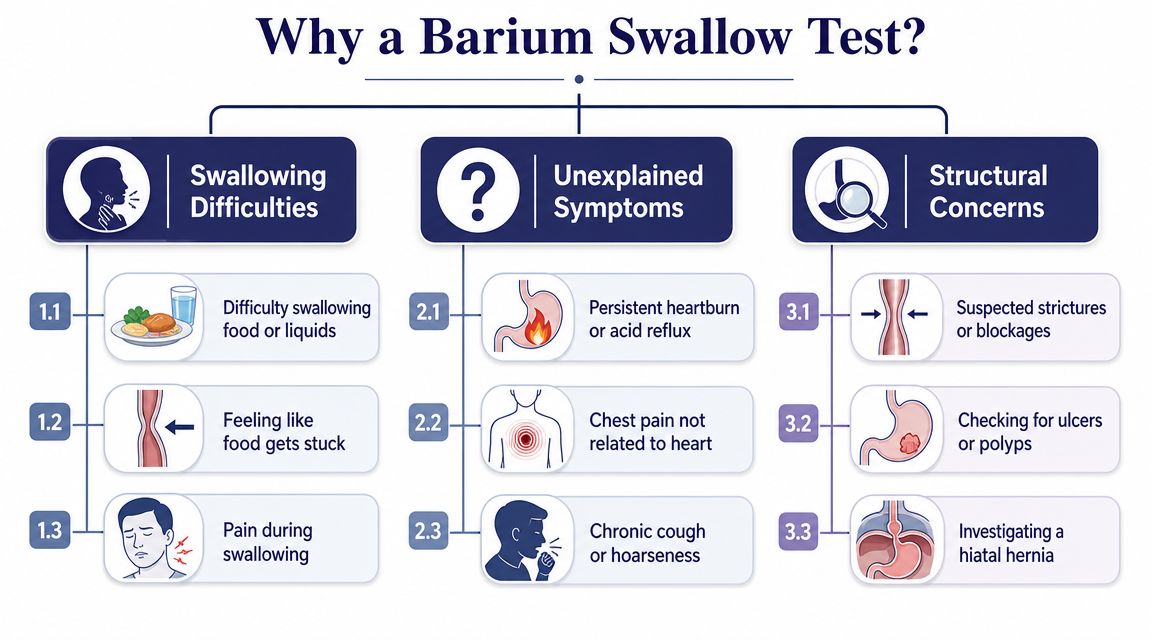
Symptoms that commonly lead to this test
A few examples come up again and again in clinic:
- Food feels slow to go down. This is the classic “sticking” symptom, especially with bread, meat, or tablets.
- You need extra sips of water to clear food. That can suggest delayed transit through the oesophagus.
- Swallowing is painful or uncomfortable. Pain changes the urgency of the conversation.
- Reflux keeps returning. Particularly if the usual self-care measures aren't giving enough relief.
- You cough, clear your throat, or become hoarse after eating. This can overlap with other swallowing problems and may need more than one kind of assessment.
- Chest discomfort seems linked to swallowing. If heart causes have been excluded, the oesophagus becomes more relevant.
What the radiologist is looking for
A barium swallow is most useful when the question is structural or transit-related. It uses contrast to coat the oesophageal lining and allows real-time fluoroscopic imaging to show strictures, rings, motility failure, or a hiatal hernia as the liquid passes through, as explained in the Cleveland Clinic overview of an esophagram.
That's why I often compare the oesophagus to a pipe. We want to know:
- Is there a narrow point?
- Is the tube moving things along properly?
- Is there a hold-up near the stomach entrance?
- Is there an anatomical issue, such as a hiatal hernia?
- Is there pressure from outside the oesophagus affecting the flow?
Symptoms, lifestyle, and context
Symptoms don't happen in a vacuum. Large late meals, alcohol, rushed eating, poor chewing, and lying down soon after dinner can all make upper GI symptoms feel worse. Stress can amplify awareness of swallowing and reflux symptoms too. That doesn't mean the problem is “just stress”. It means lifestyle can muddy the picture.
Practical rule: if you're getting recurring swallowing symptoms, slow your meals down, chew thoroughly, avoid eating late at night, and keep a short symptom diary. That record often helps the doctor decide whether a barium swallow test is the right next step.
One important point. Persistent dysphagia should never be shrugged off. It needs proper medical review so the right test is chosen promptly.
How to Prepare for Your Barium Swallow
Preparation is usually straightforward, but it helps to think ahead so the day feels calm rather than rushed. The exact instructions can vary slightly between imaging providers, so always follow the instructions from the clinic or radiology department doing your test.
The practical checklist
Use this as a common-sense guide before you go:
- Check the fasting instructions carefully. Many centres ask you not to eat or drink for a period beforehand. Don't guess. Follow the instructions you've been given.
- Review your medications. If you take regular tablets, ask in advance whether you should take them as normal on the morning of the test.
- Wear simple clothing. Clothes without metal around the chest and neck area are often easiest.
- Leave jewellery at home if possible. It saves time and avoids last-minute faffing.
- Bring your referral details and symptom history. A short note on what happens, when it happens, and what foods trigger it can be very helpful.
The day before
A few small habits can make the experience easier:
- Eat lightly in the evening if your appointment is in the morning.
- Stay well hydrated earlier in the day so fasting feels less unpleasant later on.
- Avoid a heavy late meal if reflux is one of your main symptoms.
- Write down questions before bed, especially if you tend to forget them when anxious.
Questions worth asking beforehand
Some patients feel more settled if they clarify the basics in advance. Useful questions include:
- Will I need to stop any medication beforehand?
- How long should I allow for the appointment?
- Can I drive afterwards?
- When and how will I receive the result?
- Who explains the result in context, rather than just sending the report?
If you're prone to health anxiety, planning these details early helps. Uncertainty often feels worse than the test itself.
Most people cope perfectly well with a barium swallow. Preparation isn't about passing an exam. It's about removing avoidable stress.
What to Expect During the Test Step-by-Step
You arrive, feel a bit tense, and wonder whether you're about to do something complicated. In reality, a barium swallow is a very guided test. The radiology team talks you through it as it happens, one small step at a time.
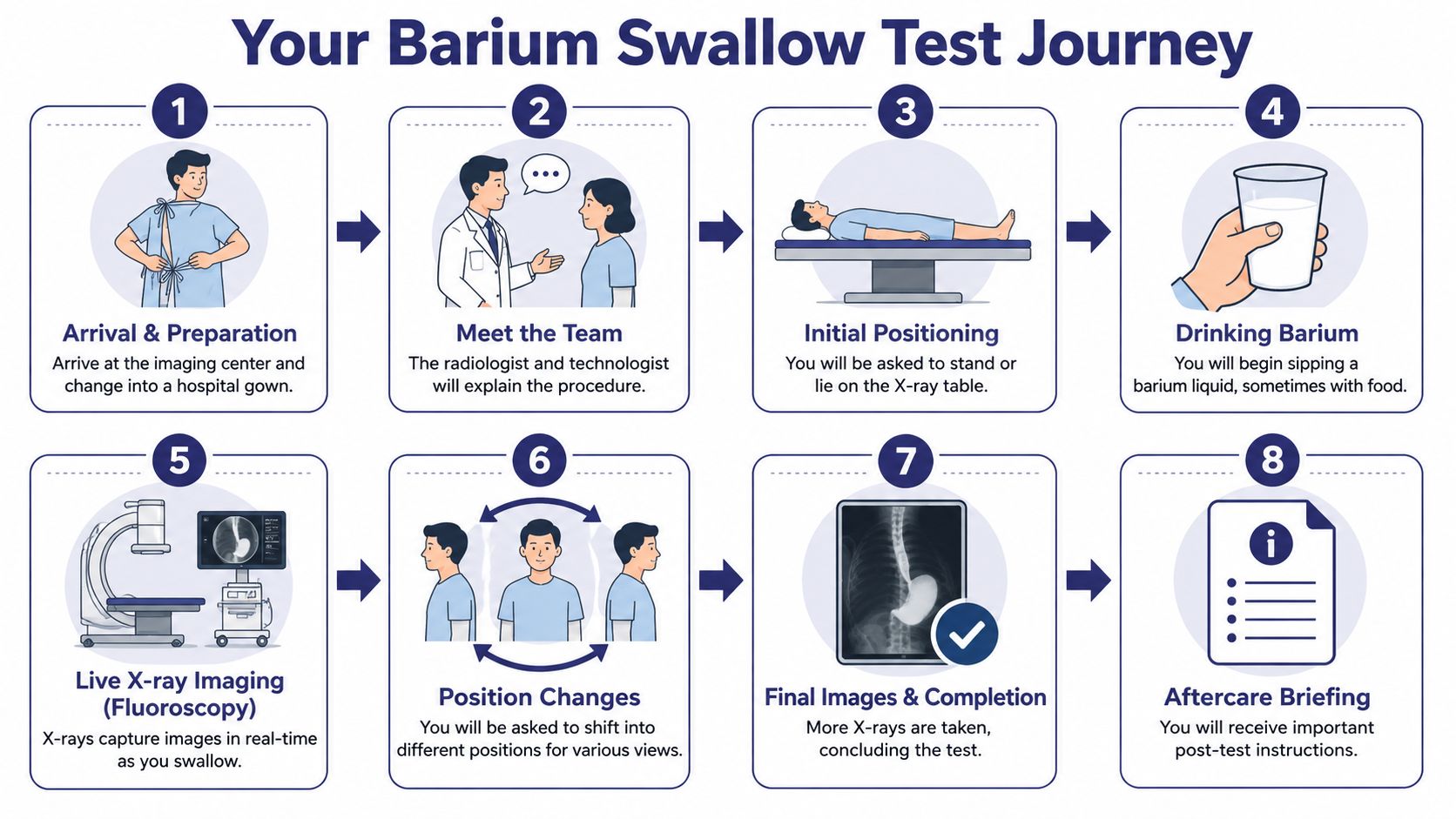
First, you'll get settled
After check-in, you may be asked to change into a gown and remove anything that could interfere with the X-ray images. A radiographer will position you either standing or on a tilting X-ray table.
This test records swallowing in real time. Rather than taking one single picture, the machine watches the barium move from your mouth and throat down into the oesophagus, rather like watching dye move through a clear tube. That helps the clinician see both the shape of the swallowing passage and how well it is working.
A standard barium swallow mainly looks at the oesophagus. Patients often confuse it with a modified barium swallow, which is a different test usually carried out with speech and language specialists to assess the mouth and throat phase of swallowing in more detail. If you are arranging a private test in Bristol through The Lagom Clinic, we help make sure you are sent for the right one.
Then you'll be asked to drink the barium
The barium liquid is white and usually fairly thick. Patients often describe it as chalky, heavy, or similar to a milkshake with an unusual texture. It is not dangerous in the way people sometimes fear. It is designed to coat the lining so the swallowing pathway shows up clearly on the moving X-ray.
You will not be left to guess what to do. The team usually gives simple instructions such as:
- Take a sip
- Hold it for a moment
- Swallow now
- Turn slightly
- Stay still
- Take another mouthful
That can feel oddly formal because swallowing is normally automatic. If you hesitate or need a second attempt, that is very common.
You may need to change position
During the test, the team may ask you to stand sideways, face forwards, or lean back slightly. These position changes help them view the oesophagus from different angles and see whether the barium passes straight through or briefly catches in one area.
Some centres also ask you to swallow different consistencies, or a tablet, if that would help answer the clinical question. The exact sequence depends on your symptoms and the radiologist's protocol.
If you like knowing how hospital imaging appointments usually flow, our guide on how long a CT scan takes gives a helpful sense of the stop-start rhythm. Much of the time is spent on positioning, instructions, and getting clear images rather than doing anything uncomfortable.
What it usually feels like
The barium itself is the part people notice most. The X-rays do not hurt. The awkward part is often the self-conscious feeling of being watched while you swallow.
Try to swallow as normally as you can.
You do not need to perform a perfect swallow. A natural swallow gives the most useful information, and the team knows that people often feel a little stiff or overaware at first.
The appointment is usually fairly short. Once the radiologist has the views they need, the test ends and you can get changed and head home. If constipation is something you are already prone to, it can be sensible to read ahead about bowel support, including XO Medical on how long Laxido takes.
Aftercare Advice Risks and Side Effects
Once the test is over, patients typically return to normal activities quickly. The aftercare is usually simple, and the main aim is to help your body clear the barium comfortably.

What's normal afterwards
Two things commonly surprise patients:
- Your stools may look pale or whitish for a short time
- You may feel a bit constipated
That happens because the barium passes through your digestive system after the scan. It's usually temporary.
Simple things you can do
Focus on the basics for the rest of the day:
- Drink extra water unless you've been told to limit fluids for another medical reason.
- Eat fibre-containing foods if they suit your stomach, such as fruit, vegetables, oats, or pulses.
- Keep moving. A gentle walk can help your bowels get going again.
- Don't ignore constipation if it starts to build.
If you've previously been advised to use laxatives, or you need to understand how one works in practice, this explainer from XO Medical on how long Laxido takes may help you think through timing and expectations.
Radiation risk in context
Radiation is the part many patients worry about most. A barium swallow study typically delivers an effective dose of about 1 mSv, which the Health Physics Society explains here. That's roughly the same order as a few months of natural background radiation exposure in the UK, which is why the test is generally viewed as low-dose and low-risk when medically justified, according to the same source.
That doesn't mean radiation is meaningless. It means the level used for this test is generally considered low, and clinicians balance that small risk against the value of answering an important diagnostic question.
When to seek advice
Get medical advice if you have:
- Persistent constipation
- Significant abdominal pain
- Vomiting
- Trouble passing stools that isn't settling
- Any symptom that feels markedly worse rather than gradually improving
If something doesn't feel right after a test, trust that instinct and ask. Reassurance is part of good care.
Interpreting Your Results and Next Steps
The report from a barium swallow test can be very helpful, but it doesn't tell the whole story on its own. The meaning of any finding depends on your symptoms, age, medical history, and what question the test was asked to answer.
What a result might say in plain English
A result may be broadly described as:
- Normal transit. The barium moved through without a clear structural hold-up.
- Narrowing. This can suggest a stricture or ring.
- Hiatal hernia seen. Part of the stomach appears to be moving up where it shouldn't.
- Disordered movement. The oesophagus isn't pushing the liquid along in the usual coordinated way.
- Reflux observed during the study. Sometimes backward flow is seen during imaging.
For patients, the useful translation is often simple. Is there a blockage-like problem? Is movement impaired? Or did the scan not show a clear explanation?
If the result is normal but symptoms continue
It's important to manage expectations. A barium swallow can miss intermittent motility disorders or subtle reflux-related issues, and a normal result doesn't always end the investigation. If symptoms persist, specialist testing such as manometry or pH monitoring may be needed next, as explained in the AHN overview of barium swallow testing.
That's why “normal” doesn't always mean “nothing is wrong”. It may only mean there's no clear structural abnormality visible on this particular test.
What you can do while waiting for follow-up
While the medical plan is being clarified, sensible lifestyle steps can still help:
- Eat more slowly
- Take smaller mouthfuls
- Avoid repeatedly washing food down with large gulps
- Reduce late-night eating if reflux is part of the picture
- Limit foods that reliably trigger symptoms
- Stay upright after meals
These steps won't fix every cause of dysphagia, but they often reduce day-to-day discomfort and may also make your pattern of symptoms clearer.
The test result matters. Your symptom story matters just as much.
Why follow-up is essential
Don't rely on the wording of the scan report alone. The most useful next step is a proper conversation with a GP or specialist who can connect the result to your wider health picture. Sometimes the next move is reassurance. Sometimes it's medication review, endoscopy, swallow therapy, or further oesophageal testing.
Alternatives and Accessing Your Test in Bristol
One of the biggest points of confusion is that not every “barium swallow” means the same thing. A standard barium swallow, also called an esophagram, looks mainly at the oesophagus and related structural issues. A modified barium swallow, often called VFSE, focuses on swallowing safety in the mouth and throat and is often used to assess aspiration risk. A normal esophagram does not rule out aspiration, which is better assessed with VFSE, often involving a speech and language therapist, as described in the UMass explanation of the modified barium swallow.
Barium swallow vs endoscopy at a glance
| Feature | Barium Swallow Test | Upper GI Endoscopy |
|---|---|---|
| Main purpose | Looks at swallowing flow, structure, and transit through the oesophagus | Looks directly at the lining of the upper GI tract |
| How it's done | You drink barium and have fluoroscopic imaging | A camera tube is passed through the mouth |
| Sedation | Usually not needed | May be offered or required depending on the setting |
| Best for | Narrowing, hold-up, rings, hiatal hernia, dynamic swallowing problems | Direct visual inspection of the lining and further specialist assessment |
| What patients often find easier | Non-invasive and outpatient-based | More intrusive, though often very informative |
Choosing the right route in Bristol
If you’re in Bristol and symptoms are affecting meals, work, sleep, or peace of mind, the practical issue is often access. Some patients start with NHS assessment. Others prefer a private GP route for faster review and quicker imaging referrals.
If you’re comparing options locally, it can help to understand how practices present specialist services online. This overview of local SEO for healthcare businesses is aimed at healthcare visibility, but it also shows why some clinics are easier to find and compare than others when you’re trying to arrange care promptly.
For Bristol patients who want a private GP to assess symptoms, coordinate referral, and interpret results afterwards, a starting point is this page for a general practitioner in Bristol. The key is not just getting the scan booked. It’s making sure the result leads to a sensible next step.
If you’d like a calm, thorough review of swallowing symptoms and help arranging the right next investigation, The Lagom Clinic offers private GP care in Bristol with time to look at the full picture. That includes symptom assessment, lifestyle guidance, rapid referral for imaging where appropriate, and clear follow-up so you’re not left trying to interpret a radiology report on your own.


 Members Consultation