


That sharp pull on the outside of your elbow often shows up in ordinary moments before it ever appears on a tennis court. You reach for the kettle, twist open a jar, lift a laptop bag, or shake someone's hand, and the pain catches you. It's irritating, limiting, and often stubborn enough to make people worry they've done real damage.
Developing tennis elbow rarely involves a dramatic event. Instead, the tendon is often overloaded gradually through activities like work, training, DIY, gardening, childcare, gym sessions, or extended time at a keyboard and mouse. The good news is that, in most cases, you can treat tennis elbow effectively with a clear plan, sensible pacing, and a bit of patience.
A GP's Introduction to Managing Tennis Elbow
Tennis elbow is common, and that matters because it means your symptoms are familiar to GPs and physiotherapists. In the UK, tennis elbow affects 1 to 3% of adults each year and accounts for about two-thirds of persistent elbow pain seen by GPs according to NHS Lanarkshire's tennis elbow guidance.
That doesn't make it trivial. It can interfere with sleep, work, exercise, cooking, driving, and even lifting a mug. What often frustrates people most is that the elbow may look normal while everyday tasks become surprisingly uncomfortable.
What good treatment actually looks like
The best approach isn't one magic exercise, one injection, or one gadget bought online at midnight. To treat tennis elbow well, you need a phased plan:
- Immediate care to calm the irritated tendon
- Active recovery to rebuild tolerance and strength
- Prevention so it doesn't keep flaring every time life gets busy
Practical rule: If a treatment promises instant cure but asks nothing of your habits, grip, workstation, training load, or recovery, it's usually overselling.
The aim is controlled loading, not complete shutdown
Many people swing between two extremes. They either push through pain for weeks or stop using the arm altogether. Neither usually works well. Tendons recover best when you reduce aggravation first, then reintroduce loading in a gradual, structured way.
That's how I'd discuss it in clinic. Calm the elbow down. Identify what's provoking it. Start the right movements. Escalate only when the tendon tolerates the previous step. Keep an eye out for signs that this may not be simple tennis elbow.
What Is Tennis Elbow and Why Does It Hurt
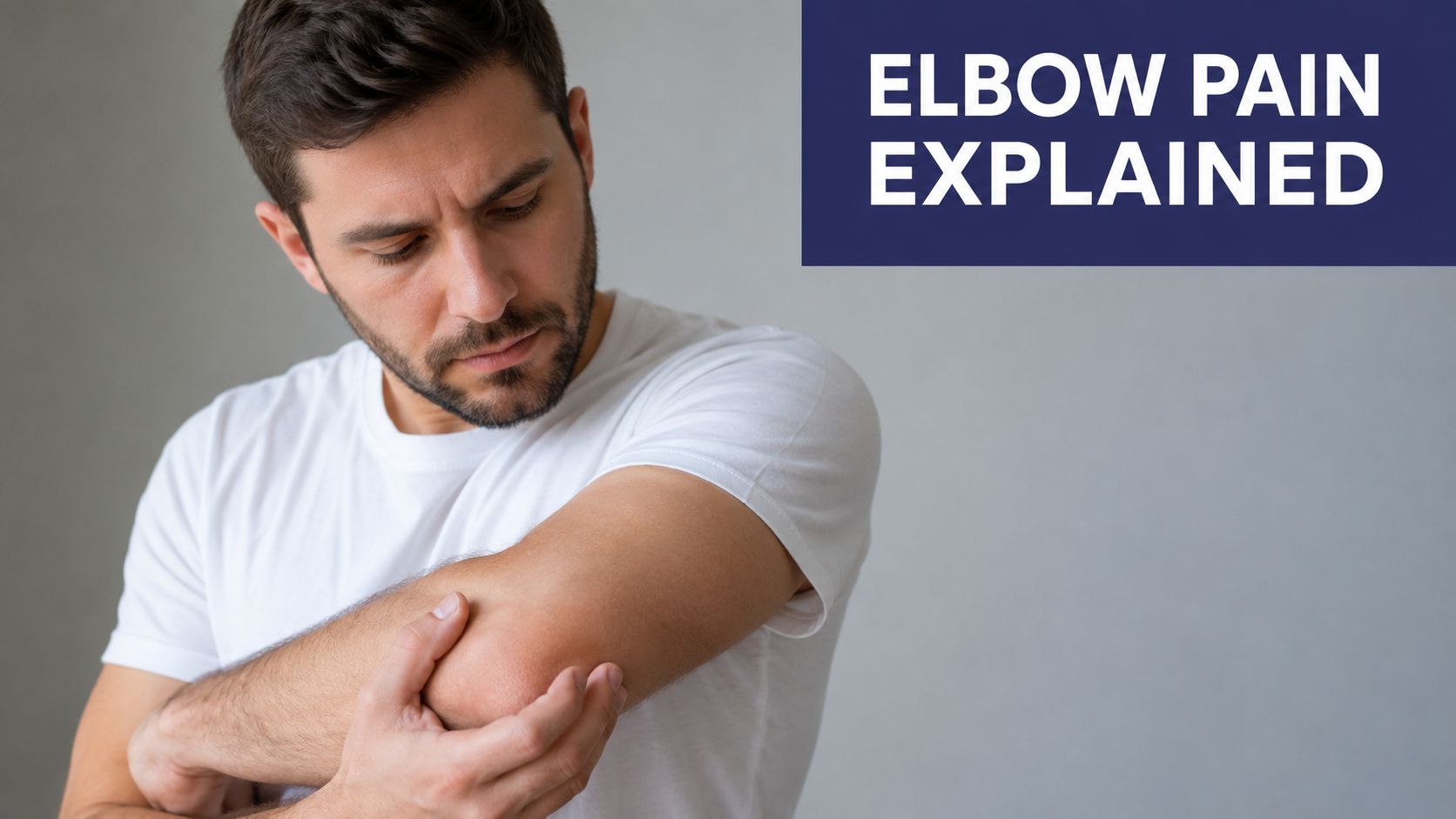
Tennis elbow is the everyday name for lateral elbow tendinopathy. That means the tendon on the outer side of the elbow, usually where the wrist extensor muscles attach, has become irritated and less able to cope with load.
Think of the tendon like a rope under repeated strain
A healthy tendon behaves like a strong rope. Repeated gripping, lifting, twisting, typing, hammering, using secateurs, carrying shopping bags, or playing racquet sports can irritate that rope over time. It's less like a sudden tear and more like a structure that's become sensitive and overloaded.
That's why pain often appears during:
- Gripping tasks such as carrying a pan, suitcase, or shopping
- Twisting movements such as opening jars or using a screwdriver
- Wrist extension such as lifting with the palm facing down
- Repetitive desk work when the forearm is held tense for long periods
In many people, the pain sits over a very specific point on the outside of the elbow. It may then spread down the forearm. Grip strength often feels reduced, not because the muscles have vanished, but because pain inhibits force.
Simple checks you can do at home
These aren't a formal diagnosis, but they can help you judge whether your symptoms fit the pattern.
Find the tender spot
Bend your elbow slightly and press the bony area on the outer side of the elbow. Tennis elbow usually feels sore at or just below that point.Try resisted wrist extension
Rest your forearm on a table, palm facing down. Try to lift your hand up while the other hand gently resists. Pain on the outside of the elbow suggests the wrist extensor tendon is involved.Check the middle finger test
Hold your hand out flat and use the other hand to press down on the middle finger while you try to lift it. If that reproduces the familiar pain near the outer elbow, the pattern fits tennis elbow.
The key clue isn't just where it hurts. It's that gripping and lifting with the palm down usually provoke it.
What doesn't fit the usual picture
Self-assessment is useful, but don't force the diagnosis if the story doesn't match. Consider medical review sooner if you have:
| Symptom | Why it matters |
|---|---|
| Numbness or tingling | May suggest nerve irritation rather than a straightforward tendon problem |
| Neck pain with arm symptoms | Pain may be referred from the neck |
| Major swelling or redness | Suggests a different cause |
| Severe loss of movement | Not typical for simple tennis elbow |
| Pain after a clear injury | May need assessment for a tear or another structural problem |
Your First 72 Hours Managing Elbow Pain
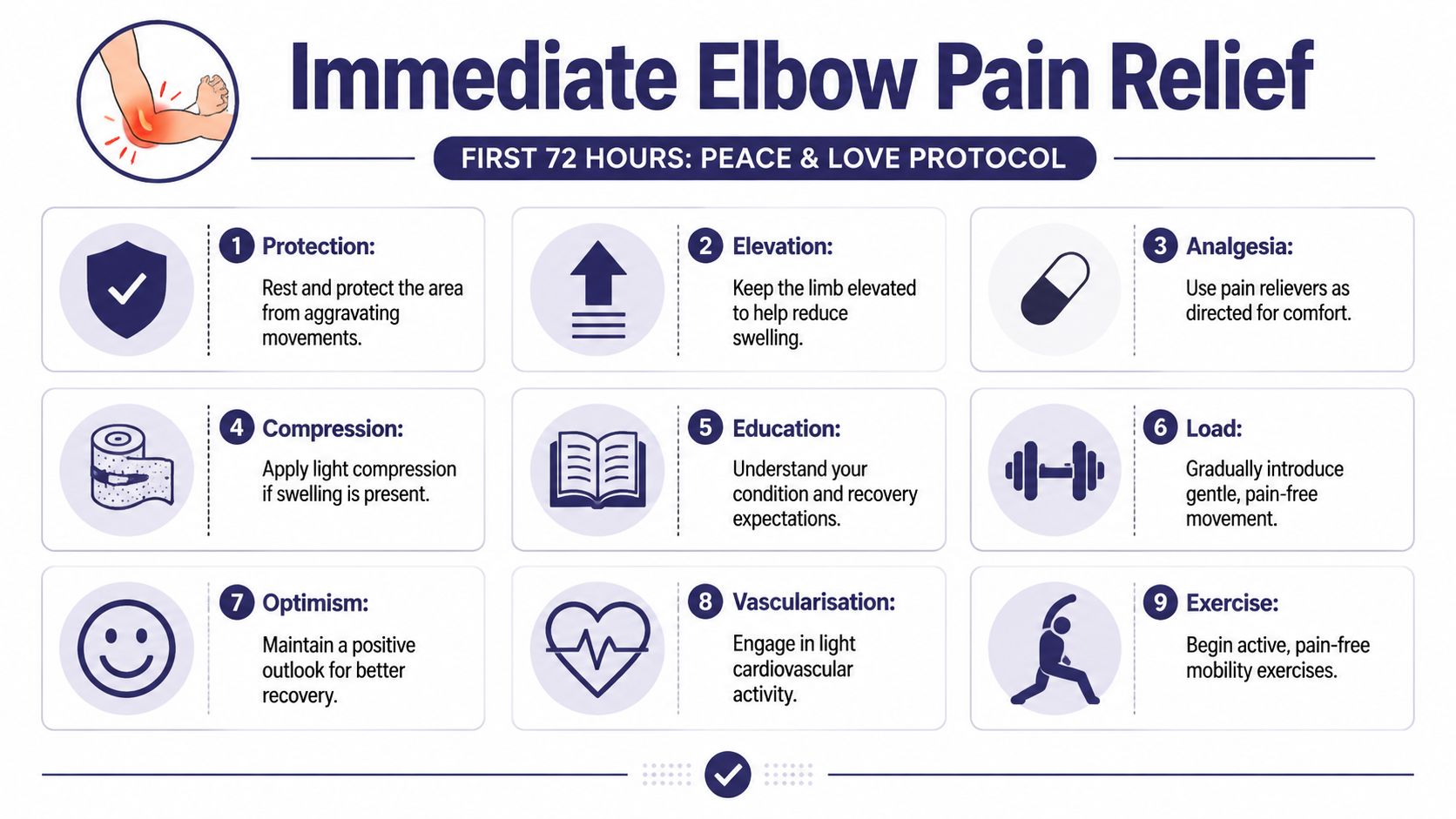
When the elbow is freshly aggravated, the goal isn't to prove toughness. It's to settle things enough that recovery can begin. For that first window, I like the PEACE & LOVE approach because it balances protection with early, sensible movement.
PEACE for the irritated phase
Protection comes first. Stop the movements that clearly spike pain. That doesn't mean immobilising the arm all day. It means avoiding repeated gripping, twisting, lifting with the palm down, and heavy gym work for now.
Elevation can help if the area feels puffy after an acute flare, especially later in the day. Rest the arm supported on cushions rather than hanging by your side for hours.
Avoid anti-inflammatories is part of the original framework because early tissue healing is complex. In practice, pain relief still has a place, but I'd avoid relying on repeated “quick fix” strategies while continuing the exact movements that triggered the problem.
Compression may help if there's a sense of swelling or strain. A light elbow sleeve or forearm support can feel reassuring, but it's an aid, not the treatment itself.
Education matters because this condition responds better to pacing than to panic. According to Oxford University Hospitals advice on elbow pain, ice for 15 to 20 minutes, 3 to 4 times daily, especially after triggering activity, can help, and taking breaks every 10 to 15 minutes during manual tasks can reduce strain by up to 30%.
LOVE for the recovery mindset
Once the first irritation settles, the second half of the framework matters more.
- Load: Reintroduce pain-free or near pain-free movement early
- Optimism: Tendons can be slow, but they usually do improve
- Vascularisation: Keep the rest of your body moving with walking or light cardio
- Exercise: Start specific rehab, not random stretching every few hours
A painful tendon usually hates surprise load more than it hates all load.
What to do today
If you want a practical checklist, use this for the next few days:
- Cool the elbow after flare-ups: Ice can help after work, training, gardening, or long computer sessions.
- Change your grip: Use two hands for heavy pans, kettles, shopping bags, and watering cans.
- Bring objects closer: Don't lift with an outstretched arm.
- Break up repetitive tasks: If you're doing DIY, keyboard work, or manual handling, pause regularly rather than waiting for pain to build.
- Use the other hand where possible: Even small task-sharing can settle an irritable tendon.
Some people also like topical options for comfort. If you're considering applying CBD pain cream, use it as a symptom-relief adjunct rather than a substitute for load management and exercise.
What not to do in the first few days
Avoid these common mistakes:
- Testing the elbow repeatedly: Don't keep squeezing, lifting, or twisting to “check if it's still there”.
- Returning to heavy pulling too soon: Rows, deadlifts, racquet sports, and heavy carries often flare symptoms early.
- Wearing a strap and ignoring the cause: Support without behaviour change rarely works for long.
- Stopping all movement: Stiff, guarded forearms tend to become more irritable, not less.
The Core Exercise Plan for Lasting Recovery
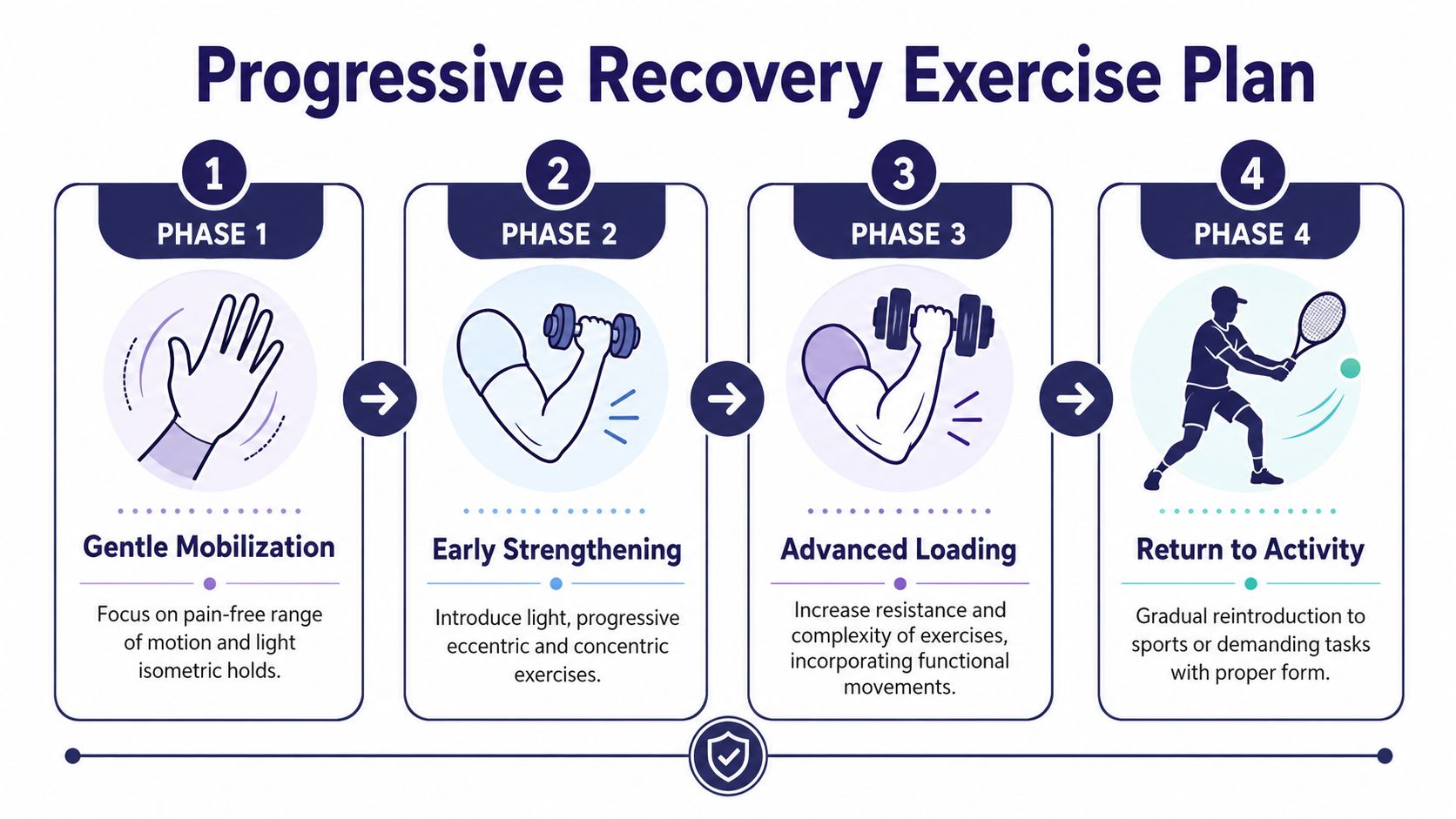
If you want the part that changes the trajectory, it's this. Exercise-based rehabilitation is the main treatment, not an optional extra. In UK clinical practice, 81% of specialists recommend exercise-based physiotherapy as first-line care, using a staged progression of isometric, concentric, and eccentric wrist extensor exercises performed 4 to 5 days weekly according to this clinical review on lateral elbow tendinopathy.
The golden rule for all phases
Work below sharp pain. A mild, tolerable awareness in the tendon can be acceptable. A sudden jab, worsening ache later that day, or a next-morning flare means you've gone too far.
If you're already doing rehab and want an example of how clinicians structure musculoskeletal exercise therapy, it's useful to compare your current routine against a proper progression rather than guessing.
Phase 1 gentle mobility and stretching
Start here when the elbow is irritable, stiff, or reactive.
Wrist extensor stretch
Straighten the affected arm in front of you with the elbow soft, not locked. Bend the wrist so the fingers point down, then use the other hand to apply gentle pressure until you feel a stretch in the top of the forearm. Hold without bouncing.
Wrist flexor stretch
Straighten the arm again, but this time extend the wrist so the fingers point up. Use the other hand to guide the palm back gently until you feel a stretch on the underside of the forearm.
A practical pattern is:
- Hold each stretch for 30 to 60 seconds
- Repeat 3 to 5 times daily
- Exercise 4 to 5 days per week
- Build load gradually over 8 to 12 weeks
Those timings come from the treatment guidance summarised in this tennis elbow treatment article, and they fit well with what most patients tolerate in practice.
Phase 2 isometric loading
This phase is useful when movement itself is provocative, but the tendon can tolerate muscle engagement without much joint motion.
Isometric wrist extension hold
Sit with your forearm supported on a table, palm facing down, wrist just off the edge. Use the other hand to resist as you try to lift the wrist slightly, but don't let it move much. Hold the effort steadily, then relax.
Wall press
Stand facing a wall with the affected palm placed flat against it at a comfortable height. Gently press into the wall as if trying to extend the wrist, without forcing pain.
Use isometrics when:
- The elbow is painful at rest or with light activity
- You need a bridge back into strengthening
- Dynamic exercises still provoke symptoms
Clinical tip: Isometrics should feel controlled and calm. If they make the tendon throb afterwards, scale back the effort, not just the repetitions.
Phase 3 concentric and eccentric strengthening
This is the rebuilding phase. It matters because the tendon needs capacity, not just temporary pain relief.
Wrist extension with a light weight
Support your forearm on a table, palm facing down, holding a very light dumbbell, half-filled water bottle, or similar object. Lift the wrist up slowly, then lower it with control. Keep the shoulder relaxed and don't clench the jaw or grip too hard.
Eccentric wrist lowering
Use the unaffected hand to help lift the weight into the starting position. Then let the affected side do the lowering slowly on its own. This focuses load on the tendon during the lengthening part of the movement.
A sensible progression looks like this:
| Stage | Focus | What you're aiming for |
|---|---|---|
| Early | Light load, small range | Calm, repeatable effort |
| Middle | More repetitions or slightly more weight | Better tolerance in daily tasks |
| Later | Functional grip and forearm endurance | Return to sport, gym, DIY, and work demands |
Phase 4 return to normal activity
The final step isn't “pain gone, job done”. It's making sure the elbow can cope with your actual life again. That may mean racquet sports, carrying a child, lifting weights, decorating a room, or spending long days at a desk.
Reintroduce demanding tasks gradually:
- Resume the easier version first
- Reduce duration before you increase intensity
- Leave a recovery gap and check the next-day response
- Keep one or two strengthening sessions in the week even after you feel better
Continuing forearm strength work as a maintenance strategy, rather than abandoning it the moment pain settles, contributes to good recovery.
When Self-Care Is Not Enough Medical Options
Some elbows don't respond on schedule. That doesn't always mean something serious is going on, but it does mean the plan may need refining. If you've been consistent with activity modification and progressive rehab and you're not moving forward, it's reasonable to consider medical assessment.
Braces and straps
A tennis elbow strap or counterforce brace can reduce symptoms for some people by changing how force travels through the forearm. That can be helpful during work or sport, especially if you need short-term symptom control.
But a brace doesn't repair tendon capacity. If it lets you overload the arm repeatedly, it can mask the problem rather than solve it.
A brace is most useful when:
- You're modifying activity at the same time
- You're using it for selected tasks, not permanently
- You're continuing a strengthening programme
Physiotherapy and when to seek it
If you're doing the right exercises but your form is poor, your loading is too aggressive, or your neck and shoulder are contributing, physiotherapy often helps. The key value isn't just supervision. It's getting the progression right.
According to this review of tennis elbow management, if symptoms don't improve within 6 to 12 weeks despite conservative management, referral to physiotherapy is standard, and most patients improve within three months, with symptoms often resolving over 9 to 18 months when managed conservatively.
That last point is worth hearing clearly. Slow recovery is common with tendons. Slow does not automatically mean failing.
Corticosteroid injections and the trade-off
Steroid injections still come up often because they can reduce pain quickly. The problem is what happens after the early relief.
The evidence summarised in the BESS patient care pathway for tennis elbow shows that corticosteroid injections provide better pain relief in the first 0 to 6 weeks, but outcomes drop significantly after 6 months and can be worse than exercise-based care. The same guidance notes that if lifestyle modification isn't added, recurrence rates are 30 to 40%.
That's the trade-off in plain English:
| Option | Main upside | Main downside |
|---|---|---|
| Steroid injection | Faster short-term relief | Higher recurrence and weaker long-term strategy if used alone |
| Exercise-based rehab | Better long-term recovery path | Slower and requires consistency |
| Brace or strap | Symptom relief during tasks | Doesn't replace strengthening |
Short-term pain relief can be useful. It becomes a problem when it convinces you the tendon is ready for loads it still can't handle.
Other options and red flags
For more persistent cases, clinicians may discuss options such as shockwave therapy or needle-based procedures. These aren't first-line fixes, and the right choice depends on duration, severity, examination findings, and what's already been tried properly.
Seek prompt medical assessment if you notice:
- Numbness or persistent tingling
- Marked weakness that feels out of proportion
- Pain waking you at night without a clear mechanical trigger
- Visible swelling, redness, or heat
- Symptoms after a significant injury
- No meaningful progress after a sustained period of good self-management
Preventing a Relapse Through Ergonomics and Lifestyle
Once the elbow settles, the key is keeping it settled. Relapse usually happens when old loading habits return before tendon capacity has caught up. Prevention is less about perfection and more about making your daily setup easier on the forearm.
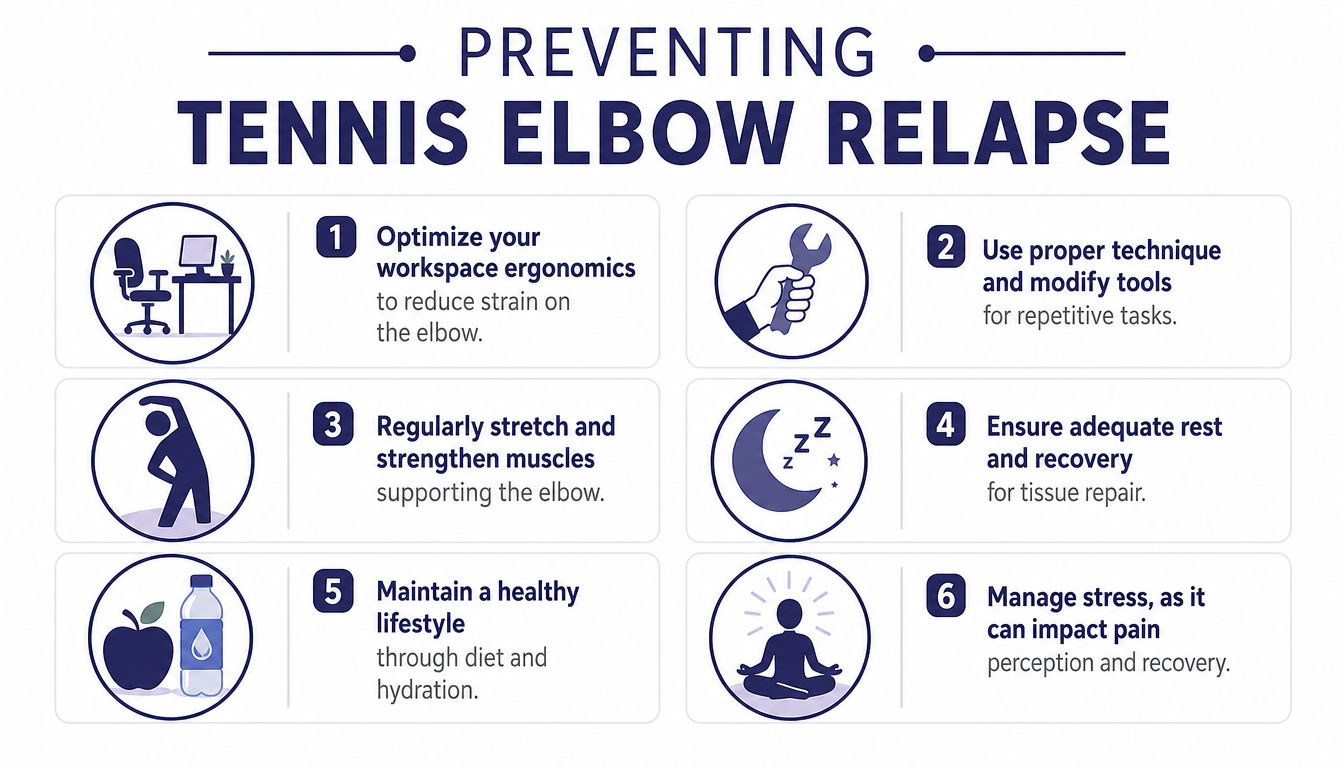
Make your environment do some of the work
For desk-based work, keep the mouse close, avoid reaching forward for long periods, and let the forearm rest rather than hover. A lighter grip on the mouse often helps more than buying expensive equipment. If exercise tends to trigger other areas too, it's worth reading about lower back pain after exercise, because whole-body load management matters more than people think.
For manual tasks, think in terms of force, repetition, and mechanical advantage:
- Use thicker-handled tools if thin grips make you squeeze hard
- Keep loads close to the body rather than reaching out
- Alternate hands or tasks where possible
- Use two hands for heavier lifting, pouring, or carrying
- Build in short pauses before fatigue changes your technique
Keep a small maintenance routine
The people who do best long term usually continue some version of rehab after pain improves. That doesn't need to be elaborate. A brief forearm routine a few times a week often protects you better than stopping completely and hoping for the best.
Good prevention habits include:
- Warm up before gripping sports or gym work
- Resume heavier loading gradually after time off
- Keep one strengthening exercise in your weekly routine
- Notice early warning signs such as morning stiffness or pain when lifting a mug
Sport and hobby technique matters
If tennis, padel, golf, climbing, rowing, or gym work contributed, check your setup and technique instead of just treating the flare. A poor racquet grip size, sudden jump in training volume, or too much wrist-dominant lifting can all keep the cycle going. If you're returning to racquet sports, a guide on how to improve your game on court can be useful when paired with sensible tendon loading.
Recovery sticks when your daily habits stop picking the same scab.
Sleep, stress, and general health matter too. People in pain often brace more, move less freely, and recover less well when tired and overloaded. The elbow may be local. The conditions for recovery are not.
If tennis elbow is lingering, recurring, or stopping you from working, training, or sleeping comfortably, The Lagom Clinic offers thoughtful private GP care with time to assess the whole picture. That includes your symptoms, workload, exercise habits, recovery patterns, and whether you need imaging, physiotherapy referral, or a more individualized rehabilitation plan.

 Members Consultation