


To effectively manage workplace stress, you must begin at its source. This process starts with a crucial first step: identifying what is actually causing the physiological and psychological stress response in your body.
This means pinpointing your specific triggers, whether it's an unsustainable workload, looming deadlines, or the 'always-on' digital culture that dissolves the boundary between your professional and personal life. Once you can accurately identify the problem, you can build a practical, evidence-based strategy to manage it and protect your health.
Getting to the Root of Workplace Stress

Feeling completely overwhelmed at work is an incredibly common experience—it is not a personal failure. It is a normal human response to being under sustained pressure that exceeds your capacity to cope. If you experience persistent anxiety on Sunday evenings or find it impossible to mentally disengage after work, you are not alone.
The factors causing this pressure are often interconnected, making them difficult to isolate. However, systematically identifying them is the first essential step towards regaining control over your well-being.
Common Culprits Behind Professional Strain
Work-related stress rarely originates from a single source. More often, it is a cumulative effect of various factors that erode your physical and mental health over time. From a clinical perspective, some of the most prevalent stressors include:
- Excessive Workloads: A persistent mismatch between the volume of work and the time available creates a chronic state of pressure.
- Unrealistic Deadlines: Timelines that do not account for the actual work required can trigger significant anxiety and lead to rushed, subpar outcomes.
- Lack of Autonomy: Feeling that you have no control over your schedule, tasks, or work methods is a major, and often underestimated, source of chronic stress.
- Poor Management: This is a significant factor. Ambiguous expectations, a lack of support, or micromanagement can be detrimental to your mental health.
The crucial shift occurs when you move from simply reacting to stress to proactively identifying its source. This awareness allows you to address the cause, not just the symptoms.
The Toll on Your Health and Productivity
Being in a constant state of high alert is not just mentally draining; it takes a significant physical toll and impairs professional performance. Chronic stress manifests physically as tension headaches, disrupted sleep patterns, and a weakened immune system, leaving you susceptible to frequent illness. For more detailed advice, see our guide to workplace health and safety tips.
The statistics underscore the severity of the issue. In Great Britain, work-related stress, depression, and anxiety were responsible for a staggering loss of 16.4 million working days in 2023/24. This accounts for over half (54%) of all sick days.
This public health issue costs the UK economy approximately £28 billion annually. Despite this, a significant gap remains, with many organisations lacking robust, evidence-based strategies to prevent burnout.
Before you can begin to manage workplace stress, you must understand your personal triggers. Generic advice is often ineffective because stress is highly individualised. What elevates one person's cortisol levels may be a routine task for another. The first step is to become an objective observer of your own emotional and physiological responses to identify what is truly causing the pressure.
Think of it as diagnosing a condition: you cannot prescribe a treatment without first identifying the underlying cause. Once you know your specific triggers, you can move from a reactive state of feeling overwhelmed to proactively managing the situations that cause it.
Play Detective with Your Stress
One of the most effective methods for identifying triggers is to keep a stress journal for one to two weeks. This does not need to be complex; a simple notebook or a notes app on your phone is sufficient. The objective is to record details whenever you experience feelings of tension, anxiety, or being overwhelmed.
It is vital to capture a complete picture. For each entry, aim to answer these questions:
- What was the situation? Were you trying to complete a report while dealing with a software issue? Or were you managing a difficult client interaction?
- Who was involved? Were you working alone, in a tense meeting, or collaborating with a specific colleague?
- How did your body react? Did you notice muscle tension in your shoulders? An increased heart rate? A sudden inability to focus?
- What were your thoughts? Was your internal monologue self-critical, such as, "I'm not capable of this," or was it focused on time pressure, like, "I will never get this finished on time"?
After several weeks, distinct patterns will likely emerge. You might discover that your stress consistently peaks before a specific weekly meeting, or that the constant influx of email notifications is the primary driver of your anxiety.
Use a Table to Connect the Dots
Visualising the connections between stressors and symptoms can help you recognise your own patterns. Use this table to map common workplace stressors to the physiological and psychological symptoms they frequently cause. It may help you realise that your recurring headaches are not random but a direct consequence of your workload.
Connecting Workplace Stressors to Your Symptoms
| Stress Trigger | Common Examples | Potential Symptoms |
|---|---|---|
| High Workload | Unrealistic deadlines, too many projects at once, working long hours. | Feeling overwhelmed, fatigue, headaches, difficulty sleeping. |
| Lack of Control | Micromanagement, having no say in decisions that affect your work. | Apathy, irritability, feeling helpless or resentful. |
| Poor Relationships | Conflict with colleagues or managers, lack of social support. | Anxiety, social withdrawal, decreased job satisfaction. |
| Role Ambiguity | Unclear job expectations, conflicting requests from different managers. | Confusion, frustration, decreased motivation, making more mistakes. |
| Work-Life Imbalance | Checking emails after hours, inability to switch off from work. | Burnout, strained personal relationships, constant tiredness. |
Reviewing this table, you may identify with one or more scenarios. This is not for self-diagnosis but to build the self-awareness necessary to implement meaningful change.
Link Your Triggers to Practical Changes
Once you have identified a recurring trigger, you can begin to make small, deliberate adjustments to your routine. For example, if you realise that consecutive video calls leave you feeling drained and irritable, the solution is structural. Start by scheduling 15-minute breaks in your calendar between meetings. This simple change can have a significant positive impact.
Identifying a trigger is not about assigning blame. It is about reclaiming agency over your health. It transforms a vague, overwhelming feeling of "stress" into a specific, manageable problem.
Consider how a technique like time blocking can fundamentally alter your workday.
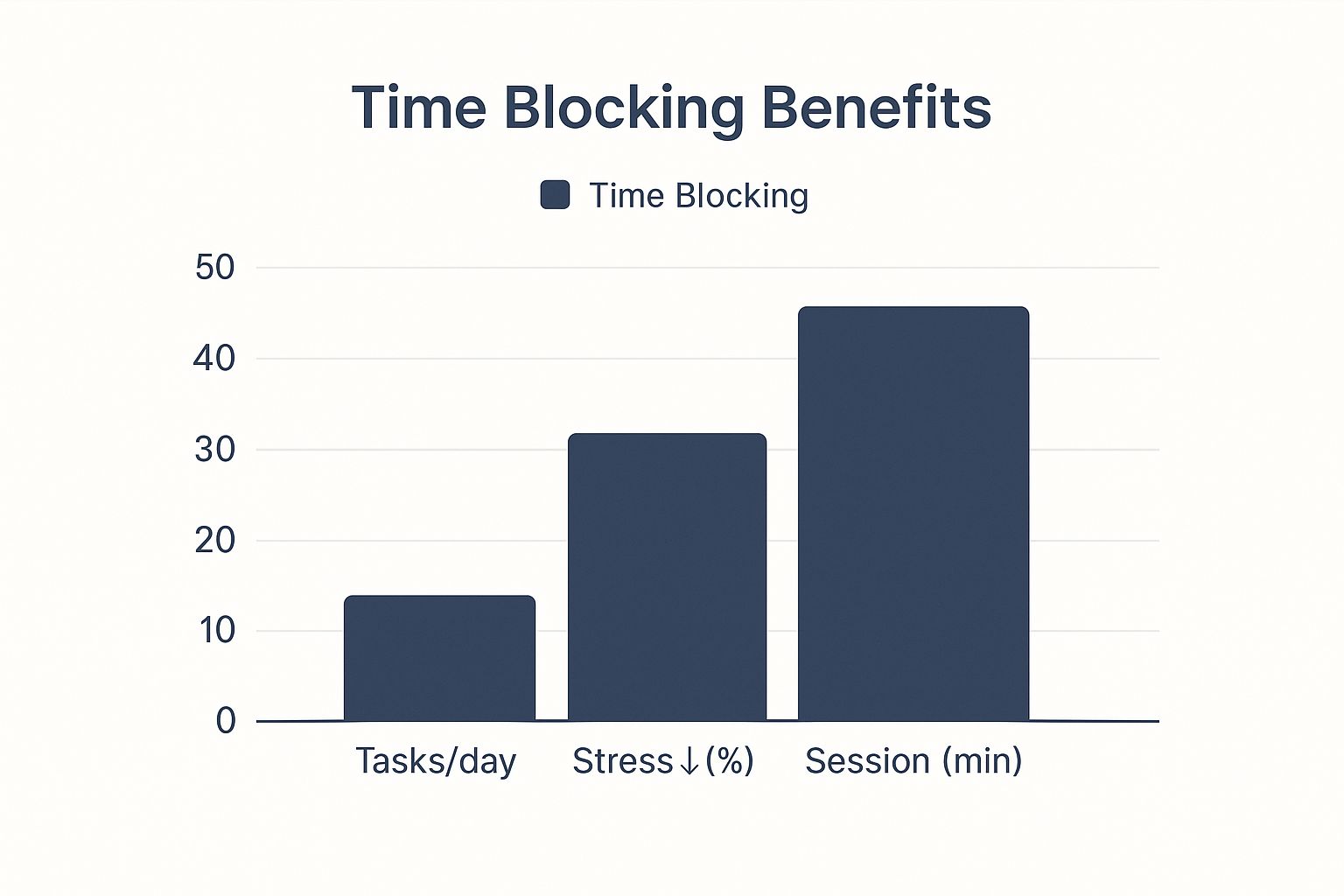
Structuring your day with dedicated blocks for specific tasks not only improves productivity but also actively reduces the cognitive load of multitasking. When you understand your triggers, you can design a workday that supports your well-being instead of undermining it.
Building Resilience with Healthy Lifestyle Habits
Your ability to manage a demanding job is influenced more by your lifestyle outside of work than by what happens during the workday itself. The foundation for coping with stress is built on consistent, healthy habits that fortify both your mind and body, acting as a buffer against daily pressures.
When you are chronically fatigued, your nervous system is already in a state of high alert, making you more susceptible to the effects of workplace stress. A few key lifestyle adjustments can change this dynamic, building a stronger baseline of well-being that makes you inherently more resilient.
Fuel Your Body to Stabilise Your Mind
The link between nutrition and mental health is well-established. Your diet directly impacts brain chemistry and energy levels, which in turn influences how you perceive and manage stress. Highly processed foods and sugary snacks cause fluctuations in blood glucose, which can mimic the physical sensations of anxiety.
To counter this, adopt a diet that promotes metabolic stability. Incorporating these food groups can make a significant difference:
- Complex Carbohydrates: Foods like oats, brown rice, and sweet potatoes provide a slow, sustained release of glucose. This prevents the energy crashes that can make tasks feel overwhelming.
- Lean Proteins: Including sources such as chicken, fish, eggs, and lentils promotes satiety and helps maintain stable blood sugar levels. Protein also provides the amino acids necessary for producing mood-regulating neurotransmitters like serotonin.
- Healthy Fats: Omega-3 fatty acids, found in oily fish, walnuts, and flaxseeds, are essential for brain health and have been scientifically shown to help reduce symptoms of anxiety.
By providing your body with proper fuel, you give your brain the resources it needs to function optimally, making it easier to navigate challenging days.
The Critical Role of Rest and Recovery
Chronic stress and poor sleep are locked in a vicious cycle. Stress disrupts sleep, and sleep deprivation impairs your ability to cope with stress. Prioritising sleep is not a luxury; it is a non-negotiable component of any effective stress management plan.
Establishing a clear separation between your 'work self' and your 'rest self' is vital for health. Without this boundary, your brain never receives the signal that it is safe to switch off, leading to mental and physical exhaustion.
One of the most effective ways to create this separation is by implementing a pre-sleep "wind-down" routine. An hour before bed, put away all work-related devices. Instead, engage in relaxing activities like reading a book, taking a warm bath, or listening to calming music. This ritual signals to your body that the day is over and it is time to recover.
Your environment also plays a crucial role in your ability to unwind. It is beneficial to learn how to transform your home into a personal sanctuary so you can fully disconnect and recharge.
Integrate Movement into Your Daily Rhythm
Regular physical activity is one of the most powerful, evidence-based tools for managing stress. Exercise stimulates the production of endorphins—the body’s natural mood elevators—and helps metabolise excess stress hormones like cortisol.
You do not need to commit to strenuous, hour-long gym sessions to reap the benefits. Consistency is the key. Even short bursts of activity can be highly effective. A brisk 10-minute walk during your lunch break can be enough to clear your mind and reset your focus for the afternoon.
By making these lifestyle habits a consistent part of your routine, you build a robust physiological support system that equips you to handle workplace demands more effectively.
In-the-Moment Techniques to Manage Stress Now
Building long-term resilience is essential, but you also need strategies for acute stress—when your heart is pounding before a presentation or your mind is racing after a difficult meeting. For these moments, you need an accessible toolkit of techniques to calm your nervous system.
These are evidence-based strategies that can pull you back from a state of overwhelm and help you regain a sense of control when you need it most.
Stress is a significant public health concern in the UK. The 2025 Burnout Report from Mental Health UK found that 91% of UK adults have experienced high or extreme stress in the last year. While workplace support is slowly improving, with a small 3% rise in interventions, it is clear that personal coping skills are essential. You can read the full Burnout Report 2025 findings for a comprehensive overview.
Master Your Breath to Master Your Stress
One of the fastest ways to interrupt the body's acute stress response is through controlled breathing. When you're stressed, your breathing becomes rapid and shallow, signalling danger to your brain. By deliberately slowing your breath, you send a countervailing signal that promotes relaxation.
A simple and effective exercise is the 4-7-8 breathing technique. It is discreet and can be performed anywhere.
- First, exhale completely through your mouth, making a gentle whoosh sound.
- Next, close your mouth and inhale quietly through your nose to a mental count of four.
- Then, hold your breath for a count of seven. This is a critical step.
- Finally, exhale completely through your mouth, making the whoosh sound again, for a count of eight.
Repeating this cycle three or four times can have a profound calming effect. The extended exhale activates the parasympathetic nervous system, which is responsible for the body's "rest and digest" response.
This is not merely a distraction; it is a physiological intervention. You are directly influencing your heart rate and blood pressure, physically shifting your body out of the fight-or-flight state.
Ground Yourself in the Present Moment
Stress often stems from future-oriented anxiety—the "what-ifs" and worst-case scenarios. Grounding techniques are designed to pull your attention out of this mental spiral and anchor it in the present moment by focusing on your physical senses.
A widely used method is the 5-4-3-2-1 technique. Wherever you are, pause and quietly observe:
- 5 things you can see: Your computer monitor, a pen, a plant, a detail on your clothing, the light in the room.
- 4 things you can feel: The floor beneath your feet, the texture of your shirt, the warmth of your laptop, the smooth surface of your desk.
- 3 things you can hear: The hum of the air conditioning, the sound of typing, distant traffic.
- 2 things you can smell: The scent of coffee, the faint smell of hand sanitiser.
- 1 thing you can taste: The residual taste of your last drink, or simply the neutral taste in your mouth.
By forcing your brain to focus on these concrete sensory details, you interrupt the anxious thought loop. This is a powerful way to find a moment of calm during a hectic day. At home, creating a calming atmosphere can aid decompression; items like stress relief candles for relaxation can signal to your brain that the workday is over.
Setting Boundaries to Protect Your Well-being

A common misconception is that workplace stress arises solely from the work itself. More often, it is the absence of clear boundaries around our work that causes harm. Without firm boundaries, your time, energy, and focus are vulnerable to constant interruptions and escalating demands, leading to a state of being chronically overwhelmed.
Setting boundaries is not about being difficult; it is a crucial form of professional self-care. It involves reclaiming control over your schedule, protecting your well-being, and creating the conditions necessary to perform at your best. Clearly communicating your limits fosters more respectful professional relationships and significantly reduces stress.
Learn to Say No Professionally
Refusing a request from a manager or colleague can be challenging. However, there is a professional and constructive way to do so. The key is to frame your response around your existing commitments and your dedication to quality, rather than a simple refusal.
For instance, if a new task is assigned when your plate is already full, try this approach:
"Thank you for considering me for this. My primary focus at the moment is completing the quarterly report, due on Friday. To ensure I can give both tasks the attention they require, could we discuss which one should take priority?"
This response demonstrates your commitment to quality work while inviting your manager to collaborate on prioritisation. It transforms a potential confrontation into a productive conversation about workload management.
Define Your Availability
In a hyper-connected world, the pressure to be constantly available is a direct path to burnout. Establishing firm boundaries around your working hours is essential for your mental health. This means disabling notifications after hours and resisting the urge to check your email compulsively.
This is a particularly critical lesson for younger workers, who often feel this pressure most acutely. There is a clear generational divide in how UK employees experience workplace stress. The Burnout Report 2025 revealed that 34% of UK adults have experienced burnout. The 18-24 age group has the highest rates of taking time off for stress-related mental health issues and is also the least likely to discuss stress with managers, which prevents early intervention. You can learn more about how crucial managerial support can alleviate workplace stress.
Here are practical steps to define your availability:
- Schedule 'Focus Time' in your calendar. Proactively block out time for deep, concentrated work. This makes your unavailability visible to colleagues and discourages interruptions.
- Utilise your out-of-office reply. Set an automatic reply even for short breaks, such as lunch. This manages expectations about your response time.
- Communicate your hours clearly. Be explicit with your team about your work schedule. Consistently adhering to these hours is what makes the boundary effective.
Answering Your Questions About Workplace Stress
It is normal to have questions when trying to manage workplace stress. Here are answers to some common concerns, grounded in practical, medically sound advice.
What's The Difference Between Normal Pressure and Harmful Stress?
This is a critical distinction. Normal pressure, or 'eustress', can be motivating. It feels challenging but manageable and is typically short-lived, helping you focus to meet a deadline.
Harmful stress, or 'distress', is a different physiological state. It is characterized by feeling persistently overwhelmed, where demands consistently exceed your capacity to cope. If you are experiencing chronic anxiety, insomnia, or physical symptoms like frequent headaches or digestive issues, you have likely crossed the line from healthy pressure into harmful stress.
How Can I Talk To My Manager About My Workload Without Sounding Like I'm Complaining?
The approach should be collaborative and solution-oriented. Frame the conversation around prioritisation and quality, rather than simply stating that you have too much work.
You could say, "I am committed to delivering high-quality work on all my projects. I would appreciate it if we could review my current priorities to ensure my efforts are aligned with the team's most critical goals." This positions you as a strategic partner in managing the workload effectively.
Are Stress Management Apps Actually Effective?
For many individuals, yes, they can be a very useful tool. The most effective apps provide guided meditations, mindfulness exercises, and breathing techniques that offer immediate support for calming the nervous system. They can be an excellent way to build mental resilience over time.
For best results, choose apps based on established therapeutic methodologies. Programmes that incorporate principles from Cognitive Behavioural Therapy (CBT) or Mindfulness-Based Stress Reduction (MBSR) are particularly beneficial as they are grounded in evidence-based techniques for managing stress and reframing negative thought patterns.
While these apps are excellent for support, they are not a substitute for professional medical advice if your stress becomes unmanageable or you are concerned about your mental health.
Can Diet Really Make A Difference To My Stress Levels?
Absolutely. Nutrition has a direct and significant impact on your body's stress response. A balanced diet rich in whole foods—such as vegetables, lean proteins, and complex carbohydrates—helps to stabilise blood sugar levels, which is crucial for regulating mood and energy.
Conversely, a diet high in caffeine, refined sugar, and processed foods can exacerbate the stress response. These substances can trigger spikes in cortisol, the primary stress hormone, leading to feelings of anxiety, jitteriness, and subsequent energy depletion. Even a simple dietary change, like replacing a daily sugary snack with a piece of fruit and a handful of nuts, can make a tangible difference in how you feel.
At The Lagom Clinic, we view managing workplace stress as an integral part of your overall health. Our private GPs in Bristol offer personalised lifestyle and wellness consultations designed to help you build resilience and achieve a healthier work-life balance. You can learn more about our approach on The Lagom Clinic website.


 Members Consultation