


Breaking the grip of health anxiety starts with seeing it for what it is: a vicious cycle. It often begins with a completely normal bodily sensation, which then triggers a catastrophic thought. This leads to compulsive checking behaviours—like frantic Googling—that offer a moment of relief but ultimately lock the fear in place.
Learning to spot and interrupt this pattern is the first real step toward reclaiming your peace of mind. Let’s look at how to do that with practical, proven tools and lifestyle changes.
Understanding the Health Anxiety Cycle
If you're living with health anxiety, you know it's a constant, exhausting battle fought inside your own mind. It’s so much more than just a normal concern for your health. It’s a relentless loop where a tiny physical quirk spirals into a terrifying conviction that you have a serious, undiagnosed illness.
This cycle usually kicks off with an innocent trigger. Imagine you get a fleeting headache. For most people, the thought might be, "I should probably drink some water." But when health anxiety has a hold on you, that thought instantly becomes, "What if this is a brain tumour?" That leap into a worst-case scenario unleashes intense fear and a desperate need for answers.
The Grip of Checking Behaviours
This urgency fuels what we call "checking" or "safety" behaviours. You might find yourself compulsively searching your symptoms online for hours, a habit often referred to as 'cyberchondria'. Or maybe you’re constantly scanning your body for new lumps, marks, or any slight change. Seeking constant reassurance from family or booking frequent GP appointments are other classic responses.
These actions do provide a sliver of relief. For a brief moment, the panic subsides. But that relief is a trap. It reinforces the anxiety, teaching your brain that these rituals are the only way to feel safe. This makes the cycle stronger and much harder to escape next time.
"At its heart, health anxiety is an intolerance of uncertainty. The whole cycle is a desperate attempt to feel 100% certain about your health, which is simply impossible. The real work begins when you start learning to sit with the unknown."
A Common Concern in the UK
If this feels uncomfortably familiar, please know you are far from alone. Anxiety disorders are among the most common mental health challenges here in the UK. In fact, recent data shows that around 22.6% of adults report experiencing a common mental disorder like anxiety.
This isn't a new trend, but it's one that has certainly grown over the past two decades. The recent global pandemic only amplified these struggles, with mental health service referrals in England hitting a record 5.2 million.
This guide is designed to give you a clear path forward. We'll walk through practical cognitive techniques and lifestyle shifts that can help you dismantle this cycle, piece by piece. You’ll learn how to challenge anxious thoughts, resist the urge to 'check', and begin to build genuine trust in your body again. For a closer look at managing those repetitive worries, you might find these strategies for managing intrusive thoughts particularly helpful.
Your First-Response Toolkit for Health Anxiety
Here’s a quick-reference guide to help you intercept anxious thoughts as they happen. Use these first steps to create a bit of breathing room between a trigger and your reaction.
| Common Trigger | Automatic Anxious Thought | Your First Calming Action |
|---|---|---|
| A slight headache | "This must be a brain tumour." | Acknowledge the thought without judgment. Stand up, stretch, and drink a large glass of water. |
| A new mole or spot | "This is definitely skin cancer." | Gently touch the area, then immediately distract yourself with a 5-minute task (e.g., tidying a drawer). |
| Feeling your heart beat fast | "I'm having a heart attack." | Place a hand on your stomach and take three slow, deep breaths, focusing on the exhale. Name 5 things you can see around you. |
| A muscle twitch | "This is the start of a neurological disease." | Remind yourself that muscle twitches are very common. Change your physical position and focus on a different sensation, like the feeling of your feet on the floor. |
Think of this table as your emergency toolkit. The goal isn't to stop the thoughts forever but to change your immediate reaction to them. Over time, this small shift can make a huge difference.
Rewiring Your Thoughts with Practical CBT
To really get a handle on health anxiety, you have to go deeper than just managing the physical feelings of panic. The real work happens in your mind, where those anxious thoughts take root and spiral out of control. This is where Cognitive Behavioural Therapy (CBT) comes in, offering a powerful and practical framework for change.
It’s no surprise that the NHS recommends CBT as a primary treatment for anxiety. It’s not about fluffy “positive thinking.” Instead, it’s a structured approach that teaches you to become a detective of your own mind. You learn to spot the unhelpful thought patterns that fuel your fears and then systematically rewire them.
The core idea is refreshingly simple: your thoughts, feelings, and behaviours are all connected. Change the thought, and you can change how you feel and what you do.
Catching the Catastrophic Thought
The first skill in your CBT toolkit is learning to recognise a catastrophic thought the moment it pops into your head. These are the thoughts that leap from a minor sensation to a worst-case scenario in a heartbeat.
Picture this: you notice a new freckle on your arm.
- The automatic catastrophic thought: "This has to be skin cancer. I've left it too late."
- The emotional response: A wave of fear, panic, and a surge of adrenaline.
- The behavioural response: Frantic online searches, obsessively checking the freckle, and trying to book an emergency GP appointment.
A huge part of managing health anxiety is learning to insert a deliberate pause between the trigger and your reaction. It’s all about catching that initial thought and holding it up for examination instead of just accepting it as fact.
Creating a Thought Record
One of the most effective ways to put these thoughts under the microscope is with a thought record. This is just a simple, structured way to challenge your anxious beliefs on paper, giving you some much-needed distance and perspective. It helps you shift from a purely emotional reaction to a more logical analysis.
Let's walk through an example. Imagine you get a brief, sharp pain in your chest.
A Simple Thought Record Example
| Situation | Automatic Thought & Emotion | Evidence For | Evidence Against | Balanced Thought |
|---|---|---|---|---|
| A sharp pain in my chest while watching TV. | "This is a heart attack. I'm going to die." (Fear: 9/10) | The pain is in my chest. | I'm young and have no history of heart issues. The pain was brief and didn't radiate. I had a big meal an hour ago. It could be indigestion or a muscle twinge. | "I felt a sharp pain, which was scary. However, given my health and the nature of the pain, it's far more likely to be something minor like indigestion. I will monitor it, and if it persists or worsens, I'll seek medical advice." |
Working through this process does something incredible. It forces your logical brain to get involved, which in turn calms the panicked, emotional part of your brain. With practice, this becomes second nature.
By consistently challenging your anxious thoughts, you are actively weakening old neural pathways and building new, more balanced ones. It's like exercising a muscle; the more you do it, the stronger your rational thinking becomes.
Learning to De-Catastrophise
Health anxiety is brilliant at one thing: making you believe the absolute worst outcome is also the most likely outcome. De-catastrophising is a technique designed to challenge this distortion by exploring other, more probable scenarios.
When an anxious thought hits, ask yourself a series of "what if" questions to ground yourself in reality.
- What if the worst-case scenario is true? Okay, let’s say the freckle is suspicious. What would actually happen next? You'd see a doctor, who would examine it.
- Then what? If they were concerned, they might remove it for a biopsy. The vast majority of removals like this are precautionary.
- And what if it is cancerous? Many forms of skin cancer, especially when caught early, are highly treatable.
- What is the most likely outcome here? The most probable scenario, by a long shot, is that it's a completely benign spot, just like most are.
This exercise isn't about dismissing your fear. It's about walking through the feared scenario logically to realise that even the "worst case" often has a manageable path forward, which dramatically reduces its power over you.
Embracing Uncertainty
A final, crucial piece of the puzzle is learning to simply sit with uncertainty. The desperate need for 100% certainty about your health is an impossible goal, and it’s the very thing that fuels the anxiety cycle. Life is inherently uncertain; learning to accept this is profoundly liberating.
Start small. The next time you feel an unusual sensation, resist the urge to immediately find an answer.
- Set a waiting period: Tell yourself, "I will not Google this for the next hour."
- Acknowledge the discomfort: Say out loud, "I feel uncertain right now, and that's okay. I can handle this feeling."
- Get absorbed in something else: Focus your full attention on a work task, a good conversation, or a hobby you enjoy.
Each time you manage to tolerate uncertainty without resorting to a checking behaviour, you prove to your brain that you are safe. This builds resilience and slowly dismantles the belief that you need immediate answers to survive. It's a gradual but incredibly effective way to reclaim your peace of mind.
Breaking Free from Reassurance-Seeking Behaviours
Health anxiety doesn't just live in your head; it thrives on your actions. It’s a cunning trickster, convincing you that compulsively checking symptoms online, repeatedly scanning your body for changes, or constantly asking loved ones for reassurance are things that keep you safe.
These are what we call safety-seeking behaviours, and they're the very fuel that keeps the anxiety fire roaring.
While checking or asking for reassurance might give you a fleeting sense of relief, it's a trap. Every time you do it, you're sending a powerful message to your brain: "This feeling of uncertainty is dangerous and I can't handle it." You end up reinforcing the anxiety, not resolving it.
The real path to freedom lies in gently but firmly dismantling these habits. It’s all about learning to sit with the discomfort of not knowing and, in doing so, showing your brain that you’re perfectly safe without those constant rituals.
The Power of Postponement
Trying to stop these ingrained habits cold turkey can feel impossible. It’s a bit like telling yourself not to think about a pink elephant—it often just makes the urge stronger. A much more practical and effective approach is what I call the postponement technique.
Instead of forbidding the behaviour, you simply decide to delay it.
This simple act of waiting is incredibly powerful. It creates a small window of opportunity between the urge and the action. In that gap, you prove to yourself that you can actually survive the uncertainty. It's a small but mighty act of defiance against the anxious part of your mind.
Here’s how to put it into practice:
- Start small. The next time the urge to Google a twitching eyelid hits, just tell yourself, "Okay, I'll do it, but I'll wait 15 minutes first." Set a timer and stick to it.
- Get busy. Don't just sit there watching the clock tick. The key is to distract yourself with something that needs your attention. Make a cup of tea, listen to a podcast, or tidy a drawer.
- Stretch the time. Once 15 minutes feels manageable, try pushing it to 30, then an hour. You'll be surprised how often the urgency just… fizzles out by the time the timer goes off.
This technique works for any safety behaviour, whether it's checking your pulse, asking a partner to look at a mole, or re-reading old medical test results. It helps you build a tolerance for doubt, which is the kryptonite of health anxiety.
Postponing a checking behaviour isn't about ignoring a real problem. It's about reclaiming control from the anxiety, giving your logical mind a chance to catch up with your initial emotional reaction.
Curating a Mindful Media Diet
We are constantly bombarded with health news, sensationalist headlines, and scary personal stories on social media. For someone grappling with health anxiety, this endless stream of information is like pouring petrol on a fire.
Creating a "media diet" isn’t about burying your head in the sand. It’s a conscious choice to manage your information intake to protect your mental health. Think of it just like a nutritional diet: you're choosing to consume content that nourishes your mind, not content that poisons it with fear.
This means taking active steps to limit your exposure to whatever triggers your health fears.
Practical Steps for Your Media Diet:
- Unfollow freely. Scroll through your social media and ruthlessly mute or unfollow accounts that frequently post alarming health content or dramatic patient stories. You're in control of your feed.
- Limit your news intake. Choose one or two trusted sources for news (like the main NHS site or Patient Info) and decide to check them just once a day, rather than having alerts pinging constantly.
- Avoid the forums. When you do need to look up health information, stick to those reliable websites. Stay away from random forums and social media groups, which often become echo chambers for worst-case scenarios.
This isn’t censorship; it's self-preservation. By taking charge of your information environment, you create a calmer mental space where anxious thoughts have less fuel to get started.
Replacing Compulsions with Constructive Actions
The final piece of the puzzle isn't just about stopping unhelpful behaviours; it's about actively replacing them with something constructive. When you resist the urge to perform a safety ritual, you create a void. It's crucial to fill that void with an action that genuinely supports your wellbeing.
Instead of compulsively checking for signs of illness, choose an action that helps you reconnect with your body in a positive, non-judgemental way. This flips the script from hunting for flaws to appreciating what your body can do.
Here are a few replacement behaviours to try:
- Engage your senses. Instead of scanning your body for pain, do a quick grounding exercise. Notice five things you can see, four things you can physically feel, three things you can hear, two you can smell, and one you can taste. This brings you right back to the present moment.
- Move your body. Feel the urge to check your heart rate? Go for a brisk 10-minute walk instead. Focus on the feeling of your feet on the ground and the rhythm of your breathing.
- Practise gratitude. Instead of asking a loved one for reassurance, tell them something you appreciate about them. This instantly shifts the interaction from one based on fear to one based on connection.
By consciously choosing these replacement actions, you're not just breaking a bad habit—you're building a new, healthy one. You're actively teaching your brain a better way to respond to discomfort, one that builds real confidence in yourself and your body.
Lifestyle Changes That Calm Your Nervous System
Anxious thoughts often spiral when our bodies stay in high alert. Simple habits can dial down that constant buzz and send reassuring signals to the brain. Over weeks and months, these small shifts build real resilience against health-related panic.
Calming Habits Vs. Anxiety-Fueling Habits
Here’s a side-by-side look at daily choices that either soothe your nervous system or keep it on high alert. Use this to make mindful shifts in your routine.
| Area of Focus | Habits to Mindfully Cultivate | Habits to Consciously Reduce |
|---|---|---|
| Nutrition | Balanced meals: protein, healthy fats, complex carbs | Excess caffeine or sugary snacks |
| Hydration | Consistent water intake | Sugary drinks or too much alcohol |
| Movement | Brief daily walks or gentle stretching | Sedentary routines or chaotic workouts |
| Rest & Sleep | Wind-down rituals (reading, soft music) | Late-night screen scrolling |
Use this overview as a guide. Swap one habit at a time, and you’ll notice a calmer baseline emerge.
Nourish Your Nerves
What lands on your plate affects your mood within minutes. Too much caffeine or refined sugar can mimic panic attacks—heart racing, jitters and all. By choosing whole foods, you remove fuel for those false alarms.
Try these simple swaps:
- Reduce Caffeine: Swap one coffee for decaf or a soothing herbal tea like chamomile.
- Balance Blood Sugar: Build meals around protein, healthy fats and complex carbs (think oats, brown rice and vegetables).
- Stay Hydrated: Carry a water bottle and sip steadily to avoid fatigue and headaches.
Move Your Body To Soothe Your Mind
Exercise isn't about pushing yourself to extremes. A brisk 20–30 minute walk can do wonders for clearing anxious thoughts. It helps metabolise stress hormones and releases endorphins—the body’s own cheerleaders.
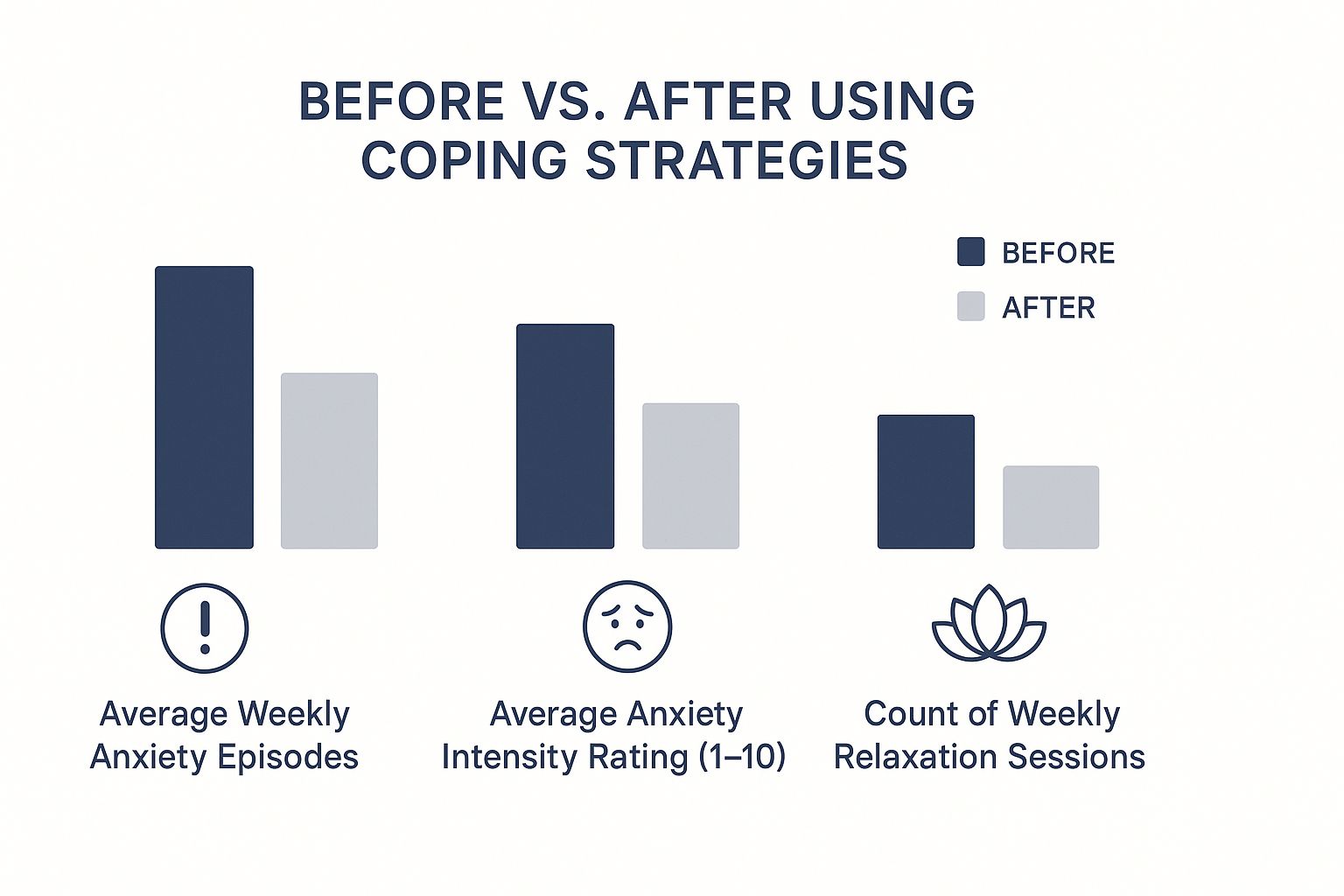
Small, steady actions add up. Over time, you’ll feel fewer spikes of panic and more moments of calm.
Master The Art Of Grounding
Even with healthy habits in place, anxiety can catch you off guard. Grounding techniques interrupt runaway thoughts by pulling your focus back to the here and now. One simple yet powerful practice is controlled breathing.
You’ll find clear instructions in these breathing exercises for anxiety. A popular option is the 4-7-8 method:
- Exhale fully through your mouth, making a soft whoosh.
- Breathe in through your nose for a count of 4.
- Hold that breath gently for 7 seconds.
- Release through your mouth over 8 seconds.
Repeat three to four cycles to calm your system and signal safety to your brain. For more strategies and a deeper dive, see our guide on how to improve mental wellbeing.
How to Find the Right Professional Support in the UK
Knowing when to ask for help is a sign of strength, not weakness. If health anxiety is constantly getting in the way of your work, relationships, or just your ability to enjoy life, that’s a clear sign it's time to reach out. The healthcare system can feel like a maze, but let's map out your options in the UK so you can take this crucial step with confidence.
Your GP should always be your first port of call. They’re trained to look at the whole picture—both physical and mental health—and can help figure out if your symptoms are driven by anxiety or need more investigation. The key is to be open about your thought patterns and any checking behaviours you’ve fallen into. It helps them get you the right support.
Navigating NHS Pathways
In England, the main route to psychological therapy on the NHS is a service called Improving Access to Psychological Therapies (IAPT). The good news is, in many areas, you can refer yourself directly online without even needing to speak to your GP first. Just search for "[Your Town/City] IAPT," and you should find the local service.
IAPT services focus on evidence-backed talking therapies, especially Cognitive Behavioural Therapy (CBT), which is widely seen as the gold standard for treating health anxiety.
Cognitive Behavioural Therapy, when it’s specifically adapted for health anxiety, has a success rate of around 60-70% in reducing symptoms. Despite this, getting access can be tough. It's estimated that only 27.6% of people with anxiety disorders worldwide get the treatment they need. To tackle this, the NHS is using more digital CBT programmes, which have also been shown to work well. You can find more UK anxiety statistics from MentalHealth.org.uk.
After you refer, you’ll usually have an initial assessment to chat about your needs and work out the best treatment plan. If you're wondering how to structure that first conversation, our guide on getting a same-day GP appointment has some great tips on how to get your concerns across clearly.
Exploring Private Therapy Options
If you'd rather not wait for an NHS appointment or want more choice in who you see, private therapy is a fantastic alternative. Yes, it’s a financial investment, but it often means you get specialised care much faster.
When looking for a private therapist, it’s absolutely vital to check they are properly qualified and accredited. The best place to start is with reputable professional bodies.
- The British Association for Behavioural and Cognitive Psychotherapies (BABCP): This is the main organisation for CBT in the UK. Their register lists accredited therapists who meet very high standards, perfect if you're set on CBT.
- The British Association for Counselling and Psychotherapy (BACP): This is another key professional body. It has a huge register of accredited counsellors and psychotherapists who use a wide range of therapeutic styles.
Don’t be shy about asking a potential therapist about their specific experience with health anxiety. A quick introductory call is a great way to see if their approach and personality feel like a good fit. Finding someone you click with is a huge part of what makes therapy work.
Common Questions About Overcoming Health Anxiety
As you start putting these ideas into practice, you'll almost certainly have questions. Let's tackle some of the most common ones that come up time and again. Think of this as a way to clear up any lingering doubts and strengthen your toolkit for the road ahead.
Is It a Real Health Issue or Just Anxiety?
This is the million-dollar question, isn't it? It sits at the very heart of the struggle with health anxiety. The real clue isn't always in the symptom itself, but in the pattern of your symptoms and, crucially, how you react to them.
A genuine health problem usually involves specific, consistent symptoms that a doctor can investigate in a logical way. Health anxiety, on the other hand, often looks different. The symptoms might wander around your body or change from one week to the next. The fear you feel is often completely out of proportion to the physical sensation, and you might find yourself stuck in a loop of seeking reassurance that never quite brings lasting relief.
Once your GP has given you the all-clear, that persistent fear and the compulsive need to check are strong signs that anxiety is in the driver's seat. A really helpful tactic I’ve seen work is to make a simple plan with your doctor for any new, non-urgent symptoms. You could agree to just "watch and wait" for two weeks. This simple act creates a buffer, giving you the space to see if a sensation is just a fleeting, anxiety-driven blip or a genuine issue that sticks around.
Can You Overcome Health Anxiety Without Medication?
Absolutely. For many people, managing and overcoming health anxiety without medication is entirely possible. In fact, the first-line treatment recommended by NICE here in the UK is psychological therapy, with Cognitive Behavioural Therapy (CBT) being a particularly strong contender.
Why does it work so well? Because CBT gets right to the root of the problem—it directly targets the unhelpful thought patterns and compulsive behaviours that keep the anxiety cycle spinning. It doesn't just talk about the problem; it gives you practical tools to challenge your thoughts and actively change your responses.
These therapeutic skills become even more powerful when you combine them with the lifestyle changes we’ve already discussed, like focusing on good nutrition, getting regular exercise, and practising mindfulness. While medication such as SSRIs can be a massive help—and may be prescribed by a doctor for severe anxiety or co-occurring depression—therapy and self-help skills are the foundational building blocks for long-term recovery.
How Can I Explain This to My Family?
It’s incredibly tough when the people closest to you just don't get it. You can feel very alone. One of the best starting points is to frame it as a recognised anxiety disorder, not just "worrying too much." This helps them understand it’s a medical condition.
Try to explain that the fear feels 100% real and uncontrollable, even if a small part of you knows it might be excessive. Sometimes an analogy can really help bridge the gap.
"You could explain it's like having a faulty smoke alarm in my head. It screeches at the slightest whiff of smoke, even burnt toast, putting my whole body on high alert. It makes it impossible to ever feel truly safe or relaxed."
Sharing reliable resources from the NHS or mental health charities like Mind can also give them a clearer picture of what the condition involves. It’s also important to explain that their well-meaning reassurance can sometimes feed the anxiety. Instead, you could ask them to support you by gently suggesting you try a coping skill—like a breathing exercise or a distraction—when they can see you’re spiralling.
Why Does Stress Make My Health Anxiety Worse?
This is an incredibly common experience, and there's a straightforward biological reason for it. When you’re stressed, your body pumps out more cortisol and adrenaline—our "fight or flight" hormones.
These hormones aren’t just in your head; they create very real physical sensations. Think of a racing heart, tight muscles, shallow breathing, or even dizziness. For a mind that's already on high alert for illness, it’s all too easy to misinterpret these normal stress responses as the terrifying symptoms of a serious disease.
On top of that, stress simply drains your mental battery. This makes it much harder to find the energy to challenge anxious thoughts with logic or to resist that powerful urge to check symptoms online. Just understanding this link is a huge step forward. It means that when you know a stressful period is coming, you can be proactive. You can double down on self-care, make relaxation a non-negotiable priority, and lean more heavily on the anxiety management tools you've learned.
At The Lagom Clinic, we understand the deep connection between mental and physical wellbeing. If you're struggling to manage health anxiety, our private GPs in Bristol offer the time and space to listen, providing personalised guidance on stress management, lifestyle adjustments, and access to the right support. Learn more about our approach to proactive, whole-person healthcare at The Lagom Clinic.

 Members Consultation