


Real, lasting motivation for exercise doesn't come from a number on the scales or a looming beach holiday. It comes from something much deeper: connecting movement to your core values and overall health. It’s about discovering a powerful, personal ‘why’ that turns a workout from a chore into a non-negotiable part of your wellbeing. This internal drive, supported by scientifically-sound lifestyle changes, is what will keep you going long after initial enthusiasm wanes.
Find Your Real Reason to Get Moving
It’s easy to start an exercise plan with a short-term aesthetic goal. Perhaps you want to fit into an old suit or look good for an event. While these goals can provide an initial spark, they rarely have the staying power to get you through a tough week or a dark, rainy morning.
The secret to making exercise a sustainable part of your life is to dig deeper. It’s about linking physical activity to what genuinely matters for your long-term health and quality of life. You have to reframe exercise from being a punishment for what you ate into a powerful tool that helps you build the life you want, today and for years to come.
Connecting Movement to Your Core Values
Think about the most important parts of your life and how exercise can support and enhance them. When you tie your workouts to these deep-seated health motivators, you build a routine that can weather almost any storm. Start by asking yourself: what health benefits do I really want from this?
- More energy for my family? Do you want the cardiovascular health to chase your kids around the park without getting winded, or keep up with your grandkids?
- Better focus at work? Could a morning run improve blood flow to the brain, giving you the mental clarity to excel in your career?
- A way to manage stress? Can a brisk walk in the evening help regulate cortisol levels and protect your mental health from the daily grind?
- Independence for the future? Is maintaining muscle mass and bone density essential so you can continue to travel, garden, or simply live life on your own terms as you age?
By finding a purpose that is medically and personally significant, you create a compelling reason to show up for yourself. It’s not about forcing it anymore. Suddenly, exercise becomes an essential act of self-care and a vital health investment.
If you're looking to explore this concept further, there are some great insights on Motivation For Training. This is how you stop adding exercise to your to-do list and start weaving it into the fabric of your life.
How Mental Wellbeing Fuels Physical Activity
It’s a well-established medical fact: a healthy body and a healthy mind are deeply connected. If you’re finding it tough to get motivated for a workout, it can be a game-changer to stop thinking of it as just a physical chore. Instead, see it for what it really is—one of the most effective lifestyle interventions for your mental health.
Science backs this up. Physical activity is a proven, evidence-based way to lift your mood, sharpen your focus, and make you more resilient to stress.
Viewing exercise through this clinical lens completely changes the game. That 20-minute jog is no longer just about burning calories; it's a dedicated moment to clear your head and reduce anxiety after a hectic day. A yoga session becomes a practical tool for finding calm and managing intrusive thoughts. For many patients, this simple shift in perspective is the secret to making exercise a habit that actually sticks.
The Brain-Boosting Power of Movement
When you start moving, your brain responds immediately. It releases a rush of endorphins—the body's natural analgesics and mood lifters—and ramps up the production of neurotransmitters like dopamine and serotonin. This neurochemical process actively counters feelings of anxiety and depression, giving your outlook a genuine boost.
This infographic lays out the direct line from getting active to feeling better mentally.
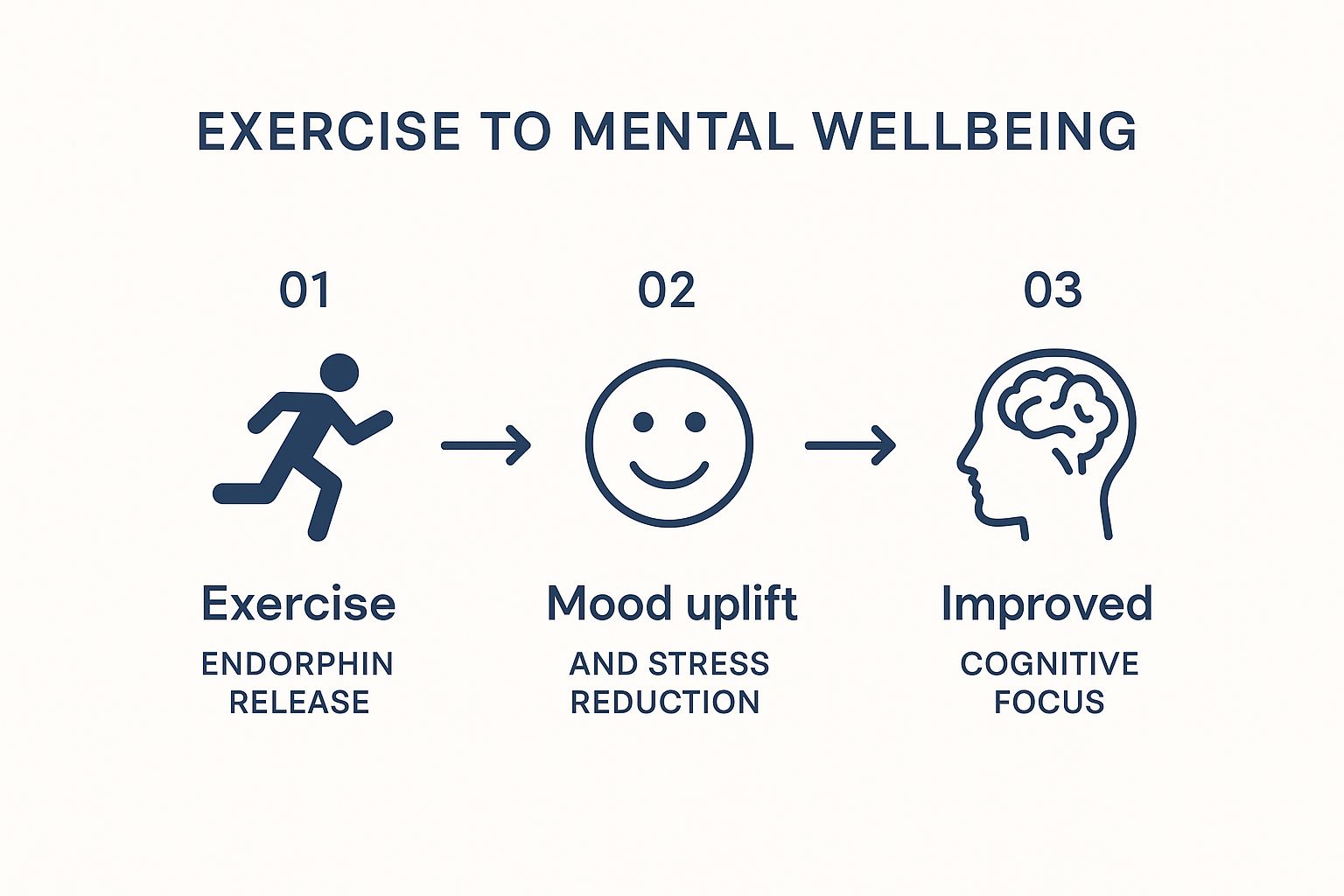
As you can see, exercise sets off a positive chemical reaction in the brain, leading to immediate emotional benefits and improved long-term cognitive function.
This link is especially important when it comes to our working lives. In the UK, a staggering 72% of people with mental health conditions say that physical activity is crucial for helping them stay in work and perform well. If you’re looking for more ways to support your mental state, our guide on how to improve mental wellbeing has some great strategies.
A Practical Tool for Mental Resilience
The psychological benefits of making exercise a regular part of your lifestyle are substantial. Consistent movement helps you build a much stronger defence against the pressures we all face day-to-day.
Here’s the science behind how it works:
- Stress Reduction: Aerobic exercise helps lower the body’s primary stress hormones, such as adrenaline and cortisol, promoting a state of calm.
- Improved Sleep: Regular physical activity can help regulate your circadian rhythms, leading to deeper, more restorative sleep—which is absolutely vital for mental and physical health.
- Increased Self-Esteem: Achieving small, consistent fitness goals builds a type of confidence and self-efficacy that naturally spills over into every other part of your life.
A recent UK Health & Fitness Market Report uncovered a telling statistic: only 3% of gym members are considered inactive, compared to a massive 33% of non-members. This really highlights how having a dedicated space and routine can make all the difference. You can dive deeper into the data on how exercise supports workplace mental health by reading the full report.
Design a Fitness Routine You Actually Enjoy
Let's be clear: if you dread your workout, you will not adhere to it long-term. It's a simple truth that often gets lost in the noise of fitness trends. The secret to staying motivated isn’t about having more willpower; it's about finding forms of movement that you genuinely enjoy and can integrate into your life.
We need to ditch the idea that a "proper" workout has to happen in a gym or involve some punishing, high-intensity routine. Sustainable fitness is deeply personal and should be enjoyable. It’s about finding something that clicks with your lifestyle, your personality, and what brings you a bit of joy. Forcing yourself onto a treadmill when you despise every minute is a fast track to burnout and abandonment.
Find Your Fitness Personality
So, how do you find what works for you? Start by thinking about what you enjoy in other parts of your life. A little self-reflection can point you towards a physical activity you'll actually look forward to.
For example:
- Love being outdoors? Think beyond a simple run. Try hiking, kayaking, or even dedicated time gardening. These activities get you moving and provide the proven mental health benefits of exposure to nature.
- A social butterfly who thrives on good tunes? You might love a dance class like Zumba, a spin session with an epic playlist, or joining a local sports team. The energy of the group can be a powerful motivator.
- Driven by clear, measurable goals? Activities like weightlifting, martial arts, or bouldering give you tangible progress to track. Hitting a new personal best or mastering a new move provides powerful positive reinforcement.
The most effective exercise is the one you will do consistently. A 30-minute dance session you love, done three times a week, is infinitely better for your health than an hour-long gym workout you constantly invent excuses to skip.
Matching your personality to an activity is the cornerstone of building a lasting habit. What works for your friend might not be right for you, and that's perfectly okay.
Finding Your Fitness Fit
| If You Are… | Consider These Activities | Why It Works |
|---|---|---|
| A Nature Lover | Hiking, trail running, cycling, outdoor yoga | It combines physical activity with the mental health benefits of being in green spaces, making it feel less like a chore. |
| A Social Creature | Group dance classes, team sports (football, netball), partner workouts | The community and shared energy make exercise feel like a social event, boosting accountability and enjoyment. |
| A Goal-Oriented Thinker | Weightlifting (tracking reps/weight), running (training for a 5k), martial arts (belt progression) | It provides clear benchmarks for success, tapping into your natural drive for achievement and progress. |
| Someone Who Gets Bored Easily | ClassPass-style memberships, circuit training, cross-training (mixing running, swimming, and cycling) | Variety keeps things mentally stimulating and physically challenging, preventing boredom and overuse injuries. |
Ultimately, the goal is to find activities in the "Consider These Activities" column that genuinely excite you.
Keep It Fresh and Flexible
Even your favourite activity can start to feel stale after a while. Variety is key, not just for preventing your body from hitting a physiological plateau but for keeping your mind engaged, too.
Don’t be afraid to mix it up. If you're a dedicated runner, why not add a weekly yoga or swimming session? It’ll work different muscle groups, improve flexibility, and can help prevent the repetitive strain injuries that often come with doing the same thing over and over.
Remember, figuring out the right kind of exercise for wellness and health is a process of discovery. Give yourself permission to experiment, to try new things, and to choose activities you genuinely love. That’s how you turn exercise from an obligation into a rewarding and energising part of your life.
Tackling the Real-World Hurdles to a Consistent Routine
Even with the best motivation, life can interfere. A jam-packed schedule, low energy, or unexpected costs can easily derail your fitness plans. The secret isn't a flawless plan; it’s building a resilient one with smart, medically-sound strategies that let you adapt to real-life challenges.
Ultimately, it’s about making exercise fit into your life, not forcing your life to revolve around exercise. This means finding clever ways to move on your busiest days and learning to respect your body’s signals when you’re not at 100%. With a toolkit of practical solutions, you can build a habit that weathers whatever life throws at it.
And it seems more people are figuring this out. A recent report showed that 63.7% of adults in England now meet the Chief Medical Officers' guidelines for physical activity. That’s nearly 30 million people getting active every week, a significant jump from previous years. It proves that these common barriers can be overcome. You can dig into the specifics in the latest Active Lives Adult Survey Report.
Making a Packed Schedule Work for You
One of the most common barriers to exercise is a perceived lack of time. The solution is to stop thinking in hours. Breaking your activity into smaller, bite-sized chunks is just as beneficial for your health.
This strategy is known as 'exercise stacking'. Instead of trying to carve out one huge block of time, you simply weave short, 10-minute bursts of movement throughout your day. These micro-workouts are infinitely easier to fit into a busy schedule, and their cumulative effect is significant.
Here are a few ways to apply this lifestyle change:
- On the clock: Take a brisk 10-minute walk during a phone call. While waiting for the kettle to boil, do a quick set of squats and lunges.
- Out and about: Consciously park further from your destination. Always choose the stairs over the lift. These small choices compound over time.
- At home: Perform a quick bodyweight circuit (e.g., push-ups, planks, and crunches) during TV ad breaks or while listening to a podcast.
The official health guideline is to build up to at least 150 minutes of moderate-intensity activity per week. Framing this in 10-minute blocks makes that goal feel so much less daunting and more achievable.
When Your Wallet and Your Energy Are Both Low
Two other classic roadblocks are the cost of a gym membership and the all-too-familiar feeling of being too drained to exercise. The good news is that an effective routine doesn't have to be expensive or leave you completely exhausted.
When your energy is low, forcing a high-intensity workout is counterproductive. Listen to your body. Gentle movement can be restorative and actually increase your energy levels. Consider a slow, restorative yoga session, a gentle walk in a local park, or even just some simple stretching at home. Often, the act of starting small is all you need to overcome that initial inertia.
As for budget-friendly options, your own body and local area are your greatest assets. Bodyweight exercises, running, and walking are free. Many local councils also provide free outdoor gym equipment in parks, offering a fantastic way to stay active without spending a penny.
Build a Support System and Track Your Progress
Trying to maintain motivation in isolation is a significant challenge. Having a solid support system is a game-changer for making fitness habits stick. When you share your goals with others, you instantly create a layer of positive social accountability.
This network can be informal. It could be joining a local running club, finding a friendly class at the gym, or even connecting with like-minded people in an online community. For more tailored support, think about finding a fitness accountability partner. Knowing someone is expecting you to show up can be the nudge you need to get out the door on days when motivation is low.
Redefine What Progress Looks Like
Tracking your progress is essential for motivation, but it's crucial to look beyond the number on the scales. Body weight can fluctuate for many reasons unrelated to fat loss, so focusing on non-scale victories gives you a much clearer and more encouraging picture of your success. These are the real-world health benefits that prove your hard work is paying off.
It's so important to celebrate small wins, as they build momentum and reinforce the new habit. Noticing your clothes fit better or realising you have more energy to play with your kids creates a powerful positive feedback loop that keeps you going.
This simple shift in focus makes the entire journey more rewarding. Start paying attention to other health markers, such as:
- Better sleep quality and waking feeling more rested
- A noticeable lift in your overall mood and reduced anxiety
- Increased strength and stamina during your daily activities
It's encouraging to see that more people are getting active across the UK, with 48% of the population now exercising regularly. The trend is even stronger among younger people, where 65% of 25-to-34-year-olds are getting their sweat on. If you're curious, you can find out more about the UK’s growing fitness trends.
Got Questions About Exercise Motivation? We've Got Answers
It's completely normal for questions to arise when you're making positive lifestyle changes. Let's tackle some of the most common ones with straightforward, evidence-based advice.
How Long Does It Really Take to Form an Exercise Habit?
You’ve probably heard the outdated 21-day myth, but modern research gives us a more realistic picture. Studies show it takes an average of 66 days for a new behaviour, like a daily workout, to become automatic.
The key isn't perfection; it's consistency. If you miss a day due to illness or unforeseen circumstances, don't worry. Simply return to your routine at the next planned opportunity. The goal is to build a sustainable rhythm, not an unbroken streak.
What to Do on Days You Have Absolutely Zero Motivation?
We all have them. On those days when your drive has vanished, don't force a high-intensity workout. Instead, aim for what is sometimes called a 'minimum effective dose' of movement.
This could be as simple as a brisk 10-minute walk, a few gentle stretches, or a short bodyweight circuit at home. The psychological barrier to starting is often the biggest hurdle. More often than not, once you begin moving, you'll feel better and may find the energy to do a little more.
The best exercise plan is the one you enjoy and will stick with. For a well-rounded approach to health, aim for a blend of cardiovascular exercise, strength training, and flexibility work each week, as recommended by health authorities.
Morning vs. Evening Workouts: Which is Better?
From a physiological standpoint, the best time to exercise is whenever you can consistently fit it into your life. There is no universally "magic" hour.
Some people feel more energetic in the morning, finding that an early workout sets a positive tone for their day. Others are night owls who prefer to use exercise to de-stress in the evening. Experiment with different times to see what feels best for your body's natural rhythm and your schedule. Consistency will always yield better results than trying to force a workout at a specific, but inconvenient, time.
At The Lagom Clinic, our focus is on helping you create healthy lifestyle habits that last a lifetime, not just for a few weeks. Our team provides personalised, medically-sound guidance on everything from exercise and nutrition to managing stress, all tailored to your unique needs. If you're ready for a proactive approach to your wellbeing, learn more about how we can support you by visiting our website.


 Members Consultation