


An occupational health assessment is a confidential medical evaluation carried out by a qualified health professional. It’s designed to explore the relationship between your work and your health. The goal is to understand how your job might be affecting your wellbeing and, just as importantly, how your health might impact your ability to do your job safely and effectively.
Understanding Your Workplace MOT
A great way to think about an occupational health assessment is to compare it to a car's MOT. Just like an MOT checks that a vehicle is roadworthy and safe for the journey ahead, this assessment makes sure you’re medically fit for your professional journey. It’s a proactive and supportive tool—not a punitive one—that protects both you and your colleagues.
The core purpose is to give employers objective, expert medical advice so they can fulfil their duty of care. This isn't about prying into your personal life; it’s about finding practical, common-sense solutions to keep you healthy, happy, and productive at work.
Who Performs the Assessment?
These evaluations are always conducted by occupational health professionals—specialist doctors or nurses who have specific training in this area. They have a deep understanding of different work environments and how they can interact with various health conditions. Their role is to be an impartial advisor, bridging the gap between your health needs and your employer's operational requirements.
The statistics really highlight why this support is so necessary. According to the Health and Safety Executive (HSE), around 1.7 million working people in the UK suffered from a work-related illness. This includes 776,000 cases of stress, depression, or anxiety and 543,000 musculoskeletal disorders, with the total cost of work-related ill health hitting an estimated £21.6 billion. You can explore more of these key health and safety statistics on hse-network.com.
Why Is It a Vital Tool?
At its heart, an occupational health assessment is crucial for creating a safer, more supportive workplace for everyone. It helps move beyond simply reacting to problems, offering a chance to prevent them before they escalate into something more serious.
Health Tip: Beyond workplace adjustments, simple lifestyle changes can significantly improve your resilience. Focus on getting 7-9 hours of quality sleep, eating a balanced diet rich in whole foods, and aiming for at least 150 minutes of moderate-intensity exercise per week. These foundational habits support both mental and physical health.
The table below breaks down what an assessment really involves and what it sets out to do.
Core Components of an Occupational Health Assessment
| Component | Purpose |
|---|---|
| Health & Work Discussion | A confidential chat about your health condition and how it interacts with your job duties. |
| Medical Review | A review of medical information (with your consent) to understand your health status fully. |
| Workplace Analysis | An evaluation of your specific role, tasks, and work environment. |
| Expert Recommendations | Providing impartial, practical advice to your employer on how to support you. |
This process helps businesses and employees work together to find the best path forward. Here’s a quick rundown of its key functions:
- Identifies Risks: It helps pinpoint specific job tasks that could worsen an existing health condition or even create a new one.
- Recommends Adjustments: Based on the findings, the clinician can suggest reasonable adjustments, like modified duties, different equipment, or flexible working hours.
- Supports Return to Work: For employees coming back after sickness absence, it provides a structured pathway to ensure their return is smooth and sustainable.
- Ensures Legal Compliance: It helps employers meet their legal obligations to protect the health and safety of their staff.
The Real Benefits for Employees and Employers

Once you understand what an occupational health assessment is, you start to see its real value. It’s so much more than a box-ticking exercise. It's a proactive step that creates a positive ripple effect, bringing tangible benefits to everyone in the organisation.
For employees, the assessment provides a confidential, supportive space to talk about health concerns without any fear of judgement. They get direct access to a medical professional who genuinely understands the demands of their job. This alone can be incredibly reassuring, giving them peace of mind that their employer is invested in their wellbeing.
But it’s the practical outcomes that often make the biggest difference. An assessment results in specific, actionable recommendations for workplace adjustments that improve daily comfort and safety.
Creating a Healthier Work Environment
The advice from an occupational health clinician is always tailored to the individual. The aim isn't just to fix a problem, but to create a sustainable working environment where people can stay healthy and productive in their roles.
Recommendations might look like:
- Ergonomic Adjustments: Suggesting a new chair or a different desk setup to ease back pain.
- Modified Duties: Temporarily changing someone’s tasks to avoid making a health condition worse.
- Flexible Working: Altering start and finish times to help manage fatigue or fit in medical appointments.
- Phased Return to Work: Crafting a gradual plan to help an employee ease back into their role after sick leave.
These adjustments help employees feel properly supported and valued, which has a direct impact on morale and engagement. When your staff can see that their health is a priority, it builds trust and loyalty.
For employers, the benefits are just as significant and tie directly into core business goals. In fact, investing in employee health is one of the smartest decisions a company can make, translating directly into a healthier bottom line.
An occupational health assessment is a proactive investment in your most valuable asset: your people. It demonstrates a commitment to care that builds a resilient, motivated, and highly productive workforce.
Boosting Business Success and Reducing Risk
Prioritising employee health through these assessments has a clear, measurable impact on key business metrics. For a start, it helps to significantly reduce sickness absence, because proactive support can stop minor health issues from escalating into long-term problems.
This, in turn, boosts overall productivity. A healthier workforce is naturally a more focused and efficient one, able to perform at its best. On top of that, by following expert medical advice, employers minimise the legal risks tied to workplace health and safety, ensuring they are fulfilling their duty of care. This approach doesn't just manage problems—it builds a stronger, more positive company culture where everyone can thrive.
Navigating the Different Types of Assessments
An occupational health assessment isn't a single, catch-all process. Think of it less as a generic check-up and more as a specific tool used for a particular purpose. Understanding the different types helps to demystify the process, clarifying exactly why and when they’re needed.
Each assessment is designed to answer a particular question about the relationship between your health and your work. The most common scenarios you’ll likely encounter are pre-employment screenings, management referrals, and health surveillance programmes.
Pre-Employment Screening
Before you even step into a new role, you might be asked to complete a pre-employment health screening. This isn't about judging your overall health; it's about making sure there's a good, safe match between you, the job, and the work environment.
Its primary goal is to spot any pre-existing health conditions that could be affected by the job’s duties, or that might require adjustments to help you work safely from day one. For instance, a prospective delivery driver with a history of back trouble might undergo a screening. This is simply to confirm they can safely manage the physical demands of lifting parcels. It's a proactive step that prevents injury and makes sure the role is sustainable.
Management Referrals
This is probably the most common type of occupational health assessment. A management referral happens when your manager, with your full knowledge, asks an occupational health service for advice about your situation. It's typically used to support an employee who is struggling at work because of a health issue or is on long-term sick leave.
The aim here is to get expert, impartial advice on how best to support you. A clinician will assess your circumstances and then provide recommendations to your employer, such as:
- A Phased Return to Work: Creating a structured, gradual plan to help you ease back into your full duties after an illness.
- Reasonable Adjustments: Suggesting modifications to your role, hours, or equipment to accommodate a health condition.
- Fitness for Work: Giving a clear medical opinion on your capacity to perform your role safely.
Think of it as a collaborative consultation. A manager might refer an employee experiencing work-related stress to find practical ways to reduce their workload or adjust their responsibilities.
The focus of a management referral is always supportive. It's about finding a clear and healthy path forward that works for both the employee and the organisation, guided by expert medical insight.
Health Surveillance
Finally, health surveillance is a specific type of ongoing assessment required for jobs that involve exposure to certain hazards. Under UK health and safety law, employers have a duty to monitor the health of employees who work with specific risks, like loud noise, vibrating tools, dust, or chemicals.
The goal is to catch the early signs of work-related ill health before they become serious problems. For example, a construction worker exposed to loud machinery might have regular hearing tests. Someone working in a factory with certain chemicals may need periodic skin checks or lung function tests. It's a crucial, preventative measure that protects long-term wellbeing in high-risk roles.
Your Step-by-Step Guide to the Assessment Process
The thought of an occupational health assessment can feel a bit intimidating, but once you understand what’s involved, a lot of that worry disappears. It’s not a test you can pass or fail. Think of it instead as a structured, confidential chat designed purely to support you. Let’s walk through the journey together, from the first step to the final report, to show you how it’s all built on collaboration.
Everything kicks off with a confidential referral. This is usually made by your manager or someone in HR, but it will only happen with your full knowledge and consent. The referral simply outlines why they’re seeking advice – maybe it’s due to a period of sickness absence or concerns about how your health is being affected at work. This gives the clinician a bit of background before they speak to you.
The Consultation Itself
The heart of the process is the consultation with the occupational health clinician, who could be a specialist doctor or a nurse. This is your time to talk openly about your health in the context of your job. It’s a completely safe space to explain how your work might be impacting a health condition, or how that condition affects your ability to do your job.
To get a clear picture, they might ask you about things like:
- What your day-to-day tasks and responsibilities involve.
- Your current health and any symptoms you're experiencing.
- Whether your symptoms change when you're at work compared to when you’re not.
- Any treatment you’re getting from your GP or another specialist.
This infographic breaks down the fundamental stages of the whole journey.
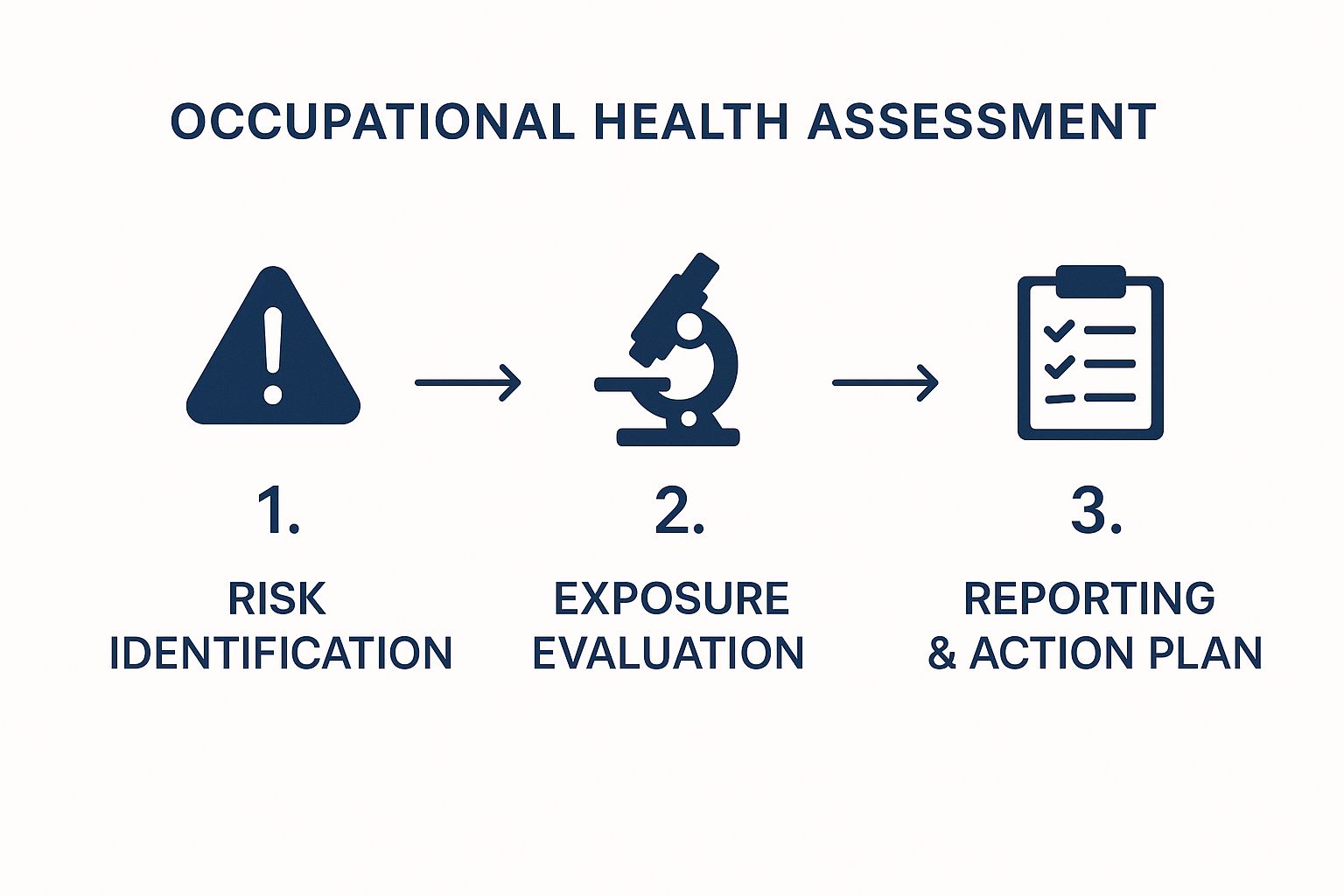
As you can see, the process flows logically, moving from identifying an issue to properly evaluating it and, finally, creating a supportive plan to move forward.
Understanding the Final Report
After your consultation, the clinician puts together a report for your employer. This is often the part that causes the most anxiety, but it’s vital to understand what it contains—and what it doesn’t. You are in control here; the report is only sent after you’ve had a chance to review it and give your consent.
The report will never share private medical details. Instead, its job is to give your employer practical, functional advice and clear recommendations. It's there to answer the specific questions from the referral and suggest supportive, sensible measures.
An occupational health report is like a bridge connecting your health needs with your employer's responsibilities. It’s all about finding solutions, offering expert advice on your fitness for work, and outlining reasonable adjustments to help you get back to thriving.
So, what might the report suggest? It could be things like:
- A phased return to work over a few weeks after an illness.
- Temporary or permanent adjustments to your role, like avoiding heavy lifting.
- Changes to your workspace, such as an ergonomic chair or specialist software.
- Altered working hours to help you manage fatigue or get to appointments.
Ultimately, the entire process is designed to be constructive. It’s a collaborative effort that gives you a voice, provides your employer with expert guidance, and results in a clear, actionable plan to support your health and wellbeing at work.
Proactive Steps for Your Health and Wellbeing at Work
While a formal occupational health assessment is a fantastic tool for getting support, you don't have to wait for a referral to start looking after yourself. You actually have a huge amount of control over your day-to-day health at work. By bringing a few practical, medically-backed strategies into your routine, you can build resilience and handle challenges before they get out of hand.
Think of these proactive steps as your personal toolkit for taking charge of your health, both in and out of the workplace. They’re like daily maintenance for your mind and body, making sure you’re running at your best.
The need for this is stark. Recent statistics show that an alarming 79% of UK workers feel the strain of workplace stress. This isn't just a feeling; it translates into 17.1 million working days lost every year due to work-related stress, depression, and anxiety, costing businesses around £5.2 billion annually. You can read more about these workplace stress statistics at work.life.
Managing Your Mental Energy
Protecting your mental health is non-negotiable. Simple, scientifically proven techniques can make a massive difference in how you cope with daily pressures and stay focused.
Feeling overwhelmed? Try the 'box breathing' method. Inhale slowly for four seconds, hold your breath for four, exhale for four, and then hold again for four. Just a minute or two of this cycle can calm your nervous system and bring a sense of clarity. Another vital tactic is setting firm boundaries to protect your mental energy—this could be as simple as logging off at a set time or scheduling blocks of deep work to avoid constant interruptions.
Your wellbeing is not a luxury; it is the foundation of sustained performance. Making small, consistent investments in your physical and mental health pays the highest dividends in both your career and your personal life.
Supporting Your Physical Health
Your physical state is directly tied to how well you can do your job. Small tweaks to your daily routine can help prevent common workplace issues like back pain and fatigue.
It all starts with your workspace. An ergonomic setup is essential for avoiding musculoskeletal problems. Make sure your chair supports your lower back, your screen is at eye level, and your wrists are straight when you type. But it's not just about the desk; you have to combat the negative effects of a sedentary job.
Try incorporating ‘movement snacks’ throughout your day:
- Stand and stretch every 30-60 minutes to get your blood flowing.
- Take a short walk during a phone call instead of staying seated.
- Choose the stairs over the lift to give your heart rate a little boost.
Finally, remember to fuel your brain and body properly with foods that provide sustained energy, like complex carbohydrates, lean proteins, and healthy fats. And don't forget to stay hydrated. Occupational health assessments are a key part of implementing 7 Effective Employee Wellbeing Strategies that help create a healthier, more productive work environment for everyone.
Spotlight on Mental and Musculoskeletal Health
If you look at today's workforce, two of the biggest health challenges that stand out are mental health and musculoskeletal conditions. Problems like burnout, anxiety, and chronic back pain aren't just personal struggles; they have a massive impact on someone's ability to perform at work and simply feel well. This is exactly where an occupational health assessment comes into its own, offering a direct way to tackle these widespread issues.
These assessments go way beyond handing out generic advice. Instead, a clinician digs into the root causes of the problem in the context of an employee's specific role. It’s a focused approach that draws a clear line between symptoms and workplace factors, which is how you get to practical, effective solutions. And this is more important than ever, because the scale of the problem is genuinely concerning.
The data paints a pretty stark picture. In the UK, more than 800,000 working-age people are now economically inactive for health reasons, a number that has shot up by 40% since 2019. This trend is hitting young people with mental health conditions and older workers with musculoskeletal issues particularly hard. You can dive deeper into the health of the workforce at occupationalhealthassessment.com.
Targeted Solutions for Complex Problems
When an employee is grappling with burnout or anxiety, an assessment can pinpoint the specific work-related triggers. From there, the clinician can recommend practical, sensible adjustments that provide immediate support while paving the way for long-term recovery.
For instance, recommendations might include:
- A phased return to work after time off for stress, gradually reintroducing tasks to avoid feeling overwhelmed.
- Suggesting flexible working hours so an individual can better manage their condition and get to necessary appointments.
- Recommending clearer boundaries around workload and after-hours communication to help protect their mental energy.
Addressing Physical Strain and Pain
It’s a similar story for musculoskeletal problems like nagging back or neck pain, where an assessment can be incredibly valuable. A clinician will look at everything from an employee’s workstation setup to their daily tasks and physical demands to figure out where the strain is coming from.
Health Tip: For persistent muscle or joint pain, try lifestyle adjustments like incorporating gentle stretching or yoga into your daily routine to improve flexibility. Over-the-counter anti-inflammatory gels can provide temporary relief, and ensuring your diet includes anti-inflammatory foods like fatty fish (salmon), nuts, and leafy greens can also support long-term joint health.
This leads to highly effective recommendations. For example, an employee with lower back pain might be advised to use specific ergonomic gear, like a standing desk or a more supportive chair. Someone with a repetitive strain injury could have their duties temporarily changed to give them time to heal properly. These kinds of targeted interventions don't just ease the pain; they stop the condition from getting worse, making sure employees can keep working safely and comfortably.
Frequently Asked Questions About Health Assessments
It's completely normal to have questions before an occupational health assessment. To help put your mind at ease, we’ve put together straightforward answers to some of the most common queries we hear.
Is My Occupational Health Assessment Confidential?
Absolutely. Think of it as a private medical consultation, just like an appointment with your GP. The entire conversation is completely confidential.
The report we send to your employer will only contain information that’s directly relevant to your ability to do your job. It will focus on our professional recommendations for adjustments, but your private medical history and the details of our discussion will not be shared without your explicit consent.
Health Tip: To feel more prepared, try jotting down a few notes before your appointment. Think about how your work might be affecting your symptoms, and vice versa. This simple step can help you make sure you cover all the important points during your confidential chat.
Can I Refuse to Have an Assessment?
You have the right to refuse an assessment, but it’s often not the best course of action for you. Without a professional medical opinion, your employer has to make decisions based only on the limited information they have.
Taking part is your chance to have your voice heard and contribute to a positive solution. It allows a medical expert to provide clear, practical recommendations that help your employer fulfil their duty of care while properly supporting your health needs at work.
What Kind of Adjustments Can Be Recommended?
Recommendations are never one-size-fits-all; they’re always tailored to your specific circumstances and needs. The main goal is to find practical, sensible ways to help you work safely, comfortably, and effectively.
Some common examples include:
- A phased return to work to let you ease back into your role after an illness.
- Altered work hours to help manage fatigue or fit in medical appointments.
- Changes to your duties, like avoiding heavy lifting to protect an injury.
- Specialist equipment, such as an ergonomic chair or a different keyboard to prevent strain.
Before your assessment, it can be helpful to think about what small changes might make the biggest difference for you. Having a few ideas ready to discuss can help the clinician make the most effective recommendations possible.
At The Lagom Clinic, we specialise in comprehensive occupational health assessments designed to create supportive, healthy, and productive work environments. To find out more about our services, please visit us at https://www.thelagom.co.uk.
Need an occupational health assessment?
The Lagom Clinic provides occupational health assessments, fitness-for-work certificates and pre-employment medicals for Bristol businesses.


 Members Consultation