


You might be reading this because you're tired of being told your blood tests are “normal” while you still feel unlike yourself. Your energy has dipped. Your sleep is patchy. Your periods have changed, or your mood feels harder to steady, or you've started wondering whether thyroid issues, perimenopause, stress, or something else is driving the change.
That uncertainty is common. Hormone-related symptoms rarely arrive in a neat, textbook pattern. They overlap with busy lives, poor sleep, parenting, training, work stress, and ageing. That's why the phrase hormone imbalance test nhs gets searched so often. People want a clear route to answers, and they want to know whether the NHS can provide it.
The NHS does test hormones, but it does so for specific clinical reasons, at specific times, and often only when symptoms fit a recognised pathway. That can feel frustrating when you're looking for a broader explanation. It can also be sensible medicine. A hormone result taken on the wrong day, or for the wrong reason, can confuse rather than clarify.
The Growing Concern Over Hormonal Health
A familiar story in clinic goes something like this. Someone puts up with symptoms for months because they're not dramatic enough to seem urgent. They keep functioning, but they're dragging themselves through the day. Coffee stops helping. They feel more irritable, more flat, less resilient. Then periods become irregular, hot flushes start, libido changes, headaches worsen, or training recovery falls off.
At that point, patients typically do not want a lecture. They want to know whether hormones could be involved and what the NHS will realistically do.
Public demand for hormone-related care has clearly grown. In England, HRT prescribing increased by 35.0% in 2021/22, with 7.80 million items prescribed, according to NHS Business Services Authority data on HRT in England. The same dataset also shows an access gap, with almost twice as many patients receiving HRT in the least deprived areas compared with the most deprived.
That matters because it tells us two things at once. First, more people are seeking help for hormonal symptoms. Second, not everyone reaches assessment or treatment equally easily.
Why symptoms feel so confusing
Hormones affect multiple systems at the same time. When levels change, or when the body's response changes, symptoms can look non-specific:
- Energy changes can resemble burnout, anaemia, poor sleep, thyroid dysfunction, or low mood.
- Cycle disruption may reflect perimenopause, stress, weight change, PCOS, or another endocrine issue.
- Mood shifts can worsen around hormonal transitions but may also be amplified by chronic stress and sleep loss.
- Weight fluctuation often has several drivers, not one single hormone.
Hormone testing is useful when it answers a clear clinical question. It's much less useful when it's used as a shortcut around a full history.
For many patients, the first helpful step isn't the blood draw. It's a careful symptom timeline. When did the change begin? Is it tied to your menstrual cycle? Are you on contraception or HRT? Has sleep, diet, alcohol, training load, or stress changed in the same period?
That sort of detail is exactly what helps a GP decide whether NHS testing is likely to help.
How to Request a Hormone Test Through Your NHS GP
The NHS route starts with symptoms, not a shopping list of blood tests. That's the key point to understand before you book an appointment. A GP isn't there to decline help. They're expected to use evidence-based pathways so that testing is clinically justified and interpretable.
What to do before the appointment
Go in prepared. The better the history, the better the consultation.
Bring or note down:
Your main symptoms
Be specific. “Tired all the time” is less helpful than “I'm waking at 3am, getting hot at night, and my concentration has dropped.”Timing
Say when symptoms started and whether they're constant, cyclical, or getting worse.Menstrual details
If relevant, record cycle length, missed periods, heavier bleeding, spotting, or changes in PMS.Medication and supplements
Include contraception, HRT, thyroid medication, steroids, acne medication, and over-the-counter products.Lifestyle context
New shift work, heavy training, poor sleep, bereavement, low calorie intake, or increased alcohol can all alter symptoms and sometimes hormone patterns.
If headaches are part of the picture, especially around periods or hormonal changes, it can also help to track them alongside sleep, hydration, meals, and cycle timing. A practical guide to understanding migraine triggers can make those patterns easier to spot before you see your GP.
What your GP is likely to ask
A good NHS consultation for possible hormonal issues usually focuses on pattern recognition. Your GP may ask about fertility plans, weight change, bowel symptoms, hair loss, skin changes, mood, sleep, libido, and family history.
They may also examine you or start with more general tests if symptoms could reflect non-hormonal causes.
Here's the trade-off. Many patients want a broad hormone panel straight away. The NHS generally doesn't work that way. According to this overview of how blood tests reveal hormone health, hormone testing on the NHS is strictly protocol-driven, and broader self-requested panels are usually declined. The same source notes that FSH is used to confirm primary ovarian insufficiency in women under 40 if levels are above 30 IU/L on two occasions.
What usually works better than asking for “all hormones”
Instead of saying “Can I have every hormone tested?”, try this approach:
- Describe function, not theory
Say what's changed in your body and daily life. - Show pattern
Explain whether symptoms link to your cycle, meals, stress, sleep, or exercise. - Ask a focused question
For example, “Could this be thyroid-related?” or “Given the change in my periods, is there any blood test that would help?”
Practical rule: A GP can do more with a precise symptom history than with a vague request for a hormone panel.
That approach usually leads to a more useful plan, whether that means targeted bloods, watchful waiting, treatment, or referral.
What Specific Hormone Tests the NHS Performs
When the NHS investigates suspected hormonal problems, it usually chooses tests that answer a narrow clinical question. The aim isn't a wellness profile. The aim is to confirm or exclude a likely diagnosis.

Tests commonly used in practice
A GP may consider some of the following, depending on the symptom pattern.
| Test | What it helps with | Important practical point |
|---|---|---|
| TSH and thyroid tests | Fatigue, weight change, feeling cold, palpitations, menstrual disruption | Thyroid disease can mimic “hormone imbalance” symptoms very closely |
| FSH | Premature ovarian insufficiency or selected menopause-related questions | It's not routinely helpful in fluctuating perimenopause |
| LH and oestradiol | Some fertility and cycle assessments | Interpretation depends heavily on timing |
| Progesterone | Ovulation assessment in subfertility work-up | Must be timed correctly in the cycle |
| Prolactin | Absent periods, galactorrhoea, pituitary-related concerns | Stress and sampling conditions can affect results |
Timing matters more than most people realise
Many misunderstandings happen at this stage. Hormone values change naturally across the menstrual cycle. A result that looks “low” or “high” on one day may be entirely expected on another.
According to NHS guidance on biochemical investigation of suspected endocrine problems in females, a luteal progesterone level above 20 to 30 nmol/L, measured 7 days before menses, can exclude an endocrine cause of subfertility. The same guidance makes clear that routine FSH testing in perimenopause is often unhelpful because levels fluctuate, so clinical history carries more weight.
That's why a patient may feel disappointed after an NHS appointment that doesn't end with a blood form. Sometimes the most accurate decision is not to test on that day.
Where patients often expect more than the NHS intends to provide
The NHS is strongest when there is a defined problem to investigate. It's less designed for broad optimisation.
That distinction matters in areas such as fertility awareness and menopause. Someone trying to understand ovarian reserve, for example, may start reading around AMH and age-related patterns. If that's your interest, resources that discuss Australian AMH data and charts can help you understand the general concept, although interpretation should always be personalised and kept in clinical context.
For people specifically wondering about menopause-focused blood work, a more detailed overview of what these tests can and cannot tell you is available in this guide to a menopause blood test.
A hormone result outside the reference range is not automatically the cause of symptoms. A hormone result inside the reference range does not always explain them away either.
The tests that often cause the most confusion
Two are worth highlighting.
FSH in perimenopause
Patients often ask for it because they want certainty. In reality, fluctuating ovarian function can make a single result misleading.Progesterone for ovulation
This can be useful, but only if timed correctly. A poorly timed sample can create unnecessary worry.
In day-to-day practice, the most helpful test is often not the most fashionable one. It's the one that matches the symptom pattern and is taken at the right moment.
Navigating NHS Timelines and Common Limitations
Most frustration with a hormone imbalance test nhs pathway comes down to one issue. Time.
The NHS is built to prioritise need, risk, and evidence. That makes sense at a system level, but it can feel slow when you're functioning badly and want clarity now. Delays can happen at several points. Getting the GP appointment, waiting for cycle-specific timing, arranging repeat tests, and then waiting again if specialist input is needed.
Why the process can feel drawn out
Hormonal medicine often requires sequence rather than speed. If your symptoms suggest thyroid disease, menopause, subfertility, pituitary issues, or ovarian insufficiency, the tests and follow-up aren't always interchangeable.
A single blood test may not answer the question. The GP may need to:
- Start with first-line bloods before deciding whether hormone testing is indicated
- Wait for the correct point in the menstrual cycle for a meaningful sample
- Repeat an abnormal result before making a diagnosis
- Refer onward if the picture is atypical or complex
According to Patient.info's discussion of hormone testing access, endocrinology referrals in England can average 12 to 18 weeks, and the same piece states that 65% of patients who go private do so primarily for speed, citing a 2025 Private Healthcare UK report.
The limitation that patients often miss
The NHS isn't designed to investigate every vague symptom with a broad endocrine screen. It's designed to identify clinically meaningful disease and manage finite resources carefully.
That creates real trade-offs:
- Good for targeted diagnosis when symptoms fit a standard pathway
- Less good for proactive screening when someone feels off but doesn't meet a clear threshold
- Good at avoiding unnecessary testing
- Less satisfying for people who want a broad snapshot quickly
Waiting doesn't always mean neglect. Often it means the system is trying to avoid the wrong test, the wrong timing, or the wrong conclusion.
This is particularly relevant in perimenopause, where symptoms may be very real but bloods are not always the best diagnostic tool. The result is a common mismatch between what patients hope testing will do and what testing can prove.
The practical response is to stay focused on decisions, not just data. Ask what the result would change. If the answer is “not much”, history, symptom tracking, and lifestyle support may matter more than another tube of blood.
Proactive Lifestyle Changes to Support Hormonal Balance
Even when blood tests are appropriate, lifestyle still matters. It affects symptom severity, sleep quality, insulin sensitivity, stress signalling, recovery, and how resilient you feel day to day. It won't cure every endocrine condition, but it often improves the background your hormones are working in.

Start with the basics you can sustain
The most effective changes are usually the least glamorous. Regular meals, enough protein, resistance exercise, consistent sleep, and less alcohol often do more than expensive supplements.
A simple weekly routine is more useful than an ideal plan you can't maintain.
Food habits that support steadier symptoms
Extreme restriction is a common mistake. Under-eating can disrupt cycles, worsen fatigue, increase cravings, and make stress symptoms feel sharper.
Useful principles include:
Build meals around protein
Eggs, Greek yoghurt, fish, tofu, beans, chicken, or lentils help with fullness, muscle maintenance, and energy stability.Include fibre daily
Vegetables, fruit, oats, pulses, nuts, and seeds support gut health and steadier glucose control.Don't fear fats
Olive oil, nuts, seeds, avocado, and oily fish can support satiety and make meals more sustainable.Reduce alcohol if symptoms are cyclical or sleep-related
Alcohol can worsen night waking, hot flushes, anxiety, and headache patterns.Watch caffeine timing
If you're wired and tired, limit late-day caffeine before blaming hormones alone.
A food diary can help, but keep it simple. You're looking for patterns, not perfection.
Exercise that helps rather than depletes
Many people do too much high-intensity training when their body is already under strain. If you're exhausted, exercising harder isn't always the answer.
A better balance often looks like:
- Resistance training a few times a week to support muscle, bone health, and insulin sensitivity
- Brisk walking for stress regulation and metabolic health
- Gentler sessions when sleep is poor, periods are heavy, or recovery is lagging
- Progressive training plans rather than erratic bursts of effort
If you need structure, an exercise and workout platform can be useful for building consistency without constantly improvising.
The best exercise plan for hormonal health is the one your body can recover from.
Sleep and stress are not optional extras
Hormonal symptoms often feel worse when sleep is fragmented. Poor sleep can amplify appetite changes, lower stress tolerance, worsen brain fog, and increase perceived pain.
Try these practical adjustments:
Keep waking time consistent
This anchors your body clock better than trying to force an early bedtime.Dim light in the evening
Bright screens and overhead lighting can make it harder to wind down.Eat enough at dinner
Going to bed hungry can contribute to night waking in some people.Create a short decompression ritual
Ten quiet minutes, a warm shower, stretching, or reading can help more than scrolling.Treat stress physically as well as mentally
Walking, breathing exercises, and lighter training days can all help reduce the physical load of chronic stress.
When lifestyle helps most, and when it doesn't
Lifestyle measures are especially helpful for symptom volatility, poor sleep, stress-related cycle changes, energy dips, and metabolic health. They are not a substitute for proper assessment if you have absent periods, fertility concerns, significant weight change, persistent palpitations, new galactorrhoea, severe hot flushes, or symptoms of thyroid disease.
The aim isn't to “fix hormones naturally” by force. It's to give your body better conditions while you investigate what's driving the problem.
Considering Private Hormone Testing An NHS Alternative
Private testing suits some patients very well and others not at all. The difference usually comes down to what you need from the process.
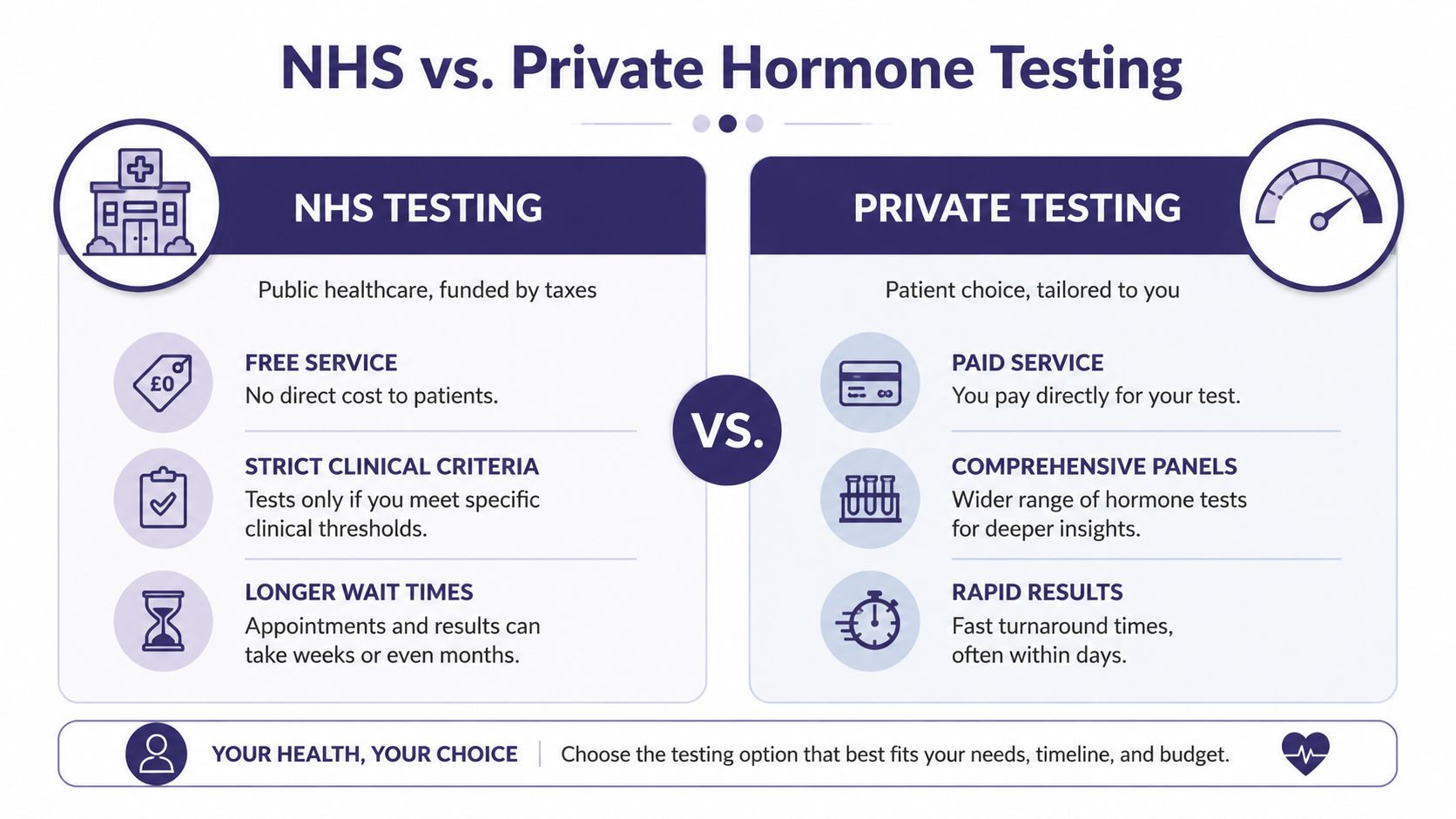
If you want a focused, no-cost route for a clear NHS indication, the NHS is appropriate. If you want broader access, more flexible timing, and a more proactive discussion around symptoms and prevention, private care may fit better.
Side-by-side practical differences
| Question | NHS pathway | Private pathway |
|---|---|---|
| Why are tests ordered? | To investigate a defined clinical concern | To investigate symptoms, and sometimes to build a broader picture |
| How quickly can it happen? | Depends on appointments, criteria, and referral steps | Usually more flexible and direct |
| How broad is the testing? | Usually targeted | Often wider, depending on the clinic |
| Who interprets the result? | GP or NHS specialist within guideline-based pathways | Private clinician, ideally with symptom and lifestyle review |
| Cost | Usually covered within NHS care | Paid by the patient or insurer, depending on policy |
Who tends to benefit most from going private
Private testing is often most useful for:
- Busy professionals who can't easily work around repeated waits or rigid appointment availability
- People with persistent but non-specific symptoms who want a fuller discussion
- Those seeking proactive review rather than waiting for a condition to become more obvious
- Patients wanting one place for testing, interpretation, and next steps
That doesn't mean more testing is always better. It means some people value speed, continuity, and a wider clinical conversation enough to pay for it.
For a broader look at what private blood testing can offer in the UK, this guide to a private blood test in the UK is a useful starting point.
The trade-off worth being honest about
Private medicine can improve access and convenience. It does not remove the need for sound clinical reasoning.
The best private care provides more than a large panel and a list of highlighted results. It explains which tests matter, which ones do not, how timing affects interpretation, and what you should change in real life based on the findings.
The wrong private approach can generate anxiety and incidental abnormalities. The right one saves time and gives context.
Your Proactive Health Journey with The Lagom Clinic
For people who feel stuck between vague symptoms and a slow, narrow pathway, a proactive private GP model can be a better fit. The advantage isn't just faster testing. It's having enough time to understand the full picture.
At The Lagom Clinic, care is built around longer appointments, on-site testing, and practical follow-through. That matters when hormonal concerns overlap with sleep issues, stress, nutrition, work pressure, training load, contraception, perimenopause, or thyroid questions. These aren't problems that fit neatly into a rushed conversation.
A more useful consultation looks at patterns. When symptoms started. How they relate to your cycle. Whether lifestyle, medication, alcohol, overtraining, or poor recovery could be contributing. Which tests are worth doing. Which ones are likely to mislead.
What a proactive private approach changes
Patients usually value three things most:
Speed and convenience
Fewer delays between consultation, blood draw, and interpretation.A broader clinical lens
Symptoms are assessed alongside lifestyle, not in isolation.Clear next steps
Results lead to a plan, whether that involves treatment, monitoring, nutrition changes, exercise adjustment, stress support, or onward referral.
Good hormone care isn't about collecting numbers. It's about making sense of symptoms in a way that leads to action.
This approach can be especially helpful for busy adults who want to stay ahead of health issues, not merely react once they become severe. It also suits people who've been told they're “fine” but still don't feel well, and want a clinician to join the dots properly.
If you're considering your options, the right question isn't “NHS or private?” in the abstract. It's “What kind of support do I need, and how quickly do I need it?”
Frequently Asked Questions About Hormone Testing
Can I ask my GP for a specific hormone test such as testosterone or oestrogen
You can ask, but the GP may not order it unless your symptoms fit a recognised clinical indication. NHS testing is usually targeted rather than open-ended. That's because isolated hormone results can be misleading if they're not tied to symptoms, timing, and clinical context.
Is a hormone blood test useful for perimenopause
Sometimes, but often less than people hope. In perimenopause, hormone levels can fluctuate, so a single blood result may not settle the question. In many cases, the symptom pattern and age range are more informative than one test result.
Are home hormone kits reliable
Some can be useful, but quality varies. The biggest issue isn't just the sample method. It's interpretation. A technically accurate result still needs context, including cycle timing, medication use, and symptoms. If you use a home kit, choose a provider that explains limitations clearly and offers clinical follow-up.
Will lifestyle changes make a difference if the issue is hormonal
Often, yes. They may not replace treatment when there is a clear endocrine disorder, but they can improve sleep, energy, insulin sensitivity, stress tolerance, and symptom burden. In practice, the best outcomes usually come from combining accurate assessment with sustainable lifestyle work.
What symptoms should prompt faster medical review
Seek prompt medical advice if you have absent periods without explanation, significant or rapid symptom change, severe palpitations, marked weight change, fertility concerns, new nipple discharge, or symptoms that interfere substantially with daily life.
If you want clear, personalised guidance on hormonal symptoms without the usual delays, The Lagom Clinic offers a calm, thorough private GP approach in Bristol, with time to review your symptoms properly, arrange appropriate testing, and build a practical plan around treatment, nutrition, exercise, sleep, and long-term health.
Private Hormone Testing in Bristol
If you suspect a hormone imbalance, our women’s health clinic in Bristol offers same-week blood tests and consultations with Dr Ruth Guest, who specialises in hormonal health and menopause. Explore our women’s health services.


 Members Consultation