


You notice it in the mirror first thing in the morning. The skin still looks healthy, but not as even as it used to. There may be fine lines that linger after you've moisturised, acne marks that haven't quite faded, or a general dullness that good skincare no longer seems to shift.
That's usually the point at which people start looking into a face peeling treatment. Some want brighter skin before an important event. Others are trying to manage persistent congestion, pigmentation, or rough texture. Most aren't looking for a dramatic transformation. They want their skin to look clearer, calmer, and more consistent without taking unnecessary risks.
A sensible peel should never be treated as a quick cosmetic impulse. It works best when it sits inside a broader plan that includes the right diagnosis, realistic expectations, skin barrier support, and habits that protect results over time.
Your Introduction to Skin Renewal
A face peel is a medical resurfacing treatment. A carefully selected solution is applied to the skin to encourage controlled shedding of damaged outer layers and stimulate renewal underneath. That sounds simple, but the important word is controlled. The difference between a professional peel and a product bought online is judgment. Skin type, current inflammation, pigmentation risk, lifestyle, and aftercare discipline all matter.

In the UK, face peeling treatment sits within the broader chemical peel category, which has been used in dermatology for well over a century. The NHS explains that chemical peels can improve fine lines, sun damage, acne, pigmentation problems and some superficial scars, which supports their place as established clinical treatments rather than a passing trend, as discussed in this historical and clinical overview of chemical peels.
What patients often get wrong
Many people assume a peel is just “strong exfoliation”. It isn't. A proper peel is chosen for a reason. If your main problem is active acne, the plan will differ from someone whose concern is sun damage or post-inflammatory marks. If your skin is reactive or prone to discolouration, the safest treatment may be a lighter peel done thoughtfully rather than a stronger one done quickly.
A good consultation should cover:
- Your main concern. Dullness, congestion, pigmentation, textural irregularity, acne scarring, or early photoageing all point in different directions.
- Your skin behaviour. Sensitive skin, eczema tendency, frequent flushing, or poor tolerance of active skincare can change the plan.
- Your routine and lifestyle. Outdoor commuting, regular exercise, travel, and social commitments all affect whether downtime is practical.
A peel isn't just about what your skin can tolerate on the day. It's about what your skin can recover from well in the days and weeks after.
There's also value in the basics. If your aim is to achieve smoother, clearer skin, daily habits such as consistent sunscreen use, gentle cleansing, enough sleep, and avoiding over-exfoliation still matter. A peel can accelerate improvement, but it won't compensate for chronic irritation, poor sun protection, or an overloaded skincare routine.
Understanding How Face Peels Renew Your Skin
Think of a peel as controlled renewal. In the same way a gardener prunes damaged growth to encourage healthier regrowth, a peel removes selected layers of skin so the repair process can produce a fresher, smoother surface.
Your skin has two main layers relevant here. The epidermis is the outer barrier you see and touch. Beneath it sits the dermis, where structural support and collagen-related changes become more important. Different peels reach different depths, and that depth largely determines both the result and the recovery.
What happens during a peel
A chemical solution is applied for a specific purpose and for a specific length of time. The solution loosens the bonds between skin cells and creates a measured injury. That wording can sound alarming, but in medicine, a controlled injury is often how healing is triggered.
The skin responds by:
- Shedding older surface cells that contribute to roughness and dullness
- Increasing cell turnover, so fresher skin reaches the surface
- Stimulating repair processes, which can improve texture over time
- Helping uneven tone look more uniform, especially when excess surface pigment is part of the problem
Why deeper isn't always better
Patients often assume the strongest option will give the best outcome. That's not how good skin medicine works. The right treatment is the one that matches the problem and the person. If someone has mild uneven tone and a busy work calendar, a lighter peel can be more useful than a stronger one that causes unnecessary disruption.
This is also where language can confuse people. “Peeling” may be visible, but visible flaking isn't the only sign that a treatment is working. Some well-chosen peels produce subtle shedding with worthwhile improvement. Chasing dramatic peeling can lead patients into over-treatment.
If you want a plain-language overview of acids, exfoliation, and how these products differ from scrubs, this guide to chemical exfoliation is a helpful primer.
Practical rule: the aim isn't to strip the skin. The aim is to prompt repair without tipping the skin into avoidable inflammation.
Where collagen fits in
When a peel reaches deeper levels, the skin's healing response can support collagen remodelling. That matters most for concerns such as finer wrinkling, some acne scarring, and photoageing. But collagen response comes with a trade-off. More depth means more healing demand, more visible recovery, and more need for careful patient selection.
That's why the most useful question isn't “What's the strongest peel you offer?” It's “What level of intervention will improve my skin with a risk profile that makes sense for me?”
The Different Types of Face Peeling Treatments
Clinicians usually divide peels into superficial, medium, and deep categories. That framework matters because the skin layer treated determines the likely benefit, the recovery pattern, and the complication risk. UK clinical guidance commonly classifies peels this way, and notes that light peels may be repeated every 2 to 5 weeks, while stronger peels are performed far less frequently, as outlined in this clinical review of chemical peels.
Superficial peels
These act mainly within the outer epidermis. They're often the most suitable starting point for people with dullness, mild acne, uneven tone, or fine surface irregularity. In practice, these are the peels many busy adults tolerate best because recovery is usually milder.
Common examples in clinical settings include glycolic acid and salicylic acid peels. During treatment, patients may feel warmth, tingling, or a prickling sensation. Some people peel visibly afterwards. Others just notice dryness, tightness, and then a brighter surface over the following days.
Superficial peels are often useful when the aim is gradual improvement rather than a single dramatic reset.
Medium-depth peels
These extend into the upper dermis. They're considered when surface treatment alone isn't enough, particularly for acne scarring, dyschromia, and more established photoageing. At this point, a peel starts to feel more like a procedure that requires planning.
A commonly discussed agent in this category is trichloroacetic acid (TCA). The treatment sensation is stronger, and recovery is more noticeable. Redness, tightness, and visible peeling are more likely than with a superficial peel. This can be worthwhile, but only when the expected gain justifies the interruption to normal routine.
Deep peels
Deep peels reach deeper dermal layers and are reserved for carefully selected cases, such as more severe photoageing, deeper wrinkles, and some scars. These are not casual lunchtime treatments. They sit at the more intensive end of resurfacing care and carry a substantially greater need for preparation and aftercare.
Patients are often surprised to learn that the “best” peel for them is very often not a deep peel. In everyday practice, depth should be earned by clinical logic, not by enthusiasm.
Comparison of Face Peel Depths
| Peel Depth | Primary Target | Common Concerns Addressed | Typical Downtime |
|---|---|---|---|
| Superficial | Outer epidermis | Dullness, acne, uneven tone, fine surface lines | Usually lower downtime, often manageable around normal routine |
| Medium | Upper dermis | Acne scarring, dyschromia, more noticeable textural change | Noticeable recovery that usually needs planning |
| Deep | Deeper dermal layers | Severe photoageing, deeper wrinkles, some scars | Significant downtime and intensive aftercare |
The correct peel isn’t the one with the most impressive name. It’s the one that treats the right depth without creating a bigger problem than the one you started with.
Is a Face Peel Right for You
A face peeling treatment can be appropriate if your concerns include persistent acne, post-acne marks, uneven tone, mild textural roughness, early fine lines, sun-related change, or superficial scarring. It can also be the wrong choice if the skin is inflamed, the diagnosis isn’t clear, or your schedule and habits won’t support proper recovery.
When a peel may be worth considering
You may be a suitable candidate if:
- Your concern is visible but relatively localised. For example, acne marks, patchy pigmentation, or rough texture that hasn’t improved with sensible home care.
- Your skin is stable. Active infection, severe irritation, or an impaired skin barrier usually needs to be settled first.
- You can commit to aftercare. Sun avoidance, sunscreen, gentle skincare, and patience are part of the treatment, not an optional extra.
When caution matters more than enthusiasm
A peel may need to be postponed or avoided if you have active cold sores, broken skin, a strong tendency to scar, or if your current medication or medical history makes healing less predictable. Pregnancy, recent use of certain prescription treatments, and uncontrolled inflammatory skin disease also need individual discussion before proceeding.
This is one reason diagnosis matters. Not every mark, bump, or patch of pigment should be peeled. Some lesions need proper assessment first. If a patient has a mole or uncertain skin change that they’re trying to “improve” cosmetically, I’d rather they understand when a lesion needs a different pathway, such as a mole removal procedure, before any resurfacing is considered.
Skin of colour and post-inflammatory hyperpigmentation
Generic advice often proves inadequate. For patients with darker skin tones or a history of post-inflammatory hyperpigmentation, the wrong peel can cause discolouration. The NHS notes complications are more likely when the wrong peel depth is chosen, and a conservative peel with careful sun protection is often the safer approach, as summarised in this patient-focused overview of chemical peel risks and suitability.
That doesn’t mean peels are off the table. It means individualisation is essential.
A careful assessment should consider:
- Your baseline pigment tendency. Do you mark easily after spots, bites, or irritation?
- Your recent sun exposure. Tanned or UV-stressed skin is less forgiving.
- Your tolerance of active products. Irritated skin often behaves badly after procedures.
- Your goals. If your top priority is brightening or reducing marks, a lighter series may be safer than one aggressive session.
For many patients, especially those prone to pigmentation, restraint gives a better cosmetic outcome than intensity.
Your Treatment Journey From Consultation to Recovery
A clearer understanding of the process’s sensations generally leads to a more positive experience. A face peel shouldn’t begin with a product. It should begin with a conversation about goals, health, routine, and risk.

The consultation
The first appointment is where the treatment is either made sensible or made unsafe. Skin concerns that sound similar can need very different approaches. Acne marks, melasma-pattern pigmentation, rosacea-related redness, and textural scarring aren’t interchangeable.
A proper consultation should cover:
- Medical background. Current medication, cold sore history, healing tendency, and any recent procedures.
- Skin analysis. Tone, sensitivity, active inflammation, barrier health, and the likely depth needed.
- Lifestyle fit. Upcoming holidays, outdoor sport, work meetings, and willingness to follow aftercare.
The key trade-off with peels is efficacy versus downtime. Deeper penetration can produce stronger collagen remodelling, but it also increases healing time and complication risk. That is why deeper peels are reserved for carefully selected patients after a thorough consultation, as described in this overview of chemical peel indications and risks.
Preparing the skin
Preparation often makes the difference between a smooth recovery and an irritated one. In practical terms, that usually means avoiding tanning, reducing irritation, and pausing products that may over-sensitise the skin before treatment. If someone arrives with a compromised skin barrier from overuse of acids, retinoids, scrubs, and active serums, the right decision may be to delay.
For some patients, a private GP-led clinic such as The Lagom Clinic can provide the broader medical context for that decision, particularly when skin treatment intersects with medication review, lifestyle factors, or other health concerns.
On the day
The skin is cleansed thoroughly. The peel solution is then applied in a controlled way. What you feel depends on the peel. A lighter peel may cause tingling or warmth. A stronger peel can feel more intense, but the response is monitored throughout.
After the treatment, the skin may look pink or red and feel tight, warm, or more sensitive. Some peels are neutralised during the session. Others are left to complete their action according to the protocol used.
The first few days
Careful planning is essential. The skin may become dry, taut, darker, flaky, or visibly peel depending on the treatment depth. Patients who’ve arranged their diary sensibly usually cope well. Patients who expected “no downtime” are often the ones who feel caught out.
Navigating Aftercare and Managing Your Recovery
Good aftercare protects both the result and your skin barrier. Poor aftercare turns a well-chosen peel into an avoidable setback. The rules are straightforward, but they matter.
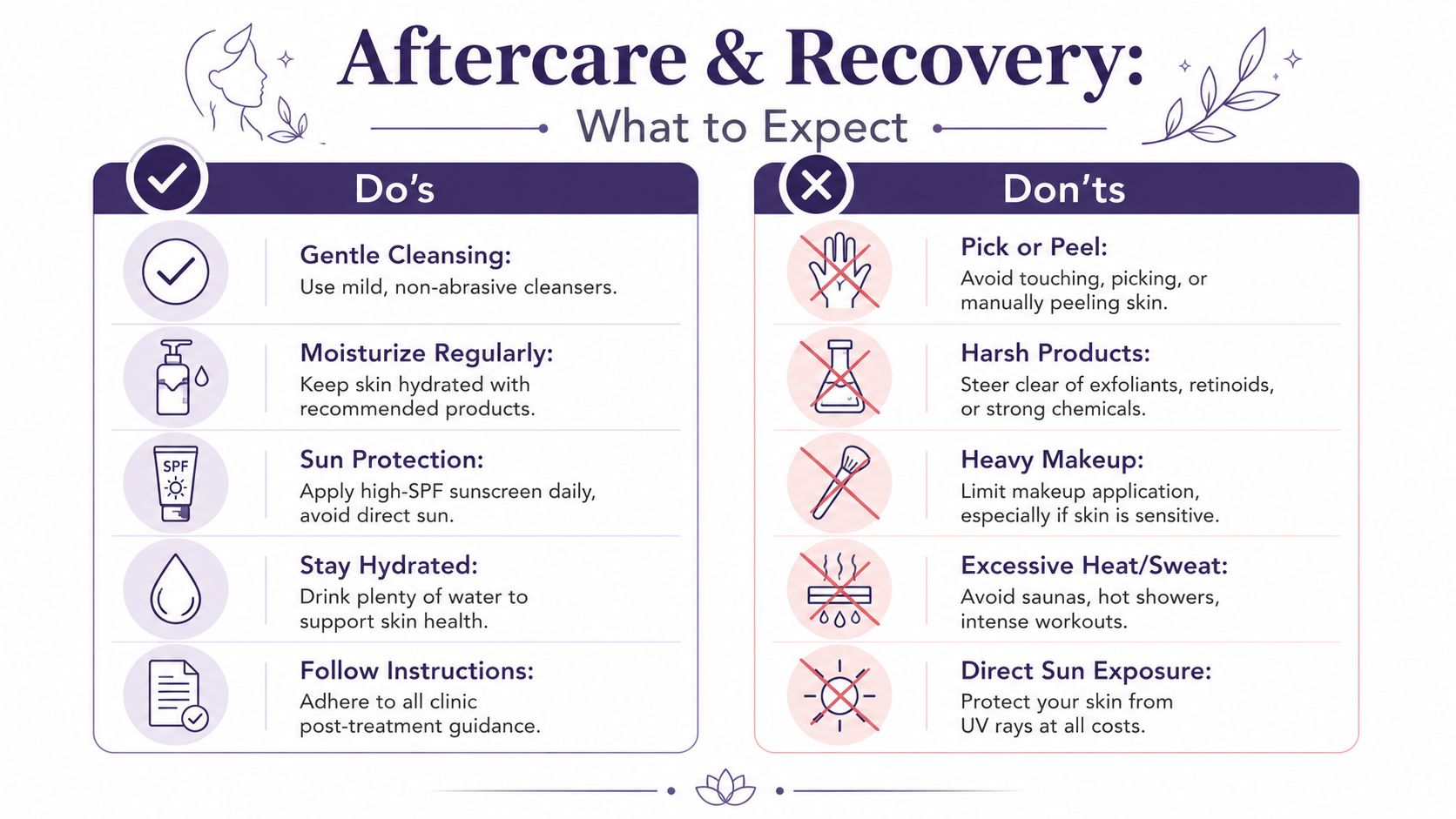
Real-world recovery time is one of the most underplayed parts of peel marketing. Medium-depth peels usually need about a week for full healing, and strict sun protection is important for several weeks afterwards, as noted in this review of peeling and re-epithelialisation timelines.
What downtime actually means
Downtime doesn’t always mean pain. More often, it means looking socially less polished for a period of time. Skin can feel tight, appear red, and then begin to flake or peel. That may be manageable if you work from home. It may be inconvenient if you have client meetings, public-facing work, or a weekend event in strong sun.
For superficial peels, the disruption is often modest. For medium-depth treatment, it’s wise to plan your calendar rather than assume you’ll “look normal” immediately.
The practical aftercare checklist
- Cleanse gently. Use a mild cleanser and lukewarm water. Friction is the enemy of healing skin.
- Moisturise consistently. Freshly treated skin loses water easily. A bland, non-irritating moisturiser helps comfort and barrier repair.
- Protect from UV every day. This is not optional. Newer skin is more vulnerable to pigment change.
- Leave peeling skin alone. Don’t pick, rub, scrub, or pull at flakes.
- Pause strong actives. Retinoids, exfoliating acids, abrasive scrubs, and harsh masks usually need to wait until healing is established.
- Be sensible with heat and exercise. Hot showers, saunas, and heavy sweating can aggravate irritation in the early phase.
Newly treated skin is easier to damage than most patients realise. The first mistake is usually overconfidence.
Lifestyle habits that help
A peel works better when recovery isn’t fighting against poor habits.
Support your skin by focusing on:
- Sleep. Skin repair is slower when you’re chronically sleep deprived.
- Hydration. Well-hydrated skin tends to feel less tight and recover more comfortably.
- Food quality. A balanced diet with adequate protein and micronutrients supports healing better than a pattern of skipped meals and alcohol-heavy evenings.
- Routine discipline. Don’t introduce five new products because your skin feels dry. Simplicity works.
When to get back in touch
If you develop unexpected pain, spreading swelling, signs of infection, or pigment changes that concern you, seek professional review rather than trying to self-correct with stronger products. The right response after a peel is usually less intervention, not more.
Making an Informed Decision About Your Treatment
A face peeling treatment is worth considering when the expected benefit matches your skin concern, your risk profile, and your real life. It’s less useful when someone wants a fast fix but isn’t prepared for assessment, aftercare, or the possibility that another treatment would suit them better.

Questions worth asking at consultation
- Why this peel, rather than a lighter or stronger one?
- What is the main problem you’re treating in my skin?
- What risks apply to my skin tone and pigment tendency?
- What will recovery look like in practical terms for work and social plans?
- What skincare should I stop before treatment and restart afterwards?
- Would another approach suit me better, such as microneedling or another form of rejuvenation?
Some patients who are primarily concerned with dynamic lines may also want to understand whether a peel should be paired with, or chosen instead of, options such as anti-wrinkle injections. That’s a useful discussion. The aim should be the right treatment plan, not forcing every concern into one procedure.
A thoughtful clinician won’t promise perfection. They should explain likely improvement, who shouldn’t be treated, and what you’ll need to do to protect the result. That’s particularly important if you’re juggling a demanding job, frequent travel, or skin that reacts easily.
If you’re considering a face peeling treatment and want a medically grounded opinion, The Lagom Clinic offers private GP care built around personalised assessment, practical risk management, and lifestyle-led health planning. The goal is simple. Clear advice, appropriate treatment, and skin decisions that make sense for the whole person, not just the mirror.


 Members Consultation