


A private transthoracic echocardiogram in the UK typically costs £250 to £500, with published private rates often clustering around £295 for a standard slot and £345 for a priority slot. If you're comparing options, it helps to know that some providers start at £250 and include both the scan and the written report, which can make the headline price better value than it first appears.
If you're reading this, you may be in a familiar position. Perhaps you've had palpitations, you've noticed breathlessness on stairs that used to feel easy, or a family member's heart diagnosis has made you wonder whether you should check your own heart more carefully. In clinic, I often find that patients aren't only asking whether they need an echocardiogram. They're also asking whether paying privately is worth it.
That's the right question.
The private echocardiogram cost isn't just a fee for an ultrasound appointment. You're often paying for speed, for a clearly written report, for a shorter path to clinical decision-making, and sometimes for peace of mind. The important part is knowing when that extra value matters, and when it may not.
Considering a Private Echocardiogram
A common scenario goes like this. Someone has an ECG that looks reassuring, but their symptoms haven't gone away. Or they've been told they have a murmur and want to know whether a valve issue sits behind it. Or they're trying to be proactive before returning to exercise, increasing training load, or undergoing an operation. An echocardiogram often becomes the next sensible step because it shows the heart's structure and function in motion.
For many patients, the hesitation isn't the test itself. It's the uncertainty around cost, what the quote covers, and whether private care offers anything beyond convenience.
When paying privately may make sense
Private testing can be worth considering when timing changes the decision that follows. That might be because symptoms are active, because a specialist review depends on imaging, or because you need clarity before travel, sport, work, or surgery.
Practical rule: The value of a private echocardiogram rises when the result will change what you do next in the near term.
That doesn't mean everyone should go private. If symptoms are stable and NHS timing is acceptable, waiting can be reasonable. But if uncertainty is dragging on, a quicker answer can reduce delay in treatment, follow-up, or simple reassurance.
The question behind the question
When patients ask about private echocardiogram cost, they're usually asking three things at once:
- What will I pay
- What do I get for that price
- Will the result help me act sooner or more wisely
Those are better questions than price alone. A cheaper quote without a formal report, or with a slower pathway afterwards, may not be cheaper in any meaningful sense.
What an Echocardiogram Reveals About Your Heart
An echocardiogram is best thought of as an ultrasound scan of the heart. It doesn't just produce a still picture. It lets the clinician watch the heart beat, look at how blood moves through it, and assess whether the heart is shaped and functioning as expected.
For a patient, that matters because symptoms such as breathlessness, dizziness, swelling, chest discomfort, reduced exercise tolerance, or persistent palpitations can come from very different causes. An echo helps separate structural heart problems from concerns that may need a different route of investigation.
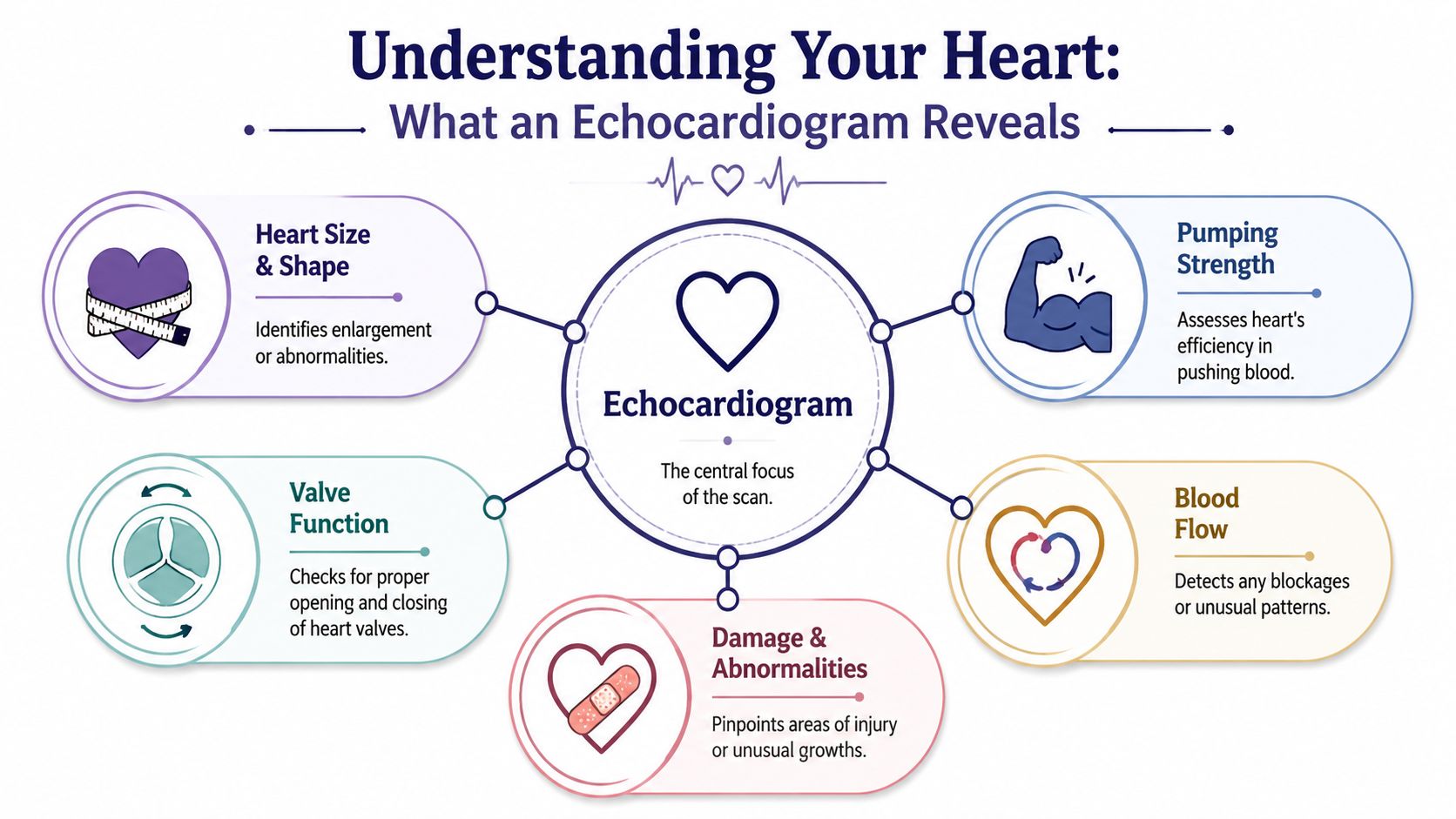
What clinicians look for
A standard echo can help assess:
- Heart size and shape. This can show whether chambers look enlarged or whether the heart muscle appears unusually thick.
- Pumping function. The scan helps show how effectively the heart contracts and relaxes.
- Valve function. It can reveal whether valves open and close properly, or whether there may be narrowing or leakage.
- Blood flow patterns. Doppler imaging helps assess how blood is moving through the heart.
- Visible abnormalities. It may identify changes consistent with damage, strain, or other structural concerns.
If you'd like a more detailed patient-facing overview of the scan itself, this heart echo scan guide gives a useful introduction.
Why a doctor recommends one
The test is often most helpful when there is a specific clinical question. For example:
- A murmur needs clarification. An echo can show whether the sound is innocent or linked to valve disease.
- Breathlessness needs context. The problem may sit in the lungs, fitness, rhythm, circulation, or heart function. An echo helps narrow that down.
- Palpitations need a fuller picture. An ECG looks at electrical activity. An echo looks at structure and function. Together, they answer different questions.
- Family history raises concern. If close relatives have significant heart disease, structural screening may be sensible depending on the history.
- High blood pressure has been present for years. Longstanding pressure load can affect the heart muscle, and imaging can help assess the effect.
A normal echocardiogram can be just as useful as an abnormal one. It rules out important structural problems and helps direct attention to the next most likely cause.
What it doesn't do on its own
An echocardiogram is powerful, but it isn't a single test for every heart question. If the concern is mainly rhythm, ambulatory ECG monitoring may matter more. If the concern is coronary artery disease, a CT coronary angiogram or another test may be more appropriate. Good care means ordering the right test for the right reason, not merely the most available one.
Comparing Echocardiogram Types
Not every echocardiogram is the same. The right type depends on the question being asked, the level of detail needed, and how much information can realistically be obtained from a standard chest scan.

The standard transthoracic echo
A transthoracic echocardiogram, often shortened to TTE, is the usual starting point. A probe is placed on the chest wall with gel, and images are taken from outside the body. For most patients, this is straightforward, painless, and enough to answer the main clinical question.
This is the scan typically referred to when inquiring about private echocardiogram cost.
The transoesophageal echo
A transoesophageal echocardiogram, or TOE, uses a probe passed into the oesophagus to obtain much closer images of the heart. Because the oesophagus sits directly behind the heart, this approach can provide greater detail when standard views aren't enough.
From the patient's point of view, this is a more involved test. It may require fasting and a more formal hospital-style pathway. It's used selectively, not casually, and usually when there is a focused need for better visualisation.
The stress echo
A stress echocardiogram looks at heart function under exertion or medication-induced stress. This can be useful when symptoms occur with activity, or when clinicians want to assess how the heart behaves when demand rises.
This isn't "a harder echo". It's a different question. A routine TTE asks how the heart looks and works at rest. A stress echo asks how it performs under load.
A practical comparison
| Type | How it's done | Best for | Patient experience |
|---|---|---|---|
| TTE | Probe on chest wall | Structure, valves, pumping function | Non-invasive and usually simple |
| TOE | Probe via oesophagus | More detailed views when needed | More invasive, more preparation |
| Stress echo | Imaging during exercise or induced stress | Symptoms or function under exertion | More active and more supervised |
Why type affects cost conversations
Even when patients compare “echo prices”, they may not be comparing like with like. Test complexity, monitoring requirements, staffing, and care setting can all differ. That’s one reason price variation has been documented so widely. A large analysis highlighted by Healthcare Dive’s report on echocardiogram price variation found prices ranging from $210 to $1,830 across 12.5 million diagnostic tests in one year.
That figure comes from the US, so it shouldn’t be used as a direct UK benchmark. It is useful for one reason. It reminds patients that the same test label can hide very different service models.
If you ever want to understand how standard echocardiograms are categorised on the billing side, this guide for medical billers on CPT 93306 is a helpful technical explainer. It isn’t a patient pricing guide, but it shows how specific the coding behind a “routine echo” can be.
Decoding the Private Echocardiogram Cost in the UK
A patient with palpitations or a newly heard murmur often asks the same question first: how much will a private echo cost? The more useful question is what that fee buys. A low quote can still leave you waiting for a report, chasing interpretation, or arranging follow-up elsewhere. A higher quote may include faster access, senior review, and a result you can act on quickly.
In the UK, published private TTE prices commonly sit in the £250 to £500 range, with consumer-facing rates around £295 for a standard slot and £345 for a priority slot, as outlined in GetScanned’s overview of private echocardiogram pricing.
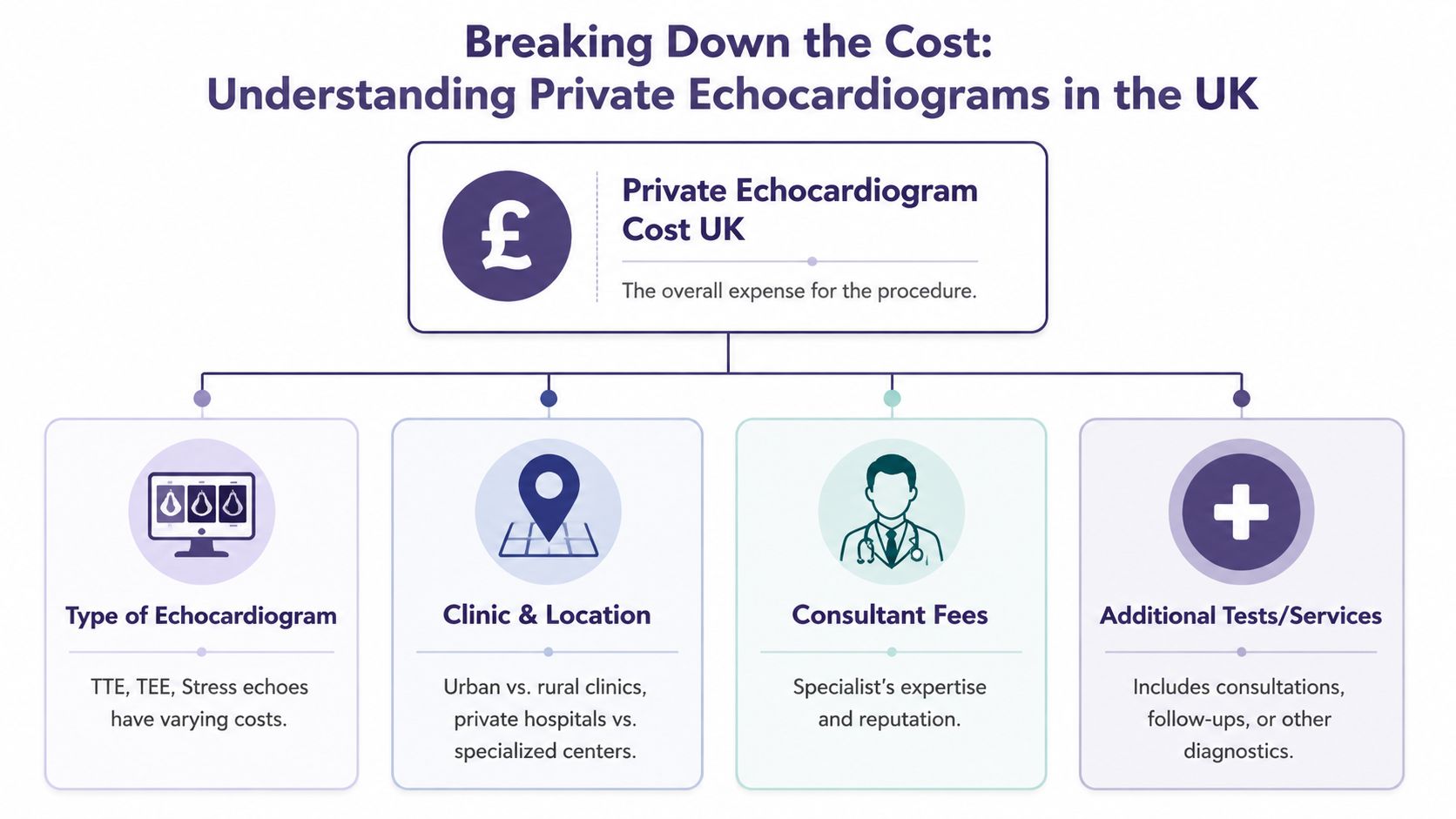
Price differences usually come from the service around the scan, not just the scan itself. Reporting speed matters. So does who interprets the images, whether the report is written clearly enough for your GP or cardiologist to use, and whether the clinic has a sensible plan if something abnormal appears.
What the fee usually includes
A private echocardiogram quote may cover several separate parts of care:
- The appointment itself. This includes the sonographer’s time and the scan room.
- Image interpretation. A written report adds clinical value because raw images do not answer the question on their own.
- Turnaround time. Faster reporting often carries a premium.
- Clinic model. Private hospitals, imaging centres, and specialist cardiac services do not price in the same way.
- Administration and onward communication. Sending the result to your GP or specialist is simple, but it still needs to happen properly.
This is why two clinics can advertise a similar test and still offer very different value.
Why reporting quality changes the real cost
From a clinical perspective, the report is where the scan becomes useful. If the wording is vague, delayed, or disconnected from the reason the test was ordered, the cheaper price can become poor value. Patients then pay twice in a different way. First for the scan, then in time, uncertainty, or an extra review to work out what the result means.
That is also why I advise patients to ask who reads the study and when the written report will be ready. If you have symptoms, are waiting on medication decisions, or need reassurance before returning to exercise, a quick and competent report can matter more than saving a modest amount on the booking fee.
Speed often explains the premium
Vista Health’s echocardiogram service page shows this clearly. Their £295 echocardiogram includes a report within three working days, while the £345 option offers a scan within 7 days. In practice, that extra spend often buys earlier access and faster clinical decision-making.
Sometimes that is worth every pound. A patient with breathlessness, chest symptoms, an abnormal ECG, or a murmur that needs clarification may benefit from a quicker answer. If symptoms are mild and stable, the urgency may be lower.
How to compare quotes properly
Use a quote the way you would use any medical result. Look at the details, not just the headline number.
- Check the exact scan type. A standard transthoracic echo should be clearly stated.
- Confirm the report is included. Do not assume it is part of the price.
- Ask who reports it. Expertise affects reliability and how confidently the result can guide next steps.
- Ask about timing. You need the scan date and the report date.
- Clarify follow-up. Some services give you a PDF and nothing more.
- Compare the whole diagnostic pathway. If you are also reviewing other private imaging fees, this guide to private CT scan cost shows how pricing can vary for similar reasons across different tests.
For readers who want background on how smaller or more focused echo studies are described in coding systems, limited echo coding guidance is a useful technical reference. It is not a UK patient pricing guide, but it helps explain why one “echo” is not always identical to another.
A good private echocardiogram is not only a scan at the lowest price. It is a scan that answers the right question, is reported promptly, and gives you and your clinician enough clarity to decide what to do next.
Making Smart Choices for Your Heart Health
A common private GP conversation goes like this. A patient has finally booked an echocardiogram after weeks of palpitations or a newly heard murmur, then asks a sensible question: “Am I paying for the scan, or am I paying for an answer?” The right service gives you both.
A private echocardiogram earns its value when the result changes what happens next. That may mean confirming that exercise is safe, clarifying whether a murmur is innocent or needs cardiology review, or giving enough detail to adjust blood pressure treatment with confidence. A cheaper scan can still be good care, but only if it includes a proper report, is reviewed by the right clinician, and leads to clear follow-up.
How to judge value rather than just price
Price matters. So does what sits behind it.
In practice, the difference between a lower quote and a better service often comes down to reporting speed, the experience of the person interpreting the images, and whether you are left with a PDF alone or actual clinical guidance. Those details affect how useful the scan is on the day you receive the result.
Ask direct questions before booking:
- Who interprets the scan, and what is their cardiac experience
- Is a formal written report included in the quoted price
- How quickly will the report be ready
- Can the result be sent to your GP, cardiologist, or both
- If the scan shows something important, is follow-up available or will you need to arrange that yourself
Those questions usually tell you more than the headline fee.
Use the result to make a decision
An echocardiogram has real value when it helps you act. I often see that in a few practical areas.
- Exercise and symptoms. A reassuring scan can support a return to training or everyday activity with less uncertainty. An abnormal finding can show that a more cautious plan is wiser.
- Medication review. Echo findings can strengthen the case for treating high blood pressure more actively or for arranging further cardiac assessment.
- Risk reduction. A normal structure on scan does not cancel out the effects of smoking, poor sleep, alcohol excess, or long-term stress. It gives you a clearer baseline from which to improve those factors.
- Long-term planning. If there is valve disease, reduced pumping function, or another structural issue, finding it earlier usually gives you more time to monitor it properly and respond before symptoms worsen.
A reassuring echo is useful. Its real benefit comes from what you do with that reassurance.
Where private testing fits, and where it does not
Private testing works well when there is a clear question to answer and a plan for using the result. It works poorly when it replaces clinical judgement or becomes a way to chase repeated scans without addressing the bigger drivers of cardiovascular risk.
For some patients, the smartest use of money is not another test. It is better blood pressure control, treatment for sleep apnoea, smoking support, weight loss, or a careful review of persistent symptoms by a clinician who can decide whether an echo is the right next step at all.
If you have chest pain at rest, fainting, marked breathlessness, or symptoms that feel acute, seek urgent medical assessment rather than arranging an elective private scan.
Your Echocardiogram Appointment What to Expect
Most standard echocardiogram appointments are much simpler than patients expect. The commonest scan is the transthoracic echo, and for that test the experience is usually calm, painless, and non-invasive.
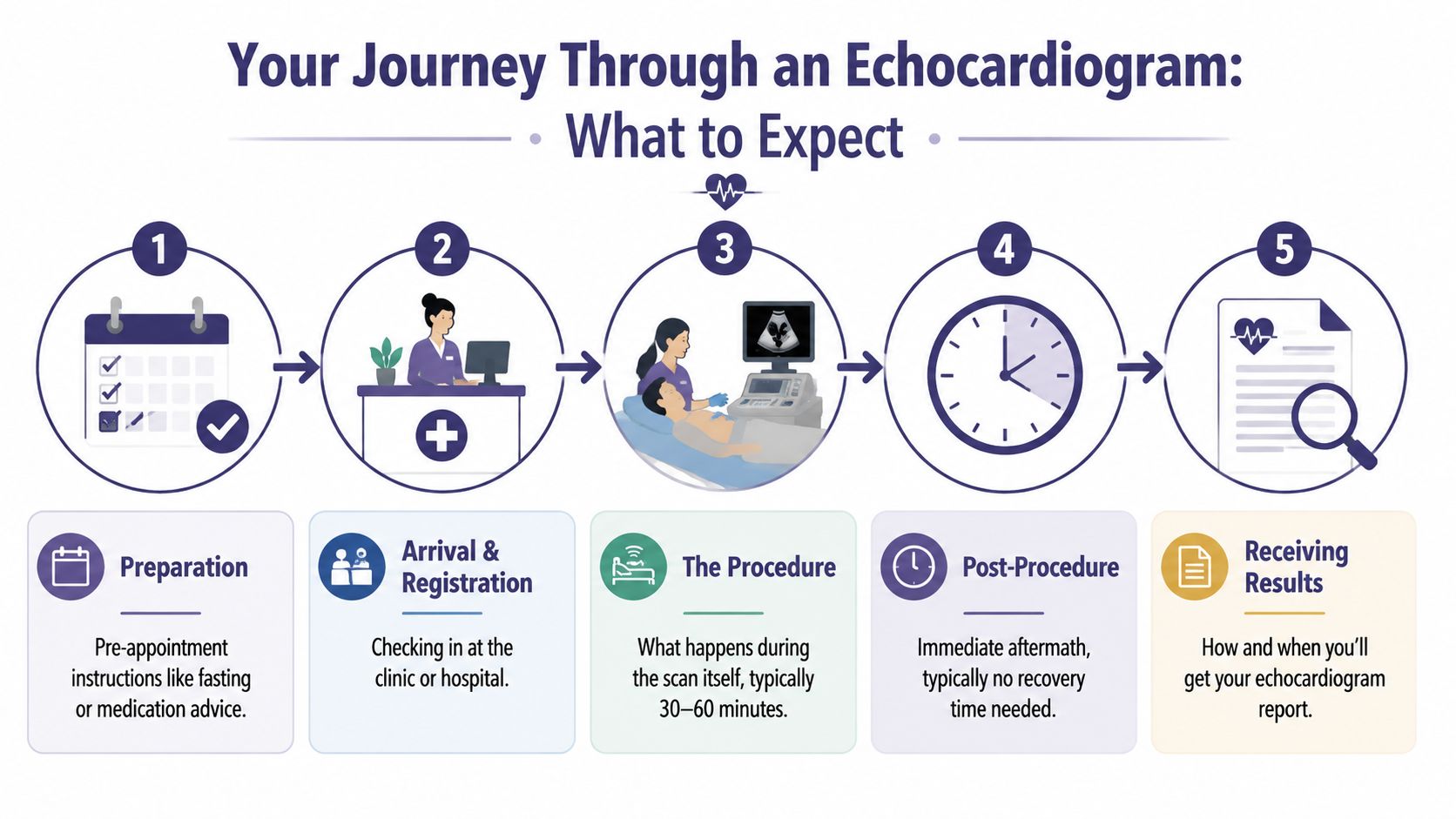
Before you arrive
For a standard chest echo, preparation is often minimal. Wear comfortable clothing and be ready to undress from the waist up or change into a gown if asked. If you’re having a more specialised test, such as a transoesophageal or stress echo, the preparation may be different, and the clinic should tell you that in advance.
Bring a list of medications, a note of your symptoms, and any previous cardiac letters or test results if you have them. These details help the reporting clinician put the images into context.
During the scan
The sonographer or clinician will usually place small stickers on your chest to help monitor heart rhythm, apply gel, and move the probe over different parts of the chest to obtain the views needed. You may be asked to turn slightly onto your side or hold your breath briefly for clearer images.
Most patients describe pressure rather than pain. Occasionally the probe needs to be pressed a little more firmly between the ribs to improve the picture, but the test is generally well tolerated.
After the appointment
For a routine TTE, you can usually return to normal activities straight away. The practical difference between providers is less about recovery and more about what happens with the result.
A useful habit is to ask these three questions before you leave:
- When will my report be ready
- Who will explain the result to me
- What should I do if my symptoms change before then
If a clinic can’t clearly explain the reporting and follow-up process, the service may be less complete than the price suggests.
Results may reassure, identify a problem that needs treatment, or point toward another test. All three outcomes can be valuable. The appointment has done its job if it helps move care forward with more clarity and less guesswork.
Book Your Consultation at The Lagom Clinic
If you’re weighing symptoms, family history, training concerns, or trying to make a sensible decision about private cardiac testing, the best starting point is a proper clinical conversation. An echocardiogram is most useful when it’s chosen for the right reason and placed into the wider context of blood pressure, exercise tolerance, sleep, stress, medication, and overall cardiovascular risk.
That’s where a private GP appointment can help. Rather than booking a scan in isolation, you can review your symptoms, decide whether an echocardiogram is the right next step, and make sure the result feeds into a practical plan. Sometimes that plan involves imaging. Sometimes it involves monitoring, blood tests, ECGs, or targeted lifestyle changes first.
For busy professionals and families in Bristol, joined-up care matters. Longer appointments create space to discuss what’s happening, what needs testing, what can safely wait, and what changes will make the biggest difference to long-term heart health. That leads to better decisions than chasing tests one by one.
If a private echocardiogram is appropriate, the aim should be simple. Get the right scan, with the right reporting, at the right time, and use the result to make a clear next decision.
If you’d like personalised advice on symptoms, referrals, preventive heart checks, or broader lifestyle support, book an appointment with The Lagom Clinic. We offer thoughtful private GP care in Bristol with time to look at the whole picture, not just the test result.


 Members Consultation