


You step off a kerb awkwardly, your ankle rolls, and within minutes the joint feels hot, swollen, and unreliable. Or you pivot during tennis, feel a sharp twist in the knee, and suddenly don't trust the leg beneath you. That moment is unsettling because ligament injuries rarely give you much warning. One movement, one stumble, one awkward landing, and normal daily life changes.
A ligament is the tough connective tissue that links one bone to another and helps keep a joint stable. When it's overstretched or torn, the result can range from a mild sprain to a complete rupture with obvious instability. The good news is that better results are often achieved by following a clear plan rather than guessing.
That plan matters more than many patients realise. The first few days are about calming pain and swelling. After that, progress depends on the right assessment, the right rehab, and knowing when self-care is enough and when it isn't. If your symptoms involve the pelvis or lower back during pregnancy rather than a sports sprain, this guide to pregnancy ligament pain gives a useful overview of how hormonal and mechanical changes can create a very different kind of ligament discomfort.
That Sudden Twist The First Sign of a Ligament Injury
Ligament injuries often start with a very ordinary story. A five-a-side footballer turns to change direction. A runner clips an uneven paving slab. A parent carrying shopping misses the last stair. Then comes the same cluster of thoughts. Was that a pop? Why is it swelling so quickly? Should I walk on it or keep completely off it?
In clinic, the first thing I try to do is reduce panic. A painful joint doesn't automatically mean surgery, and early swelling doesn't tell the whole story. Some mild sprains look dramatic. Some significant tears initially seem manageable, then reveal themselves a day later when the joint keeps giving way.
What a ligament actually does
Think of a ligament as a strong strap that helps guide and restrain movement at a joint. It doesn't create movement. Muscles do that. Ligaments provide control, especially at the edges of movement where a joint is most vulnerable.
When a ligament is injured, patients usually notice one or more of these:
- Pain at a specific point around the joint
- Swelling that develops soon after the twist or impact
- Reduced confidence when standing, walking, gripping, or changing direction
- Stiffness after the initial pain settles
- A sense of looseness or giving way in more serious injuries
A ligament injury is rarely just a pain problem. It's a stability problem, and recovery depends on restoring trust in the joint as well as reducing symptoms.
Why the right response changes the outcome
The biggest early mistake is doing either too little or too much. Some people push through because they don't want to “lose fitness”. Others stop moving entirely for far too long. Neither approach tends to work well.
Good ligament injury treatment is structured. It moves from protection to loading, from swelling control to strength, from fear of movement to confident function. If you understand that from the start, the injury feels less chaotic and much more manageable.
What to Do Immediately After a Ligament Injury
The first 24 to 72 hours shape the rest of recovery. That doesn't mean you must get every detail perfect, but it does mean you should avoid two common traps. The first is ignoring a potentially unstable joint. The second is treating all sprains with complete rest and endless icing.
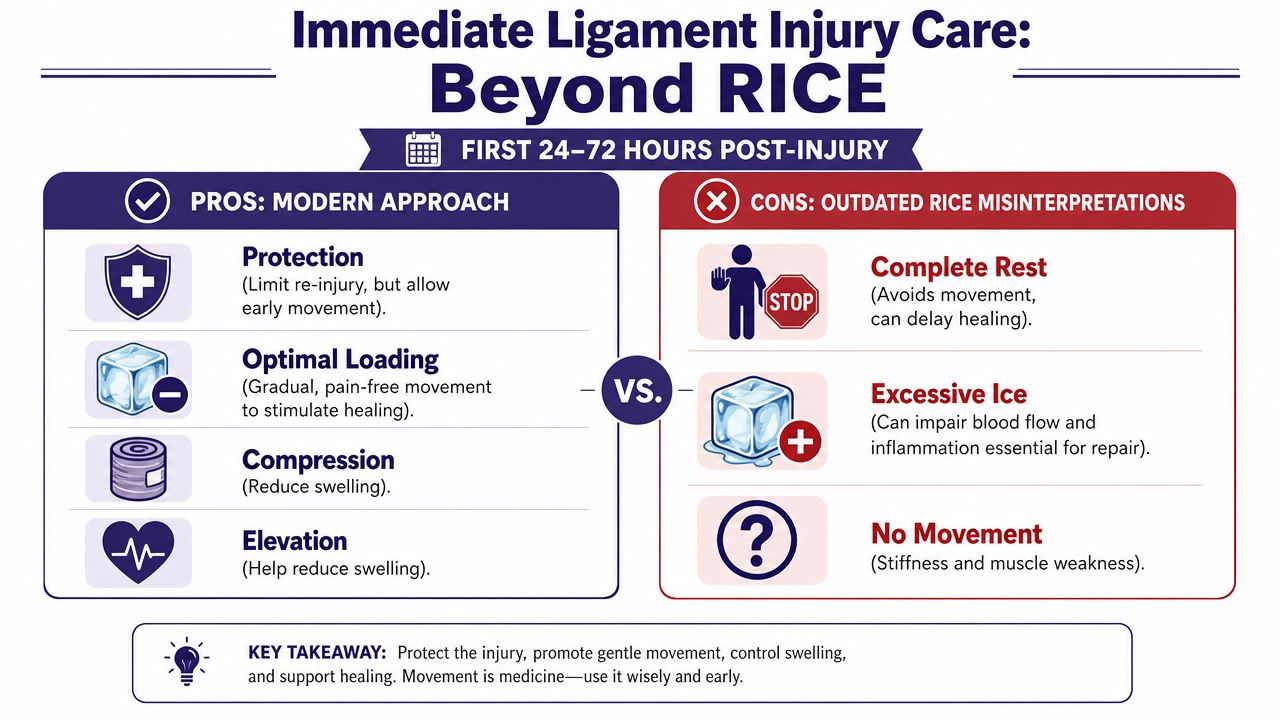
Recent evidence summaries and sports-medicine guidance increasingly support early, controlled loading and functional bracing over prolonged immobilisation for many sprains, and note that prolonged rest can delay recovery and may worsen longer-term joint outcomes because injured ligaments are associated with later osteoarthritis risk, as outlined by Tufts Medicine's overview of ligament injuries.
Think PEACE first
Many patients still know the old RICE model. Parts of it remain useful, but the modern approach is better captured by PEACE & LOVE.
In the earliest phase, focus on PEACE:
- Protection. Reduce movements that sharply increase pain or risk another twist. That may mean a brace, a support, crutches, or avoiding pivoting.
- Elevation. Raise the injured limb when practical to help manage swelling.
- Avoid overdoing anti-inflammatories. Some clinicians prefer not to rely heavily on them early because inflammation is part of tissue healing. If you need pain relief, get individual advice, especially if you have asthma, kidney disease, stomach ulcers, or take blood thinners.
- Compression. A well-fitted elastic bandage or brace can help limit swelling and improve comfort.
- Education. Don't chase miracle fixes. The joint needs a calm, progressive plan.
Then move into LOVE
Once the immediate flare starts settling, LOVE becomes important:
| Focus | What it means in practice |
|---|---|
| Load | Start gentle, pain-limited movement and weight-bearing as tolerated |
| Optimism | Understand that pain doesn't always equal damage and progress is often uneven |
| Vascularisation | Light activity, when appropriate, supports circulation and recovery |
| Exercise | Begin a structured rehab programme rather than waiting passively |
Practical rule: protect the joint from another bad movement, but don't keep it still for longer than necessary.
What works and what doesn't
What usually helps:
- A compressive support that feels snug, not tight enough to cause numbness
- Relative rest, meaning you reduce aggravating movements rather than stopping all activity
- Short walks or gentle range-of-motion work if your pain allows it
- Good sleep, regular meals, and hydration, because healing tissue needs energy and routine
What usually backfires:
- Complete bed rest for a routine sprain
- Repeated aggressive testing, where you keep twisting or stressing the joint to “see if it's better”
- Returning to running or sport too soon because swelling has reduced
- Depending on internet hacks instead of a proper assessment
If you want a simple field-guide style overview for ankle injuries, Adventure Medical Kits' sprain guide is a practical companion to the principles above.
Understanding Your Diagnosis How Severity Is Assessed
Once the pain settles a little, most patients ask the same question. How bad is it? That answer comes from the history, the examination, and sometimes imaging. It shouldn't come from swelling alone or from whether you managed to limp through the day.
The usual grading system
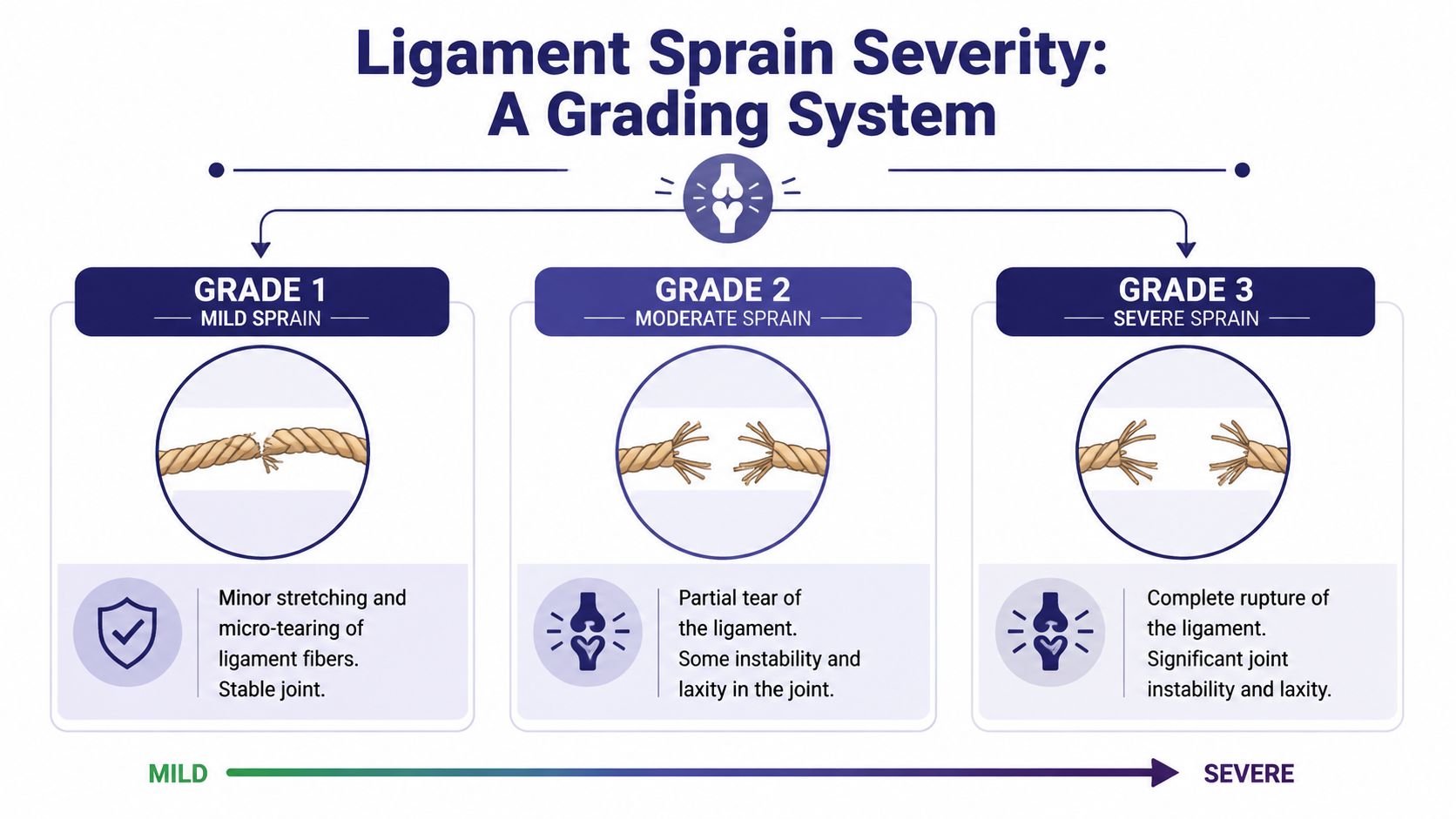
Clinicians often describe ligament injuries in three grades. A rope analogy helps.
- Grade 1 is a stretched rope with tiny fibre damage. The joint is painful, but broadly stable.
- Grade 2 is a partly frayed rope. Some fibres are torn, and the joint may feel less secure.
- Grade 3 is a fully snapped rope. Instability is usually much more obvious.
That grading is helpful, but it isn't the whole story. A moderate ankle sprain in a desk worker and the same sprain in a rugby player create different treatment decisions because the functional demands are different.
What a clinician is looking for
A good assessment starts with the mechanism. Twisting, contact, overextension, a direct blow, or a fall onto an outstretched hand all point in different directions. The timing matters too. Immediate swelling can suggest a more significant injury. Delayed stiffness may fit a milder sprain.
During the examination, the aim isn't just to find tenderness. It's to answer practical questions:
- Is the joint stable enough to manage conservatively?
- Is there restricted movement because of pain, swelling, or mechanical blockage?
- Can you bear weight safely?
- Is there evidence of another injury such as cartilage, tendon, meniscus, or fracture?
Persistent swelling, a blocked range of movement, or a joint that repeatedly gives way deserves proper review rather than more guesswork.
When self-care should become medical care
NHS-style pathways tend to emphasise clinical assessment first, with imaging used when it changes management, and public information often lacks clear thresholds on which symptoms suggest a tear or justify referral, as discussed in this overview of ligament injury assessment and referral questions.
You should move beyond self-care sooner if you have:
- Instability, especially a clear sense that the joint buckles or gives way
- Persistent swelling that isn't settling
- Movement restriction that remains marked after the first few days
- Inability to trust the limb for normal walking or stairs
- A high-demand goal, such as returning to sport, manual work, or carrying young children safely
When imaging is useful
Imaging isn't a prize for severe pain. It's a tool used when the result will alter the next step. An MRI can help if there's suspected major ligament disruption, associated internal joint injury, or persistent symptoms despite a sensible rehab trial. Ultrasound can be useful in some superficial ligament injuries, depending on the joint involved and the clinician's question.
The point of diagnosis isn't to collect labels. It's to guide the next decision well.
The Foundation of Recovery Conservative Treatment and Rehab
Most ligament injury treatment doesn't begin in an operating theatre. It begins with a careful rehabilitation plan. In the UK, the NHS advises that most ligament sprains and many partial tears are treated conservatively first, using approaches such as PRICE or PEACE & LOVE, pain relief, and rehabilitation exercises, with surgery generally reserved for severe tears or ongoing instability, as summarised in this review of knee ligament repair and rehabilitation.

Rehab is active, not passive
The word conservative sometimes makes patients think “minimal treatment”. In reality, conservative management is often highly structured and more demanding than people expect. It isn't just waiting for time to pass. It's a sequence of deliberate steps.
A typical rehab pathway includes:
Settling pain and swelling
Early on, the goal is to make the joint calm enough to move. Compression, sensible pacing, and symptom-guided activity all matter here.Restoring movement
A joint that stays stiff tends to stay weak. Early range-of-motion work helps prevent the cycle of pain, guarding, and further stiffness.Rebuilding strength
Ligaments don't work alone. The surrounding muscles must support the joint again.Retraining balance and control
Many people stop too early with balance and control retraining. A joint may feel less painful but still lack proprioception, which is the body's sense of position and control.Returning to function
Walking, stairs, squatting, lifting, running, jumping, and cutting movements are not interchangeable. Rehab should match the demands of your real life.
What patients can do well at home
Home habits influence the quality of recovery more than people expect.
- Keep a routine. Short, regular rehab sessions usually beat occasional heroic efforts.
- Prioritise sleep. Tissue repair and training adaptation both suffer when sleep is poor.
- Eat enough protein and overall calories. Healing is slowed when the body is under-fuelled.
- Don't smoke if you can avoid it. Poor tissue healing and reduced training tolerance make recovery harder.
- Reduce alcohol while healing. It often disrupts sleep and worsens decision-making around activity.
The most common rehab mistakes
Here's where many recoveries drift off course:
| Mistake | Why it causes trouble |
|---|---|
| Stopping when pain drops | Symptom relief comes before restored stability |
| Doing only stretching | Mobility without strength rarely protects the joint |
| Skipping balance work | Re-injury risk often rises when control hasn't returned |
| Returning to sport on confidence alone | Confidence matters, but it must be backed by function |
If you're dealing specifically with an ankle injury, these ankle sprain rehabilitation exercises show how progressive loading can be built into a realistic home programme.
The best rehab plans are boring in the right way. Repeated, progressive, specific work is what restores a joint. Not novelty.
What good progress looks like
Recovery is rarely linear. A little soreness after a new exercise doesn't always mean damage. What matters is the trend. Is swelling settling overall? Is movement improving week by week? Can you do more without the joint feeling unreliable afterwards?
That's why a written plan helps. Patients who know what they're progressing toward usually cope better with the normal ups and downs of ligament recovery.
Advanced Interventional Treatments Beyond Physiotherapy
Some injuries sit in the middle ground. They aren't settling properly with rehabilitation alone, but they also don't clearly need surgery. That's when patients start asking about injections, biologic treatments, and newer pain interventions.
The first principle is simple. These treatments are usually adjuncts, not replacements, for rehab. If the joint is weak, poorly controlled, or repeatedly overloaded, no injection fixes the whole problem.
Comparing the main options
A specialist may discuss a few different approaches depending on the joint, the chronicity of symptoms, and whether the main issue is pain, local inflammation, or slow tissue healing.
| Option | Potential role | Main trade-off |
|---|---|---|
| Corticosteroid injection | Can reduce pain and inflammation in selected cases | May help symptoms but doesn't restore mechanical stability |
| PRP | Sometimes considered for chronic soft tissue problems | Expectations need to stay realistic and evidence varies by problem |
| Hyaluronic acid | More commonly discussed around joint symptoms than isolated ligament tears | May not address the actual source of instability |
| Shockwave therapy | Used more often for certain chronic tendon and soft tissue conditions | Not a universal answer for acute ligament rupture |
Who may benefit
These options tend to be considered when there is:
- Persistent pain despite a well-run rehab programme
- A chronic or slow-to-settle injury
- A clear target for treatment, rather than vague general joint pain
- A reason to avoid or delay surgery, while still addressing symptoms or function
What doesn't work well is using an intervention too early, before a proper diagnosis, or treating an unstable joint as though it were purely an inflammation problem.
Keep expectations grounded
Patients often ask whether PRP or another procedure will “speed everything up”. Sometimes it may help a specific problem. Sometimes it doesn't move the needle much. The more important question is whether the intervention changes your ability to progress rehab meaningfully afterwards.
For people exploring non-surgical recovery tools more broadly, this explanation of shockwave therapy in Deerfield Beach is a helpful example of how these modalities are positioned in clinical practice.
A sensible clinician should be able to tell you not just what a treatment is, but what problem it is meant to solve. If that answer is vague, caution is wise.
When Surgery Is Necessary and What Recovery Looks Like
Surgery enters the conversation when a ligament is completely torn and the joint remains unstable, when an active patient needs reliable function for pivoting or cutting sports, or when a good course of conservative care hasn't restored usable stability. This is especially relevant in injuries such as the ACL, where treatment decisions have long-term consequences.
For ACL injuries where surgery is indicated, the AAOS guideline states that early reconstruction is preferred because the risk of additional cartilage and meniscal injury increases within 3 months, and it also notes that autograft is generally favoured over allograft in young or active patients because of lower graft rupture and revision risk, according to the AAOS ACL clinical practice guideline.

What surgery is trying to achieve
Most ligament operations aim to restore stability, not just “repair damage”. In some cases that means reconstruction using a graft rather than stitching the old ligament back together. The operation is one piece of the treatment. The rest is rehabilitation, which determines much of the final function.
The NHS notes that after knee ligament surgery, recovery often takes a few months, with rehabilitation typically including early icing and a structured exercise programme to restore strength, stability, and range of motion. Patients often underestimate this part. The operation may be one day. The rebuilding phase is much longer.
What the long-term data tells us
A 2017 review reported that after ACL reconstruction, about 81% return to sport, 65% return to their pre-injury level, and 55% return to competitive sport, while long-term risks still matter, including ipsilateral re-tear rates of 5.8%, contralateral injury rates of 11.8%, and osteoarthritis evidence in roughly 20% to 50% within 10 to 20 years, according to this ACL return-to-sport review.
Those numbers are useful because they correct two extremes. Surgery is neither pointless nor magic. Many people do very well, but a reconstructed ligament doesn't remove the need for strength, movement quality, and careful return-to-play decisions.
The operation can stabilise a joint. It can't do your rehab for you.
A realistic recovery mindset
Early progress after surgery can feel dramatic, then slow. Patients often move from pain control and swelling management into a long stretch of strength work, balance retraining, and graded return to impact activity. The frustrating bit is that the knee or ankle may feel “fine” for everyday walking before it is actually ready for sport.
If you want a more detailed overview of milestones after knee reconstruction, this ACL surgery recovery timeline is a useful companion.
The key trade-off is straightforward. Surgery may improve mechanical stability when rehab alone cannot, but it commits you to another full rehabilitation journey. People do best when they understand that before the operation, not after it.
Your Path to Full Function Prevention and Personalised Care
Once a ligament has healed, the next goal is making the joint dependable again. That means building a body that is harder to injure and easier to trust. Prevention isn't just for athletes. It matters if your life involves commuting, carrying children, gardening, skiing, lifting in the gym, or trying to stay active as you get older.
The habits that protect joints are not glamorous, but they work:
- Strength training around the hips, legs, shoulders, and core
- Balance and control drills so the body reacts better to awkward movement
- A proper warm-up before fast or demanding activity
- Gradual progression when increasing running, sport, or gym volume
- Supportive footwear and sensible terrain choices when fatigue is high
People often want one perfect exercise. In reality, resilience usually comes from consistency across many small choices. Sleep enough. Fuel properly. Don't ignore repeated minor sprains. Address stiffness before it alters how you move elsewhere.
Personalised care matters because no two patients are managing the same context. A solicitor who needs to commute pain-free, a parent who needs to carry a toddler, and a club footballer chasing a return to play all need different rehabilitation targets. Good care recognises that quickly and adjusts the plan.
A structured approach gives most patients something very reassuring. It replaces uncertainty with milestones. When you know what the injury is, what stage you're in, and what the next job is, recovery becomes far less overwhelming.
If you want a personalised assessment, a clear rehabilitation plan, or fast access to onward imaging and musculoskeletal support, The Lagom Clinic offers private GP care in Bristol with a proactive, whole-person approach. Longer appointments make it easier to assess the injury properly, discuss lifestyle factors that affect healing, and build a practical plan that fits your work, family life, and activity goals.

 Members Consultation