


If you've ever rolled your ankle, you know that sharp, sudden pain all too well. But a sprain is much more than a simple "twist." It’s a real injury to the ligaments—the tough, fibrous bands that connect bone to bone—and getting back on your feet properly requires a smart, structured recovery plan.
One of the biggest mistakes people make is trying to rush back into their daily routine or sport. This almost always leads to chronic ankle instability and, you guessed it, more sprains down the line. To support your recovery, adopting a few key lifestyle changes, such as maintaining a healthy weight and ensuring a nutrient-rich diet with anti-inflammatory foods like fatty fish and leafy greens, can provide your body with the building blocks it needs to heal effectively.
Your Ankle Sprain Recovery Roadmap
The first step in any good recovery plan is understanding exactly what you're dealing with. Ankle sprains are graded by severity, which tells us how much damage has been done to the ligaments. This grade is the key to mapping out your healing timeline and the kind of exercises you'll need to do.
Understanding Ankle Sprain Grades
Think of the grades as a simple scale of ligament damage, from a minor stretch to a complete tear.
-
A Grade 1 sprain is the mildest form. It’s a small stretch or a few microscopic tears in the ligament, leading to some tenderness and minor swelling. Most people can still walk on it, albeit gingerly.
-
A Grade 2 sprain is a step up in severity. Here, the ligament has partially torn. You'll see more obvious swelling and bruising, and walking will be painful and difficult.
-
A Grade 3 sprain is a complete tear, or rupture, of the ligament. This is the most severe sprain, causing significant instability, major swelling, and making it nearly impossible to put any weight on your ankle.
In the UK, how quickly you recover is directly linked to the grade of your sprain and how seriously you take your rehabilitation. NHS data shows that while most people can get back to daily activities within 6–8 weeks, a safe return to sport often takes a full 8–12 weeks of dedicated work. You can find more details on these recovery statistics from NHS Lanarkshire.
The Core Principles of Effective Rehabilitation
Recovering from an ankle sprain isn't just about waiting for the pain to go away; it's an active process. A truly effective rehab plan is built around a few key principles and moves through distinct phases, each with its own specific goal.
A smart recovery roadmap always follows this progression:
- Phase 1: Control Inflammation. Right after the injury, the priority is to get pain and swelling under control. This creates the best possible environment for your body to start healing itself.
- Phase 2: Restore Motion. Once the initial swelling has eased, the focus shifts to gently regaining your ankle's natural range of movement. This is crucial for preventing stiffness.
- Phase 3: Rebuild Strength & Stability. This is where the real work begins. You'll actively rebuild the muscular support system around your ankle. Stronger muscles act like a natural brace, protecting the healing ligaments from further stress.
- Phase 4: Retrain Balance (Proprioception). A sprain messes with your ankle's ability to sense its position in space. We call this proprioception. Balance exercises are absolutely essential for rewiring this connection and preventing future sprains.
To give you a clearer picture, here’s a quick overview of what to expect from each stage of your recovery.
Ankle Sprain Recovery Phases At A Glance
| Rehabilitation Phase | Primary Goal | Typical Duration | Key Focus |
|---|---|---|---|
| Phase 1: Acute | Reduce pain and swelling | 1-7 days | Rest, ice, compression, elevation (RICE) |
| Phase 2: Sub-Acute | Restore range of motion | 1-3 weeks | Gentle mobility exercises, light stretching |
| Phase 3: Strengthening | Build strength and stability | 3-8 weeks | Resistance band exercises, calf raises |
| Phase 4: Functional | Return to full activity | 8-12+ weeks | Balance, agility, and sport-specific drills |
Following this phased approach with patience is non-negotiable. Each step builds on the last, guiding you towards a stronger, more resilient ankle that you can trust for the long haul.
Managing Pain And Swelling In The First 48 Hours

The moment you sprain your ankle, the clock starts ticking. Those first 48 hours are absolutely critical and can genuinely set the tone for your entire recovery. The main goal right now is to get a handle on the body's natural, but often overzealous, inflammatory response.
A bit of swelling is a good thing – it's your body sending healing resources to the site. But when it balloons up, it causes unnecessary pain, severely limits your movement, and can really slow down the healing process. This is where a smart, proactive approach pays off big time.
Most of us have heard of the old RICE method, but let’s be honest, it's a bit outdated. For a more modern and effective start, we need to upgrade to the PRICE protocol.
Mastering The PRICE Protocol
Think of PRICE – Protection, Rest, Ice, Compression, and Elevation – as your first-aid blueprint. Each element plays a crucial part in giving your injured ligaments the best possible environment to start mending.
-
Protection: This is non-negotiable. You have to shield the injured ankle from any more damage. That could mean using crutches to stay off it completely or wearing a brace to stop it from rolling again. Don't be a hero; protect the joint.
-
Rest: This sounds simple, but it's more than just putting your feet up. It means actively avoiding anything that causes pain. If walking sends a sharp signal, you need to stop. Your body is telling you what it needs, so listen.
-
Ice: Cold therapy is fantastic for numbing the area and helping to shrink the blood vessels, which in turn reduces swelling. But there’s a right way and a wrong way to do it.
-
Compression: Wrapping the ankle with a compression bandage provides a physical barrier against swelling. It's like giving your ankle a gentle, consistent hug to keep the fluid from building up.
-
Elevation: This one’s all about gravity. Getting your ankle higher than your heart helps all that excess fluid drain away from the injury. It’s a simple but remarkably effective trick.
Here's the golden rule for icing: Apply ice for 15-20 minutes every 2-3 hours. And please, never put ice directly on your skin. Wrap it in a tea towel first to prevent a nasty ice burn. Short, frequent sessions are far better than one long one.
Applying Cold Therapy And Compression Correctly
To really get the benefit, ice and compression need to work together. A huge mistake I see all the time is people wrapping the bandage way too tightly. This can do more harm than good by restricting blood flow.
The bandage should feel snug, but it should never be painful. A quick check of your toes will tell you if it's too tight – any tingling, numbness, or a pale or bluish colour means you need to loosen it immediately.
For the best results, combine icing with elevation. Lie back, prop your foot up on a few pillows so it's well above your heart, and then apply your wrapped ice pack. This one-two punch is the most effective way to tackle swelling in these crucial early days.
Introducing Gentle Movement Early
While rest is vital, keeping the ankle completely still for too long can lead to stiffness and poor circulation. That’s why modern recovery plans introduce very gentle, pain-free movement right from the start.
These aren't strengthening exercises. The goal here is simply to stop the joint from seizing up and to encourage a bit of blood flow, which brings all the good, healing stuff to the area.
The number one rule? These movements should never cause sharp pain. A mild stretch is fine, but if you feel a real twinge, back off straight away.
Here are the first two ankle sprain rehabilitation exercises to start within the first 48 hours, as long as they feel okay:
-
Ankle Pumps: While sitting or lying down, slowly point your toes away from you as if you're pushing a car pedal. Hold for a moment, then slowly flex them back towards your shin. This simple action gets the calf muscles working, helping to pump fluid away from the ankle. Aim for 20-30 repetitions a few times throughout the day.
-
Ankle Alphabet: A true classic for a reason. Imagine your big toe is a pen and gently draw the letters of the alphabet in the air. This gets the ankle moving in all directions—up, down, side to side—without any weight-bearing stress. Run through the alphabet 1-2 times per session, several times a day.
Getting on top of symptoms and starting these gentle motions from day one lays a solid foundation for the rest of your recovery. It’s this proactive mindset that makes all the difference in getting you back on your feet faster and more completely.
Getting Your Ankle's Range Of Motion Back
Right, so the worst of the swelling has started to go down. What’s next? Your immediate job is to start gently reintroducing movement to your ankle. After being immobilised, even for a short time, the joint and surrounding muscles will feel incredibly stiff. Leaving it that way is a surefire way to cause yourself problems down the line.
This whole phase is about one thing: regaining your range of motion. The ankle sprain rehabilitation exercises we'll cover here are designed to carefully stretch the healing ligaments and loosen up those tight muscles that have been working overtime to guard the joint. Think of this as laying the crucial groundwork before we can even consider building back strength.
The approach here in the UK really backs up the idea of early, controlled movement. Take the guidance from York Hospitals, for instance. They suggest starting gentle range-of-motion exercises within the first 48 hours, as long as the swelling is manageable. It's a proactive strategy that pays off. Studies show that while around 70–80% of people with mild sprains feel much better within 10 days, the remaining 20–30% with more serious injuries really benefit from this kind of early physiotherapy. You can read more on the official NHS ankle sprain recovery guidelines.
Essential Stretches To Improve Ankle Mobility
The two golden rules for this stage are consistency and listening to your body. You're aiming for a gentle pull or stretch, never sharp pain. Pushing too hard, too soon will only set you back.
Here are the foundational movements you need to master to get your ankle moving properly again:
-
Towel Stretch for the Calf: This is a brilliant exercise because it hits both major calf muscles—the gastrocnemius and the soleus—which get notoriously tight after an ankle injury. Sit on the floor with your injured leg straight out. Loop a towel around the ball of your foot and gently pull it towards you, keeping your knee straight. You should feel a good stretch up the back of your lower leg.
-
Gentle Inversion and Eversion: Getting that side-to-side movement back is absolutely vital for walking normally. While seated, slowly and with full control, turn the sole of your foot inwards (inversion), hold it for a moment, and then turn it outwards (eversion). Make sure the movement is coming from your ankle, not from twisting your hip.
This simple flow shows how these movements work together to bring back your ankle's flexibility without overdoing it.
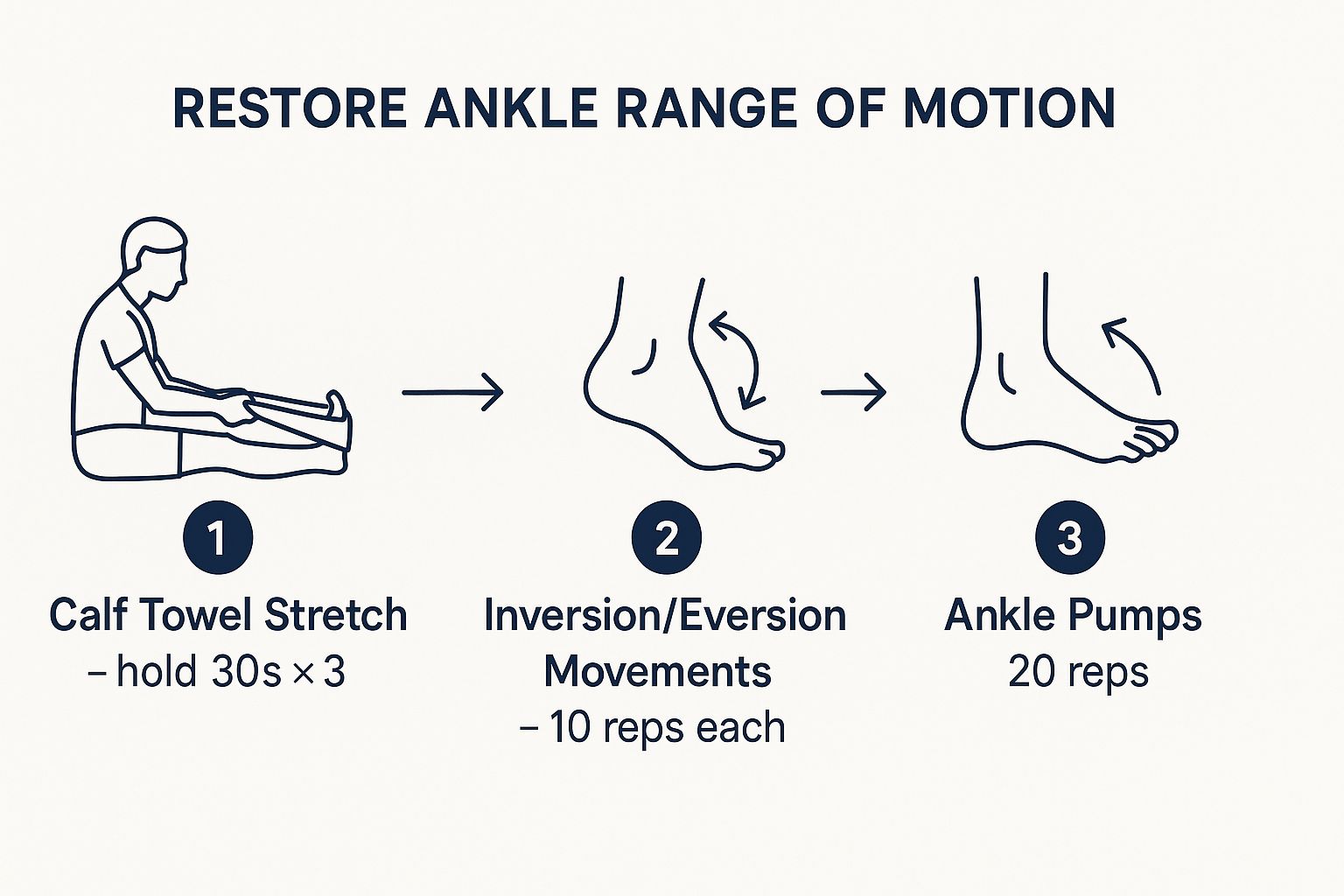
As you can see, it’s a simple, repeatable routine that helps improve flexibility and blood flow without putting too much strain on the healing joint.
How To Perform The Exercises Correctly
Form is everything here. Getting it right ensures you’re targeting the correct areas and, more importantly, protecting the joint from any new damage. One of the most common mistakes I see is people rushing through these simple movements.
For the Towel Stretch, this is your protocol:
- Gastrocnemius Stretch: First, keep your knee straight. Pull the towel until you feel a comfortable stretch. Hold that position for 30 seconds. Release gently.
- Soleus Stretch: Now, bend your knee just a little. Pull the towel again. This time, you'll feel the stretch a bit lower down in your calf. Hold for another 30 seconds.
- Repeat this entire sequence 3 times on the injured leg.
When doing your Inversion and Eversion, control is far more important than speed. Aim for 10-15 slow repetitions in each direction. If your ankle starts to feel tired, that's your cue to stop and rest.
A bit of hard-won advice: whatever you do, don't 'bounce' during a stretch. A slow, sustained pull is infinitely more effective and safer for healing tissues than jerky movements. I always tell my clients to think of it like slowly melting butter, not trying to crack ice.
Making time for these exercises once or twice a day will make a huge difference. You're not just stretching; you're actively preventing stiff scar tissue from forming, boosting circulation to the area, and building the perfect foundation for the more demanding strengthening phase to come.
Building a Stronger, More Stable Ankle
Now that you've coaxed some movement back into your ankle, it's time to shift our focus from flexibility to strength. Think of it this way: a mobile joint without strong muscles to support it is like a wobbly flagpole in the wind. The muscles around your ankle are your dynamic brace, there to absorb shock and protect those healing ligaments.
This phase is all about methodically rebuilding that muscular support system. We'll start gently, waking the muscles up without much movement, and then gradually bring in resistance to build real, functional strength. This isn't just about ticking a box; it's about creating an ankle you can trust again, whether you're navigating a cobbled street or getting back to your favourite sport.
Awakening the Muscles with Isometrics
The safest way to kick off the strengthening process is with isometric exercises. It's a fancy term for a simple concept: you contract the muscles without actually moving the joint. This is a brilliant way to gently wake up the muscles that have likely "switched off" after the injury due to pain and a lack of use.
Imagine you're sitting in a car, foot hovering over the accelerator but not pressing down. The muscles are primed and ready, but nothing is moving. That’s the feeling we're after.
- How to do it: Find a comfortable spot to sit, either on the floor or a chair, with your foot resting against something solid like a wall or a heavy table leg.
- For Eversion (pushing out): Place the outside of your foot against the wall. Gently push into it, as if you're trying to turn your sole outwards.
- For Inversion (pushing in): Now, place the inside of your foot against the wall and gently push inwards.
- Hold each contraction for 5-10 seconds, then relax completely. Aim for about 10 repetitions in each direction. You should feel a gentle tension in the muscles, but absolutely no joint movement or sharp pain.
Adding Resistance for Targeted Strength
Once the isometrics feel easy and pain-free, you're ready to introduce some movement against resistance. A simple resistance band is one of the best tools you can have in your recovery kit. The aim here is to strengthen the four main movements of the ankle.
For each of these exercises, aim for 3 sets of 10-15 repetitions. The key is to choose a band that feels challenging by the last few reps but doesn't cause you to compromise your form. If you find yourself hitching or rushing, the resistance is too high.
- Dorsiflexion (Toes Up): Loop the band around a secure anchor point (like a table leg) and hook the other end over the top of your foot. Sit with your leg straight out and pull your toes towards your shin against the band's pull.
- Plantar Flexion (Toes Down): Sit and loop the band around the ball of your foot, holding the ends in your hands. Gently press your foot down, like you're pointing your toes or pushing a car pedal.
- Inversion (Foot In): Anchor the band to the side, away from your injured ankle. Hook it around your foot and slowly pull your foot inwards, against the resistance.
- Eversion (Foot Out): Switch the anchor point to the other side (towards your injured ankle). Hook the band around your foot and push your foot outwards.
Here’s a crucial tip from my experience: Control trumps everything. Slow, deliberate movements build far more effective strength and control than fast, jerky ones. The return journey of the movement—as you let the band pull back—should be just as slow and controlled as the push.
Progressing to Functional Bodyweight Exercises
When you've built a solid foundation with the bands, it's time to get on your feet and do exercises that mimic the demands of everyday life. These functional movements are where you really start to integrate your newfound ankle strength with the rest of your body.
The classic calf raise is your perfect starting point. Standing with your feet flat, slowly rise up onto the balls of your feet, pause for a moment at the top, and then lower yourself back down with control. Begin with both feet on the ground. Once you can comfortably manage 3 sets of 20 repetitions, you're ready to progress to single-leg calf raises on your injured side.
From there, you can bring in more dynamic movements:
- Heel Walks: Simply walk around on your heels for about 30 seconds, keeping your toes and the balls of your feet lifted off the floor.
- Toe Walks: The opposite! Walk around on your tiptoes for 30 seconds.
These simple drills are fantastic for building endurance in your lower leg muscles, which is absolutely vital for maintaining ankle stability throughout the day. If you ever feel stuck or want a more tailored programme, understanding what is musculoskeletal physiotherapy can shed light on how an expert can fine-tune your recovery.
Don't forget the rest of your body, either. Maintaining overall strength provides a stable platform for your ankle to operate from. You don't need a gym; there are some excellent minimal equipment workouts for overall body toning that you can easily do at home to support your general fitness while your ankle gets back to 100%.
Retraining Your Balance to Prevent Re-injury
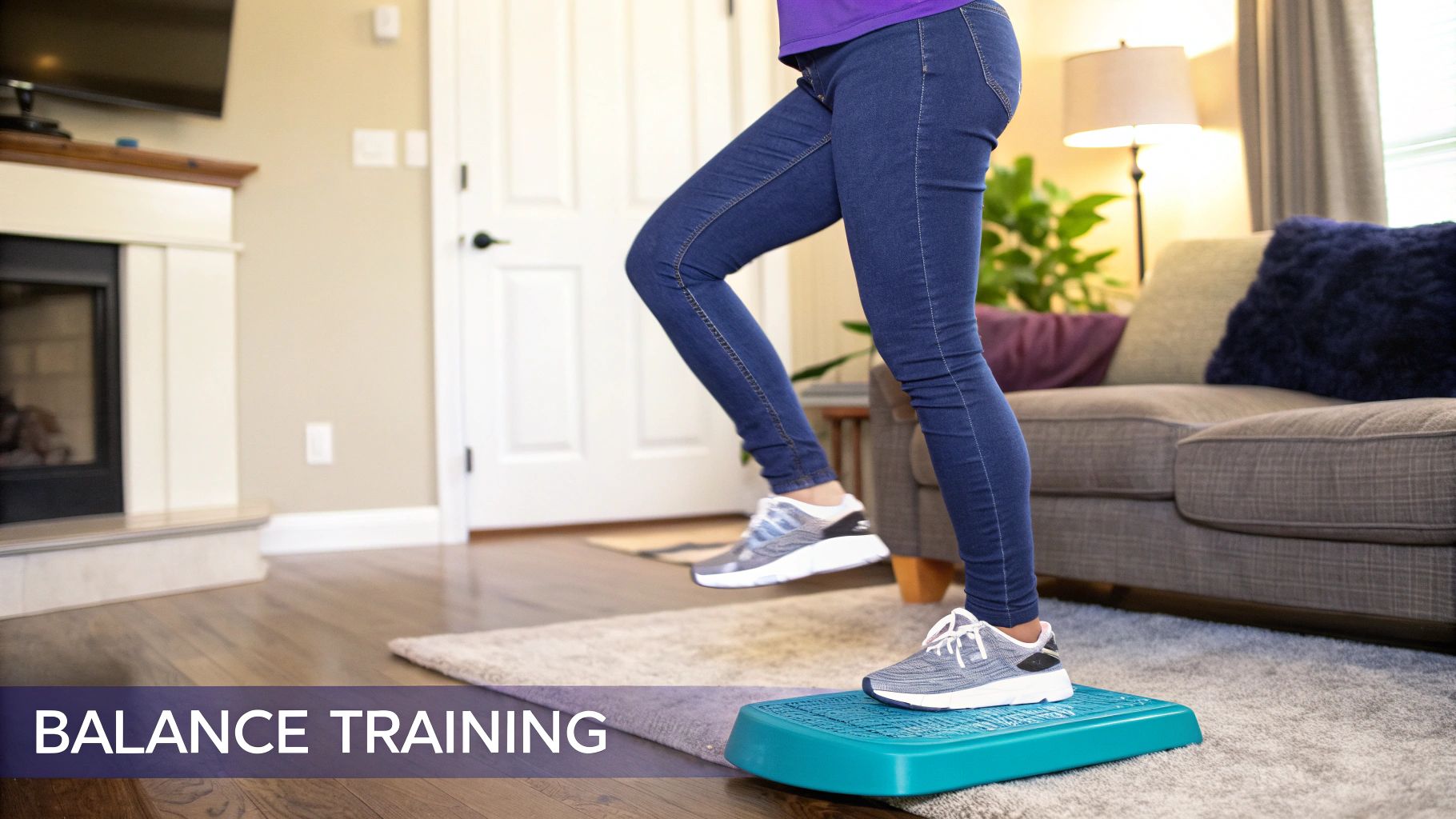
This stage is, in my experience, the most critical part of your long-term recovery. An ankle sprain isn't just about torn ligaments; it fundamentally disrupts a vital sense called proprioception.
Think of it as your joint’s internal GPS. It's the reason you can walk in the dark without looking at your feet—your ankle knows exactly where it is in space and sends that information to your brain.
When you sprain your ankle, this communication system gets scrambled. The nerves that carry these signals are damaged, which is why your ankle can feel so wobbly and untrustworthy long after the pain has faded. It's also the single biggest reason people sprain their ankles over and over again.
This phase is all about deliberately re-calibrating that brain-ankle connection. By challenging your balance, you’re forcing those neural pathways to fire up and work more efficiently, essentially bulletproofing your ankle for the future.
Mastering the Fundamentals of Balance
You have to walk before you can run, and that same logic applies here. We’ll start with the most basic yet powerful balance drill: the single-leg stand. Don't underestimate it; getting this right is the foundation for everything that comes next.
Find a clear space, maybe near a wall or a sturdy chair you can grab if you need to. Stand on your injured leg. The goal isn't to be perfectly still—that’s impossible. Instead, focus on the small, constant adjustments your foot and ankle are making to keep you upright.
- Starting Goal: Try to hold your balance for 30 seconds.
- Repetitions: Complete 3 sets on the injured side.
- Frequency: Practice this every day to really see progress.
Once you can comfortably hit that 30-second mark without too much of a wobble, it's time to up the ante.
Here's the key to effective balance training: you must consistently challenge the system. The moment an exercise feels easy, your brain stops adapting. The goal is to find that sweet spot where you feel challenged but are still in control.
Progressing Your Balance Training
To keep your brain and ankle adapting, we need to introduce new variables that disrupt your stability. This is what forces your proprioceptive system to work harder and get smarter.
Here are three simple ways to make your single-leg stand more difficult:
-
Remove Visual Cues: Try the single-leg stand with your eyes closed. You’ll immediately feel how much you rely on your vision for balance. Just start with 5-10 seconds and build from there.
-
Create an Unstable Surface: Once you've mastered the solid floor, try standing on a pillow, a cushion, or a folded-up yoga mat. The soft, uneven surface forces your ankle to make thousands of tiny micro-adjustments.
-
Add Dynamic Movement: While balancing on one leg, gently toss a small ball from one hand to the other. You could also slowly move your non-standing leg forwards, backwards, and out to the side like a clock hand.
This systematic progression is absolutely vital. Research shows the risk of re-injuring a sprained ankle can be as high as 70% within the first year for some athletes. That startling number highlights just how crucial it is to complete your rehab properly, especially these balance drills, before returning to sport. The NHS patient guide on ankle sprains also provides some great foundational information.
Proprioception Exercise Progression
To get the most out of your balance work, it's helpful to think in terms of levels. This table lays out a clear path from getting your basic stability back to performing dynamic, sport-specific movements. The idea is to master one level before moving on to the next.
| Difficulty Level | Exercise Example | Progression Tip | Goal |
|---|---|---|---|
| Beginner | Single-Leg Stand (Eyes Open) | Use a wall for support initially. Focus on holding for 30 seconds. | Re-establish basic neural connection and stability. |
| Intermediate | Single-Leg Stand (Eyes Closed) | Start with short holds (5-10 seconds) and gradually increase time. | Force the ankle to rely on its own senses, not vision. |
| Advanced | Balancing on an Unstable Surface | Stand on a pillow or foam pad. Keep eyes open at first. | Improve reactive stability and muscular control. |
| Functional | Single-Leg Stand with Movement | Toss a ball, reach for cones, or perform gentle single-leg squats. | Integrate balance with upper and lower body movements. |
| Sport-Specific | Hopping & Landing Drills | Start with small hops, focusing on a soft and controlled landing. | Rebuild confidence and prepare the ankle for dynamic impact. |
Remember, listen to your body. Progress when an exercise feels manageable, but don't rush. The aim is steady, sustainable improvement.
Integrating Sport-Specific and Functional Drills
When you can confidently balance on an unstable surface, it's time to start adding movements that actually mimic your sport or daily life. This is where you bridge the gap between clinical rehab and real-world performance.
Think about the movements you need to do every day. Do you change direction quickly when playing football? Do you need to jump and land in netball? These are the patterns we need to retrain.
- For runners: Start with single-leg hops in place. The key is a soft, controlled landing, not how high you can jump.
- For field sports (football, rugby): Try gentle, slow-motion "cutting" drills (changing direction) or have a partner gently try to push you off balance while you stand on one leg.
- For daily life: Something as simple as practicing stepping on and off a low step or curb with perfect control can make a huge difference.
This final stage is about rebuilding not just your ankle’s stability, but your confidence in it. By safely reintroducing these dynamic movements, you teach your brain to trust that joint again. This kind of targeted work is a cornerstone of any effective strategy for how to prevent sports injuries in the long run.
Answering Your Ankle Sprain Recovery Questions
When you're recovering from an ankle sprain, a lot of questions pop up. It’s completely normal to wonder what’s okay, what’s not, and how to know you’re on the right track. Getting clear, practical answers can make all the difference in your recovery, helping you feel confident and in control.
Here are some of the most common questions I hear from people navigating their way back from an ankle sprain.
How Can I Tell the Difference Between Good and Bad Pain?
This is the big one, and learning to listen to your body is a skill you'll carry with you long after your ankle has healed. There's a world of difference between the satisfying ache of a muscle that’s been worked and the sharp warning sign of genuine pain.
- Good Pain: Think of this as muscle fatigue or a mild, dull ache. It’s the feeling you get when your muscles are strengthening and adapting. It's a sign of progress, not a problem.
- Bad Pain: This is a sharper, more specific pain, often right at the injury site. It might feel like a stabbing sensation or a deep throb. This is your body's alarm bell, telling you to stop what you're doing.
If you feel that sharp, 'bad' pain during any of your ankle sprain rehabilitation exercises, stop immediately. Pushing through it is a recipe for reinjury and will only set your recovery back.
When Is It Okay to Ditch the Crutches?
Getting off your crutches feels like a huge step towards freedom, but it’s crucial not to rush it. The main sign you're ready is your ability to walk with a relatively normal pattern, without a major limp or a spike in pain.
Start by testing the waters at home. Try walking short distances without your crutches. If you can bear most of your weight on the injured ankle with just a bit of discomfort, you're heading in the right direction. If you find yourself limping heavily or the pain and swelling flare up, your body is telling you it’s not quite ready for that step.
What Are the Best Shoes to Wear After a Sprain?
Your choice of footwear can either help or hinder your recovery. Right now, your ankle needs all the support it can get.
For the first few weeks, a solid, well-fitting trainer is your best friend. Look for one with a firm heel counter—the bit that cups the back of your heel—and decent cushioning. Steer clear of unsupportive shoes like flip-flops, slippers, or old, worn-out trainers.
Wearing the right shoes is a simple but powerful way to protect your healing ankle and prevent a frustrating setback. As you get stronger, you can start reintroducing other shoes, but it pays to be mindful.
Am I Doing Too Much? How Do I Know?
Your body is great at giving you feedback; you just have to learn to interpret it. The most obvious signs you've overdone it are increased swelling or a nagging, dull ache that's still there the morning after your exercises.
This doesn't necessarily mean you've caused any serious damage, but it's a clear signal to ease off a little. Listen to that feedback. Maybe the next day should just involve some gentle range-of-motion work, or perhaps it's a good day to rest completely. Remember, consistent, steady progress is far more effective than a boom-and-bust cycle of overdoing it and then being forced to stop.
Can Other Therapies Help Speed Things Up?
Definitely. While your exercise programme is the cornerstone of getting better, other treatments can be fantastic for managing symptoms and helping the healing process along. For the kind of nagging joint discomfort that can linger after a sprain, some people find relief with treatments like acupuncture for joint pain relief.
It’s always a good idea to chat with your doctor or physiotherapist before adding any new therapies to your plan. They can help you figure out what’s safe and appropriate for your specific injury and where you are in your recovery journey.
At The Lagom Clinic, we believe in building a complete picture of your health to guide you back to full strength and beyond. If you're struggling with an ankle injury or need expert guidance on your recovery, we're here to provide personalised medical advice and support. Visit us at https://www.thelagom.co.uk to learn more about our approach to musculoskeletal health and book your consultation.
Need professional rehabilitation support?
If your ankle sprain isn’t healing as expected, our musculoskeletal medicine team can assess, image and build a recovery plan.


 Members Consultation