


In the UK, anti wrinkle injections sit in a market that is no longer niche. A 2024 UK market summary said the UK skincare market was worth $4.14 billion in 2024, with over 900,000 botox injections administered annually, and it also recorded over 3,000 complaints about such procedures in 2022 (UK aesthetics market summary). Those numbers tell two stories at once. Demand is high, but so is the need for caution.
As a GP, I think that's the right starting point. Anti wrinkle injections can be effective, subtle, and appropriate for the right patient. They can also be poorly done, badly explained, or offered in settings where medical standards are weak. A sensible consultation should never feel like a sales pitch. It should feel like medical decision-making.
A good outcome isn't just smoother skin. It's a treatment that suits your face, your health, your priorities, and your tolerance for risk. It also sits alongside the basics that matter more than any syringe ever will: sun protection, sleep, smoking avoidance, nutrition, stress control, and realistic expectations.
Understanding Anti Wrinkle Injections in the UK
Anti wrinkle injections are usually used to soften dynamic wrinkles. These are the lines created by repeated facial movement, such as frowning, raising the eyebrows, or squinting. The common examples are forehead lines, the vertical frown lines between the brows, and crow's feet.
In everyday practice, what patients often need most isn't a hard sell. They need clear answers to sensible questions. What exactly is being injected? What can it improve? What can't it improve? Who should be doing it? What happens if something goes wrong?
Why this treatment needs a medical lens
The treatment is popular, but popularity can create a false sense of simplicity. People start to think of it as routine beauty maintenance rather than a prescription treatment that affects muscle activity and has real contraindications, side effects, and follow-up needs.
That matters in the UK because the market is busy, varied, and not always easy for patients to judge. A polished Instagram page doesn't tell you whether the injector understands facial anatomy, can assess asymmetry, recognises when not to treat, or knows what to do if a complication occurs.
Practical rule: If a clinic can explain the benefits clearly but becomes vague when you ask about risks, qualifications, prescribing, or follow-up, walk away.
What a patient should expect before saying yes
A medically sound consultation should cover more than the wrinkle itself. It should include your medical history, past treatment experience, medication review, pregnancy and breastfeeding status where relevant, your goals, and an honest discussion about what result would look natural on your face.
It should also separate cosmetic desire from clinical suitability. Some people are good candidates. Some are better served by skin care, sun protection, improved sleep, stress management, or waiting.
Key points to keep in mind:
- This is common, not casual. High demand doesn't make it risk-free.
- Natural results need planning. Better outcomes usually come from conservative dosing and review.
- Wrinkles aren't all the same. Dynamic lines often respond better than deeper static lines that remain at rest.
- The cheapest option can be the most expensive one later. Correcting poor treatment is harder than getting it right first time.
How These Injections Work on Dynamic Wrinkles
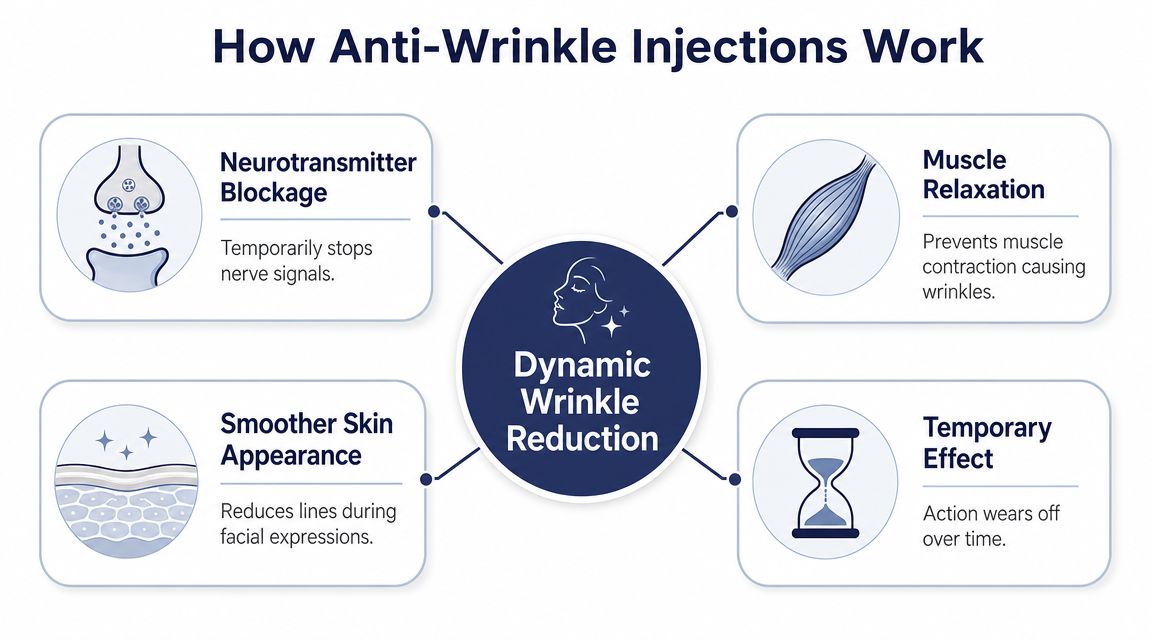
Repeated facial movement is one of the main reasons lines form in the upper face. Anti wrinkle injections target that specific mechanism. They reduce the signal from the nerve to the muscle, so the treated muscle contracts less strongly for a temporary period. The result is softer movement and, in the right patient, smoother skin over the muscle, as described by the NHS overview of botulinum toxin.
In practice, this means the treatment is most effective for dynamic wrinkles. These are lines that appear or deepen when you frown, raise your brows, squint, or smile. If a line is visible only on movement, or is much worse on movement than at rest, it usually responds better than a line that has become permanently etched into the skin.
I explain this clearly in clinic because patients often expect one injectable treatment to solve every type of facial ageing. It does not. Anti wrinkle injections reduce muscle activity. They do not replace lost volume, tighten loose skin, or improve every aspect of skin texture.
Dynamic wrinkles are different from volume loss and skin ageing
This distinction matters if you want a natural result and an honest treatment plan.
- Dynamic wrinkles are driven mainly by repeated muscle movement
- Static lines stay visible at rest and may only soften partially
- Volume loss causes hollowness, shadowing, or a tired appearance
- Skin quality changes relate more to sun exposure, smoking, sleep, stress, hydration, and age-related collagen loss
A patient with forehead lines from muscle overactivity may do very well with anti wrinkle injections. A patient worried about under-eye hollowness or puffiness needs a different assessment. In Bristol, where patients are often well-informed and rightly cautious, I find the safest consultations are the ones that separate these concerns properly rather than bundling them together. If under-eye ageing is part of the picture, this guide on treatments for eye bags and tired-looking eyes may help explain why muscle-relaxing injections are only one part of facial assessment.
Results develop over days, not minutes
Patients sometimes come in before an event assuming the effect is immediate. It is not. The change builds gradually over several days, with the full result usually assessed at around two weeks in routine aesthetic practice.
A simple timeline is more useful than marketing claims:
- First couple of days. There may be little visible change.
- Several days in. Movement often starts to feel weaker.
- Around two weeks. The main result can usually be judged properly.
- Over the following months. The effect wears off and movement returns.
This temporary effect is part of the trade-off. It allows dose adjustments at future appointments and avoids a permanent change to expression, but it also means maintenance is needed if you want ongoing smoothing. At The Lagom Clinic, that is one reason I prefer conservative treatment plans over trying to chase a completely frozen look.
A good result should leave you looking less tense or less lined on expression, while still looking like yourself. If a line remains visible at rest, that can still be an appropriate outcome. Biology sets limits, and safe prescribing means being honest about them.
If you're trying to understand the broader causes of fine lines as well as treatment options, this expert guide on fine line reduction is useful background reading. Skin care, sun protection, sleep, and smoking status all affect skin quality. Anti wrinkle injections address the movement component only.
Comparing Injection Brands and Common Treatment Areas
Globally, botulinum toxin injections have become the dominant non-surgical aesthetic treatment. A UK-facing summary citing ISAPS data reported 9,221,419 botulinum toxin procedures worldwide in 2022, a 26.1% rise from 2021 (global treatment trend overview). For patients, the practical benefit is that clinicians aren't working with an obscure treatment. There is extensive clinical experience with these medicines.
In the UK, the most commonly discussed brands include Botox, Azzalure, and Bocouture. Patients often ask which one is “best”. That usually isn't the most useful question. A better question is which product is appropriate for your anatomy, treatment area, previous response, and the injector's technique.
Comparison of Common Anti-Wrinkle Injection Brands
| Brand | Molecule Size | Typical Onset | Key Characteristic |
|---|---|---|---|
| Botox | Not directly comparable in a way that matters to patients at consultation level | Varies by patient | Widely recognised brand used for dynamic lines |
| Azzalure | Not directly comparable in a way that matters to patients at consultation level | Varies by patient | Commonly used in aesthetic practice for facial movement reduction |
| Bocouture | Not directly comparable in a way that matters to patients at consultation level | Varies by patient | Another licensed botulinum toxin type A option used by trained practitioners |
A careful injector doesn’t choose a brand by marketing reputation alone. They consider how they want the product to behave in a specific area, your past treatment history, and whether the goal is a softer or more defined change in muscle movement.
The areas that usually respond best
The most reliable cosmetic treatment areas are the areas where repeated muscular contraction clearly drives the wrinkle pattern.
- Glabellar lines. These are the vertical “11” lines between the eyebrows. They often respond well because they’re strongly linked to frowning muscles.
- Forehead lines. These need balance and restraint. Overtreating the forehead can create a heavy brow or an unnatural look.
- Crow’s feet. These usually soften nicely because they are classic dynamic smile lines.
A proper facial assessment matters because these areas don’t function in isolation. Relaxing one muscle group changes the pull of another. That’s one reason copy-and-paste treatment plans are poor medicine.
Why under-eye concerns are often misunderstood
Patients frequently ask whether anti wrinkle injections can fix tired-looking eyes. Sometimes they help indirectly by softening crow’s feet or reducing a tense brow pattern. But they don’t correct every eye-area concern.
If your main issue is puffiness or contour under the eyes, you may need a different assessment entirely. This guide on removing eye bags gives a better overview of what causes that problem and why it shouldn’t automatically be treated as a wrinkle issue.
Your Treatment Journey From Consultation to Results
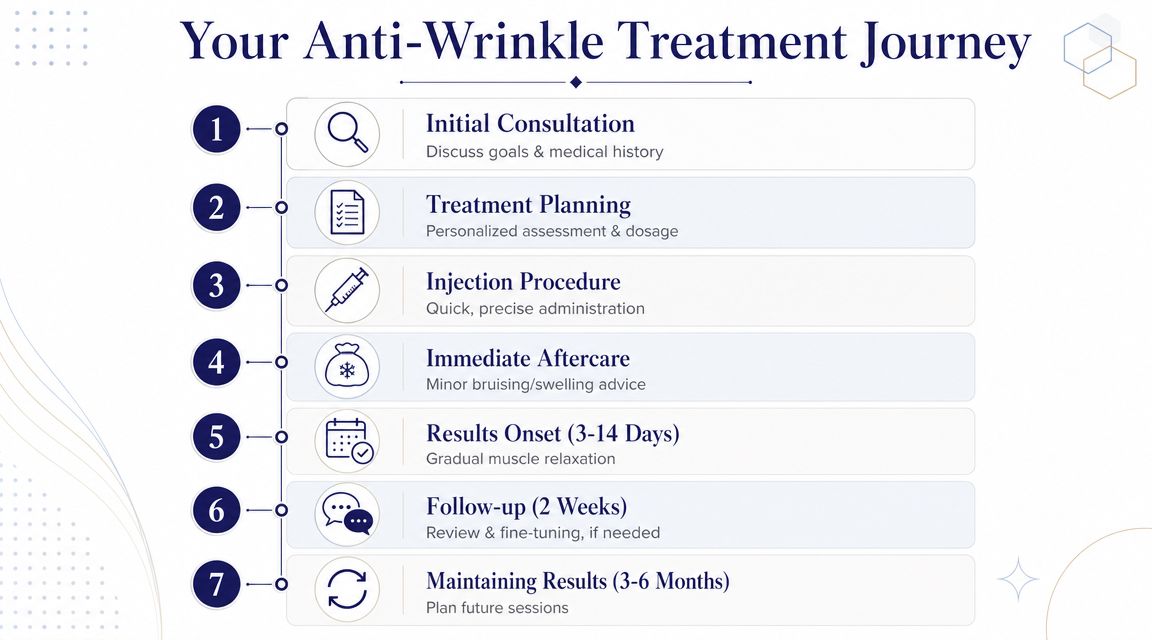
A good treatment journey is calm, structured, and surprisingly straightforward. Most anxiety comes from uncertainty, not from the procedure itself. When patients know what should happen at each stage, they’re better able to judge whether they’re in safe hands.
The consultation and planning stage
The first appointment should be more than a quick look at your forehead. A proper consultation includes medical history, allergies, medications, previous cosmetic treatments, your pattern of facial movement, and what you’re hoping to change.
The best conversations are specific. “I want to look fresher” is a starting point, but a clinician then needs to work out whether that means softening a frown, reducing brow tension, balancing asymmetry, or deciding that injections aren’t the right answer.
What should happen before treatment:
- Assessment of movement. You may be asked to frown, raise your brows, and smile so the injector can see how your muscles behave.
- Discussion of limits. Deep static lines, skin laxity, or volume loss may not respond fully.
- Consent. You should understand common side effects, less common complications, and what review arrangements are in place.
The procedure and the waiting period
On the day, the skin is cleaned and the injection points are planned. The treatment itself usually involves several small injections into selected muscles. Most patients describe it as brief and very tolerable.
Afterwards, you may see minor redness, tiny raised marks, or slight tenderness at the injection sites. Those short-term changes usually settle quickly. What matters more is patience over the next two weeks.
A rushed review is rarely helpful. The treatment needs time to declare itself before anyone decides whether it has worked as planned.
What the first two weeks often feel like
Results tend to creep in rather than switch on. In the first few days, you may notice no obvious difference. Then certain expressions begin to feel weaker or less forceful. By around two weeks, the effect is clearer and you can judge symmetry, movement reduction, and whether the result still feels like you.
The follow-up is where good practice shows. If a clinician offers treatment but no meaningful review, that’s not ideal. The review is where subtle adjustments and safety checks happen.
Realistic Results Longevity and Lifestyle Factors
The desired result isn’t a frozen face. It’s a face that looks less strained, less tired, and less creased in motion. When anti wrinkle injections are done well, other people often notice that you look well without being able to say exactly why.
That subtlety is part of good practice. A forehead that doesn’t move at all may suit some patients’ preferences, but for many people it looks unnatural. Modern treatment planning usually aims for controlled movement, not complete immobility.

How long results last
The effect is temporary, and that’s not a flaw. It’s part of the design. For many patients, that temporary nature is reassuring because it allows cautious, adjustable treatment rather than a permanent change.
If you’re interested in practical ways people try to support longer-lasting results, this piece on botox longevity covers common habits and expectations. I’d frame those ideas carefully. Lifestyle can support skin health and help you look better overall, but it won’t turn a temporary medicine into a permanent one.
The debate about preventative treatment
A UK-facing summary described the UK anti-wrinkle market at about USD 172 million in 2023 and noted growing interest from younger users focused on prevention, while also making the important point that the evidence base for preventative treatment in low-wrinkle patients is less direct than it is for established dynamic lines (preventative treatment discussion). That’s exactly the nuance patients need.
If you’re younger and asking about prevention, the primary question isn’t “Can this be done?” It’s “Does it make sense for me now?” Sometimes the answer is yes. Sometimes the answer is that your skin would benefit more from diligent SPF use, better sleep, smoking cessation, and a consistent topical routine.
Lifestyle changes that genuinely matter
These measures sound less glamorous than injectables, but they often make the bigger long-term difference:
- Use daily sun protection. UV exposure accelerates visible skin ageing and makes lines harder to treat.
- Don’t smoke. Smoking affects skin quality, healing, and overall ageing.
- Prioritise sleep. Tired faces look more drawn, tense, and lined.
- Eat for skin health. A balanced diet supports general tissue health better than any “miracle” supplement.
- Manage stress. Stress can show in facial tension, sleep disruption, and self-care habits.
Skin ages in the context of your whole life. A syringe can reduce muscle pull. It can’t replace recovery, hydration, and sun protection.
How to Choose a Safe and Qualified Clinic in Bristol
This is the part patients should take most seriously. In 2024, the MHRA said it seized more than 5,400 unlicensed botulinum toxin vials in an operation targeting illegal cosmetic injection products, and NHS warnings have highlighted risks including eyelid droop, asymmetry, swallowing problems, and rare but serious toxin spread (UK safety and enforcement overview). That isn’t background noise. It’s a clear signal that provider choice matters.
Anti wrinkle injections may be quick, but shortcuts in this field can cause lasting distress. A lower price is never reassuring if you don’t know who prescribed the product, where it came from, or whether the person injecting can manage complications.
What to verify before booking
In Bristol, patients have many options. That means you need a shortlist, not blind trust.
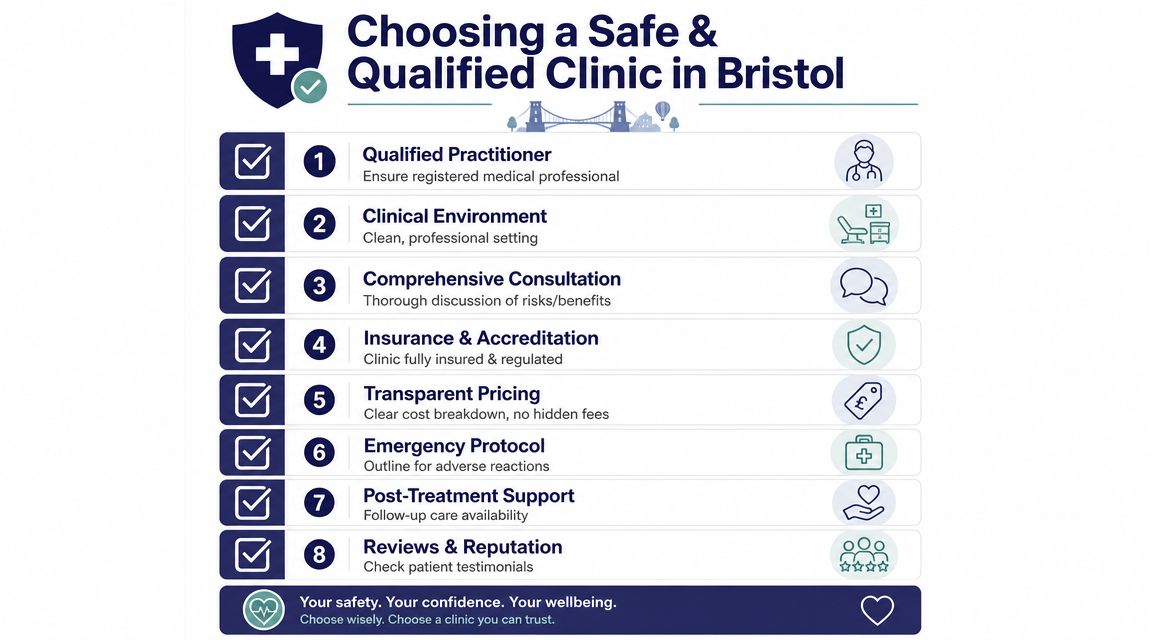
Use this checklist:
- Medical qualification. Ask whether the injector is a doctor, dentist, or nurse prescriber, and whether they are appropriately registered.
- Prescribing process. Botulinum toxin is a prescription-only medicine. There should be a legitimate prescriber involved.
- Clinical environment. Treatment should happen in a proper medical setting, not an improvised beauty room.
- Consent and records. You should get a real consultation, not a rushed signature.
- Follow-up plan. Good clinics review outcomes and remain available if there’s a concern.
- Product transparency. You should be told what product is being used and why.
- Complication readiness. Ask what happens if you develop ptosis, asymmetry, or another adverse effect.
- Pressure-free decision making. Discounts that expire “today only” are a red flag in medical aesthetics.
Red flags patients often overlook
Some warning signs are obvious. Others are subtle.
A provider may seem warm and confident, but still be unsafe if they minimise side effects, promise perfection, recommend more treatment than you asked for, or can’t explain why they selected a particular pattern of injection points. Another concern is when every face receives the same treatment menu. Anatomy varies. Goals vary. Medical standards should vary with them.
One local option patients sometimes consider when they want a GP-led setting is private GP care in Bristol, particularly if they value a broader medical discussion alongside cosmetic decision-making. Wherever you go, the standard should be the same. Proper assessment, proper consent, proper prescribing, and proper aftercare.
If your injector can’t explain why they are treating a specific muscle, they shouldn’t be injecting it.
Essential Aftercare and Frequently Asked Questions
Aftercare is usually simple, but it still matters. The aim is to minimise irritation, reduce the chance of product migration, and give the treatment the best chance to settle predictably.
Straightforward aftercare advice
For the first day or so, keep things calm and uncomplicated.
- Stay upright initially. Don’t lie flat straight after treatment unless your clinician advises otherwise.
- Leave the area alone. Avoid rubbing, pressing, or massaging the injected sites.
- Pause strenuous exercise. Heavy workouts too soon can increase flushing and irritation.
- Avoid excess heat. Saunas, steam rooms, and very hot environments are better postponed briefly.
- Use gentle skin care. Keep products simple if the skin feels irritated.
- Watch for anything unusual. Mild redness or small bumps can happen early on, but worsening symptoms should be reported.
A sensible rule is this: if you’re unsure whether a post-treatment symptom is normal, ask the clinic that treated you. Good aftercare includes access to advice, not just the injection itself.
Common questions patients ask
Does it hurt
Most patients say it feels like a brief series of small stings. It’s usually fast and manageable. Anxiety about the idea of injections is often worse than the treatment itself.
Will I look frozen
Not if the treatment is planned and dosed well for your face and your goals. An overtreated look usually reflects poor assessment, overly aggressive dosing, or a mismatch between what was wanted and what was delivered.
Can anti wrinkle injections remove every line
No. They work best on movement-related lines. Deeper lines that remain when your face is completely relaxed may soften but not disappear fully.
Who should avoid treatment until they’ve had proper medical advice
Anyone who is pregnant, breastfeeding, unwell, or has relevant neurological or muscle-related conditions should discuss suitability with a qualified clinician before going ahead. In these instances, medical history is key.
How often do people repeat treatment
That depends on the area treated, your muscle activity, your preferences, and how subtly or strongly you like the result. Some people prefer regular maintenance. Others decide to treat only occasionally.
Is there a “right age” to start
No single age fits everyone. The right time is when there is a clear concern, a realistic goal, and a sound medical reason to think treatment is appropriate. Starting because friends are doing it isn’t a good reason.
What if I’m not sure I want injections
Then don’t rush. Good aesthetic medicine allows room for hesitation. Skin care, SPF, smoking cessation, sleep, stress reduction, and review of broader skin concerns are all valid first steps.
If you’re considering anti wrinkle injections and want a medically grounded discussion rather than a sales-led consultation, The Lagom Clinic offers a GP-led setting in Bristol where treatment suitability, safety, lifestyle factors, and realistic outcomes can be assessed properly before any decision is made.


 Members Consultation