


Weight management is a multifaceted journey that extends far beyond calorie counting. It's about building a sustainable, healthy lifestyle that fosters both physical strength and mental wellbeing. While a balanced diet rich in whole foods and adequate, quality sleep are foundational, the right kind of physical activity is the catalyst that accelerates results and builds lasting health. Kettlebell training, in particular, offers a medically sound blend of cardiovascular conditioning and resistance training, making it an exceptionally efficient tool for achieving your goals.
Unlike isolated machine exercises, a single kettlebell movement can engage multiple muscle groups simultaneously. This dynamic, full-body approach not only burns a significant number of calories during your workout but also builds metabolically active muscle. This is crucial because more muscle increases your resting metabolic rate, meaning your body burns more calories even at rest. A consistent kettlebell exercise for weight loss routine is a powerful, science-backed strategy for fat loss and improved body composition.
This article provides a comprehensive guide to the top kettlebell exercises, focusing on safe, effective techniques and practical lifestyle integration. We will delve into proper form, suggested sets and reps, and how to incorporate these movements into a holistic health plan, aligning with a proactive approach to long-term wellness.
1. Kettlebell Swing
The kettlebell swing is the cornerstone of any effective kettlebell exercise for weight loss programme. It’s a dynamic, full-body movement that burns a significant number of calories, often cited as high as 20 per minute, by combining resistance training with cardiovascular conditioning. The exercise involves an explosive hip hinge, not an arm lift, to propel the kettlebell forward to chest height. This powerful action primarily targets the posterior chain: the glutes, hamstrings, and lower back muscles, which are crucial for posture and power.
This single movement also engages the core for stability, the shoulders for control, and the cardiovascular system, making it an incredibly efficient fat-burning exercise. Its reputation is well-earned, popularised by strength coaches and integrated into high-intensity programmes for its proven physiological benefits. Numerous case studies highlight its transformative potential for body composition when combined with dietary modifications.
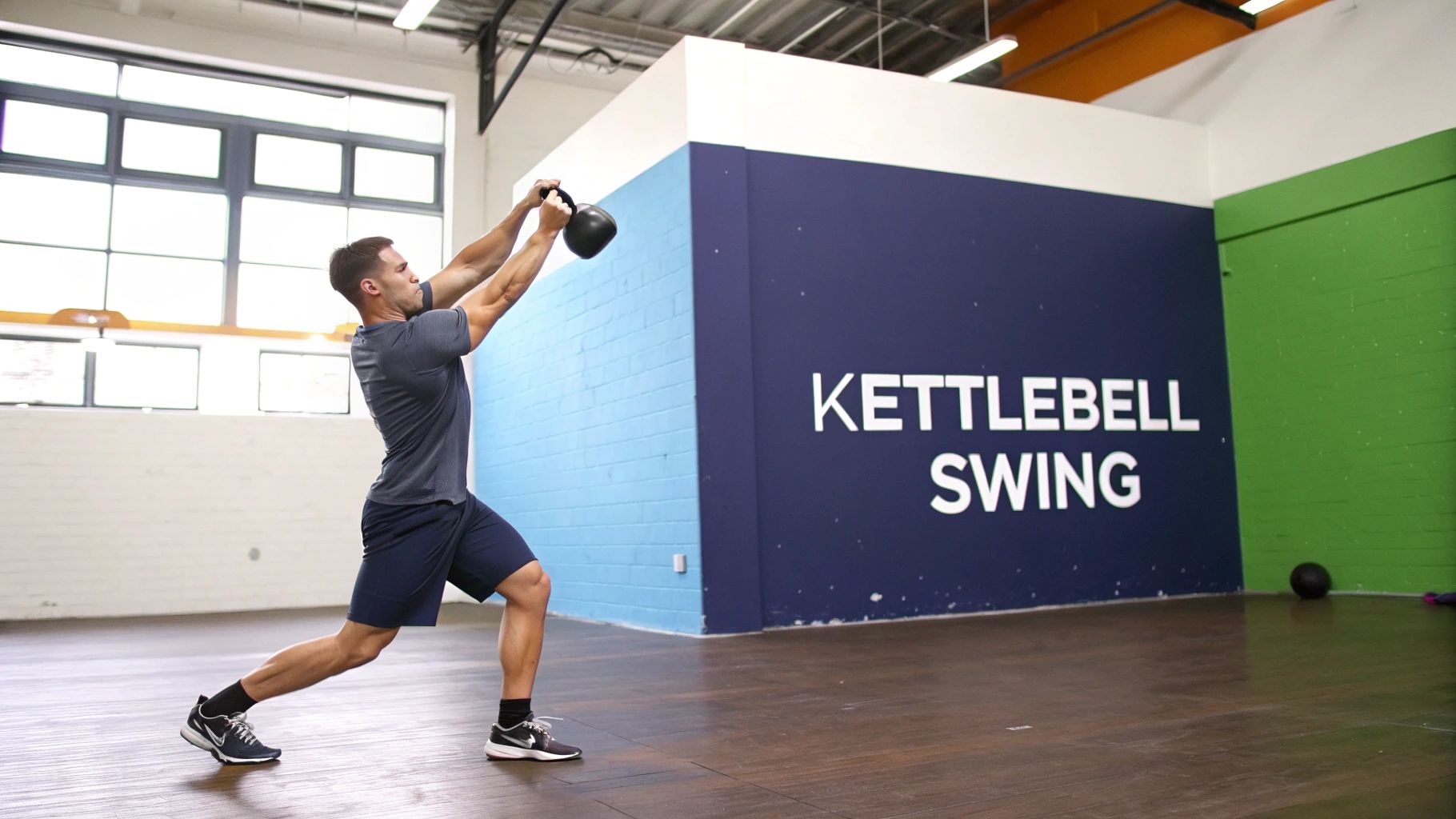
How to Implement the Kettlebell Swing
For maximum fat loss, incorporate swings using interval protocols. This method keeps your heart rate elevated and maximises the metabolic effect. A scientifically sound starting point is a Tabata-style workout: 20 seconds of swings followed by 10 seconds of rest, repeated for 4-8 rounds. As your fitness improves, you can extend the work period, for example, 40 seconds of work with 20 seconds of rest.
Pro Tip: Aim to complete 100 swings in as few sets as possible, 3-5 times per week. This approach builds a powerful engine for fat loss without requiring hours in the gym. For a comprehensive look at integrating this kind of activity into a balanced routine, you can explore how much exercise is enough for wellness and health.
Key Form and Safety Tips
- Start Light: Master the form with a lighter weight (e.g., 8-12kg for women, 16kg for men) before increasing the load. Proper form is a medical necessity to prevent injury.
- Power with Your Hips: The movement is a hip hinge, not a squat. Drive your hips forward explosively to "float" the kettlebell up. Your arms are just guiding it.
- Maintain a Neutral Spine: Keep your back flat from your head to your hips throughout the entire movement to prevent injury. This is non-negotiable for spinal health.
- Breathe Powerfully: Exhale sharply as you thrust your hips forward and inhale as the kettlebell swings back down between your legs. This supports core stability.
2. Turkish Get-Up
The Turkish Get-Up (TGU) is a slow, controlled, and deliberate full-body movement that builds immense strength, stability, and resilience. It is a sophisticated, multi-step exercise that takes you from lying on your back to a standing position, all while holding a kettlebell safely overhead. Dating back centuries, this single movement engages almost every muscle, making it a surprisingly effective kettlebell exercise for weight loss. Its value lies in the prolonged time under tension, which builds lean muscle and elevates metabolic rate, and the intense core control required, which enhances overall functional strength.
Esteemed by physical therapists for its ability to assess and correct movement asymmetries, the TGU is a staple in conditioning programmes designed to build robust, injury-resistant bodies. Its slow, methodical nature forces you to be mindful of your body's position in space, improving coordination and joint health. The sustained effort over 30-60 seconds per repetition keeps your heart rate elevated, providing a unique blend of strength training and cardiovascular work.
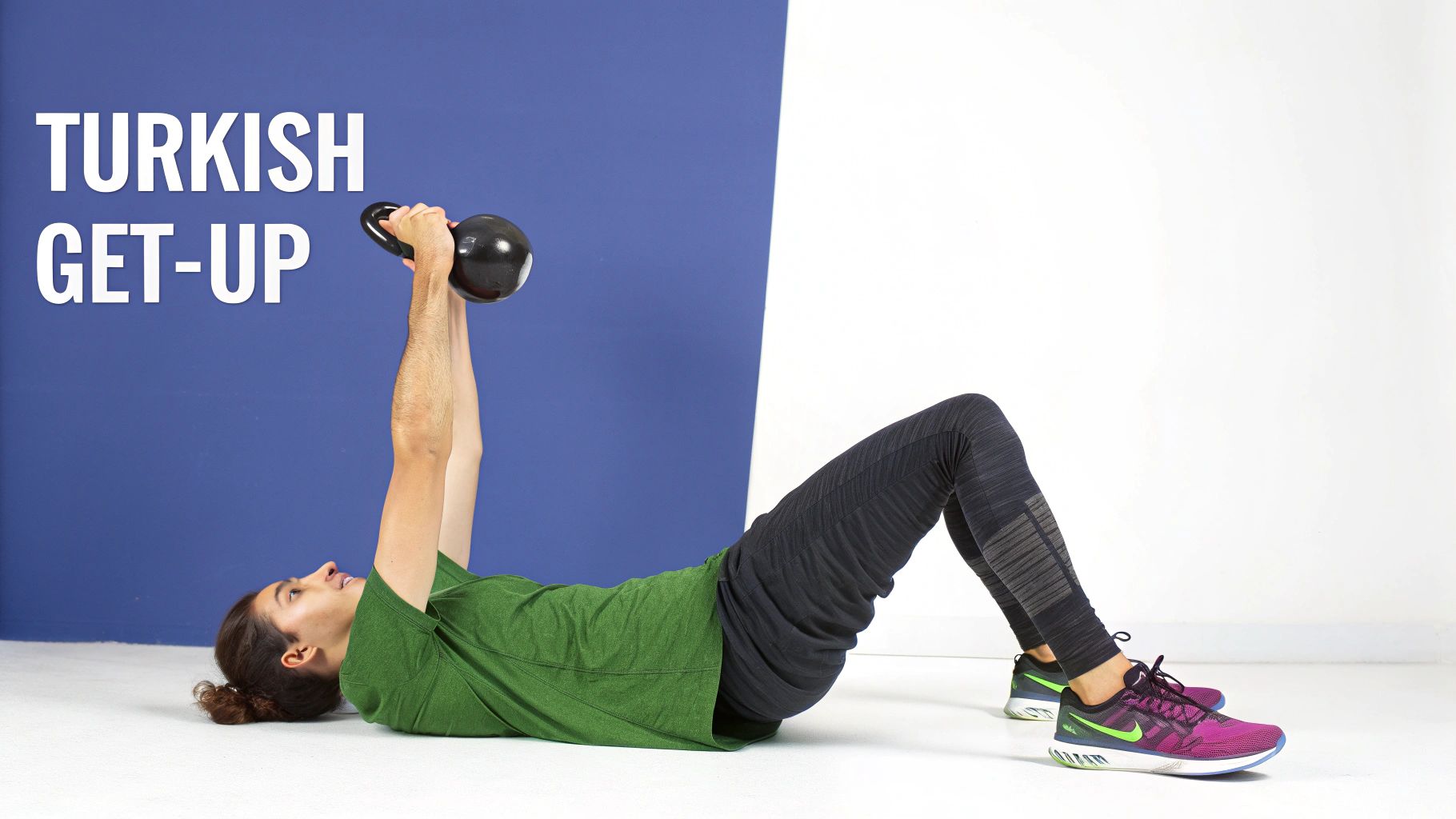
How to Implement the Turkish Get-Up
The TGU is a skill that must be practised; it's not about speed or heavy weight initially. The focus is on perfect, deliberate movement. For weight loss, performing TGUs creates a significant metabolic demand and builds muscle that burns calories even at rest. A simple yet highly effective session could involve alternating sides for a set number of repetitions or for a set time, such as 10 minutes.
Pro Tip: Start your kettlebell workouts with TGUs. Performing one get-up on each side serves as a comprehensive warm-up that activates the central nervous system and stabilises joints. For a full workout, aim for 5 get-ups per side to build serious strength and conditioning.
Key Form and Safety Tips
- Start with No Weight: Master the sequence first. A popular method is to balance a shoe on your closed fist to learn the required stability and control. This ensures safety.
- Move Slowly and Deliberately: Each of the 7-9 steps is a distinct position. Pause at each one to ensure you are stable and correctly aligned before moving to the next.
- Keep Your Eyes on the Kettlebell: Your gaze should be locked onto the bell until you are in the lunge position, ready to stand up. This helps maintain shoulder stability and balance.
- Learn in Reverse: Some people find it easier to learn the TGU by starting from the standing position and carefully reversing the steps back down to the floor. This can help ingrain the movement pattern.
3. Kettlebell Goblet Squat
The Kettlebell Goblet Squat is a foundational lower-body exercise that offers immense benefits for a weight loss programme. Holding a single kettlebell at chest level, this movement naturally encourages proper squat form, making it safer and more accessible than traditional barbell squats. The front-loaded position acts as a counterbalance, allowing you to achieve a deeper squat while forcing your core and upper back to remain engaged, which increases the overall metabolic demand.
As a functional movement pattern, the goblet squat is more than just a leg exercise; it's a full-body movement that builds muscle and burns significant calories. The constant tension on the quadriceps, glutes, and core muscles elevates the heart rate, turning a strength movement into a powerful fat-burning tool. It is often used as a primary teaching tool to build a strong foundation before progressing to more complex lifts, ensuring long-term joint health.
How to Implement the Kettlebell Goblet Squat
For weight loss, the goblet squat is exceptionally versatile. It can be used for building strength with lower repetitions or integrated into high-intensity metabolic conditioning circuits. A safe and effective method is to include it in an AMRAP (As Many Rounds As Possible) workout, combining it with movements like kettlebell swings and push-ups for a high-calorie burn in a short amount of time.
Pro Tip: For a simple yet effective metabolic challenge, perform 30 seconds of continuous goblet squats followed by 30 seconds of rest. Repeat this for 5-10 rounds. This protocol keeps your heart rate high and muscles working, creating an ideal environment for fat loss. The Kettlebell Goblet Squat is a fundamental exercise for building lower body strength and power. For those seeking additional strategies, exploring other powerful leg workouts with weights can further enhance your routine.
Key Form and Safety Tips
- Secure Your Grip: Hold the kettlebell by its "horns" (the sides of the handle) close to your chest, with your elbows tucked in and pointing down.
- Initiate with the Hips: Begin the movement by pushing your hips back as if sitting in a chair, not by bending your knees first. This protects the knee joint.
- Chest Up, Back Straight: Keep your chest proud and maintain a neutral spine throughout the entire movement. Do not let your upper back round forward.
- Use Your Elbows: As you descend, gently guide your knees outwards with your elbows. Aim to have your elbows touch the inside of your knees at the bottom of the squat.
4. Kettlebell Snatch
Often called the 'Czar of kettlebell exercises', the kettlebell snatch is an explosive, full-body movement that stands at the pinnacle of kettlebell exercise for weight loss. It is a highly technical, ballistic lift that takes the kettlebell from between the legs to a stable overhead position in one fluid motion. Research from the University of Wisconsin has shown that the snatch can burn up to 20.2 calories per minute, placing it among the most metabolically demanding exercises you can perform. This potent combination of power, strength, and cardiovascular conditioning makes it a true fat-torching powerhouse.
The snatch builds on the hip hinge of the swing but adds an overhead lockout, engaging the entire posterior chain, core, shoulders, and grip. Its effectiveness is demonstrated in its use in high-level athletic conditioning and military fitness protocols, underscoring its ability to build work capacity and improve body composition when performed correctly.
How to Implement the Kettlebell Snatch
Due to its intensity, the snatch is perfectly suited for high-intensity interval training (HIIT) to maximise calorie burn and the afterburn effect. Begin with shorter work periods to focus on technique before increasing the duration. A safe starting point is 30 seconds of snatches on one arm, followed by 30 seconds of rest, then switching arms for the next interval.
Pro Tip: For a challenging fat-loss protocol, try the 5-minute snatch test. Perform as many repetitions as possible in five minutes, switching hands only once. This is a brutal but effective measure of your conditioning and a powerful workout in itself. Always prioritise form over speed.
Key Form and Safety Tips
- Master Prerequisite Moves: Do not attempt the snatch until you have perfected the one-arm kettlebell swing. Progress to a high pull before attempting the full snatch. This is crucial for safety.
- Keep the Bell Close: Guide the kettlebell up your body in a straight line. Allowing it to arc outwards wastes energy and puts undue stress on your shoulder.
- Punch, Don't Flip: At the top of the movement, punch your hand through the kettlebell handle to bring it to the overhead lockout position. This prevents the bell from slamming onto your forearm.
- Tame the Arc Down: Control the kettlebell on its descent. Drop it smoothly into the backswing rather than letting it crash down.
- Protect Your Hands: The high volume of repetitions can damage skin. Start with a lower volume (5-10 reps per arm) and consider using chalk to improve your grip.
5. Kettlebell Clean and Press
The kettlebell clean and press is a powerful, two-part compound movement that stands as a full-body conditioning powerhouse. It combines a dynamic "clean" to bring the kettlebell to the shoulder rack position with a strict overhead press, engaging nearly every muscle group from your legs to your shoulders. This demanding sequence makes it an exceptional kettlebell exercise for weight loss by creating a huge metabolic impact and building functional, real-world strength.
This exercise teaches the body to generate power from the ground up, transferring force through the core to the upper body. This coordinated effort not only burns a high number of calories but also improves muscular endurance and cardiovascular health. It's a staple in programmes designed for resilience and strength for its incredible efficiency.
How to Implement the Kettlebell Clean and Press
To leverage this movement for fat loss, focus on moderate repetitions with minimal rest to keep your heart rate elevated. A great method is to perform ladders, where you increase the reps each set (e.g., 1, 2, 3, 4, 5 reps per side), rest briefly, and repeat. Another effective strategy is to include it in metabolic conditioning circuits, performing 8-10 reps per arm between other movements like squats or rows.
Pro Tip: For a significant metabolic boost, try performing clean and press ladders (e.g., 1-5 reps per arm) for 15-20 minutes, resting only as needed. This approach builds immense strength-endurance and helps torch body fat. Listen to your body and adjust rest periods to maintain good form.
Key Form and Safety Tips
- Break It Down: Master the kettlebell clean and the overhead press as separate movements before combining them into one fluid motion. This ensures safety and efficacy.
- Keep it Close: During the clean, keep your elbow tucked in and the kettlebell close to your body. This prevents the bell from crashing onto your forearm.
- Solid Rack Position: Create a stable platform before pressing. Your forearm should be vertical, with the kettlebell resting comfortably between your bicep and forearm.
- Engage Your Core and Glutes: Before pressing overhead, squeeze your glutes and brace your abdominal muscles to create a stable base and protect your lower back.
6. Kettlebell Thruster
The kettlebell thruster is a brutally effective compound exercise that combines a front squat with an overhead press into one seamless, powerful movement. It’s a total-body metabolic powerhouse, making it an exceptional kettlebell exercise for weight loss. Starting with the kettlebell(s) in the rack position at the shoulders, you descend into a full squat and then explosively drive upward, using the momentum from the squat to help press the kettlebell overhead. This demanding action recruits almost every major muscle group in the body, from your quads and glutes to your core, shoulders, and triceps.
This hybrid movement creates a significant oxygen debt, leading to a high level of Excess Post-exercise Oxygen Consumption (EPOC), also known as the "afterburn effect." This means your metabolism remains elevated, and you continue to burn calories for hours after your workout is complete. The thruster is a staple in high-intensity programmes designed for maximum conditioning and fat loss for this very reason.
How to Implement the Kettlebell Thruster
To maximise the thruster's fat-burning potential, focus on higher repetitions and shorter rest periods to keep your heart rate high. It is perfectly suited for interval training or as a high-intensity finisher to your workout. A common protocol is to perform 40 seconds of thrusters followed by 20 seconds of rest for 5-8 rounds. This work-to-rest ratio ensures you are working in an anaerobic state, ideal for stimulating metabolic change.
Pro Tip: For a challenging metabolic conditioning workout, try a thruster pyramid. Perform one rep, rest briefly, then two reps, and so on, up to a target number like 10, then work your way back down to one. This format builds volume while managing fatigue and is an advanced technique.
Key Form and Safety Tips
- Master the Basics First: Before attempting the thruster, ensure you are proficient in both the goblet squat and the overhead press individually.
- Drive with Your Legs: The power for the press comes from the explosive upward drive from your squat. Use the momentum from your hips and legs to propel the kettlebell overhead.
- Maintain a Strong Rack Position: Keep your elbows tucked in and the kettlebell resting securely against your forearm and chest during the squat portion.
- Breathe Rhythmically: Inhale as you descend into the squat and exhale forcefully as you drive up and press the kettlebell overhead. This helps regulate blood pressure during exertion.
- Full Extension: At the top of the movement, ensure your hips, knees, and arms are fully extended, with the kettlebell directly over your shoulder and head.
7. Kettlebell Renegade Row
The kettlebell renegade row is a formidable compound exercise that forges exceptional core strength and torches calories. It combines a static plank hold with a dynamic single-arm row, creating a huge metabolic demand that makes it a top-tier kettlebell exercise for weight loss. This movement challenges your stability from head to toe, forcing your core, glutes, and shoulders to work overtime to prevent your torso from rotating while you lift.
This constant tension, paired with the powerful pulling motion of the row, engages the lats, biceps, abdominals, and obliques simultaneously. Used by health professionals for its functional strength benefits, it has become a staple in metabolic resistance training circuits. Its ability to build muscle while dramatically elevating heart rate makes it an incredibly efficient choice for improving body composition.
How to Implement the Kettlebell Renegade Row
To maximise its fat-burning potential, integrate the renegade row into circuits or as a standalone high-intensity interval. Its challenging nature means lower reps are often more effective. A safe protocol is to perform it for time, such as 30 seconds of continuous, alternating rows followed by 30 seconds of rest, repeated for 3-5 rounds. Alternatively, you can pair it with another non-competing exercise, like kettlebell swings or goblet squats, for a potent full-body workout.
Pro Tip: Focus on "anti-rotation" as the primary goal. The true health benefit of this exercise comes from keeping your hips and shoulders perfectly square to the floor. This intense core stabilisation is what elevates the metabolic cost and builds a rock-solid, functional midsection.
Key Form and Safety Tips
- Choose Stable Kettlebells: Use kettlebells with wide, flat bases to create a solid foundation and prevent wobbling, which is essential for wrist safety.
- Start with a Wide Stance: Place your feet wider than your hips to create a more stable base. As your strength improves, you can gradually bring them closer together.
- Keep Your Hips Level: The main challenge is to avoid rotating your hips as you row. Squeeze your glutes and brace your abs to lock your pelvis in place and protect your spine.
- Row to Your Hip: Pull the kettlebell towards your hip, not straight up towards your armpit. Keep your elbow tucked in close to your body to engage the back muscles correctly.
- Control the Movement: Avoid using momentum. Perform each row with deliberate control, both on the way up and the way down. Quality over quantity is crucial for injury prevention.
8. Kettlebell Complex
A kettlebell complex is a highly advanced and incredibly effective kettlebell exercise for weight loss. It involves performing a series of different exercises back-to-back without putting the kettlebell down, creating a single, flowing set. This continuous sequence challenges your strength, cardiovascular endurance, and mental toughness all at once, forcing your body into a significant metabolic state. A complex might involve moving from cleans to squats, then into presses and rows, all before any rest is taken.
This method is exceptional for fat loss because it keeps muscles under tension for an extended period, which skyrockets your heart rate and creates a massive calorie burn. Favoured by strength and conditioning specialists, complexes are a staple in programmes for their efficiency. Their power lies in generating a profound Excess Post-exercise Oxygen Consumption (EPOC) effect, meaning your body continues to burn calories at an elevated rate long after the workout is over.
To give you a quick reference on the typical structure of a complex workout, the infographic below highlights the key metrics.
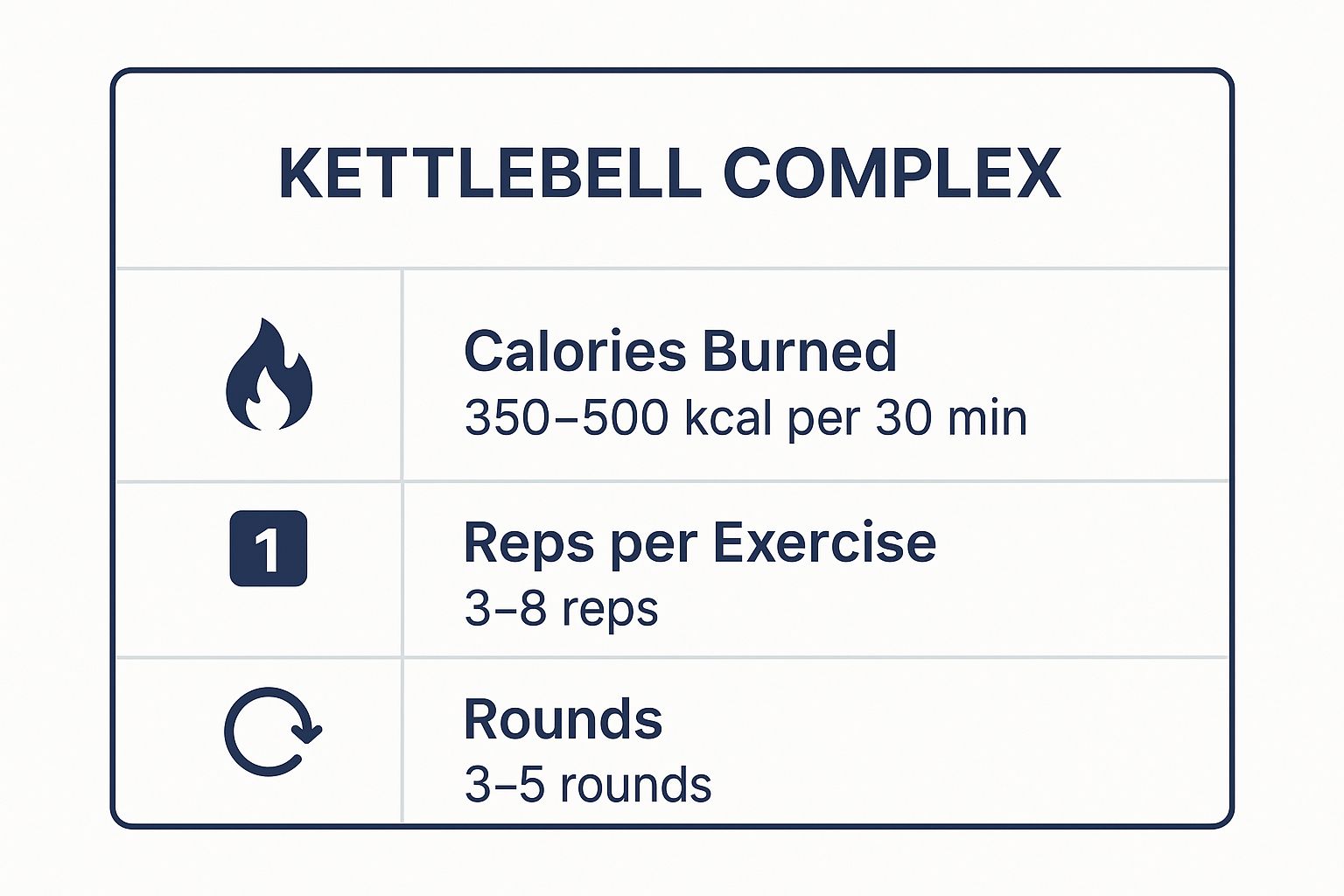
These figures demonstrate that complexes are designed for high intensity over short durations, focusing on quality repetitions within a structured framework of multiple rounds.
How to Implement the Kettlebell Complex
Complexes should be performed 1-2 times per week on non-consecutive days to allow for adequate recovery. The intensity is high, so they should not replace all of your training. A great starting point is to choose 3-4 exercises and perform 3-5 repetitions of each, completing 3-5 total rounds. Rest for 2-3 minutes between each round. A simple beginner complex could be: 5 swings, 5 cleans, 5 goblet squats, and 5 overhead presses per side.
Pro Tip: Your limiting factor in a complex will almost always be your weakest lift, typically the overhead press. Select a kettlebell weight that you can comfortably press for all the required repetitions with perfect form. This ensures you can complete the entire sequence safely and effectively. The mental challenge is significant, and focusing on form can positively impact your mental wellbeing through mindful movement.
Key Form and Safety Tips
- Master Individual Lifts: Do not attempt a complex until you have perfected the form of each individual exercise within it. This is a non-negotiable safety precaution.
- Choose a Conservative Weight: Start lighter than you think you need. The accumulated physiological fatigue is much greater than when performing single exercises.
- Prioritise Form Over Speed: As you get tired, your form will be the first thing to suffer. Stop the set if your technique breaks down; do not risk injury.
- Sequence Logically: Organise the exercises in a way that allows for a smooth biomechanical transition from one to the next (e.g., a swing flows naturally into a clean).
Kettlebell Exercises Weight Loss Comparison
| Exercise | Implementation Complexity | Resource Requirements | Expected Outcomes | Ideal Use Cases | Key Advantages |
|---|---|---|---|---|---|
| Kettlebell Swing | Beginner to Intermediate | Single kettlebell, space | High calorie burn, explosive power, posterior chain | Fat loss, metabolic conditioning | Max calorie burn, low technical barrier, time-efficient |
| Turkish Get-Up | Intermediate to Advanced | Single kettlebell, floor space | Core stability, shoulder mobility, lean muscle gain | Functional strength, mobility, rehab | Builds real-world strength, corrects imbalances |
| Kettlebell Goblet Squat | Beginner to Intermediate | Single kettlebell | Leg muscle development, core engagement, fat loss | Squat form training, metabolic conditioning | Reinforces squat mechanics, safe, accessible |
| Kettlebell Snatch | Advanced | Single kettlebell | Maximum calorie burn, explosive power, endurance | High-intensity conditioning, competition | Highest calorie burn, builds power and cardio |
| Kettlebell Clean and Press | Intermediate | Single or double kettlebells | Full-body strength, shoulder stability, metabolic demand | Functional pressing strength, conditioning | Comprehensive full-body, versatile programming |
| Kettlebell Thruster | Intermediate to Advanced | Single or double kettlebells | Extreme calorie burn, cardiovascular adaptation | Interval training, metabolic conditioning | Combines squat and press, maximizes metabolic disturbance |
| Kettlebell Renegade Row | Intermediate to Advanced | Two kettlebells | Core stability, upper back strength, metabolic demand | Core strength, functional fitness | Exceptional core development, scalable difficulty |
| Kettlebell Complex | Advanced | Single kettlebell | Max calorie burn, total-body strength and endurance | Time-efficient full-body conditioning | Highly customizable, intense metabolic disruption |
Integrating Kettlebells into Your Holistic Health Journey
You have now explored a powerful arsenal of kettlebell exercises, from the explosive Swing to the intricate Turkish Get-Up. Each movement offers a unique pathway to building strength, improving cardiovascular fitness, and significantly boosting your metabolism. Mastering these exercises is a crucial first step, but achieving sustainable, long-term weight loss requires integrating this powerful training tool into a broader, more holistic health strategy.
Think of kettlebells not as a standalone solution but as a potent catalyst. Their true power is unlocked when combined with other fundamental pillars of well-being: sound nutrition, restorative sleep, and proactive stress management. The high-intensity nature of a kettlebell exercise for weight loss programme demands proper fuel and recovery to be effective and safe.
Building Your Sustainable Kettlebell Routine
To translate knowledge into results, focus on consistent lifestyle changes. Here are actionable next steps to weave kettlebells into your life effectively:
- Start with a Manageable Schedule: Begin by incorporating two to three dedicated kettlebell sessions per week on non-consecutive days. This frequency allows for adequate muscle repair and adaptation, which is when the real progress happens.
- Prioritise Form Over Weight: The single most important takeaway is that flawless technique precedes heavy lifting. Film yourself, practise movements without weight, or consider a session with a qualified coach. Nailing the form on the Goblet Squat or the hinge of the Kettlebell Swing will prevent injury and ensure you’re targeting the right muscles.
- Listen to Your Body: Pay close attention to your body's signals. Muscle soreness is normal, but sharp pain is a red flag. On days you feel fatigued, opt for a lighter session, focus on mobility, or take an active recovery day with a brisk walk or gentle stretching. This is key to long-term adherence.
Beyond the Kettlebell: A Whole-Person Approach
A successful weight loss journey extends far beyond the gym floor. Your efforts with kettlebells will be exponentially more effective when supported by mindful lifestyle choices. Remember, exercise creates the demand for change, but nutrition, sleep, and stress management provide the resources for your body to respond.
To truly unlock your weight loss potential with kettlebells, it's crucial to combine your workouts with smart nutrition, starting with understanding how to calculate daily calorie needs. Creating a moderate, sustainable calorie deficit is the cornerstone of fat loss, ensuring your body uses stored energy for fuel. By complementing your powerful kettlebell workouts with a balanced, nutrient-dense diet, you create the optimal environment for your body to shed fat, build lean muscle, and improve overall health markers. Consistency, not intensity, is the ultimate key to transforming your health for good.
Ready to build a comprehensive health strategy that integrates effective exercise with expert medical guidance? At The Lagom Clinic, we specialise in personalised wellness plans that support your fitness goals with proactive health screening, lifestyle medicine, and bespoke support. Book a consultation today to discover how our holistic approach can help you achieve lasting results.


 Members Consultation