


Hip pain often starts as something you try to work around. You shift your weight when standing in the kitchen. You take the stairs more slowly. You stop sitting cross-legged, pause before getting out of the car, and begin planning your day around the moments that hurt.
For busy adults, that slow drift matters. A sore hip can affect sleep, walking, exercise, work concentration, and confidence in your body. Athletes notice it in training. Professionals notice it during commuting and long desk days. Parents notice it when lifting children, carrying bags, or trying to keep up on a weekend walk.
The good news is that effective hip pain treatment usually starts well before surgery enters the conversation. In many cases, a careful diagnosis, the right exercise plan, sensible activity changes, and targeted medical support can calm symptoms and restore function. The key is knowing what kind of pain you're dealing with, what helps, and when home care isn't enough.
Understanding Your Hip Pain and Finding a Path Forward
Hip pain can feel confusing because the hip sits at the centre of so many daily movements. It helps you walk, rotate, bend, climb, sit, and stabilise your pelvis. When something goes wrong, the pain doesn't always stay neatly in one place. Some people feel it in the groin. Others feel it on the outside of the hip, in the buttock, or even down the thigh.
That uncertainty often leads people into two unhelpful extremes. They either push through and irritate the joint or surrounding tissues further, or they stop moving altogether and become stiffer, weaker, and more worried. Neither approach tends to work well for long.
What good hip pain treatment usually starts with
The first step is to identify the pattern. Is the pain linked to impact, twisting, prolonged sitting, hills, side-lying in bed, or the first few steps after rest? Does it feel sharp, stiff, catching, aching, or weak? Those details matter because they help separate joint problems from tendon irritation, bursitis, muscle overload, or pain referred from the lower back.
A useful plan usually includes:
- A clear diagnosis: Not every painful hip has arthritis, and not every groin pain comes from the hip joint itself.
- Load management: Reducing aggravating activities without becoming inactive.
- Progressive exercise: Building strength and control around the hip, pelvis, and trunk.
- Lifestyle input: Sleep, body weight, recovery habits, workstation setup, and training patterns all affect symptoms.
- Escalation when needed: Imaging, injections, or surgical opinion have a place, but timing matters.
Practical rule: If your plan only focuses on pain relief and ignores strength, movement, and daily habits, it's probably incomplete.
What patients can control right away
You can make useful changes before a formal appointment. You can reduce repeated painful movements, avoid sitting in one position for too long, switch to lower-impact cardio, and start rebuilding confidence with tolerable movement. You can also keep a simple symptom note for a week. Write down when the pain starts, where it travels, what worsens it, and what eases it. That record often shortens the route to the right treatment.
A balanced approach works best. You don't need to rest endlessly, but you also shouldn't train aggressively through a worsening limp. The aim is steady progress, not heroic effort.
Common Causes of Hip Pain from Arthritis to Injury
A Bristol runner in their 30s with sharp groin pain after training needs a different plan from a desk-based professional in their 60s who feels stiff for the first few steps each morning. Both call it hip pain. The cause, the likely timeline, and the right treatment can be very different.

That distinction matters because waiting months under the assumption that it is "just wear and tear" can delay the right treatment. In clinic, I regularly see hip pain coming from the joint, the tendons on the outside of the hip, irritated soft tissue, or pain referred from the lower back. Private care can shorten the route to clarity with earlier assessment and, when needed, imaging. Self-management still plays a central role either way.
Osteoarthritis and stiffness from joint wear
Hip osteoarthritis usually causes deep ache and stiffness, often felt in the groin, front of the thigh, or sometimes the buttock. Symptoms commonly build gradually. People often notice trouble putting on socks, getting out of a car, or walking after sitting for a while.
Typical features include:
- Groin-dominant pain: Often worse with longer walks or weight-bearing
- Stiffness after rest: Common first thing in the morning or after prolonged sitting
- Loss of rotation: Crossing legs or turning the knee out becomes harder
Age increases the chance of osteoarthritis, but age alone does not confirm it. Some active adults in midlife have clear arthritic change. Some older adults with hip pain do not.
Gluteal tendinopathy and lateral hip pain
Pain over the outside of the hip is commonly linked to gluteal tendinopathy, sometimes alongside irritation of the bursa. This pattern is especially common in people who suddenly increase walking, return to running too quickly, stand with weight dropped onto one hip, or sleep on the painful side.
The pattern is usually quite specific. Lying on that side hurts. Hills, stairs, and single-leg loading often aggravate it more than easy flat walking. Treatment is different from treatment for joint arthritis, which is why getting the label right matters.
I often have to correct one assumption here. Outer hip pain is often called bursitis, but in practice the gluteal tendons are frequently the main driver. Rest alone rarely settles it for long. Progressive strength work usually needs to be part of the plan, and patients who want a place to start can review these hip exercises for strength and control.
Femoroacetabular impingement and labral irritation
In younger adults, active gym-goers, and field sport athletes, femoroacetabular impingement, often shortened to FAI, can be part of the picture. The ball and socket do not move together as freely as they should in deeper positions. Repeated flexion and rotation can then irritate the joint lining or labrum.
Common clues include:
- Pinching in the groin: During squats, lunges, rowing, cycling, or low sitting
- Pain after sport: Especially after sprinting, kicking, or repeated change of direction
- Clicking or catching: Sometimes present, though this only matters if it matches pain and loss of function
This is one of those areas where trade-offs matter. Some people improve well with activity modification and targeted rehab. Others need imaging to confirm whether the joint shape, labrum, or cartilage is contributing, particularly if symptoms keep returning.
Strains, overload, and tendon injury
Hip pain also starts after more obvious overload. A heavy deadlift session, a fast return to football, a long hilly walk after months at a desk, or a sudden increase in interval training can irritate the hip flexors, adductors, deep rotators, or hamstring origin near the pelvis.
These cases often have a clearer trigger. Pain may come on quickly, then linger because the area never gets a proper period of reduced load and rebuild. Patients often try one of two unhelpful extremes. They either stop moving altogether or keep training through a worsening pattern. A better approach is to reduce the provoking load, keep tolerable movement going, and rebuild strength in a staged way.
Referred pain from the back and pelvis
Hip-area pain does not always start in the hip. The lumbar spine can refer pain into the buttock, side hip, groin, or thigh. If symptoms travel below the knee, include tingling or numbness, or change more with bending the spine than moving the hip, the back deserves close attention.
Sleep position and mattress setup can also influence this wider picture, especially when back and hip pain overlap at night. For some people, Tyner Furniture's guide to back pain relief is a useful starting point for reviewing whether their sleep setup is adding strain.
Less common but important causes
A few causes need faster assessment. A fall with immediate pain and difficulty weight-bearing raises concern for fracture. Sudden severe pain with fever, unexplained weight loss, night pain that does not ease with position change, or a history of cancer needs medical review rather than self-treatment.
The main point is simple. "Hip pain" is a location, not a diagnosis. The fastest route to improvement is matching the treatment to the structure involved, then deciding whether you can manage it conservatively, need clearer imaging, or would benefit from earlier specialist assessment rather than sitting on an NHS waiting list hoping it settles on its own.
Effective Self-Care and Lifestyle Changes for Hip Pain
You wake up sore, loosen off after a shower, then aggravate the hip again by lunch because your day still asks for the same sitting, stairs, driving, or training that irritated it yesterday. That pattern is common in Bristol professionals and active adults. The answer is not to wait months and hope it settles. Early self-care can calm symptoms and buy time, but it works best when it is specific and consistent.

Use relative rest and keep the hip moving
Pain usually settles faster when you reduce the aggravating load while keeping some comfortable movement in the day. Complete rest often leaves the joint stiffer and the surrounding muscles less supportive. On the other hand, repeatedly pushing through sharp pain can keep the area irritated.
A better approach is to change the dose.
- Reduce the trigger: Shorten your walk, reduce hill work, or pause speed sessions for a week or two rather than stopping all activity.
- Swap to lower-irritation exercise: Cycling, swimming, or a cross-trainer often feel better than running, deep squats, or long strides.
- Break up static positions: If desk work or long drives stiffen the hip, stand up regularly and change position before pain builds.
- Use cold packs after flare-ups if helpful: A wrapped ice pack for 10 to 15 minutes can settle an irritated outer hip after activity.
This is usually more effective than doing nothing for a few days, then testing the hip with a long walk or hard gym session.
Build strength gradually
Hip pain often improves when the glutes, deep hip rotators, and trunk muscles do their share of the work. That does not mean chasing fatigue or stretching aggressively into pain. It means choosing a small number of exercises you can repeat several times a week without a flare.
Start with movements you can control well. Bridges, sit-to-stands, supported balance work, step-ups, and simple banded exercises are often useful starting points, depending on the diagnosis. If you need a structured place to begin, our guide to hip exercises for strength and mobility sets out sensible home options.
Consistency beats intensity here.
Weight, recovery, and daily habits all matter
For arthritic hips in particular, body weight can influence joint load and symptom severity. This should be handled carefully and without blame. Hip pain is not just a weight issue. But if weight has crept up while activity has dropped, gradual changes in nutrition and movement can reduce strain on the joint and make exercise easier to tolerate.
Useful starting points include:
- Prioritise protein and fibre at meals: This helps appetite control and supports muscle maintenance during recovery.
- Watch drinks as well as food: Alcohol, sugary coffees, and juice can add calories without much satiety.
- Use short bouts of movement: A 10-minute walk, a few minutes on a bike, or two brief exercise blocks can be more realistic than waiting for a perfect training window.
- Protect sleep where you can: Poor sleep tends to amplify pain sensitivity and slows recovery.
Make your environment less provocative
Home and work setup can either help the hip settle or keep feeding the problem. Deep sofas, low car seats, poor desk setup, and awkward sleep positions commonly show up in clinic because they load the hip in the same painful positions for hours at a time.
Simple changes often help:
- Raise low seats if getting up hurts: A firmer cushion can reduce the amount of hip flexion needed.
- Use a pillow between the knees in side-lying: This can reduce compression through the outer hip.
- Avoid sitting with legs crossed for long periods: It often aggravates side hip pain.
- Review your sleep setup if mornings are the worst time: For people dealing with overlapping back and hip discomfort at night, Tyner Furniture's guide to back pain relief offers useful general advice on how sleep surfaces can affect spinal and joint comfort.
The main trade-off with self-care is time. Sensible home treatment can settle many mild or early problems, but it should produce some change. If you are still stuck in the same pain pattern after a few weeks, or you cannot progress activity without repeated flare-ups, the next step is a proper diagnosis rather than more guesswork.
When to Seek Professional Diagnosis for Your Hip Pain
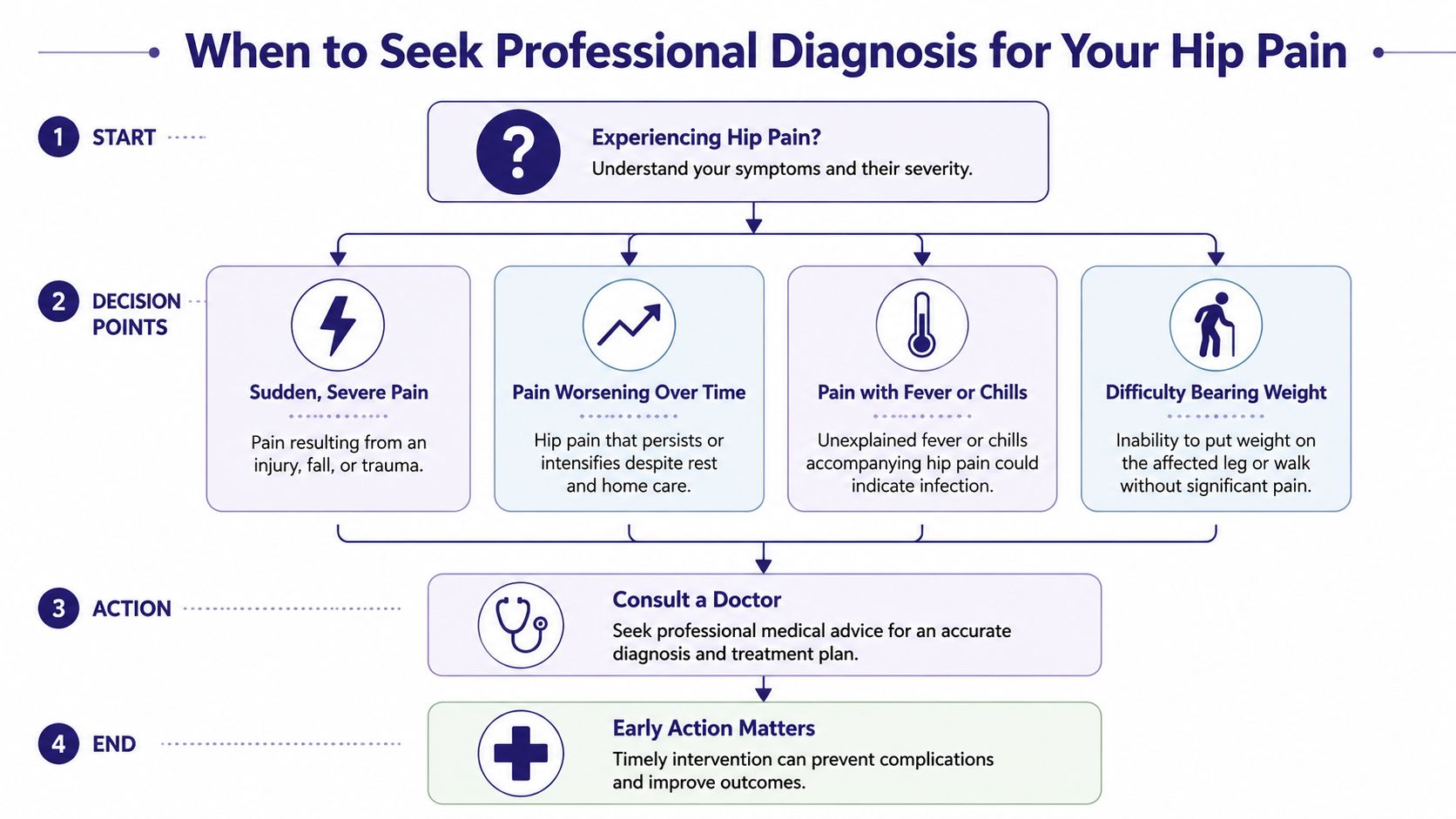
Some hip pain can be monitored for a short period with sensible home care. Some needs assessment sooner. The difference matters because the right diagnosis often changes treatment quickly.
Red flags that need prompt attention
Seek urgent medical help if the pain follows a significant fall or trauma, if you can't bear weight, or if the hip is acutely painful with fever, redness, or you feel systemically unwell. Those patterns raise concern for fracture, significant injury, or infection.
Pain that wakes you constantly, severe night pain without a mechanical trigger, or rapidly worsening symptoms also deserves timely review.
The more common reason to book an assessment
Typically, the situation isn't an emergency. They're dealing with pain that lingers, returns, or stops them exercising, sleeping, or working comfortably. That's enough reason to seek help. You don't need to wait until it becomes disabling.
A proper assessment should look at:
- Location and behaviour of pain: Groin, side hip, buttock, thigh
- Range of movement: Rotation, flexion, extension, and whether these reproduce symptoms
- Strength and control: Especially gluteal and pelvic stability
- Walking pattern: Limping, stride length, and weight transfer
- Back involvement: To check whether the hip is the true source
If you want a clearer idea of what a good clinical review involves, this overview of a musculoskeletal assessment explains the process well.
Why diagnosis changes treatment quality
Many people lose time. They're given generic stretches, vague advice to “rest it”, or an X-ray without a full examination. Good care joins the story, the physical findings, and imaging only when imaging will help.
UK guidance strongly backs this conservative-first approach. NICE-aligned evidence notes that individualized physical therapy, education, and lifestyle interventions can achieve 50% to 90% success rates in pain relief and function restoration without surgery in clinical practice, as summarised in this review of non-surgical hip care.
Early assessment doesn't mean rushing into scans or procedures. It means making fewer wrong turns.
X-rays are useful when arthritis or bony shape problems are suspected. MRI is more helpful for cartilage, tendons, labral injury, or when the clinical picture stays unclear. The value isn't the image alone. It's using the right test at the right moment.
Conservative Hip Pain Treatments Beyond Self-Care
Once self-care has started but symptoms still limit progress, structured conservative treatment usually becomes the main driver of recovery. For most patients, that means a personalised physiotherapy plan, sometimes supported by medication.
Physiotherapy is more than a sheet of exercises
A good programme should match the diagnosis. Someone with gluteal tendinopathy won't need the same approach as someone with hip osteoarthritis or femoroacetabular impingement. The right plan usually combines strengthening, mobility work, gait or movement retraining, and a clear progression for return to normal activity.
Evidence supports that approach. Physiotherapist-led interventions over three months showed a pooled standardised mean difference of 0.66 for improved function, favouring treatment over control groups in this systematic review of hip-related physiotherapy trials.
What tends to work well:
- Targeted glute strength: Especially for side-hip pain and pelvic control
- Progressive loading: Building tissue tolerance rather than chasing pain-free rest
- Movement correction: Adjusting squat depth, step mechanics, running load, or sitting habits
- Reassessment: Changing the plan when the hip responds, rather than repeating the same drills for weeks
What often doesn't work:
- Random internet exercises: Especially if they're chosen by pain location alone
- Aggressive stretching into a pinching hip: This can worsen joint irritation in some patients
- Passive treatment only: Massage can help symptoms, but it rarely solves the main problem on its own
Medication can support rehab, but it isn't the whole treatment
Anti-inflammatory medication can be useful when pain is stopping sleep or limiting the ability to engage with rehabilitation. It can lower irritation enough to let you move better and start strengthening.
That said, tablets don't rebuild muscle capacity, improve joint control, or fix movement habits. They're often best viewed as support, not the centrepiece.
For patients whose hip symptoms are tied closely to weight-bearing load and broader metabolic health, a medically supervised approach to weight reduction can make rehab more effective. This medical weight loss overview from Blue Haven RX gives a useful general explanation of what structured support can look like.
Comparing conservative hip pain treatments
| Treatment | Primary Goal | Best For | Typical Duration |
|---|---|---|---|
| Physiotherapy | Improve strength, movement quality, and tolerance to load | Most mechanical hip pain, including arthritis, tendon pain, and impingement-related symptoms | Often delivered over weeks to months |
| NSAID medication | Reduce pain and inflammation so movement becomes more manageable | Short-term symptom flares, especially when pain blocks rehab participation | Usually short-term, depending on medical suitability |
| Education and activity modification | Remove aggravating patterns and build safer daily habits | Everyone with hip pain, especially early in treatment | Ongoing, adjusted as recovery improves |
| Weight management support | Reduce joint load and improve overall health factors affecting pain | Hip osteoarthritis and load-sensitive symptoms | Longer-term lifestyle change |
Exploring Injections and Surgical Hip Pain Treatments
If pain persists despite good conservative care, it's reasonable to consider the next layer of treatment. That doesn't mean the earlier work failed. It usually means the hip needs extra help.
When injections make sense
An ultrasound-guided intra-articular corticosteroid injection can be useful for selected patients with joint-driven pain. Clinical data indicate that 60% to 70% of patients experience greater than 50% pain reduction at 4 to 6 weeks, helping them engage more effectively in rehabilitation, according to this clinical review of hip injection evidence.
The key point is purpose. A steroid injection isn't usually a permanent fix. It's often best used to calm inflammation, confirm the joint as a pain source, and create a window in which rehab becomes possible again.
An injection works best when it opens the door to better movement and strengthening. Used on its own, the benefit is often shorter-lived.
Emerging regenerative options such as PRP are part of ongoing discussion in sports and musculoskeletal medicine, but suitability depends on the diagnosis, activity goals, and the quality of available evidence for that specific condition.
Surgery has a clear place for the right patient
Surgery isn't a failure. For severe structural problems, persistent mechanical symptoms, or advanced arthritis with major quality-of-life impact, it can be the right and most effective step. Depending on the problem, that may involve arthroscopy or hip replacement.
What matters most is preparation and rehabilitation. Patients considering surgery often benefit from understanding the recovery role of physiotherapy in advance. This guide on physical therapy after hip replacement surgery gives a helpful overview of how rehab supports function afterwards.
Good decision-making here is practical. If symptoms remain severe despite strong non-surgical care, walking is restricted, sleep is poor, and daily life keeps shrinking, it's time to discuss procedural options properly rather than endlessly repeating treatments that aren't moving the needle.
How The Lagom Clinic Can Help Your Hip Pain
The hardest part of hip pain is often not the pain itself. It's the waiting, uncertainty, and fragmented care. People are told to rest, then to exercise, then to wait for imaging, then to try medication, often without one clinician tying the whole story together.
A better model is integrated care. That means enough appointment time to hear how the pain began, what your week looks like, what movements trigger symptoms, and what you need your body to do again. It also means examining the hip properly, considering the back and pelvis, and deciding whether treatment should begin immediately or whether imaging would change the plan.
For Bristol professionals, parents, and athletes, speed matters because delayed care often leads to compensation patterns, lost training time, poorer sleep, and more anxiety around movement. Rapid access to assessment and private imaging can shorten that cycle. So can a plan that blends medical diagnosis with realistic lifestyle medicine.
The most effective hip pain treatment is rarely one thing. It's a joined-up pathway. You need a diagnosis that makes sense, advice you can apply in a real week, exercise that matches the tissue involved, and escalation options when first-line treatment isn't enough.
That balanced approach is at the heart of good musculoskeletal care. It respects both sides of the problem. The biology of the painful hip, and the person living with it.
If your hip pain is stopping you from walking comfortably, training properly, sleeping well, or getting through the workday without thinking about every step, The Lagom Clinic offers a clear, personalised route forward. With longer appointments, musculoskeletal expertise, rapid access to imaging, and an all-encompassing focus on exercise, lifestyle, and recovery, the clinic helps Bristol patients move from uncertainty to a practical treatment plan.


 Members Consultation