


If you want to build truly resilient knees, the secret isn't just to focus on the knee itself. The real work happens in the muscles that surround it. We need to build up a strong, supportive scaffolding using your quads, hamstrings, and glutes, which act as the knee's personal bodyguards. It's about creating a balanced system, not just an isolated joint.
Why Do My Knees Feel So Weak?
Before we jump into any exercises, let’s get to the bottom of why your knees might feel wobbly or unstable in the first place. More often than not, the culprit isn't a problem inside the knee joint, but rather with the support network around it. Think of your knee as a hinge on a gate; if the fence posts (your hips and ankles) are loose, the hinge will take all the strain.
It's a surprisingly common story. Musculoskeletal (MSK) issues are a major concern across the UK, and if your joints feel weak, you're in good company. Recent government data shows that 17.9% of adults aged 16 and over live with a long-term MSK condition. The figures are even higher for women (20.0%) than for men (15.6%). You can read the full government report on MSK health trends for a deeper look.
The Real Reasons Your Knees Are Complaining
That feeling of weakness or giving way often traces back to a few key areas. Pinpointing the source is the first real step toward building strength that lasts.
To make this clearer, let's break down the most common factors we see in the clinic. The table below outlines the underlying issues, how they create that feeling of instability, and what we can do about them.
Common Causes of Knee Weakness
This table breaks down the key factors contributing to knee instability, helping you pinpoint areas to focus on for improvement.
| Contributing Factor | How It Affects Your Knees | Primary Solution |
|---|---|---|
| Muscle Imbalances | Weak glutes and tight hips (common from desk work) force the quads to overwork, pulling the kneecap out of alignment. | Glute strengthening and targeted hip flexor mobility work. |
| Weak Quads, Hams & Glutes | These muscles are your body's primary shock absorbers. When they're weak, impact goes straight to the knee joint. | A progressive strengthening programme for the entire leg. |
| Poor Core & Hip Stability | An unstable core and weak hips create sloppy movement patterns, placing enormous shearing forces on your knees. | Exercises that build core strength and improve hip control. |
| Old, Unresolved Injuries | A past ankle sprain or even a minor knee knock can change how you move, creating compensation patterns that overload the knee. | A biomechanical assessment to identify and correct faulty movement patterns. |
| Age-Related Muscle Loss | We all naturally lose muscle mass over time (sarcopenia). This makes the knees more vulnerable without consistent strength work. | Regular resistance training to preserve and build muscle mass. |
Understanding these root causes helps us shift our thinking. Instead of just trying to "fix the knee," we can start building a stronger, more dependable foundation from the ground up.
The big idea here is that strong, healthy knees are the result of a strong, healthy system. It’s never just about one muscle; it's about getting the entire lower body working together in harmony.
The exercises and strategies that follow are all designed with these principles in mind. They will help you tackle the underlying problems, so you can move with confidence and leave that wobbly feeling behind.
Building Your Foundation with Gentle Knee Exercises
Now that we’ve covered the 'why' behind knee weakness, let's get into the practical side of things. Building stronger, more resilient knees doesn't start with a sprint; it begins with slow, deliberate movements that lay a solid foundation. This first phase is all about re-establishing the conversation between your brain and the muscles that protect your knee, but without putting the joint under any real strain.
Think of it like setting the footings for a house. You simply can't build strong walls on a shaky base. These initial exercises are your concrete and steel—they create the stability needed to make every other movement safer and more effective down the line. The best part? You don't need a gym membership. A bit of floor space is all it takes to get going.
Our primary goal here is something we call neuromuscular activation. It's a medical term for waking up sleeping muscles, especially your glutes and quads, and reminding them how to fire properly. This isn't about lifting heavy or chasing a burn; it's about precision, control, and forging a strong mind-muscle connection.
Mastering Foundational Movements for Knee Stability
Let's walk through three essential, low-impact exercises. The golden rule is to focus on slow, controlled movements and really tune into your form. Quality over quantity is everything here.
For each exercise, try to complete 2-3 sets of 10-15 repetitions. Aim to do this routine 3-4 times a week, making sure to take a day off in between to let your body recover and adapt.
Glute Bridges
This exercise is an absolute powerhouse for your posterior chain—your glutes and hamstrings. Why does that matter for your knees? Strong glutes are what control your thigh bone, stopping it from rotating inwards and causing that dreaded knee-collapse pattern.
- Lie on your back with your knees bent and feet flat on the floor, about hip-width apart. Let your arms rest by your sides.
- Gently brace your core and give your glutes a good squeeze.
- Lift your hips from the floor until your body forms a straight line from your shoulders right down to your knees.
- Hold this position for 2-3 seconds. The key is to feel the squeeze in your glutes, not your lower back.
- Slowly, and with full control, lower your hips back to the start.
Clamshells
Clamshells are brilliant because they specifically target the gluteus medius, a crucial muscle on the side of your hip that acts as a stabiliser for your pelvis. When this muscle is weak, it often leads to poor knee tracking when you're just walking, running, or climbing a flight of stairs.
- Lie on your side with your knees bent at around a 45-degree angle, legs stacked neatly. You can rest your head on your lower arm.
- Keep your feet touching and your core switched on (this stops your hips from rocking backwards). Now, slowly raise your top knee as high as you comfortably can without letting your pelvis shift.
- Really focus on starting the movement from your glute muscle. It helps to imagine a string gently pulling your knee up towards the ceiling.
- Pause briefly at the top before slowly returning to the starting position.
Straight Leg Raises
To build a truly solid base for your knees, you have to work the muscles that directly support them. This exercise is a fantastic way to engage the quadriceps—the big muscles on the front of your thigh—without actually having to bend the knee joint. Strong quads are your body's natural shock absorbers and help control how your kneecap moves.
For more variety, you can find other great quad strengthening exercises to work into your routine as you get stronger.
- Start by lying on your back. Keep one leg straight and bend the other, placing your foot flat on the floor.
- Tighten the thigh muscle (quad) of your straight leg and slowly lift it about 6-8 inches from the floor. The leg should stay perfectly straight.
- Hold it there for 3-5 seconds.
- With the same slow control, lower the leg back down to the floor.
Remember, the guiding principle is pain-free movement. Feeling your muscles work or a bit of fatigue is normal and expected. Sharp, stabbing pain in the joint is not. If an exercise hurts, try reducing the range of motion. If it still hurts, stop and seek professional advice.
By consistently practising these foundational movements, you are effectively reprogramming your body for better alignment and support. This isn't just a temporary fix. It's the essential first step in a long-term strategy for how to strengthen knees, dial down pain, and get your confidence back. Once you can nail these exercises with perfect form and zero discomfort, you know you're ready for the next level.
Stepping Up Your Knee Strengthening Routine Safely
So, you’ve been consistent with the foundational exercises and can do them comfortably, with good form and no pain. That's a huge step. It means you’ve built the base, and now we can start adding a bit more challenge to keep making progress.
The next part of your journey is about moving from simple muscle activation towards more functional, compound movements that mimic everyday life. Think bodyweight squats and lunges. But here's the thing: as we dial up the intensity, how you perform the exercise becomes even more important than what you're doing. Flawless form is everything.
Introducing Intermediate Exercises
As you step up your routine, remember the goal is to challenge your muscles, not to overload your joints. Think of it like carefully adding more weight to scaffolding you’ve already built—it has to be done systematically to keep everything stable.
Here are a couple of excellent intermediate exercises to start with:
- Bodyweight Squats: Stand with your feet about shoulder-width apart, toes pointing slightly out. Start the movement by hinging at your hips and sending them backwards, as if you’re about to sit in a chair. Keep your chest lifted and your back straight. Crucially, make sure your knees track in line with your toes and don’t collapse inwards. Go as low as you comfortably can, then drive back up to the start.
- Static Lunges: Take a comfortable step forward with one foot. Keeping your torso upright, lower your body straight down until both knees are bent at roughly a 90-degree angle. Your front knee should be stacked over your ankle, not drifting forward, and your back knee should hover just off the floor. Push through your front foot to return to the top, finishing all your reps before you switch sides.
The most common mistake I see in the clinic is people allowing their front knee to drift forward past their toes during lunges or squats. This puts a lot of unnecessary shear force on the knee joint itself. Focus on sending your hips back and keeping your weight centred over the middle of your foot.
If you want a hand with tracking your progress and making sure you're advancing at the right pace, a personalized strength training app can be a really useful tool to keep you on track.
The infographic below shows some of the foundational moves you should be comfortable with before tackling the intermediate exercises we've just covered.
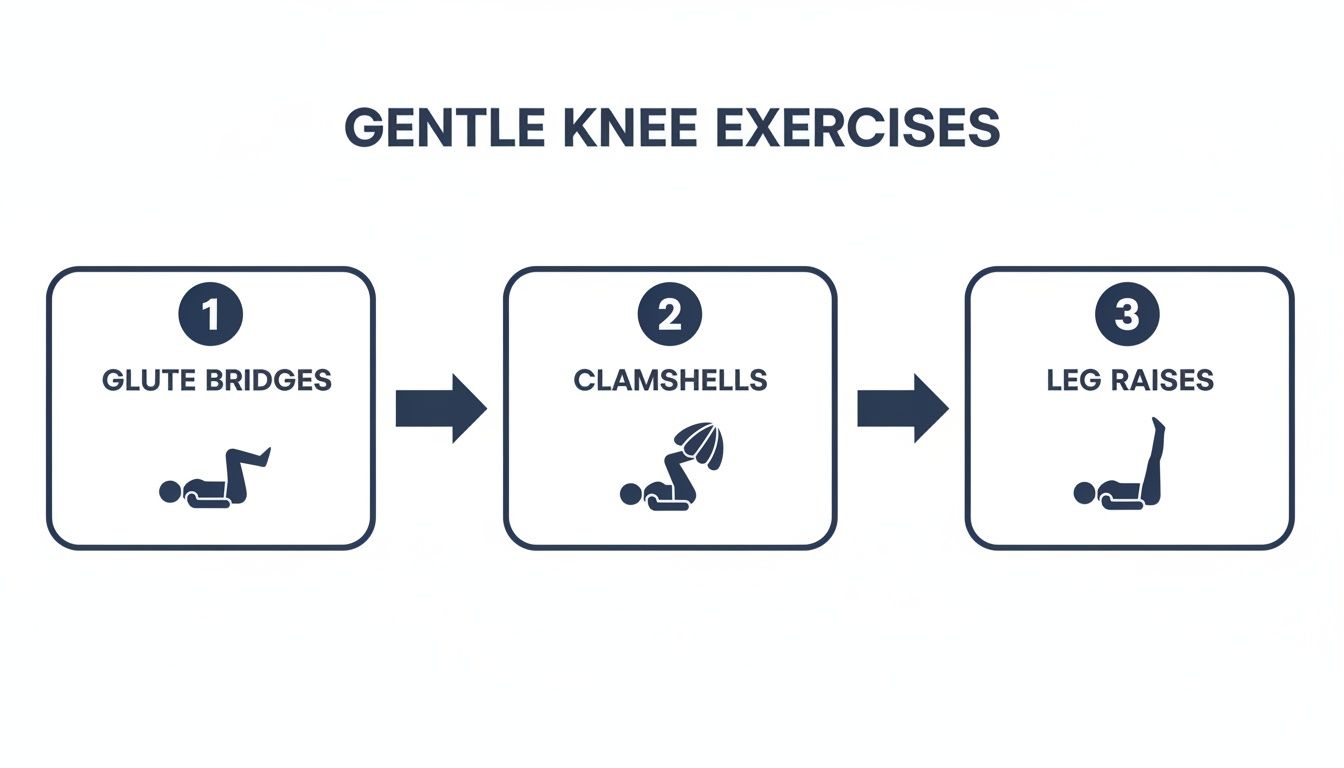
Nailing these low-impact exercises builds the muscle control you need to progress safely.
How to Add Resistance Effectively
Once you can comfortably perform 3 sets of 15 reps of the bodyweight exercises above, it’s time to start thinking about adding some resistance. This is where you’ll really start to build noticeable strength.
Resistance bands are the perfect place to start. They offer variable resistance, which simply means the tension increases as you stretch the band. This is brilliant because it's gentler on your joints at the beginning of the movement where they are most vulnerable.
- Banded Squats: Loop a resistance band just above your knees. As you squat down, focus on actively pushing your knees out against the band. This small cue is fantastic for getting your gluteus medius—a key stabiliser for your hips and knees—to fire up.
- Banded Glute Bridges: With the band in the same position, perform your bridges while constantly pressing your knees outwards. You'll feel the difference immediately.
After mastering bands, you can move on to light weights like dumbbells or kettlebells for goblet squats and weighted lunges. Always start lighter than you think you need to. The weight is just there to challenge your form and stability, not to break it.
Progressing to Advanced Movements
For those aiming to get back to sport or other high-impact activities, the final step involves single-leg exercises and controlled plyometrics (jumping). Be warned: these movements demand serious strength and stability. Rushing into them is a shortcut to getting injured.
In the UK alone, there are an estimated 20,200 ACL injuries each year. This isn't just a short-term problem; these injuries can lead to long-term knee issues and a higher risk of osteoarthritis down the line. It's a sobering reminder of why a structured, monitored approach is so vital.
Before you even consider these advanced moves, you must be able to:
- Hold a single-leg balance for at least 30 seconds without wobbling.
- Perform partial single-leg squats with perfect control.
- Be completely pain-free during and after your intermediate workouts.
Advanced exercises include things like single-leg Romanian deadlifts, pistol squat progressions, and box jumps. With any jumping, the most important part is the landing—it needs to be soft and quiet. You have to learn to absorb the force through your muscles, not by jarring your joints. This full progression, from basic stability to dynamic control, is how you build truly resilient knees.
More Than Just Exercises: Why Mobility and Daily Habits Matter
While a solid strengthening programme is your foundation, truly resilient knees are built both in and out of the gym. Think of it this way: your exercises build the strong, supportive structures, but your daily habits and mobility work are what keep everything running smoothly 24/7.
Without good flexibility, even the strongest muscles can't properly protect a joint that's constantly being pulled out of alignment. Strength and mobility really are two sides of the same coin.
When muscles around the knee get tight—and I'm looking at you, quadriceps, hamstrings, and hip flexors—they can start a constant tug-of-war. This disrupts how the kneecap moves, leading to that nagging, chronic irritation so many people feel. It's like having the guy ropes on a tent pulled at uneven tensions; sooner or later, the whole structure becomes unstable.
This is exactly why we need to look at the bigger picture. It’s about weaving simple mobility work into your routine and making smarter everyday choices that ease the overall load on your joints.
Unlocking Your Knees with Key Stretches and Mobility Work
Dedicating just a few minutes to mobility can make a world of difference. You can do these before or after your workout, or even as a quick break from your desk. The main goal here is to release tension in those big muscle groups that cross the knee joint.
- Quadriceps Stretch: Standing, hold onto something for balance. Grab your right foot and gently pull your heel towards your glute until you feel a good stretch down the front of your thigh. A key tip: keep your knees together and think about pushing your hips slightly forward. Hold for 20-30 seconds and repeat on the other side.
- Hamstring Stretch: Sit on the floor with one leg out straight. Bend the other leg and place the sole of your foot against your inner thigh. Gently hinge forward from your hips over the straight leg, keeping your back flat. Once you feel a comfortable stretch, hold it for 20-30 seconds before switching legs.
- Hip Flexor Stretch: Get into a lunge position, as if you were proposing. Your front knee should be at a 90-degree angle and stacked directly over your ankle. Now, gently push your hips forward while keeping your torso upright. You should feel this at the front of the hip on the kneeling side. This is an absolute must if you spend a lot of time sitting.
Tight hips are a massive, and often overlooked, contributor to knee pain. If you suspect this is you, our guide on effective exercises for hip mobility has some excellent routines you can add in.
Here's a quick self-test for tightness: Lie on your back and pull one knee towards your chest. Does your other leg lift off the floor? If so, it’s a classic sign your hip flexors are tight and likely adding strain to your knees.
A foam roller is another fantastic tool for your arsenal. Gently rolling out your quads, hamstrings, and the IT band (the side of your thigh) can work wonders for releasing knots and improving blood flow. It’s like giving yourself a deep-tissue massage.
Everyday Habits That Protect Your Knees
The small choices you make all day long can either help or hinder your progress. Over time, these little adjustments add up to a huge reduction in joint stress.
Consider These Simple Lifestyle Tweaks
- Maintain a Healthy Weight: This might be the single most impactful lifestyle factor outside of exercise. Research consistently shows that for every extra pound of body weight, your knees feel about four extra pounds of pressure with every step. Even a small amount of weight loss can take a massive load off.
- Choose Supportive Footwear: Your feet are the foundation for everything above them. Worn-out trainers or shoes with zero arch support can throw your entire walking pattern off, sending shockwaves right up to your knees. Always opt for cushioned, supportive shoes, especially if you walk or stand a lot.
- Mix in Low-Impact Activity: High-impact workouts like running on pavement can be brutal on sensitive knees. It’s smart to complement your strengthening work with low-impact cardio. Think swimming, cycling, or using an elliptical trainer. You’ll still get a great cardiovascular workout without all the repetitive jarring.
When you combine these daily habits with a consistent mobility and strengthening programme, you've got a complete strategy for building stronger, more resilient knees. You're creating an environment where your joints are supported, flexible, and ready to handle whatever you throw at them.
When to See a Specialist for Knee Pain
While this programme is a fantastic way to build resilient knees, it’s not a magic bullet for every issue. Knowing the difference between the normal aches of getting stronger and the warning signs of a real problem is one of the most important parts of training smart.
Sometimes, what you assume is just weakness could actually be an underlying structural issue. Pushing through the wrong kind of pain can do more harm than good, turning a small niggle into a long-term setback.
Identifying the Red Flags
It’s crucial to listen to your body. There's a world of difference between the general, dull ache of muscle soreness a day or two after a workout and the sharp, specific pain that signals a joint problem. Joint pain tends to be more immediate, happening during a movement, and feels more localised.
Here are the specific symptoms that tell you it’s time to pause your routine and get a professional opinion:
- Sharp, persistent pain: Any pain that feels stabbing, intense, or simply doesn't ease off with rest is a clear signal to stop.
- Mechanical symptoms: Does your knee lock, catch, or produce a painful click when you move? This can point to an issue with your cartilage, like a meniscus tear. We cover this in more detail in our guide to the signs of a torn ligament in the knee.
- Instability or ‘giving way’: If you ever feel your knee is about to buckle or can’t support you, it's a major red flag, often for ligament damage.
- Significant swelling or redness: Obvious puffiness, warmth, or discolouration around the joint suggests inflammation or an acute injury that needs checking out.
- No improvement after consistent effort: If you’ve been diligently following a sensible plan for several weeks and your pain isn't getting any better, it's time for an expert to take a look.
If your knee pain is the result of a traumatic injury—a fall, a collision in sport, or a sudden twist—or you find you can't put any weight on it at all, you need to seek immediate medical attention. Don't wait.
What to Expect from a Professional Assessment
The next logical step is booking in with your GP or a musculoskeletal specialist like a physiotherapist. Their first job is to become a detective and figure out exactly what’s going on.
During a consultation, they'll start by taking a detailed history, asking you all about your symptoms, activity levels, and what makes the pain better or worse. The more detail you can provide, the better.
Next comes a physical examination. This is where they'll assess your knee's range of motion, check for any swelling, and use specific hands-on tests to stress different structures like your ligaments and meniscus to pinpoint the source of the trouble. They will also likely watch you walk, squat, or lunge to analyse your movement patterns and spot any biomechanical habits that could be putting extra strain on your knee.
Based on all this, a skilled clinician can often give you a clear diagnosis. If the picture is still a bit fuzzy, they may refer you for diagnostic imaging like an MRI or X-ray to get a look inside the joint.
Clinical data backs this up. Current NHS guidance suggests that if your symptoms don't improve after 6 weeks of self-management, a specialist assessment is the right move. As findings on how specialist knee clinics improve care pathways show, early access to experienced clinicians and imaging leads to better outcomes. An expert can then build a recovery plan that’s right for you, making sure your path back to full strength is as safe and effective as possible.
Common Questions We Hear at the Clinic
Starting a knee-strengthening programme often brings up a lot of questions. That’s a good thing. Being curious and a little cautious means you’re taking your health seriously. To give you some clarity, here are the answers to the most common queries we address with our patients.
Think of this as a conversation you might have in our clinic, clearing up myths and giving you the confidence to get moving safely.
Is It a Good Idea to Exercise If I Already Have Knee Arthritis?
Yes, absolutely. In fact, it’s one of the best things you can do. There’s a persistent myth that exercising an arthritic joint will only wear it down faster, but the right kind of exercise does the exact opposite.
When you strengthen the muscles around the knee—your quads, hamstrings, and glutes—you're essentially building a natural, living support system. These muscles then absorb much of the shock and daily strain that would otherwise go straight to the compromised joint cartilage. The secret is sticking to low-impact exercises that build muscle without aggravating the joint.
How Long Before I Actually Feel a Difference?
This is the big question, and the honest answer is that it takes patience. While we all want a quick fix, true strength doesn't happen overnight. Most of our patients start to notice a real difference in stability and less day-to-day achiness within 4 to 6 weeks, assuming they’re consistent with their exercises about three times a week.
To build the kind of deep, lasting strength that really protects your knees for the long haul, you'll want to think in terms of 8 to 12 weeks. That's the typical timeframe for your muscles to genuinely adapt and for stronger, better movement patterns to feel natural.
The goal isn't just to feel better for a week; it's to build a foundation that supports you for years to come. Consistency will always beat intensity when it comes to joint health.
What's the Deal with Knee Braces and Supports?
Knee braces can definitely have their place. They can give you a bit of extra support and confidence, especially if you're returning to an activity that you know puts a strain on your knee. For some, they offer welcome, temporary pain relief.
The key word there, however, is temporary. A brace doesn't fix the underlying issue, which is almost always a lack of muscle strength and control. If you rely on one too heavily, it can become a crutch that stops your muscles from doing their job and getting stronger. Our advice? Use a brace strategically for specific activities, but don’t let it replace the real work of your strengthening programme.
Should I Expect Pain When I Start Exercising?
It's crucial to know the difference between good discomfort and bad pain. Feeling some general muscle fatigue or what’s known as Delayed Onset Muscle Soreness (DOMS) a day or two after your workout is normal. It's just a sign that your muscles are adapting.
What you should never ignore is sharp, stabbing, or grinding pain that you feel in the joint itself while you're doing an exercise. That’s your body’s alarm bell, and it means you need to stop. A good rule of thumb for strengthening your knees is to "challenge the muscle, don't chafe the joint." If a movement causes joint pain, stop, check your form, or simply choose a different exercise.
At The Lagom Clinic, our private GPs in Bristol are focused on giving you personalised medical guidance that gets to the root of the problem. If you're tired of dealing with knee pain or want an expert to assess your situation and build a plan that’s right for you, we are here to help. Book a consultation today and take the first real step towards stronger, more confident knees. Learn more or book your appointment at The Lagom Clinic.


 Members Consultation