


You're getting through the day. You're answering emails, joining meetings, keeping family life moving, and probably telling yourself you'll slow down after this deadline, this quarter, this launch. Meanwhile, sleep is patchy, your patience is shorter than it used to be, and the background hum of anxiety or low mood is starting to feel less like a blip and more like your new normal.
That pattern is common in high-functioning professionals. From the outside, life can still look organised. On the inside, concentration slips, motivation drops, and ordinary decisions start to feel heavy. Many people wait until work suffers, relationships strain, or panic symptoms become hard to ignore. That's usually later than it needs to be.
A mental health care plan is a structured way to stop drifting and start acting. Think of it as a practical roadmap made with a clinician. It should help you define what's wrong, what matters most, what support fits your situation, and what to do if things worsen.
If you're outside your local system or want to start with a therapist directly, sometimes the most useful first step is just finding someone suitable and available. For readers looking beyond the NHS pathway, this resource on finding a Penticton therapist shows the sort of practical provider-search approach that can help when you need to move from intention to action.
Your First Step Towards Calmer Waters
A good plan should make life feel less chaotic, not more clinical. It isn't a test you pass or fail, and it isn't a document that exists only for the record. It should answer three questions clearly: what are you dealing with, what are you going to do about it, and how will you know if it's helping?
A useful care plan reduces uncertainty. It turns “I need to sort myself out” into specific next steps.
For a busy adult, that often means building something realistic rather than idealised. If your current week barely has room for lunch, a plan that depends on daily hour-long therapy homework and six gym sessions won't last. If your symptoms include poor sleep, irritability, racing thoughts, or emotional flatness, the plan should account for your actual energy, schedule, and pressures.
What this often looks like in practice
In clinic, the starting point is rarely dramatic. It's often a person saying some version of, “I'm coping, but I'm not myself.” That sentence matters. It often signals the point where stress, anxiety, burnout, depression, grief, or chronic overload have started to affect function.
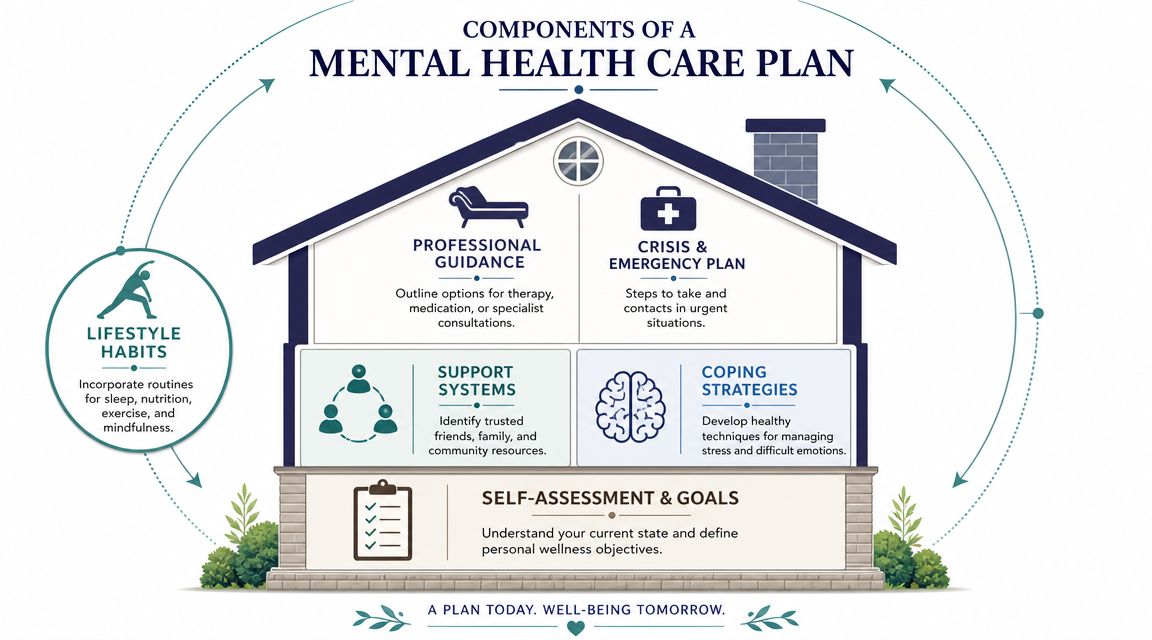
A proper mental health care plan gives that experience structure. It can include assessment, therapy options, medication review where appropriate, changes to work patterns, sleep support, exercise targets, alcohol reduction, and a clear review point. If risk is part of the picture, it should also include safety planning.
Why early action works better
People usually do better when they seek help before a crisis. Earlier care gives you more options, more flexibility, and more room to start with lower-intensity strategies before symptoms become entrenched.
That's especially important if you're used to being the capable one. Competence at work doesn't protect you from burnout. In some cases, it hides it for longer.
What a Good Mental Health Plan Includes
A good plan should tell you what is happening, what you are going to do about it, who is responsible for each part, and when you will review whether it is helping. If any of those pieces are missing, people often end up with vague advice, delayed follow-up, or treatment that does not fit real life.
Start with a clear clinical picture
The first part is assessment. In practice, that means building a picture of symptoms, severity, triggers, physical health, and day-to-day impact rather than attaching a quick label and stopping there.
A useful assessment usually covers:
- Symptoms such as anxiety, low mood, panic, irritability, poor concentration, sleep disruption, or emotional blunting
- Function at work, at home, and socially, including whether deadlines, meetings, parenting, or basic routines are starting to slip
- Physical contributors such as pain, hormonal change, alcohol use, stimulant intake, medication side effects, and lack of recovery
- Risk including self-harm thoughts, suicidal thinking, impulsive behaviour, or rapid deterioration
- Context such as bereavement, burnout, financial pressure, relationship strain, or caring responsibilities
The next step is setting goals that are specific enough to guide treatment. “I want to feel like myself again” is a valid starting point, but it needs translating into measurable targets. That might mean sleeping six to seven hours most nights, getting through presentations without panic, cutting weekend drinking, or being less reactive with family.
Match the plan to severity, time, and budget
Good care plans are not one-size-fits-all. NICE recommends a stepped-care approach for common mental health problems, where support is matched to the severity and complexity of the problem rather than giving everyone the same intervention. You can review the model in the NICE guidance on common mental health problems identification and pathways to care.
For busy professionals, there is also a practical trade-off. The NHS route can be appropriate and cost-conscious, but waiting times, local service thresholds, and limited appointment flexibility can slow things down. Private care can offer faster access, longer appointments, and more continuity, but it comes with direct cost. Clinics that combine therapy with medical review and lifestyle support, such as mental health therapy at The Lagom Clinic, can suit people who want a more joined-up plan from the outset.
A well-matched plan may include:
- Talking therapy for anxiety, depression, trauma, grief, perfectionism, or burnout
- Medication review if symptoms are persistent, severe, or preventing engagement with therapy and daily life
- Lifestyle medicine input for sleep, movement, alcohol, nutrition, work patterns, and recovery time
- Monitoring tools such as PHQ-9 or GAD-7 to check whether treatment is working
- Safety planning with clear instructions on what to do if symptoms worsen, including out-of-hours support
Build around the whole person
Mental health care works better when it reflects how people live. A plan that ignores shift patterns, long commutes, menopause symptoms, chronic pain, parenting pressure, or heavy alcohol use is less likely to hold up in a demanding week.
This matters clinically. Sleep loss can intensify anxiety. Low mood can reduce activity and worsen physical health. Alcohol can disturb sleep and blunt progress in therapy. Work stress can keep the nervous system switched on even when someone looks high-functioning from the outside.
I often tell patients that the right plan should feel realistic, not aspirational. It needs enough structure to create change, but not so much that it collapses by week two.
If you are unsure which professional should lead which part of care, this guide to choosing mental health professionals can help clarify the different roles.
Who Can Help You Create Your Plan
Different professionals do different jobs. Choosing the right starting point saves time and frustration.
When a GP is the best first contact
A GP is often the most practical place to begin, especially if you're not sure whether you're dealing with stress, anxiety, depression, burnout, a physical health issue, or a mixture of several. A GP can assess symptoms in context, screen for contributing medical problems, discuss work impact, review medication, and help coordinate next steps.
This is especially useful when the picture is mixed. If poor sleep, low mood, alcohol use, perimenopausal symptoms, pain, and work strain are all interacting, a broad medical view helps.
When to see a therapist directly
A psychotherapist, counsellor, or psychologist is often the right choice if you already know you need talking therapy and you're safe, functioning reasonably, and ready to work on patterns, coping strategies, or emotional processing. Therapy is particularly helpful when the main need is structured psychological support rather than diagnosis or prescribing.
If you want a plain-English overview of different roles, this guide to choosing mental health professionals is a useful companion read.
For people exploring therapy options within a broader wellbeing plan, it can also help to look at mental health therapy in the context of how GP input and psychotherapy can work together rather than as competing choices.
When a psychiatrist is the right fit
A psychiatrist is a medical doctor specialising in mental health. Their input becomes particularly important when:
- Diagnosis is unclear and symptoms may be complex, severe, or overlapping
- Medication decisions matter because previous treatment hasn't helped or side effects have been difficult
- Risk is higher with suicidal thoughts, severe functional decline, or episodes suggesting bipolar disorder or psychosis
- Comorbidity is significant such as ADHD traits, trauma, substance misuse, or major physical health interaction
If you're struggling to work out where to start, begin with the clinician who can make the broadest assessment. You can always narrow the pathway afterwards.
The best care is often shared care. A GP may coordinate, a therapist may do the weekly psychological work, and a psychiatrist may guide diagnosis or medication when needed. You don't need to pick one professional forever. You need the right starting point for the problem in front of you.
Your Pathway to Getting a Care Plan
It is 7:30 am, your inbox is already filling up, and you are trying to decide whether what you are feeling is stress you should push through or something that needs proper medical attention. By the time many professionals book an appointment, they have usually been coping for longer than they realise. A care plan works best when you come in ready to describe what is happening in real life, not when you try to sound sorted.
Before the appointment
Bring notes if your mind goes blank under pressure. I often find that busy patients give a clearer history when they have written down a few specifics beforehand.
Focus on five things:
-
What has changed
Use plain examples. “I wake at 4 am thinking about work,” “I dread Monday on Sunday afternoon,” or “I have stopped replying to friends” gives a much clearer starting point than “I'm stressed.” -
How long it has been happening
A rough timeline matters. Symptoms that appeared after a difficult month at work raise different questions from symptoms that have cycled for years. -
What is taking the hit
Include work performance, relationships, sleep, alcohol, concentration, exercise, appetite, or libido. This tells the clinician how much your day-to-day functioning has shifted. -
What you have already tried
Time off, gym sessions, mindfulness apps, reduced caffeine, therapy, supplements, previous medication, or nothing yet. Knowing this stops you wasting time repeating steps that have already not worked. -
Any immediate risks
If you have had thoughts of self-harm, suicidal thoughts, panic that feels unmanageable, or periods where you felt unsafe, say that clearly and early.
What should happen in the consultation
A good first appointment should do more than generate a referral. It should help you make sense of the problem, judge urgency, and decide what kind of support fits your life.
Expect questions about symptoms, triggers, sleep, physical health, previous episodes, family history, substance use, and risk. You may also be asked how your job affects your symptoms, and how your symptoms affect your job. For professionals, that two-way relationship is often missed.
The practical question is usually timing. NHS talking therapies and specialist services help many people, but waiting times and local availability can shape what is realistic. If you are trying to stay functional at work, keep a family routine going, and get help before things deteriorate further, timing is not a minor detail. It is part of the treatment decision.
If you want context on common obstacles that delay care, this guide on finding mental health care is useful.
NHS and private routes compared
The NHS route is often the right starting point if your needs fit standard local pathways and you are happy to begin with stepped support. Private care becomes more attractive when speed, continuity, clinician choice, or a broader health review matters.
| Factor | NHS Pathway | Private Pathway (e.g., The Lagom Clinic) |
|---|---|---|
| Access point | Usually through your GP or self-referral where available | Direct booking with a private GP, therapist, or psychiatrist |
| Speed | May involve waits, especially for specialist input | Often quicker to arrange |
| Appointment length | Often shorter, with triage and referral focus | Often allows 30 to 60 minutes |
| Choice of clinician | Limited by local service capacity | Greater choice over who you see |
| Integration | Care may sit across separate services | Mental and physical health can be reviewed together |
| Cost | Usually NHS-funded | Self-funded or insurance-backed |
| Flexibility | Appointment times may be harder to fit around work | Often easier to schedule around demanding jobs |
Private care does not need to replace NHS care. In practice, many patients use both. They might use private appointments for a faster assessment, an earlier medication review, or therapy that starts quickly, while still keeping their NHS GP involved.
At The Lagom Clinic, for example, the focus is on longer GP appointments that can look at mental health symptoms alongside sleep, lifestyle, physical health, and work pressures in one place. That suits people who want a more personalised starting point and do not want their care split into disconnected parts.
How to choose the route that fits your life
Choose based on what you need now, not what sounds ideal on paper.
If symptoms are affecting safety, your ability to function, or your capacity to work, faster access matters. If your presentation is relatively straightforward and you are comfortable starting with standard therapy pathways, the NHS route may be enough. If the picture is mixed, such as poor sleep, burnout, low mood, alcohol creep, physical symptoms, and concentration problems all sitting together, a longer appointment can be more useful because it gives room to sort out what is driving what.
Continuity matters too. Some people engage well with a stepped system and are happy to see different professionals. Others do much better when one clinician holds the bigger picture and adjusts the plan over time.
For a practical next step, it can help to read about ways to improve mental wellbeing in everyday life alongside your treatment options. That makes the plan easier to act on between appointments.
Beyond the Plan Proactive Lifestyle Strategies
A care plan works better when it changes what happens between appointments. For busy professionals, that is often the difference between short-lived relief and steadier progress over time.

In clinic, I often see the same pattern. Someone has started therapy or medication, but sleep is poor, meals are irregular, alcohol has crept up, and the working day has no real pauses. Treatment can still help, but progress is usually slower and more fragile. A good plan should deal with those drivers directly.
This matters whether you are using the NHS, private care, or a mix of both. The NHS often provides the core treatment pathway. Private clinics such as The Lagom Clinic may offer more time to personalise the lifestyle side of the plan and adjust it around work, family, and physical health. The trade-off is cost. The benefit is often speed, continuity, and enough appointment space to build a plan you can realistically follow.
Rest like it matters
Sleep is one part of recovery. Rest is broader. Many professionals move from meetings, to messages, to evening admin, then wonder why their body still feels alert at midnight.
Useful starting points include:
- Protecting a wind-down period before bed with less light, less work, and less scrolling
- Cutting back on late alcohol if sleep is broken or early waking is common
- Taking short recovery breaks during the day, even if that only means five minutes away from a screen
- Putting downtime in the diary rather than waiting for a free evening that never appears
Eat for steadier mood and energy
Food is rarely the whole problem, but it often affects the severity of the problem. I regularly see anxiety feel worse when someone is running on coffee, skipping lunch, and eating heavily late at night.
Aim for regular meals, enough protein, enough fibre, and consistent hydration. It is not glamorous advice, but it works. Stable blood sugar and fewer stimulant spikes usually make concentration, patience, and sleep easier to manage.
Move in a way that helps your nervous system
Exercise is useful, but the right dose matters. Someone recovering from burnout may benefit more from walking, lighter strength work, yoga, or swimming than from hard training that leaves them more wired.
Ask a simple question. Does your current exercise leave you clearer and calmer, or more exhausted and irritable?
Consistency beats intensity for many people. Twenty minutes four times a week is often more helpful than an ambitious routine that lasts nine days.
Use short reset tools you will actually repeat
The best mental reset techniques for working adults are usually brief enough to use on an ordinary Tuesday.
Examples include:
- A two-minute breathing exercise before a difficult call or meeting
- A quick written brain dump at the end of the workday
- A transition ritual after the commute or after closing the laptop
- A simple self-check asking, “What is most likely to help today. Rest, movement, food, connection, or support?”
If you want practical ideas you can use straight away, this guide on improving mental wellbeing in everyday life is a good place to start.
Lifestyle strategies do not replace therapy, medication, or specialist input when those are needed. They do make the rest of the plan easier to tolerate and more likely to work.
The Benefits A Clear Path Forward
The main benefit of a mental health care plan is that it replaces vagueness with direction. That matters more than many people realise. Distress feels worse when it's shapeless. Once you know what the problem is likely to be, what support you're using, and when you'll review it, the burden often feels more manageable.

In England, NHS Digital data show that 1 in 6 adults aged 16 to 64 had a common mental disorder, and 20.3% experienced suicidal ideation in the previous year, underlining that structured planning, follow-up, and risk assessment are routine health needs rather than niche concerns, as summarised in mental health by the numbers.
What changes when the plan is good
A strong plan gives you:
- A clearer diagnosis or working formulation so you're not guessing what's going on
- Access routes into therapy, medication review, or specialist support where needed
- Accountability because someone is reviewing progress rather than leaving you to self-manage indefinitely
- A framework for setbacks so a bad week doesn't feel like total failure
- More agency because you can see what actions are in your control now
Why this matters for career longevity
Professionals often frame mental health support as damage limitation. It's more accurate to see it as maintenance, prevention, and performance protection. Concentration, judgement, patience, sleep, communication, and physical resilience all suffer when mental health is neglected.
The aim isn't to become endlessly productive. It's to become stable enough, clear enough, and well enough to live and work without dragging yourself through every week.
A care plan doesn't solve everything at once. It does something more useful. It gives you a way forward you can follow.
Mental Health Care Plan FAQs
Is my mental health care plan shared with my employer
Not routinely. Your medical information is confidential. Your employer doesn't automatically see your care plan. If workplace adjustments are needed, you can discuss what should and should not be shared. Usually, only relevant functional information is provided, and ideally with your knowledge and consent.
What if I don't agree with the plan suggested
Say so. A mental health care plan should be collaborative, not imposed. If a suggestion doesn't fit your values, your schedule, your past experience, or your symptoms, that matters. Good care plans are adjusted. They're working documents, not fixed verdicts.
How often should a plan be reviewed
That depends on severity, risk, and treatment type. Early review is sensible when symptoms are changing, medication has started, or function is poor. Stable situations can be reviewed less urgently. The key is that there should be a review point, not an open-ended “come back if needed” when you're already struggling to ask for help.
Is a care plan the same as a sick note or a referral letter
No. Mental health care plans in the UK are part of a broader move towards integrated support following the 2019 NHS Long Term Plan, and they function as structured pathways into assessment, therapy, and coordinated support through GPs and community services rather than just acting as a single referral letter, as described in this overview of integrated mental health care planning.
Can a plan include lifestyle changes as well as treatment
It should. For many adults, improvement depends on both. Therapy and medication can be valuable, but sleep, workload, exercise, alcohol, relationships, and recovery habits often determine how well treatment works in daily life.
If you want a more personalised starting point, The Lagom Clinic offers private GP care with time to look at the full picture, including symptoms, lifestyle, physical health, and the practical realities of work and family life. For many busy adults, that kind of longer, full-picture appointment is what turns “I need to do something” into a plan they can readily use.
Considering an ADHD Assessment?
If concentration difficulties, restlessness, or impulsive decision-making are part of the picture, a specialist ADHD assessment can add real clarity to your mental health care plan. Find out about ADHD assessment and treatment at The Lagom Clinic.


 Members Consultation