


You twist to get out of the car, take the first few steps, and the knee doesn't feel right. Maybe it's a sharp jab on the inside, a deep ache behind the kneecap, or that unnerving sense that the joint might give way on the stairs. Most people don't need a list of every possible knee problem. They need help answering a simpler question: what does this pattern mean, and what should I do next?
That's where knee injuries symptoms become useful. A pop doesn't always mean the same thing. Swelling can point to a sports injury, but it can also appear with arthritis, gout, or infection. Locking, catching, stiffness, and pain with movement matter, but their meaning changes depending on where the pain sits, what triggered it, and whether you can still trust the leg.
Good assessment starts with pattern recognition. If you can describe the pain clearly, where it is, what brought it on, and what movements make it worse, you're already much closer to the right diagnosis and the right treatment.
Decoding Your Knee Pain Symptoms
A footballer feels a twist, hears a pop, and can't continue. Another person notices a dull ache at the front of the knee after long days at a desk and painful stairs by evening. A third wakes with a hot, swollen knee and assumes it's a strain from yesterday's walk. Those three stories can all start with “my knee hurts”, but they don't belong in the same category.
That's why symptom lists on their own often frustrate patients. Terms like locking, popping, and swelling sound precise, but they aren't specific enough by themselves. Guidance for clinicians and patients alike recognises that the cause of knee pain often isn't obvious without a proper history, and that learning the full pattern helps separate a likely sports injury from problems such as arthritis, gout, or infection, while also clarifying when urgent assessment is needed versus watchful waiting (American Family Physician on knee pain pattern recognition).
The three clues that matter most
When I assess knee pain, I want three things early:
Type of pain
Sharp pain often points to a structure being stressed in a specific movement. Dull or aching pain can fit better with overload, irritation, or wear-related change.Location of pain
Front-of-knee pain tends to tell a different story from pain along the joint line, at the back of the knee, or directly over a tendon.Trigger pattern
Twisting, pivoting, squatting, stairs, running, kneeling, or sitting for a long time each create a different mechanical demand on the joint.
Practical rule: Don't ask only “What does it feel like?” Ask “Where exactly is it?” and “What movement reproduces it?”
A knee rarely hurts at random. It usually leaves clues. Your job isn't to diagnose yourself with certainty. It's to notice the pattern well enough to decide whether sensible self-care is enough, or whether the knee needs proper medical assessment now.
A Quick Tour Inside Your Knee Joint
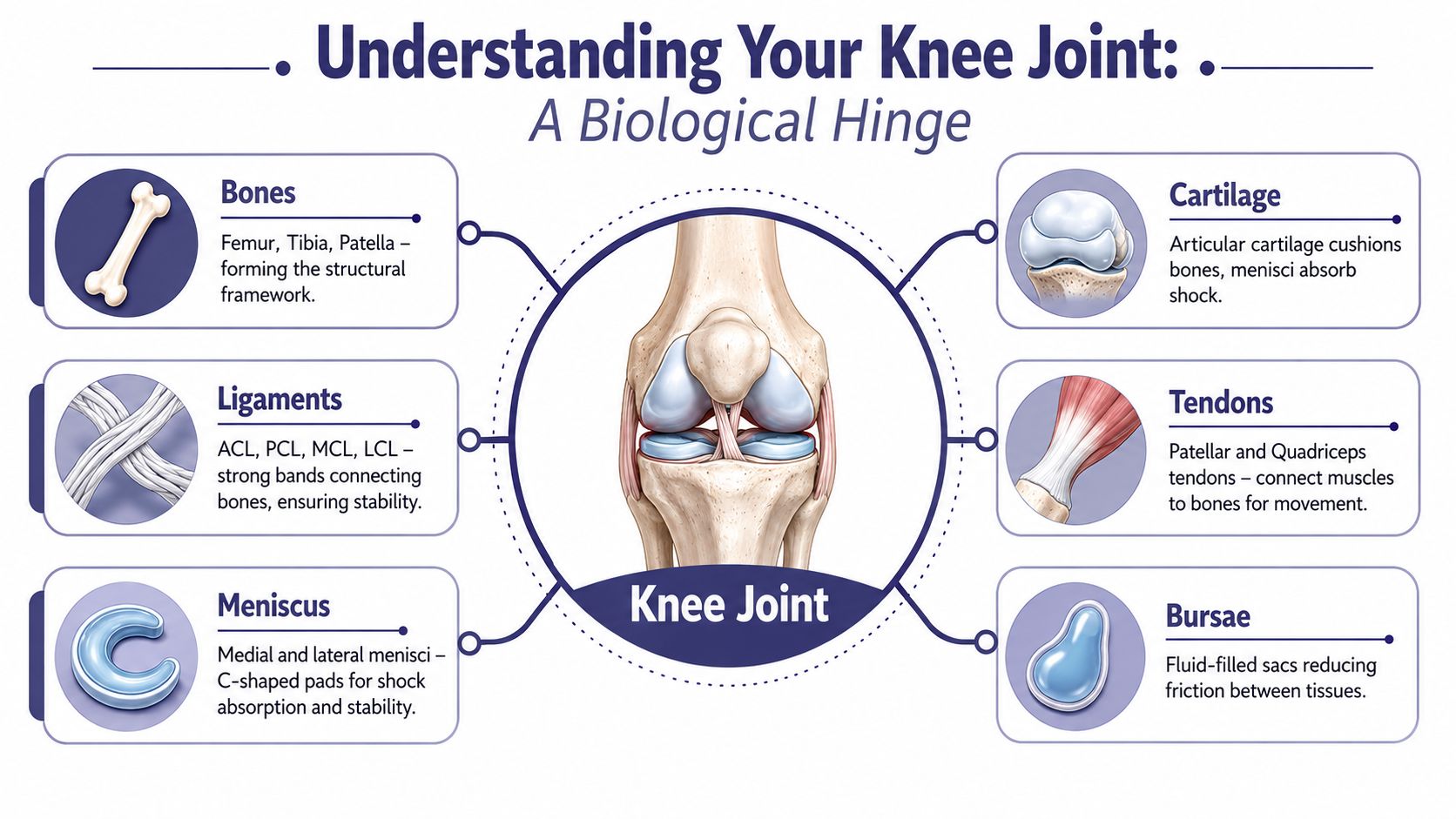
Your knee works like a biological hinge, but it's more complex than a door hinge. It has to bend, straighten, absorb force, and stay stable when you pivot, land, climb, and change direction. When one part stops doing its job, the symptoms often reflect that specific failure.
Bones and cartilage
Three bones form the knee: the femur above, the tibia below, and the patella at the front. The ends of the bones are coated in articular cartilage, a smooth surface that helps them glide.
If you think of the joint as machinery, cartilage is the low-friction lining. When it's irritated or worn, people often describe grinding, aching, stiffness, or pain with prolonged loading.
Menisci and ligaments
Inside the knee sit the menisci, two C-shaped pads that act like shock absorbers and help spread load more evenly across the joint. A meniscal problem often produces pain with twisting and sometimes catching or locking.
The ligaments are the knee's restraint system. The ACL and PCL control forward and backward movement. The MCL and LCL steady the inner and outer sides. If a ligament is overstretched or torn, the knee may feel unstable rather than painful.
A painful knee can still be stable. A damaged ligament often announces itself by making the knee feel unreliable.
Tendons and bursae
Tendons connect muscle to bone. Around the knee, the quadriceps tendon and patellar tendon help you straighten the leg, climb stairs, stand from a chair, and jump. Tendon pain is usually localised. You can often point to it with one finger.
Bursae are small fluid-filled sacs that reduce friction where tissues rub. When one becomes inflamed, the knee can develop a tender, swollen patch that feels more superficial than pain coming from deep inside the joint.
If you keep these roles in mind, many knee injuries symptoms make more sense. Instability suggests support failure. Locking suggests a mechanical issue inside the joint. Front-of-knee ache with stairs often points somewhere very different from a twist-related joint-line pain.
Common Sudden Knee Injuries and Their Symptoms
Sudden injuries usually have a memorable moment. You plant the foot, turn, land awkwardly, collide with someone, or fall directly onto the knee. The key is to connect the mechanism with the symptom cluster rather than chasing one dramatic sign.
Ligament sprains and tears
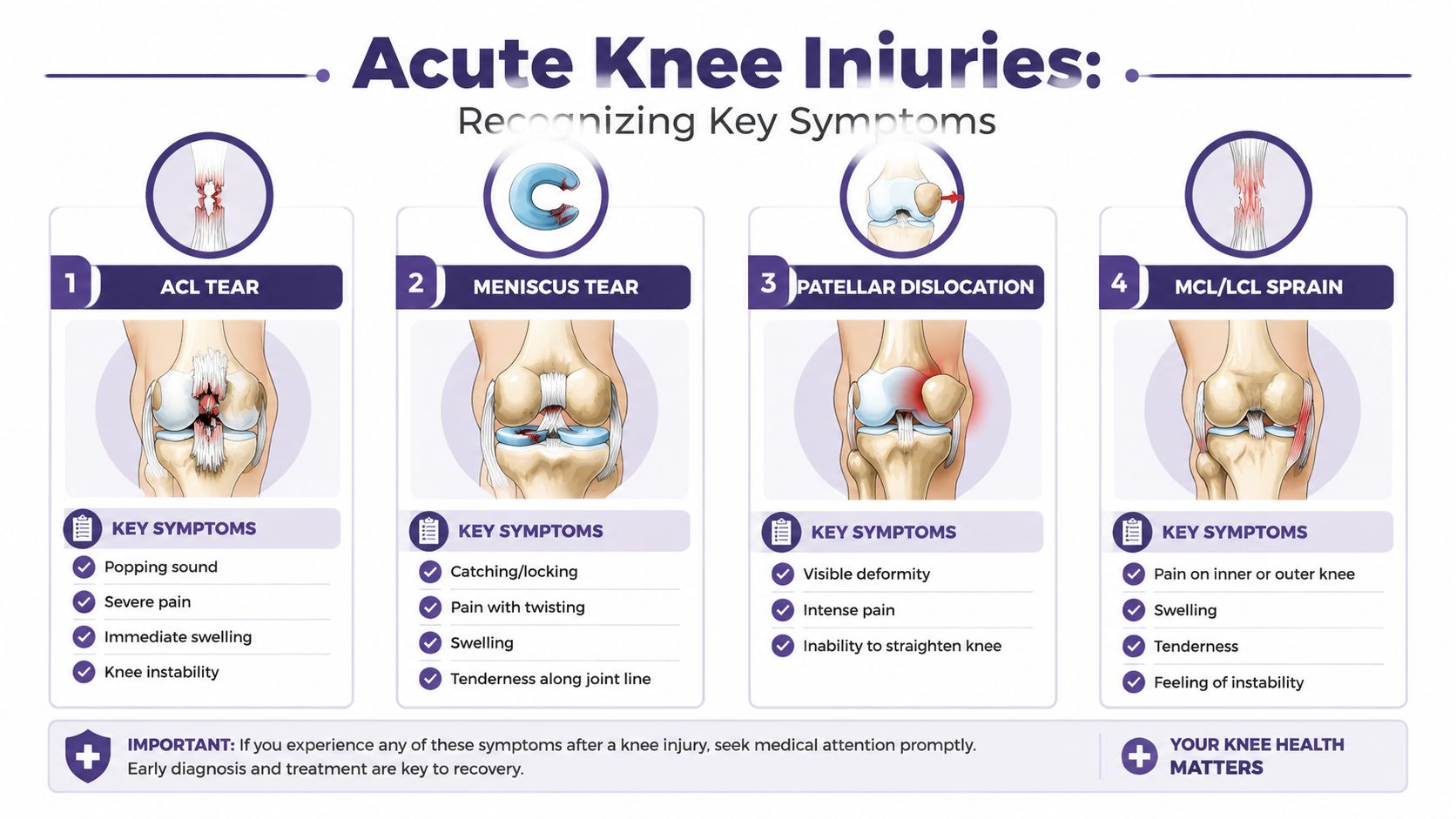
A ligament injury often follows a twist, pivot, blow to the side of the knee, or awkward landing. Patients may report a pop, rapid swelling, and a sense that the knee isn't trustworthy.
ACL-type pattern
Often linked to twisting or landing. Common descriptions include a pop, fast swelling, and instability, especially on turning.MCL or LCL-type pattern
Pain tends to sit on the inner or outer side of the knee, often after the knee is forced sideways. The knee may still move, but it feels tender and less secure.
If you want a more focused explanation of ligament-related patterns, this guide on torn ligament in knee symptoms is a useful companion.
Meniscal tears
Meniscal injuries often happen with twisting on a planted foot, though they can also occur during a squat or awkward pivot. The symptom pattern is usually less about dramatic instability and more about mechanical irritation.
People often say:
- “Something catches when I turn.”
- “It feels stuck.”
- “I can't fully straighten it comfortably.”
- “The pain is right along the joint line.”
Swelling can appear, but the standout feature is usually the feeling that something inside the knee isn't moving smoothly.
When a knee catches or locks after a twist, think mechanical problem before assuming simple strain.
Patellar dislocation
A patellar dislocation means the kneecap has shifted out of place. This often produces immediate pain, obvious distress, and difficulty straightening the knee. Sometimes the deformity is visible at the time of injury and then improves if the kneecap slips back.
This tends to feel different from a general sprain. Patients often describe a sudden shift at the front of the knee rather than a deep internal twist.
Fracture and major structural injury
These are the injuries people should not try to “walk off”. The pattern is more dramatic:
- Visible deformity
- Marked swelling
- Severe pain
- Inability to bear weight
- Loss of normal movement
That combination points away from minor soft-tissue irritation and towards injury that needs prompt assessment.
Symptoms of acute knee injuries at a glance
| Injury Type | Key Symptoms | Common Sensation |
|---|---|---|
| ACL tear | Pop, swelling, instability, pain after twisting or landing | “My knee gave way” |
| Meniscus tear | Catching, locking, pain on twisting, joint-line tenderness | “Something is stuck inside” |
| Patellar dislocation | Front-of-knee pain, visible displacement, trouble straightening | “My kneecap moved out” |
| MCL/LCL sprain | Inner or outer knee pain, tenderness, swelling, reduced confidence in side-to-side movement | “It hurts along one side and feels wobbly” |
What doesn't work well here is guessing from one symptom alone. A pop without instability means less than a pop with rapid swelling and a knee that buckles. A swollen knee after sport isn't automatically a torn ligament. The full pattern matters.
Understanding Gradual Onset Knee Conditions
Not all knee problems begin with one bad step. Many develop gradually over weeks or months. That slower build changes the diagnostic clues. Instead of “I felt it go”, the history becomes “it's been building”, “stairs set it off”, or “it aches after I've been sitting”.
Front-of-knee pain and patellofemoral irritation
A dull ache around or behind the kneecap often behaves differently from an acute sports injury. It may flare with stairs, squats, hills, or long periods of sitting. Some people notice it when they stand after being still for too long.
This pattern often points to irritation around the kneecap rather than a major internal tear. It's common in runners, gym-goers, and people whose hips, glutes, and thigh muscles aren't sharing load efficiently.
Typical clues include:
- Pain at the front of the knee
- Worse on stairs or squatting
- Ache after prolonged sitting
- No single memorable injury moment
Tendon pain and bursitis
Tendon pain is usually more local. Patellar tendon irritation often sits just below the kneecap and feels worse with jumping, sprinting, repeated stairs, or getting up from a chair. Early on, it may ease during activity and return later. With time, it can become stubborn and easier to provoke.
Bursitis feels different again. Patients often describe a more superficial swelling, tenderness to touch, or a puffy area at the front or side of the knee. Kneeling can be particularly aggravating.
A useful distinction is this: tendon problems often hurt with loaded movement, while bursitis often hurts with pressure and friction.
Osteoarthritis and non-injury causes
A gradually stiff, aching knee can reflect osteoarthritis, especially when symptoms are linked to first movement after rest, longer walks, or end-of-day fatigue. Some people notice grinding or crunching. Others mainly feel stiffness and reduced confidence in the joint.
But gradual pain isn't always “wear and tear”. Gout, inflammatory arthritis, and infection can all involve the knee. That's where pattern recognition matters again. A hot, red, swollen joint that feels unwell systemically belongs in a different category from a knee that has slowly become creaky over months.
Not every swollen knee is an injury, and not every painful knee after exercise is a sports problem.
What gradual conditions usually don't look like
Compared with sudden injuries, gradual onset problems are less likely to involve:
- A clear twisting event
- Immediate major swelling
- A dramatic pop with collapse
- Visible deformity
That doesn't make them trivial. They often persist because people either ignore them or keep loading the knee in exactly the way that provokes it.
What works better is adjusting the load early, improving strength and movement control, and getting assessed if the pattern doesn't fit a simple overuse problem or starts to interfere with walking, sleep, or daily life.
Red Flag Symptoms Demanding Urgent Medical Attention
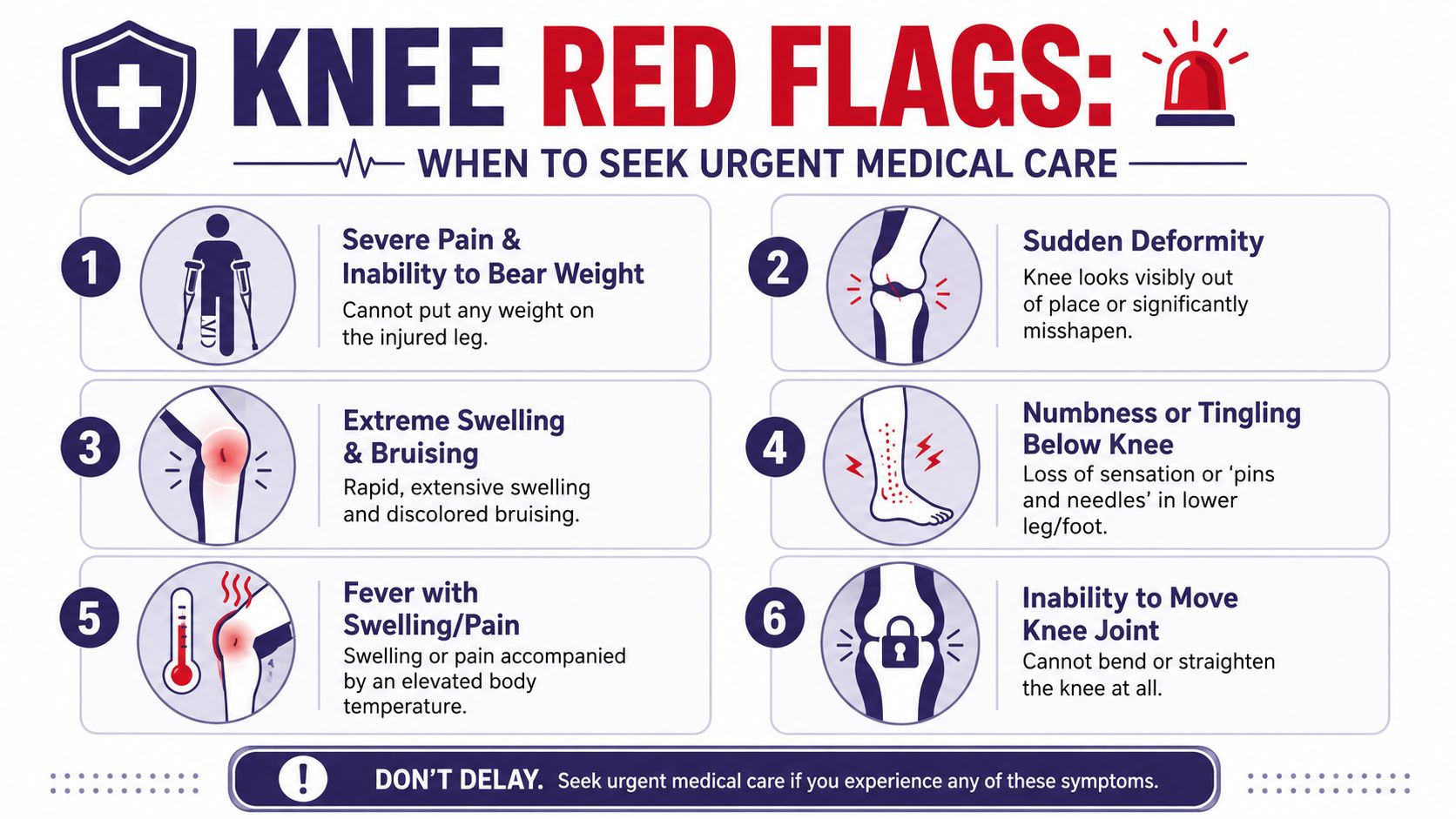
Some knee injuries symptoms are not suitable for trial-and-error self-management. If the knee looks wrong, won't support you, or won't move properly, you need medical assessment.
In UK-style clinical guidance, the pattern that most strongly suggests a significant knee injury is instability or inability to bear weight combined with marked swelling or locking. These are red flags because they suggest structural failure of a ligament, meniscus, or bone rather than simple soft-tissue irritation (Healthdirect knee injury guidance).
Symptoms you shouldn't ignore
You can't bear weight
If the leg won't reliably take your weight, stop pushing through it.The knee is visibly deformed
A misshapen joint raises concern about dislocation, fracture, or major disruption of normal alignment.There is marked swelling, especially after injury
Significant swelling after a twist, fall, or impact deserves assessment.The knee locks or won't fully straighten
This may suggest a mechanical block inside the joint.The knee feels unstable
A buckling or giving-way sensation can signal ligament damage or another important structural issue.The joint is hot, red, swollen, or associated with fever
That combination raises concern about infection or an inflammatory process, not a routine strain.
Why these signs matter
A sore knee after a run can often be watched carefully. A knee that won't bend, won't straighten, or won't hold you up is different. The trade-off is simple. Waiting might save you an appointment if it settles, but it can also delay diagnosis of an injury that needs protection, imaging, drainage, or urgent referral.
If your knee is mechanically failing, this is not the moment for internet reassurance.
One practical point matters here. People often underestimate a “locked” knee. True locking isn't just stiffness because swelling makes movement uncomfortable. It's the sense that the joint physically won't go through its normal arc. That distinction matters, and it's one of the clearest reasons to seek prompt review.
Your Action Plan From Self-Care to a GP Assessment
If your symptoms don't fall into the urgent category, early management still matters. The aim is to settle irritation without making the knee weaker or stiffer than it needs to be.

What to do in the first phase
A practical modern approach is PEACE & LOVE. You don't need to memorise every letter perfectly to use the idea well. The principles are straightforward.
Protect the knee from obvious aggravation
Reduce the movement or activity that clearly provoked the pain. That doesn't mean complete bed rest.Compress if swelling is present
A simple compression bandage or sleeve can help with comfort and swelling control.Avoid doing too much too soon
The common mistake is testing the knee repeatedly. If every twist, squat, or run-through hurts, don't keep checking.Reintroduce movement gradually
Gentle range-of-motion work and sensible loading often beat total inactivity once serious injury has been ruled out.Build back strength and confidence
Recovery depends on progressive loading, not only symptom suppression.
What usually doesn't work
Complete rest for too long
This often leaves the knee stiffer and the surrounding muscles less supportive.Returning to sport because pain is “not too bad”
Pain severity and injury severity don't always match.Using a brace as the whole treatment plan
Support can help, but it doesn't replace diagnosis, rehab, or load management.
When to book an assessment
Clinical guidance aimed at UK-style care suggests that swelling, stiffness, instability, and inability to bear weight warrant assessment, especially if they don't improve within 2 to 3 weeks. Pain that limits walking, or an inability to fully bend or straighten the knee, also points to the need for review (guidance on when knee symptoms need assessment).
You should move from self-care to medical assessment sooner if:
- Walking remains limited
- The knee repeatedly gives way
- You can't fully bend or straighten it
- Swelling keeps returning
- The pain pattern doesn't fit a simple strain
- You need a faster, clearer diagnosis for work, childcare, training, or sport
A good consultation is less about being told to rest and more about sorting the pattern properly. That may involve examining where the pain sits, whether the knee is stable, which movements trigger it, and whether imaging such as ultrasound or MRI is likely to change management.
Proactive Knee Health for Prevention and Recovery
Healthy knees usually come from boring habits done consistently. Strong hips and thighs, sensible training progression, regular movement through the day, and paying attention to recurring symptoms all matter more than any single gadget or support.
One important point is often missed. Persistent knee symptoms aren't harmless background noise. In a major cohort study, knees with chronic symptoms were 1.84 times as likely to sustain a new injury over the following 12 months, which is why ongoing pain, stiffness, or instability should be taken seriously rather than normalised (study on chronic symptoms and future knee injury risk).
A few habits make a real difference:
- Keep body weight in a healthy range so the joint isn't carrying unnecessary load.
- Strengthen glutes and quadriceps to improve alignment and control.
- Break up long sitting periods if you work at a desk. Short walks and mobility breaks help prevent stiffness.
- Warm up before sport and build training gradually rather than jumping straight back in after time off.
- Don't ignore recurring pain after activity. That's often the stage where small adjustments prevent bigger problems.
For practical movement ideas, you can read about joint health support and also explore this guide on how to strengthen knees if you want a more structured approach to building resilience.
If your knee pain is limiting work, training, sleep, or confidence in the joint, The Lagom Clinic offers private GP care with time to assess the full picture and help you move from uncertainty to a clear plan.

 Members Consultation