


You notice it when you reach for your laptop bag, pull a shirt over your head, or try to press overhead in the gym. The shoulder doesn't just ache. It interrupts your day. For busy professionals, it starts stealing time in small, irritating ways. For athletes, it quickly becomes a performance problem.
Facing shoulder pain, individuals often attempt one of two extremes: either pushing through and hoping it settles, or stopping use of the arm almost entirely. Neither approach is usually the right one. Good shoulder pain relief is usually more deliberate than that. It means calming the irritation, keeping safe movement going, and rebuilding strength in a way the joint can tolerate.
Your Action Plan for Shoulder Pain Relief
A familiar pattern in clinic goes like this. Someone has a niggling shoulder for a few days after a long week at a desk, a hard training session, or a poor night's sleep. They ignore it. A week later they can still type, drive, and work, but putting on a coat, lifting a child, or reaching into the back seat has become noticeably harder.
That experience is common, not unusual. A global systematic review reported a median community prevalence of 16% for shoulder pain, with incidence ranging from 7.7 to 62.0 per 1,000 persons per year, and it also noted that symptoms can last beyond 6 months in some people if the problem becomes prolonged (global review of shoulder pain prevalence and course). The practical message is simple. Shoulder pain deserves early attention.
If your symptoms sit more on the left side and you're trying to work out what might be driving them, this guide on left shoulder pain causes and next steps can help you think it through.
A staged plan works better than random fixes
Shoulder pain relief usually improves when you split the problem into phases:
- Immediate phase: calm the pain, reduce obvious aggravators, and avoid the trap of complete inactivity.
- Short-term phase: restore comfortable movement and start low-load control work.
- Long-term phase: rebuild strength, fix repeated triggers, and return to normal training or workload.
Practical rule: If the shoulder is painful, make the task smaller, lighter, or lower. Don't stop moving altogether unless a clinician has told you to.
What this means for a busy person
If you've got meetings, commuting, childcare, or training in your week, you need a plan that fits real life. That usually means short exercise blocks, sensible workstation changes, and clear thresholds for when home management is enough and when it's time to get assessed properly.
The mistake I see most often isn't lack of effort. It's lack of structure. People try ice one day, stretches the next, then test a heavy lift too soon. A better plan is consistent, boring, and effective.
Immediate Steps for Acute Shoulder Pain
The first mistake people make is “resting” the shoulder into stiffness. The second is trying to force it through pain because they don't want to lose progress. Early shoulder pain relief sits between those extremes.
Authoritative guidance from Harvard Health frames movement, activity modification, and rehabilitation as central to recovery, rather than complete rest, and emphasises conservative care first for many non-traumatic shoulder problems (Harvard Health on shoulder pain treatment).

Use relative rest, not complete rest
Relative rest means you temporarily reduce or modify movements that clearly aggravate the shoulder, without shutting the joint down altogether.
That usually means avoiding:
- Heavy pressing or lifting: especially overhead work, loaded carries, or repeated reaching.
- Provocative positions: deep stretches, end-range overhead movement, and sleeping directly on the sore side.
- Repeated irritation: constant mouse use with a shrugged shoulder, awkward driving posture, or repeated sports drills that reproduce the pain.
It doesn't mean wearing a sling all day because the shoulder feels grumpy.
Your first 48 hours
In the acute phase, keep things simple and repeatable.
Reduce the trigger
If the pain started after a specific lift, long desk session, or sport session, step back from that exact trigger for now. You're not stopping all activity. You're stopping the movement pattern that keeps poking the sore tissue.
Use ice if the area feels hot, freshly irritated, or reactive
An ice pack can help settle symptoms after a flare. Wrap it in a towel rather than placing it directly on skin. Keep the aim modest. You're trying to reduce discomfort enough to move better, not “cure” the problem with cold.
Keep gentle movement going
Pendulum swings are often a sensible place to start. Lean forward with the unaffected arm supported on a table or chair and let the painful arm hang loose. Make small, relaxed circles or gentle forward-back movements. The shoulder should feel easy, not forced.
Rehearse normal posture without bracing
Many people react to pain by hiking the shoulder up and tensing the neck. Instead, let the shoulder blade settle down and back softly. Think “long neck, relaxed jaw, easy arm”.
Don't judge recovery by whether the shoulder is silent at rest. Judge it by whether daily movement is becoming easier.
What to avoid early on
A few things regularly slow progress:
- Aggressive stretching: If it sharply reproduces pain, it's too much.
- Testing the shoulder repeatedly: Don't keep checking whether it still hurts by doing the one movement that sets it off.
- Jumping straight to resistance bands or weights: Early loading has its place, but not before basic movement settles.
For many people, the best immediate shoulder pain relief comes from fewer irritants, smarter movement, and patience for a couple of days. That approach often does more than “doing nothing”.
Building Resilience with Progressive Exercises
Once the shoulder is less reactive, the next job is to rebuild capacity. During this rebuilding phase, many recoveries either accelerate or stall. The common error is going too hard, too early, especially with rotator cuff work.
A Cochrane review found that a supervised exercise programme can produce clinically meaningful gains for shoulder pain. In one trial of 56 people with mixed shoulder disorders, recovery at 1 month was greater with a supervised programme, with a risk ratio of 7.74, along with better function and abduction range than placebo (Cochrane review of physiotherapy for shoulder pain).

If you want a clearer sense of how clinicians approach these programmes, this overview of musculoskeletal physiotherapy is a useful companion.
Phase 1 with gentle mobilisation
Your first target is comfortable motion, not strength.
Try:
- Pendulum swings: small and relaxed, as above.
- Table slides: sit facing a table, place the hand on a towel, and slide the arm forward only as far as feels comfortable.
- Assisted wall walks: use your fingers to “walk” the hand up a wall, then stop before pain sharpens.
The key test is what happens afterwards. Mild discomfort during movement can be acceptable. A clear increase in pain later that day usually means you did too much.
Phase 2 with low-load activation
When the shoulder is moving a bit more freely, start waking up the muscles that stabilise it. Keep the load low and the movement tidy.
Useful starters include:
- External rotation isometrics: elbow by your side, forearm bent, gently press the back of the hand into a wall without moving.
- Internal rotation isometrics: same set-up, pressing inward into a doorframe or towel.
- Scapular setting: light shoulder blade control, not a hard military squeeze.
- Band rows: low resistance, slow return, chest open, neck relaxed.
This phase matters because shoulder pain often isn't just about the sore spot. It's also about poor control around the shoulder blade and rotator cuff.
Clinical point: If an exercise makes you compensate with neck tension, shrugging, or trunk twisting, the load is too high or the drill is too advanced.
Phase 3 with functional strengthening
Now you can start building resilience for work, sport, and normal life. This phase should still feel controlled, not heroic.
A practical progression might include:
- Light dumbbell scaption: lifting in the plane of the shoulder with the thumb slightly up.
- Supported pressing variations: if tolerated, starting with a limited range.
- Carries: very light at first, focusing on posture and control.
- Task-specific practice: reaching shelves, swimming drills, racquet prep, or gym patterns adapted to tolerance.
For lifters, pressing often needs temporary adjustment rather than total abandonment. If standard benching irritates the joint, these shoulder-friendly bench press alternatives can help you keep training while symptoms settle.
A weekly rhythm that busy people can stick to
You don't need marathon rehab sessions. Short, regular practice works better.
- Most days: mobility and low-load control work.
- Some days: strengthening once the shoulder tolerates it.
- Daily: reduce unnecessary aggravators, especially poor desk posture and repeated overhead strain.
The shoulder usually responds well to consistency. It doesn't respond well to one hard rehab session followed by three days of neglect.
Your Ergonomic Audit for Work and Life
Shoulder pain often keeps getting fed by the same small daily mechanics. A laptop that's too low. A mouse arm that lives permanently abducted. A heavy bag always carried on one side. A car seat set so far back that every steering movement becomes a reach.
That's why prevention isn't a vague concept. It's environmental design.
A systematic review of workplace interventions found that exercise programmes reduced shoulder-pain intensity by a mean difference of 1.31 points on a 10-point scale, while workstation modifications were associated with a pooled risk ratio of 1.88 for reducing the prevalence of shoulder pain, although the review noted the evidence was low-grade (systematic review of workplace shoulder interventions).
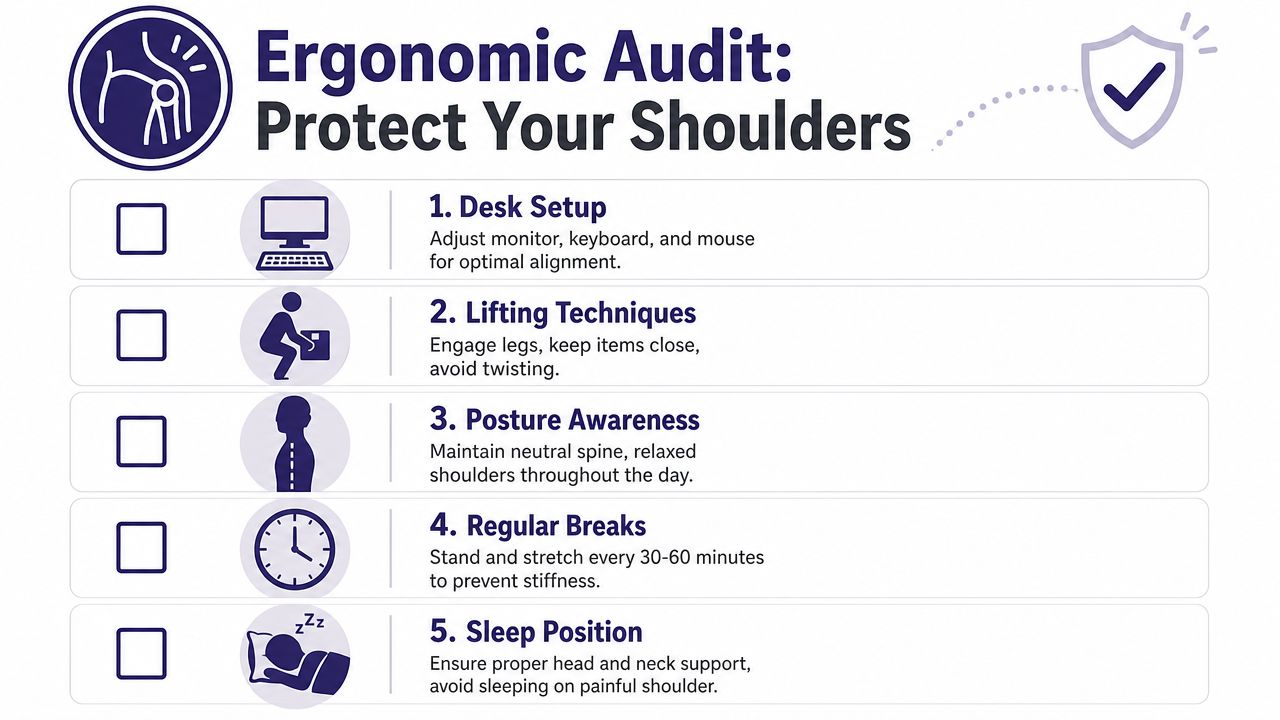
Desk and screen
For desk workers, the shoulder should not spend all day hovering.
Check these first:
- Monitor position: top of the screen roughly at eye level, so you're not dropping the head and rounding the upper back.
- Keyboard and mouse: close enough that elbows can rest near your sides.
- Chair set-up: feet supported, shoulders relaxed, forearms resting rather than suspended.
If you use a laptop for long periods, a separate keyboard and mouse usually help more than trying to “sit better” through poor kit.
Commute and carrying
The commute can undo a good workstation.
Ask yourself:
- Do you grip the steering wheel with lifted shoulders?
- Do you carry a backpack or laptop bag on the same side every day?
- Do you spend long periods looking down at a phone on trains or in queues?
These habits aren't dramatic, but they can keep the shoulder irritated. Swap sides, lighten the bag, and bring the phone higher rather than folding yourself towards it.
Training and home routines
Athletes and active people need an ergonomic audit too. In sport, “ergonomics” usually means technique, training volume, and recovery habits.
- Review form: pressing, serving, swimming, and throwing all become problematic when shoulder blade control is poor.
- Manage spikes in load: weekend warrior sessions after a sedentary week often provoke trouble.
- Check sleep set-up: avoid lying for long periods on the painful shoulder, and use pillow support if the arm feels better slightly supported.
Small changes matter when they remove irritation you repeat every day.
A good ergonomic change doesn't feel dramatic. It just quietly stops the shoulder being annoyed hundreds of times a week.
Smart Pain Management Beyond Pills
Pain relief matters. It helps you sleep, work, and keep moving. But painkillers are support tools, not the main treatment.
For most non-traumatic shoulder pain, I'd rather see someone using simple symptom control while they continue sensible movement and rehab than relying on tablets alone and changing nothing else. Topical anti-inflammatory gels can be useful for some people. Paracetamol or ibuprofen may help in the short term if they're safe for you personally, but they're not a substitute for addressing the cause.
Ice versus heat
The most common question is whether to use ice or heat. The short answer is that both can help, but they help in different situations.
| Therapy | Best For | Mechanism | How to Apply |
|---|---|---|---|
| Ice | Fresh flare-ups, hot or irritated pain, symptoms after aggravating activity | Cools the area and can reduce pain sensitivity | Use an ice pack wrapped in a towel for short periods, then remove and reassess |
| Heat | Stiff, achy shoulders, morning tightness, discomfort before mobility work | Warms tissues and can help movement feel easier | Use a warm pack or hot water bottle with a cover for a short spell before exercises |
Other useful options
Some people find extra relief from:
- Topical anti-inflammatory gels: often worth trying if oral tablets aren't ideal.
- Warm shower before exercises: simple, quick, and often effective for stiffness.
- TENS devices: these can help some people manage pain during a flare. If you're considering one, the Drive Deluxe Dual Channel TENS is an example of the kind of unit people often use at home.
Medication should make movement easier. If it only masks pain well enough for you to overload the shoulder again, it's not helping.
A sensible approach
Use the least medication that gives acceptable relief, for the shortest reasonable period, and combine it with the mechanical fixes already discussed. If you need frequent pain relief just to get through ordinary daily tasks, that's often a sign the shoulder needs a proper assessment rather than stronger self-treatment.
When to See a Doctor for Your Shoulder Pain
Most shoulder pain improves with sensible self-management. Some doesn't. The trick is knowing when to stop experimenting and get examined.
A delay matters when the pain is caused by a significant injury, when the joint has become very stiff, or when weakness is more than simple pain inhibition. It also matters when the diagnosis isn't straightforward. Shoulder pain can come from the joint itself, the rotator cuff, the neck, the upper back, or less commonly from problems that need urgent medical attention.

Red flags that need prompt medical review
Seek urgent assessment if you have:
- Major trauma: a fall, collision, heavy impact, or a shoulder that looks deformed.
- Inability to lift the arm: especially if this came on suddenly after injury.
- Fever or feeling systemically unwell: particularly if the shoulder is also hot and very painful.
- Numbness, marked tingling, or obvious weakness: especially if symptoms extend down the arm.
- Chest symptoms or unexplained breathlessness: shoulder pain isn't always a shoulder problem.
- Rapid swelling or extensive bruising: particularly after an acute event.
These features need more than home advice.
Yellow flags that mean book an appointment soon
You don't need to wait for a crisis.
Arrange a routine review if:
- Pain keeps returning: especially after repeated attempts at rest, ice, and gradual exercise.
- Sleep is regularly disturbed: night pain changes the threshold for assessment.
- Range of movement is shrinking: for example, reaching behind your back or overhead is getting worse, not better.
- You can't train or work normally: if the pain is affecting function, the diagnosis needs clarifying.
- You're relying on painkillers to cope: that's often a sign self-management has reached its limit.
What a proper assessment should include
A useful shoulder consultation is practical, not mysterious. It should include a careful history, a focused examination, and a sensible plan.
That usually means looking at:
- How it started: sudden injury, overuse, desk strain, gym lift, sport, or no obvious trigger.
- Where the pain sits: top of shoulder, front, side, deep joint ache, or pain travelling from the neck.
- What movements provoke it: overhead reaching, dressing, bench press, throwing, sleeping on that side.
- What function is affected: work tasks, childcare, sport, driving, sleep.
An examination should then compare movement, strength, painful arcs, neck contribution, and any signs that suggest instability, frozen shoulder, cuff irritation, or referred pain.
The right diagnosis often saves weeks of random treatment.
What happens after that
Depending on the findings, the next step might be straightforward advice and exercise progression. If symptoms or examination findings suggest something more specific, further help may include:
- Targeted physiotherapy: especially when exercise needs more structure or supervision.
- Private imaging: ultrasound or MRI can be useful when the diagnosis remains unclear or a tendon injury is suspected.
- Injection options: sometimes appropriate for carefully selected cases, but not a substitute for rehab.
- Referral onward: if there's significant weakness, suspected structural injury, or persistent symptoms that aren't improving.
The aim isn't to medicalise every painful shoulder. It's to avoid wasting time when the shoulder has already told you self-management alone isn't enough.
A good rule is this. If the pain is mild, settling, and function is improving, keep going with the plan. If pain is worsening, function is dropping, or the story doesn't fit a simple overuse problem, get it checked.
If your shoulder pain is interfering with work, training, sleep, or day-to-day movement, The Lagom Clinic offers private GP care in Bristol with a practical, whole-person approach. You can get a thorough assessment, individualized advice, and rapid access to onward care such as physiotherapy or imaging when needed.


 Members Consultation