


A simple beginner swimming workout breaks down into three core parts: a warm-up, a main set focused on short, achievable distances like 25 or 50 metres, and finally, a cool-down. The real goal here isn’t speed or distance; it’s about building a solid foundation with good technique and steady breathing in manageable 20-30 minute sessions as part of a healthier lifestyle.
Why Swimming Is Your Best First Step to Fitness
Jumping into a new fitness routine can feel like a massive hurdle, but swimming offers a path that’s both effective and incredibly welcoming. What really sets it apart is its low-impact nature. The water’s buoyancy supports your body, taking the pressure off your joints, tendons, and bones—a key consideration for long-term health.
This makes it a fantastic starting point for nearly anyone—from busy professionals looking to counteract a sedentary lifestyle, to individuals with joint sensitivity, or anyone seeking a sustainable form of exercise. A good swim session is a full-body workout that builds your cardiovascular endurance and muscular strength all at once, something you don't always get from running or lifting weights.
A Powerful Tool for Holistic Health
Swimming isn't just about physical conditioning; it's a significant boost for your mental wellbeing too. The rhythmic motion of strokes and breathing has a meditative quality that can lower cortisol levels and reduce stress. It's a genuine opportunity to disconnect from daily pressures and focus on the sensation of moving through the water.
This unique combination of mind and body engagement is what helps turn swimming from a simple workout into a sustainable lifestyle habit. The benefits ripple out beyond the pool, leading to better posture, improved flexibility, and a real sense of balance in your life.
The Importance of a Structured Start
The appeal of swimming as a cornerstone of fitness is undeniable. The State of the UK Swimming Industry Report highlights this perfectly, showing that over a million people learn to swim each year in facilities managed by Community Leisure UK members. In fact, a massive 96% of public pools offer lessons.
A structured beginner workout plan takes the guesswork out of getting started, helping you build confidence from your very first lap. But before diving in, a medical consultation is always a prudent first step.
An initial health check is a crucial step, especially if you have any pre-existing health conditions or have been inactive for a while. A conversation with a doctor ensures your new routine is safe, appropriate, and perfectly aligned with your personal health goals.
Getting Your Kit and Health in Order Before You Dive In
Setting yourself up for success with a new swimming routine starts long before you get your feet wet. Having the right gear not only makes your swim more comfortable but also gives you a real confidence boost. Equally important is a health screening to ensure this new lifestyle change is safe and sustainable for you.
First things first, let's get you kitted out. You don't need to buy the entire shop at once—just start with the basics and you can always add more specialised gear as you progress. The most crucial item is comfortable and practical essential swimwear.
For a good beginner swimming workout, you’ll want something functional and chlorine-resistant that gives you a full range of motion. Think about a suit that fits snugly but doesn't feel like it’s pinching your shoulders or hips.
Your Core Swimming Kit
Beyond a good costume or trunks, a couple of other items are pretty much non-negotiable for a decent swim.
Goggles: A good pair of goggles is probably your most important investment. They protect your eyes from chlorine and, crucially, let you see what you're doing underwater. This is key for achieving correct head position and form. Look for a pair with a double strap and an adjustable nose piece to get that perfect, leak-proof seal.
Swim Cap: While you don't strictly have to wear one, it is highly recommended. A cap keeps your hair out of your face, makes you more streamlined in the water, and protects your hair from chlorine damage. Silicone caps usually last longer and feel more comfortable than the old-school latex ones.
Once you’ve got these basics sorted, you could think about adding a few training aids. A kickboard is brilliant for isolating your legs so you can focus on building a stronger kick. A pull buoy, which you pop between your thighs, does the opposite—it lets your legs float so you can concentrate entirely on your arm stroke and build upper-body strength.
The Most Important First Step: A Health Check
Before you even book your first pool session, it’s vital to consider your current health. Swimming is a wonderfully low-impact activity, which is why so many people love it, but starting any new exercise plan requires a bit of common sense. This is particularly true if you’ve been inactive for a while or you're managing an existing health condition.
A pre-exercise health screening isn’t just a box-ticking exercise; it’s the bedrock of a smart, safe fitness journey. It provides you with personalised medical guidance and the peace of mind to start swimming with confidence.
There are certain conditions where it’s always best to consult with your GP first. I’d recommend booking a consultation if you have any history of:
- Heart conditions: This includes high blood pressure, a previous heart attack, or any known cardiac arrhythmias.
- Respiratory issues: If you have asthma or COPD, you'll need a clear management plan for exercise-induced symptoms.
- Joint problems: For anyone with arthritis or a previous injury, a doctor can give you advice on how to adapt your swimming to avoid causing a flare-up. You might also find some helpful tips in our guide on how to prevent sports injuries.
- Diabetes: Exercise affects blood glucose levels, so getting clear medical advice on how to manage this is absolutely essential.
Here at The Lagom Clinic, we can offer a thorough health assessment, checking your vital signs and talking through your medical history. This quick check-up ensures that a beginner swimming workout is the right move for you. It also allows us to give you tailored advice to help you hit your goals safely and effectively.
Your First Month: A Structured Swimming Plan
Jumping into a new habit can feel daunting, but a little structure makes all the difference, especially in the pool. This four-week plan is designed to ease you into a consistent swimming routine, with just two manageable sessions per week.
Forget about speed or smashing out endless lengths. For now, it’s all about getting the fundamentals right: your breathing, how you hold your body in the water, and the basics of a good stroke. This plan takes the guesswork out of it, so you can walk onto the poolside knowing exactly what you’re doing.
Following this structure helps turn that initial burst of enthusiasm into a lasting, healthy habit.
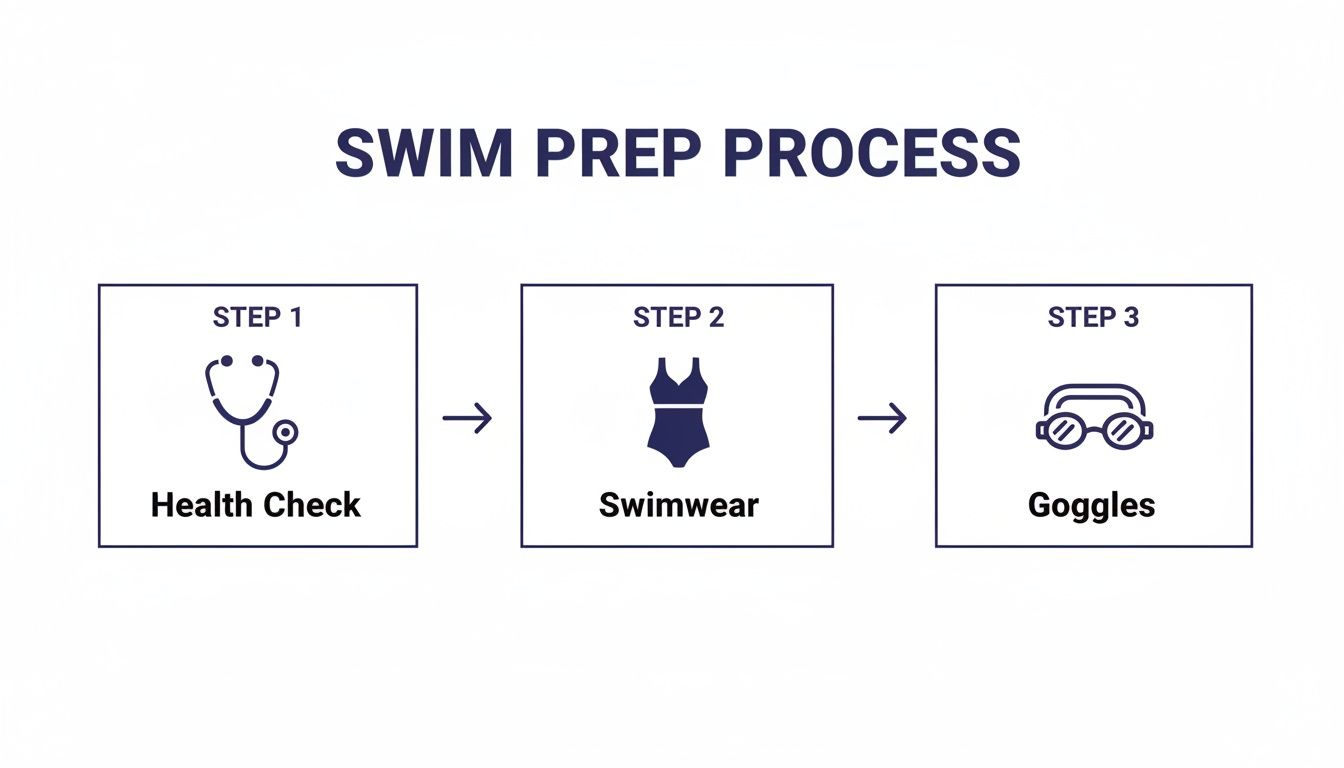
This simple flow is a great reminder that a good workout always starts with being properly prepared.
Week 1: Getting Comfortable in the Water
Your first week is purely about acclimatisation. The main goal here is simple: get comfortable putting your face in the water and learn to breathe out steadily while you’re submerged. Don't even think about swimming full lengths just yet. The focus is 100% on control and relaxation.
Session 1: Breathing and Balance
- Warm-up (5 minutes): Start by just walking back and forth across the shallow end. This helps your body get used to the water’s resistance and hydrostatic pressure. Then, grab the side of the pool and practise bobbing up and down, blowing a gentle stream of bubbles through your nose and mouth every time your head goes under.
- Main Set (15 minutes):
- 4 x 25m Kick with a Kickboard: Hold the board out front with straight arms. Kick gently from your hips, making sure your feet stay just below the surface. Try putting your face in the water to blow bubbles, lifting your head only when you need a breath. Rest for 30 seconds after each length.
- 4 x Streamline Glides: Stand in the shallow end and gently push off the wall in a streamlined position—arms stretched overhead, one hand over the other. See how far you can glide without kicking or pulling. The aim is to feel your body moving through the water with minimal effort.
- Cool-down (5 minutes): Finish with a bit of slow walking or some gentle floating on your back to let your heart rate settle.
Session 2: Introducing Propulsion
Use the same warm-up as Session 1. This time, we’re going to introduce a simple arm movement into the main set.
- Main Set (15 minutes):
- 4 x 25m Kick with a Kickboard: Just like before, focusing on that consistent kick and controlled breathing.
- 4 x 25m Single-Arm Freestyle Drill: Hold the kickboard with one hand and swim a length using only the other arm. This is a brilliant drill for isolating the pulling motion. Switch arms on the next length. Rest for 30–45 seconds between each one.
- Cool-down (5 minutes): Some easy kicking with the board or more gentle back-floating will do the trick.
Week 2: Building a Basic Stroke
Now that breathing and kicking feel a bit more natural, it’s time to start piecing together the freestyle stroke. We're keeping the distances short so your focus stays firmly on good form.
Session 1: Coordinating Arms and Kick
- Warm-up (5 minutes): Do 2 x 25m of easy kicking with a board, then 2 x 25m of the single-arm drill from last week.
- Main Set (15 minutes):
- 6 x 25m Freestyle Swim: This is it—time to try swimming a full length. Speed is irrelevant. Concentrate on long, smooth arm strokes and a steady, gentle kick. Your only goal is to finish the length feeling in control, not breathless. Take a generous 45-second rest after each length.
- Cool-down (5 minutes): 2 x 25m of very slow kicking on your back.
Session 2: Increasing Repetitions
- Warm-up (5 minutes): Same as the previous session.
- Main Set (15 minutes):
- 8 x 25m Freestyle Swim: We’re just adding a couple more lengths here. The focus remains the same: good technique and calm breathing. If you feel your form starting to degrade, take a longer rest. Quality beats quantity every time at this stage. Rest for 30–45 seconds.
- Cool-down (5 minutes): A 50m very easy swim, using whatever stroke feels most comfortable.
Remember, a good beginner’s workout isn't about pushing to exhaustion. It's about showing up consistently and making small, steady progress. Listen to your body—if you need extra rest, take it. This is key to preventing injury and making exercise a sustainable part of your life.
Week 3: Developing Endurance
This week, we’ll start building a little stamina by introducing 50-metre swims. This is your first test of maintaining technique over a slightly longer distance.
- Warm-up (5 minutes): A 100m mix of kicking and single-arm drills.
- Main Set (20 minutes):
- 4 x 50m Freestyle Swim: This is your main event for the week. The challenge is to swim two consecutive lengths without stopping. The key is to find a relaxed, sustainable pace right from the start—don't sprint the first length! Rest for a full 60 seconds after each 50m to make sure you’re recovered for the next one.
- Cool-down (5 minutes): Finish with a 100m easy, slow swim.
Week 4: Consolidating Your Skills
In the final week of your first month, the goal is to pull everything together. We’ll increase the total distance slightly to build your confidence and cement what you’ve learned.
- Warm-up (5 minutes): A gentle 100m swim, mixing freestyle and kicking.
- Main Set (20 minutes):
- 2 x 50m Freestyle Swim: Start with two 50s to find your rhythm. Rest for 45 seconds between them.
- 4 x 25m Freestyle Swim: After the 50s, drop back down to single lengths. Try to hold onto that good form you found in the longer swims. Rest for 30 seconds between these.
- Cool-down (5 minutes): A final, relaxing 100m slow swim to wrap up your first month.
By now, you'll have built a solid foundation and a consistent routine. You should feel far more confident in the water and ready to tackle slightly more challenging workouts.
Your Beginner Swimming Workout At a Glance (Weeks 1-4)
This table provides a summary of the weekly focus and sample drills to guide your first month in the pool.
| Week | Main Focus | Sample Drill | Session Duration |
|---|---|---|---|
| Week 1 | Water comfort, breathing & balance | Kickboard drills, streamline glides | 25-30 minutes |
| Week 2 | Piecing together the full stroke | Single-arm freestyle, full-stroke 25s | 25-30 minutes |
| Week 3 | Building basic endurance | First 50m continuous swims | 30-35 minutes |
| Week 4 | Consolidating form and fitness | Mixed 25m and 50m sets | 30-35 minutes |
This structure provides a clear path forward, helping you build skills progressively without feeling overwhelmed. Stick with it, and you'll be amazed at how far you've come in just four weeks.
Building a Strong and Efficient Freestyle Stroke
So, you're starting to feel comfortable in the water. That's fantastic! Now we can shift our focus from just getting from one end to the other, to moving with purpose. This is where the real fun begins.
The freestyle stroke, or front crawl, is the cornerstone of fitness swimming for good reason. It’s rhythmic, efficient, and gives you an incredible full-body workout. Improving your freestyle isn't about becoming an Olympian overnight; it’s about making small, smart tweaks that make a huge difference in how you feel in the water.
A solid, efficient stroke means you can swim for longer without getting winded, turning your pool sessions into a sustainable part of your lifestyle. Let's break it down into the three pillars of a great freestyle: body position, kicking, and breathing. Nail these, and you'll unlock a much smoother, more powerful swim.
Mastering a Streamlined Body Position
Think of your body like a speedboat. The flatter and more level it is on the water, the less resistance it creates. In swimming, we call this being streamlined. Your goal is to keep a straight, horizontal line from your head right down to your toes.
The most common mistake beginners make is letting their hips and legs sink. This creates significant drag, forcing you to work much harder. An easy fix? Gently press your chest down into the water. It sounds counterintuitive, but this small movement helps to lever your hips and legs up towards the surface.
A crucial piece of the puzzle is keeping your head in a neutral position. You want to be looking directly at the black line on the bottom of the pool, not at the wall ahead. Lifting your head is a natural instinct, but it's the primary cause of sinking hips. Trust the line to guide you.
Finally, engage your core muscles—the same ones you’d use to hold a plank. A strong core connects your upper and lower body into one solid unit, preventing inefficient 'wiggling' and helping you glide through the water.
Developing a Powerful and Steady Kick
Your kick does more than just push you forward. It's your engine for stability and lift, keeping your lower body from sinking. For freestyle, you’re aiming for a gentle but continuous "flutter" kick that originates from your hips, not your knees.
Imagine your legs are long and loose, like fins. The power should come from your glutes and hips, with just a slight, natural bend in the knee. Keep your ankles relaxed and toes pointed, so your feet can 'whip' the water. A stiff, 'bicycle' kick where you bend your knees too much is a huge energy-waster and creates a ton of drag.
Want to work on your kick? Try these drills:
- Kickboard Drills: Grab a kickboard to isolate your legs. Focus on making small, quick kicks that just break the surface of the water. You're looking for a gentle "boil," not a giant splash.
- Vertical Kicking: Head to the deep end and tread water using only your flutter kick. This is a brilliant way to build leg strength and really feel how your kick provides that essential lift.
A steady kick is the foundation for a balanced, powerful stroke.
Mastering Rhythmic Breathing
Let’s be honest, this is the biggest hurdle for most new swimmers. The secret isn't taking huge, frantic gulps of air. It’s about developing a calm, predictable rhythm of exhaling and inhaling. And the most important part of this happens underwater.
You should be exhaling the entire time your face is in the water. A fantastic technique to practise is trickle breathing—just let out a slow, steady stream of bubbles from your nose and mouth. This ensures your lungs are already empty and ready for a quick, relaxed inhale when you turn your head.
When it's time to breathe, rotate your head to the side as a natural extension of your body rolling. Try to keep one goggle in the water. Think of it less like lifting your head up and more like turning it on a spit. This simple change keeps your body aligned and streamlined.
For your beginner swimming workout, one specific drill can make all the difference here:
- The Catch-Up Drill: As you swim freestyle, leave one hand stretched out in front until the other hand "catches up" to it before you begin the next pull. This drill forces you to slow down, encouraging a longer, more graceful stroke and giving you plenty of time to concentrate on your body roll and breathing.
By breaking the freestyle stroke down into these three parts—body position, kick, and breathing—you can focus on improving each one. With just a bit of practice, you'll see them start to click together into a smooth, efficient, and genuinely enjoyable swimming style.
How to Keep Progressing After Your First Month
You’ve put in the work for a month and built a solid foundation in the pool—that's a huge win. The real trick now is to keep that momentum going and challenge yourself in a way that’s smart, not just hard. This is where the principle of progressive overload comes in. It’s all about gently increasing the demands on your body so you continue to adapt and get fitter.
This doesn't mean you need to suddenly double your pool time or thrash your way through every length. Think smaller. Think smarter. Try adding just one or two extra lengths to your main set each week. Or maybe trim your rest time between reps. If you were taking 45 seconds of rest after a 50-metre swim, see how 40 seconds feels.
These small, incremental adjustments are what prevent your body from plateauing, ensuring you continue to improve your stamina and strength.
Introducing New Challenges to Your Workout
To stop things from getting stale, it's a good idea to start mixing things up. One of the best ways to do this is with some simple interval training. This just means switching between faster and slower swimming during your session.
For example, you could try a set of 8 x 25 metres. Swim the first length at a moderately higher intensity, then swim the next one at a very easy recovery pace. This is a fantastic way to improve cardiovascular fitness without causing excessive fatigue.
Another great way to progress is to start learning a second stroke. If you've spent the last month nailing your freestyle, why not give backstroke a try?
- It works different muscles: Backstroke engages your posterior chain—your back, glutes, and hamstrings—helping you build a more balanced physique and preventing muscular imbalances.
- It improves your "feel" for the water: Swimming in a completely different orientation makes you much more aware of how your body moves and interacts with the water.
- Breathing is a non-issue: With your face out of the water, you can put all your focus into your body position and arm technique without worrying about when to breathe.
Listening to Your Body for Sustainable Progress
As you start to increase the intensity or duration of your swims, it becomes even more important to listen to your body’s feedback. Mild muscle soreness (Delayed Onset Muscle Soreness or DOMS) is normal—it's a sign your muscles are adapting. But you need to learn the difference between this and the first sign of an injury.
Your body gives you constant feedback. Learning to interpret it is one of the most important skills for long-term fitness. Pushing through sharp or persistent pain is counterproductive and can set you back for weeks.
Remember, recovery is just as important as the workout itself. Ensure you are getting adequate sleep, staying hydrated, and eating a balanced diet. As you build your swimming fitness, adding recovery tactics can make a huge difference. For a deeper dive, check out the sauna benefits for athletes to see how heat can aid muscle recovery.
Structured learning isn't just for getting fit; it's about building fundamental life skills. A 2026 Swim:ED report revealed a shocking statistic here in the UK: one in three children leaves primary school unable to swim 25 metres. Their pop-up pool programme, however, helped 91.1% of 15,382 children across 118 schools hit that benchmark, which just goes to show what a proper plan can do.
That same principle applies to you. A well-thought-out plan is your safest and most effective route to becoming a confident swimmer. For more ideas on how to structure your sessions as you advance, take a look at our detailed swim training plan.
Your Top Questions About Learning to Swim
Starting anything new brings a wave of questions, and swimming is no different. It's perfectly normal to feel a bit unsure before you take the plunge, but getting some clear, medically-sound answers can make all the difference. Think of this as your poolside pep talk.
We'll tackle the most common queries we hear from beginners, giving you the practical health advice you need to build a safe, sustainable swimming habit that will serve you for years to come.
How Often Should a Beginner Swim?
When you’re just getting started, forget about speed and intensity. The real goal is consistency. It’s so easy to go too hard, too soon, which is a classic recipe for feeling burnt out or even picking up an injury. Instead, focus on letting your body adapt to moving in a new way and building that crucial muscle memory for your technique.
For most people dipping their toes in, two to three sessions a week is the sweet spot. Aim for each swim to last between 30 and 45 minutes. This schedule gives your muscles and connective tissues enough time to recover and strengthen between workouts, which is a critical part of the physiological adaptation process. Spacing your swims out—say, Monday, Wednesday, and Friday—is a great way to ensure you're getting that vital rest.
Is Swimming a Good Choice if I’m Not Very Fit?
Absolutely. In fact, it's one of the best activities you can choose. The magic of swimming lies in the water itself. Its natural buoyancy supports around 90% of your body weight, which takes a huge amount of stress and impact off your joints, bones, and muscles.
This makes swimming a fantastic starting point if you're carrying a bit of extra weight, managing a condition like arthritis, or just getting back into exercise after a break. You are completely in charge of the pace. You can start gently and build up your fitness at a speed that feels right for you, making it a safe and effective path to better health without the strain of many land-based workouts.
Swimming is a powerful tool for rebuilding fitness because it allows for a full-body cardiovascular workout with minimal orthopaedic stress. This is particularly beneficial for deconditioned individuals, as it mitigates the risk of joint-related pain that can often derail new exercise regimens.
What if I Have a Fear of the Water?
Feeling anxious in the water is incredibly common, so you are definitely not alone. The most important thing is to be patient with yourself and never push past what feels comfortable. The key is gradual exposure in a controlled, safe environment.
Here are a few gentle steps that can make a huge difference:
- Start in the shallow end. Seriously, just begin where you can stand with your feet firmly on the pool floor. Spend some time walking back and forth, getting used to the sensation of the water moving around you.
- Practise your breathing. A lot of water anxiety is tied to breathing. Try simply putting your face in and blowing bubbles. It’s a small act, but it gives you a sense of control and helps relax your facial muscles.
- Use a kickboard. A kickboard is your best friend when you're starting out. It provides support and stability, letting you focus on one thing at a time without worrying about staying afloat. It's a fantastic confidence-builder.
It's also worth checking your local pool. Many offer adult beginner lessons specifically designed to help people overcome this fear in a supportive and structured setting.
Do I Need to See a Doctor Before I Start Swimming?
For most healthy adults, starting a low-impact activity like swimming is generally very safe. That said, a pre-exercise medical consultation is always a sensible precaution, and it becomes even more important in certain situations.
We strongly advise a check-up with your GP if you have been inactive for a long time, are over the age of 45, or have a known chronic health condition. This would include things like:
- Heart disease or high blood pressure
- Diabetes
- Asthma or other respiratory conditions
- Significant joint problems or a history of musculoskeletal injuries
A quick chat with a professional can flag any potential risks and give you personalised advice. This ensures your new beginner swimming workout is not just effective but, most importantly, safe for your long-term health.
At The Lagom Clinic, our goal is to provide proactive, personalised healthcare that fits your life. If you have any health concerns before starting a new fitness plan, or if you're looking for expert advice on building a sustainable wellness routine, we are here to help. Visit us at The Lagom Clinic to book a consultation and start your health journey with confidence.

 Members Consultation