


Mild tendon injuries often improve within 2 to 3 weeks, but more significant tears or ruptures commonly need 12 to 16 weeks for initial healing, and full tendon remodelling can continue for longer than 12 months. That's why a single answer to how long do tendons take to heal is misleading. The tendon can feel calmer well before it is structurally ready for sport, lifting, or repeated high load.
The advice people hear most often is simple: rest until it stops hurting, then get back to normal. That sounds sensible, but it's one of the main reasons tendon problems drag on or flare again.
A runner's Achilles may settle enough for walking. A parent with elbow pain may get through the workday. A gym-goer may find their shoulder is no longer painful at rest. None of that automatically means the tendon is ready for impact, heavy gripping, overhead work, or explosive training.
Pain matters, but pain alone is a poor return-to-activity test. Tendons recover in stages, and the slow part is often unseen. If you understand that mismatch between symptom relief and tissue recovery, you make better choices about loading, exercise, work, sleep, and when to get proper assessment.
Why Feeling Better Is Not the Same as Healed
Most patients don't struggle because they're careless. They struggle because the body gives mixed signals. The tendon feels better, daily life becomes easier, and it's natural to assume healing is nearly complete.
That assumption causes trouble. Mild tendon injuries often improve within 2 to 3 weeks according to NHS guidance on tendonitis. But that same broad picture is very different for more significant injuries, where initial healing commonly takes 12 to 16 weeks, and deeper tissue remodelling continues far longer.
Symptoms usually improve before the tendon is ready
Pain often settles before strength, stiffness tolerance, and load capacity return. That's especially true when someone reduces aggravating activity for a short period. The irritated tendon gets a break, so it complains less. But less pain isn't the same thing as restored tissue quality.
Practical rule: If your tendon feels better only because you've stopped asking much of it, you haven't tested healing. You've tested avoidance.
Often, busy people fall into a trap. They don't want months off life. So they use a short improvement in pain as permission to rush back to running, tennis, CrossFit, DIY, or long days on their feet. The tendon may cope briefly, then react again once the load rises.
Recovery needs a phased mindset
A tendon doesn't recover on a calendar alone. It recovers when loading is rebuilt in the right order. In practice, that means thinking in phases:
- Settle symptoms first: Reduce the movements and volumes that clearly flare it.
- Rebuild capacity next: Add controlled exercise so the tendon can tolerate more.
- Return gradually: Reintroduce sport or heavy work in steps, not in one jump.
- Watch the response: Morning stiffness, post-exercise pain, and swelling can tell you more than how it feels in the moment.
If symptoms aren't improving within a few weeks, or you suspect a rupture, NHS advice is to seek medical review. That matters because the treatment plan for a mild irritated tendon is very different from the plan for a tear.
The Three Phases of Tendon Healing
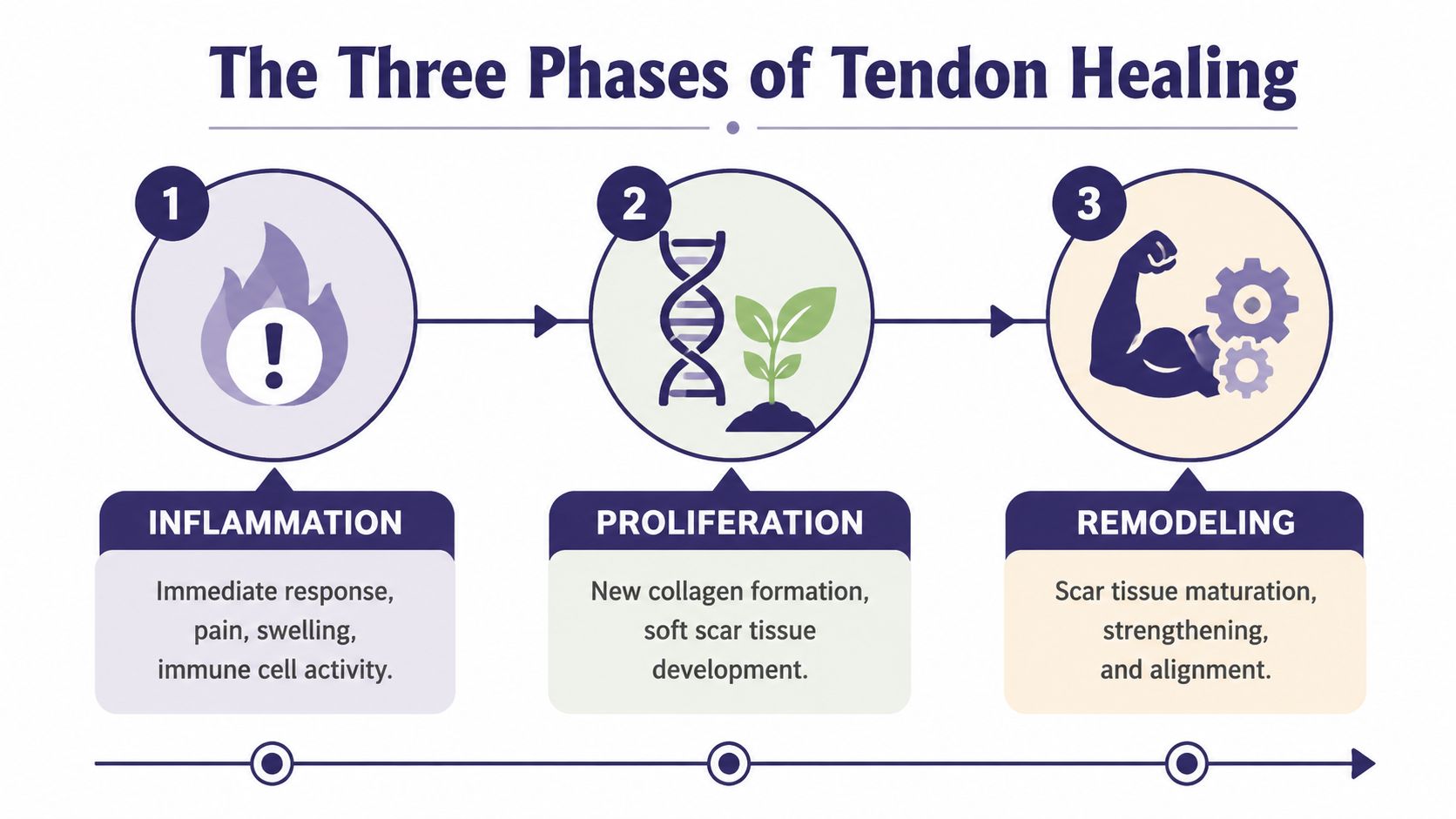
Tendon healing works more like road repair than like switching a light back on. First the area is secured and cleaned up. Then temporary material is laid down. Only later is that structure reorganised into something stronger and more functional.
Inflammation
This is the immediate response after injury. The body sends cells and chemical signals to the area. You may notice pain, swelling, warmth, and reduced tolerance for movement or loading.
Inflammation gets a bad reputation, but some of it is part of normal healing. The problem isn't that inflammation exists. The problem is either overwhelming the tendon too early or trying to suppress every symptom while ignoring the reason it was overloaded in the first place.
Proliferation
In the proliferative phase, the body starts laying down new tissue. A peer-reviewed review on tendon healing biology describes this phase as typically lasting 7 to 21 days, while the later remodelling phase begins months after injury and can continue for longer than 12 months.
That new tissue is useful, but it isn't mature. Think of it as temporary scaffolding. It helps bridge the problem, but it doesn't yet behave like a well-organised tendon built for repeated force.
Early improvement is often real. It's just not the same as full mechanical recovery.
Remodelling
This is the long game. The tendon gradually reorganises and strengthens. Fibres align more effectively when the tendon is exposed to sensible, progressive load. Too little stimulus can leave the tissue underprepared. Too much, too soon can keep irritating it.
A simple way to think about it:
| Phase | What's happening | What usually helps |
|---|---|---|
| Inflammation | The body reacts to injury and begins clean-up | Relative rest, symptom control, avoiding obvious overload |
| Proliferation | New collagen is laid down as early repair tissue | Gentle, appropriate movement and guided loading |
| Remodelling | Tissue matures and adapts to force over time | Progressive strengthening and graded return to activity |
Why this matters in real life
If you only judge progress by pain at rest, you'll often move ahead too fast. A tendon has to tolerate the specific load you need from it. That might be sprinting, climbing stairs at speed, carrying children, typing all day, or lifting overhead.
Patients do best when they stop asking “does it hurt today?” and start asking better questions:
- How does it feel the next morning?
- Can it tolerate a little more than last week?
- Am I rebuilding strength, not just avoiding pain?
Realistic Timelines for Common Tendon Injuries
People searching how long do tendons take to heal usually want a straightforward number. The honest answer is that the range depends far more on severity than on location alone.
A mild irritated tendon and a ruptured tendon are not the same injury. Treating them as if they share one timeline leads to bad planning, especially if you're trying to organise work, childcare, training, or a return to sport.
A practical timeline table
The table below gives broad planning ranges using only the verified milestones available. Use it as a starting point, not a guarantee.
| Injury Location | Mild (Tendinopathy) | Moderate (Partial Tear) | Severe (Rupture/Surgical Repair) |
|---|---|---|---|
| Achilles | Mild cases may improve in 2 to 3 weeks if they fit the pattern of a mild tendon injury | Often longer and more variable. Needs individual assessment | Initial healing commonly 12 to 16 weeks |
| Rotator cuff | Mild cases may improve in 2 to 3 weeks if irritation is minor | Often longer and influenced by function demands | Initial healing commonly 12 to 16 weeks |
| Tennis elbow | Mild cases may improve in 2 to 3 weeks | Often longer and load-dependent | Severe tearing patterns need specialist review and may follow 12 to 16 weeks or more |
| Patellar tendon | Mild cases may improve in 2 to 3 weeks | Often longer and commonly aggravated by jumping, stairs, or gym work | Initial healing commonly 12 to 16 weeks |
What the table doesn't show
The table is deliberately cautious. It doesn't pretend every tendon has the same behaviour, and it doesn't invent precise injury-specific figures where the evidence provided doesn't support them.
What matters clinically is the decision-making behind the timeline:
- Mild irritation can settle quickly if load is adjusted early.
- Partial tears vary. Imaging, function, pain behaviour, and job or sport demands all matter.
- Rupture or surgery changes the conversation entirely. Rehab has to respect tissue protection as well as gradual strengthening.
If you're also planning a return after major lower-limb injury, expert sports PT advice for ACL recovery is useful because it explains the same principle seen in tendon rehab: feeling improved and being ready for full sport are not the same thing.
For knee-related overload, our guide to patellar tendonitis treatment goes into the practical details of progressing exercise without repeatedly aggravating the tendon.
Good rehab uses time as one factor. It doesn't use time as the only factor.
Key Factors That Speed Up or Slow Down Healing
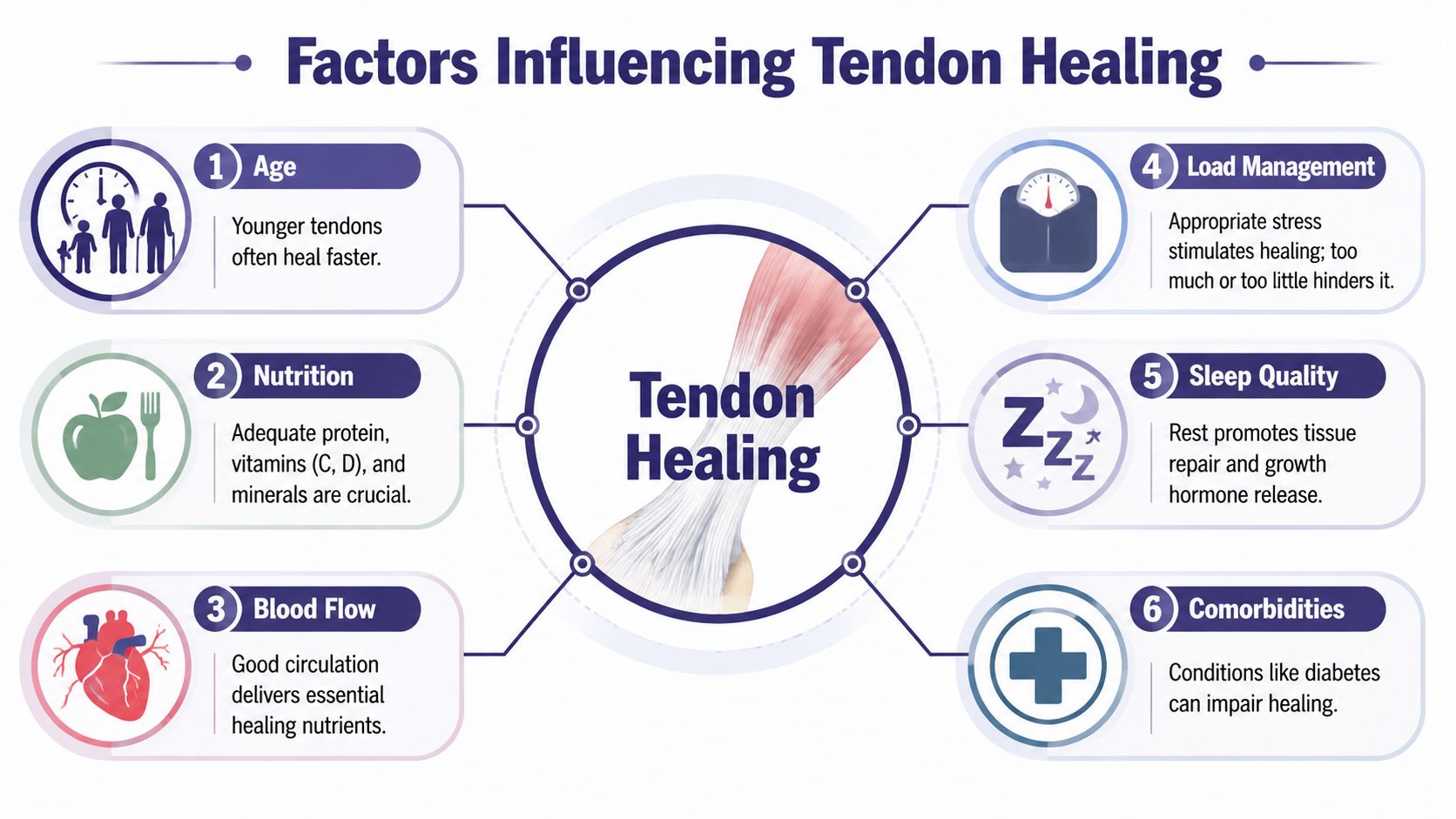
Two people can have the same diagnosis and recover very differently. That's frustrating, but it isn't random. Tendon healing responds to the environment you give it.
Load is the biggest practical lever
Too much load keeps the tendon irritated. Too little leaves it deconditioned. The middle ground is where progress happens.
Common mistakes include stopping all activity for too long, then returning with a sudden jump in steps, hill running, lifting volume, racquet play, or overhead work. Tendons prefer consistency more than heroics.
A useful weekly question is not “can I push through?” but “did the tendon tolerate the last increase well enough to earn the next one?”
Sleep, food, and hydration are not side issues
Recovery is slower when the basics are poor. If sleep is fragmented, meals are erratic, and hydration is poor, the body has less support for repair and adaptation.
Focus on habits you can repeat:
- Protein across the day: Regular intake supports tissue repair and maintenance.
- Vitamin C-rich foods: These fit well into a general eating pattern that supports collagen-related healing processes.
- Hydration: Tendons don't need trendy drinks. They need you not to run on dehydration and caffeine alone.
- Steady meal timing: Busy professionals often under-eat during the day, then overload late in the evening. That pattern doesn't help training or recovery.
If you're comparing soft-tissue recovery more broadly, this overview on how to speed up muscle strain healing is useful because it highlights the same lifestyle pillars that matter in tendon rehab.
Health status and daily behaviour matter
Some factors are harder to change quickly, such as age or underlying medical conditions. Others are highly modifiable.
Consider these common recovery blockers:
- Smoking: It works against tissue health and recovery.
- Poorly managed long-term conditions: These can interfere with healing quality and exercise progression.
- Repeated “testing” of the tendon: Patients often poke at recovery by doing too much every time it feels slightly better.
- Stress overload: High stress often worsens sleep, recovery habits, and pain tolerance.
A calmer routine helps. That might mean reducing unnecessary training volume, spacing out demanding days, building in walking rather than high-impact cardio, and treating rehab exercises like an appointment rather than an optional extra.
Your Role in a Successful Tendon Recovery
The old model was simple: rest it, ice it, wait. That advice still has a place in the very early, irritated stage, but it breaks down if used as the whole plan. Tendons don't just need protection. They need the right dose of work.
Rest helps early. Reloading rebuilds function
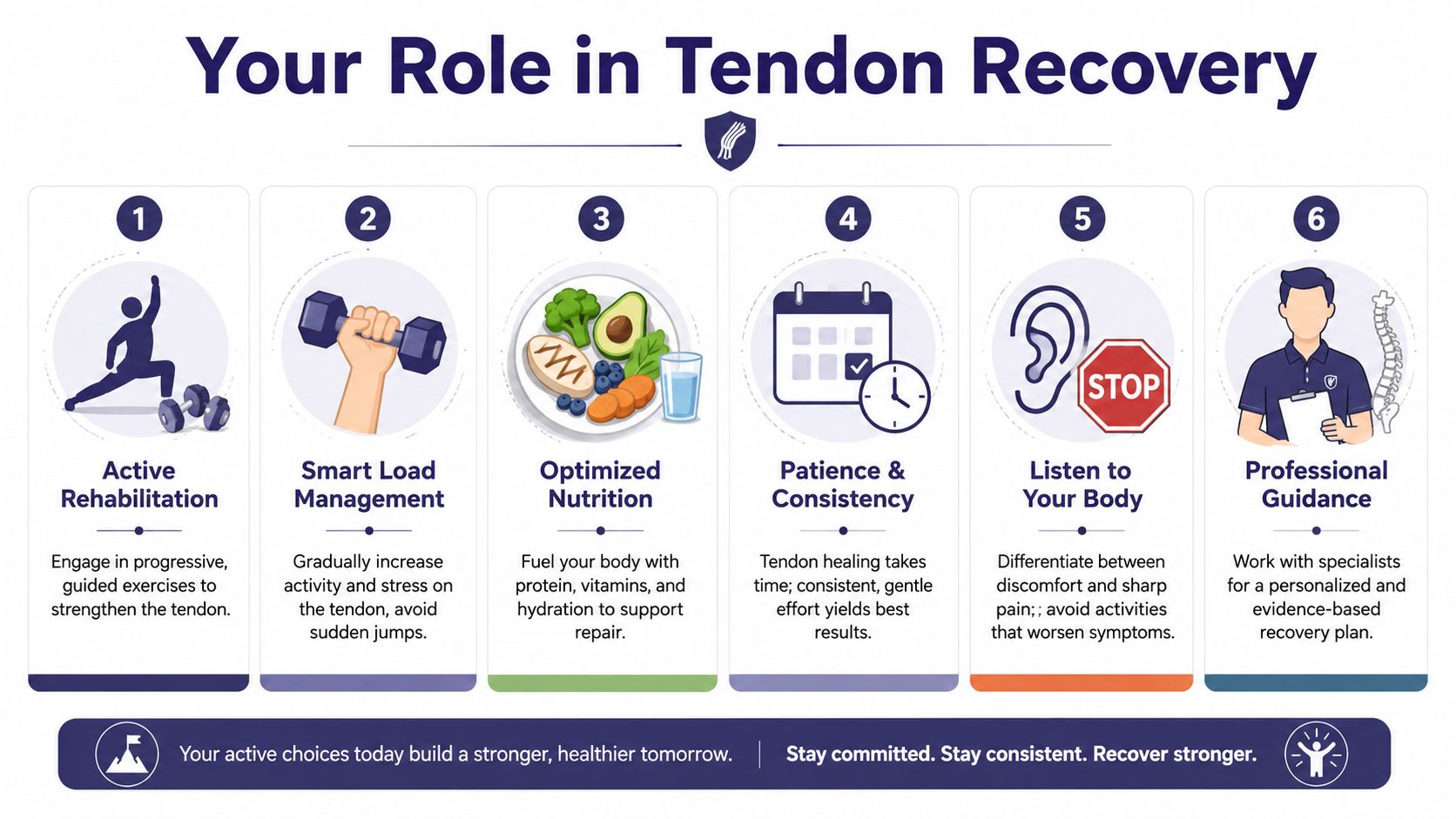
A healing tendon needs controlled movement and progressive loading so the tissue adapts to real-life demand. That doesn't mean pushing through sharp pain. It means giving the tendon enough mechanical input to recover strength and tolerance.
This is especially important after surgery. According to clinical guidance on tendon healing after repair, a repaired tendon is often weakest at 7 to 10 days post-op, gains strength by 21 to 28 days, and doesn't reach maximum strength until about 6 months after surgery.
That timeline explains why “I'm moving better” isn't enough reason to skip stages in rehab.
What actually works
Patients usually do better when they follow a few consistent principles rather than chasing lots of treatments.
Reduce the load that clearly flares symptoms
That might mean shortening runs, changing grip-heavy tasks, lowering training volume, or using a temporary modification at work.Do targeted strengthening regularly
Tendons respond to repetition and progression. Random stretching without a plan rarely changes much.Increase one variable at a time
Don't raise speed, volume, intensity, and frequency all in the same week.Use symptom response as feedback
Some discomfort during rehab can happen. A significant increase in pain later that day or the next morning usually means the dose was too high.
Recovery goes better when the tendon sees a manageable load often enough to adapt, but not so much that it stays irritated.
Practical habits that improve the odds
A good tendon plan usually includes more than exercises on a sheet.
- Warm up properly: Don't go from desk to sprint, or sofa to heavy lifting.
- Keep your routine predictable: Large spikes in weekend activity commonly cause setbacks.
- Support recovery tools wisely: If you train at home, this expert guide for home gym recovery can help you think practically about which tools may support recovery habits, though tools don't replace progressive rehab.
- Get expert input when needed: If the diagnosis is unclear or progress stalls, assessment matters. In Bristol, options include sports medicine, physiotherapy, and private GP review. At The Lagom Clinic, patients can access musculoskeletal physiotherapy as part of a broader plan that uses therapeutic exercise and manual treatment where appropriate.
What doesn't work well
Some patterns repeatedly slow recovery:
| Approach | Why it often fails |
|---|---|
| Total rest for too long | The tendon loses capacity and often becomes sore again when activity returns |
| Repeated stretching alone | It may feel relieving briefly, but it doesn't rebuild load tolerance by itself |
| Painkiller-led decision making | Symptoms may be quieter while the tendon still isn't ready |
| Weekend-only rehab effort | Tendons usually respond better to steady, repeated exposure |
Patience isn't passive here. It's active, structured, and surprisingly disciplined.
When to See Your GP or a Musculoskeletal Specialist
Some tendon problems can be managed early with sensible load reduction and a structured rehabilitation plan. Others need prompt assessment because the diagnosis changes the treatment.

Seek urgent help if you suspect a rupture
Get urgent medical advice if you notice any of the following:
- A sudden pop or snap: Especially if pain started immediately during sport or lifting.
- A visible change in shape: A gap, bunching, or obvious deformity can matter.
- Marked loss of function: If you suddenly can't push off, lift the arm properly, or bear load in the usual way.
- Rapid swelling with major weakness: This needs proper examination.
Book a review if recovery is not moving
A GP or musculoskeletal specialist review is sensible when:
- Symptoms aren't improving within a few weeks
- You're unsure if it's a tendon, muscle, ligament, or joint problem
- Pain keeps returning each time you restart exercise
- Your job or sport needs a more precise return plan
- You've had surgery and need structured progression
Good assessment can save time. It helps separate a mild tendon flare from a tear, clarifies whether imaging is useful, and gives you a realistic plan rather than vague advice to “rest and see how it goes”.
If your tendon pain isn't improving, keeps recurring, or you're unsure whether you're dealing with irritation, a partial tear, or something more serious, The Lagom Clinic offers private GP care in Bristol with a proactive musculoskeletal focus, lifestyle guidance, and access to further assessment when needed.

 Members Consultation