


You open the letter, see the word “screening”, and feel two things at once. Relief that the system has remembered you, and a quiet dread about fitting the appointment into real life, getting through the test comfortably, and waiting for answers.
That reaction is common. Cervical screening is one of the most useful preventive tests we have, but it can still feel awkward, rushed, or hard to organise around work, childcare, travel, or anxiety. For some people, private smear tests are mainly about convenience. For others, they're about having enough time to ask the questions they didn't get to ask before.
What matters most isn't just whether you choose NHS or private care. It's whether you're having the right assessment for your situation now. Sometimes that is routine cervical screening. Sometimes it's a review of symptoms, an HPV-based test, or a wider sexual health check. If you're unsure where your question fits, a broader guide to sexual health screening options can help place cervical screening in context.
Private care can also sit alongside sensible planning for the rest of your health needs. If you work for yourself or need flexible access to treatment and testing more widely, it's worth understanding how Pounds Health Insurance for self-employed coverage fits into that picture.
Understanding Your Cervical Screening Choices
A screening invitation often lands in the middle of everything else. You may be due for a routine test, overdue because life got busy, or wondering whether you should book privately because the NHS slot you were offered doesn't work for you.

The NHS cervical screening programme is structured and evidence-based. It's designed to invite people at set intervals according to age and risk, which is exactly how a national screening programme should work. Private smear tests don't replace that logic. In good clinical practice, they work alongside it by offering more flexibility around booking, more time in the room, and space for individual concerns.
What private care changes
Private care usually changes the experience, not the biology of screening. The sample still needs to be taken properly. The test still needs to match modern UK practice. The result still needs sensible follow-up.
What often works better in private settings is the surrounding care:
- Timing that suits you if you can't manage daytime NHS appointments easily
- More discussion before the test if you've had pain, embarrassment, or trauma around intimate examinations
- Continuity with one clinician if you want the same doctor to assess, test, explain, and follow up
A good cervical screening appointment doesn't begin with the speculum. It begins with a conversation about what you need, what happened last time, and how to make this one easier.
The question to ask first
Before booking, ask yourself one simple question. Am I looking for routine screening, or am I worried about a symptom?
That distinction matters. Screening is for people without symptoms. If you have bleeding after sex, bleeding between periods, persistent pelvic pain, or unusual discharge, you may need a medical assessment rather than a routine smear appointment. Private clinics can be useful here, not because “private is better” in some broad sense, but because they can help direct you to the right pathway without delay.
NHS and Private Smear Tests Compared
The practical difference between NHS and private smear tests is less about right versus wrong, and more about standard pathway versus personalized access. Both can have a role. The better choice depends on whether you need routine recall, reassurance, flexibility, or a more personalised consultation.
Screening intervals and what patients often get told wrongly
The NHS follows a clear schedule. It invites people aged 25 to 49 every 3 years and those aged 50 to 64 every 5 years. That age-based schedule is one of the most important facts in cervical screening, yet confusion is still common. In a 2025 AXA Health report, 38% of women believed screening should happen every 4 years, and only 28% knew they could request a different-sized speculum, which highlights how often practical details are missed in routine care (AXA Health cervical screening statistics).
That matters in clinic. A patient may attend believing she is overdue when she is not. Another may delay for too long because she thought the recall interval was longer. Others may assume discomfort is just part of the process, without realising small adjustments can make the test much more manageable.
What the comparison looks like in practice
Here's a straightforward side-by-side view.
| Feature | NHS Screening | Private Screening (The Lagom Clinic) |
|---|---|---|
| Who it's for | People invited under the national age-based programme | People seeking flexible access, more discussion, or an individual review of what test is appropriate |
| Recall timing | Routine invitations follow the national schedule | Good private care should still respect UK screening logic rather than encourage unnecessary testing |
| Appointment style | Usually focused and efficient | Typically longer, allowing time for questions, comfort planning, and follow-up discussion |
| Comfort adjustments | Available, but not always discussed in detail | Usually easier to explore in advance, including previous difficult experiences |
| Continuity | May vary by service and availability | More likely to allow review with a chosen clinician |
| Use case | Excellent for routine programme screening | Helpful when access, anxiety, scheduling, or clinical clarification are the main issue |
What private care can do better
Private appointments are particularly useful when the obstacle isn't willingness, but logistics or experience. People often delay screening for reasons that sound minor from the outside and feel very significant from the inside.
Common examples include:
- Past discomfort where nobody explained that a different-sized speculum could be used
- Time pressure when a brief appointment leaves no room to pause, breathe, or ask questions
- Work and family constraints that make fixed clinic times hard to manage
- Need for explanation when previous results were confusing or badly communicated
Practical rule: If the thing stopping you from attending is the process rather than the principle, private care may solve the real problem.
What private care does not do
Private screening isn't automatically more clinically appropriate. It doesn't mean you should test more often than necessary, and it doesn't turn routine screening into a symptom investigation. If the provider offers a test without checking whether it's the right test, that's a weak service, however convenient it looks.
The value is in appropriateness, comfort, and access. That's what patients are really paying for.
Is a Private Smear Test Right for You
Some people search for private smear tests when they already know what they want. Others use the phrase as shorthand for “I'm not sure what I need, but I want this checked properly.” Those are different starting points, and they lead to different decisions.
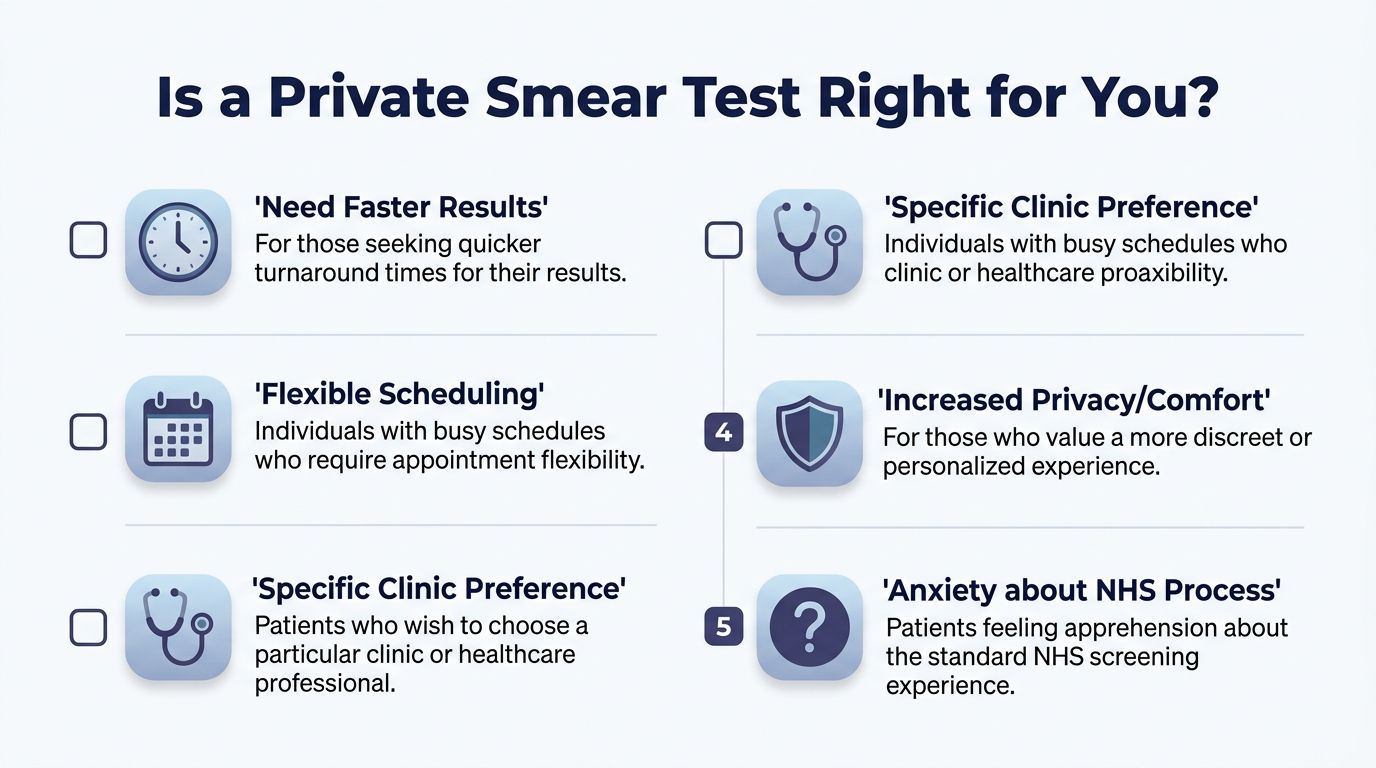
Situations where private screening may make sense
A private appointment can be sensible if your main issue is practical access or the need for a calmer, more individual consultation.
That often includes people who:
- Need flexible scheduling around demanding work or caring responsibilities
- Prefer a specific clinician because continuity makes intimate care easier
- Feel anxious about the standard process and want time to discuss pain, trauma, or embarrassment
- Want clinical guidance because they're unsure whether routine screening is what they need
In those situations, private care can lower the barrier to attendance. That alone can be valuable.
When a “smear test” may not be the real answer
Private consultations can be particularly useful. Many people ask for a smear test when the more accurate question is whether they need an HPV primary screen, a repeat test after a previous result, or an assessment of symptoms.
The language hasn't fully caught up with modern practice. People still say “smear test” because that's familiar. But clinically, the first step is deciding whether this is routine screening or something else.
The YouScreen trial in London showed that offering HPV self-sampling kits significantly increased participation among people who were overdue for screening, particularly in under-screened groups. The key lesson is not just that self-sampling exists. It's that uptake improves when people are offered a pathway that fits their situation (YouScreen trial report).
A useful decision filter
If you're deciding whether to book, use this simple filter:
No symptoms, due or overdue for screening
Routine cervical screening is likely the right path.No symptoms, but strong anxiety or practical barriers
Private screening may help you attend in a more manageable way.Symptoms such as unusual bleeding or unusual discharge
Book a medical assessment. Don't rely on screening alone.Unsure what previous results meant
Ask for review before repeating tests.
The right test at the wrong time, or for the wrong reason, creates false reassurance. Good care starts by naming the problem accurately.
The deeper reason many people book privately
In practice, people often book private smear tests because they want certainty. Not certainty that the result will be normal, because no clinician can promise that. They want certainty that someone will listen, explain the plan, and tell them what happens next.
That's a reasonable expectation. It's also one of the clearest reasons a private consultation may be worth it.
Your Private Smear Test Journey at The Lagom Clinic
A good cervical screening appointment should feel organised, calm, and predictable. Most anxiety comes from not knowing what will happen, whether the test will hurt, or what the result wording will mean. The process is usually simpler than people expect.
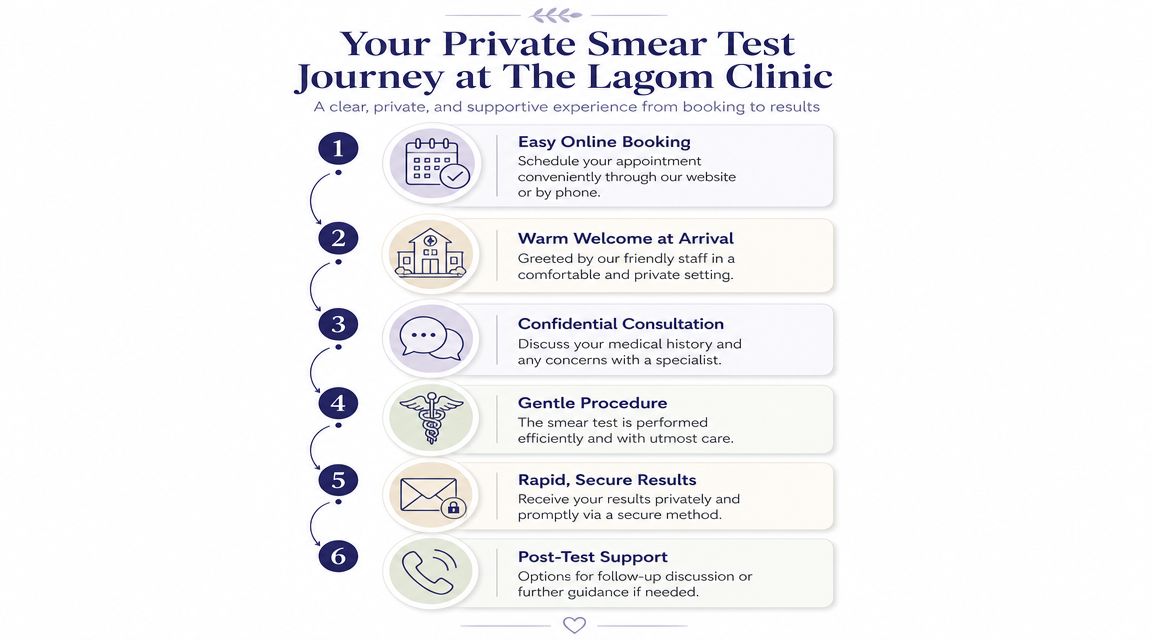
Before the appointment
When you book, the first job is to make sure you're booking the right kind of appointment. Routine screening, repeat screening, and symptom review are not interchangeable.
A few practical steps help the sample quality and make the visit easier:
- Book when you're not bleeding heavily if possible, because heavy bleeding can make sampling more difficult
- Bring your screening history if you know it, especially any previous abnormal or unclear result
- Mention anxiety early so the clinician can plan for a slower approach, pauses, and comfort adjustments
- Write down questions if you tend to forget them once you're in the room
During the consultation
This part matters more than many people realise. Before the examination, there should be time to talk through your screening history, contraception, pregnancy possibility, symptoms, previous discomfort, and any fears about the procedure.
That conversation often changes the tone of the whole appointment. Someone who felt dismissed before may need reassurance that the test can be paused. Someone who had pain in the past may need a smaller speculum, extra lubrication, or a different position. Someone else may realise after discussing symptoms that a smear isn't the main priority that day.
The test itself
The examination is brief. A speculum is inserted so the cervix can be seen, and a soft brush is used to take the sample. It is often described as uncomfortable rather than painful, though experiences vary.
What matters clinically is what happens after the sample is taken. High-quality private screening should use primary high-risk HPV testing, because that is the UK's current screening model. The NHS moved to this HPV-first approach in 2019 because it is more sensitive for detecting precancerous change than older cytology-only testing. If HPV is found, the laboratory then performs reflex cytology on that sample rather than using cytology as the first-line test (Nuffield Health explanation of HPV primary cervical screening).
That detail is not a technicality. It tells you whether the service is using an up-to-date pathway or an older one.
Results and what they mean
Result handling matters almost as much as sample taking. People usually cope well with waiting when they know what is being checked and who will contact them.
In broad terms, results may lead to one of several outcomes:
- No high-risk HPV detected, which usually means routine recall
- High-risk HPV detected with further laboratory review, which may lead to monitoring or referral depending on the findings
- An inadequate sample, meaning the test needs repeating because the sample could not be interpreted properly
A good clinic should communicate this in plain English, not lab shorthand.
If you don't understand your result, you haven't really received it yet. You've only received the paperwork.
Follow-up and next steps
Follow-up should be direct and practical. If the result is reassuring, you should be told clearly when routine screening is next appropriate. If it isn't, you should be told what happens next and why.
Joined-up care holds significant value. At The Lagom Clinic, cervical smears sit within a wider private GP service, which means results can be discussed in the context of your broader health, symptoms, and preventive care rather than as an isolated lab report. That makes it easier to decide whether you need repeat testing, a gynaecology referral, or reassurance and a clear recall plan.
Costs, Timelines, and Proactive Health Tips
When patients ask about private smear tests, they usually want three practical answers. What am I paying for? How long will it take? What else can I do for my cervical health apart from having the test?
What you're really paying for
A private smear test fee usually covers more than sample collection. In most private settings, the value sits in the consultation around the test.
That may include:
- Clinical review before testing to check whether screening is appropriate
- A more comfortable appointment with time for questions and adjustments
- Laboratory processing through an HPV-based pathway if the service is up to date
- Clear follow-up so you know what the result means and what to do next
Costs vary by clinic, and they should be transparent before you book. If pricing isn't clear, ask exactly what is included, whether follow-up discussion is separate, and whether the test is HPV-first or cytology-only.
What realistic timelines look like
Private care can shorten waiting around the appointment itself, but no responsible clinician should promise an exact result date unless the laboratory pathway supports that promise. Different labs work at different speeds, and a delayed result doesn't automatically imply a worrying finding.
The useful question isn't “How fast can I get this done?” It's “When and how will you contact me, and what support is available if I don't understand the result?”
Lifestyle steps that support cervical health
No lifestyle plan replaces screening. Screening detects risk. It doesn't stop HPV exposure or remove the need for sensible self-care. What you can do is support your immune system and reduce avoidable risk factors.
A practical approach includes:
- Stop smoking if you smoke. Smoking is one of the clearest modifiable risks for cervical health, and quitting helps far beyond screening alone.
- Use condoms where appropriate. They don't eliminate HPV risk completely, but they can reduce exposure to sexually transmitted infections and support safer sex overall.
- Prioritise sleep, nutrition, and stress management. Immune function is affected by how you live day to day. Regular meals, enough protein, fruit and vegetables, movement, and adequate rest all matter.
- Attend when you're invited. The healthiest lifestyle in the world doesn't replace routine screening.
Small habits that make follow-through easier
Patients are more likely to keep screening up to date when they remove friction early.
Try this:
- Put recall dates in your calendar when you get your result.
- Book at a time of day when you're least rushed.
- Tell the clinic in advance if you've had pain before.
- Don't wait for the “perfect month”. If you're due, book.
Your Private Smear Test Questions Answered
Does a smear test hurt
It shouldn't be sharply painful, but it can feel uncomfortable. If you've had a difficult examination before, say so before the test starts. Smaller speculums, lubrication, slower pacing, and pauses usually make a big difference.
Can I have it done on my period
Light bleeding may still allow testing, but heavy bleeding can affect the sample. If you're unsure, ask before attending so the clinic can advise whether to proceed or rebook.
Can I have cervical screening when pregnant
Timing during pregnancy depends on your circumstances. If you're pregnant or think you might be, mention it when booking so the timing can be planned properly.
I've had the HPV vaccine. Do I still need screening
Yes. The vaccine is very important, but it doesn't remove the need for routine cervical screening.
What if I'm very anxious
Tell the clinic beforehand. Anxiety is common, and it's manageable when the team knows in advance. Planning for comfort, explanation, and control usually helps more than trying to push through without saying anything.
What if I have discharge or bleeding between periods
That needs assessment, not just screening. If you're trying to work out whether discharge is normal or needs medical review, this guide to discharge after your period may help you think through what's routine and what should be checked.
When should I book privately
Book privately if access, timing, continuity, or anxiety are the main barriers, or if you need help deciding whether screening is even the correct next step. If you have symptoms, book an assessment rather than assuming a smear test will answer the problem.
If you want a calm, confidential discussion about cervical screening, symptoms, or whether private testing is the right next step for you, you can arrange a consultation with The Lagom Clinic.


 Members Consultation