


The letter often lands on an ordinary day. You open it between meetings, school runs, or errands, and suddenly you're wondering whether a medical condition, a birthday milestone, or a licence renewal could affect your independence. That reaction is completely normal.
A driving medical assessment can feel personal in a way other forms don't. It isn't just paperwork. It touches work, family logistics, confidence, and routine. The good news is that this process is usually far easier to handle once you understand what's being asked, why it's being asked, and what you can do to prepare well.
The most helpful mindset is to treat it as a safety and health review, not a trap. Good preparation doesn't just improve the appointment itself. It often improves day-to-day driving, symptom control, sleep, blood sugar stability, and recovery after illness.
Understanding Your Driving Medical Assessment Notice
Drivers often read a DVLA notice with one immediate fear. “Am I about to lose my licence?”
Usually, the notice means something more straightforward. The DVLA needs medical information to decide whether you're currently fit to drive, whether you need a temporary pause, or whether you can continue with monitoring or updated evidence. That's all.
I often see people become more distressed by uncertainty than by the assessment itself. A driver who has just turned 70 may assume age alone means they're no longer trusted on the road. Another may have had a recent TIA, stroke, diagnosis of diabetes, or change in vision and worry that one event has already decided the outcome. In practice, the process is more measured than that.
What the notice is really asking
The letter is usually prompting one or more of these things:
- Medical clarification: The DVLA wants details about a condition, treatment, or recovery.
- Functional evidence: They need to know how the condition affects driving tasks such as concentration, vision, mobility, or alertness.
- Updated review: A previous condition may require repeat certification.
- Formal examination: Some licence types and some conditions require a structured medical assessment.
Practical rule: Read the notice slowly, then separate what is required now from what you fear might happen later.
A better way to approach it
If you treat the notice as an invitation to get organised, the process becomes much less intimidating. Gather your records, review your medication, reflect on your symptoms, and ask your GP or specialist where your condition stands now, not where it stood six months ago.
That last point matters. A driving medical assessment is about present fitness and foreseeable risk. If your health has improved, your preparation should show that clearly.
What Is a Driving Medical Assessment
A driving medical assessment is a focused medical review of whether you can operate a vehicle safely. It isn't the same as a general GP check-up, and it isn't a broad wellness screen. It's much narrower and more practical.
Think of it as a health MOT for the driver rather than the car. The question isn't whether you're perfectly healthy. The question is whether any medical issue could impair safe driving through sudden incapacity, poor concentration, delayed reaction, visual loss, reduced movement, or impaired judgement.
What it looks at
The exact content depends on your licence type and your medical history, but the assessment commonly considers:
- Vision: Clarity, field of vision, and whether glasses or contact lenses bring you to the required standard.
- Cardiovascular health: Whether symptoms such as blackouts, chest pain, arrhythmia, or breathlessness could affect driving.
- Neurological function: Stroke effects, seizure history, balance problems, weakness, sensory change, or cognitive symptoms.
- Metabolic conditions: Blood sugar stability, hypoglycaemia risk, and medication effects in diabetes.
- Sleep and alertness: Daytime drowsiness, sleep apnoea, and whether fatigue could make driving unsafe.
- Medication review: Sedating medicines, recent changes, and whether treatment is controlled and documented.
What it is not
A driving assessment isn't there to diagnose every possible health problem. It also isn't a test of personality, confidence, or whether you're a “good” person behind the wheel. It's a legal and clinical judgement about fitness to drive at this point in time.
That's why the paperwork can feel more specific than a routine consultation. The clinician may need to document exact symptoms, dates, treatment stability, and specialist input.
For readers who want a clearer sense of how thinking, attention, and processing speed can be examined in a structured way, this overview of AI's role in cognitive assessment is useful background, especially when neurological or cognitive symptoms are part of the picture.
The strongest assessments are the ones that connect diagnosis to real driving tasks, not just labels on a problem list.
Who Needs a Driving Medical Assessment and Why
Three groups most often need a driving medical assessment in the UK. The trigger is usually age, a medical condition, or licence class.
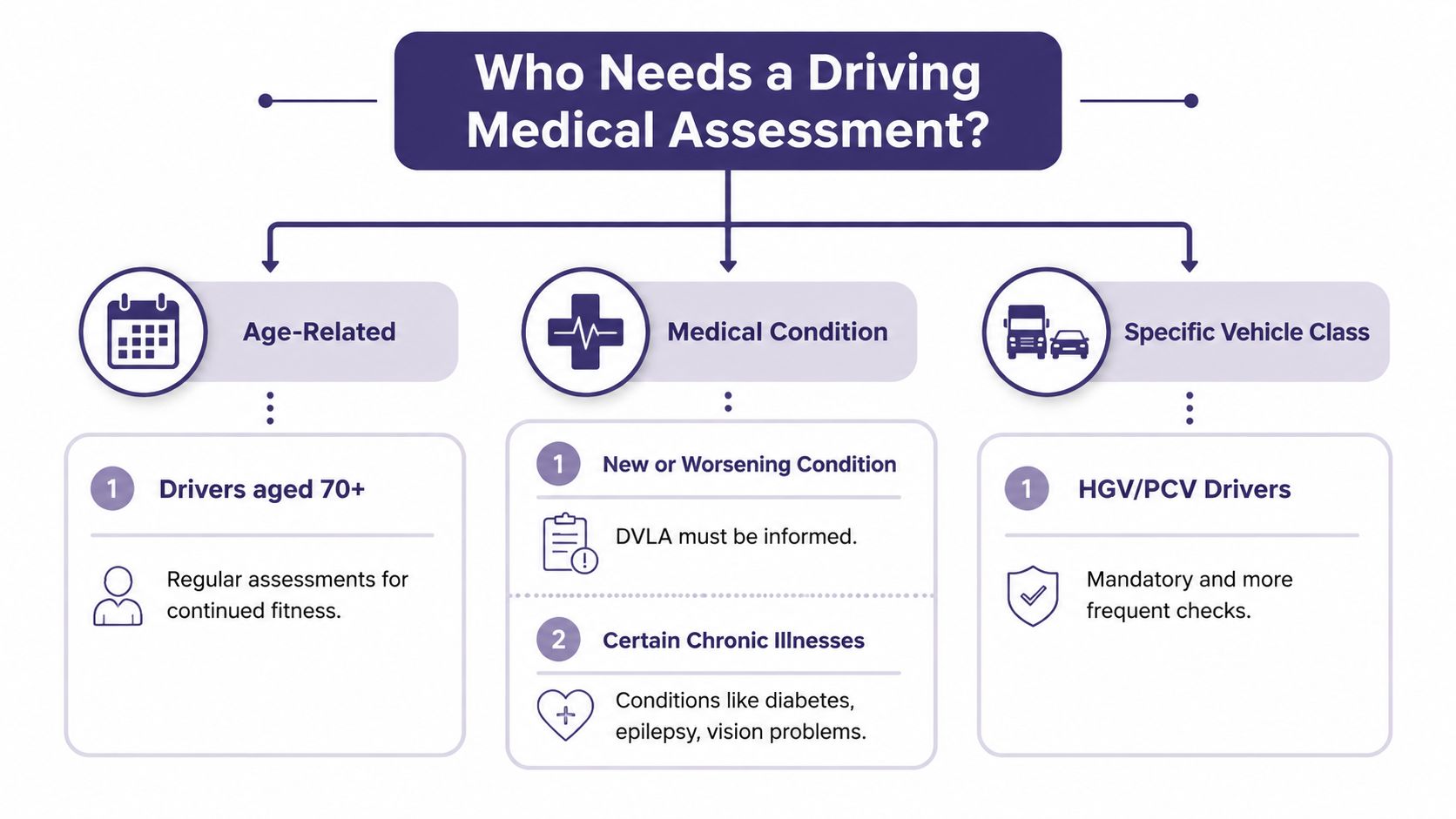
Age-related review
Older age doesn't automatically make someone unsafe to drive. Many older adults remain excellent drivers. The reason review becomes more common later in life is that vision change, frailty, medication burden, cardiovascular disease, and cognitive decline become more likely, and these can affect driving in subtle ways before a person notices them.
The key point is that age-triggered review looks beyond age itself. It asks whether function remains adequate and whether any specific condition needs closer monitoring.
Medical conditions that must be considered
Some conditions create a legal duty to inform the DVLA or prompt a formal review because they can affect safety directly. These include conditions associated with blackouts, seizures, stroke, significant visual impairment, severe sleepiness, or impaired awareness.
Historical UK transport policy shifted significantly after the 2015 Duty to Notify regulations, which required drivers with certain conditions such as diabetes, epilepsy, and stroke to report their status to the DVLA. That framework sits behind many of the assessments patients now encounter.
A major reason for this scrutiny is the burden of illness in professional drivers. A 2023 meta-analysis of 32 studies involving 151,644 UK commercial drivers found high prevalence of obesity at 45%, diabetes at 33%, and hypertension at 23%, with sleep disorders at 19%. The analysis also found that sleep disorders, particularly obstructive sleep apnoea, were linked to increased crash risk, which strengthens the case for proper health review in drivers (Journal of Occupational Health summary in the verified data provided).
Licence class matters
The standard is usually stricter for drivers of larger or passenger-carrying vehicles because the risk of harm is greater if a driver becomes suddenly unwell or impaired. HGV and PCV drivers often face more frequent review and more detailed medical certification than ordinary car drivers.
That's why someone may feel perfectly capable in daily life but still need a formal medical sign-off for a Group 2 licence.
Common Medical Conditions and DVLA Standards
The diagnosis matters, but control matters just as much. Two people with the same condition can have very different driving outcomes depending on symptoms, treatment stability, and how responsibly they manage risk.
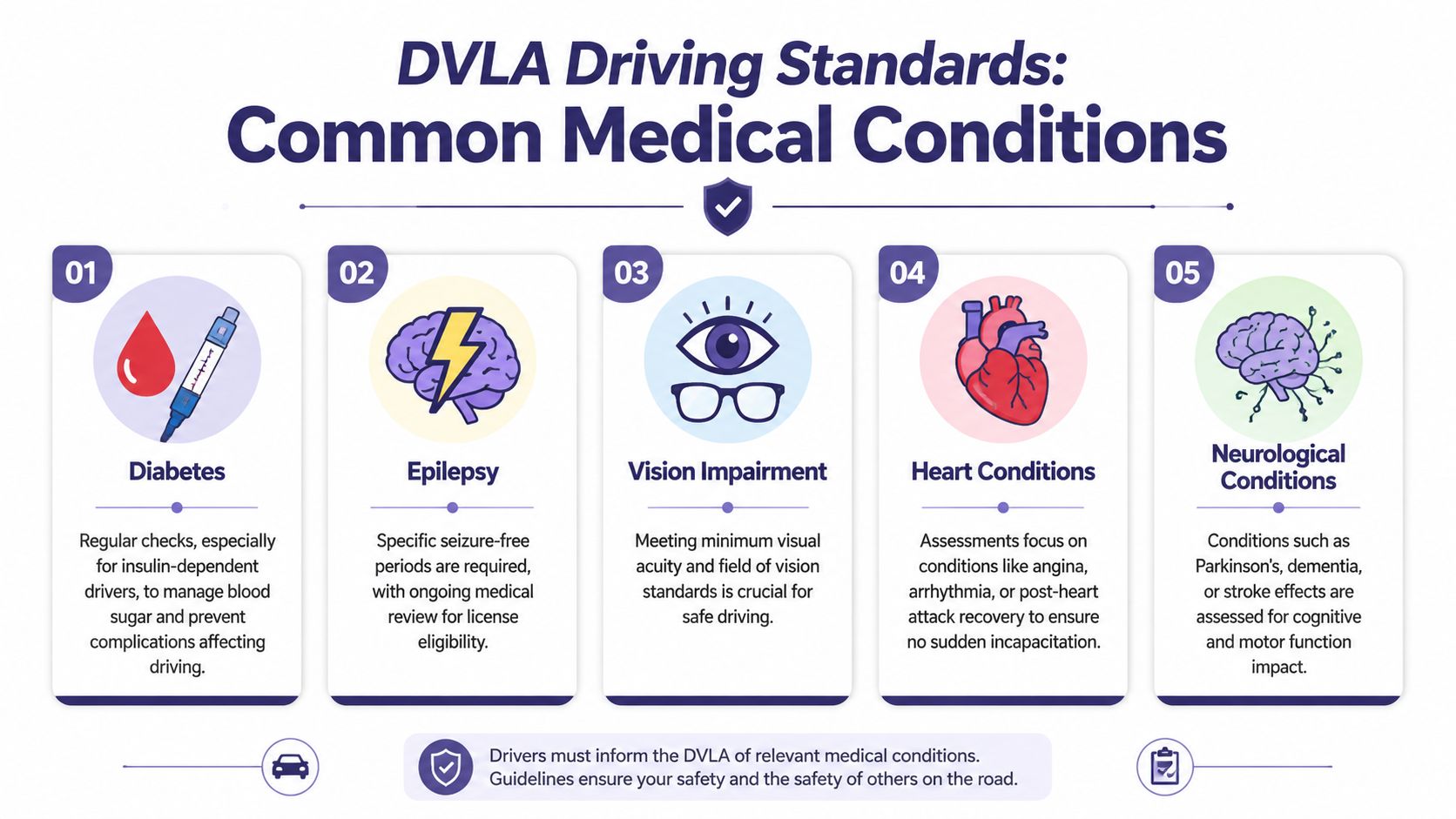
Diabetes
Diabetes becomes a driving issue when blood sugar swings affect thinking, reaction time, or consciousness. The practical danger is hypoglycaemia, especially if it occurs while driving or shortly beforehand.
For people with type 2 diabetes, NHS-aligned guidance summarised in the Merck Manual overview of medical assessment of the older driver advises avoiding driving for at least 3 months after a hypoglycaemic episode involving reduced consciousness, or until the contributing factors have been assessed and managed. The same source notes that blood glucose below 3.0 mmol/L impairs cognitive function and reaction time.
Useful habits make a real difference:
- Check patterns, not just single readings: If you're having lows at similar times, your meal timing, insulin timing, or activity pattern may need adjustment.
- Carry rapid-acting glucose: Keep it in the car, not in another bag you may forget.
- Eat predictably before long drives: Skipping meals, then relying on sugary snacks, often creates unstable control.
- Review medication changes early: Don't wait until the week of the assessment to mention recurrent hypos.
Neurological conditions
Stroke, TIA, vestibular disorders, Parkinsonian symptoms, and other neurological problems raise two separate questions. First, are you legally allowed to drive now? Second, can you function safely in real traffic situations?
Updated DVLA guidance has been influenced by evidence around sleep-related impairment and neurological risk. UK data found that drivers with mild obstructive sleep apnoea had a 5.77 times higher relative risk of a Department-reported crash, and current guidance includes a 1-month driving cessation after a single TIA and a 3 to 6 month event-free period for recurrent episodes before driving can resume (University of Bristol and DVLA-linked findings in the verified data provided).
For fluctuating neurological symptoms, generic advice doesn't help much. Better strategies include:
- practising dual-task activities during rehabilitation
- working on head movement tolerance if dizziness is an issue
- improving route-planning and spatial navigation if confidence has dropped
- asking a clinician to document what has improved, not only what happened at the time of the event
If your symptoms vary from day to day, your preparation should show the pattern, the triggers, and the progress.
Heart conditions
Heart conditions become relevant when there's a risk of sudden incapacity, poor exercise tolerance, dizziness, or uncontrolled symptoms. A licence review may follow arrhythmia, angina, heart failure, or a cardiac event.
What helps most isn't trying to “look well” at the appointment. It's good control beforehand:
- take medication exactly as prescribed
- reduce excess salt if blood pressure is running high
- build back exercise gradually if you're in recovery
- report blackouts, near-blackouts, or exertional chest symptoms promptly
Epilepsy and seizure disorders
This area depends heavily on the specific diagnosis, the seizure pattern, and time since the last event. The safest practical advice is simple. Don't guess. If there's any uncertainty about whether an episode counts as a seizure, clarify it quickly with your treating team.
Lifestyle still matters here. Missed medication, sleep deprivation, alcohol excess, and irregular routines commonly worsen seizure control. Patients often focus on the form and forget the basics. The basics are what protect both the licence and the driver.
Vision impairment
Drivers are sometimes surprised that familiar roads don't prove visual fitness. The standard is about measurable function, not familiarity.
Book an eye test if your vision has changed, your glasses feel less effective, or night driving has become harder. Bring the correct glasses or contact lenses to the assessment. If glare, cataract symptoms, or visual field issues are affecting confidence, say so plainly. Those details matter.
How to Prepare for Your Medical Assessment
Preparation is where patients usually have the most control. A calm, organised appointment gives the assessing clinician a much clearer picture than a rushed one built on missing records and half-remembered details.
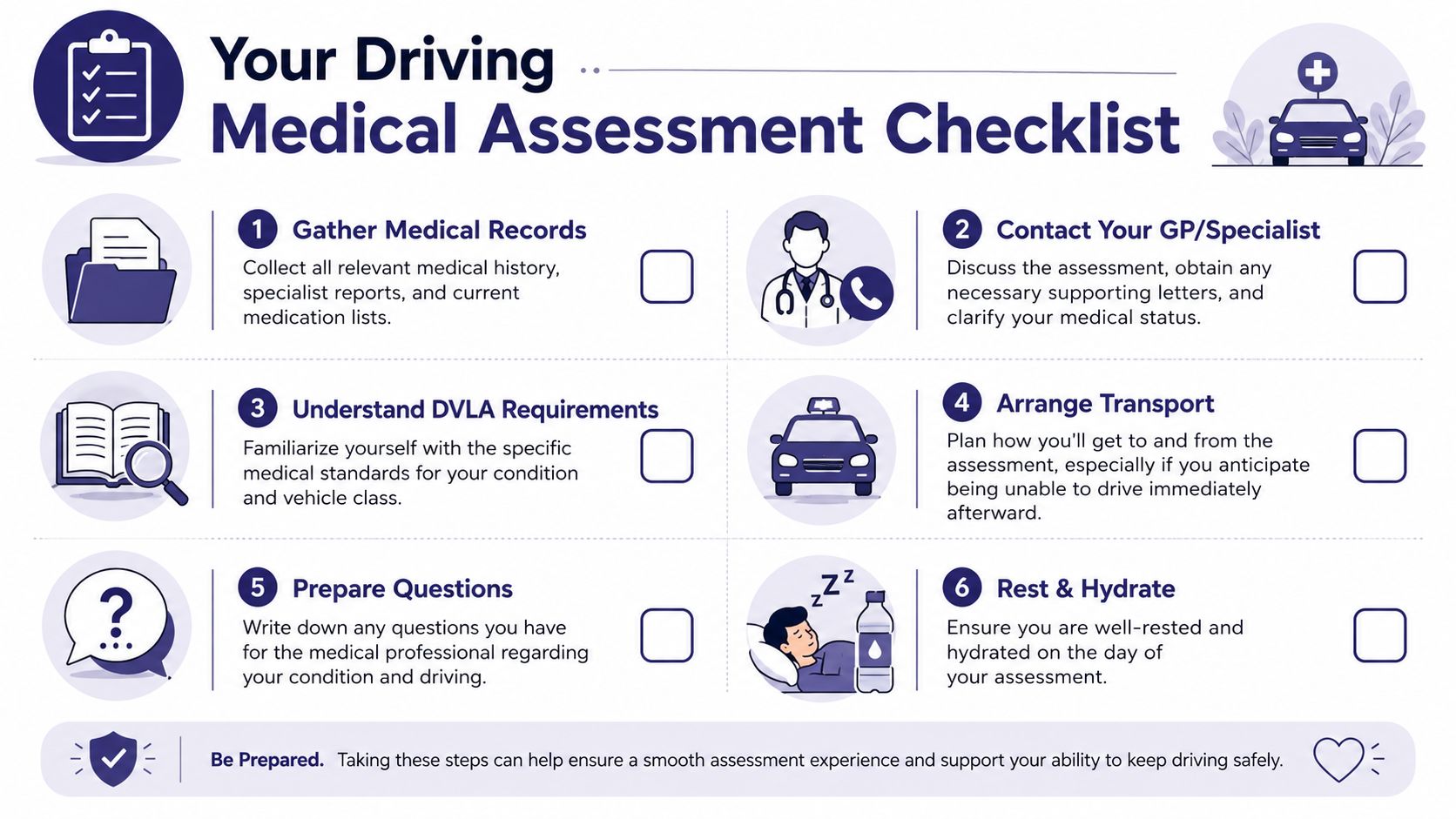
Build your file before the appointment
Bring documents that answer questions quickly. That usually means:
- Medication list: Include dose changes and recent additions.
- Clinic letters: Hospital, consultant, stroke clinic, diabetes team, or cardiology correspondence.
- Investigation results: Relevant blood tests, eye reports, sleep study reports, ECGs, or imaging summaries if these relate directly to fitness to drive.
- Optical aids: Glasses, contact lenses, and hearing aids if you use them.
- Symptom log: Especially useful for dizziness, blackouts, blood sugar lows, sleepiness, or fluctuating cognition.
If your family paperwork is scattered across phones, email chains, and drawers, a system for storing secure family medical information can make this process much easier, especially when more than one clinician is involved.
Prepare for functional questions, not just diagnosis questions
Many people rehearse the name of their condition but not how it affects actual driving. That's a mistake.
Be ready to describe things such as:
- whether you can turn your head comfortably at junctions
- whether fatigue worsens after a certain time of day
- whether supermarket glare or night lights affect vision
- whether complex roundabouts overwhelm you since a stroke or vestibular event
- whether you've had any recent episodes of reduced awareness
These aren't trick questions. They help the clinician connect the medical condition to real road behaviour.
If you have a mild stroke or vestibular disorder
This is one of the commonest areas where poor preparation leads to an unnecessarily poor first result. Verified UK data shows that 34% of patients with mild stroke or vestibular dysfunction are initially deemed unfit to drive because of inadequate preparation, while 61% regain fitness after targeted rehabilitation and a second, better-prepared functional evaluation (British Stroke Association and related verified data summary).
That doesn't mean you should perform or exaggerate wellness. It means you should prepare properly.
Try this practical routine in the run-up to review:
- Track fluctuating symptoms: Note when dizziness, visual disorientation, or fatigue is worst.
- Practise task switching safely: Reading signs, following spoken directions, and holding attention through distractions can expose areas needing rehab.
- Work with rehab goals: If your therapist gives balance, scanning, or coordination exercises, do them consistently.
- Rest before the appointment: Exhaustion can make mild deficits look much worse.
- Bring evidence of progress: A short note showing improved function is often more useful than a long history of the original event.
A well-prepared assessment should reflect your usual function, not your most chaotic day.
The day itself
Keep the day simple. Eat, hydrate, take prescribed medicines as usual unless told otherwise, and leave enough travel time that you don't arrive flustered. If there's any chance you may be advised not to drive afterwards, arrange alternative transport in advance.
Write down your own questions too. Patients who do this often leave with much more clarity about next steps.
Navigating the Process NHS versus Private Assessments
The administrative side causes almost as much stress as the medicine. Patients often ask who is making the decision, what form is needed, and whether an assessment for one purpose will satisfy another.
The first distinction is straightforward. The DVLA is responsible for licensing decisions. The doctor carrying out the assessment provides medical evidence. That evidence may be on a condition-specific form or, in some cases, on a form such as a D4 for vocational driving. The clinician reports findings. The DVLA decides licensing.
NHS route and private route
Where available, an NHS route may suit patients who are not in a hurry and whose situation is clinically straightforward. A private route may suit people who need faster appointments, longer discussions, or easier scheduling around work and caring responsibilities.
A useful general primer on how patients weigh public and private healthcare trade-offs is this NHS vs private blood test comparison, because many of the same themes apply here: speed, continuity, convenience, and how much time you get with the clinician. Similar considerations also come up in broader choices around private healthcare vs NHS.
| Feature | NHS Assessment | Private Assessment (e.g., The Lagom Clinic) |
|---|---|---|
| Access | May depend on local service availability and appointment capacity | Usually easier to book at a convenient time |
| Waiting time | Can be longer | Often quicker |
| Appointment flexibility | More limited | Often better for busy professionals |
| Consultation length | May be shorter and task-focused | Often allows more time for explanation and paperwork |
| Continuity | Can vary | May be easier to see the same clinician |
| Cost to patient | Usually lower at point of access if available through NHS pathways | Paid privately |
| Best suited to | Straightforward reviews without urgency | Time-sensitive, work-related, or more detailed support needs |
The insurance problem patients regularly miss
One of the most confusing parts of this area is that DVLA compliance and insurance acceptance are not always the same thing.
Verified UK data for 2025 projections found that 68% of drivers over 70 were uncertain whether a DVLA medical exam met insurance renewal criteria, while 42% of insurers explicitly rejected standard DVLA assessments without additional evidence of functional fitness. The same verified data notes that this gap between statutory compliance and insurer requirements contributes to ongoing confusion in older drivers and after medical events (National Insurance Claims Survey, Department for Transport, and UK Insurance Ombudsman figures provided in the verified data).
What works better
Don't assume one certificate solves every administrative problem. Ask two separate questions:
- What does the DVLA require for licensing?
- What does my insurer require for policy renewal or continuation?
If an insurer wants evidence of functional ability, a basic licensing medical may not be enough. You may need additional documentation describing cognition, mobility, reaction, or day-to-day capability after a stroke, cardiac event, or progressive condition.
That distinction saves a lot of frustration.
Your Next Steps for a Confident Assessment in Bristol
A good outcome usually starts weeks before the appointment. Manage the condition well. Sleep properly. Keep blood sugar stable if diabetes is relevant. Follow rehabilitation if you're recovering from a neurological event. Make sure your glasses prescription is current. Bring records that tell a clear story.
Most of all, be honest. Patients sometimes worry that admitting fatigue, dizziness, or a recent hypo will automatically end their driving. In reality, honest detail usually helps the clinician judge risk properly and explain what can improve. Trying to minimise symptoms tends to create confusion, repeat appointments, and poor decisions.
For people in Bristol, practical access matters. Work schedules are tight, family calendars are full, and medical administration often gets pushed to the edge of the week. That's why choosing a clinic that can offer enough time, clear paperwork, and a thorough review is often just as important as choosing the date itself.

A driving medical assessment should do more than tick a box. It should identify what's stable, what still needs work, and what practical changes will keep you safer on the road for the long term. When the process is handled properly, patients usually leave with more clarity and less anxiety than they expected.
If you need a professional, patient-centred assessment in Bristol, The Lagom Clinic offers DVLA and occupational medicals with the time and attention these appointments need. The aim isn't just to complete a form. It's to give you a clear, medically sound review of your fitness to drive, along with practical advice on lifestyle, treatment, and next steps so you can move forward confidently.


 Members Consultation