


You notice it while typing, gripping the handlebars, or pushing up from a yoga mat. A firm lump on the wrist. It may not hurt much at first, but it’s distracting, and once you’ve seen it, you can’t stop checking whether it’s getting bigger.
For busy professionals and active people, that uncertainty is often the hardest part. Is it something serious? Will it affect work, training, sleep, or grip? Do you need to leave it alone, have it drained, or book ganglion cyst surgery and get it sorted properly?
Most wrist lumps like this turn out to be a ganglion cyst, which is benign. In simple terms, it’s a small sac of joint fluid that has pushed out from a joint capsule or tendon sheath. I often describe it as a small balloon on a stalk. The balloon fills with the same lubricating fluid your joint normally uses, but it collects where you can feel and sometimes see it.
Introduction What Is This Lump On My Wrist
You notice it halfway through a packed day. It catches your eye while typing between meetings, shifting gears on the bike, or loading weight through the wrist at the gym. A firm lump on the wrist is often a ganglion cyst, and the first practical question is usually not “what is it?” but “what does this mean for my work, training, and whether I need it treated?”
On the wrist, these cysts are often found on the back of the joint. Their starting point can affect symptoms, treatment choices, and the chance of recurrence. In clinic, that detail helps guide whether simple observation is sensible or whether referral is more appropriate.
Why it can change from day to day
Ganglion cysts often fluctuate in size and tension. A long day at a keyboard, a hard session on the erg, or repeated weight-bearing through the wrist can make them feel tighter. Then they may settle again. That happens because the cyst is connected to a joint or tendon sheath, and fluid can move in and out.
Some people have a visible lump with very little discomfort. Others get aching, stiffness at the end of wrist extension, or an awkward pulling sensation during gripping. For a Bristol patient with a demanding job or training schedule, the problem is often functional before it is painful. Press-ups become unreliable. Front rack positions feel restricted. Long laptop sessions, rowing on the harbour, or cycling the Avon Trail can start to aggravate the wrist in a way that is hard to ignore.
Ganglion cysts are benign. They can still be disruptive.
I often advise patients not to focus only on whether the lump looks worrying. The better question is whether it is changing how you use your hand. If the wrist is becoming less reliable for work, lifting, racquet sport, climbing, or sleep, that changes the conversation. In some cases, a review with a clinician and a good musculoskeletal physiotherapy assessment helps clarify whether the cyst is the main issue or whether there is joint irritation around it as well.
What people usually want to know first
Most patients ask four things early on:
- Is it dangerous? Usually no. A typical ganglion cyst is non-cancerous.
- Will it go away by itself? Sometimes it settles or varies over time, but many persist.
- Can it be drained instead of removed? Sometimes, yes. The trade-off is that it may come back.
- When is surgery worth considering? Usually when pain, repeated recurrence, or loss of function starts affecting daily life.
The right decision depends on more than the lump itself. It depends on how much it interferes with your wrist, how predictable you need that wrist to be for work and sport, and how much short-term treatment disruption you are willing to accept for a better long-term result.
Exploring Your Non-Surgical Treatment Options
A lot of busy patients want the same thing at this stage. Keep the wrist usable, avoid unnecessary treatment, and know what would justify doing more.

Watchful waiting is often the right starting point
If the cyst looks typical, the wrist is functioning well, and symptoms are mild, monitoring it is a sensible medical decision. Many ganglion cysts do not need immediate treatment.
For a Bristol professional with a packed clinic list, court diary, or travel schedule, that can be the least disruptive option. For an athlete in the middle of training, it may also be the best way to avoid an unnecessary procedure during the season.
Monitoring works best when it is specific. Keep track of size, pain, stiffness, grip confidence, and whether the wrist feels less reliable under load. I usually advise patients to seek review sooner if the lump becomes more painful, starts interfering with typing or lifting, causes tingling, or makes activities like rowing on the harbour or cycling the Avon Trail uncomfortable.
Aspiration can help, but recurrence is common
Aspiration drains the cyst with a needle. It is quick, minimally invasive, and can reduce pressure or improve the appearance of the lump for a period.
The limitation is durability. The cyst wall and its connection to the joint often remain, so the fluid can return. That is why aspiration suits some people as a short-term or lower-intervention option, but it is less reliable if your priority is a lasting fix.
This matters in real life. If you have a major work event, a race block, or a holiday approaching, aspiration may buy some short-term relief with less initial downtime. If you need a more predictable long-term result, especially after recurrence, it often falls short.
Reducing wrist irritation can make a real difference
Small changes in load can settle symptoms even when the lump itself stays present. The goal is not to stop using the wrist. The goal is to stop repeatedly provoking it.
Useful adjustments include:
- Desk setup: Keep the forearms supported and avoid sustained wrist extension during long laptop sessions. A separate keyboard and mouse often help.
- Training changes: Reduce repeated loaded extension for a few weeks. Neutral-grip pressing or dumbbells are often easier than flat-palmed floor work.
- Short-term support: A simple wrist splint can help during a flare, especially for commuting, driving, or heavier tasks, but it should not become an all-day habit.
- Pacing: Break up long periods of typing, DIY, racket drills, or gym work before the wrist becomes irritable.
- Rehab input: If the joint around the cyst is stiff or overloaded, a proper musculoskeletal physiotherapy assessment can help clarify what is driving symptoms and what to modify.
What I do not recommend
Trying to press, burst, or repeatedly massage a ganglion at home is not a good idea. It does not remove the connection to the joint, and it can leave the area more inflamed and sore.
Complete rest is not usually the answer either. In practice, relative rest works better. Keep the wrist moving, reduce the movements that trigger symptoms, and review things if function starts slipping.
When to Consider Ganglion Cyst Surgery
You notice it most on a busy day. A morning of typing, a cycle across Bristol, then a gym session or an evening row on the harbour, and the wrist is the thing dictating what you can and cannot do. That is usually the point at which surgery becomes a sensible discussion.
The decision is rarely driven by size alone. I advise patients to judge the cyst by what it is costing them in pain, confidence, routine, and planning.
Three common reasons to move beyond conservative care
Surgery usually enters the conversation for one of four practical reasons.
- Persistent pain: the wrist aches with ordinary tasks, pinches at the end of movement, or becomes sore enough to affect sleep.
- Functional limitation: you are avoiding loaded extension, changing grip, dropping out of training, or finding that keyboard work and commuting are harder than they should be.
- Cosmetic concern with genuine psychological impact: the lump bothers you in meetings, client-facing work, social settings, or sport. That is a valid reason to seek treatment.
- Recurrence after aspiration: if it has already been drained and returned, many patients prefer a more definitive option.
For Bristol professionals, the threshold is often lower than generic online advice suggests. A cyst that is merely annoying on paper can become a real problem if your week involves long laptop hours, regular travel, Pilates, tennis, CrossFit, or cycling the Avon Trail.
Choosing based on life impact, not just anatomy
Good decision-making matters at this stage.
A proper surgical discussion should cover your diary as much as your wrist. If you are a solicitor heading into trial, a consultant with operating lists, a founder preparing for fundraising meetings, or a creative with a filming schedule, timing affects whether surgery feels manageable. The same applies if you are training for a regatta, climbing regularly, or trying to keep a steady gym routine without losing momentum.
Private care can make that planning easier because consultations, imaging, and procedure dates are often more flexible. If imaging is needed because the diagnosis is not straightforward, it helps to know the practicalities in advance, including how long an MRI appointment usually takes.
If the cyst looks minor in clinic but keeps interfering with work, training, or sleep, it deserves a serious conversation.
Treatment Options for Ganglion Cysts A Comparison
| Approach | Best For | Recurrence Rate | Typical Downtime |
|---|---|---|---|
| Watchful waiting | Mild symptoms, little functional impact, uncertain commitment to procedure | Not applicable | Minimal formal downtime, but symptoms may fluctuate |
| Aspiration | People wanting a low-intervention option and willing to accept a higher chance of recurrence | Recurrence is common | Usually brief, but varies by symptoms |
| Open surgery | Persistent pain, recurrence, functional limitation, desire for more definitive treatment | Lower recurrence than aspiration, but not zero | Recovery requires planning |
| Arthroscopic surgery | Selected patients where a surgeon feels keyhole treatment is suitable | Can be effective in the right hands | Practical timelines still need individual discussion |
Open surgery is often the better fit when the aim is reliability. Arthroscopic surgery can be appropriate for selected cases, but suitability depends on the cyst location, the surrounding anatomy, and the surgeon’s experience. The right choice is the one that matches your symptoms, priorities, and tolerance for recurrence versus recovery time.
Signs it’s time to book a surgical opinion
Consider a surgical consultation if any of the following are true:
- The lump keeps returning, especially after aspiration.
- You are reorganising too much around it, whether that means changing your desk setup, modifying lifts, avoiding yoga positions, or steering clear of rowing sessions.
- You want a clearer plan, rather than repeating a cycle of flare, settle, flare again.
- The diagnosis is not completely clear, particularly if the lump is unusually painful, changing, or sitting in a more complex part of the wrist.
The best time to get an opinion is often before the problem starts dominating your week. Patients usually cope better when surgery is chosen as part of a plan, not after months of frustration and cancelled activity.
The Ganglion Cyst Surgery Pathway From Consultation to Closure
If you are trying to work out how wrist surgery fits around client meetings, school drop-offs, gym sessions, or weekend training, the helpful question is not only “Do I need it?” It is “What exactly happens, and how much disruption should I plan for?” A clear pathway usually lowers anxiety because the process is predictable, even if the wrist itself has been irritatingly unpredictable.
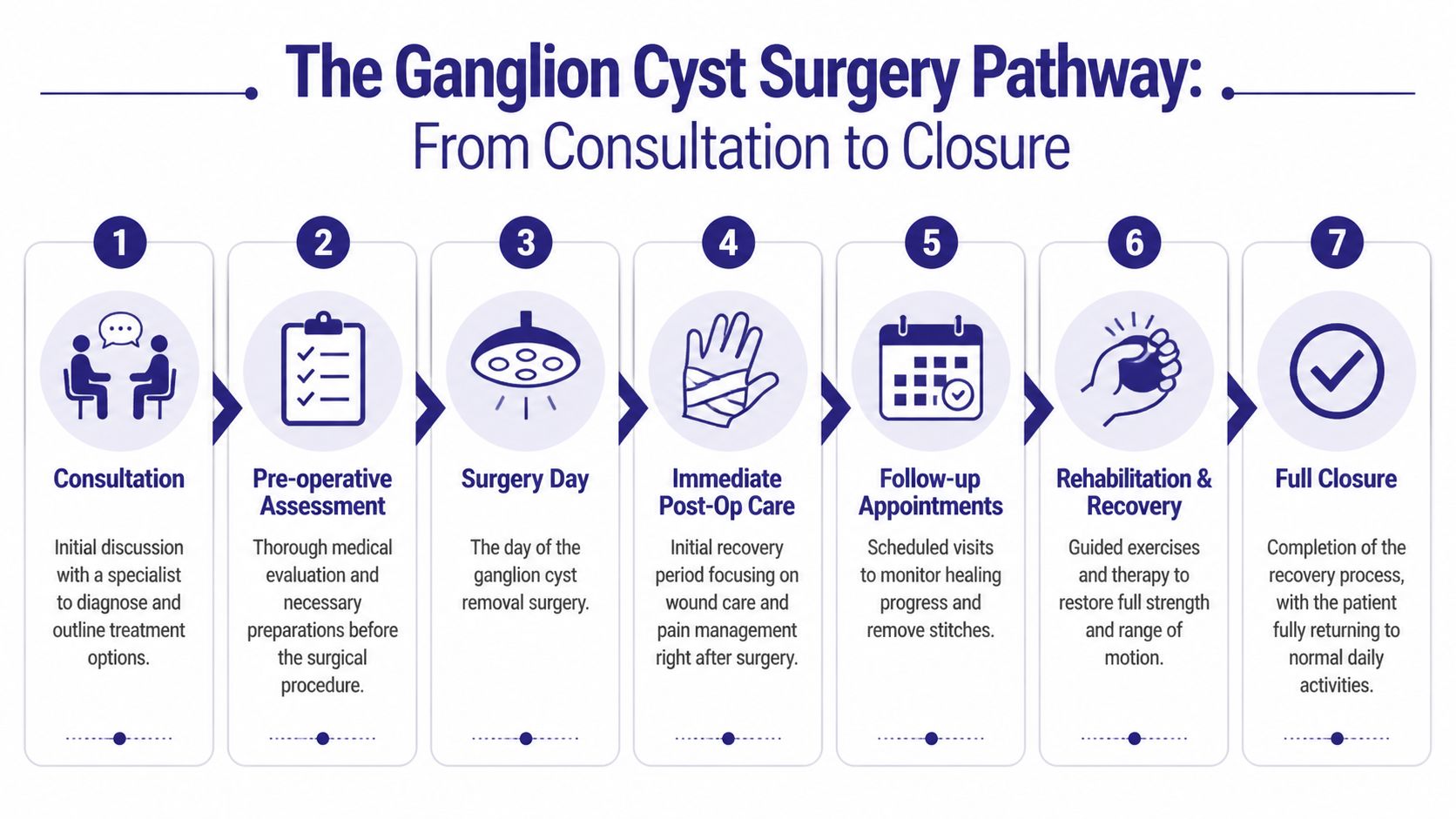
The first consultation and imaging
The first job is to confirm that the lump is a ganglion and to define where it sits, how fixed it is, and whether the symptoms really match the lump. A straightforward dorsal wrist ganglion can often be diagnosed clinically. A more awkward volar cyst, an unusually painful lump, or a wrist with deeper joint symptoms sometimes needs imaging to make the plan safer and clearer.
Ultrasound can be useful before surgery because it helps map the cyst and its connection. For patients, that matters in a practical way. Better pre-operative mapping can help the surgeon plan the incision, understand the stalk, and avoid surprises on the day.
Some people also need imaging because the ganglion is only part of the story. If there is persistent wrist pain, clicking, or concern about another problem inside the joint, MRI may be discussed. If you want a realistic sense of the process, this guide on how long a private MRI appointment usually takes explains what to expect.
Anaesthetic and day-of-surgery planning
Ganglion excision is usually a day-case procedure. You come in, have the operation, recover for a short period, and go home the same day.
Anaesthetic choice depends on the surgeon, the setting, and your preferences. Many patients have regional or local anaesthesia with sedation, which avoids an overnight stay and is often well suited to a minor hand procedure. Some prefer to be more asleep. Others would rather avoid that if possible. Neither approach is automatically “better” for everyone. The right option is the one that balances comfort, medical suitability, and how you tend to cope with procedures.
Busy Bristol patients often do best when they prepare for the first 72 hours before the operation rather than after it. That means arranging transport home, setting up one-handed essentials, clearing avoidable diary pressure, and accepting that even a small operation can make simple tasks clumsy for a few days.
Open versus arthroscopic surgery
Open surgery remains the standard approach for many wrist ganglia because it gives direct access to the cyst and its stalk. That visibility is useful, especially when the aim is to remove the connection properly rather than just flatten the lump.
Arthroscopic, or keyhole, surgery can be appropriate in selected cases. It may appeal to patients who like the idea of smaller portals, but suitability depends on the cyst location, the anatomy of the wrist, and the surgeon’s experience with the technique. In practice, this is not a branding decision. It is a surgical planning decision.
For a Bristol professional or athlete, the trade-off is usually simple. The best operation is the one most likely to solve the problem safely, with a recovery plan that fits real life. Someone who needs dependable grip for surgery, dentistry, coding, rowing, climbing, or regular cycling around the city usually values a clear operative strategy more than the label attached to it.
What the surgeon is doing during open excision
During open excision, the surgeon does more than remove the visible bump. The aim is to identify the ganglion carefully, follow it down to its origin, and remove the stalk from the capsule or tendon sheath where the fluid is tracking from. That is why surgery is more definitive than aspiration.
This part matters. If the deeper connection is not dealt with, the wrist can continue to push fluid back into the same pathway and the lump can return.
The operation is done in a small, crowded area with tendons, ligaments, vessels, and sensory nerves nearby. Good surgery here is measured, anatomical, and precise. Patients do not need to know every structure by name, but they should know why surgeon experience matters, especially for volar cysts or any lump sitting close to important nerves and blood vessels.
From a patient point of view, closure is usually straightforward. The wound is stitched, dressed, and protected. You then move into the more important part for daily life. Recovery planning. That is the stage that determines how quickly you can get back to typing comfortably, driving across Bristol, training sensibly, or returning to harbour rowing without setting yourself back.
Your Recovery Timeline Returning to Work and Sport
You have surgery on a Friday and by Monday morning there are emails waiting, a clinic list to run, or a training plan you do not want to lose. That is the moment generic advice becomes unhelpful. What matters is not a vague promise that you will be “back soon”. What matters is when you can type comfortably, drive safely across Bristol, hold a rowing handle, or get back on the bike without setting the wrist back.

Recovery after ganglion cyst surgery is usually steady rather than dramatic. The incision is small, but the wrist can stay sore, tight, and weak for longer than busy patients expect. In practice, the biggest mistake is doing too much too early because the hand looks better before it is ready for load.
The first week
Keep this week simple.
The priorities are swelling control, wound protection, pain relief, and regular finger movement. Light use of the hand is usually fine for basic tasks, but prolonged typing, lifting shopping bags, upper-body gym work, and repeated gripping often flare pain and swelling.
For professionals in Bristol who work at a keyboard, a modified return may be possible if you can use shorter bursts, voice dictation, and regular breaks. If your day depends on fast, accurate hand use, such as dentistry, surgery, beauty work, manual therapy, or tools, it is sensible to expect more disruption.
Helpful habits include:
- Keep the hand raised for the first few days, especially if swelling builds by evening.
- Move the fingers little and often to reduce stiffness.
- Keep the dressing dry and intact unless your surgical team has advised otherwise.
- Set up workarounds early such as dictation, left-handed mouse use, or reduced meeting notes.
Weeks two to three
This is often the awkward phase. The wound is improving, but the wrist still does not feel normal.
Stitches may be removed during this period, depending on the closure used. Once the wound is properly healed and your clinician has said it is safe, scar massage and gentle mobility work can help with tightness. Patients who protect the wrist for too long often become stiffer than patients who start sensible movement at the right time.
Typing usually becomes easier here, but not always comfortable for a full day. Driving short distances around Clifton, Redland, or into the city centre may be reasonable once you can grip the wheel confidently, react without hesitation, and are no longer limited by pain or bulky dressings. The legal and practical standard is simple. You must be able to control the car safely.
Judge progress by comfort, movement, and confidence with daily tasks, not just by whether the lump has gone.
Weeks four to six
Many desk-based professionals feel more functional by this stage. A full office day is often more realistic, although long stretches of laptop work can still irritate the wrist if you do not pace it well. I usually advise patients to build capacity in blocks rather than testing it with one punishing day.
Sport needs a graded return. The right timeline depends less on fitness and more on how much force goes through the wrist.
A practical guide looks like this:
- Desk work: often close to normal, with short breaks and a sensible workstation setup.
- Driving: usually easier, provided grip strength and comfort are back.
- Gym work: restart with lower loads, machines or patterns that keep the wrist neutral, and no sudden pushing or heavy gripping.
- Road cycling or commuting: start with short, smoother rides before longer efforts.
- Avon Trail cycling: leave the longer or rougher rides until the wrist tolerates sustained pressure through the bars.
Patients are often surprised by extension-based discomfort at this point. Press-ups, front rack positions, yoga poses on flat palms, and barbell lifts can still feel sharper than expected even when ordinary daily life is going well.
Weeks six to twelve
This is the stage where people get their life back, but not always their full performance immediately.
For athletes and active professionals, the main job now is rebuilding load tolerance. A harbour rower may manage easy erg work before a hard session on the water. A climber may return to easier routes first and avoid powerful pulling on awkward wrist positions. Someone doing reformer Pilates or yoga may still need wedges, fists, or other wrist-friendly modifications before fully loading the hand.
Manual work often needs more planning than office work. Builders, mechanics, healthcare staff, personal trainers, and anyone lifting repeatedly can uncover weakness that does not show up at a desk. A phased return is often the fastest route back to full function because it avoids the stop-start pattern that follows an early flare.
What usually helps recovery go more smoothly
Small decisions make a real difference:
- Do the hand exercises you were given, little and often.
- Avoid sleeping with the wrist curled underneath you, which can increase morning stiffness.
- Keep moving during computer-based work, rather than locking into one position for hours.
- Eat and drink properly, especially in the first two weeks when routines are off.
- Avoid smoking if applicable, because wound healing is better without it.
- Tell your employer, coach, or crew early if you need a phased return.
If recovery feels slower than expected, that does not automatically mean something is wrong. Swelling, scar sensitivity, and reduced confidence with loading are common for a while. The useful question is whether function is gradually improving week by week. That is the pattern we want.
Understanding Risks Recurrence and Long-Term Success
You have the lump removed, the wound settles, work is back to full speed, and then one question lingers in the background. Is this finished, or will it interfere with training and work again in six months?
That is the right question to ask. Long-term success after ganglion cyst surgery is not judged only by whether a lump reappears. It is judged by whether pain has improved, whether the wrist is reliable under load, and whether the trade-off of surgery was worthwhile for your life.
The main surgical risks
Ganglion surgery is usually straightforward, but it is still wrist surgery. The risks I discuss most often in clinic are infection, wound irritation, scar tenderness, stiffness, and irritation of nearby small nerves. Volar cysts, which sit on the palm side of the wrist, often need a more cautious conversation because important structures are closer by.
Most problems, when they happen, are manageable rather than serious. The catch is that even a minor issue can matter if you spend your day typing, treating patients, lifting, climbing, cycling, or rowing. A tender scar or a stiff wrist may be a nuisance for one person and a genuine work problem for another.
Technique matters. So does aftercare. Protecting the wrist for too long can leave it stiff and hesitant, while pushing too hard too early can keep it swollen and sore.
Why recurrence happens
A ganglion usually arises from a joint capsule or tendon sheath. The operation aims to remove the cyst and the point it comes from, rather than just draining the visible lump. If that connection persists, fluid can collect again over time.
This is why recurrence can still happen after good surgery. It does not always mean anything was done badly. Some cysts are more awkward in position or more prone to coming back.
It also explains why aspiration is less definitive. Removing fluid can flatten the lump for a while, but it does not reliably deal with the origin.
Dorsal versus volar cysts
The position of the cyst changes the discussion.
Dorsal ganglia, on the back of the wrist, are often more straightforward from a surgical planning point of view. Volar ganglia can be trickier because they sit near structures we want to protect carefully. That can affect the balance between symptom relief, scar position, recurrence risk, and the level of dissection required.
For a Bristol-based professional or athlete, that distinction matters in practical terms. A dorsal cyst may be mainly aggravated by weight-bearing through an extended wrist, such as in yoga, strength work, or time on the drops during a long ride. A volar cyst may be more noticeable with gripping, lifting, or wrist flexion, which can affect racket sports, rowing, and some gym work.
If the cyst comes back
Recurrence after surgery is possible. The right response depends on what has returned and how much it matters.
A small recurrent lump that does not hurt and does not limit function often does not need another operation. A painful recurrence, a lump that interferes with grip or wrist extension, or a swelling that is no longer behaving like the original diagnosis deserves review.
Before considering repeat surgery, I would usually ask:
- Is the problem cosmetic, painful, or function-limiting?
- Has it come back in exactly the same place?
- Did the first operation improve things for a meaningful period?
- How disruptive would another recovery window be for your work, travel, or sport calendar?
- Is there any doubt that this is still a ganglion rather than a different wrist lump?
Second procedures can help the right patient, but they require a more careful risk-benefit discussion. Scar tissue, altered anatomy, and the reason the cyst returned all matter.
What long-term success usually looks like
The best outcome is not a flat wrist alone. It is a wrist you stop thinking about.
For an office-based professional, that means getting through a full day of keyboard use, commuting, and training without the wrist becoming the limiting factor. For an athlete, it means returning to normal loading with confidence, whether that is rowing on Bristol Harbour, riding the Avon Trail, lifting in the gym, or getting back onto a climbing wall without guarding the hand.
That is the standard worth aiming for.
Ganglion Surgery FAQs for Bristol's Professionals
I work at a desk all day. When can I type properly again
Most desk workers can do some light keyboard use earlier than they expect, but not comfortably for full days straight away. The better question is not “When can I type?” but “When can I type without guarding the wrist, compensating through the shoulder, or flaring the wound?”
If your work is heavy on emails, spreadsheets, coding, drafting, or presentations, plan for a short period of reduced output. Use dictation, lighter days, and shorter bursts. Comfort usually returns in stages, not all at once.
Can I book surgery around a busy work period
Yes, and you should. For professionals, timing matters almost as much as technique. Try not to schedule ganglion cyst surgery immediately before a week of travel, a major hearing, product launch, exam sitting, or an important sports event.
A well-timed procedure is easier to recover from because you’re not fighting your diary at the same time as your wound.
I row in Bristol Harbour. When can I get back on the water
Rowing combines grip, pull, repetition, and some wrist control under fatigue. That means thinking in phases is advisable. Early return is usually about general motion and light conditioning first, then technique work, then stronger pulling.
Start with what your wrist tolerates rather than what your fitness demands. Fitness can return quickly. A reactive wrist will slow you down if you rush it.
What about cycling on the Avon Trail
Cycling is often possible before heavier gym work because the load is shared and adjustable, but handlebar pressure can still irritate a healing wrist. Many people do better starting with shorter rides, smoother terrain, and a position that avoids prolonged wrist extension.
Padded gloves, small route choices, and honest pacing help more than bravado.
Will surgery leave a scar
Yes. The aim is a neat, well-healed scar, not no scar. For most patients, the trade-off is acceptable if the cyst has been painful, recurrent, or functionally limiting.
Good scar care, gradual movement, and not provoking the wound repeatedly all improve the cosmetic result over time.
Is arthroscopic surgery always better because it’s keyhole
Not automatically. Keyhole surgery sounds appealing, and some evidence suggests stronger patient-centred outcomes, but “better” depends on the cyst location, the surgeon’s experience, and what your main goal is. For some patients, open surgery remains the clearest route to complete stalk removal.
That’s why a proper consultation matters more than assuming the smallest incision is always the best answer.
What if I’m an athlete and don’t want to lose training momentum
That’s common. The best approach is to plan what you can still train. Lower body work, conditioning that doesn’t stress the wrist, mobility, and technique in unaffected areas can often continue in modified form.
The patients who cope best don’t think in all-or-nothing terms. They think in substitutions.
Should I have aspiration first so I can avoid surgery
Sometimes that’s reasonable, especially if you want a less invasive first step and understand the chance of recurrence. If your cyst is already interfering significantly with work or sport, or if you want the most definitive option, aspiration may only delay the treatment you’re likely to need anyway.
The right answer depends on your tolerance for recurrence versus your desire to avoid an operation.
What should make me seek help after surgery
Don’t wait if the wound becomes increasingly red, swollen, or starts discharging, or if pain is escalating rather than easing. Ongoing numbness, marked stiffness, or a new lump in the same area also deserve review.
Most recoveries are straightforward. Problems are easier to manage when they’re picked up early.
I’m mostly bothered by how it looks. Is that a valid reason
Yes. It may not be medically urgent, but it’s still valid. If a visible wrist lump makes you self-conscious in meetings, photos, sport, or daily life, that counts.
Treatment decisions should reflect how a condition affects the whole person, not just whether it looks dramatic on examination.
If you’re weighing up aspiration versus ganglion cyst surgery, or you want a practical plan that fits your work, sport, and recovery expectations, The Lagom Clinic offers personalised private GP care in Bristol with a strong focus on musculoskeletal medicine, lifestyle advice, minor surgery, and planning treatment around real life.
Ganglion cyst removal in Bristol
Our minor surgery clinic offers same-week consultations for cyst assessment and removal. GMC-registered surgeons, transparent pricing.

 Members Consultation