


You finish a long day in Bristol, your shoulders are up around your ears, and a drink feels like the quickest way to switch off. One glass becomes two, you feel softer around the edges, and for a little while it seems to work. Then morning arrives. Your heart feels louder, your mind starts scanning for problems, and even opening your inbox feels oddly threatening.
If that sounds familiar, you’re not imagining it. Many people ask some version of the same question: does alcohol cause anxiety, or does it reveal anxiety that was already there? In practice, it can do both. Alcohol can temporarily blur stress, but it can also set up the exact brain and body changes that make anxiety worse later.
That’s why ‘hangxiety’ feels so confusing. The same substance that seemed calming the night before can leave you tense, flat, restless, or panicky the next day. Understanding that pattern matters, especially if you’re someone with a demanding job, patchy sleep, and very little spare capacity for feeling off.
The Deceptive Promise of a Relaxing Drink
A lot of people don’t drink because they want to lose control. They drink because they want relief. After meetings, deadlines, commuting, parenting, or just the low hum of modern life, a drink can feel like a neat little boundary line between “work mode” and “finally done”.
That first stage is real. Alcohol can make you feel calmer in the moment. It lowers inhibition, slows things down, and can create a sense of ease. The problem is that the calm is borrowed, not built.
Why the next morning feels so different
Many readers describe the same sequence. They feel fine when drinking, sleepy later, then wake in the night or early morning with a racing mind. Suddenly they’re replaying conversations, worrying about work, or feeling a general sense of dread they can’t quite explain.
If morning anxiety is something you notice often, Ben's guidance on morning anxiety is a thoughtful resource that helps make sense of why waking up can feel so emotionally loaded.
Alcohol can feel like a fast-acting off switch. For many people, it behaves more like a delayed anxiety trigger.
This isn’t a niche issue. In the UK, an estimated 12.5 million people exceed the Chief Medical Officers’ low-risk drinking guideline of 14 units per week, and Alcohol Change UK’s anxiety data shows a clear pattern. 24% of never-drinkers report anxiety, compared with 32% of hazardous drinkers and 50% of harmful drinkers.
The trap busy professionals fall into
For professionals, alcohol often gets woven into routine rather than excess. A glass while cooking. Drinks after a client event. A Friday release valve. Weekend socialising that looks normal from the outside. The risk is that drinking becomes your main stress tool without you fully noticing.
That’s where the cycle starts. You feel stressed, so you drink. The drink changes your brain chemistry and your sleep. The next day you feel more unsettled, so another drink seems reasonable. Over time, it can become harder to tell whether alcohol is helping your anxiety or feeding it.
A kinder and more accurate way to see this is not “I’m weak” or “I’ve got no discipline”. It’s this: your brain is responding to a substance exactly the way brains do.
How Alcohol Creates a Chemical Imbalance in Your Brain
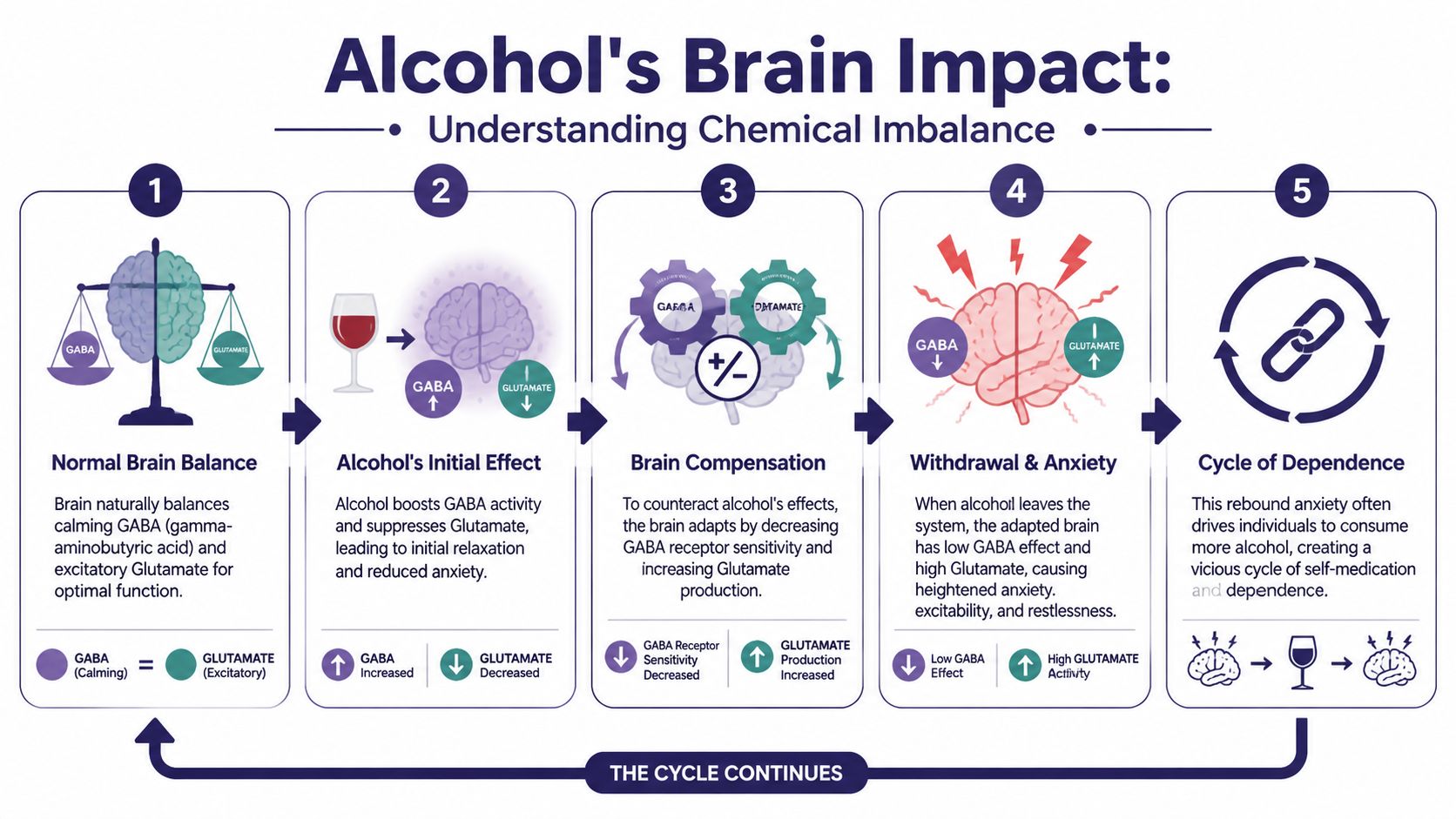
The clearest answer to “does alcohol cause anxiety” sits in brain chemistry. You don’t need a neuroscience degree to understand it. Think of your nervous system as a seesaw that works best when both sides stay in balance.
One side is your brain’s calming system. A key chemical here is GABA, short for gamma-aminobutyric acid. The other side is your brain’s activating system, which helps you stay alert and responsive. When the balance is right, you can feel calm without being sluggish, and focused without feeling wired.
What alcohol does at first
Alcohol pushes down on the calming side of the seesaw. It increases GABA activity, which is one reason you may feel more relaxed, less socially awkward, or less mentally tense after a drink.
That early effect can be especially appealing if you already run “high alert” as a person. If your mind is always busy, alcohol can seem like it gives you a break from yourself.
Why the brain pushes back
Your brain doesn’t like being artificially pushed too far in one direction. It’s always trying to keep you steady. So when alcohol repeatedly boosts GABA, the brain adapts.
According to Henry Ford’s explanation of alcohol, GABA and rebound anxiety, acute alcohol use increases GABA activity and creates initial relaxation, but repeated exposure leads the brain to downregulate GABA receptors and reduce its own GABA production. When the alcohol wears off, that adaptation can leave GABA activity below baseline, which is when rebound anxiety shows up.
Rebound anxiety in plain English
If the first drink felt like pressing the brake pedal, the next morning can feel as if the brake has gone soft while the accelerator is still working. That’s why people often report:
- Restlessness that seems out of proportion to what’s happening
- Irritability over small things
- A racing mind at exactly the time they want calm
- Poor sleep that leaves them physically tired but mentally activated
This helps explain why “hangxiety” can happen even when someone doesn’t think they drank that much. The issue isn’t only intoxication. It’s the brain’s rebound.
Practical rule: If alcohol is your main way to come down from stress, your nervous system may start relying on a substance that later pushes it the opposite way.
For people already living with chronic stress, it’s worth building other calming routines so alcohol isn’t doing all the heavy lifting. Approaches such as sleep protection, breathing work, movement, and daylight exposure often fit well with broader strategies for lowering cortisol naturally, especially when work pressure is high.
Why this feels stronger over time
At first, this effect may only show up after a bigger night. Later, some people notice it after moderate drinking, or even after what they’d once have called a normal evening. That doesn’t mean you’re failing. It means your brain has learned from repeated exposure and is compensating more quickly.
The important point is simple. Alcohol’s calming effect is temporary. The anxious rebound is part of the same process.
From Rebound Anxiety to Long-Term Risk
A rough morning after drinking is one thing. A steadily more anxious baseline is another. The difference matters.
Short-term hangxiety is the immediate rebound. Long-term risk develops when the brain keeps adapting to repeated alcohol exposure. The nervous system becomes less flexible. You may need more alcohol to get the same sense of ease, and feel more unsettled when you’re not drinking.
What changes over time
This process is often called neuroadaptation. In everyday language, your brain starts treating alcohol as part of the environment it has to work around. That can make ordinary life feel more jagged without it.
People often notice a few warning patterns:
- The same amount doesn’t relax you like it used to
- You feel edgy on alcohol-free evenings
- Your sleep is lighter, earlier, or more broken
- You start drinking for relief rather than enjoyment
None of these automatically means dependence. They do suggest that alcohol may be shifting from an occasional social tool into a regular regulator of mood.
A simple comparison
| Timeframe | Effect on Brain Chemistry | Perceived Feeling | Underlying Consequence |
|---|---|---|---|
| Short-term | Alcohol temporarily boosts calming activity and suppresses overactivation | Relief, looseness, sleepiness, reduced inhibition | The brain rebounds after alcohol wears off, which can lead to next-day anxiety and poor sleep |
| Long-term | Repeated exposure trains the brain to compensate more strongly | Drinking feels less effective, sober time feels more tense | Anxiety can become more persistent, and alcohol can shift into a self-medication pattern |
Many people think the problem is the hangover. Often the bigger issue is the relationship forming between stress, relief, and repeated drinking.
Why self-medicating can backfire
If you drink because you feel anxious, alcohol may appear to solve the problem in the short run. But it doesn’t teach your body how to settle itself. It rents calm for a few hours and then sends the bill to tomorrow.
That’s one reason people can feel trapped. They aren’t only managing stress from life. They’re also managing the after-effects of the thing they used to manage stress. Over months or years, that loop can deepen anxiety rather than reduce it.
A balanced approach proves helpful. Some people do need to stop drinking altogether. Others benefit first from tracking patterns, reducing frequency, and building better ways to recover from stress. What matters is noticing whether alcohol is still serving you, or whether you’ve unknowingly started serving it.
Who Is at Higher Risk for Alcohol-Induced Anxiety?
Some people can have a drink and feel little emotional fallout. Others experience a very obvious next-day dip in mood, sleep, or anxiety. The basic chemistry is similar, but vulnerability isn’t equal.
People who already live with anxiety, low mood, chronic stress, or poor sleep often feel alcohol’s downsides more sharply. That includes many professionals who seem outwardly high-functioning but spend most of the week in a mildly overactivated state.
Patterns that increase vulnerability
You may be at higher risk if any of these sound familiar:
- You already have anxiety or low mood. Alcohol can slot into an existing pattern of emotional self-management.
- You drink to cope rather than to celebrate. The motive matters. Relief drinking tends to build stronger psychological dependence.
- Your stress is constant. If work pressure, responsibility, or decision fatigue never really switch off, alcohol may become your default decompression tool.
- Your sleep is already fragile. Alcohol and broken sleep are a poor combination for anxiety.
Why workplace stress matters
This is particularly relevant in Bristol’s working population. Priory Group’s write-up on alcohol and anxiety cites UK data from an ONS 2025 survey indicating that 28% of Bristol working adults aged 25 to 54 reported heightened anxiety linked to hangxiety after moderate weekend drinking, while only 12% accessed occupational health support. The same source reports a 35% rise in alcohol-anxiety co-occurrence among executives since 2024.
Those figures fit what many clinicians see in practice. Capable people often minimise their own symptoms because they’re still functioning. They’re still getting through meetings, parenting, replying, performing. But functioning isn’t the same as feeling well.
The high-achiever blind spot
Busy professionals can be especially good at rationalising a pattern that isn’t helping. Common thoughts include:
- “I only drink at weekends.”
- “Everyone I work with drinks like this.”
- “It helps me switch off.”
- “I’m not drinking enough for it to be a real problem.”
Sometimes that’s true. Sometimes it isn’t. The key question isn’t whether your drinking looks dramatic from the outside. It’s whether your anxiety, sleep, energy, and resilience are worse because of it.
Practical Lifestyle Changes to Break the Cycle
If alcohol has become part of your stress routine, the answer isn’t always a harsh all-or-nothing rule. For many people, the most sustainable change is a Lagom-style one. Not extreme, not careless. Just enough structure to help your body feel safe again.
That means reducing the strain on your nervous system from several angles at once. Better evenings. Better sleep. Better recovery. Better boundaries around drinking.
Start with your evening routine
If your first drink usually happens in the same place and at the same time, don’t rely on willpower alone. Change the sequence.
Try one or two of these:
- Delay the first drink by giving yourself a transition ritual first. A shower, a short walk, ten quiet minutes, or changing clothes can create the feeling of “day over” without opening a bottle.
- Eat before drinking. Alcohol hits harder on an empty stomach and can make emotional dips feel sharper later.
- Use a proper alternative. A grown-up non-alcoholic option in a nice glass works better than telling yourself sparkling water should feel exciting.
Build other ways to come down
Many people need stress relief, not alcohol specifically. If you replace the function, reducing the habit gets easier.
A few practical options for busy schedules:
A brisk walk after work
This is one of the simplest ways to discharge tension from the day. It creates a physical boundary between work stress and home life.Brief breathing practice
You don’t need a meditation cushion. A few quiet minutes of slower breathing can tell your body that the threat has passed.Low-friction exercise
Think short and repeatable. A cycle, a gym session, yoga, or even a home mobility routine. The best option is the one you’ll do when tired.
If your only route to relaxation comes in a glass, add at least one other route this week.
Protect sleep like it matters
Alcohol often makes people sleepy at first, which is why it gets mistaken for a sleep aid. But many notice they wake earlier, sleep more lightly, or feel unrefreshed.
Useful sleep habits include:
- Keep the bedroom cool and dark
- Avoid late emails or doom-scrolling
- Leave a gap between drinking and bed where possible
- Keep wake-up time steady, even after a poor night
Try mindful drinking instead of autopilot drinking
Not everyone is ready or needs to stop completely. A thoughtful middle path can still make a big difference.
Consider this approach:
- Set your limit before the event, not during it
- Alternate alcoholic and non-alcoholic drinks
- Choose smaller drinking occasions, rather than defaulting to both Friday and Saturday
- Notice your motive. Are you drinking for taste, sociability, habit, or emotional escape?
If you want more ideas on building resilience more broadly, this guide on improving mental wellbeing complements the same balanced approach.
Make it measurable without becoming obsessive
You don’t need a spreadsheet for life, but a short note on your phone can be useful. Track three things for a couple of weeks:
- How much you drank
- How you slept
- How anxious you felt the next morning
Patterns usually appear quickly. That can be much more motivating than vague intentions.
When to Seek Professional Support at The Lagom Clinic
Self-help works well for some people. For others, anxiety and alcohol start reinforcing each other too strongly, and extra support becomes the sensible next step.
That isn’t a sign that you’ve failed. It’s a sign that the problem deserves proper care.
Signs it’s time to speak to a clinician
It’s worth booking an appointment if:
- You want to cut down but keep slipping back into the same pattern
- Your anxiety feels unmanageable, especially the day after drinking
- Alcohol is affecting work, concentration, or relationships
- You feel you need alcohol to relax, socialise, or sleep
- You notice physical withdrawal symptoms when you don’t drink
Withdrawal symptoms can include shaking, sweating, marked agitation, or feeling physically unwell when alcohol wears off. If that’s happening, don’t try to manage it alone.
Why a joined-up approach matters
Alcohol and anxiety often need to be assessed together, not as separate issues. If someone only looks at the anxiety, they can miss the role alcohol is playing. If someone only focuses on alcohol, they can miss the reason you’re reaching for it.
That’s why integrated care matters. For readers who want to understand that model in more depth, Altura Recovery integrated care support explains how dual-focus treatment can help when anxiety and substance use are tangled together.
Professional support should feel calm, confidential, and practical. You shouldn’t have to prove that things are “bad enough” before asking for help.
A good clinical assessment can look at the whole picture. Your symptoms, sleep, work stress, physical health, drinking pattern, and any underlying drivers such as low mood or burnout. From there, support might include a medical review, lifestyle changes, talking therapy, blood tests where appropriate, and a safe plan for cutting down if needed.
If your drinking is heavy and stopping suddenly feels difficult, seek medical advice before making abrupt changes. Safety comes first.
Reclaiming Your Mental Wellbeing
Alcohol can feel soothing in the moment because it shifts brain chemistry in a way that mimics calm. The problem is that the brain responds, compensates, and often leaves you more anxious afterwards. That’s the core reason hangxiety happens, and why repeated drinking can gradually raise the emotional cost.
The encouraging part is that this cycle is changeable. Once you recognise the pattern, you can start interrupting it. Sometimes that begins with one smaller choice. One alcohol-free evening. One earlier dinner. One walk after work. One honest look at how you feel the next morning.
You don’t need to approach this with shame or extremes. A balanced, thoughtful approach usually works better. Reduce what isn’t helping. Add what helps your body recover. Ask for support sooner than your inner critic says you’re allowed to.
If you’ve been wondering, “does alcohol cause anxiety for me?”, your own experience is worth taking seriously. If you feel worse after drinking, that matters. If your mornings feel fragile, that matters too.
Small changes can create real relief.
If you’d like calm, confidential support with anxiety, stress, sleep, or your relationship with alcohol, The Lagom Clinic offers personalised private GP care in Bristol with a proactive, whole-person approach.

 Members Consultation