


You might be reading this late at night after another negative test, or during a lunch break between meetings, wondering whether it’s too soon to ask for help. Many people search for a test for fertility, long before they say the words out loud to a partner, friend, or doctor.
That hesitation is understandable. Fertility testing can sound technical, exposing, and emotionally loaded. In practice, it’s usually a structured medical review designed to answer a simple question: how are things working, and what would be the most sensible next step for you?
Deciding to Explore Your Fertility
A common starting point is this. You’ve been trying to conceive and nothing has happened yet. Or you’re not trying now, but you know work, age, health history, or life plans may affect when you want to start a family.
That doesn’t make you anxious or overreactive. It makes you thoughtful.

Infertility is more common than many people realise. It affects approximately 1 in 8 couples, and among married women aged 15 to 49 with no prior births, the rate is 19.4%, according to CDC infertility data. Those numbers matter because they help remove the sense that you’re somehow the exception or that seeking answers means something has gone badly wrong.
When people usually seek testing
In clinic, I often see three groups of patients:
- People who’ve been trying for a while and want to know if there’s an obvious reason conception hasn’t happened.
- People over 35 who don’t want to lose time waiting and would rather assess things early.
- People planning ahead who want a realistic picture before making decisions about timing, egg freezing, or family planning.
If you’ve been having regular unprotected sex for 12 months without pregnancy, it’s sensible to seek medical advice. If you’re over 35, many clinicians advise getting assessed after 6 months of trying. You may also want to seek help earlier if your periods are very irregular, you’ve had pelvic surgery, significant endometriosis symptoms, known hormonal issues, or previous treatment that could affect fertility.
You don’t need to wait until you feel desperate. Fertility assessment is often most useful when it helps you make calm, informed decisions.
A proactive step, not a verdict
One reason people delay a test for fertility is fear of being “labelled”. I’d encourage a different view. Testing is less like sitting an exam and more like having a map drawn. It may show everything looks reassuring. It may show one or two areas worth addressing. It may point towards specialist care. All of that is useful.
If you’re in the stage of gathering balanced information, the Bornbir guide for expecting parents is a helpful read alongside a medical consultation.
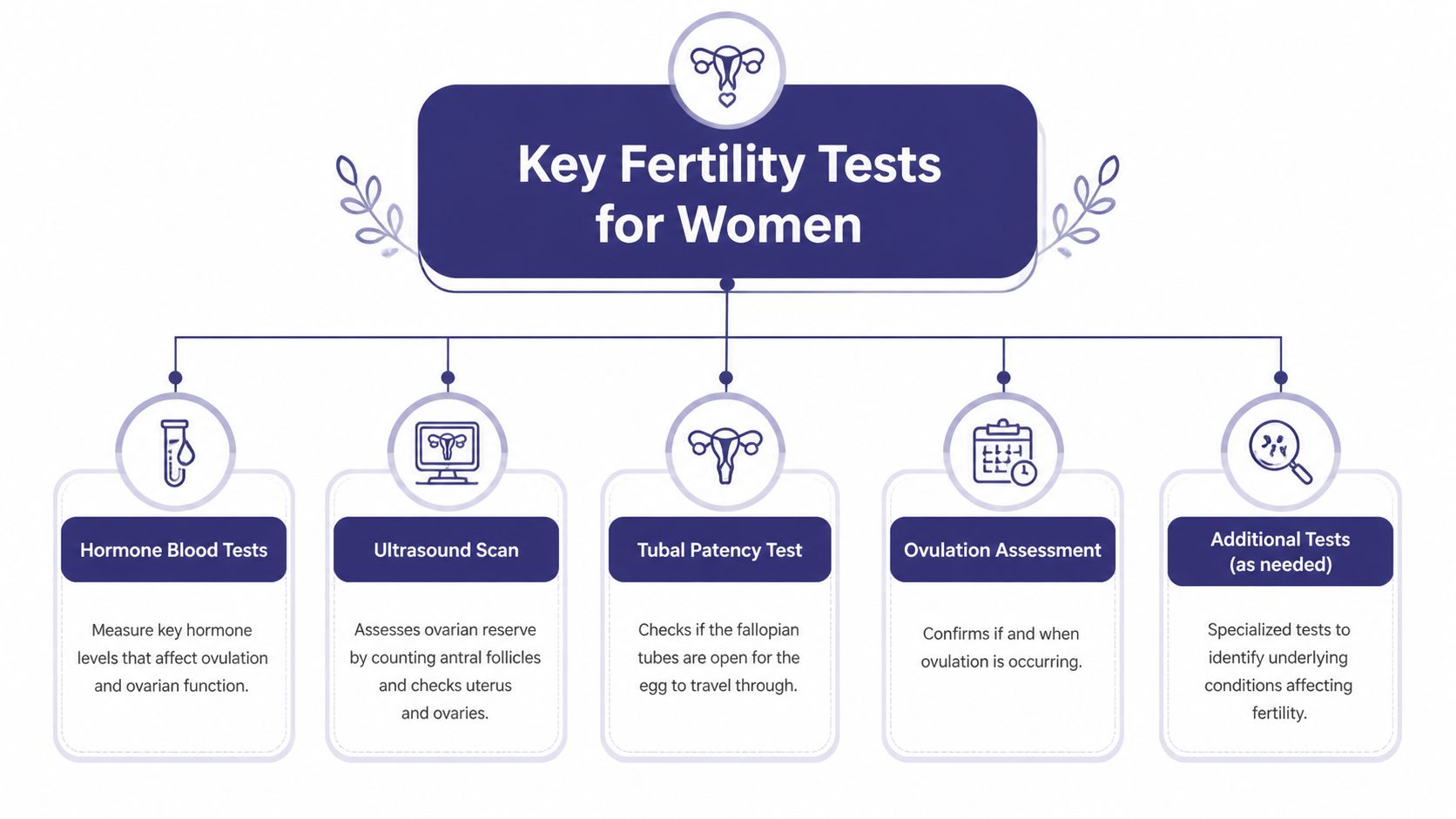
Key Fertility Tests for Women
Female fertility testing usually combines blood tests with imaging. Each test answers a different question. No single result tells the whole story.
Blood tests that look at hormone function
The best-known hormone test is AMH, or Anti-Müllerian Hormone. This helps estimate ovarian reserve, which means the remaining pool of eggs in the ovaries. It doesn’t tell you whether you can get pregnant this month, but it does help your doctor understand the likely response to fertility treatment and how urgently planning may matter.
UK data shows that the median AMH for women aged 35 to 39 is 13 pmol/L, and low AMH can predict a reduced response in IVF. NICE guideline CG156 supports using AMH to help identify poor responders, as outlined in this guide to fertility evaluation.
A second set of blood tests often includes FSH and sometimes related reproductive hormones. These help assess how the brain and ovaries are communicating. If AMH is a rough guide to egg supply, FSH helps show how hard the body is working to recruit eggs.
Other blood tests may check for wider medical issues that can affect ovulation and conception, such as thyroid imbalance or high prolactin.
Imaging that looks at ovaries and womb structure
A pelvic ultrasound helps assess the ovaries and uterus. This can show:
- Antral follicle count, which gives another clue about ovarian reserve
- Fibroids or cysts, which may or may not affect fertility depending on size and position
- Features suggesting ovulation problems, such as changes in the ovaries
- The shape of the womb, which can sometimes explain implantation difficulties
Think of ultrasound as mapping the physical environment. Blood tests show some of the chemistry. Ultrasound shows the anatomy.
Tests that check whether the pathways are open
If sperm and egg are to meet naturally, the fallopian tubes need to be open. That’s where tests such as an HSG come in. HSG stands for hysterosalpingogram. It uses dye and imaging to see whether the tubes are open and whether the uterine cavity looks normal.
Patients often worry this means something major is wrong. Often it’s part of a complete work-up, especially if you’ve been trying for some time or if there’s a history of pelvic infection, surgery, or endometriosis.
Practical rule: A fertility result is most useful when it’s interpreted with your age, menstrual pattern, symptoms, medical history, and your partner’s results.
What these tests can and can’t tell you
It helps to avoid two common misunderstandings.
- AMH is not egg quality. It gives information about ovarian reserve, not a guarantee about natural conception.
- A normal scan doesn’t mean “nothing is wrong”. Some fertility issues are hormonal, tubal, male factor, or unexplained.
- One abnormal result isn’t the final answer. Timing, cycle variation, and the broader clinical picture matter.
- Normal results can still be valuable. They narrow the field and make decision-making clearer.
If your periods are irregular, heavy, very painful, or absent, tell your doctor before testing is arranged. That history often shapes which tests matter most and how results should be read.
Essential Fertility Tests for Men
Male fertility is sometimes treated as an afterthought. It shouldn’t be. In many couples, the clearest and quickest way to gather useful information is to assess both partners early.
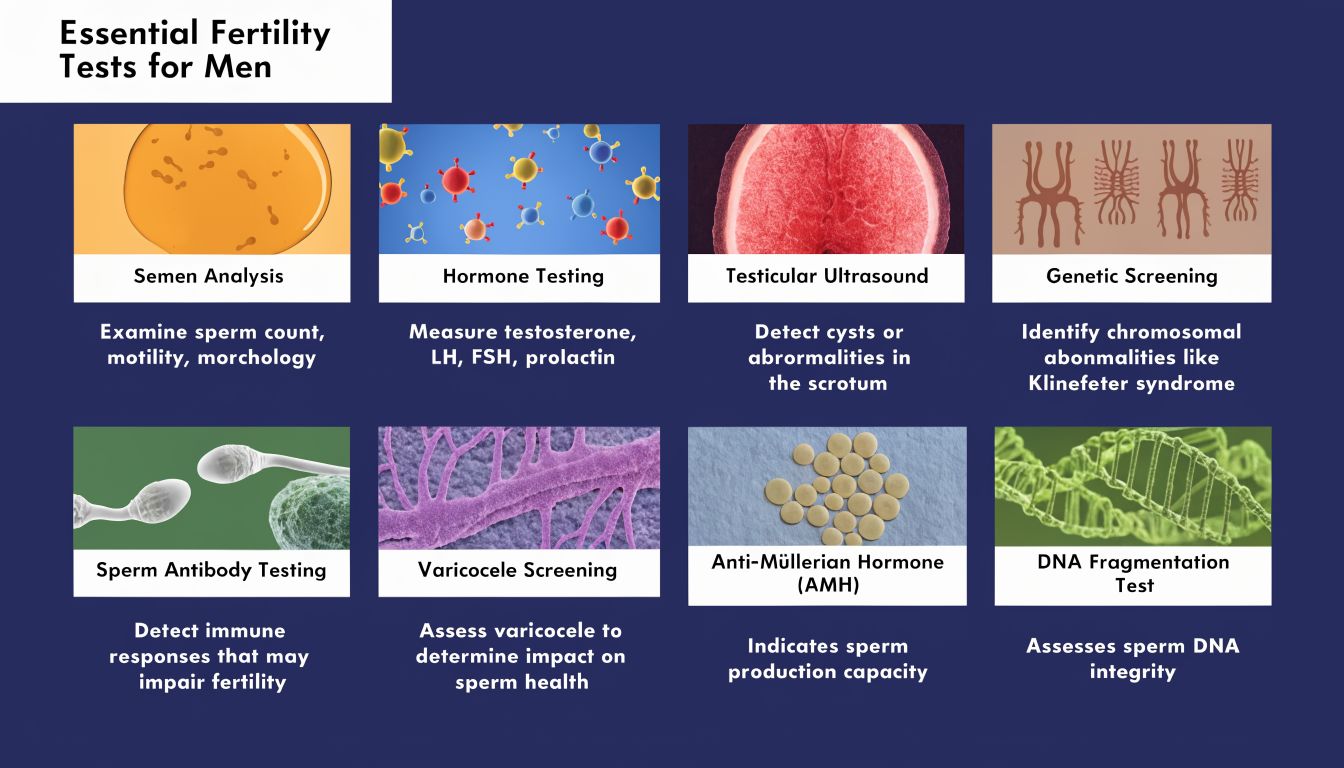
The semen analysis
The cornerstone test for men is the semen analysis. It’s straightforward, and it gives important information that blood tests in women cannot replace.
The lab is mainly looking at three things:
- Count. How many sperm are present.
- Motility. How well they move.
- Morphology. How they’re shaped.
A simple analogy helps here. If sperm are like swimmers trying to reach a destination, count tells you how many are at the starting line, motility tells you how many are moving effectively in the right direction, and morphology describes whether they’re structurally built for the journey.
The process itself is usually non-invasive. The emotional side can be harder than the physical side. Some men feel embarrassment, pressure, or a misplaced sense of blame. It helps to remember that this is a medical test, nothing more. It isn’t a measure of masculinity, virility, or worth.
When extra tests may be useful
Sometimes a semen analysis is enough to guide next steps. In other cases, a doctor may recommend further assessment, especially if the first result is abnormal or there’s a relevant medical history.
That may include:
- Hormone blood tests if there are signs that testosterone or other hormones may be contributing
- Physical examination if there could be a structural issue, such as varicocele
- More advanced sperm testing in selected cases, especially after recurrent fertility problems or where standard testing doesn’t fully explain the picture
If you want a clear patient-friendly overview of what the male testing process involves, how Hera Fertility simplifies fertility testing explains the basics well.
Everyday factors that can matter
A semen result is also a chance to review health habits. Some changes won’t transform fertility overnight, but they may improve the environment in which sperm develop.
Men often benefit from focusing on:
- Sleep quality because disrupted sleep can affect hormone balance
- Alcohol intake by keeping it moderate
- Smoking and recreational drugs because these can impair sperm health
- Heat exposure such as frequent hot tubs or prolonged laptop heat on the lap
- Weight, exercise, and metabolic health because general health and reproductive health are closely linked
For a practical next read, this guide on improving male fertility covers sensible lifestyle measures in more detail.
Male fertility testing works best when it happens early, not only after female investigations have already become long and stressful.
Navigating the Testing Process
A common concern once testing is arranged is how disruptive it will be. The reassuring answer is that a typical diagnostic workup can often be completed within 2 to 4 weeks, and fertility care has become much more familiar in public awareness, with 42% of American adults saying they’ve used fertility treatments or know someone who has, according to Pew Research on fertility treatment awareness and timelines.
Timing matters more than people expect
For women, some hormone tests are most useful when done early in the menstrual cycle. You may hear your doctor refer to day 2 to 5 bloods. That means tests taken near the beginning of a period, when the body is in a baseline state.
For men, semen analysis usually comes with instructions about abstinence before the sample. Follow the lab guidance carefully. Too short or too long a gap can affect interpretation.
If your cycles are irregular, don’t panic. Your doctor can still plan testing, but timing may need a bit more thought.
What appointments usually involve
The process often includes a mix of consultation, blood tests, and one or two imaging appointments. Some people can do bloods and a review of both partners’ histories first, then add ultrasound or tubal testing only if needed.
If you’re also exploring other screening options, this overview of private blood tests in the UK can help you understand how blood testing is usually organised in private practice.
Your checklist is below.
| Test | What it Assesses | What's Involved | Preparation |
|---|---|---|---|
| AMH and other hormone bloods | Ovarian reserve and hormonal patterns | Blood sample, usually early in cycle for some tests | Check cycle timing with your clinician |
| Pelvic ultrasound | Ovaries, womb, antral follicle count, structural concerns | Internal or abdominal scan depending on context | Follow clinic instructions about bladder and timing |
| HSG | Whether fallopian tubes are open and the uterine cavity shape | Dye test with imaging | Usually booked at a specific stage of the cycle |
| Semen analysis | Count, movement, and shape of sperm | Sample provided for laboratory testing | Follow abstinence guidance from the lab |
| Follow-up consultation | Meaning of results and next steps | Review with doctor | Bring cycle dates, medications, and questions |
How to make it less stressful
- Keep a simple record of cycle dates, symptoms, and past test results.
- Book partner testing early so one side isn’t completed while the other is still waiting.
- Ask what must be timed and what can be done any day.
- Write down questions in advance because many people forget them once the appointment starts.
Understanding Your Fertility Test Results
Results can feel heavier than the tests themselves. A normal result may leave you relieved but still confused. An abnormal result may sound stark on paper and far more frightening than it really is in context.
That’s why interpretation matters.
A result is a clue, not a verdict
If someone is told they have diminished ovarian reserve, the immediate fear is often, “I can’t get pregnant.” That’s not automatically what it means. It usually means the ovaries may have fewer remaining eggs than expected for age, which can matter for timing and for response to treatment.
If a semen analysis shows low motility, that doesn’t mean pregnancy is impossible. It means fewer sperm may be moving efficiently, so your doctor will consider how significant that is, whether to repeat the test, and whether any reversible factors are present.
Clinical language can sound final when it often isn’t. Fertility medicine deals in probabilities, patterns, and next steps more than absolutes.
Lifestyle changes that support fertility
You can’t control every aspect of fertility, but you can improve the conditions in which conception is more likely. In practice, I usually encourage patients to focus on the basics before chasing supplements or internet trends.
- Nutrition first. Aim for regular meals, enough protein, good fibre intake, and a balanced pattern that supports stable energy and weight.
- Sleep protection. Shift work, late nights, and chronically short sleep can affect hormones, stress, and recovery.
- Exercise with balance. Sedentary habits aren’t helpful, but neither is punishing exercise that leaves you depleted or disrupts cycles.
- Smoking and alcohol review. Reducing avoidable exposures is one of the clearest practical steps for both partners.
- Stress management. Stress doesn’t “cause infertility” in a simplistic way, but living in a persistently stressed state can make the whole process harder physically and emotionally.
If you receive difficult results, don’t try to solve everything in one evening. Ask what the result means, what can be changed, what needs repeating, and what the realistic options are.
The emotional side deserves proper attention
Fertility testing can stir up grief, guilt, resentment, urgency, or conflict between partners. UK research indicates that 45% of couples undergoing fertility investigations experience clinically significant anxiety, and psychological support is often overlooked, as noted by Women and Infants fertility testing guidance.
That fits what many patients describe. One person wants more tests immediately. The other needs time to process. Both responses are normal.
A few practical steps help:
- Attend result discussions together when possible
- Avoid blame language, especially around phrases like “your result” and “my result”
- Limit doom-scrolling after appointments
- Ask for support early, whether that’s counselling, coaching, or a trusted GP conversation
Your Next Steps with The Lagom Clinic
You have the results. It is 7:30pm, your inbox is still full, and you are trying to work out whether a number on a blood test means “reassuring,” “fixable,” or “time to act.” That moment is often where people feel stuck.
The next step depends on two things. What the tests show, and what matters to you right now. For one person, the right plan is to keep trying with better timing and a clearer understanding of the fertile window. For another, it is repeating a result, arranging one more test, or referring early to a fertility specialist so time is not lost.
Busy professionals often find that fertility care is not hard only because of the medicine. It is hard because appointments compete with meetings, travel, school runs, and the emotional strain of carrying uncertainty through a normal working week. Research on access barriers reflects that practical pressure, with scheduling problems commonly affecting people trying to seek fertility assessment, as described in this research on barriers to fertility care.
Common pathways after testing
Your plan may include:
- Preconception health work if your results are broadly reassuring and the aim is to improve the conditions for pregnancy
- Repeat or follow-up testing if one result needs confirmation or raises a new question
- Specialist referral if the findings suggest that fertility treatment or more advanced investigation should be discussed
- Planning support if you are weighing timelines around trying sooner, preserving fertility, or fitting decisions around work and family life
A good plan should feel practical, not abstract. You should know what to do first, what can wait, and which findings change decisions.
Why a joined-up approach helps
Fertility testing is a bit like reading a map with several layers on it. One layer shows hormones. Another shows ovulation or sperm health. Another shows age, cycle pattern, symptoms, medical history, sleep, stress, and daily logistics. Looking at only one layer can give an incomplete picture.
That is why joined-up care matters. A clinician who can interpret the test results alongside your wider health and your real-life constraints is often better placed to give useful advice than someone who only comments on isolated numbers.
At The Lagom Clinic, care is built around that fuller view. As a private GP clinic in Bristol, we offer flexible appointments, on-site testing where appropriate, and time to discuss nutrition, sleep, stress, mental wellbeing, and the practical realities of trying to conceive while managing a busy life. If your results have left you with more questions than answers, a personalised consultation can help turn them into a clear, realistic plan.
Frequently Asked Questions
Can I get fertility testing even if I’m not trying yet
Yes. Many people choose fertility testing because they want information before they start trying, especially if age, irregular cycles, prior medical treatment, or life planning are part of the picture. Testing is often most useful when it helps you make decisions early rather than react under pressure later.
Are fertility tests painful
Most fertility blood tests are no more uncomfortable than standard blood sampling. Pelvic ultrasound is often well tolerated, though internal scans can feel awkward. HSG can be uncomfortable for some women, with cramping during or shortly after the procedure, but the experience varies. Semen analysis is physically non-invasive, though many men find it emotionally uncomfortable rather than painful.
Should both partners be tested
Usually, yes. Fertility is shared biology, not a female issue by default. Testing both sides early often prevents unnecessary delay and avoids putting all the focus on one partner.
Can I improve my fertility before testing
Often, yes. You won’t fix every fertility issue through lifestyle alone, but you can make useful changes now.
- Stop smoking if you smoke
- Keep alcohol moderate
- Aim for steady sleep
- Move regularly without overtraining
- Work on a healthy weight if weight is affecting cycles or metabolic health
- Review medications and supplements with a clinician rather than guessing
How much does private fertility testing cost
Costs vary widely depending on whether you need basic blood tests only or a fuller package including ultrasound, semen analysis, and specialist review. The best approach is to ask for a clear written breakdown before booking so you know what is included, what may be added later, and whether follow-up appointments are separate.
What if my results are normal but I’m still not pregnant
That does happen. Normal initial results are still useful because they narrow the possibilities and guide what to do next. You may need further timing advice, repeat testing, or referral depending on your age, how long you’ve been trying, and your broader history.
If you’d like calm, personalised support with fertility concerns, The Lagom Clinic offers private GP care in Bristol with flexible appointments, proactive testing, and practical guidance on lifestyle, wellbeing, and next steps.
Fertility Testing at Our Bristol Clinic
Our women’s health clinic in Bristol offers private fertility blood tests — including AMH, FSH, LH and thyroid function — with results discussed in a dedicated consultation. Visit our women’s health clinic page.


 Members Consultation