


Private gastric band prices in the UK usually sit around £4,500 to £8,000, but that starting figure is only one part of the full financial and health commitment. If you're comparing quotes right now, the most important question isn't only what the operation costs today, but what the band may cost you to live with over time.
Many people reach this stage after years of trying diets, gym plans, apps, meal replacements, and sheer willpower. By the time you start looking up gastric band prices, you're often tired, frustrated, and hoping for a clear answer. That's understandable.
As a private GP, I'd encourage you to slow the decision down just enough to ask a better question. Not “What's the cheapest quote?” but “What am I buying, and is this still a good long-term option for my health?”
A gastric band can help some people. But it isn't a simple one-off purchase. It usually involves surgery, repeated adjustments, regular follow-up, dietary changes, and sometimes further procedures if the band needs revision or removal. That's why a low headline price can be misleading.
Thinking Beyond the Initial Gastric Band Price Tag
If you've opened several clinic pages and seen different figures for gastric band prices, you're not alone. Most price pages lead with a single number because that's what patients search for first. The problem is that a single number rarely reflects the whole experience.

A gastric band isn't just an operation. It's an implanted device that needs ongoing management. The band works by placing an inflatable silicone ring around the upper stomach and tightening or loosening it through a port under the skin, so follow-up adjustments are built into how the treatment works rather than being optional aftercare, as outlined by Cleveland Clinic's explanation of adjustable gastric banding.
The quote is only the first layer
A private quote may look attractive at first glance, especially if you're comparing it with other bariatric procedures. But many people don't realise that the upfront fee may or may not include all the follow-up appointments, fills, dietetic support, imaging, or future problem-solving.
That matters because UK price content often focuses on a single quoted fee, while longer-term evidence suggests gastric banding can involve repeat procedures and inadequate weight loss compared with other bariatric operations, so the cheapest upfront option isn't necessarily the lowest-cost choice over time, as discussed in this review of long-term gastric banding cost considerations.
Practical rule: If a clinic gives you one price but can't explain the long-term follow-up plan in detail, you don't yet have a complete price.
Think like a patient, not just a shopper
In medicine, value and price aren't the same thing. A more expensive package may include better aftercare, clearer access to adjustments, and stronger complication support. A cheaper package may leave you paying separately for essentials later.
This is similar to the way careful buyers evaluate peptide vendor quality rather than comparing list prices alone. In healthcare, that same principle applies even more strongly. You're not buying a product off a shelf. You're choosing a clinical pathway, a team, and a long-term relationship with follow-up care.
For your health, that distinction matters as much as the pounds and pence.
Deconstructing a Gastric Band Cost Breakdown
When a clinic advertises gastric band prices, the sensible next step is to ask what sits inside that number. Some quotes are broad package prices. Others are narrower and leave important parts out.
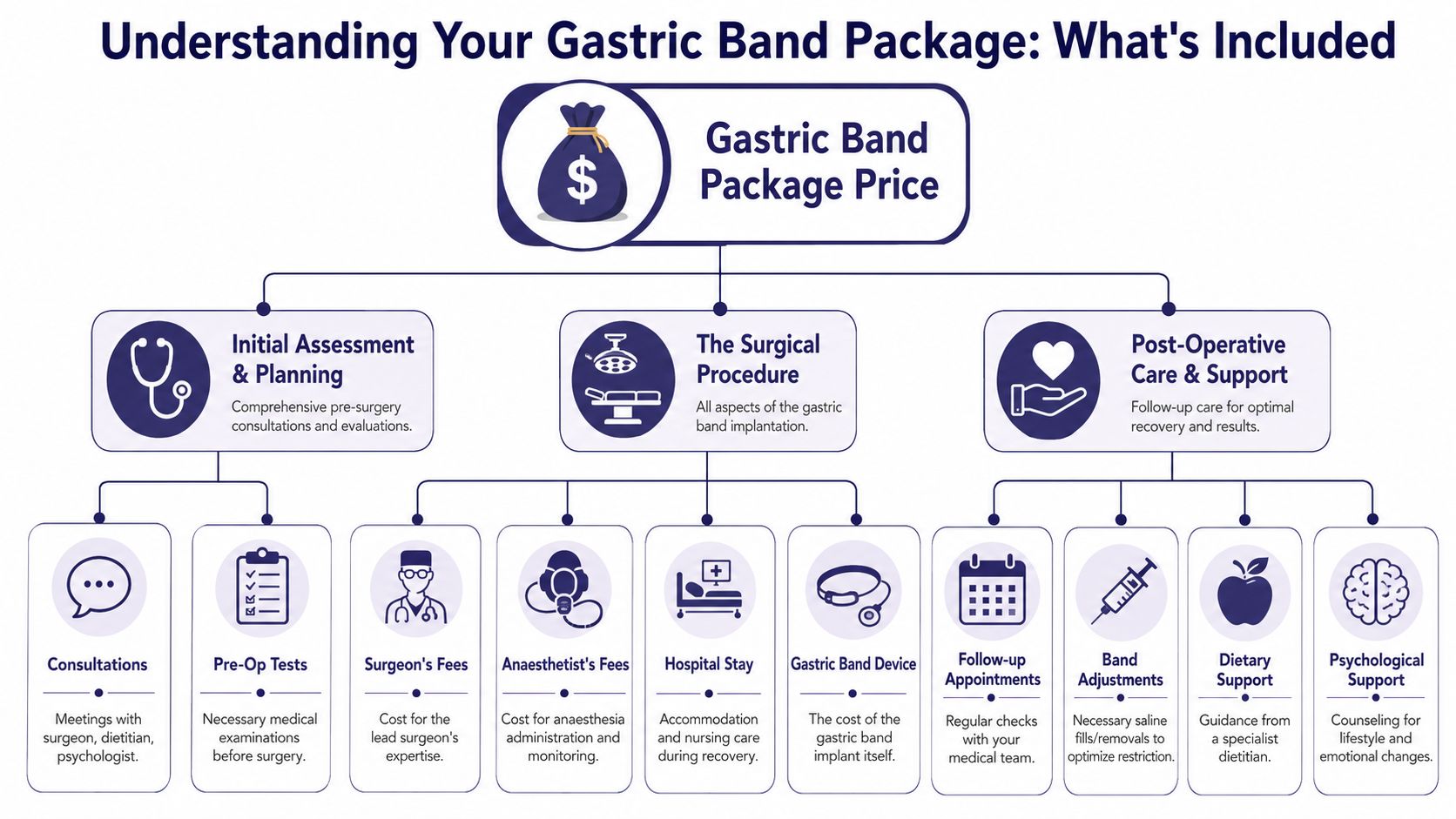
International private-pay references show gastric band self-pay averages around $12,000 to $14,500, and those figures typically bundle the surgeon, anaesthesia, hospital stay, and a defined set of follow-up visits or adjustments, according to Atlantic Health's overview of gastric band package pricing. The lesson for UK patients is simple. A meaningful quote usually reflects a package, not just theatre time.
What a package may include
Most private packages are built from several parts:
- Clinical assessment: Initial consultations, review of your weight history, medication review, and checks for whether surgery is appropriate.
- Pre-operative work-up: Blood tests, anaesthetic review, and sometimes input from dietetic or psychological services.
- The operation itself: Surgeon's fee, anaesthetist's fee, theatre costs, hospital stay, and the gastric band device.
- Early aftercare: A period of post-operative review, wound checks, and basic dietary guidance.
- Adjustment visits: Band fills or deflations to fine-tune restriction.
What's often underestimated
The most commonly overlooked cost is the adjustment pathway. With a gastric band, adjustments aren't an optional extra for perfectionists. They're part of how the treatment functions. If the band is too loose, weight loss may be poor. If it's too tight, you may struggle with vomiting, reflux, or swallowing.
A second hidden area is the possibility of further surgery. In a large population study of 25,042 patients, 4,636 people (18.5%) underwent 17,539 reoperations, averaging 3.8 procedures per affected patient. Medicare spent USD 470 million on gastric-band-associated procedures, and USD 224 million (47.6%) of that went to reoperations, according to this population study on gastric band reoperations and spending.
If you only compare the day-one package price, you can miss the biggest part of the long-term bill.
Another clinical series in that same evidence summary reported 85 bands removed over a 5-year period, with an average BMI at removal of 40.7. That doesn't mean every patient will need removal. It does mean revision or removal is realistic enough to discuss before you commit.
Questions that make a quote clearer
A useful way to test a quote is to ask for a written breakdown.
| What to ask | Why it matters |
|---|---|
| Are band adjustments included? | The band usually needs repeated postoperative adjustment. |
| How long does aftercare last? | A short package may leave you paying early. |
| Is dietitian support included? | Surgery works better when eating habits change with it. |
| What happens if I need imaging or urgent review? | Extra costs can appear quickly if symptoms develop. |
| What is the fee for revision or removal? | Future procedure costs can change the overall value. |
Your aim isn't to interrogate the clinic. It's to understand the full cost of care before making a life-changing decision.
Key Factors That Influence Your Final Cost
Two patients can request gastric band prices from different providers and receive very different quotes. That doesn't always mean one clinic is overcharging. It often reflects differences in expertise, setting, and aftercare.
Why prices vary so much
One major factor is the provider model. Gastric banding has become a more niche procedure. The authoritative volume figures provided for market context show 773 band procedures in 2011 versus 2,500 in 2023, while total bariatric surgery volumes remained far higher at 270,089 in 2011 and 158,000 in 2023. That means banding represented a small share of bariatric activity by the early 2020s, and lower procedure volumes can reduce economies of scale, shaping pricing in specialist settings, as noted in the ASMBS bariatric surgery numbers resource.
Clinics offering a less common procedure may not price it like a high-volume service.
The main variables behind a quote
Some cost drivers are straightforward:
- Surgeon experience: A specialist with long bariatric experience may charge more.
- Hospital setting: A premium private hospital usually costs more than a smaller unit.
- Location: Central city locations often carry higher facility costs.
- Aftercare depth: A package with more follow-up tends to cost more than a lean package.
- Access and convenience: Rapid scheduling and easier review appointments can affect pricing.
Other variables are less visible. Some clinics build in wider multidisciplinary support. Others may focus tightly on the operation itself and leave additional support to be arranged separately.
Higher price doesn't always mean worse value
A low quote can still be reasonable if it includes robust care. A high quote can be poor value if it doesn't. What matters is the match between price and support.
A better question than “Why is this clinic dearer?” is “What care am I getting for the extra money?”
Understanding health outcomes and practical life is critical. If you're a busy professional, repeated travel for adjustments, time off work, and fragmented follow-up may become part of the cost as well. The cheapest sticker price can become the most inconvenient option.
The NHS Pathway Versus Private Treatment
For some people, choice isn't between one private clinic and another. It's between pursuing surgery through the NHS or self-funding private care.
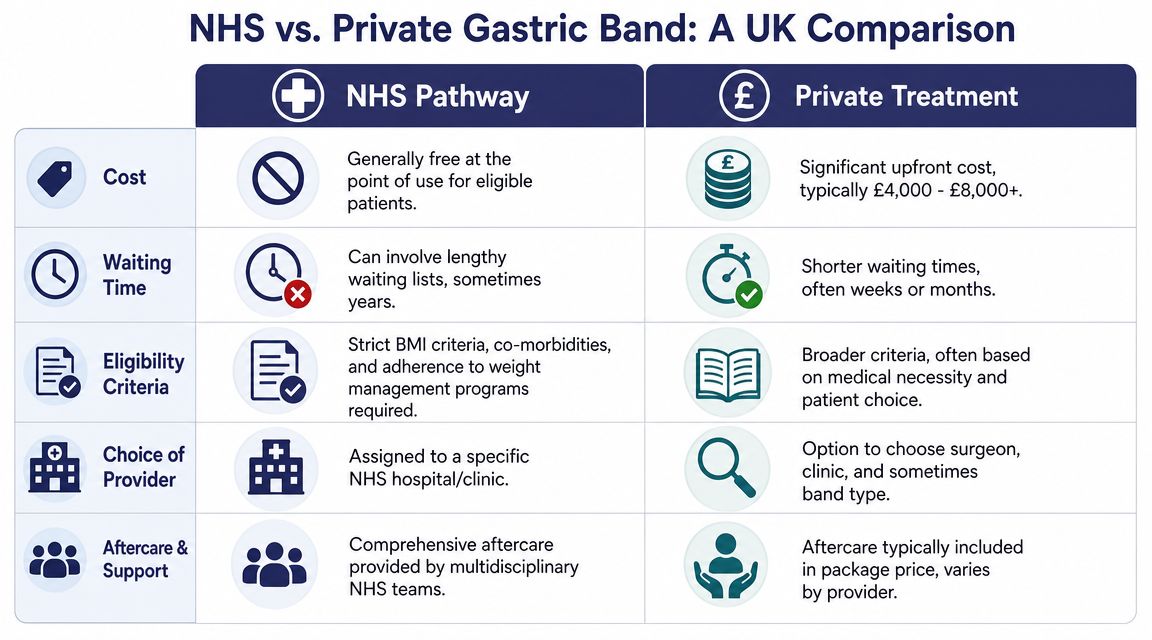
NICE supports bariatric surgery for appropriate patients, and the NHS pathway is built around eligibility criteria, specialist assessment, and multidisciplinary care rather than quick access. For many patients, the deciding issue is whether they meet criteria and are prepared for the process.
How the two routes usually differ
| Consideration | NHS pathway | Private treatment |
|---|---|---|
| Upfront payment | Usually free at the point of use if you qualify | Self-funded or sometimes insurance-assisted depending on policy |
| Timing | Often slower, with more steps before surgery | Usually quicker access |
| Eligibility | More structured and criteria-driven | Broader, but still medically assessed |
| Choice | Less personal choice of provider | More choice of surgeon and hospital |
| Follow-up | Multidisciplinary by design | Varies significantly by package |
If you're trying to understand private treatment in the wider context of self-funded medicine, this private healthcare comparison in the UK is a useful starting point.
Insurance and funding questions matter
People often assume private medical insurance will automatically cover weight-loss procedures. Sometimes it doesn't, or it may set specific conditions. That's why it helps to look at how insurers approach device-based treatments more broadly. This 2026 hyperbaric chamber coverage guide is useful as an example of how coverage decisions can depend on indication, medical necessity, and policy wording.
Before you book a consultation, ask your insurer for written confirmation of what they will and won't cover.
If you're considering the NHS route, expect to engage with weight management support, nutrition, and behaviour change. If you're considering the private route, make sure your faster access doesn't come at the expense of proper assessment.
Is a Gastric Band the Right Long-Term Choice for You?
This is the most important part of the conversation. Even if the price is manageable, a gastric band still needs to be the right tool for your body, your eating patterns, and your long-term goals.
Why surgeons use bands less often now
Clinical practice has shifted away from gastric bands because they're generally seen as less durable than sleeve gastrectomy or gastric bypass. The more useful question now isn't just what a band costs, but what it costs per durable outcome when compared with newer procedures, as discussed in this overview of gastric band value versus newer procedures.
That doesn't mean a gastric band has no place. It means you should ask whether it's still the best fit for you.
Lifestyle change is not optional
No bariatric procedure works well in the long run without behaviour change. A band may reduce portion size, but it doesn't choose your meals, stop emotional eating, or build exercise into your week.
The people who do best usually commit to:
- Eating slowly: Small bites, proper chewing, and stopping early when full.
- Prioritising protein and fibre: This supports fullness and helps preserve muscle during weight loss.
- Avoiding liquid calories: Frequent high-calorie drinks can work around restriction.
- Planning activity: Walking, resistance training, and consistent movement help maintain progress.
- Addressing stress and mood: Anxiety, low mood, poor sleep, and binge patterns can all undermine results.
A few hard questions to ask yourself
Sometimes the kindest medical advice is also the most honest.
- Are you comfortable with an implanted device that may need repeated adjustment?
- Can you reliably attend follow-up appointments?
- Do you tend to eat quickly, graze, or comfort eat when stressed?
- Would another procedure offer a better chance of a durable result?
- Are you ready for long-term support rather than a quick fix?
The best bariatric procedure isn't the one with the lowest entry price. It's the one that gives you the safest and most sustainable result for your circumstances.
If you're not sure, that uncertainty is worth respecting. It often means you need a broader conversation, not a faster booking.
Exploring Alternatives to Gastric Banding
If a gastric band doesn't feel like the right long-term match, that doesn't mean you've run out of options. It usually means the conversation needs to widen.
Surgical alternatives
The two procedures commonly compared with a band are gastric sleeve and gastric bypass. In broad terms, they're often favoured because they don't rely on an implanted adjustable device and are generally viewed as offering more durable long-term results in current practice.
A good bariatric consultation should explain why one of these might suit you better, especially if reflux, portion control, snacking patterns, or long-term weight goals are part of the picture.
Non-surgical pathways
Not everyone needs surgery. Some people are better served by a structured medical weight-loss plan that combines:
- Prescription support: For suitable patients, weight-loss medication may help reduce appetite and improve adherence.
- Nutrition coaching: A dietitian can help you build meals that are filling, practical, and realistic for work and family life.
- Exercise planning: This doesn't need to start with intense training. Walking, strength work, and consistency matter more than perfection.
- Behavioural support: Sleep, stress, routine, and emotional eating need direct attention.
If you're using GLP-1 medication or thinking about it, practical food structure becomes important. Some patients find guides to satiating GLP-1 snacks useful because they focus on staying full without relying on ultra-processed grazing.
Another non-surgical option some people explore is the gastric balloon pill, which may appeal to patients who want a less invasive route.
The best option is the one you can live with
A treatment only works if it fits your real life. If you travel constantly, struggle with follow-up, dislike the idea of an implanted device, or need to rebuild eating habits before considering surgery, that should shape the decision.
Good care looks at the whole person. Not just the scale.
Your Next Steps and Questions for Your Doctor
By the time you speak to a surgeon or GP, you want more than a brochure and a price list. You want enough clarity to decide whether this option is medically sensible, financially realistic, and compatible with your life.
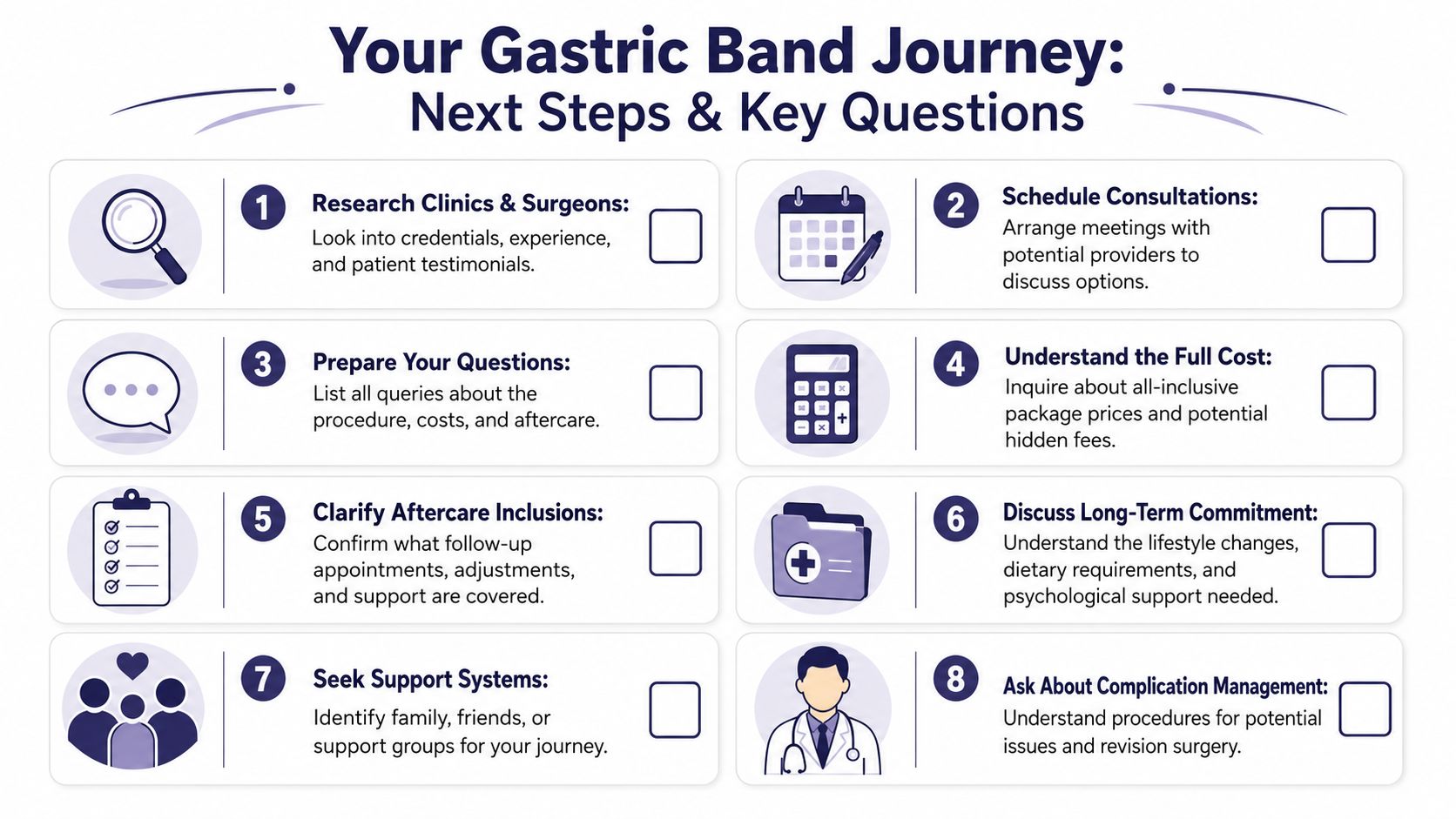
Bring these questions to your consultation
- Suitability first: Why are you recommending a gastric band for me rather than a sleeve, bypass, or non-surgical programme?
- Package detail: Exactly what is included in the quoted price, and what would I pay for separately?
- Adjustment plan: How many follow-up appointments and band fills are included?
- Complication pathway: If I develop reflux, vomiting, swallowing trouble, or poor weight loss, what happens next?
- Revision costs: What are the likely costs if the band needs removal or conversion to another procedure?
- Lifestyle support: Will I have access to dietetic, exercise, and psychological support?
- Commitment: How often will I need to attend in the first year and later on?
- Outcomes discussion: In your practice, when do you advise against a gastric band?
A sensible next move
Write your questions down before the appointment. Ask for answers in writing if possible. If a clinic seems irritated by careful questions, that's useful information.
The right decision should leave you feeling informed, not pressured.
Frequently Asked Questions About Gastric Banding
Can I finance a gastric band privately?
Many private providers offer payment plans or finance options, but the details vary. Ask for the full repayable amount, not just the monthly figure. Also ask whether future adjustments or complications fall outside the finance package.
Does private health insurance cover gastric band surgery?
Sometimes, but often only under specific policy terms. Cover may depend on medical necessity, exclusions, and whether obesity treatment is included in your plan. Always ask for written confirmation.
What happens if I don't lose enough weight?
That depends on why. Sometimes the issue is band adjustment, eating pattern, or follow-up. In other cases, the procedure may not be delivering enough benefit, and a specialist may discuss alternatives or revision.
How long does the band stay in?
A gastric band is designed as a long-term device, but it may not stay in forever. Some people need removal or revision because of symptoms, poor weight loss, or other clinical issues.
Is the band enough on its own?
No. It's a tool. Long-term success still depends on eating behaviour, physical activity, sleep, stress management, and consistent follow-up.
If you want a thoughtful, non-pressured discussion about weight-loss options, long-term health, and whether surgery is even the right next step, The Lagom Clinic offers a comprehensive private GP approach that looks beyond the sticker price and focuses on what will work for you.


 Members Consultation