


If you're searching for private bowel cancer screening, you're probably in one of a few situations. You've had your NHS invite and want to understand whether private testing offers anything extra. You're younger than the NHS screening age but feeling uneasy because of family history or a recent health scare. Or you just want quicker answers and a clearer plan.
That instinct is understandable. Bowel cancer screening can feel confusing because people often mix up screening with testing for symptoms, and private providers don't always explain where one ends and the other begins. Good care starts by sorting that out. Screening is for people who feel well and want to look for early signs of disease before symptoms appear. If you have bleeding, ongoing change in bowel habit, unexplained weight loss, abdominal pain, or iron deficiency anaemia, that's no longer screening. It needs assessment.
Private care can be helpful, but only when it's used properly. The right test, for the right person, with a clear follow-up plan, is what matters. A random one-off test bought online rarely gives the same value as a thoughtful medical pathway.
Why Consider Bowel Cancer Screening
Bowel cancer often develops subtly. It can begin with small growths in the bowel lining called polyps, and some of those can change over time. The practical problem is simple. Early bowel cancer and precancerous polyps may cause no symptoms at all.
That's why screening matters. In the UK, bowel cancer remains a major public health issue. Cancer Research UK estimates around 48,200 new bowel cancer cases each year, which is more than 130 cases every day, and it is the 4th most common cancer overall in the UK, according to Cancer Research UK bowel cancer statistics.
What screening can and cannot do
Screening doesn't guarantee that nothing is wrong. It reduces the chance that an important problem is missed before symptoms start. That's a worthwhile distinction.
A stool test such as FIT looks for hidden blood in a sample of stool. A colonoscopy directly examines the bowel. These tests answer different questions, and neither should be treated as a casual tick-box exercise.
Practical rule: A screening test is most useful when it leads to the right next step, not when it sits in a drawer and reassures you without context.
Lowering risk in daily life
Screening is only one part of prevention. In clinic, the most useful conversations are rarely just about which test to buy. They're about what patients can change this month and keep doing next year.
A sensible bowel-health plan usually includes:
- More fibre in everyday meals: Build meals around vegetables, beans, pulses, oats, fruit, and wholegrains where they suit your digestion.
- Less red and processed meat: If meat is a regular part of your week, reducing portion size and frequency is often a realistic place to start.
- Regular movement: Brisk walking, cycling, swimming, strength training, and any routine you'll keep all count.
- Weight management: A steady approach works better than extreme dieting. Focus on habits you can repeat.
- Alcohol awareness: If alcohol has become routine, cutting back is a meaningful health decision.
- Stop smoking if you smoke: This helps far beyond bowel health.
When average-risk people think about private screening
For many average-risk adults, the question isn't “Is screening good?” It's “Does private screening add value for me right now?” Sometimes it does. Sometimes it duplicates what the NHS already offers.
Private bowel cancer screening is most helpful when it fills a genuine gap. That might mean faster access, more personalised decision-making, or help for someone who is between routine invitations and wants a medically guided discussion rather than a generic kit posted to their home.
Your Guide to Private Bowel Cancer Screening Tests
Private screening isn't one thing. It can mean a home stool test, a specialist investigation, or a clinician-led plan that starts with one test and moves to another only if needed. The key is understanding what each option is for.
The main tests used privately
FIT is the most common starting point. It checks for tiny amounts of blood in stool that you wouldn't see yourself. It's simple, home-based, and non-invasive. It doesn't diagnose bowel cancer on its own, and a normal result doesn't rule everything out.
Colonoscopy is the most direct test. A specialist uses a flexible camera to examine the bowel lining. It can identify visible abnormalities and allows biopsies or polyp removal during the same procedure. It's more involved, needs bowel preparation, and usually requires sedation or at least procedural support depending on the setting.
CT colonography is sometimes called a virtual colonoscopy. It uses imaging to look at the bowel rather than a camera passed through the whole colon. It can be useful in selected cases, especially when a colonoscopy isn't straightforward or preferred, but it doesn't offer the same ability to remove polyps there and then.
Some people also ask about blood tests marketed for bowel cancer screening. In practice, these are not usually the first choice for average-risk screening in UK primary care. If you're considering one, it's worth asking a very direct question: what happens if it's positive, and what happens if it's negative?
For a broader overview of how doctors investigate symptoms as well as screening concerns, this guide on tests for bowel cancer is a useful companion read.
Comparison of Private Bowel Cancer Screening Tests
| Test Type | How it Works | Invasiveness | Preparation | Typical Private Cost |
|---|---|---|---|---|
| FIT | Stool sample tested for hidden blood | Non-invasive | Minimal | Varies by provider |
| Colonoscopy | Camera examines the inside of the bowel | Invasive | Full bowel prep required | Higher than stool testing |
| CT colonography | Scan-based view of the bowel | Minimally invasive | Bowel prep usually required | Varies by provider and imaging centre |
| Blood-based screening tests | Blood sample analysed for selected markers | Minimally invasive | Usually minimal | Varies by provider |
Which test suits which patient
For an average-risk person without symptoms, FIT is often a sensible first step if the goal is screening rather than immediate invasive testing.
For someone who wants the most complete structural assessment, colonoscopy is usually the stronger option because it examines the bowel directly and can deal with some findings immediately.
For a person who can't or won't have colonoscopy, CT colonography may be worth discussing. It can answer some important questions, but it's not a direct substitute in every clinical situation.
The best private test is the one that answers the right question and comes with a plan for what happens next.
Common misunderstandings
Patients often assume that a more expensive test must be better. That isn't always true.
A stool test is useful when you want a low-burden triage tool. A colonoscopy is useful when you need direct visual assessment. Problems arise when people expect one to behave like the other. That's where disappointment and false reassurance can creep in.
NHS vs Private Screening What Are the Differences
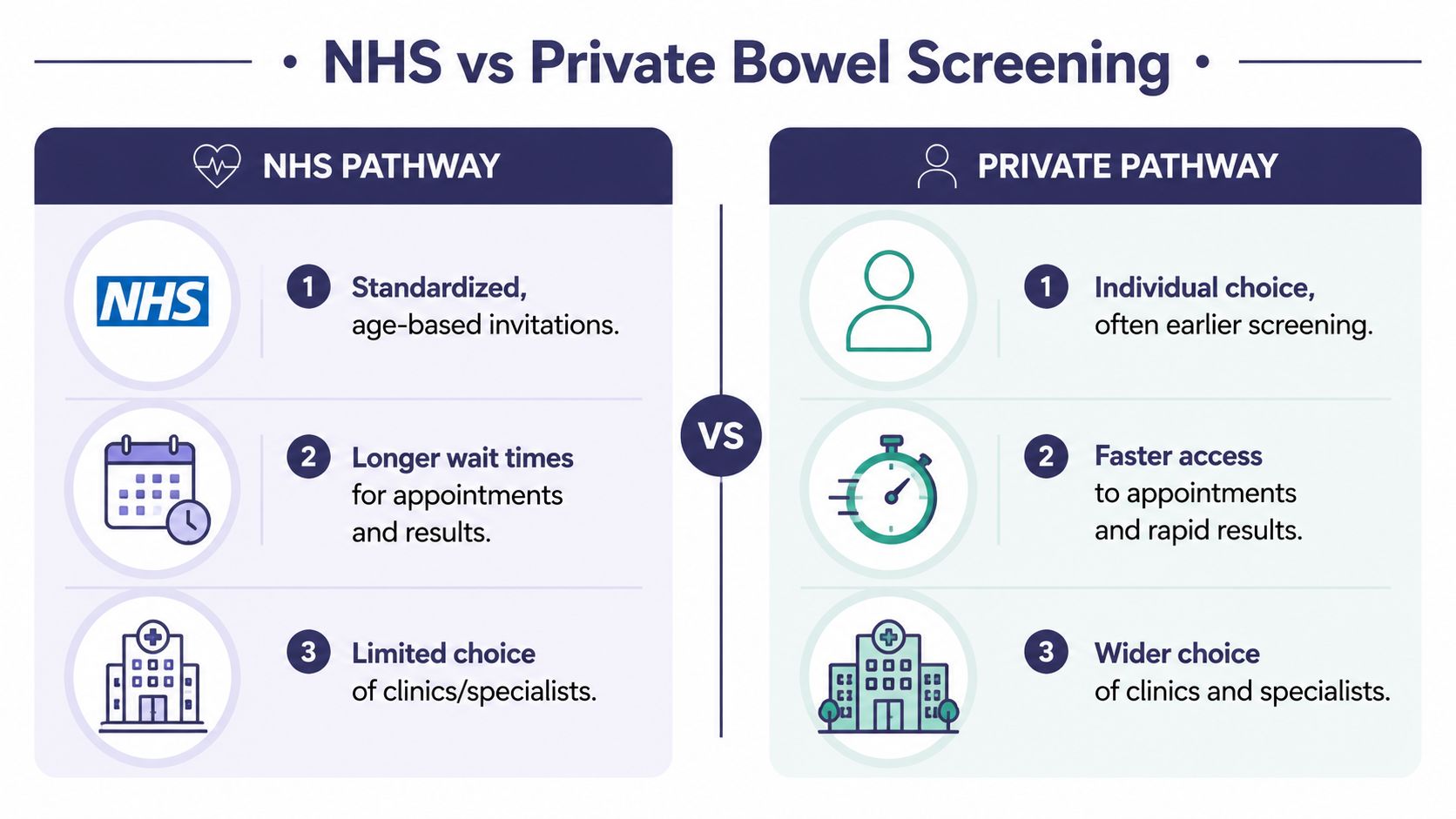
The NHS pathway is an organised screening programme. That phrase matters because organised programmes are built around invitations, recall, standard follow-up, and consistent thresholds for what happens next.
In England, the NHS Bowel Cancer Screening Programme now invites everyone aged 50 to 74 every two years with a home FIT kit, and the extension down to age 50 was completed in March 2024, as outlined in this colorectal screening overview for England.
How the NHS pathway works
The NHS route is structured. You're invited based on age, you complete the home FIT if you choose to participate, and the result determines whether further investigation is needed. That consistency is one of its strengths.
It also has clear boundaries. Screening is designed for people without symptoms. If symptoms are present, the right route is diagnostic assessment, not routine screening.
How private care differs in real life
Private bowel cancer screening is more flexible. You can usually book sooner, discuss options in more depth, and choose a pathway that fits your circumstances. That can be attractive if you're not yet in the NHS age range, if you're in between screening rounds, or if you want a more individualized discussion of risk.
Private care also puts more responsibility on the patient and clinician. There isn't the same automatic recall structure unless your provider creates one. Without that, a single private stool test can become an isolated event rather than part of a meaningful screening strategy.
When private screening adds value
Private screening is often most useful in these situations:
- You want a bridge to the NHS pathway: You're not yet invited routinely, but you want a medically supervised discussion now.
- You want speed: You'd prefer faster access to consultation and next-step planning.
- You need individualisation: Your family history, anxiety level, or preferences make a standard one-size-fits-all approach less suitable.
- You want test choice: Some patients prefer to discuss going straight to colonoscopy rather than beginning with stool testing.
It adds less value when it merely duplicates an NHS invitation you already have, without improving follow-up or decision-making.
The Real Pros and Cons of Private Screening
Private screening is easy to overrate if you focus only on convenience. It's also easy to dismiss if you focus only on cost. Most patients need a more balanced answer than either of those extremes.

Where private care helps
The strongest benefit is usually speed. Faster access can reduce uncertainty and allow decisions to be made while the concern is fresh, rather than after weeks of second-guessing.
Another advantage is choice. Some people want more time with a clinician before testing. Others want to discuss colonoscopy, CT colonography, or whether a home stool test is enough for their situation. Private care can support that better than a generic retail test.
There's also the value of continuity. A good private pathway can keep consultation, interpretation, referral, and follow-up joined up, rather than leaving the patient to coordinate the process alone.
Where private screening falls short
A private test can create false reassurance if it's used as a once-only check with no repeat plan. Stool-based screening works best when it's repeated over time, and benefit depends on sticking to the proper interval and acting on abnormal results. The USPSTF colorectal cancer screening recommendation explains that stool-based tests are quick, home-based, and non-invasive, but their benefit depends on repeated rounds and follow-up colonoscopy after a positive result.
That has a practical implication. Buying one stool test because you feel uneasy is not the same as being in a reliable screening programme.
A one-off private screen can be useful. It shouldn't be mistaken for a complete long-term strategy.
Private screening can also open the door to incidental findings, especially with imaging. Some findings matter. Some do not. But once they appear on a report, they often lead to more appointments, more tests, and more anxiety.
A decision frame that works
Ask three questions before booking anything:
- Am I well and looking for screening, or do I have symptoms and need diagnosis?
- If this test is abnormal, who will arrange the next step?
- If this test is normal, what is my repeat plan?
If those answers aren't clear, the test probably isn't the right starting point.
Navigating Your Private Screening Journey in Bristol
In Bristol, the smoothest private pathway usually starts with a GP appointment rather than a test order form. That may sound slower, but it often saves time because the wrong test is what causes the biggest delays later.
Start with risk, not with a kit
A proper first consultation should cover your age, family history, previous bowel issues, current symptoms, medications, and what you're hoping to achieve. Some people want reassurance. Some want the most thorough available assessment. Some need help deciding whether private care is worthwhile at all.
That conversation usually leads to one of three outcomes:
- A screening plan: often for someone at average risk who feels well.
- A diagnostic plan: for someone with symptoms who needs investigation rather than screening.
- A watch-and-review approach: where immediate testing isn't the best next step.

What the process often looks like
A typical private journey in Bristol might run like this:
-
Initial GP review
Your clinician clarifies whether this is screening or symptom-led investigation. -
Test selection
FIT may suit a low-burden screening approach. Colonoscopy may suit someone needing direct visual assessment. CT colonography may fit selected circumstances. -
Booking and preparation
Home stool testing is straightforward. Colonoscopy and CT colonography need more planning and clear instructions. -
Results interpretation
The result is discussed in context, not just emailed as a laboratory number or short report. -
Referral or surveillance plan
At this stage, good care distinguishes itself from transactional testing.
Preparation matters more than most people expect
Patients often focus on the test itself, but preparation strongly affects usefulness.
For stool testing:
- Read the instructions carefully: Sample handling mistakes can make results less reliable.
- Don't use a screening test to ignore symptoms: If symptoms are present, book a medical review instead.
- Plan the follow-up in advance: Know who will contact you and what happens after an abnormal result.
For colonoscopy:
- Follow the bowel prep exactly: A poorly prepared bowel can limit what the specialist can see.
- Arrange transport if sedation is planned: Don't leave this until the day before.
- Keep the day quiet afterwards: Even straightforward procedures can leave you tired.
Costs and timelines
Private costs and waiting times vary widely between clinics, hospitals, and insurers, so it's better to ask for a written quotation than rely on broad online estimates. The same applies to timelines. Some services can move quickly from consultation to testing, while others depend on specialist and theatre availability.
The most useful question isn't “What does the test cost?” It's “What is included?” Ask whether the quoted fee covers consultation, reporting, specialist review, pathology if needed, and follow-up discussion.
Understanding Your Results and Planning Follow-Up
Results often cause more worry than the test itself. The reason is simple. People want a yes-or-no answer, but bowel screening results often need interpretation.
If your FIT result is negative
A negative FIT is reassuring, but it doesn't mean “nothing could possibly be wrong”. It means no significant hidden blood was detected by that test at that time.
That's why context matters. If you're using FIT for screening and you remain well, the next question is when to repeat it. If you have symptoms despite a negative result, the result should not close the conversation.
If your FIT result is positive
A positive stool test does not diagnose bowel cancer. It means hidden blood has been detected and the result needs clinical review and, in many cases, colonoscopic follow-up.
Bowel Cancer UK notes that private stool-blood self-tests are not approved for NHS screening, and a positive private result does not automatically trigger referral without GP review. Their screening guidance also makes clear that the standard UK pathway uses FIT and then decides whether colonoscopy is needed based on the result. That's why the value of private testing depends on proper follow-up. See Bowel Cancer UK guidance on screening and private tests.
Don't treat a private positive result as self-explanatory. It needs a doctor to place it in a proper clinical pathway.
If your colonoscopy or imaging is normal
A normal colonoscopy is generally more reassuring than a normal stool test because the bowel has been examined directly. Even then, the significance depends on why the test was done in the first place.
If the procedure found polyps, inflammation, or another abnormality, the report needs explaining in plain English. Many patients leave with a technical summary and only half understand what it means. Good follow-up should cover what was found, whether anything was removed, whether biopsies were taken, and whether surveillance is advised.
If you're preparing for colonoscopy after an abnormal screening result, this patient guide on preparation for a colonoscopy can help you know what to expect.
Your Questions Answered About Bowel Cancer Prevention
What if I have symptoms rather than just worry
If you have rectal bleeding, a persistent change in bowel habit, unexplained weight loss, abdominal pain, or ongoing fatigue that concerns you, don't book a screening test as your first move. Book a medical assessment. Symptoms need diagnosis, not routine screening.
Is private screening worth it if I'm already eligible for the NHS
Sometimes yes, often no. If private care gives you quicker access, clearer advice, or a better-managed route because your circumstances are individual, it may help. If it merely duplicates a screening invitation you already have without improving follow-up, it may not add much.
Will health insurance cover private bowel screening
Policies vary. Some insurers cover investigations when there is a medical indication. Pure screening is handled differently and may not be included. Ask your insurer for the exact position before booking, and ask the clinic what costs could arise if further tests are needed.
What lifestyle changes matter most for prevention
The most helpful starting points are usually practical ones. Eat more fibre-rich foods, reduce red and processed meat if it's a regular habit, keep active, maintain a healthy weight, cut back on alcohol, and stop smoking if you smoke. None of these replaces screening, but all of them support long-term bowel health.
If you'd like personalised advice on whether private bowel screening is appropriate for you, The Lagom Clinic offers thoughtful private GP care in Bristol with time to discuss risk, symptoms, prevention, and the most sensible next step for your situation.
Screen for More Than Bowel Cancer
Our private health screening packages in Bristol can include the TruCheck multi-cancer screen alongside a comprehensive blood panel, ECG, and full medical examination. Start from £500 with same-week appointments — no referral needed.


 Members Consultation