


You're trying to open a jar, type an email, hold a coffee cup, or scroll your phone, and one finger keeps reminding you there's a problem. It may ache at the base, feel stiff first thing in the morning, or catch when you bend it. Sometimes it clicks. Sometimes it locks. Sometimes it just feels weak and irritable in a way that's hard to ignore.
That pattern often points to tendonitis in a finger, or more precisely irritation of a tendon or its surrounding sheath. In general practice, this is one of the common hand complaints I see in people who use their hands all day without thinking much about them until something starts to hurt. Office work, childcare, sport, gardening, tools, music practice, long periods on a phone, all of these can contribute.
The reassuring part is that many cases improve with a sensible, early plan. The unhelpful part is that people often do the exact things that keep it going. They push through pain, keep repeating the aggravating task, or start aggressive hand exercises too soon. Better results usually come from calming the irritation down first, then restoring movement, then rebuilding tolerance.
That Nagging Pain in Your Finger Explained
A tendon is the structure that connects muscle to bone. In the hand, tendons let your fingers bend and straighten smoothly. When one of these tendons becomes irritated, or the lining around it becomes inflamed, movement starts to feel less smooth and more effortful. That's what people usually mean when they talk about tendonitis in finger problems.
For some people, the main symptom is pain. For others, it's stiffness, a catching sensation, or a finger that seems to stick before suddenly releasing. The thumb can be involved too, particularly at its base or on the thumb side of the wrist. Although the name sounds alarming, this is usually a mechanical and inflammatory problem, not a sign that your hand is permanently damaged.
What this usually feels like
Common descriptions include:
- A dull ache when gripping, pinching, typing, or carrying bags
- Morning stiffness that eases as the hand warms up
- Tenderness at the base of the finger or around the thumb
- Clicking or locking when bending or straightening
- A sense of weakness because using the hand hurts
Practical rule: pain that keeps returning during ordinary daily tasks is worth taking seriously early. Hand problems are easier to settle before the movement pattern becomes guarded and stiff.
Lifestyle matters here. The finger itself is the painful site, but the cause often sits in your routine. Long keyboard sessions, repeated phone use, gripping gym equipment, carrying shopping with hooked fingers, or using poorly designed tools can all keep the tendon under strain. That's why good treatment isn't just about pain relief. It's about changing the load your hand deals with every day.
How Tendons in Your Fingers Work
Your hand works because muscles in the forearm pull on tendons that run into the fingers. A simple way to picture this is a cable running through a tunnel. The cable is the tendon. The tunnel is the tendon sheath and supporting pulleys that keep the tendon close to the bone and guide its motion.
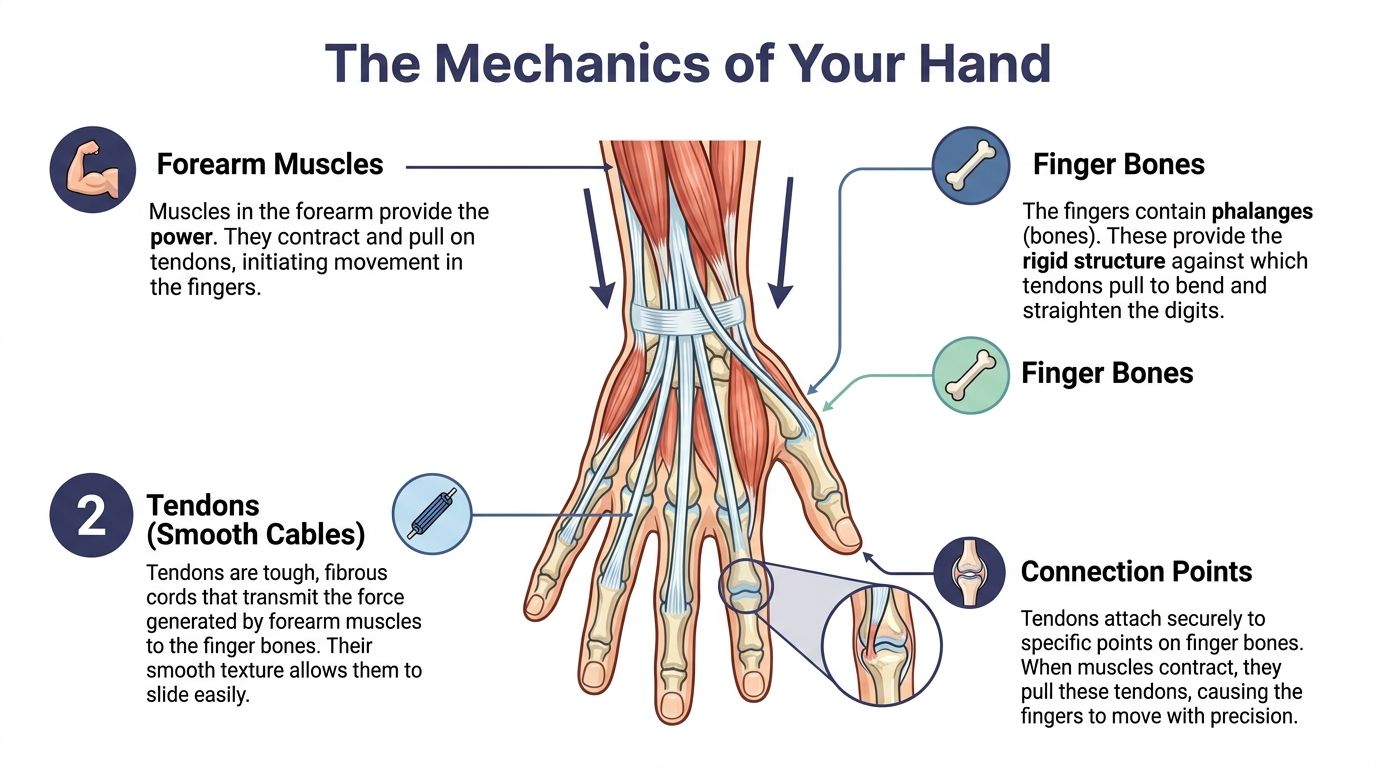
When everything is working well, the tendon glides smoothly as you make a fist, hold a pen, button a shirt, or tap on a screen. You don't notice it. When the tendon or its sheath becomes irritated, that smooth glide is lost. The tendon can thicken slightly, the sheath can become more reactive, and movement starts producing friction.
The cable and tunnel problem
Finger tendons don't have much spare room. Even a small amount of swelling or thickening can make a noticeable difference. That's why symptoms can seem out of proportion to what looks like a minor issue.
You may notice:
- Pain on movement rather than at complete rest
- Stiffness after inactivity such as sleep or long desk sessions
- A click or catch when the tendon struggles to glide
- Tenderness at one precise point rather than vague whole-hand pain
What doesn't usually help is repeatedly forcing the finger through the painful range to “loosen it up”. That often increases irritation. Tendons respond better to calm, controlled movement than to repeated provocation.
Trigger finger and thumb-side tendon problems
One common form is trigger finger, also called stenosing tenosynovitis. In this condition, the flexor tendon that bends the finger becomes irritated near the base of the finger. A small thickened area can catch as it passes through the pulley system. That produces the classic catching, popping, or locking feeling. Some people feel a tender lump in the palm-side crease near the finger base.
Another common pattern affects the thumb side of the wrist and is known as De Quervain's tenosynovitis. Although it isn't strictly in the finger itself, patients often describe it as thumb or finger tendon pain because gripping and pinching are what trigger it. Lifting a child, wringing a cloth, opening jars, and heavy phone use often provoke it.
Smooth motion depends on a tendon gliding through a confined space. Once that space becomes irritated, ordinary tasks start feeling surprisingly difficult.
Why understanding the mechanics helps
Patients often worry they've torn something. In most cases, they haven't. The problem is usually a load and friction issue, not a dramatic injury. That distinction matters because the recovery strategy changes. Tears need one pathway. Irritated tendons need another.
The hand also compensates quickly. If one finger hurts, you'll grip differently, use the other hand more, or tense the wrist and forearm. That can spread discomfort beyond the original spot. Good management looks at the whole chain, not only the sore finger.
Why Finger Tendonitis Happens
Finger tendonitis rarely comes from one single event. More often, it builds because the hand is asked to do the same thing over and over without enough variation, rest, or support. The finger becomes the site of pain, but the driver is often a pattern in work, training, or home life.
Daily habits that commonly trigger it
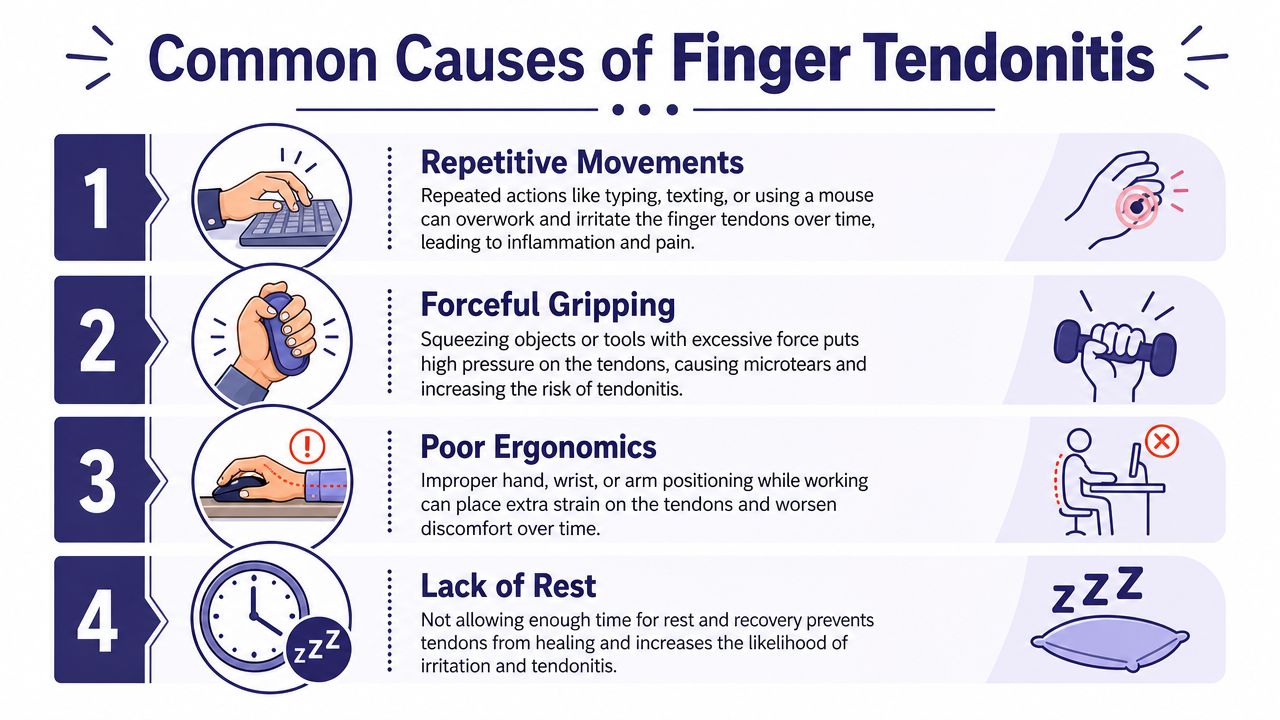
The causes I see most often are practical rather than mysterious:
- Repetitive hand use such as typing, mouse work, sewing, hairdressing, or food prep
- Sustained gripping with weights, racquets, climbing holds, gardening tools, or steering wheels
- Heavy thumb use from scrolling, texting, gaming, or one-handed phone use
- Poor hand position at a desk, especially when wrists are cocked up or the mouse is too far away
- Too little recovery after busy periods of work, DIY, sport, or caring duties
These don't affect everyone equally. One person can text all day and be fine. Another develops pain after a short period of increased load. That usually reflects the balance between tissue tolerance and demand. If the demand rises faster than the tendon can adapt, symptoms begin.
Work, hobbies, and health conditions
Certain hobbies and jobs create a predictable pattern. Musicians, climbers, racquet sports players, knitters, gardeners, mechanics, and people using vibrating tools often describe flare-ups after periods of more intense activity. Busy professionals get a different version, usually lower force but much more repetition and very few breaks.
There are also medical factors that can increase susceptibility. Diabetes, rheumatoid arthritis, and other inflammatory or metabolic conditions can make tendon irritation more likely or make recovery slower. Previous hand injury, pregnancy-related fluid retention, and a sudden return to exercise after a break can also contribute.
The trade-off people miss
The common mistake is assuming the answer is complete rest forever or, at the other extreme, ignoring it and carrying on. Neither works well.
- Too much rest can make the finger stiffer and more sensitive.
- Too much loading keeps the tendon inflamed and sore.
- The useful middle ground is reducing aggravating tasks while keeping gentle, pain-limited movement.
That's also why gadgets aren't magic. An ergonomic keyboard, a larger mouse, padded handles, or voice dictation can help, but only if they reduce the movement pattern that caused the problem. Equipment supports recovery. It doesn't replace load management.
Symptoms to Watch For and When to Worry
The symptoms of finger tendon irritation are usually local and fairly recognisable once you know what to look for. The exact pattern depends on which tendon is involved, but there are a few features that come up again and again.
Common symptoms
Discomfort is often localized to a single finger or the thumb instead of the entire hand. Typical symptoms include:
- Pain when moving the finger or when gripping, pinching, lifting, or twisting
- Stiffness after rest, often worse in the morning
- Tenderness at the base of the finger on the palm side
- Mild swelling or fullness around the sore area
- Clicking, popping, or catching during movement
The pain can start as an annoyance and become functionally limiting. Tasks like fastening buttons, holding cutlery, using keys, writing, and lifting a kettle may start to feel awkward. Some patients describe a brief sharp pain followed by a sense that the finger doesn't want to move properly.
Patterns that suggest a specific diagnosis
Trigger finger often produces a distinct catch or lock. You bend the finger, and it sticks on the way back up. Sometimes it snaps straight suddenly. In more irritated cases, you may need your other hand to straighten it.
If the problem sits around the thumb side of the wrist and flares with gripping, twisting, lifting, or lifting a child under the arms, De Quervain's tenosynovitis becomes more likely. People often point to the thumb-side wrist rather than the finger itself, even though thumb movement is what sets it off.
If your finger clicks but still moves fully, it's irritating. If it locks and you have to free it with the other hand, it's time to get it assessed.
Red flags that need prompt medical advice
Most cases aren't emergencies, but some symptoms should make you seek help quickly.
- Marked redness, heat, and swelling especially if the finger is very painful at rest
- Sudden inability to move the finger after an injury
- Visible deformity following trauma
- Spreading swelling into the hand
- Fever or feeling unwell with finger pain
- Numbness or colour change in the finger
These features raise different concerns, including infection, fracture, dislocation, or a tendon injury rather than simple tendonitis.
When to book a routine appointment
A non-urgent review is sensible if the pain keeps returning, your finger is locking, your grip is getting worse, or home measures haven't helped. The right diagnosis matters because hand pain isn't always tendon-related. Arthritis, a cyst, a pulley injury, or nerve irritation can feel similar at first.
In general, if symptoms are interfering with work, sleep, sport, or everyday tasks, don't wait for months hoping it will disappear on its own. Earlier assessment usually means simpler treatment.
How Tendonitis Is Diagnosed and Treated
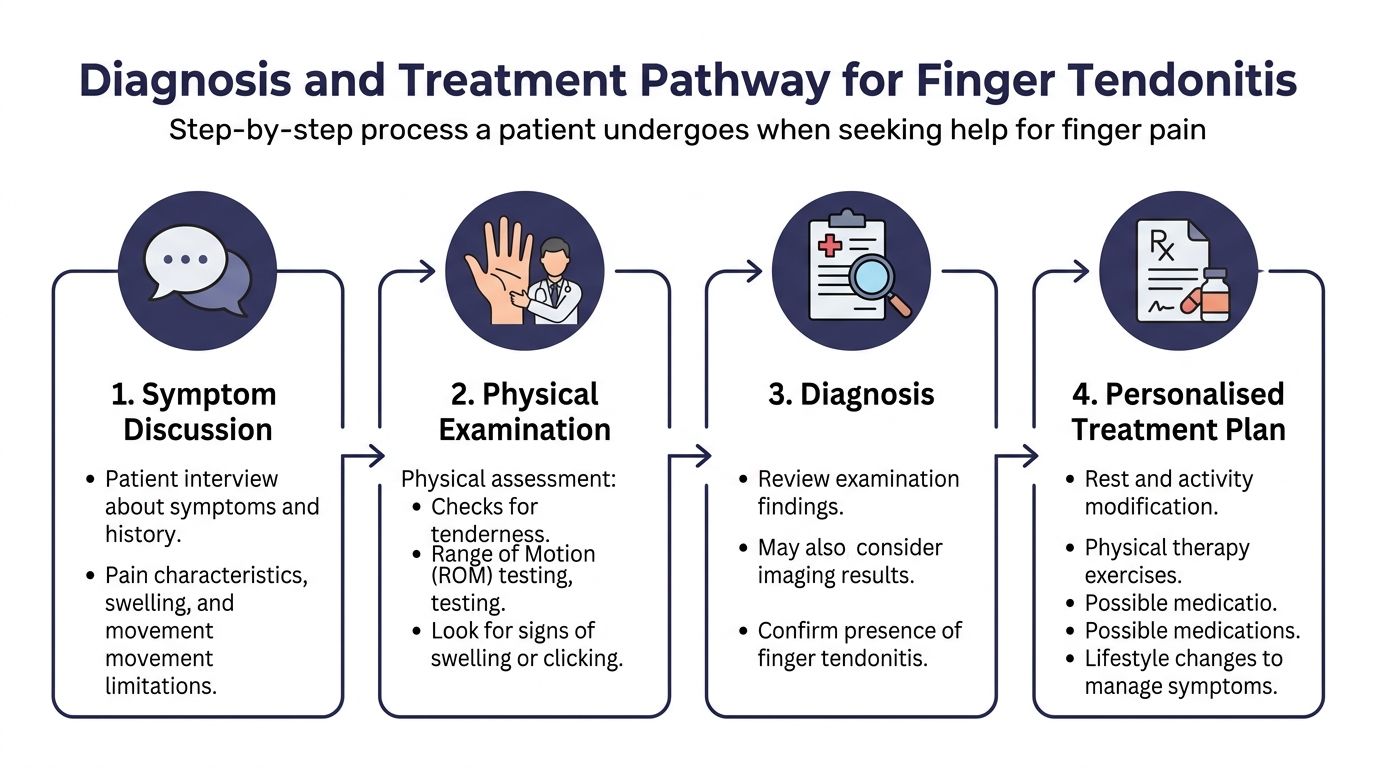
Diagnosis usually starts with a conversation, not a scan. A clinician will ask where the pain is, what movements trigger it, whether it clicks or locks, how long it's been going on, and what your hands do all day. Work, hobbies, gym habits, childcare, and past medical history all matter because they often explain why the problem developed.
What happens at the appointment
The examination is usually straightforward. Your doctor or therapist will feel for tenderness, swelling, or a small nodule, and watch how the finger moves. They may ask you to make a fist, straighten the finger, pinch, or grip. If thumb-side wrist pain is the issue, they may perform specific clinical tests to reproduce the pain in a controlled way.
Most of the time, this is a clinical diagnosis. Scans aren't always necessary. An ultrasound can be helpful if the picture isn't clear, if another diagnosis is possible, or if an injection is being considered. X-rays are more useful when arthritis or injury is suspected than when simple tendon irritation is the main issue.
The treatment ladder that usually works
Treatment works best when it follows a sensible sequence rather than jumping straight to the most invasive option.
| Stage | What it involves | Where it helps most |
|---|---|---|
| Settle it down | Activity modification, avoiding provoking grips, short-term splinting, simple pain relief if appropriate | Early irritation, recent flare-ups |
| Restore movement | Gentle range-of-motion work, tendon gliding, reducing stiffness | Stiff, catching fingers that still move |
| Rebuild tolerance | Graduated strengthening and return to tasks | Recurrent problems and return to sport or heavy use |
| Escalate if needed | Injection, specialist hand therapy, imaging, or surgery in selected cases | Persistent locking or symptoms not improving |
What doesn't usually help is random squeezing exercises from day one, especially if gripping is already the main aggravating factor. Equally, wearing a splint all day for too long can reduce movement and make the hand feel clumsy. Splints are often most useful for short periods, especially at night or during aggravating tasks.
Medicines, therapy, and procedures
Simple anti-inflammatory medication can help some people, provided it's safe for them to take. Ice can reduce a hot flare-up. Heat can help stiffness before movement. The right choice depends on whether the finger feels more inflamed or more stiff.
A hand therapist or musculoskeletal physiotherapist can be particularly useful when the issue is lingering, recurring, or linked to work mechanics. If you're unsure how much pinch and grip loading your thumb and fingers should tolerate, this evidence-based pinch grip guide gives useful context for hand function, though it doesn't replace a personal assessment. You can also read more about recovery timelines in this guide on how long tendons take to heal, because progress is often steadier than patients expect rather than immediate.
For persistent trigger finger or De Quervain's, a steroid injection into the tendon sheath can reduce inflammation and create a window for normal movement to return. This isn't appropriate for everyone, but it can be very effective when conservative measures haven't been enough. If symptoms continue despite a good trial of treatment, a minor surgical release may be considered.
The best treatment is the least invasive one that gets your hand working normally again. Most people don't need surgery, but some do need more than rest.
One practical option in Bristol is The Lagom Clinic, which can assess hand pain, arrange further investigation when needed, and offer treatments including injections for suitable trigger finger cases.
Lifestyle Changes and Exercises for Finger Health
Recovery improves fastest when you change the activities that keep provoking the tendon. That doesn't mean stopping life completely. It means becoming more deliberate about how you use your hands.

The daily habits that make a real difference
Start by looking at the tasks you repeat without noticing.
- Change your grip pattern. Carry bags on the forearm or shoulder rather than hooking handles with your fingers. Use both hands for heavier pans and shopping.
- Reduce thumb strain. Hold your phone with the other hand and type with a different finger or use voice-to-text when possible.
- Improve your desk setup. Keep the mouse close, wrists neutral, and avoid resting the wrist on a hard desk edge for long periods.
- Break up repetition. Alternate keyboard work with calls, reading, or standing tasks instead of doing one hand-heavy activity for long stretches.
- Choose better tools. Chunkier pens, padded handles, jar openers, spring-loaded secateurs, and ergonomic kitchen tools reduce pinch force.
These changes seem small, but they often determine whether exercises help or fail. If the tendon is still being irritated all day, even the best rehab plan will struggle.
Gentle exercises that tend to help
Exercises should feel controlled, not punishing. Mild awareness is acceptable. Sharp pain, catching that worsens, or prolonged soreness afterwards usually means you've done too much.
Tendon gliding
Move through a sequence slowly:
- Straight hand with fingers extended
- Hook fist with middle and end joints bent
- Full fist
- Tabletop position with knuckles bent and fingers straighter
- Straight fist if comfortable
Do the movements smoothly and stop before a painful lock. The goal is glide, not force.
Finger extension with light resistance
Place a light rubber band around the fingers and thumb, then gently open the hand against the resistance. This can help balance out a hand that spends all day gripping and flexing. Keep the resistance light and movements slow.
Passive stretch and soft mobility
Use the other hand to gently straighten or support the affected finger if it feels stiff. Warm water or a warm flannel beforehand can make movement easier when morning stiffness is the main issue.
Don't chase pain. A useful exercise leaves the finger feeling looser or more confident, not angrier an hour later.
Heat, cold, and when to seek guided rehab
If the finger feels hot, swollen, and recently aggravated, a cold pack wrapped in cloth can calm it. If it feels stiff and reluctant, warmth often helps before exercises or before a busy part of the day. Many patients do well with warmth before movement and cold after heavier use.
If you're not sure how to progress, seeing a professional is worthwhile. A good overview of what musculoskeletal physiotherapy is can help you understand where guided rehab fits. The right therapist won't just hand you a sheet of exercises. They'll help identify which part of your routine is keeping the tendon overloaded and how to build back safely.
Personalised Care for Hand and Finger Pain in Bristol
Finger tendon pain is rarely just about the finger. It's usually about the way your hand is being used at work, at home, in training, or while caring for others. That's why quick advice alone often falls short. A proper assessment needs time to understand the pattern, examine the hand carefully, and work out whether this is trigger finger, De Quervain's, another tendon problem, or something else entirely.

At a private GP level, the most useful approach is a joined-up one. That means listening to the story, checking hand mechanics, reviewing work and sport demands, and then matching treatment to the actual cause. Some people need reassurance and practical self-management. Some need a splint and a few targeted adjustments. Some need imaging, hand therapy, or an injection because the finger is locking and ordinary tasks are becoming difficult.
The Lagom Clinic in Bristol takes that kind of whole-person approach. Longer appointments allow space to examine the problem properly, discuss the lifestyle factors behind it, and map out the next step without rushing. If a steroid injection, private imaging, or referral to hand therapy is appropriate, that pathway can be arranged clearly and quickly.
The aim isn't only to reduce pain. It's to get you back to typing, training, lifting, parenting, driving, cooking, or sleeping without that constant reminder from one irritable finger.
If finger pain is starting to interfere with your work, grip, sleep, or everyday tasks, a focused assessment can save a lot of frustration. The Lagom Clinic offers personalised private GP care in Bristol, with practical advice, diagnostic assessment, and treatment options suited to your individual hand usage.


 Members Consultation