


You lift a laptop bag into the car, reach for a mug in the cupboard, or roll onto one side in bed. Then you feel it. A sharp catch in the shoulder, or a nagging ache that wasn't there a few weeks ago. By the end of the day, you're wondering whether you've strained something, torn something, or slept awkwardly.
That uncertainty is one of the hardest parts of shoulder pain. Many people assume every painful shoulder means a torn tendon. Others ignore it for too long because they can still move the arm, at least a bit. The truth sits somewhere in the middle. The rotator cuff is a very common source of shoulder trouble, but it's only one part of a much bigger picture.
As a GP, I often meet patients at exactly this stage. They're busy, they want a clear answer, and they want to know what they should do today. Rest it? Exercise it? Book a scan? Worry about surgery? If that sounds familiar, a practical guide to shoulder pain relief can also help alongside understanding the diagnosis itself.
That Familiar Twinge in Your Shoulder
Sometimes the story is obvious. You slipped, grabbed the bannister, and felt a sudden jolt. Sometimes it's much less dramatic. The shoulder has been grumbling for months, especially after gym sessions, long hours at a desk, or repeated lifting at work. Then one day it becomes hard to ignore.
What makes shoulder pain confusing is that the same body part can produce very different patterns. One person gets pain at night but can still lift the arm. Another has very little pain but notices weakness when reaching overhead. A third can't fasten a bra, tuck in a shirt, or reach into the back seat without a sharp reminder that something isn't right.
A rotator cuff injury sits on a spectrum. It can mean irritation of the tendons, inflammation around them, fraying, or a tear. It can happen after an accident, but it can also develop gradually over time. That's why the question “what is rotator cuff injury?” doesn't have a one-line answer. It's really a question about how the shoulder moves, how tendons age, and how doctors decide what matters clinically.
Shoulder pain is common. A tendon problem is common too. But the right plan depends on whether the issue is pain, weakness, stiffness, injury timing, or all four together.
Your Shoulder's Anatomy Explained Simply
The shoulder is brilliantly mobile and slightly demanding. It lets you reach up, behind, across, and overhead. That freedom comes with a trade-off. The joint depends heavily on muscles and tendons to stay controlled.
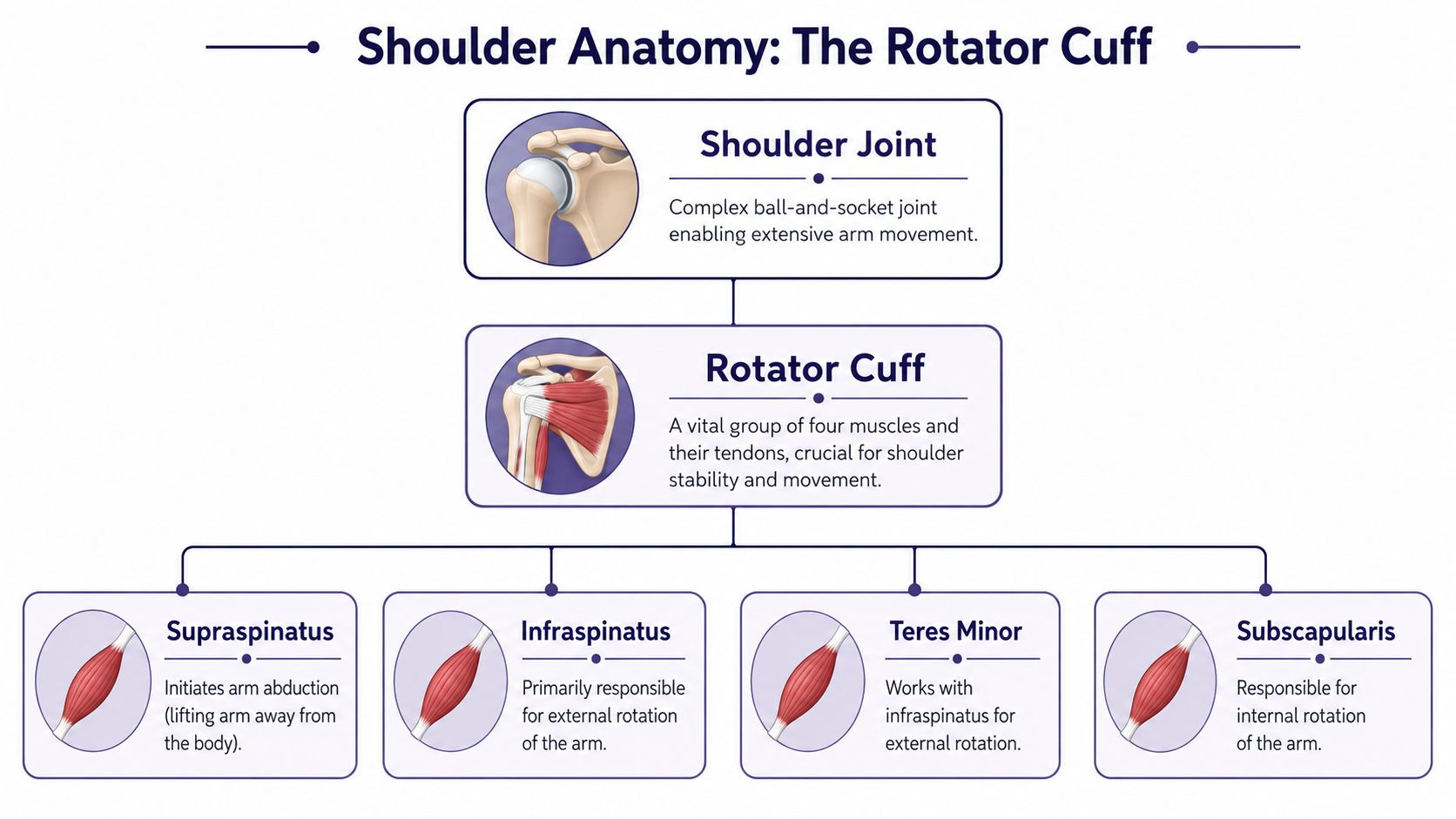
The rotator cuff is four tendons working together
A simple way to picture it is a ball-and-socket joint held steady by four guide ropes. The ball is the top of your upper arm bone. The socket is part of the shoulder blade. The guide ropes are the rotator cuff tendons, attached to four muscles.
Those four muscles are:
- Supraspinatus. This helps start lifting your arm away from your body.
- Infraspinatus. This helps turn your arm outward.
- Teres minor. This also helps with outward rotation.
- Subscapularis. This helps turn your arm inward.
These tendons don't just create movement. They also keep the ball centred in the socket while larger muscles power the arm. If the cuff is irritated or torn, the shoulder may still move, but it often moves less smoothly and with less strength.
Why ageing matters more than many people realise
Many patients worry that a scan showing a tear must mean major damage. That isn't always the case. In a BMJ Open study of women over 60 in the UK, 22.1% had full-thickness rotator cuff tears, 59.4% had tendon abnormalities, and 41.7% of those with a full-thickness tear had no symptoms at all.
That matters because it tells us two useful things. First, rotator cuff changes become more common with age. Second, a structural change on a scan doesn't automatically explain the pain in front of you.
Clinical takeaway: a painful shoulder can have only mild tendon changes, and a larger tear can sometimes be surprisingly quiet.
This is one reason doctors don't diagnose a rotator cuff problem from imaging alone. We combine the scan with your story, your examination, and what the shoulder is failing to do.
Injury Types from Overuse to Acute Tears
A rotator cuff injury is often less like a rope snapping and more like a fabric wearing thin over time. For many patients, the problem starts with an irritated tendon that is coping poorly with repeated strain. In others, there is a more sudden tear after a fall, a heavy lift, or a sharp pulling movement.

Doctors usually place these problems on a spectrum. That matters in clinic, because treatment decisions often depend on where you seem to sit on that spectrum, how your shoulder is functioning, and whether the problem came on gradually or after a clear injury.
Irritation and overload at the milder end
One common diagnosis is rotator cuff tendinopathy. This means the tendon has become sore and less able to cope with the load being placed through it. A useful way to picture it is an overworked cable. It still does its job, but it does not tolerate repeated strain as well as it used to.
This pattern often follows repetitive overhead activity, gym technique errors, sudden increases in exercise, or work that keeps the arm lifted for long periods. The pain may build over days or weeks rather than after one single moment.
You may also hear about bursitis. The bursa is a small fluid-filled sac that reduces friction around the shoulder. When it becomes irritated, lifting the arm can feel sharp or pinching, especially through a middle arc of movement. In real life, tendinopathy and bursitis often overlap, which is one reason shoulder pain can sound messy rather than neat.
Partial tears and full-thickness tears
Further along the spectrum, the tendon can begin to fray. That is a partial-thickness tear. Some of the tendon fibres are damaged, but the tendon is not fully divided. People with partial tears may have pain, weakness, or both, and the story can sound very similar to tendinopathy.
A full-thickness tear means the tendon has torn all the way through. There are two broad patterns that GPs and shoulder specialists look for.
- Acute traumatic tear. This follows a clear event, such as a fall, a sudden jerk, or lifting something unexpectedly heavy.
- Degenerative tear. This develops more gradually as tendon tissue becomes less resilient over time.
The American Academy of Orthopaedic Surgeons overview of rotator cuff tears describes the same broad split between tears caused by a single injury and tears linked to gradual wear.
That difference helps guide the clinical journey. A shoulder that became weak straight after a fall raises different questions from a shoulder that has been aching on and off for six months. In the first case, your GP may be more concerned about a larger tear that needs early imaging or specialist input. In the second, the focus is often on restoring strength and control first, because many gradual cuff problems improve without surgery.
Patterns patients often recognise
These are common stories heard in general practice:
- The decorating flare-up. Hours of painting or reaching overhead, followed by an aching shoulder that is worse at night. This often fits overload, bursitis, or tendinopathy.
- The gym setback. Pain during pressing or lifting movements, then reduced confidence and strength afterwards. This may fit tendinopathy or a partial tear.
- The sudden loss of lift after a fall. The arm feels weak, awkward, or difficult to raise soon after an injury. This raises more concern for an acute tear.
- The slow decline. No obvious injury, but everyday tasks like reaching a shelf or putting on a coat become harder over time. This often points towards a degenerative cuff problem.
The main point is that rotator cuff injury is a broad label, not one single diagnosis. Your symptoms, the way the problem started, and what the shoulder can still do are often more useful than the scan result alone. That is why a GP does not just ask, “Is there a tear?” We ask, “What kind of cuff problem is this, how is it affecting function, and which route is most likely to help?”
Common Symptoms and When to Seek Advice
Patients often expect one classic symptom. In reality, the shoulder is less tidy than that. A rotator cuff problem may cause pain, weakness, disturbed sleep, or a combination of all three.
Symptoms people often notice first
Common complaints include:
- A dull ache in the outer or upper shoulder that builds during the day
- Pain when reaching overhead for a shelf, wardrobe, or car boot
- Night pain, especially when lying on the affected side
- Difficulty reaching behind your back, such as fastening clothing or tucking in a shirt
- Weakness when lifting or rotating the arm
- A catching sensation during certain movements
Not everyone gets all of these. Some patients mainly notice weakness. Others are bothered most by sleep disruption.
When it may not be the rotator cuff
It's common for online articles to oversimplify the issue. Shoulder pain does not always mean a rotator cuff tear. Symptoms can overlap with frozen shoulder, arthritis, and pain coming from the neck. That overlap is one reason self-diagnosis can be misleading.
For example:
| Condition | What patients often notice |
|---|---|
| Rotator cuff problem | Painful lifting, weakness, pain in a movement arc |
| Frozen shoulder | Marked stiffness, trouble in many directions, not just pain |
| Neck-related pain | Pain radiating from neck to shoulder or arm, tingling, altered sensation |
| Arthritis | Deeper joint pain, stiffness, creaking, reduced range |
According to MedlinePlus guidance on rotator cuff injuries, you should seek assessment if pain lasts more than about a week or if there is immediate, significant weakness after an injury.
Practical rule: if the shoulder is sore but improving day by day, a short period of relative rest may be reasonable. If it's weak, persistently painful, or clearly not improving, it needs proper assessment.
Signs that shouldn't be ignored
Book medical advice sooner if you have:
- Sudden weakness after a fall or lifting injury
- Pain that doesn't settle after several days of simple measures
- A shoulder that's becoming progressively stiffer
- Pain with neck symptoms, numbness, or pins and needles
- Fever, redness, or systemic illness, which suggests a different and more urgent problem
The most useful question isn't “does this hurt?” It's “what can't this shoulder do that it used to do?”
How Your GP Will Diagnose the Problem
You come in saying, “I can lift the arm, but it suddenly gives way when I reach for a cupboard,” or, “It aches at night and I cannot tell if it is weakness or just pain.” That is often where the diagnosis starts. A GP is not only asking, “Does this sound like a rotator cuff problem?” We are also working out what it is not, how serious it may be, and whether you need time, physiotherapy, imaging, or a faster surgical opinion.

The story often gives the first clues
The shoulder history matters because different problems leave different fingerprints.
I would usually ask:
- Did the pain build up gradually, or did something specific trigger it?
- Was there a fall, a heavy lift, or a sudden pull?
- Is your biggest problem pain, weakness, stiffness, poor sleep, or loss of function?
- Which movement is hardest. Reaching up, reaching behind, lifting away from the body, or lowering the arm?
- What has changed in real life. Getting dressed, fastening a bra, washing your hair, driving, gym work, or work tasks?
Those details help a GP sort common tendon irritation from a more significant tear. They also help separate shoulder pain from frozen shoulder, arthritis, or pain referred from the neck. In practice, the question is often less “where does it hurt?” and more “what pattern does this follow?”
What your GP examines, and why
A shoulder examination is a bit like testing a set of pulleys and cables. The shoulder can be painful yet still strong. It can also move quite well but fail when resistance is added. Those are different patterns, and they point in different directions.
The examination usually looks at three things.
First is movement. If both you and the doctor struggle to move the shoulder in several directions, stiffness becomes a bigger clue. If movement is possible but painful in a certain arc, the rotator cuff becomes more likely.
Second is strength. Your GP may ask you to hold the arm in certain positions while gentle pressure is applied. Marked weakness, especially after an injury, raises suspicion of a larger tear.
Third is provocation tests. These are simple guided movements that stress particular tendons. No single test gives a perfect answer. What matters is the overall pattern from the story, the movement, and the strength findings taken together.
When scans are useful, and when they are not the first step
Many patients understandably want a scan straight away. Sometimes that is sensible. Sometimes it is not the part that changes treatment.
Guidance from the American Academy of Orthopaedic Surgeons on rotator cuff tears explains that diagnosis usually begins with the history and examination, with imaging used to clarify the problem when needed.
A GP may choose imaging in different ways:
- X-ray if the aim is to look for arthritis, bone changes, or another structural cause of shoulder pain
- Ultrasound if there is a question about tendon irritation or tearing, especially when a dynamic look at the tendons would help
- MRI if the diagnosis remains uncertain, symptoms are not improving as expected, or surgery is being considered and the exact size and pattern of a tear matters
This is one of the points patients often find confusing. A scan can show a tear, but the scan still has to match the person in front of you. Some tendon changes are present without causing the main symptoms. That is why a GP does not treat the scan result alone.
How your GP decides what happens next
The purpose of the appointment is to place you on the right pathway.
If the picture fits an overuse problem or a smaller degenerative cuff injury, the usual next step is a structured rehabilitation plan, often with musculoskeletal physiotherapy explained here. If there has been a clear injury followed by sudden weakness or loss of function, your GP is more likely to consider earlier imaging or referral because timing can matter more in larger tears.
That surgery versus physiotherapy decision is rarely made from one symptom alone. It depends on age, activity demands, how the injury started, how much weakness is present, and whether the shoulder is improving with good rehab. Good information on treating rotator cuff injuries can help you understand why many people recover well without an operation, while a smaller group benefits from surgical assessment.
A useful question to ask your GP is this: “Do you think this looks like a painful tendon that needs rehabilitation, or a tear that may need imaging or specialist review?” That often gets you a clearer, more practical answer than asking for a scan in isolation.
Effective Treatments and Rehabilitation Pathways
Individuals often share a common goal. They desire reduced pain, restored function, and the fastest safe route to normal life. The important point is that surgery is not the default solution for every rotator cuff problem.
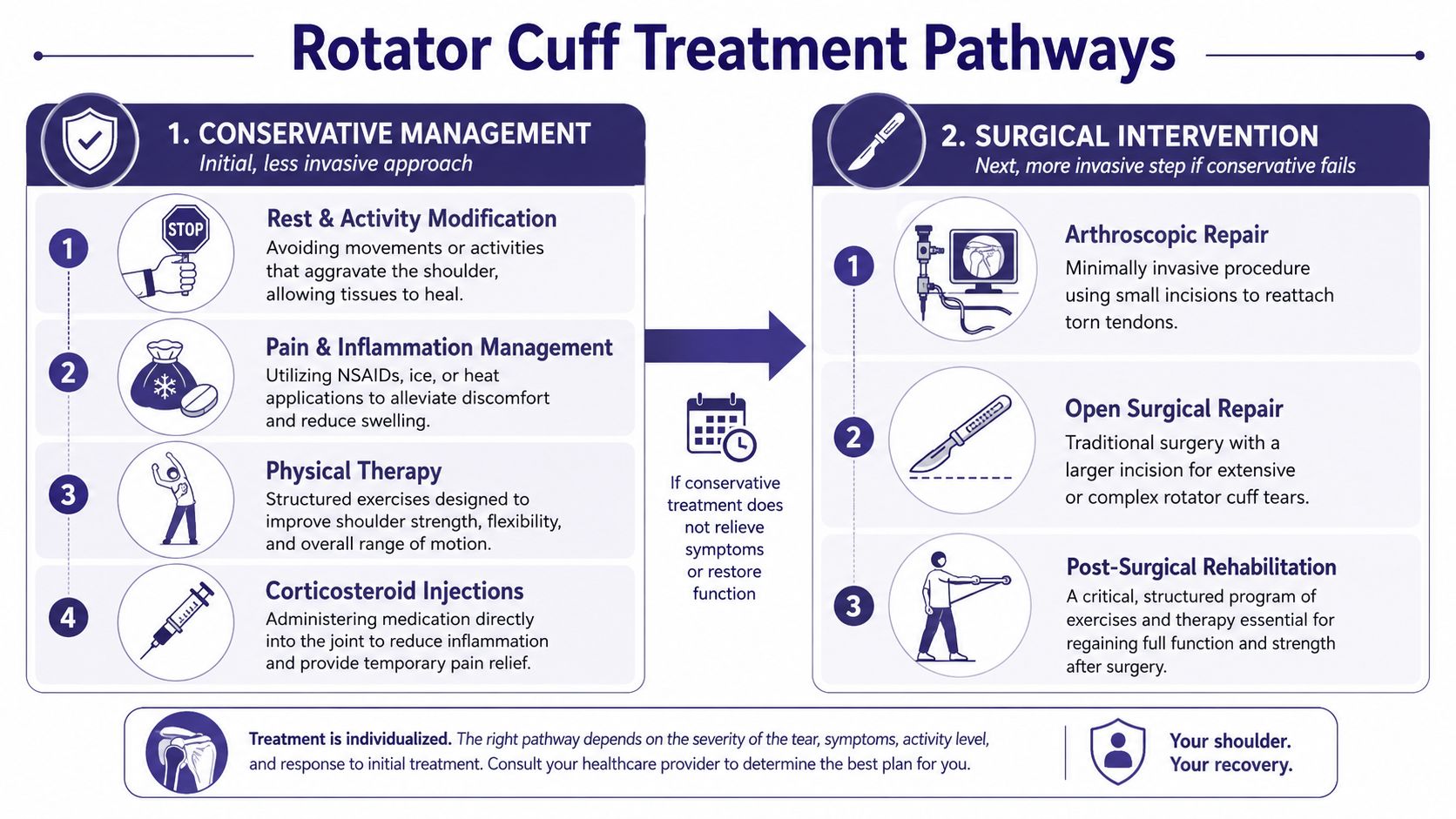
Why conservative care usually comes first
A Harvard Health overview of rotator cuff injury notes that many injuries, especially degenerative ones, respond well to conservative care like physiotherapy. It also explains that surgery depends on factors such as age, activity level, tear type, and symptoms that persist after several months of structured rehabilitation.
That fits what many GPs and musculoskeletal clinicians see in practice. Plenty of shoulders improve without an operation, especially when treatment is organised rather than vague.
The first stage usually includes:
- Relative rest. This means reducing aggravating movements, not putting the arm in total retirement.
- Pain management. Ice can help after aggravating activity. Some patients also use anti-inflammatory medication if it's medically appropriate for them.
- Load correction. Small changes in gym technique, desk set-up, lifting habits, and sleep position can make a real difference.
- Structured physiotherapy. This is usually the backbone of recovery.
What good physiotherapy actually does
Physiotherapy isn't just a printout of shoulder circles. A good programme usually works through phases.
Early on, the focus is often on calming pain and restoring movement. Later, the work shifts to rebuilding strength in the cuff and the muscles around the shoulder blade. Then comes return to function, whether that's carrying children, working overhead, swimming, serving in tennis, or pressing weights in the gym.
If you'd like a plain-language overview of how rehab fits into broader musculoskeletal care, this guide to musculoskeletal physiotherapy is useful. For a more treatment-focused rehabilitation perspective, LifeWorks also has a practical resource on treating rotator cuff injuries.
Where injections and surgery fit
Corticosteroid injections can be helpful in selected cases, usually when pain is so dominant that the patient can't engage properly with rehabilitation. They are a tool, not a cure. If an injection settles pain enough for someone to sleep and start physio properly, it may have done its job well.
Surgery enters the picture more seriously when there is:
- A large acute tear after trauma
- Clear weakness after a specific injury
- Persistent pain and dysfunction despite months of structured rehabilitation
- A patient whose work or sport demands high shoulder function and whose imaging supports repair
The operation itself isn't the whole treatment. Whether done arthroscopically or through a more open approach, the result still depends heavily on post-operative rehabilitation.
A simple comparison of the main pathways
| Pathway | Who it often suits | Main goal |
|---|---|---|
| Activity modification and pain relief | Early irritation, flare-ups, overuse | Settle symptoms and reduce further aggravation |
| Physiotherapy-led rehab | Most tendinopathy, many degenerative tears, post-injury weakness without urgent surgical signs | Restore movement, control, and strength |
| Injection plus rehab | Significant pain limiting sleep or exercise progression | Reduce pain enough to allow rehabilitation |
| Surgical assessment | Acute traumatic tears, larger tears, ongoing disability despite rehab | Decide whether tendon repair is appropriate |
Recovery usually improves when treatment matches the type of problem. A painful overload pattern needs a different plan from a sudden traumatic weakness pattern.
Lifestyle changes that genuinely help recovery
The advice I give most often is practical rather than dramatic:
- Change the provoking task. Move heavy items closer to waist height. Use both hands. Break long overhead jobs into shorter blocks.
- Adjust desk posture. Keep elbows supported, shoulders relaxed, and avoid long periods of hunching over a laptop.
- Sleep smarter. Avoid lying directly on the painful side. A pillow under the forearm can reduce strain.
- Return gradually. Don't test the shoulder every day with the exact movement that irritated it.
- Stick with the plan. Tendons often improve steadily, not instantly.
If local assessment is needed, The Lagom Clinic offers private GP appointments with musculoskeletal assessment and access to imaging pathways, which can help patients move from uncertainty to a structured rehab or orthopaedic plan.
Prevention and Your Partner in Shoulder Health
Shoulders rarely like neglect or sudden heroics. They usually do best with regular movement, sensible loading, and attention to posture and technique. Prevention doesn't mean avoiding activity. It means preparing the body for the activity you ask it to do.
Habits that protect the shoulder
A few routines make a real difference:
- Build the upper back as well as the shoulder. Scapular control matters. Rows, band work, and posture drills help support overhead movement.
- Warm up before demanding activity. A shoulder that goes from desk mode to maximal effort often complains.
- Progress load gradually. New gym programmes, DIY weekends, and racket sports are common moments for overload.
- Respect technique. Reaching, lifting, and landing mechanics all matter across sport. Even if your issue is in the shoulder, the wider principle is the same as in this Vanta Sports blog on footwork safety. Better movement patterns reduce avoidable strain.
- Don't ignore recurring night pain or weakness. Repeated flare-ups are often a sign that the shoulder needs assessment and a better plan, not just more rest.
Think long term, not just symptom by symptom
The best shoulder care usually combines diagnosis, activity modification, targeted rehab, and follow-up. Busy professionals often struggle because they either push through too long or stop everything out of fear. Neither extreme is ideal.
A calmer approach works better. Know what aggravates it. Keep what you can do. Rebuild what you've lost. Ask for help when the pattern suggests more than a simple strain.
If your shoulder pain isn't settling, if you've developed weakness, or if you want a clear plan rather than trial and error, The Lagom Clinic offers private GP appointments in Bristol with time for detailed assessment, practical lifestyle advice, and access to onward imaging or rehabilitation when needed.


 Members Consultation