


Routine mole mapping isn't available on the NHS for the general public. In practice, the NHS usually assesses one suspicious mole at a time through your GP, while full-body digital mapping is reserved for specific high-risk patients and is more often accessed privately at £350 to £600+.
If you're reading this because you've noticed a mole that seems darker, newer, itchier, or otherwise different, that worry is understandable. Those concerned don't need a lecture on skin cancer pathways. They need a clear answer on what the NHS does, what it doesn't do, and what they should do next.
Anxious About a Mole? Understanding Your Options
You notice a mole that was never on your upper arm before. Or one on your back starts looking darker at one edge, but you cannot tell whether it has changed or whether you are now staring at it every day. That is usually the point where people search for mole mapping NHS and expect a routine screening service to be available.
What they find is a narrower NHS offer than the phrase suggests.
In day-to-day practice, the NHS is set up to assess a concerning lesion, usually starting with a GP, and to refer suspected skin cancer urgently when the features justify it. Full-body digital mole mapping sits in a different category. It is usually used for surveillance in selected higher-risk patients, rather than proactive screening for anyone who wants reassurance.
That distinction matters because it changes what sensible next steps look like. If there is one mole that is new, changing, bleeding, crusting, persistently itchy, or clearly unlike your other moles, book a GP appointment promptly and aim to do that within the next couple of weeks. If you have many moles, a strong family history, previous melanoma, or ongoing difficulty tracking changes across your skin, private mole mapping is often the more direct route to a photographic baseline and planned follow-up.
The key distinction that matters
“Mole check” and “mole mapping” are often used as if they mean the same thing. They do not.
A mole check is a clinical assessment of a lesion or a set of lesions that concern you. Mole mapping is a structured monitoring service for people who need comparison over time. On the NHS, that comparison-based monitoring is generally reserved for patients whose history or mole pattern puts them at higher risk. If your concern is straightforward but urgent, the NHS pathway can work very well. If your concern is broader and proactive, it may not offer what you are asking for.
Practical rule: If one lesion is changing, do not wait for a mapping appointment. Get that mole assessed. If your problem is uncertainty across many moles, a private baseline can be a practical alternative.
What actually helps
Four steps are useful in real life:
- Act within four weeks of noticing change. Do not adopt a wait-and-see approach for longer than a month if a mole is changing in size, shape, colour, or sensation.
- Check your skin once a month, properly. Use bright natural light, a full-length mirror, a hand mirror for your back and scalp line, and your phone to photograph any lesion you are watching.
- Compare with your own pattern. The “ugly duckling” sign matters. A mole that looks different from your usual moles deserves attention even if you are not sure it meets every textbook rule.
- Set a review date. If you decide a lesion does not need same-week assessment, photograph it and review it again in 4 weeks, not by glancing at it repeatedly every few days.
- Protect skin that is exposed often. Daily SPF 30 or higher on the face, neck, ears, chest, and backs of the hands is sensible. Use higher protection and shade for prolonged midday sun.
For many patients, the anxiety comes less from the mole itself and more from not knowing which system fits their situation. The clearest way to handle that is to separate two questions. Does this specific lesion need medical assessment now? Do I also want a more proactive record of my skin because I am in a higher-risk group or tired of guessing? Once you split it that way, the NHS and private options make much more sense.
What Is Digital Mole Mapping?
Digital mole mapping is best thought of as a high-resolution atlas of your skin. Instead of judging a mole from memory, clinicians create a photographic baseline and compare future images against it.
That matters because early change can be subtle. A mole may not look dramatic on a single day, but comparison over time can show a new border irregularity, colour shift, or a lesion that has enlarged.
What the process usually includes
A proper mapping appointment usually combines two types of imaging:
- Total body photography: wider images record the pattern and distribution of moles across the skin
- Dermoscopic close-ups: magnified images look at individual lesions in more detail
The technical standard used in NHS-approved mole monitoring is very specific. The Imaging Medical Images national guideline describes high-definition imaging, consistent 45° foreground lighting, and numbered adhesive centimetre scales placed beneath highlighted moles so location and size can be followed accurately in later reviews, as set out in the IMI national mole monitoring guideline.
How it differs from a standard GP mole check
A GP mole check is usually focused and problem-led. You attend because of one lesion, the doctor examines it, and if it looks suspicious the next step is referral.
Digital mapping is broader. It's designed to answer different questions:
| Question | Standard GP mole check | Digital mole mapping |
|---|---|---|
| What is being assessed? | One mole or a small number of concerns | The overall pattern of moles across the body |
| Main purpose | Decide if a lesion needs referral | Create a baseline and track change over time |
| Best suited to | A new or changing suspicious mole | People needing structured surveillance |
Good mole mapping isn't just photography. It's repeatable documentation that lets a clinician compare like with like.
When mapping is most useful
It tends to be most valuable for people who have many moles, atypical-looking moles, or a personal history that makes surveillance more important. It's less useful as a blanket service for someone with only a few stable lesions and no concerning changes.
That trade-off is worth understanding. Mapping can support early detection, but it doesn't replace self-monitoring, sun protection, or a prompt medical review when a mole becomes clearly suspicious.
NHS Availability and Referral Pathways
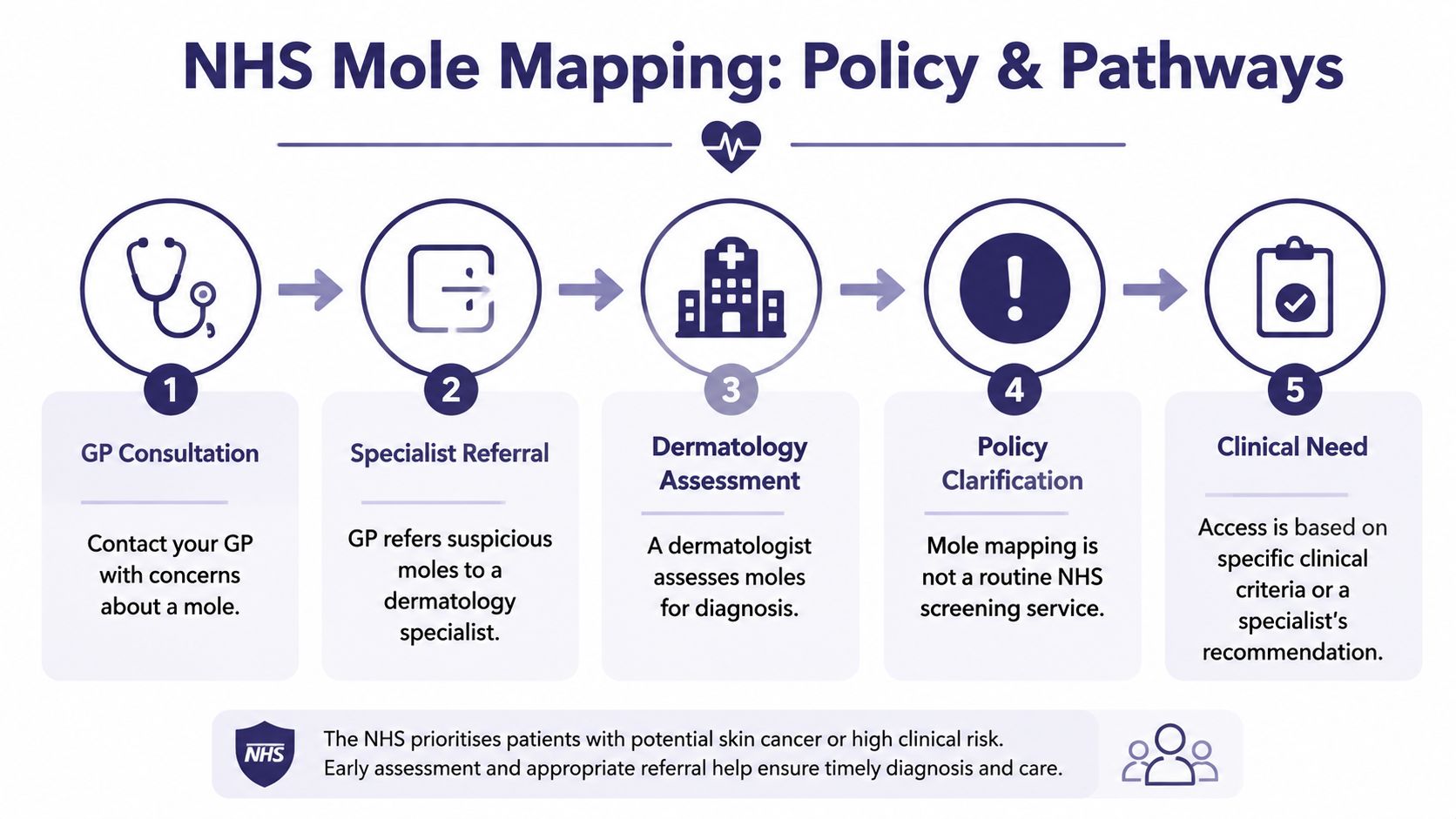
If you want the plain answer on mole mapping NHS availability, current NHS commissioning policy is clear. Routine whole-body proactive mole mapping is not routinely available, and dermatology departments restrict digital mole mapping to patients with a specific clinical indication such as high genetic risk of melanoma or a history of multiple changing lesions, as stated in the University Hospital Southampton patient guidance on digital mole mapping.
Who may get NHS mole mapping
Access is selective and often local. Some NHS services reserve it for patients with a previous melanoma or similarly high-risk histories. The Royal Marsden patient information also makes the broader point that there is no national screening programme for melanoma, and that mapping is part of surveillance rather than routine preventive screening for anyone worried about having many moles, according to Royal Marsden guidance on mole surveillance.
That distinction matters because many readers assume “high-risk” automatically means “eligible.” In reality, eligibility depends on the service, the local trust, and whether a specialist believes structured surveillance is clinically necessary.
The usual NHS route for a worrying mole
For most patients, the pathway looks like this:
- Book a GP appointment about a specific lesion.
- Describe what has changed, such as size, colour, itch, crusting, or bleeding.
- GP assessment decides whether the mole appears suspicious.
- Urgent referral follows if skin cancer is suspected.
This is a strengths-and-limitations model. It works well when there is a concerning mole that needs expert review. It doesn't function as a whole-body reassurance service.
If your concern is “this mole has changed”, the NHS pathway is built for that. If your concern is “I have lots of moles and want a full baseline”, it usually isn't.
Digital developments inside the NHS
Although routine full-body mapping isn't offered to the public, the NHS has started using digital tools that move parts of assessment closer to patients. A notable example is the Map My Mole app trial that began in March 2024 across three NHS clinics in Devon and Cornwall, where more than 1,500 moles and lesions were evaluated. The trial achieved a 50% reduction in hospital referrals from GPs, and the technology had already been adopted by 915 private clinics across the UK since September 2023, as reported in this BBC report on the Map My Mole NHS trial.
This is promising, but it doesn't mean NHS mole mapping is now widely available. It means parts of skin cancer triage are becoming more digital, while access still depends heavily on geography and local service design.
What works best from a patient point of view
The NHS route works best when you use it for what it's designed to do:
- Use it promptly for suspicious change
- Be specific when speaking to your GP
- Bring photos if you have them
- Don't expect routine whole-body screening if you have no qualifying indication
If you're in a monitored high-risk group, specialist surveillance can be excellent. If you aren't, the practical alternatives are careful self-checking and, if you want proactive full-body review, a private service.
How to Check Your Moles A Practical Guide
Most skin cancers are first noticed because a person, partner, or clinician spots change. That makes self-checking one of the most practical habits you can build.
The aim isn't to inspect your skin obsessively. It's to create a calm, repeatable routine that helps you notice what's new, what's changing, and what needs medical review.
Use the ABCDE method
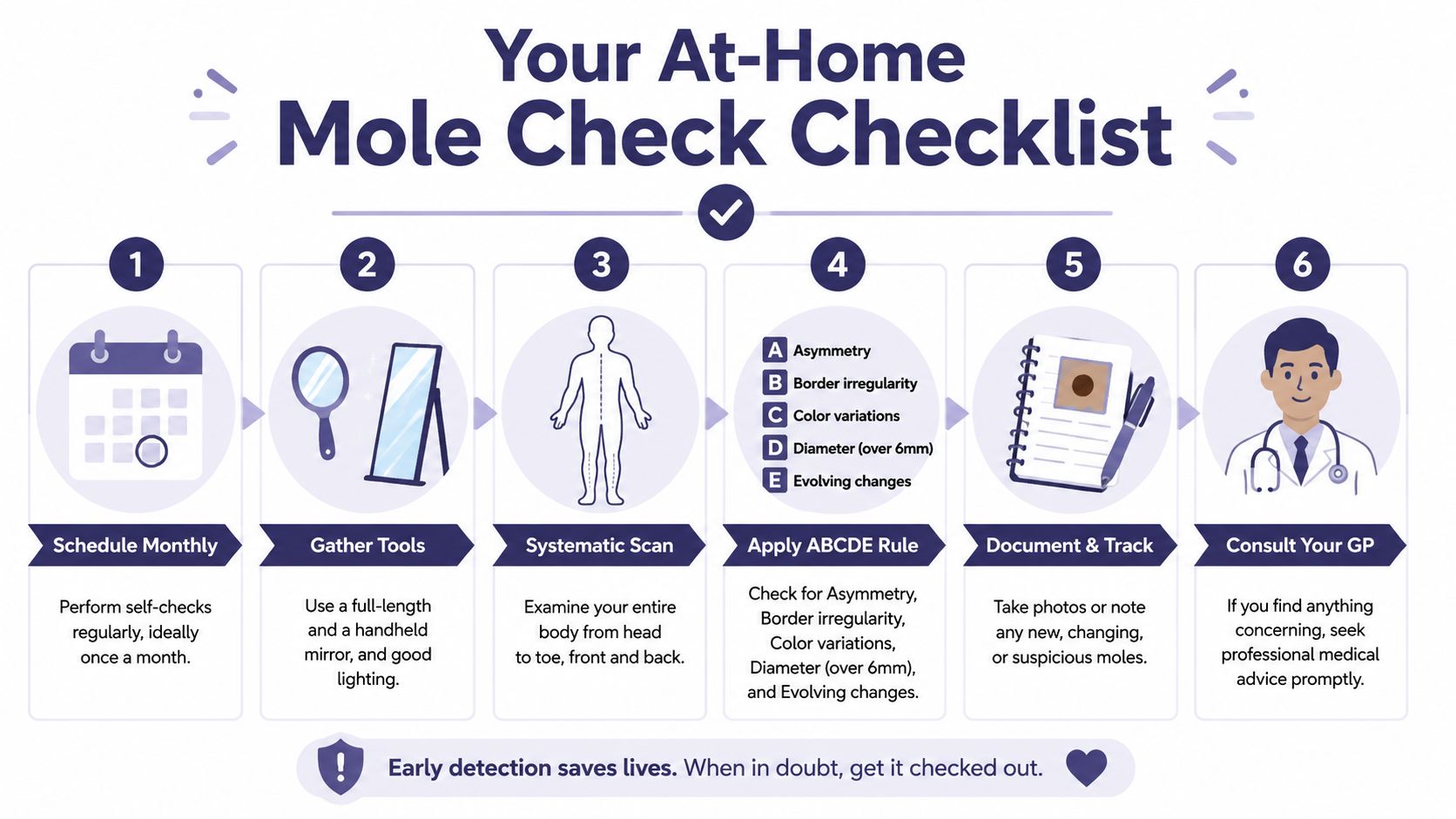
The Royal Marsden advises patients to use the ABCDE approach and to watch for the ugly duckling sign, where one mole looks different from the others. It also advises urgent medical review if a mole becomes larger, darker, oozes, itches, becomes crusty, or if a new pigmented lesion appears after age 40, as described in its skin cancer diagnosis guidance for patients and GPs.
Here's how to apply that in everyday terms:
A for Asymmetry
One half doesn't match the other.B for Border
The edges look ragged, blurred, or uneven.C for Colour
You can see more than one colour, or the mole is getting darker.D for Diameter
A lesion over 6mm deserves attention, especially if it's changing.E for Evolving
Any change over time matters most. New itch, crusting, oozing, or visible enlargement should never be ignored.
A sensible monthly routine
A monthly check is practical. Use good lighting, a full-length mirror, and a hand mirror for hard-to-see areas such as the back, scalp, and backs of the legs.
Try this order so you don't miss areas:
- Face, ears, scalp
- Front of chest and abdomen
- Arms, hands, fingernails
- Sides of the body
- Back, buttocks, backs of legs
- Feet, soles, toenails
If you have a partner, ask for help with your back and scalp. Those are common blind spots.
A well-lit photo taken once a month from the same angle is more useful than trying to remember what a mole looked like six months ago.
How to document moles without overcomplicating it
You don't need specialist equipment for home monitoring. A smartphone photo can help if it's clear, dated, and taken from a similar angle each time.
A simple system works well:
- Create an album on your phone for skin checks
- Photograph the same lesion consistently
- Add a note about symptoms such as itch or bleeding
- Review trends, not day-to-day tiny differences
What doesn't work is taking dozens of inconsistent photos in poor light and then trying to compare them when anxious. Keep it organised and repeatable.
When to seek help promptly
Don't wait for a perfect ABCDE score. Seek medical review if:
- A mole looks different from your others
- It's changing in a way you can describe
- It oozes, crusts, or itches persistently
- A new pigmented lesion appears later in adult life and concerns you
Self-checking is useful because it gets you to the right appointment sooner. It isn't a substitute for that appointment.
Comparing NHS and Private Mole Mapping
A common scenario is this: someone has several moles, one or two they cannot easily keep track of, and a lot of uncertainty about whether the NHS will offer ongoing checks. The answer is usually more limited than people expect.
In UK practice, NHS mole assessment and NHS mole mapping are not the same thing. The NHS is set up to assess suspicious lesions and to monitor selected higher-risk patients under specialist care. It does not routinely offer whole-body digital mole mapping for anyone who wants a baseline or regular screening.
That distinction matters because it changes which route is sensible.
NHS vs private mole mapping at a glance
If the concern is one mole that is changing, bleeding, crusting, or clearly unlike the others, the NHS pathway is the right starting point. If the concern is broader, such as having many moles, difficulty checking your own skin, or wanting structured photographic surveillance despite not meeting NHS follow-up criteria, private mole mapping is often the more practical option.
| Feature | NHS Pathway | Private Mole Mapping |
|---|---|---|
| Main purpose | Assess suspicious lesions and monitor selected high-risk patients | Baseline recording and ongoing surveillance |
| Access | GP referral, then specialist triage if needed | Self-arranged |
| Who it suits best | People with a concerning lesion or clear clinical reason for referral | People who want proactive whole-body monitoring |
| Cost | Free at point of use | Paid service |
| Scope | Usually focused on the lesion causing concern, or specialist follow-up in higher-risk cases | Full-body imaging, lesion documentation, and interval comparison |
The real trade-offs
The NHS is strongest where diagnosis and treatment matter most. If a mole needs urgent review, possible biopsy, or cancer treatment, that is exactly what the NHS pathway is designed to handle well.
Private care serves a different purpose. It gives patients access to baseline photography and repeat comparisons even when there is no single lesion that meets referral thresholds. For a patient with dozens of moles, that can be very useful. It can reduce guesswork and make future change easier to spot.
It also has limits. A private map is only as useful as the follow-up behind it, and it does not make a suspicious lesion less suspicious. If a mole is clearly evolving, the priority is prompt medical assessment, not better photography.
Questions that usually clarify the decision
These are the questions I ask patients who are unsure which route to choose:
- Is there one specific mole that is worrying, or is the problem that there are too many to track confidently?
- Have you been told you qualify for NHS dermatology follow-up, or are you assuming mole mapping is routinely available?
- Do you want diagnosis of a current concern, or documentation for future surveillance?
- Will waiting for the standard NHS process feel reasonable, or will you remain stuck checking the same lesions repeatedly without a baseline?
Those answers usually make the next step obvious.
What private care can and cannot replace
Private mole mapping can make access faster and more organised. It is often chosen by patients with many moles, a strong family history, previous sun damage, or persistent uncertainty after self-checking. It can also help people who struggle to monitor hard-to-see areas consistently.
It cannot replace clinical judgment. It cannot promise that every future melanoma will be caught early. It also does not remove the need to use the NHS urgently if a lesion starts changing in a concerning way.
For a wider comparison of how the two systems differ, this guide to private healthcare versus the NHS sets out the practical differences clearly.
Private mole mapping is mainly a surveillance tool. NHS assessment is mainly a diagnostic and treatment pathway, with mole mapping reserved for selected higher-risk patients rather than routine screening.
A sensible way to choose
Use the NHS first for a suspicious mole that needs diagnosis. Consider private mole mapping if your main need is proactive monitoring, a photographic baseline, or regular comparison when you do not fit NHS surveillance criteria.
The confusion usually comes from expecting the NHS to offer screening-style mole mapping on request. In reality, its role is narrower. Once patients understand that, they can make a calmer and more practical decision.
Your Action Plan for Skin Health
The best plan is the one you'll follow. This typically means sensible sun protection, a regular home check, and quick action when something changes.
Start with prevention
The NHS advice is straightforward. Use a high-factor sunscreen with a minimum SPF of 30, reapply it immediately after swimming, and cover exposed skin with clothes, a hat, and sunglasses for facial protection, as set out in NHS mole and skin protection advice.
These habits matter more than people think. They don't remove existing moles, but they do reduce avoidable UV exposure that can contribute to skin damage and concerning change.
A practical routine looks like this:
- Apply SPF 30 or above before time outdoors
- Reapply after swimming
- Use clothing well, especially on the shoulders, chest, scalp, and face
- Avoid the trap of “I don't burn, so I'm fine”
Make your GP appointment easier and more useful
If you need a mole checked, arrive prepared. That often leads to a better consultation.
Useful things to bring or describe:
- A short timeline of when you first noticed the mole
- What changed, such as colour, shape, itch, crusting, or bleeding
- A photo history, if you have one
- Any relevant personal history, especially previous skin concerns
Keep your description factual. “It has become darker over the last few months” is more useful than “I've always hated how it looks.”
Build a simple long-term system
For ongoing skin health, keep it boring and consistent:
- Check your skin monthly
- Photograph anything you're watching
- Use sun protection routinely
- Seek review early if a lesion changes
- Consider proactive private assessment if baseline surveillance is what you want
If you're thinking about procedures after assessment, it helps to understand what's involved in a private mole removal procedure before making assumptions about what should or shouldn't be removed.
Skin surveillance works best when it becomes part of normal health maintenance, like dental checks or blood pressure review. Calm, regular attention beats panic-driven checking every time.
The practical bottom line is simple. Use the NHS for suspicious lesions and urgent concerns. Use self-monitoring and lifestyle measures to reduce risk and spot change early. If you want proactive whole-body surveillance and don't meet NHS criteria, private mole mapping is the straightforward alternative.
If you'd like a calm, thorough review of a concerning mole or broader advice on proactive skin health, The Lagom Clinic offers private GP care with time to assess your concerns properly, discuss surveillance options, and help you choose the most sensible next step.


 Members Consultation