


You've put off the cervical screening booking again, haven't you. The calendar's full, the practice feels awkward, and there's that quiet little thought that if you just ignore it for a few more weeks, the whole thing will sort itself out. It won't. What usually keeps people away isn't laziness, it's fear, embarrassment, or the sheer nuisance of fitting one more appointment into an already packed life.
That's where a smear test private appointment makes sense for some people. Not because private care is magically better in every case, but because it changes the experience, more time, more privacy, and sometimes a clinician you feel more comfortable with. It also comes with limits, and if you're choosing one, you deserve the plain truth about what it does, what it doesn't, and when the NHS route is still the right one.
What a Private Smear Test Involves
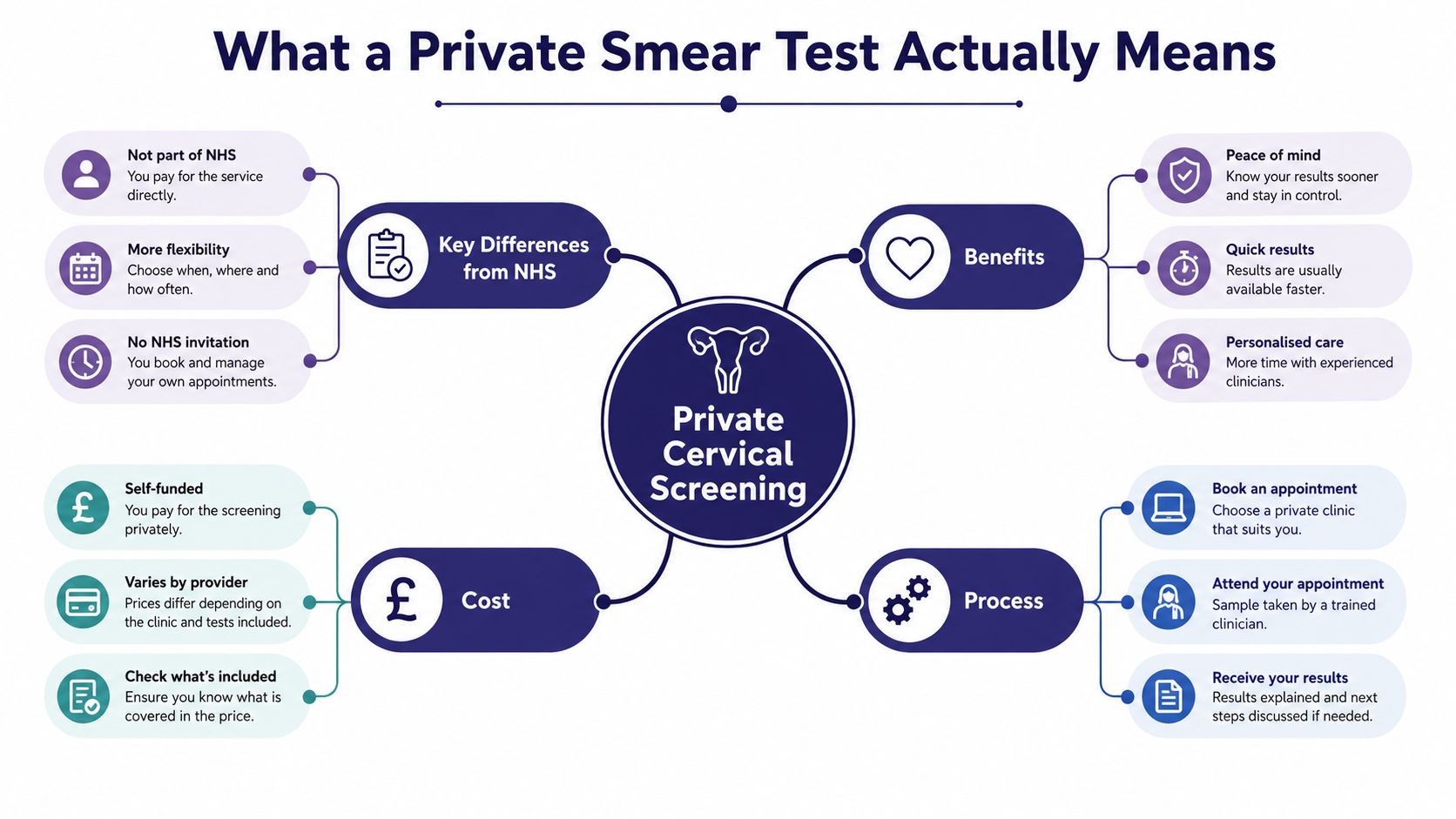
A lot of women arrive thinking they need “a smear”, then find out they are really choosing between different screening pathways. The key point is simple. A private smear test is usually a liquid-based cytology sample taken during a private GP appointment, then processed by an accredited UK laboratory and reported back to you directly. It is a screening test, not a diagnosis, and it is designed to pick up HPV and cell changes before cancer develops, not to investigate symptoms that are already there.
The test you are choosing
Private clinics do not all offer the same service. Some offer a pure smear or cytology-focused test, some offer an HPV primary test, and some offer co-testing, where the same sample is used for both. That distinction matters because the value of the appointment depends on what happens to the sample after it is taken, not just the swab itself.
If you want a clearer sense of why HPV matters so much now, a practical primer on understanding abnormal HPV cells can help before you book. It is useful to know what the lab is looking for, so the result letter feels less mysterious when it lands in your inbox.
Why screening exists in the first place
Cervical screening exists to catch problems early, before they become harder to treat. That is a different job from a GP appointment for bleeding, pain, discharge, or anything else that feels wrong in the moment. Screening looks for warning signs on the cervix itself, usually through HPV testing first, then cytology if needed, so the sample has to be handled carefully and fixed immediately for the lab to read it properly, as the NHS-aligned guidance explains in the technical literature on sample quality and liquid-based cytology handling PMC guidance on cervical screening sample quality.
Practical rule: if you have symptoms, do not try to “screen them away”. Screening and symptom assessment are different jobs.
A private appointment gives you a different route into the same prevention system. It also asks you to understand the trade-offs before you book. For a clear comparison of appointment styles in general, see understanding the difference between NHS and private GP appointments in the UK.
Private Smear Test vs NHS Screening
For some women, a private smear test is a practical alternative to the NHS pathway. The reason is usually not abstract convenience. It is often fear, embarrassment, a packed diary, or the feeling that a rushed appointment will make it easier to keep postponing the test. Private care changes the experience by offering more time, more privacy, and sometimes a clinician you feel more comfortable with. It still sits within the same clinical framework, though. Abnormal results need follow-up, and symptoms need their own assessment rather than being folded into screening.
| Factor | Private smear test | NHS cervical screening |
|---|---|---|
| Eligibility | Chosen with a clinician, often for missed invites, anxiety, or special circumstances | Offered to women aged 25 to 64, on an invitation schedule |
| Screening interval | Can be arranged more flexibly if clinically appropriate | Every 5 years for ages 25 to 64, depending on age and recall rules |
| Turnaround | Often quicker, commonly communicated by phone or email | Usually by post, often within a couple of weeks |
| Follow-up | Private result communication, with referral onward if needed | NHS recall and NHS follow-up pathways |
| Cost | Usually paid for privately | Free at the point of use |
The money side is straightforward. Private clinics commonly charge for the consultation, sampling, lab processing, and result communication, while NHS screening is free. The AXA Health survey cited in the brief shows that attendance is still a real problem, with 16% of the estimated female population avoiding a smear test and around 5 million women in the UK doing so, while 78% of females of relevant age had attended cervical screening AXA Health cervical screening statistics. That helps explain why private screening exists. Access and completion are not the same thing.
Which route fits which situation
If you are within the NHS age range and due a routine screen, the NHS route usually makes the most sense. If you have missed an invite, cannot face the wait, need a calmer setting, or want a longer appointment, private care can be a sensible choice. The NHS still matters here because it remains the main route for follow-up, and follow-up is where screening becomes meaningful rather than just ticked off.
The difference between NHS and private GP appointments in the UK matters too, because it helps you decide how much of your care you want to keep with your NHS practice and how much you want to place in a private setting: understanding the difference between NHS and private GP appointments in the UK.
Simple rule of thumb: NHS for routine eligibility. Private for when the NHS pathway does not fit your life cleanly.
Who Should Consider Booking a Private Smear Test
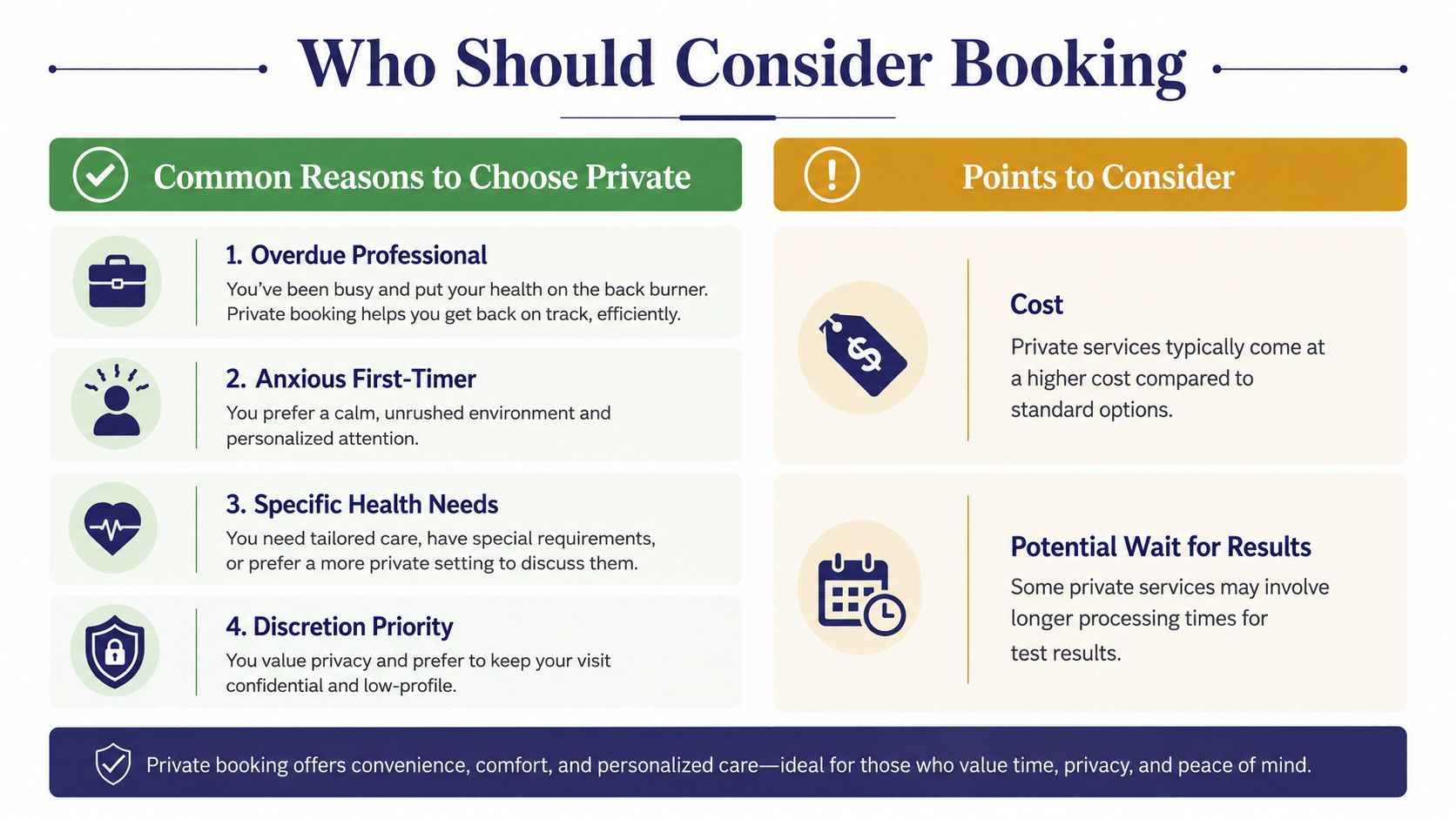
Some people book privately because they've fallen behind. Others book because the idea of a rushed, unfamiliar appointment makes them avoid the whole thing. Both are valid reasons to look at private screening, but they don't carry the same clinical logic.
The four situations where private care often helps
A busy professional who keeps meaning to book is one of the most common cases. If you're overdue, you're not a bad patient, you're just stuck in the usual life clutter, emails, childcare, travel, work deadlines, and the appointment keeps sliding down the list. Private screening helps here because it removes some of the friction.
An anxious patient is a different story. If you need a longer consultation, a female clinician, or a quieter environment, that can be the difference between attending and cancelling. Private care can be worth it because you'll get the test done.
Women over 65 with a history of abnormality may also want ongoing screening, and a private GP can discuss whether that's appropriate in context. The point isn't to keep screening forever. It's to make sure prior abnormal findings are handled properly rather than assumed to be over.
There's also the person who wants screening more often than the NHS offers because of a previous HPV issue, a family history worry, or persistent anxiety. That can be reasonable, but more frequent testing doesn't automatically mean better outcomes for low-risk women. Sometimes the better answer is proper counselling, not more swabs.
A quick self-check before you pay privately
- You missed your NHS invite: Private can get you back on track without waiting for the next administrative cycle.
- You feel too anxious to attend normally: Extra time and a calmer setting may help you complete screening.
- You have a previous abnormal result history: A clinician should check whether ongoing screening is still clinically relevant.
- You want extra reassurance more often than standard intervals: That may suit some patients, but it's not always medically necessary.
The 2025 AXA Health data also showed attendance was highest among women aged 45 to 54 at 84%, while women aged 25 to 34 were least likely to attend at 74%, with the highest avoidance rate at 20% AXA Health cervical screening statistics. That's useful context, because the problem isn't one single type of patient. It's a mix of age, timing, fear, and logistics.
If you're choosing private just because you're embarrassed, say that out loud to yourself. Then decide whether private care solves the embarrassment or whether you really need a more supportive clinician, a longer appointment, or a different conversation altogether.
What Happens Before, During and After Your Appointment
A smear test often feels bigger in the mind than it is in the room. That is usually because the uncertainty sits there first. Once the sequence is clear, the appointment becomes more manageable, and the practical details matter more than the worry. Before you go, avoid intercourse, lubricants, spermicides, and douching for 24 hours, and empty your bladder so you are more comfortable on the couch.
The hour before the visit
Choose clothes that are easy to manage, ideally a skirt or loose trousers. If you are bleeding heavily, or have vaginal bleeding, tell the clinician before you set off, because it may affect whether the test can be done that day, as the NHS advises NHS cervical screening preparation. That is not fussiness. It is about getting a sample the lab can read properly.
The appointment itself is usually brief, but it should not feel hurried. One private hospital page states that the whole visit takes 15 to 20 minutes, with the sample collection itself about 30 seconds Tower Bridge Hospital cervical screening information. That leaves room for questions before anyone gets near the speculum, and good private care should use that time properly.
What the clinician does and what happens next
You will usually have a private GP consultation first, then consent, then the examination. The speculum is inserted so the cervix can be seen clearly, and a small brush collects the sample from the cervix. The sample is fixed immediately, because delayed fixation can damage the cell detail the lab needs to read it properly PMC cervical screening sample quality guidance.
Plain truth: the sample itself is quick. The part that takes time is the appointment in your head, not the swab.
Afterwards, the sample goes to an accredited UK laboratory, and results are usually sent back directly to you by phone or email in the private setting. If the test felt uncomfortable, or you are left wondering what is normal afterwards, a practical recovery guide such as Lake City PT smear test recovery can help you judge what usually settles on its own and when to ask for help.
A few clinics also discuss whether the result can feed into your NHS record, which is a sensible question to ask before you book. If continuity matters to you, ask how they handle sharing, record-keeping, and onward referral before the appointment ends.
Understanding Your Smear Test Results
People often think a result letter is either good or bad. It usually isn't that simple. Cervical screening now follows an HPV-first pathway, so the first question is often whether high-risk HPV was detected, then whether the cells look normal enough to return to routine recall or need more checking WHO technical guidance on cervical screening pathways.
The four result patterns most women see
- HPV negative: usually means return to routine recall.
- HPV positive, no abnormal cells: usually means you're recalled sooner for repeat testing.
- HPV positive with abnormal cells: usually leads to colposcopy.
- Inadequate sample: the test needs repeating because the lab couldn't read enough material.
An HPV positive result does not mean cancer. It means the virus is present and needs monitoring, because some infections clear while others need closer follow-up. That's the whole point of screening, catching the pattern early enough to act without panic.
What screening does not replace
Two situations sit outside ordinary screening. Symptoms such as bleeding after sex, unusual discharge, or persistent pelvic discomfort need a proper clinical assessment, not just a screening swab. Abnormal results that need colposcopy also don't disappear just because the first test was private. The NHS pathway still handles the onward work-up.
The practical issue is that a negative result can feel like the end of the conversation, but it isn't a free pass forever. It means the current screen is reassuring, not that cervical health no longer needs attention. That distinction matters, especially if you're the kind of person who books once, relaxes, and then forgets the next recall entirely.
If you want to understand how private screening sits within a wider cancer-screening mindset, the article on private cancer screening is a useful companion, because the question is often how to build a sensible prevention plan rather than chase one-off reassurance.
Lifestyle Habits That Support Cervical Health
Private screening is one piece of the puzzle. What you do between tests matters too, and the good habits here are unglamorous but useful. They don't replace screening, they make the whole system more effective.
The habits worth keeping
- Stop smoking if you smoke: smoking weakens cervical immunity and is linked with a higher cervical cancer risk, so quitting is one of the strongest lifestyle moves you can make.
- Keep your HPV vaccination status up to date: it doesn't replace screening, but it reduces risk from the common high-risk strains.
- Use condoms with new partners: that doesn't block every exposure, but it does lower HPV exposure.
- Eat for your immune system: folate, vitamin A, and a colourful Mediterranean-style plate are sensible, evidence-aligned choices.
- Keep moving and manage stress: regular movement and stress regulation support the wider immune and hormonal picture.
The smoking point is the one I see ignored most often, probably because it feels less immediate than a smear booking. But it's not optional if you want to lower risk in the long term. That's why this sort of prevention works best when it's honest and practical, not inspirational and vague.
If you're interested in broader preventive health support, some clinics also use lifestyle-based consultations alongside routine screening. A relevant example is B12 injections, which may be discussed in some settings as part of a wider wellness conversation, although they are not a substitute for screening, vaccination, or risk reduction.
A screenshot-friendly pre-appointment checklist
- 24 hours before: no intercourse, no lubricants, no douching.
- On the day: empty your bladder and wear something easy to remove.
- Longer term: don't smoke, keep up with HPV vaccination, and keep attending screening on schedule.
- If you have symptoms: book a clinical assessment, not just a screening appointment.
The NHS says screening is offered every 5 years for women aged 25 to 64 NHS cervical screening overview, and that schedule makes more sense when the lifestyle side is steady in between appointments. Regular screening plus sensible habits is the combination that moves the needle.
Booking Your Smear Test at The Lagom Clinic
A private smear test should sit alongside the NHS schedule, not pretend to replace it. It won't solve symptoms, and it won't bypass follow-up if something abnormal shows up. What it can do is give you a calmer, more flexible route into screening, with enough time to ask questions and enough structure to get a proper result.
At The Lagom Clinic, a private GP appointment in Bristol can include cervical smear testing as part of a women's health consultation. The appointment is built around privacy, discussion, and on-site sample collection, with laboratory processing and direct result communication afterwards. If you're juggling work, family, training, or all three, that kind of continuity can make the difference between putting it off again and getting it done.
The practical value here is not that private care is more dramatic. It's that it's more manageable for some people. You can use the appointment to talk about screening, prevention, and any wider health questions at the same time, which is often the most sensible way to use a private GP visit.
If you're overdue, anxious, or just tired of the whole thing hanging over you, book a private cervical screening appointment with The Lagom Clinic. You'll get a calm Bristol GP consultation, proper sample handling, and clear next steps if anything needs follow-up. It's a straightforward way to stop carrying the worry and get the test done properly.


 Members Consultation