


The most popular claim around gut microbiome testing is also the most misleading. Many people come to it hoping for a neat explanation for bloating, IBS symptoms, food reactions, fatigue, or a vague sense that their gut is “off”. In practice, these tests rarely work like a clean diagnostic shortcut.
That doesn't make the field unimportant. It means the right question isn't “Should I buy a gut test because everyone is talking about them?” It's “Will this test change what I do next, and is that change grounded in something sensible?”
In the UK, that distinction matters. Research on the microbiome has expanded rapidly, but routine clinical use has not kept pace. Patients are often stuck between enthusiastic marketing and cautious medical guidance. The result is confusion, especially when a private report promises personalised insight but doesn't clearly explain its limits.
A sober approach is more useful. Gut microbiome testing can sometimes provide interesting clues. It is not, at present, a stand-alone answer to common digestive complaints. If you understand what it measures, where it falls short, and which lifestyle steps support gut health, you're in a much stronger position to decide whether it's worth your time and money.
Demystifying Gut Microbiome Testing in the UK
The appeal of gut microbiome testing is obvious. It sounds modern, personalized, and scientific. Send off a stool sample, receive a report, and finally understand what your gut has been trying to tell you. That is the promise many people buy into.
The clinical reality is more restrained. The British Dietetic Association noted that by the end of 2019 there were more than 9,500 gut microbiome citations in Web of Science, around 30 times more than in 2001, yet still concluded that commercial gut microbiota testing and lifestyle programmes based on those results cannot be advised currently because the science is not mature enough to support testing-and-treatment programmes, as outlined in the British Dietetic Association guidance on commercial gut microbiome testing.
That gap between research growth and clinical usefulness is the central issue in gut microbiome testing UK patients need to understand.
Why the hype and the caution coexist
Scientists are learning a great deal about the gut microbiome. Clinicians are also aware that many things remain uncertain, including what should count as a normal or healthy result for one individual versus another.
Commercial providers operate in that unsettled space. Some offer careful reports with reasonable caveats. Others imply a level of precision that current evidence doesn't support. If a test is presented as a definitive route to diagnosing IBS, identifying food intolerance, or providing a complete picture of “gut health”, caution is sensible.
Practical rule: Treat a microbiome test as an optional source of context, not as a verdict on your health.
What helps patients most
A useful consultation usually starts elsewhere. Before any specialist testing, it is worth reviewing:
- Your symptom pattern: timing, triggers, stool changes, pain, bloating, reflux, or weight change.
- Medication factors: antibiotics, acid suppressants, laxatives, and supplements can all affect symptoms.
- Dietary habits: fibre intake, alcohol, meal timing, and ultra-processed foods often matter more than people think.
- Stress and sleep: both influence gut symptoms in a way many test reports cannot capture.
That grounded starting point often leads to clearer decisions. Sometimes a microbiome kit may still have a role. Often, the most useful gains come from basics done well.
What Is the Gut Microbiome and Why Does It Matter
The gut microbiome is best thought of as an internal ecosystem. Not a single organism, and not a single “gut health score”, but a crowded living community made up of bacteria and other microorganisms within the digestive tract.
Like a garden, it works best when there is balance, variety, and resilience. A healthy garden is not built around one perfect plant. It depends on diversity, stability, and the conditions that help useful species thrive. The same idea helps when thinking about the gut.

What this ecosystem actually does
The microbiome helps with several jobs at once. It contributes to digestion, interacts with the immune system, and plays a role in how the gut communicates with the rest of the body. That is one reason the subject attracts so much attention.
In everyday practice, the most relevant point is this. The gut does not operate in isolation. Food choices, stress, sleep, illness, medication use, and routine all influence the gut environment.
Common terms can sound more intimidating than they are:
- Diversity means having a broad range of organisms rather than a narrow, fragile pattern.
- Dysbiosis refers to an imbalance or disrupted ecosystem.
- Function matters as much as composition. Two people may have different microbial patterns and still both be well.
Why symptoms and microbiome talk often get mixed together
Patients often assume that digestive symptoms automatically mean they need a microbiome test. Sometimes what they really need is a clearer symptom analysis. Bloating after certain carbohydrates, for example, may relate more to food tolerance patterns than to a useful microbiome report.
If you're trying to make sense of bloating, wind, abdominal discomfort, or reactions to certain foods, OrganizEat's guide to FODMAP symptoms is a practical resource because it explains a common symptom pattern that people often confuse with a need for broad testing.
A resilient microbiome is a helpful goal. Chasing a “perfect” microbiome profile usually isn't.
What matters more than a perfect profile
There isn't one ideal microbiome that every healthy person should have. That's one of the reasons interpretation is hard. The useful aim is not perfection. It is resilience.
That usually means supporting the basics:
- varied plant intake
- regular meals
- enough sleep
- lower stress where possible
- sensible use of antibiotics and supplements
- attention to real symptoms rather than app scores
That foundation matters whether you ever do a test or not.
A Look Inside the Gut Microbiome Testing Process
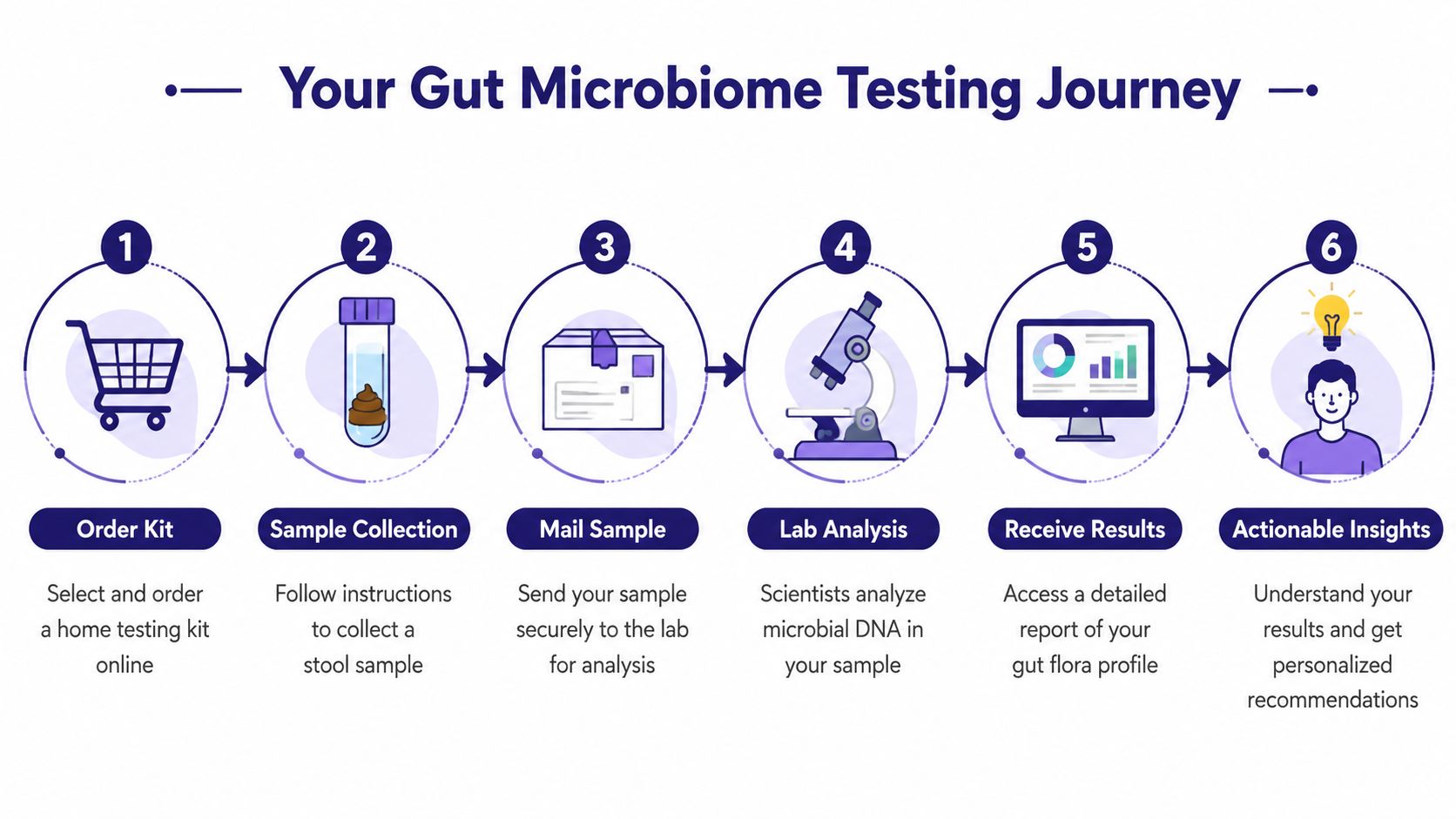
Most UK microbiome tests follow the same broad path. You order a kit, collect a stool sample at home, package it as instructed, post it to a laboratory, then receive a digital report. The report may include microbial composition, commentary on diversity, and sometimes extra markers linked to digestion, inflammation, or pathogens.
What sounds simple can become less simple once you look at how much the result depends on technique, timing, and interpretation.
What happens before the sample reaches the lab
The collection step matters more than many people realise. UK at-home tests commonly instruct users to keep diet stable for about a week before sampling and collect on Monday to Wednesday so the sample can reach the lab in time, because diet shifts and delayed posting can distort the apparent microbial profile, as explained in Lantern Clinic's doctor guide to gut microbiome testing in the UK.
That means the report is shaped not only by your biology, but by what happened in the days before the sample. A weekend of different meals, recent illness, travel, alcohol excess, constipation, diarrhoea, or mailing delays can all alter the picture.
What the lab may measure
Different providers use different methods. In plain terms, some tests look broadly at bacterial DNA in the stool. Others use more targeted techniques such as qPCR. Some reports stay focused on microbial composition. Others bundle in extra measures such as inflammation markers, digestion and absorption indices, secretory IgA, or pathogen panels.
The trade-off is straightforward:
- Broader sequencing can provide a wider view of what is present.
- Targeted testing can be more focused for specific questions.
- Mixed panels may give more data, but more data is not always more clarity.
A long report can still leave the key question unanswered. Does any of this explain your symptoms in a way that changes management?
Why a result is only a snapshot
A stool sample is not a live video feed of your gut. It is one sample, from one point in time, influenced by collection conditions and by the test method itself.
That has practical implications:
- One sample can mislead if it was taken during an unusual week.
- Changes in routine matter more than people expect.
- Repeat testing under similar conditions is more informative than comparing random one-off samples.
If you want to track change, standardise the conditions first. Similar diet, similar routine, and similar timing matter as much as the laboratory platform.
Gut microbiome testing frequently disappoints UK consumers. They expect certainty. What they often receive is a detailed but conditional snapshot.
Comparing NHS, Private GP, and At-Home Kits
In the UK, people usually approach gut testing through one of three routes. The NHS, a private GP, or a direct-to-consumer home kit. These routes are not interchangeable because they serve different purposes.
The NHS is geared towards diagnosing recognised medical problems using validated tests. A private GP can help decide which tests are worth doing in the context of symptoms. An at-home kit is usually the most accessible route for microbiome profiling, but it also places more responsibility on the patient to interpret what comes back.
What the NHS does and does not offer
Detailed mapping of a person's microbiome is not currently available on the NHS, which mainly uses targeted qPCR assays for specific infections rather than whole-microbiome profiling, as described in Healthpath's in-depth UK guide to microbiome testing.
That distinction is important. If a clinician suspects infection, inflammation, coeliac disease, or another defined condition, NHS testing can be very useful. If you want broad microbiome profiling out of interest or in the hope of uncovering a vague root cause, the NHS is not set up for that.
How the private and home-testing routes differ
Private pathways can be more flexible, but flexibility isn't the same as better evidence. A good private consultation can help decide whether symptoms suggest standard medical testing, dietary review, or whether a commercial microbiome kit is likely to add little.
The direct-to-consumer market is easier to access. It is also varied. Healthpath reports UK at-home test pricing from £129 to £389 and above depending on the package and provider details in its overview. Price often reflects breadth of testing, branding, support, and report design as much as pure clinical usefulness.
For a broader look at how private care differs from public pathways, this comparison of private healthcare vs NHS options is useful background.
Gut Microbiome Testing Routes in the UK
| Feature | NHS | Private GP (e.g., The Lagom Clinic) | At-Home Kit |
|---|---|---|---|
| Main purpose | Diagnose specific medical conditions or infections | Assess symptoms, decide what testing is justified, interpret results clinically | Provide direct access to microbiome profiling |
| Microbiome mapping | Not routinely available | May be discussed, but usually as one part of a wider assessment | Commonly available |
| Interpretation | Based on established medical pathways | Personalised clinical interpretation | Often report-led, sometimes with coaching or practitioner support |
| Convenience | Can involve referral pathways and waiting | Flexible appointments | Done at home |
| Cost | NHS route for indicated tests | Private consultation fees apply | Commercial pricing, often from £129 to over £389 |
| Best for | Clear medical red flags or standard diagnostic questions | People who want symptom-led, whole-person guidance | Curious consumers who understand the limits |
The best route depends less on curiosity and more on the question you are trying to answer.
What Gut Microbiome Tests Can and Cannot Tell You
In this context, marketing and medicine often part company. A commercial report may look impressively detailed, but detail is not the same as diagnostic certainty.

The British Dietetic Association states that despite the 30-fold increase in gut microbiome research since 2001, commercial testing programmes cannot be advised currently because the science is not mature enough, and Guts UK also says routine testing is not recommended. That position is summarised in the earlier linked BDA guidance.
What a test may tell you
A test may offer clues about broad bacterial composition, possible diversity patterns, and sometimes additional stool markers depending on the kit. It may generate ideas for discussion about diet, consistency of routine, or whether your symptoms need more conventional investigation.
That can be useful for some people, especially if the report is treated as a prompt for reflection rather than a diagnosis.
A sensible reading of a report might be:
- This is a snapshot, not a fixed identity.
- This may hint at patterns, but it doesn't prove cause.
- This doesn't replace clinical assessment, especially if symptoms are significant or changing.
What a test cannot reliably do
Guts UK says these tests have “very little value” for a patient or GP in routine use because a single stool sample is only one snapshot and DNA testing may detect organisms that are dead rather than active. It also notes that different companies can produce conflicting results from the same sample, which reflects the lack of standardisation in the market.
That leads to several practical limits.
Tests cannot reliably do these jobs
- Diagnose IBS: IBS remains a clinical diagnosis based on symptom patterns and exclusion of other causes where appropriate.
- Prove a food intolerance: Stool microbiome tests are not the same as validated allergy assessment or structured dietary review.
- Define a perfect healthy gut: We still don't have a universal benchmark for what that should look like.
- Settle uncertainty between labs: Different methods can produce different answers.
One reason this matters is behavioural. People sometimes give too much authority to a colourful report and too little to symptoms, routine, and basic health measures. That same pattern appears in other areas of wellbeing. For example, when people think about daily movement and pain, footwear choices often matter more than gadgets, which is why practical resources such as this guide to best and worst sneakers can be more useful than trend-driven fixes.
A stool test can generate information. It cannot, on its own, tell you what symptoms mean or what treatment you need.
Turning Gut Test Results Into Actionable Health Steps
If you already have a microbiome report, the most helpful response is not to obsess over individual species names. It is to ask what practical habits support gut health regardless of the report.
That shift matters because Guts UK says these tests have “very little value” for diagnosing conditions such as IBS, partly because a single sample is only one snapshot in time. The useful part is often not the claim of diagnosis, but whether the result prompts healthier day-to-day choices, as discussed in Guts UK's advice on gut microbiome poo testing.

Focus on patterns, not microbial trivia
Reports often tempt people into microscopic thinking. One species is high, another is low, and suddenly every meal becomes a correction exercise. That usually isn't productive.
Better questions are:
- Is my diet varied enough?
- Am I eating plants regularly?
- Do I have obvious triggers such as excess alcohol or irregular meals?
- Is stress driving part of this?
- Am I sleeping properly?
- Do I need formal medical assessment instead of more self-testing?
Lifestyle changes that are usually worth making
These are the changes most likely to help, whether your test is interesting, confusing, or never done at all.
- Build dietary variety. Aim for more diversity across plant foods over the week. Different vegetables, fruit, legumes, nuts, seeds, herbs, and wholegrains expose the gut to a broader nutritional pattern.
- Increase fibre gradually. Sudden large jumps can worsen bloating. Slow increases are easier to tolerate.
- Include fermented foods if they suit you. Live yoghurt, kefir, kimchi, sauerkraut, and similar foods can be useful for some people, but they are not mandatory and they do not suit everyone.
- Stabilise meal habits. Irregular eating, repeated grazing, and heavy late meals often aggravate symptoms.
- Take stress seriously. The gut and brain communicate constantly. Symptoms often flare when stress is poorly managed.
- Protect sleep. Gut symptoms are often worse when sleep is fragmented or consistently short.
If you want a practical overview of food-first approaches, Healtsy insights on gut health give a useful lay summary of the kind of supportive habits that can complement medical advice.
When to seek medical input
A report should never delay proper review if you have ongoing pain, rectal bleeding, weight loss, persistent diarrhoea, iron deficiency, or symptoms that are escalating.
For less urgent but persistent problems, the next step is often not another kit. It is a careful review of symptoms, medications, diet, and lifestyle, followed by appropriate testing if needed. This guide on how to improve digestive health is a sensible place to start if you want practical measures before jumping into more testing.
Small, repeatable habits usually do more for the gut than chasing a single “bad bacteria” result.
Your Gut Microbiome Testing Questions Answered
Is a microbiome test the same as a food intolerance test
No. These tests look at stool-based microbial patterns. They do not directly diagnose food intolerance, allergy, or coeliac disease. If your symptoms point towards specific food reactions, structured clinical assessment is more useful than assuming a microbiome report will settle it.
How often should I re-test
Only if there is a clear reason. Repeat testing makes more sense when conditions are standardised and you are tracking a defined intervention. Random repeat testing usually creates more noise than insight.
Can a microbiome test diagnose IBS
No. IBS is not diagnosed by a commercial microbiome kit. A report may sit alongside symptom review, but it does not replace proper clinical assessment.
Why do different companies give different answers
There is no established protocol for microbiome testing, so laboratories may use different methods and reporting systems. That makes comparison difficult and helps explain why one company's interpretation can differ from another's.
What is changing in this field
A 2024 European review confirms that most services still rely on faecal samples, while newer methods are only beginning to emerge. In the UK, professional bodies such as the BSG Gut Microbiota for Health Expert Panel are still working on clinical standards, which shows the science is still developing rather than settled, as noted in the 2024 European review on microbiome testing and standards.
So is gut microbiome testing worth it
Sometimes, if you are curious, understand the limits, and won't mistake the report for a diagnosis. If you want a test to explain all digestive symptoms or to provide an NHS-style clinical answer, it is likely to disappoint.
If you want clear, balanced advice on digestive symptoms, prevention, and sensible testing choices, The Lagom Clinic offers private GP care in Bristol with time to look at the bigger picture. That includes symptoms, lifestyle, nutrition, sleep, stress, and the tests that are worth doing for your situation.


 Members Consultation