


You can ignore a sore shoulder for a while, blame a stiff neck on your desk, or assume a knee that aches after every run will settle on its own. Then the same pain keeps showing up. You rest, stretch, take it easier for a few days, and the problem returns as soon as you move the way you normally do.
That pattern is exactly where sports therapy becomes useful. It's a movement-based clinical approach that looks for the reason pain keeps coming back, then helps you rebuild strength, control, and confidence in everyday movement. In the UK, that matters because musculoskeletal conditions affect around 20 million people in England, place a major burden on primary care, and are a leading cause of pain and disability, which is why injury assessment and rehabilitation matter far beyond the sports field (NHS musculoskeletal context).
Why Persistent Pain Needs More Than Rest
A lot of people reach the same point. They've done the sensible things, they've reduced training, avoided heavy lifting, maybe even stopped the activity that triggers the pain. Yet the ache still shows up when they climb stairs, carry shopping, sit too long, or return to the gym.
Pain that keeps returning usually has a pattern
That's because pain often reflects more than irritation at one exact spot. In UK practice, sports therapy is defined around injury prevention, assessment, rehabilitation, and return to optimal functional, occupational, and sport-specific fitness, so the target isn't only symptom relief, it's restoring what the body can do (The SST). If your knee hurts after a run, the problem may not be the knee alone. Your hip strength, ankle mobility, running mechanics, or load management may all be part of the picture.
Practical rule: if a pain pattern repeats with the same movement, don't just keep resting it and hoping for a different result.
That's why sports therapy isn't just for competitive athletes. A weekend footballer, a parent carrying a child up stairs, and a desk worker with a stiff back can all have musculoskeletal issues that benefit from a structured movement assessment. A useful example is knee pain in football, where the sore area is often only part of the story, and a broader guide such as the guide to football knee injuries can help readers understand how common lower-limb overload patterns develop.

The aim is to get you moving safely again
Sports therapists in the UK specialise in the prevention, assessment, treatment, and rehabilitation of sports and exercise injuries, and the profession became more formalised through degree-level education and professional regulation in the 1990s and 2000s (UK sports therapy overview). That history matters because it shows sports therapy grew from the need to manage soft-tissue and joint injuries properly, not from a general fitness trend.
The mindset is simple. Don't ask only, “How do I make the pain stop today?” Ask, “What makes this keep happening, and how do I stop it coming back?”
The Five Pillars of Sports Therapy Practice
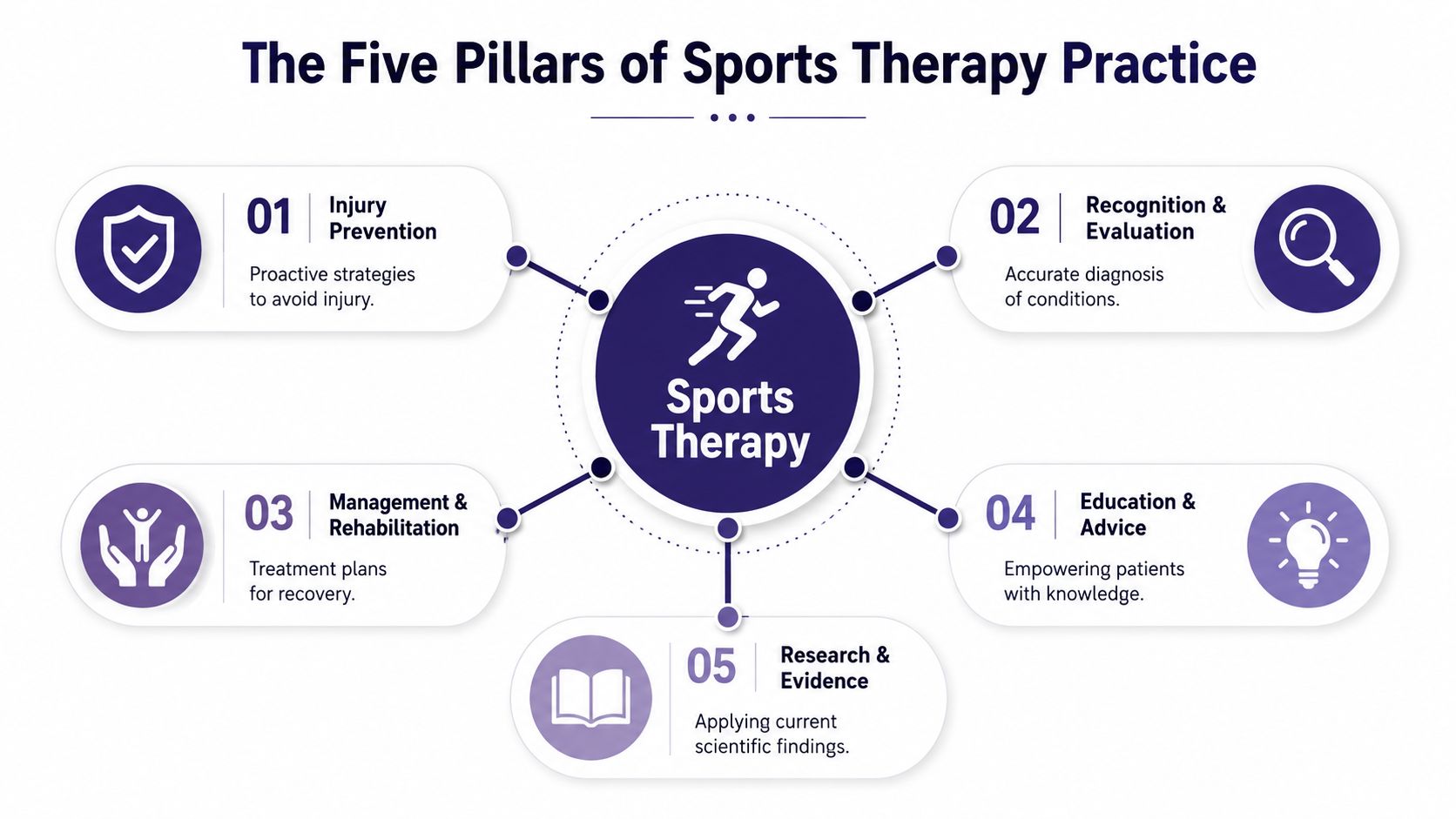
Good sports therapy isn't one treatment with a fancy name. It's a structured clinical process built around five competency pillars, and each one has a different job. Together, they show why a therapist does far more than massage a painful area or tape a joint and send you home.
Prevention and evaluation come first
Think of prevention like servicing a car before the warning light comes on. A therapist looks for load issues, movement habits, and early warning signs that could lead to injury, then helps you change what's driving the strain. In practice, that can mean adjusting training, improving warm-up habits, or changing the way you lift, sit, or return to sport.
The second pillar, recognition and evaluation, is the detective work. UK-facing descriptions of sports therapy consistently describe assessment as clinical, movement-based, and cause-focused, because the goal is to understand the root problem rather than only react to the painful site (Find a Therapy sports therapy overview). A competent therapist will ask what triggers the pain, what eases it, and what your body does during movement.
Treatment, rehabilitation, and education do the heavy lifting
The third pillar, treatment management and referral, is where the therapist decides what can be handled in clinic and what needs onward medical review. That's an important safety point, because not every ache is a sports therapy problem, and good therapists know when to refer.
The fourth pillar, rehabilitation, is where the body is rebuilt step by step. That can include progressive exercise, control work, and a return-to-activity plan that starts below your current limit and progresses as the tissue adapts. It's more like rebuilding a house on solid foundations than patching over a crack and hoping it holds.
The fifth pillar, education and professional issues, is easy to underestimate. Yet it's often the part that prevents relapse. UK competency frameworks explicitly include education, which is why a sports therapist should teach you how to manage load, pace activity, and recognise when to back off (BASRaT competency framework video).
A strong plan should leave you with fewer questions about your body, not more.
That's why sports therapy is best thought of as a clinical education process as much as a treatment service. If you understand what changes triggered the pain, you're far less likely to repeat them.
How Sports Therapists Find the Root Cause
A sports therapist usually starts with a conversation, not a machine. They want the story of the problem, when it started, what makes it worse, and what your week looks like. That history matters because pain that appears after running, sitting, lifting, or turning can point to different mechanical stress patterns.
Assessment is about how you move, not just where you hurt
The next step is a movement-based assessment. UK practice commonly combines symptom history, strength and mobility checks, gait and postural analysis, and palpation to identify the root cause rather than only the painful site (Find a Therapy assessment overview). If you turn up with knee pain, the therapist may check your hip control. If your shoulder keeps tightening, they may look at your thoracic spine or desk posture.
That feels broad, but it's exactly the point. The body works as a chain, so a problem in one area can show up somewhere else. A good therapist is looking for the link, not just the symptom.
Clinical shortcut to avoid: don't assume the area that hurts is always the area that caused the problem.
A useful comparison is a detective examining several clues before naming a suspect. One clue alone rarely tells the full story. A poor squat, a stiff ankle, or a weak hip may not hurt on their own, but together they can make a joint overloaded every time you move.
Treatment follows the assessment, not the other way round
Once the pattern is clear, treatment typically progresses through hands-on techniques such as deep tissue massage, trigger-point therapy, taping or strapping, and a graded exercise programme (Find a Therapy treatment overview). The goal isn't to chase temporary relief. It's to restore strength, improve control, and reduce recurrence risk.
For readers who want a broader explanation of what a musculoskeletal assessment can include, the overview at The Lagom Clinic's musculoskeletal assessment guide is a useful companion. The key idea is the same, good assessment changes the treatment plan.
A simple health tip that helps during recovery
Keep a short note of what aggravates the pain, what reduces it, and what movements feel easier or harder from one day to the next. That information helps your therapist make more accurate decisions, and it helps you notice progress that's easy to miss when you're checking only for pain.
Sports Therapy Versus Physiotherapy and Other Professions
People often confuse sports therapy with physiotherapy, osteopathy, chiropractic care, and personal training because all of them can deal with pain or movement. The differences sit in scope, setting, and the kind of problem being solved. Once you see those differences clearly, choosing the right professional becomes much easier.
Which profession fits which problem
Sports therapy is typically anchored in musculoskeletal injury management and return-to-participation goals, using sport and exercise science principles to restore functional fitness (The SST). Physiotherapy is broader in scope and often works within NHS pathways, while sports therapy is more tightly centred on injury prevention, assessment, rehabilitation, and performance support. That distinction helps when you're deciding who should see your pain first.
| Profession | Primary Focus | Typical Setting | Treatment Approach |
|---|---|---|---|
| Sports Therapy | Injury prevention, assessment, rehabilitation, return to activity | Private clinics, sports settings, rehab-focused services | Movement assessment, graded exercise, manual techniques, education |
| Physiotherapy | Broader rehabilitation across musculoskeletal and other clinical needs | NHS and private care | Exercise therapy, rehabilitation, and wider clinical management |
| Osteopathy | Musculoskeletal pain, particularly structural and manual assessment | Private clinics | Hands-on treatment and movement advice |
| Chiropractic Care | Spine and joint-related care | Private clinics | Manual treatment, spinal and joint techniques |
| Personal Training | Fitness, strength, conditioning | Gyms and training environments | Exercise programming without clinical rehabilitation |
How to choose in real life
If your main problem is pain that changes the way you move, sports therapy is often a strong fit. If you need a broader medical pathway, physiotherapy may be more appropriate. If you're mainly seeking fitness progression without injury rehabilitation, a personal trainer may be the right first step.
For people with back pain who are also weighing up rehabilitation options, the 2026 back pain physiotherapy guide offers another useful angle on recovery planning. The important thing is to match the problem to the profession, not pick a title at random.
Sports therapy also overlaps with osteopathy and chiropractic care in that all three can address movement and discomfort, but the clinical emphasis differs. Sports therapy stays tightly tied to activity, function, and rehab progression. Personal training, by contrast, doesn't diagnose injury or build a clinical return-to-sport plan.
What to Expect at Your First Appointment
Walking into a new clinic can feel awkward, especially if you're not sure how much movement will be tested or whether you'll be expected to “push through” pain. A good appointment should feel structured, calm, and collaborative. You should know what's happening before anything happens.

The session usually starts with a detailed history
At The Lagom Clinic in Bristol, appointments are flexible, with 30- to 60-minute options available, which gives space for a proper conversation about symptoms, activity, and goals. The therapist should ask about what hurts, how long it's been happening, what makes it worse, and what you want to get back to doing. That conversation matters because treatment should fit your life, not sit apart from it.
Wear something you can move in, bring any previous scans or reports if you have them, and be ready to show the therapist what movements provoke symptoms. If you've already seen another clinician, those notes can help avoid duplication and keep the assessment focused.
Movement tests follow, then a plan
The physical part usually includes movement tests, strength checks, mobility testing, and palpation. Nothing should feel rushed or mysterious. The therapist should explain why each test is being done, because the point is to connect symptoms with function, not to perform a checklist for its own sake.
A useful clinic model is one that treats the whole person rather than just the painful part. The Lagom approach in Bristol reflects that broader view, with sports-focused advice sitting alongside wider health screening and lifestyle conversations. That matters when pain is linked to work routines, stress, sleep, or a sudden jump in training load.
A realistic plan should include what you should do between visits, what to avoid for now, and what recovery progress should look like. If you leave with clear next steps, that's a good sign. If you leave confused, you probably didn't get enough information.
Lifestyle Changes That Accelerate Recovery
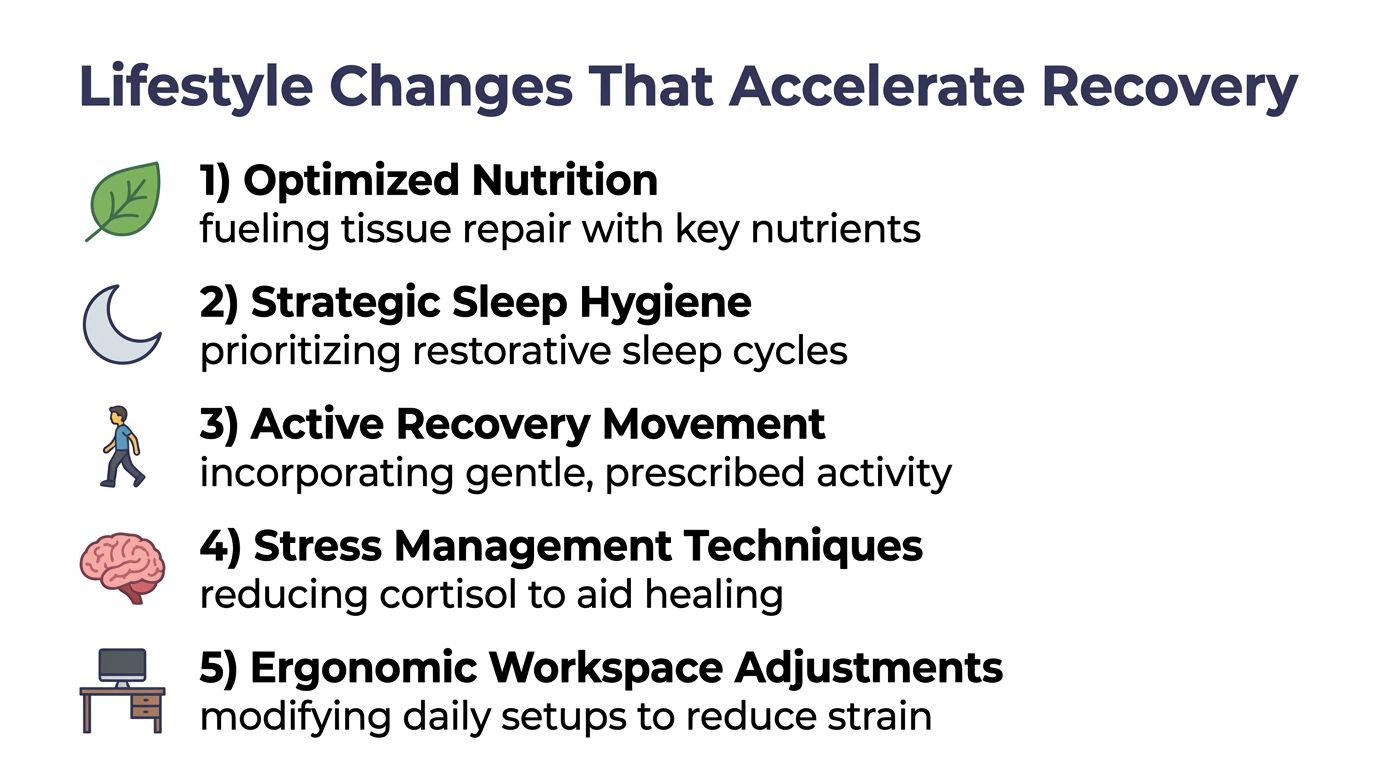
Hands-on treatment can help, but recovery usually depends on what you do every day. Small changes to sleep, movement, workload, and routine often make the biggest difference to how consistently tissue settles and how confidently you return to activity. That doesn't mean doing more. It means doing the right things in a steady way.
Build the recovery habits that support treatment
Ergonomic changes matter if you sit for long hours. A screen at the right height, a chair that supports you, and regular movement breaks can reduce the same repeated strain that keeps flaring the problem. Progressive loading matters too. If you stop moving completely, the body often becomes less tolerant, not more ready.
Sleep is another critical component. Good sleep supports tissue repair, pain regulation, and decision-making, which is why poor rest can make everything feel harder the next day. Stress management matters as well, because pain is not only mechanical. It's also influenced by how sensitive your system is to threat and overload.
Helpful habit: keep your prescribed exercises small enough that you can actually do them consistently.
Food, movement, and pacing all count
For practical nutrition guidance that supports recovery, see The Lagom Clinic's muscle recovery guide. Food won't replace rehabilitation, but steady meals, enough protein, and sensible hydration can support the work your body is doing. The same goes for active recovery, which usually beats complete inactivity when a therapist has cleared gentle movement.
Common mistakes are easy to spot. People either push through pain and irritate the area again, or they stop the exercises the moment symptoms improve. Neither approach helps much. A better rule is to match effort to the plan, then adjust with your therapist if symptoms change.
Sports therapy works best when treatment and self-management are paired. The therapist brings the clinical assessment and programme design. You bring the day-to-day habits that make the programme effective.
When to Seek Sports Therapy and How The Lagom Clinic Helps
Seek sports therapy when pain, stiffness, or recurring strain keeps interrupting activity, work, or daily movement, especially if the problem seems mechanical and doesn't settle with simple rest. Tendon injuries, ligament sprains, muscle strains, post-surgical rehabilitation, and chronic overuse issues are all common reasons to book. If you have sudden severe swelling, an obvious deformity, chest pain, fainting, fever, or a serious injury after a fall or collision, you need urgent medical assessment first.
The Lagom Clinic in Bristol offers a private GP setting with musculoskeletal medicine, flexible appointment lengths, blood tests, ECGs, and rapid access to private imaging, which can help when symptoms need a broader clinical view. For people who want one place for movement problems, lifestyle advice, and wider health screening, that integrated model can reduce the fragmentation that often slows recovery. It also fits the broader sports therapy idea that care should treat the whole person, not just the painful joint.
If your pain is affecting the way you move, train, work, or sleep, don't wait for it to become a bigger problem. Book a proper assessment, get clear on the cause, and build a plan that supports both recovery and long-term self-management.
If you're dealing with a recurring injury or a pain pattern that keeps coming back, The Lagom Clinic can assess the problem alongside wider musculoskeletal and lifestyle factors. Visit The Lagom Clinic to explore flexible appointments, screening, and sports-focused care that can help you move forward with a clear plan.


 Members Consultation